Archives

The Brighton Road: “The Most Nearly Perfect, and Certainly the Most Fashionable of All”

dust jacket

The following post is the twelfth of a series based on information obtained from a fascinating book Susana recently obtained for research purposes. Coaching Days & Coaching Ways by W. Outram Tristram, first published in 1888, is chock full of commentary about travel and roads and social history told in an entertaining manner, along with a great many fabulous illustrations. A great find for anyone seriously interested in English history!

The Brighton Road, Mr. Tristram suggests, might be called the “Regent’s Road,” since it was the Prince who, once he determined the health benefits of the seaside city, saw to it that the road was made passable.

For before the Pavilion was, Brighton was about as easy to get at as the Cranmere Pool in the middle of Dartmoor, the moon, the North Pole, the special exits in case of fire at our principal theatres, or anything else on earth totally inaccessible.

It was in 1750 when Brighton was nothing but a small fishing village that Doctor Richard Russell visited and proclaimed that sea water was beneficial to health, which began the exodus of wealthy hypochondriacs to seaside resorts. At that time, however, our author suggests that oxen were required to cope with the deep ruts. “People got into coaches to go to Brighton and only got out of them when they were overturned.”

All these horrors of the Brighton Road the much abused George the Fourth did away, with a sweep as it were of his fat, bejewelled and august hand! He built the Pavilion, and people from all parts of the country came straightway to see it and him… the crowds soon found…that if they were to come to Brighton, and to court, they had better have some decent road to come upon. And from this simple bringing home of a plain truth came into existence the Brighton Road—“perhaps the most nearly perfect, and certainly the most fashionable of all.”
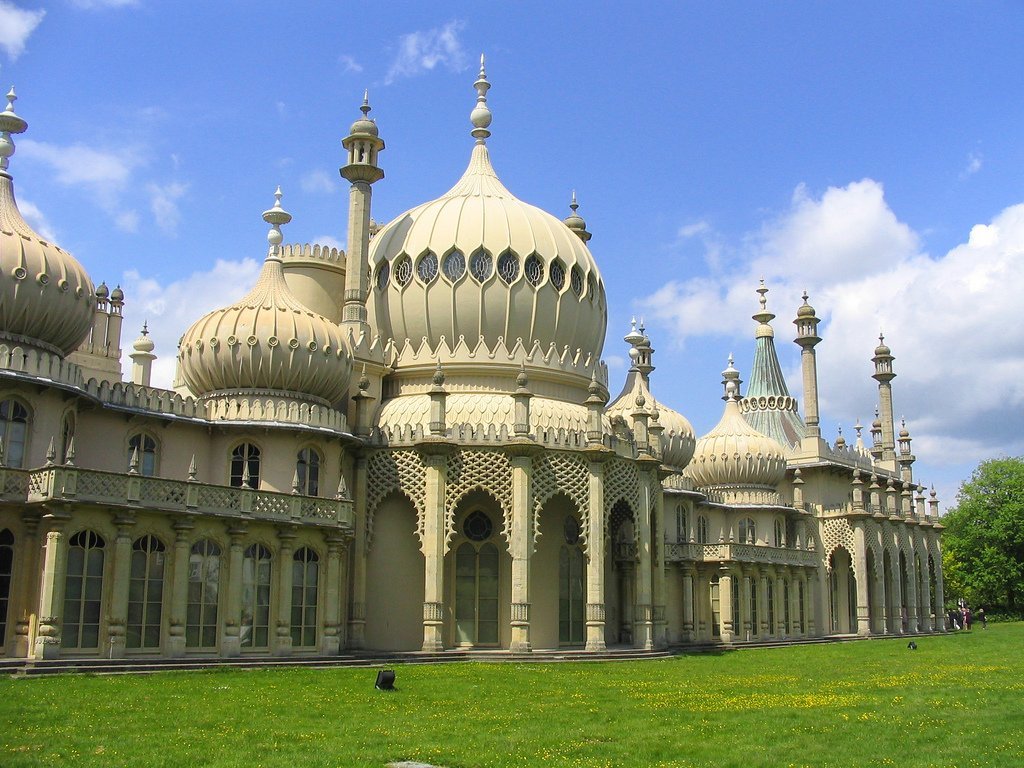
Brighton Pavilion1

Brighton Pavilion

Cuckfield Park, Cuckfield, West Sussex

This sixteenth century manor is known for its ghost, said to be that of Anne Sergison, who, already afflicted with a somewhat combative nature, had to fight a long and sordid court battle to get it. It came to light after her brother’s death that the thirteen-year-old girl assumed to be his daughter was actually a “supposititious” (don’t you just love that word?) child imposed on him by his wife. No one knows what happened to the girl and her mother, but Anne’s ghost has been spotted in the corridors and the avenue leading to the house, and some say she particularly attended her granddaughter’s wedding in 1890. No rest for the wicked, so they say.

Cuckfield Park was the inspiration for William Harrison Ainsworth’s novel Rookwood.
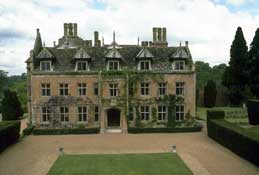
Cuckfield Park

Cuckfield Park

The Dorset Arms, East Grinstead

All distinguished travellers on the Brighton Road pulled up as a matter of course at the Dorset Arms. Amongst those whose names have been handed down as habitual visitors, was Lord Liverpool, who always stayed at the Dorset Arms when on his way to visit the Harcourt seat near Buxted… Another constant guest was Lord Seymour, who died, I believe, in 1837—mean, I am sorry to say…and yet not mean either one way, for if he didn’t eat and drink much, he possessed a passion for illumination which must have produced some respectable items in the bill—thirty wax candles or more burning in his bedroom all night. Spencer Perceval too (the Prime Minister remarkable for great ability and for having been shot in the lobby of the House of Commons in 1812 by John Bellingham) must have been a familiar figure at the Dorset Arms, for the house from which he was married in 1790 to Miss Jane Wilson stands just at the bottom of the Dorset Arms’ garden.
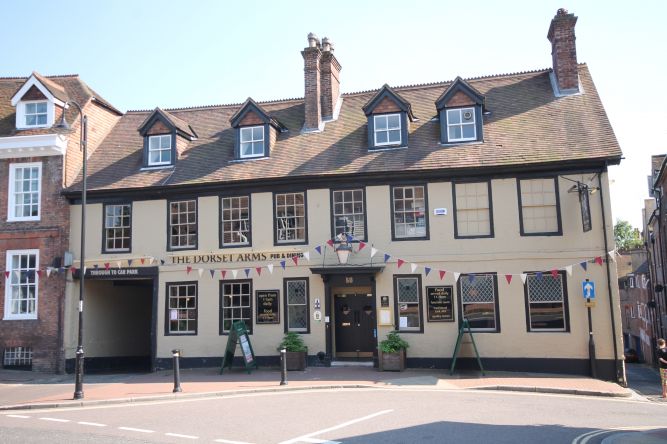
The Dorset Arms

The Dorset Arms

The Clayton Arms, formerly the White Hart and currently the White Hart Barn, Godstone Green

It is said the that in 1815 the Regent, the Tsar of Russia, and many royal visitors stayed at the inn on their way to Blindley Heath, to be present at the fight for the championship of England…Blindley Heath was one of the most popular and celebrated of prize-fighting rendezvous.

“The Fancy were all upon the alert soon after breakfast” (I quote from Boxiana’s description of the Grand Pugilistic combat between Randall and Martin, at Crawley Down, thirty miles from London, on Tuesday, May 4, 1819 “on the Monday to ascertain the seat of action; and as soon as the important whisper had gone forth, that Crawley Down was likely to be the place, the toddlers were off in a twinkling… Between the hours of two and three o’clock in the afternoon upwards of a hundred gigs were counted passing through Croydon… Long before eight o’clock in the evening every bed belonging to the inns and public houses in Godstone, East Grinstead, Reigate, Bletchingley, &c., were doubly and some trebly occupied.”

“Those persons whose blunt enabled them to procure beds, could not obtain any sleep, for carriages of every description were passing through the above towns all night… The brilliants also left Brighton and Worthing at about the same period, and thus were the roads thronged in every direction… It is supposed if the carriages had all been placed in one line they would have reached from London to Crawley. The amateurs were of the highest distinction, and several noblemen and foreigners of rank were upon the ground.”
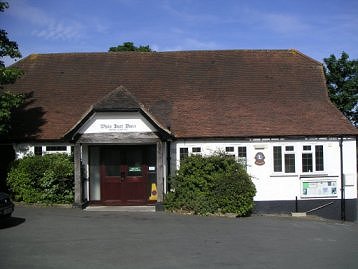
The White Hart Barn, now the village hall of Godstone Green

The White Hart Barn, now the village hall of Godstone Green

Regent and emperor putting up at a wayside inn to witness a fight for the championship!…The noblemen and foreigners of rank crowding round the twenty-four foot ring! What can give us a better idea of the Brighton Road in its prime than these facts? What paint more vividly what I call its “Regency flavour”, its slang, its coarseness, its virility—in a word, its “Corinthianism”?
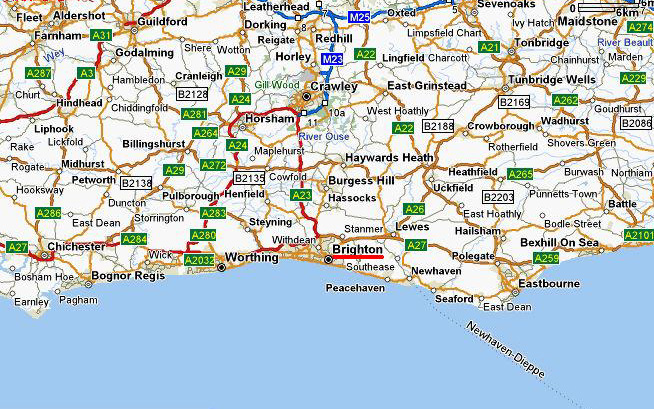
brighton-map

 Index to all the posts in this series

1: The Bath Road: The (True) Legend of the Berkshire Lady

2: The Bath Road: Littlecote and Wild William Darrell

3: The Bath Road: Lacock Abbey

4: The Bath Road: The Bear Inn at Devizes and the “Pictorial Chronicler of the Regency”

5: The Exeter Road: Flying Machines, Muddy Roads and Well-Mannered Highwaymen

6: The Exeter Road: A Foolish Coachman, a Dreadful Snowstorm and a Romance

7: The Exeter Road in 1823: A Myriad of Changes in Fifty Years

8: The Exeter Road: Basingstoke, Andover and Salisbury and the Events They Witnessed

9: The Exeter Road: The Weyhill Fair, Amesbury Abbey and the Extraordinary Duchess of Queensberry

10: The Exeter Road: Stonehenge, Dorchester and the Sad Story of the Monmouth Uprising

11: The Portsmouth Road: Royal Road or Road of Assassination?

12: The Brighton Road: “The Most Nearly Perfect, and Certainly the Most Fashionable of All”

13: The Dover Road: “Rich crowds of historical figures”

14: The Dover Road: Blackheath and Dartford

15: The Dover Road: Rochester and Charles Dickens

16: The Dover Road: William Clements, Gentleman Coachman

17: The York Road: Hadley Green, Barnet

18: The York Road: Enfield Chase and the Gunpowder Treason Plot

19: The York Road: The Stamford Regent Faces the Peril of a Flood

20: The York Road: The Inns at Stilton

21: The Holyhead Road: The Gunpowder Treason Plot

22: The Holyhead Road: Three Notable Coaching Accidents

23: The Holyhead Road: Old Lal the Legless Man and His Extraordinary Flying Machine

24: The Holyhead Road: The Coachmen “More Celebrated Even Than the Most Celebrated of Their Rivals” (Part I)

25: The Holyhead Road: The Coachmen “More Celebrated Even Than the Most Celebrated of Their Rivals” (Part II)

26: Flying Machines and Waggons and What It Was Like To Travel in Them
27: “A few words on Coaching Inns” and Conclusion

The Portsmouth Road: Royal Road or Road of Assassination?

dust jacket

The following post is the eleventh of a series based on information obtained from a fascinating book Susana recently obtained for research purposes. Coaching Days & Coaching Ways by W. Outram Tristram, first published in 1888, is chock full of commentary about travel and roads and social history told in an entertaining manner, along with a great many fabulous illustrations. A great find for anyone seriously interested in English history!

The Portsmouth Road has been described to me by one having authority as the Royal Road: and certainly kings and queens have passed up and down it, eaten and drunken in the Royal Rooms, still to be seen in some of the old inns; snored in the Royal Beds (also in places to be seen, but not slept in), and dreamed of ruts of bogs, and blasted heaths and impassable morasses, and all the sundry and other mild discomforts which our ancestors, whether kings or cobblers, had to put up with; or those among them at all events who travelled when the weather was rainy, and there were no real roads to travel upon.

To me however the Portsmouth Road—so called Royal—presents itself in a less august guise; so much so that if I were asked to give it a name whereby it might be especially distinguished, I should be inclined, I think, to call it the Road of Assassination. And it will be found to have claim to the title.

The Unknown Sailor

The Portsmouth Road after Godalming and Milford consisted of a “gravelly road” for five miles up Hindhead Hill that led them directly to a “silent memorial of murder,” a gravestone reminder

of a barbarous murder committed on the spot on the person of an unknown sailor (who lies buried in Thursley Churchyard, a few miles off); and airs also with some satisfaction the feeling then very prevalent (before Scotland Yard was), that murderers are a class who invariably fall into the hands of justice. We are perhaps not so credulous as this nowadays; but we put our trust in a large detective force when our throats have been cut, and hope for the best. The local police of 1786 however could have given many of our shining lights a lesson, it seems to me; for on the very afternoon of September the 4th in that year (which was the date of the murder) they apprehended three men named Lonegon, Casey, and Marshall, twelve miles further down the road…engaged in the unwise exercise of selling the murdered man’s clothes. For this, and previous indiscretions, they were presently hanged in chains on the top of Hindhead as a warning…

The ill-fated sailor, walking from London to rejoin his ship in Portsmouth, met up with three other sailors in Thursley and treated them to food and drinks before setting off again in their company. His reward was to be murdered and decapitated and thrown into a valley, where he was promptly discovered and the alarm raised. His murderers were apprehended that same day at the Sun Inn in Rake, rather unwisely selling off their victim’s clothing.

220px-Unknown_Sailors_GraveIn memory of

A generous but unfortunate Sailor

Who was barbarously murder’d on Hindhead

On September 24th 1786

By three Villains

After he had liberally treated them

And promised them his farther assistance

On the road to Portsmouth.

The Murders by the Smugglers

Sussex_Police_Authority_Map

All through the last century, then, it seems the country from Portsmouth…was infested by gangs of smugglers.

From time to time, after some unusually audacious outbreak against custom-house laws had taken place, violent reprisals were made; but on the whole the revenue officers seem to have had decidedly the worst of it, and the smugglers enjoyed an enviable immunity from the retribution of justice. The climax to this condition of affairs came on the 6th and 7th of October, 1747, when a gang of some sixty of these desperadoes assembled secretly in Charlton Forest; made a suddenly raid on Poole; broke open the custom, where a large quantity of tea which had been seized from one of their confederates, was lodged, and made off with the booty, without encountering any resistance from the surprised authorites.

barbarous11

Ye Smugglers breaking open ye King’s Custom House at Poole

The cocky smugglers made a “riotous procession” retreating with their booty, and one of them, a man named Diamond, recognized Daniel Chater, a shoemaker, in the crowd and threw him a bag of tea. The same Diamond was taken into custody at Chichester, and Chater, having been promised a reward, was persuaded to accompany a custom house officer, William Galley, to Chichester for the purpose of identifying said Diamond.

The pair made the unfortunate decision to stay at the White Hart, where the landlady, “friendly of course to smugglers and highwaymen”, suspecting that they meant harm to her friends, sent for seven of them to intervene. Galley and Chater “were prevailed upon with force to stay and drink more rum” and when unconscious, the letter Galley was carrying detailing their errand was intercepted, and the criminals debated whether or not to murder them. Two of the smugglers’ wives who had joined the party urged them to “Hang the dogs, for they came here to hang us.”

This view of the case seems to have in an instant turned men into monsters. A devilish fury possessed the whole company. Jackson rushed into the room where Chater and Galley were sleeping. He leaped upon the bed and awakened them by spurring them on the forehead. He flogged them about the head with a horsewhip till their faces poured with blood. Then they were taken out to the back yard, and both of them tied on to one horse, their four legs tied together, and these four legs tied under the horse’s belly.

They had not got a hundred yards from the house when Jackson, in one of those sudden accesses of fiendishness continually characteristic of the whole affair, and which seemed a veritable possession of the devil himself, yelled out—“Whip them! Cut them! Slash them! Damn them!” and in an instant the whole gang’s devilish fury was wreaked on their bound and helpless enemies.

Near Rake Hill, Galley fell off the horse and was presumed to be dead, so they buried him in a foxhole in Harting Coombe. When he was found, however, his hands were covering his eyes, presumably to protect them from the dirt, so he was, in effect, buried alive.

Chater did not find so fortunate a release from his torments. He was kept for over two days chained by the leg in an outhouse of the Red Lion at Rake, “in the most deplorable condition that man was ever in; his mind full of horrors, and his body all over pain and anguish with the blows and scourges they had given him.” All this while the smugglers were calmly debating as to how they should finally make an end of him. At length a decision was come to. Subjected all the way to treatment which I cannot describe, he was taken back to the same Harris Well where it had been originally proposed to murder Galley; and after an unsuccessful attempt at hanging him there, he was thrown down it, and an end put at last to his awful sufferings by heaving stones being thrown on top of him.

The heinousness of the crime demanded swift justice, and the gang was hanged at Chichester on 18th January 1749, except for one, who died of fright the night before the execution.

barbarous8

The unfortunate William Galley put by the Smugglers into the Ground … before he was quite Dead

barbarous12

Mr Galley and Mr Chater put by ye Smugglers on one Horse near Rowland Castle

The Assassination of the Duke of Buckingham

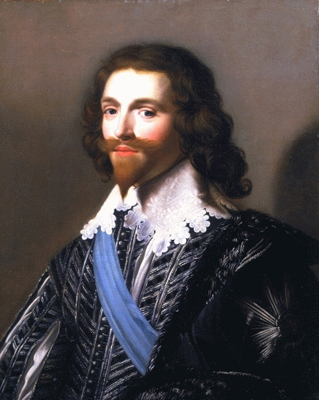
After all this, a simple assassination may strike you as a mere church picnic. But it was at the Spotted Dog Inn in 1628 that James I’s favorite (and some say lover) was assassinated by a discontented half-pay officer who had been turned down for promotion.

buckingham

It remains for me to remark that the journey of Felton to London, where he was hanged, drawn, and quartered at Tyburn, was accomplished amidst scenes of extraordinary and many-sided excitement; and coming, as it does, before a similarly mournful expedition over the same ground on the part of the Duke of Monmouth, seems to me to cast a characteristic gloom over the annals of a road—not remarkable for coaching anecdotes or coaching records—which has been called Royal, and rightly perhaps enough,—but which has yet witnessed, so far as its historical side is concerned, and so far as my knowledge goes, gloomier and more tragic scenes than any other of the great thoroughfares out of London.

These days we have organized police forces and all sorts of high-tech devices and forensic methods to apprehend and prosecute criminals…and yet crime seems to be everywhere, even such horrific murders as described here. Are today’s criminals smarter, do you think, or were more crimes undetected back then?

Comment and enter to win Susana’s September Giveaway, a lovely necklace from London’s National Gallery (see photo at right).

 Index to all the posts in this series

1: The Bath Road: The (True) Legend of the Berkshire Lady

2: The Bath Road: Littlecote and Wild William Darrell

3: The Bath Road: Lacock Abbey

4: The Bath Road: The Bear Inn at Devizes and the “Pictorial Chronicler of the Regency”

5: The Exeter Road: Flying Machines, Muddy Roads and Well-Mannered Highwaymen

6: The Exeter Road: A Foolish Coachman, a Dreadful Snowstorm and a Romance

7: The Exeter Road in 1823: A Myriad of Changes in Fifty Years

8: The Exeter Road: Basingstoke, Andover and Salisbury and the Events They Witnessed

9: The Exeter Road: The Weyhill Fair, Amesbury Abbey and the Extraordinary Duchess of Queensberry

10: The Exeter Road: Stonehenge, Dorchester and the Sad Story of the Monmouth Uprising

11: The Portsmouth Road: Royal Road or Road of Assassination?

12: The Brighton Road: “The Most Nearly Perfect, and Certainly the Most Fashionable of All”

13: The Dover Road: “Rich crowds of historical figures”

14: The Dover Road: Blackheath and Dartford

15: The Dover Road: Rochester and Charles Dickens

16: The Dover Road: William Clements, Gentleman Coachman

17: The York Road: Hadley Green, Barnet

18: The York Road: Enfield Chase and the Gunpowder Treason Plot

19: The York Road: The Stamford Regent Faces the Peril of a Flood

20: The York Road: The Inns at Stilton

21: The Holyhead Road: The Gunpowder Treason Plot

22: The Holyhead Road: Three Notable Coaching Accidents

23: The Holyhead Road: Old Lal the Legless Man and His Extraordinary Flying Machine

24: The Holyhead Road: The Coachmen “More Celebrated Even Than the Most Celebrated of Their Rivals” (Part I)

25: The Holyhead Road: The Coachmen “More Celebrated Even Than the Most Celebrated of Their Rivals” (Part II)

26: Flying Machines and Waggons and What It Was Like To Travel in Them
27: “A few words on Coaching Inns” and Conclusion

The Exeter Road: Stonehenge, Dorchester and the Sad Story of the Monmouth Uprising

dust jacket

The following post is the tenth of a series based on information obtained from a fascinating book Susana recently obtained for research purposes. Coaching Days & Coaching Ways by W. Outram Tristram, first published in 1888, is chock full of commentary about travel and roads and social history told in an entertaining manner, along with a great many fabulous illustrations. A great find for anyone seriously interested in English history!

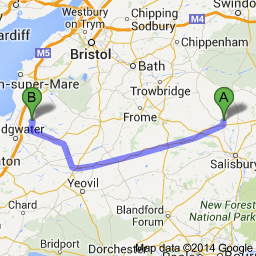
map

A = Stonehenge, B = Sedgemoor

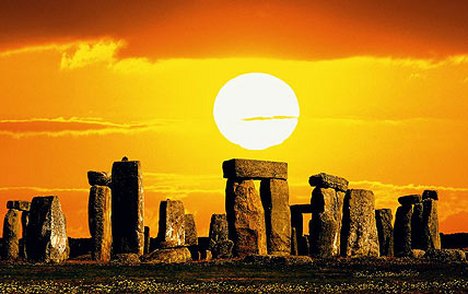
Stonehenge

Mr. Outram declines to say much about Stonehenge

because everybody has written about it, and most people have read what has been written. If anybody however has not seen it, should chance to be in the neighbourhood I would advise them (without troubling themselves much beforehand as to whether it is Druidical, or post Roman, or built by the Belgae) to approach it from Amesbury about sunset, when they will see what they will see, and return home—or I am in error—well-pleased with what they have seen.

Stonehenge2SAT_428x269_to_468x312

The Woodyates Inn and the Taking of Monmouth

James Scott, Duke of Monmouth was the illegitimate son of Charles II and his mistress, Lucy Walter. There were rumors of a marriage between the two, which would have made the duke heir to the throne, but Charles II himself maintained that his only wife was the queen, Catherine of Braganza. Unfortunately, he and Catherine never had any children, so when he died, the throne passed to his brother, who became James II.

James Scott, Duke of Monmouth

James Scott, Duke of Monmouth

James had Catholic leanings and was married to a Catholic wife, and  this caused a great deal of unrest. Few people wanted to see the sort of bloody inquisition that occurred in the reign of Mary I. Monmouth was good-looking and as charming as his father and decidedly Protestant, so there were many who preferred to believe that he was the true heir, as he did himself, declaring on multiple occasions that he was the true King and even undergoing a coronation of sorts.

It was not to be, however. Monmouth’s forces were defeated by King James II’s armies on the

bleak plain of Sedgemoor, and crushed for ever the daring hopes of the brilliant young nobleman who was for so long the darling of the West. The memory of Monmouth is still preserved about Woodyates. It was close to the Woodyates Inn that the giving in of the desperately ridden horses stopped the flight of Monmouth, Grey, and Buyse to the sea. Here the fugitives turned their horses loose, concealed the bridles and saddles, disguised themselves as rustics, and made their way on foot towards the New Forest; and quite close by they fell into the hands of James’s troopers. Monmouth himself was taken on the Woodlands Estate near Horton, his captors failing for some moments to recognise in the gaunt figure, crouching in a ditch, dressed like a shepherd, with a beard of three days’ growth, already prematurely grey, the once brilliant and graceful son of Charles II and Lucy Walters.

battle-of-sedgemoor

Monument of the Battle of Sedgemoor

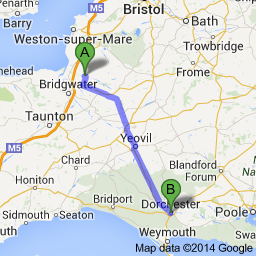
Dorchester and the Bloody Assize of Judge Jeffreys

A = Sedgemoor B = Dorchester

A = Sedgemoor, B = Dorchester

Although he begged forgiveness of his uncle and converted to Catholicism, the wayward Monmouth was executed for treason at Tower Hill. The disposition of his followers is described below.

“The court, writes Macaulay, “was hung, by order of the chief justice, with scarlet, and this innovation, seemed to the multitude to indicate a bloody purpose. It was also rumoured that when the clergyman who preached the assize sermon enforced the duty of mercy, the ferocious countenance of the judge was distorted by an ominous grin. These things made men augur ill of what was to follow.

“More than three hundred prisoners were to be tried. The work seemed heavy, but Jeffreys had a contrivance for making it light. He let it be understood that the only chance of obtaining pardon or respite was to plead guilty. Twenty-nine persons who put themselves on their country and were convicted were ordered to be tied up without delay. The remaining prisoners pleaded guilty by scores. Two hundred and ninety-two received sentence of death.”

Charles Jeffreys, the Hanging Judge

George Jeffreys, the Hanging Judge

James II Deposed

With the birth of a son from his Catholic wife in 1688, the unrest about a Catholic heir increased, and James was deposed, to be replaced by his daughter from his first wife, Mary II, and her husband, William III.


 Index to all the posts in this series

1: The Bath Road: The (True) Legend of the Berkshire Lady

2: The Bath Road: Littlecote and Wild William Darrell

3: The Bath Road: Lacock Abbey

4: The Bath Road: The Bear Inn at Devizes and the “Pictorial Chronicler of the Regency”

5: The Exeter Road: Flying Machines, Muddy Roads and Well-Mannered Highwaymen

6: The Exeter Road: A Foolish Coachman, a Dreadful Snowstorm and a Romance

7: The Exeter Road in 1823: A Myriad of Changes in Fifty Years

8: The Exeter Road: Basingstoke, Andover and Salisbury and the Events They Witnessed

9: The Exeter Road: The Weyhill Fair, Amesbury Abbey and the Extraordinary Duchess of Queensberry

10: The Exeter Road: Stonehenge, Dorchester and the Sad Story of the Monmouth Uprising

11: The Portsmouth Road: Royal Road or Road of Assassination?

12: The Brighton Road: “The Most Nearly Perfect, and Certainly the Most Fashionable of All”

13: The Dover Road: “Rich crowds of historical figures”

14: The Dover Road: Blackheath and Dartford

15: The Dover Road: Rochester and Charles Dickens

16: The Dover Road: William Clements, Gentleman Coachman

17: The York Road: Hadley Green, Barnet

18: The York Road: Enfield Chase and the Gunpowder Treason Plot

19: The York Road: The Stamford Regent Faces the Peril of a Flood

20: The York Road: The Inns at Stilton

21: The Holyhead Road: The Gunpowder Treason Plot

22: The Holyhead Road: Three Notable Coaching Accidents

23: The Holyhead Road: Old Lal the Legless Man and His Extraordinary Flying Machine

24: The Holyhead Road: The Coachmen “More Celebrated Even Than the Most Celebrated of Their Rivals” (Part I)

25: The Holyhead Road: The Coachmen “More Celebrated Even Than the Most Celebrated of Their Rivals” (Part II)

26: Flying Machines and Waggons and What It Was Like To Travel in Them
27: “A few words on Coaching Inns” and Conclusion

The Exeter Road: The Weyhill Fair, Amesbury Abbey and the Extraordinary Duchess of Queensberry

dust jacket

The following post is the ninth of a series based on information obtained from a fascinating book Susana recently obtained for research purposes. Coaching Days & Coaching Ways by W. Outram Tristram, first published in 1888, is chock full of commentary about travel and roads and social history told in an entertaining manner, along with a great many fabulous illustrations. A great find for anyone seriously interested in English history!

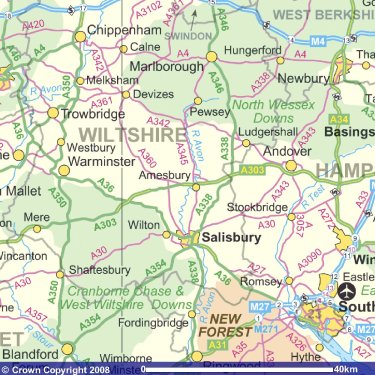
map

The Weyhill Fair

The Telegraph, rival of the Quicksilver which our author repeatedly states can do 175 miles in eighteen hours, used to pass through Weyhill, which was famous for its annual fair, “which would make those people who have never seen one stare.”

This festivity, which is indeed quite an un-English and out-of-the-way sight, begins on October 10th (Michaelmas Eve) and goes on for six days, during which all the country-side seems to have broken loose, and high junketings are to be seen. Besides junketings (which prevail chiefly on the last day of the fair in connection with peep-shows of the most blood-curdling description, whirligigs, merry-go-rounds, rifle galleries, and gingerbread) are also to be seen wonderful shows of sheep, magnificent cheeses, the finest hops in England displayed in the Farnham Row, great exhibits of machinery and enormous carthorses, and, enveloping all, a Babel indescribable.

Amesbury and the Abbey

Amesbury is where Guinevere arrived “somewhat late at night, after a ride across the Plain” after her affair with Lancelot was discovered.

“…hither came Queen Elfrida in 980…after her murder of her stepson Edward at Corfe; and, bent like all medieval murderesses suffering from a temporary mental depression, on building a church. When she came to the point however, and had interviewed the architect and the abbot, she went the whole hog and built an abbey.”

Amesbury Abbey (the church)

Amesbury Abbey (the church)

Prior to Henry VIII’s dissolution, the abbey played host, when “the Exeter road at that time was but a medieval cart-track, and a very bad one too,” to Eleanor of Brittany, sister of Prince Arthur and Mary, sixth daughter of Edward I. “Eleanor, Queen of Henry III, died here, and Katharine of Aragon stayed for a while here on her first arrival in England in 1501.”

Following the dissolution, “the abbey of Amesbury became Amesbury Abbey and passed from the Earl of Somerset, to whom it was granted by Henry VIII, into the respective hands of the Aylesburys, Boyles, and Queensberrys…”

The Abbey eventually became the parish church, and the nearby mansion of the same name built by Inigo Jones is now part of a group by the same name that operates nursing and retirement homes in the area.

Amesbury Abbey_thumb

Amesbury Abbey (the stately home)

This is where Kitty, “the charming Duchess of Queensberry played the Lady Bountiful in the place, and by entertaining Prior and Gay the Abbey graced the quaint old Wiltshire town with the memories of two of the not least celebrated of the English humorists.”

The Duchess of Queensberry

According to the Douglas family history, Catherine Douglas, née Hyde, was an outspoken, rather eccentric woman who “loved walking, avoided alcohol and was an enthusiastic planter of trees at her husband’s estates.” She’d grown up “in a household frequented by literary celebrities,” and it was she about whom Prior wrote the poem “The Female Phaeton: Upon Lady Kitty’s First Appearing in Public” when she was sixteen.

Catherine Douglas, Duchess of Queensberry

Catherine Douglas, Duchess of Queensberry

Following her marriage to Charles Douglas, 3rd duke of Queensberry, the acclaimed beauty Kitty became an avid patron of the arts, to the point of being exiled from court when her defense of the playwright John Gay offended King George II. Gay spent the last years of his life at the Abbey, where he wrote the Beggar’s Opera, and was given a lavish funeral at his death in 1732.

The Douglas family history fails to mention the fascinating story of Julius Soubise, a Negro slave from the West Indies who was given to the duchess in 1764 when he was ten years old. She gave him a privileged life, treating him as her own son, and he became a noted fencing and riding master, a member of the most exclusive clubs, and quite popular among upper-class social circles. A violinist and singer, he trained in oratory with the actor David Garrick. At times he claimed to be African royalty, calling himself “Prince Ana-Ana-maboe” or the “Black Prince.” It was rumored that the duchess and her protégé had a sexual relationship, so perhaps that is the reason Soubise was left out of the family history. Is it only coincidence that the duchess died two days after Soubise sailed for India?

julius-soubise

Julius Soubise

One reason I love delving into these family histories is the interesting things you find. The 3rd Duke of Queensberry, it turns out, succeeded his father “due to special remainder,” when his older brother James was declared insane. Both of the 3rd duke’s sons predeceased him and the title passed to a distant cousin, William Douglas, who later became a friend of the Prince of Wales.

The Duchess of Queensberry Rules

Actually, it was the 9th Marquess of Queensberry to whom the  1867 code on which modern boxing is based can be attributed (although he was not the author, merely the endorser). This code, meant for both amateur and professional matches, is and was the first to mention the use of gloves for boxing. The dear duchess had nothing to do with it, having passed on ninety years earlier.

 Index to all the posts in this series

1: The Bath Road: The (True) Legend of the Berkshire Lady

2: The Bath Road: Littlecote and Wild William Darrell

3: The Bath Road: Lacock Abbey

4: The Bath Road: The Bear Inn at Devizes and the “Pictorial Chronicler of the Regency”

5: The Exeter Road: Flying Machines, Muddy Roads and Well-Mannered Highwaymen

6: The Exeter Road: A Foolish Coachman, a Dreadful Snowstorm and a Romance

7: The Exeter Road in 1823: A Myriad of Changes in Fifty Years

8: The Exeter Road: Basingstoke, Andover and Salisbury and the Events They Witnessed

9: The Exeter Road: The Weyhill Fair, Amesbury Abbey and the Extraordinary Duchess of Queensberry

10: The Exeter Road: Stonehenge, Dorchester and the Sad Story of the Monmouth Uprising

11: The Portsmouth Road: Royal Road or Road of Assassination?

12: The Brighton Road: “The Most Nearly Perfect, and Certainly the Most Fashionable of All”

13: The Dover Road: “Rich crowds of historical figures”

14: The Dover Road: Blackheath and Dartford

15: The Dover Road: Rochester and Charles Dickens

16: The Dover Road: William Clements, Gentleman Coachman

17: The York Road: Hadley Green, Barnet

18: The York Road: Enfield Chase and the Gunpowder Treason Plot

19: The York Road: The Stamford Regent Faces the Peril of a Flood

20: The York Road: The Inns at Stilton

21: The Holyhead Road: The Gunpowder Treason Plot

22: The Holyhead Road: Three Notable Coaching Accidents

23: The Holyhead Road: Old Lal the Legless Man and His Extraordinary Flying Machine

24: The Holyhead Road: The Coachmen “More Celebrated Even Than the Most Celebrated of Their Rivals” (Part I)

25: The Holyhead Road: The Coachmen “More Celebrated Even Than the Most Celebrated of Their Rivals” (Part II)

26: Flying Machines and Waggons and What It Was Like To Travel in Them
27: “A few words on Coaching Inns” and Conclusion

The Exeter Road: Basingstoke, Andover and Salisbury and the Events They Witnessed

dust jacket

The following post is the eighth of a series based on information obtained from a fascinating book Susana recently obtained for research purposes. Coaching Days & Coaching Ways by W. Outram Tristram, first published in 1888, is chock full of commentary about travel and roads and social history told in an entertaining manner, along with a great many fabulous illustrations. A great find for anyone seriously interested in English history!

Basingstoke

In 1645 Cromwell took Basing House after a four-year struggle, stripped the lead off the roof of the Abbey in order to cast bullets, leaving the house in ruins. Basingstoke, however was a popular place for coaches to stop for meals.

Between Basingstoke and Andover is a “desolate country” where coaches could make good time. The White Hart in Whitchurch was a “bustling place” where coaches from London to Salisbury and Oxford to Winchester crossed each other.” (Note: it’s still there and has fifteen rooms available should you desire to stay there!)

Andover

Here Henry VII rested from his labours after suppressing the insurrection of Perkin Warbeck; but whether the miserly Tudor put up at the Star and Garter, or the everlasting White Hart, or their medieval equivalents, if there were any, is more than I can say. It was upon Andover to link another royalty with the place, that James II fell back, after the breaking-up of the camp at Salisbury. Here it was that he was deserted by Prince George [Prince of Denmark, his daughter Anne’s husband], remarkable for his impenetrable stupidity and his universal panacea for all contingencies in a catch-word. Whatever happened, “Est-il possible?” was his exclaim. He supped with the king, who was at the moment overwhelmed naturally enough with his misfortunes, said nothing during a dull meal, but directly it was over slipped out to the stable in the company of the Duke of Ormond, mounted, and rode off. James did not exhibit much surprise on learning the adventure, being used to desertion by this time. He merely remarked, “What, is ‘Est-il possible?’ gone too! A good trooper would have been a greater loss;” and left for London—I was going to say by the next coach.

Two important coaching roads diverge about a half-mile out of Andover, which was also the scene of an escaped lioness on the Exeter Mail on October 20, 1816.

Salisbury

salisbury-cathedral-whats-on-in-salisbury“One of the most picturesque towns in the south of England,” Salisbury, where the Quicksilver (which could do 175 miles in 18 hours, our author notes repeatedly) stopped to change horses, “is almost exactly half way between Exeter and London.”

The town of Salisbury, which is eighty miles seven furlongs from Hyde Park Corner, is chiefly remarkable for its cathedral; and it owes this agreeable notoriety to the north wind. This may sounds trange in the ears of those who have not, attired as shepherds, highwaymen or huntsmen, braved the elements in the surrounding plain. Those however who have enjoyed this fortune, will not be surprised to learn, that when the winds raged in the good old days of 1220 round the original church of Old Sarum, which was quite unprotected and perched upon a hill, the congregation were utterly unable to hear the priests say mass; and no doubt they were unable to hear the sermon too. This fact much exercised the good Bishop Poore; and so, a less windy site having opportunely been revealed to him in a dream by the Virgin he got a license from Pope Honorius for removal. Which done—with a medieval disregard for the safety of the local cowherd or government inspector—he aimlessly shot an arrow into the air from the ramparts of Old Sarum, and (unlike Mr. Longfellow’s hero), having marked where it fell, there laid the foundations of the existing beautiful church.

The first among the myriad of royal visitors to Salisbury was Richard II, “who was here immediately before his expedition to Ireland, where he should clearly never have gone.” Apparently the town was not at all impressed with his “amiable inclination towards charging his subjects with his outings,” considering the fact that his household consisted of “ten thousand persons, three hundred of whom were cooks” and for him they had to provide tables. The town “a short time after expressed their thanks for his visit, by, with almost indecent alacrity, espousing the cause of Henry.”

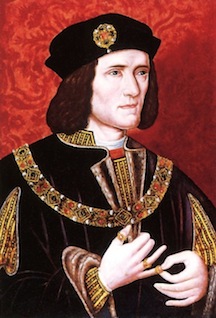
In 1484

Richard III

Richard III

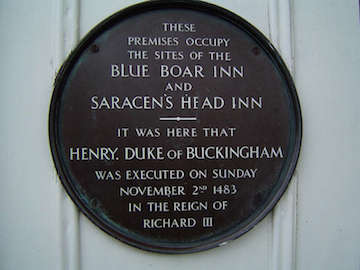
…the hunchbacked Richard honoured Salisbury with his presence; but he was not I expect in the best of tempers, for here to him was brought the Buckingham we have all read of in the play, who had just seized the fleeting opportunity to head an insurrection against the king, in an unprecedentedly wet season in Wales. The result was that he was unable to cross the Severn, and this misfortune brought him too to Salisbury, where Richard was waiting to superintend his execution at what is now the Saracen’s Head.

In the courtyard of this inn, which was then called the Blue Boar, and not “in an open space,” as Shakespeare has described it (as if he were speaking of Salisbury Plain), Buckingham had his head cut oft according to contemporary prescription. We have none of us seen the episode presented on the stage, but we have read the carpenters’ scene, which Shakespeare wrote in, to give the gentleman who originally played Buckingham a chance, and allow a few moments more preparation for Bosworth Field. And we may recollect that it consists princiapply in Buckingham asking whether King Richard will not let him speak to him, and on being told not at all, informing the general company, at some length, that it is All-Souls’ Day, and that as soon as he has been beheaded, he intends to commence “walking”.

plaque2

Although the inn has been replaced by Debenham’s, a department store, some say they have seen or experienced the Duke’s ghost, so ladies, you might want to reconsider using the dressing rooms there—just an FYI.

After Richard and Buckingham, there came to Salisbury in the way of kings, Henry VII in 1491. Henry VIII in 1535 with Ann Boleyn, already in all probability engaged in those sprightly matrimonial differences as to men and the things which culminated the year following on Tower Green. Next in order, came to Salisbury, Elizabeth, bound for Bristol, bent, as on all her royal progresses, on keeping her nobility’s incomes within bounds, and shooting tame stags that were induced to meander before her bedroom windows. After the virgin queen came James I, who liked the solitudes which surrounded the Salisbury of those days, for the two-fold reason, firstly, because they saved him in a large measure from the invasion of importunate suitors (who were afraid of having their purses taken on Salisbury Plain before they could proffer their supplications), and, secondly, because they were well stocked with all sorts of game on which he could wreak his royal and insatiable appetite for hunting. The “open” nature of the country might perhaps be added as another reason for the sporting king’s liking for the place: for James was no horseman, and as he was in no danger of meeting a hedge in an area of thirty miles, the going must have suited him down to the ground.

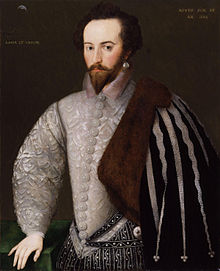
Sir Walter Raleigh

Sir Walter Raleigh

It was also hear that Sir Walter Raleigh, upon his return to England from an unsuccessful expedition to Spain, tried to gain audience with James to explain himself and beg pardon, but was forced to return to London where he was imprisoned and executed.

The merry monarch [Charles II] was here twice, but on neither occasion, I suspect was he peculiarly merry; for after the battle of Worcester, when he lay concealed near the town for a few days, and his companions used to meet at the King’s Arms in John Street, to plan his flight, the Ironsides were much too close on his track to allow opportunity for jesting; and when he came here as king in 1665, all but the most forced mirth was banished from a court which dreaded every day to be stricken by the plague.

 Index to all the posts in this series

1: The Bath Road: The (True) Legend of the Berkshire Lady

2: The Bath Road: Littlecote and Wild William Darrell

3: The Bath Road: Lacock Abbey

4: The Bath Road: The Bear Inn at Devizes and the “Pictorial Chronicler of the Regency”

5: The Exeter Road: Flying Machines, Muddy Roads and Well-Mannered Highwaymen

6: The Exeter Road: A Foolish Coachman, a Dreadful Snowstorm and a Romance

7: The Exeter Road in 1823: A Myriad of Changes in Fifty Years

8: The Exeter Road: Basingstoke, Andover and Salisbury and the Events They Witnessed

9: The Exeter Road: The Weyhill Fair, Amesbury Abbey and the Extraordinary Duchess of Queensberry

10: The Exeter Road: Stonehenge, Dorchester and the Sad Story of the Monmouth Uprising

11: The Portsmouth Road: Royal Road or Road of Assassination?

12: The Brighton Road: “The Most Nearly Perfect, and Certainly the Most Fashionable of All”

13: The Dover Road: “Rich crowds of historical figures”

14: The Dover Road: Blackheath and Dartford

15: The Dover Road: Rochester and Charles Dickens

16: The Dover Road: William Clements, Gentleman Coachman

17: The York Road: Hadley Green, Barnet

18: The York Road: Enfield Chase and the Gunpowder Treason Plot

19: The York Road: The Stamford Regent Faces the Peril of a Flood

20: The York Road: The Inns at Stilton

21: The Holyhead Road: The Gunpowder Treason Plot

22: The Holyhead Road: Three Notable Coaching Accidents

23: The Holyhead Road: Old Lal the Legless Man and His Extraordinary Flying Machine

24: The Holyhead Road: The Coachmen “More Celebrated Even Than the Most Celebrated of Their Rivals” (Part I)

25: The Holyhead Road: The Coachmen “More Celebrated Even Than the Most Celebrated of Their Rivals” (Part II)

26: Flying Machines and Waggons and What It Was Like To Travel in Them
27: “A few words on Coaching Inns” and Conclusion

The Bath Road: The Bear Inn at Devizes and the “Pictorial Chronicler of the Regency”

The following post is the fourth of a series based on information obtained from a fascinating book Susana recently obtained for research purposes. Coaching Days & Coaching Ways by W. Outram Tristram, first published in 1888, is chock full of commentary about travel and roads and social history told in an entertaining manner, along with a great many fabulous illustrations. A great find for anyone seriously interested in English history!

dust jacket

The Bear Inn

bear inn old

The Bear Inn (or Hotel) in Devizes was a popular stopping-off point for travelers headed for Bath. According to Mr. Tristram, author of Coaching Days & Coaching Ways, the Bear Inn was known for its fine stables. After Bath became a popular retreat for the wealthy elite, the roads also became targets for highwaymen, and many travelers abandoned the normal routes to take the one through Devizes. At its peak, the Bear was taking in up to 30 coaches a day.

Devizes.10

Among its more prestigious guests were King George III and Queen Charlotte as well as the Duchess of Kent and Princess Victoria. In 1817, Queen Charlotte wrote that she had had an “elegant repast” at the Bear and that the landlord had put at her disposal “10 pairs of horses as fine as any were put to harness.”

SAMSUNG DIGITAL CAMERA

Note: The Bear Hotel continues to be a hotel today. Rooms can be had for as little as 99 pounds. Click here for more information.

Miss Fanny Burney and Hester Thrale Make the Acquaintance of a Young Thomas Lawrence

Miss Fanny Burney

Miss Fanny Burney

In April of 1780, Miss Fanny Burney, who later became a famous novelist (Evelina was published anonymously in 1778), was traveling to Bath with her friend and patron, Hester Thrale. While waiting for supper, the pair sat down to cards, but were soon interrupted by the sound of a pianoforte. Following the music, they found the musician to be “a very handsome girl with fine dark hair upon a finely-formed forehead”. Another girl welcomed them and found them chairs, and it was then that the visitors discovered that the girls were the daughters of the hostess of the inn. “Oh, what a surprise!”

“But though these pretty girls struck us much,” she writes, “the wonder of the family was yet to be produced. This was their brother, a most lovely boy of ten years of age, who seems to be not merely the wonder of their family, but of the times, for his astonishing skill at drawing. They protest he has never had any instruction, yet showed us some of his productions, that were really beautiful.”

Apparently, the father of the future Sir Thomas Lawrence was making good use of his son’s talents. Tristram says that:

Instead of offering lame excuses when the roast had gone wrong, or saying that a bad bottle of claret was simply “sick from a journey,” this original in the way of a host, used to simply to introduce his son to the malcontents, and in a moment where there had been disgust there was wonder. At the simple talisman, “Gentlemen, here’s my son; will you have him recite from the poets or take your portraits?” the most confirmed bald-headed grumbler ceased his monotonous drone, and the storm in the coffee-room fell before the smile of the young genius.

The Rise To Fame Of Sir Thomas Lawrence

Thomas Lawrence self-portrait in pastels

Thomas Lawrence self-portrait in pastels

By the time the family moved to Bath soon after this encounter, young Thomas was supporting his family drawing portraits in pastel. Due to his talent, charm and good looks, Thomas became very popular about Bath society and was allowed to view private art collections. In 1787, at the age of not quite eighteen, he established a studio in London, settling his parents nearby. In 1788 he exhibited five portraits in pastel and one in oil. In 1789 he exhibited 13 portraits, mostly in oil, to critical acclaim. At age 20, he received his first royal commission, portraits of Queen Charlotte and Princess Amelia. After the death of Sir Joshua Reynolds in 1792, George III appointed him “painter-in-ordinary-to-his-majesty.” In 1794, he became a full member of the Royal Academy. He went on to paint many portraits of the elite, as well as important figures in the war with Napoleon, and even the Pope. In 1815 he was knighted, and in 1820 he became President of the Royal Academy.

Sir Thomas and the Siddons Sisters

Sally Siddons

Sally Siddons

Maria Siddons

Maria Siddons

Thomas fell in love with Sally Siddons, one of the daughters of the famous actress, Sarah Siddons. But then he fell in love with her sister Maria. But then he decided to go back with Sally. (Imagine the turmoil in that household!) But neither of the girls was healthy. Before Maria died in 1798, she got her sister to promise not to marry him. Sally did not, refusing to see him for the five years before she herself passed away.


Lawrence never married. His companions in later life were Elizabeth Croft (half-sister of Sir Richard Croft, the accoucheur who apparently botched the delivery of Princess Charlotte’s son and who committed suicide soon after) and Isabella Wolff, separated from her husband and whose son Herman may have been Lawrence’s.

Plagued With Financial Problems

One might expect that, with all the commissions pouring in and his prolific work ethic, Lawrence should be a wealthy man. On the contrary, he was constantly in debt, to the point where he seemed to be always on the brink of bankruptcy and had to be rescued by his friends, dying insolvent. Nobody is quite sure why this was, except for an assumption that he was unable to keep good accounts, and perhaps he was too generous with family and friends. He himself wrote:

“I have never been extravagant nor profligate in the use of money. Neither gaming, horses, curricles, expensive entertainments, nor secret sources of ruin from vulgar licentiousness have swept it from me.”

Legacy

The director of the National Portrait Gallery described Lawrence as “a huge figure. But a huge figure who we believe deserves a great deal more attention. He is one of the great painters of the last 250 years and one of the great stars of portraiture on a European stage.”

Queen_Charlotte_by_Sir_Thomas_Lawrence_1789

Queen Charlotte

George IV at his Coronation

George IV at his Coronation

Pinkie

Pinkie


 Index to all the posts in this series

1: The Bath Road: The (True) Legend of the Berkshire Lady

2: The Bath Road: Littlecote and Wild William Darrell

3: The Bath Road: Lacock Abbey

4: The Bath Road: The Bear Inn at Devizes and the “Pictorial Chronicler of the Regency”

5: The Exeter Road: Flying Machines, Muddy Roads and Well-Mannered Highwaymen

6: The Exeter Road: A Foolish Coachman, a Dreadful Snowstorm and a Romance

7: The Exeter Road in 1823: A Myriad of Changes in Fifty Years

8: The Exeter Road: Basingstoke, Andover and Salisbury and the Events They Witnessed

9: The Exeter Road: The Weyhill Fair, Amesbury Abbey and the Extraordinary Duchess of Queensberry

10: The Exeter Road: Stonehenge, Dorchester and the Sad Story of the Monmouth Uprising

11: The Portsmouth Road: Royal Road or Road of Assassination?

12: The Brighton Road: “The Most Nearly Perfect, and Certainly the Most Fashionable of All”

13: The Dover Road: “Rich crowds of historical figures”

14: The Dover Road: Blackheath and Dartford

15: The Dover Road: Rochester and Charles Dickens

16: The Dover Road: William Clements, Gentleman Coachman

17: The York Road: Hadley Green, Barnet

18: The York Road: Enfield Chase and the Gunpowder Treason Plot

19: The York Road: The Stamford Regent Faces the Peril of a Flood

20: The York Road: The Inns at Stilton

21: The Holyhead Road: The Gunpowder Treason Plot

22: The Holyhead Road: Three Notable Coaching Accidents

23: The Holyhead Road: Old Lal the Legless Man and His Extraordinary Flying Machine

24: The Holyhead Road: The Coachmen “More Celebrated Even Than the Most Celebrated of Their Rivals” (Part I)

25: The Holyhead Road: The Coachmen “More Celebrated Even Than the Most Celebrated of Their Rivals” (Part II)

26: Flying Machines and Waggons and What It Was Like To Travel in Them
27: “A few words on Coaching Inns” and Conclusion

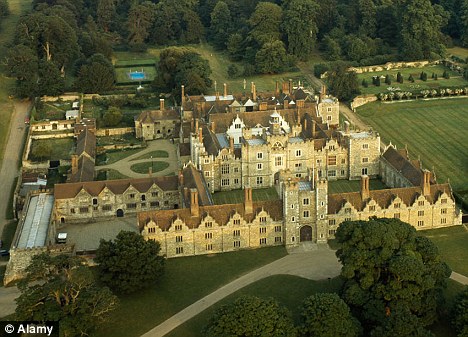
Knole House: One of the Top Five Largest English Homes

grounds

Anyone seeking a stately manor experience within easy reach of London might consider Knole House, in Sevenoaks, Kent. Depending on the train, it’s about 30-40 minutes by train, and my roundtrip fare purchased online was less than 12 pounds. Situated about 1.5 miles from the train station, there are buses from the station. If you go on a weekend in the summer, you can ride the vintage bus that does a simple trip around the town and ends up at Knole. (If you meet Alan or Ian or Ray, please say hi for me!)

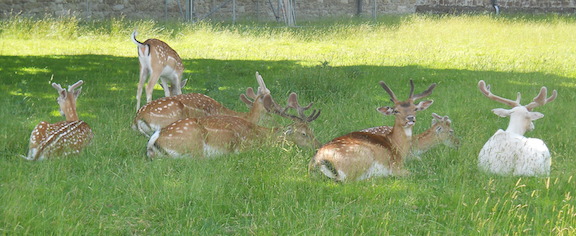
deer

It’s a deer park!

An Archbishop’s Palace

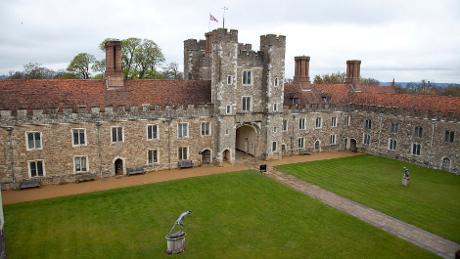
Originally built in 1456 for Thomas Bourchier, Archbishop of Canterbury, who left it to the Canterbury See, the house was later enlarged and improved with a new courtyard—Green Court—and entrance tower. Henry VIII liked it so much that he apparently thought it much too palatial for an archbishop, and he seized it for himself from Thomas Cranmer in 1538.

Green Court

Green Court

The Sackvilles

250px-Thomas_Sackville,_1st_Earl_of_Dorset_by_John_De_Critz_the_Elder

Thomas Sackville

In 1566 the house came into the possession of Thomas Sackville, a cousin of Elizabeth I, and it has remained in the Sackville family (Earls and Dukes of Dorset and Barons Sackville) since 1603. Vita Sackville-West, author of Knole and the Sackvilles, a classic in the literature of English country houses, was unable to inherit the house due to the family tradition of primogeniture, and it passed on to her uncle instead.

Currently maintained by The National Trust, the Sackvilles still own (and occupy) more than half of the house and a large share of the gardens.

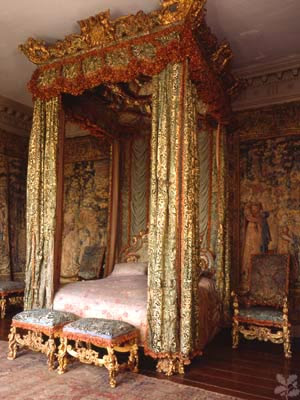
The Furnishings

The collection of 17th century Stuart furnishings is unmatched anywhere, primarily because the 6th Earl, in his position as Lord Chamberlain to William III, was able to snatch for himself pieces discarded from royal redecorating schemes.

Toward the end of the 18th century, the third Duke added to the collection paintings by the old masters from his grand tour of Europe, as well as portraits commissioned from (then contemporary) artists Reynolds and Gainsborough.

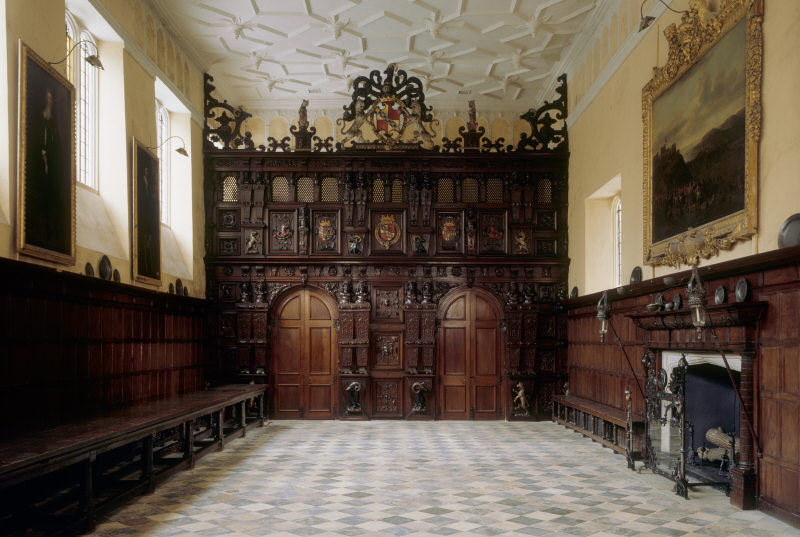
Great Hall

Great Hall

Due to the fact that the house was occupied intermittently and the pieces kept under dust sheets for many years, the visitor will find little changed in this house from the time of the third Duke.


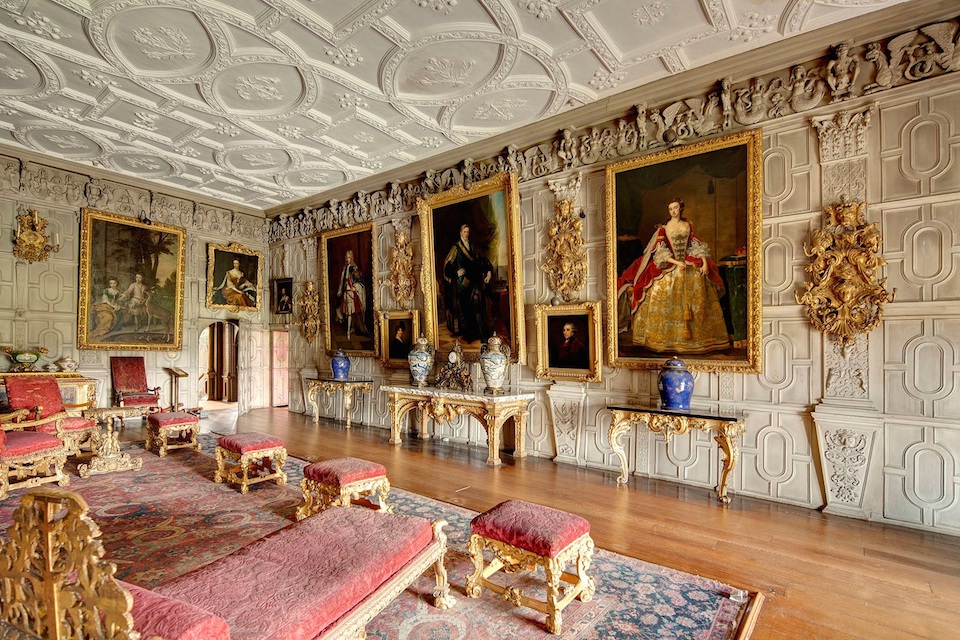
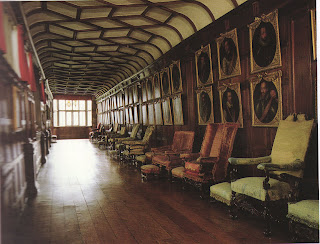
The Brown Gallery

The Brown Gallery

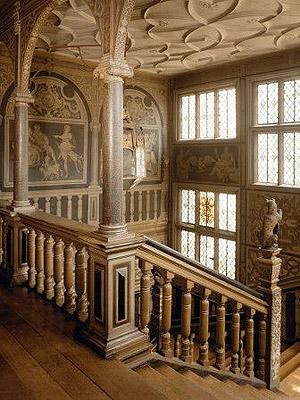
stairway

Notice the image of the leopard (taken from the Sackville coat of arms) on the newel post.


The Venetian Room

The Venetian Room

The ballroom

The ballroom

Mirror in the Cartoon Room

Mirror in the Cartoon Room

KNOLE

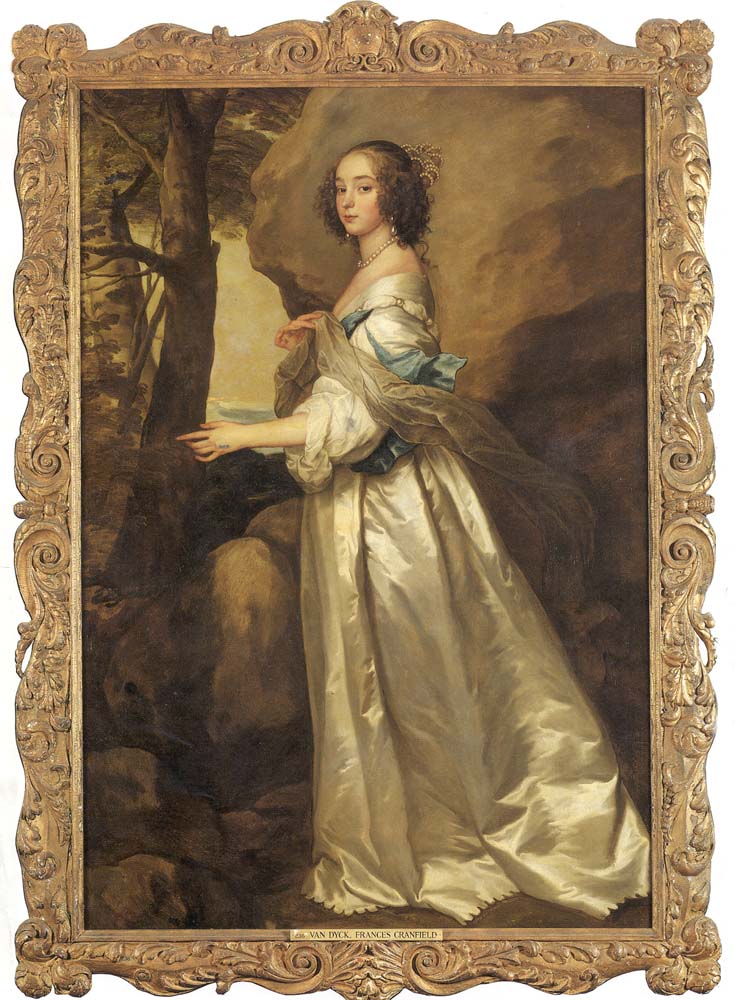
Van Dyke: Lady Frances Cranfield, later Countess of Dorset

A Calendar House

This house may have once been a calendar house, with 365 rooms, 52 staircases, 12 entrances and 7 courtyards, but the current number of staircases is much lower.

For more photos, check out my Pinterest board.

Apsley House Celebrates the 199th Anniversary of the Victory of Waterloo

wellington

Arthur Wellesley, Duke of Wellington

Many authors of historical romance are passionate about military history and delight in studying every little detail. I have to admit that I was always bored in history class when we studied battles and dates and stuff. To me, history is the story is people and how they lived, what they thought, and how they struggled through life’s challenges. Which is why I love visiting historical homes and museums and imagining what it was like back then.

As much as Society tried to ignore the military conflicts and live their lives normally (much as we do even today), these wars—particularly the Peninsular War—directly affected them. As a Regency romance author, I don’t (or haven’t) written directly about this war with Napoleon, but it is important to know about it because my characters would have known about it, and it would no doubt have affected their thoughts and attitudes. Britain lost 15,000, the Prussians, 7,000, at Waterloo alone (Napoleon lost 25,000 and 8,000 captured). That’s not counting the losses in the previous years. And keep in mind that France was only an English Channel away, so there was a good chance Napoleon might try to invade Britain itself at some point. (It wasn’t quite like WWII where Britain was actually attacked by German warplanes, but it had to be a concern of the British people during the Regency era as well.)

For that reason alone, I embrace the study of this important battle, and why I returned to Apsley House (Wellington’s home) this weekend for the Waterloo Festival.

Jacques-Louis_David_-_The_Emperor_Napoleon_in_His_Study_at_the_Tuileries_-_Google_Art_ProjectImagine how the history of the world would have changed had Napoleon emerged the victor at Waterloo? Would he indeed have been able to conquer the world? There is no doubt that he was a military genius, but he was human and made some mistakes that contributed to his downfall. Of course, the heavy downpour the day before the battle was a contributing factor as well.

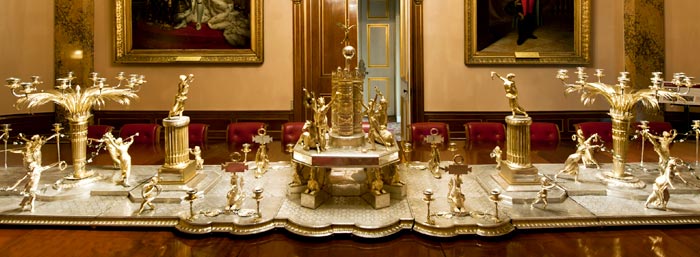
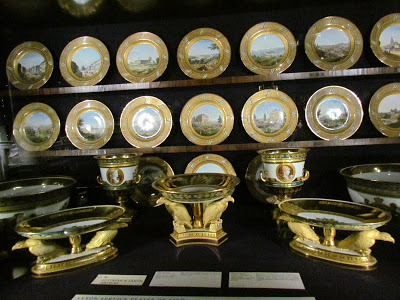
Apsley House is a beautiful home, full of portraits of Wellington and his cronies and important statesmen of the time. (Did you know he and Napoleon were born the same year?) I have a feeling Wellington actually admired Napoleon’s military acumen, in spite of his determination to thwart the man’s ambitions to rule the world. I’ve seen a lot of beautiful homes this summer, and I love to savor each and every piece, but the one thing that really impresses me about Apsley House is the numerous, extravagant gifts that were pressed upon the Iron Duke from grateful statesmen all over the world. The priceless silver pieces, the china and porcelain, the furniture, the sculptures—this extraordinary man did the world a tremendous favor by managing to stop the most cunning, determined, and ambitious man anyone of the time had ever seen.

spectacular-silver

porcelain

silver

Arthur Wellesley, the Duke of Wellington, was like a god!

The Festival

Besides visiting the house itself, during the festival included various events. For example, I enjoyed watching the demonstration of the soldiers of the 95th Rifles. See the video here. I believe they will improve with practice! Then, in the ballroom, another “soldier” gave a rundown of the battle using vegetables, fruits, and baguettes. The end of the demonstration is here.

95th Rifles

95th Rifles

For more photos of Apsley House, Wellington, and Waterloo, check out my Pinterest page here.

Next year is the bicentennial. Are you up for a trip to London in 2015?


Hever Castle: Anne Boleyn’s Childhood Home

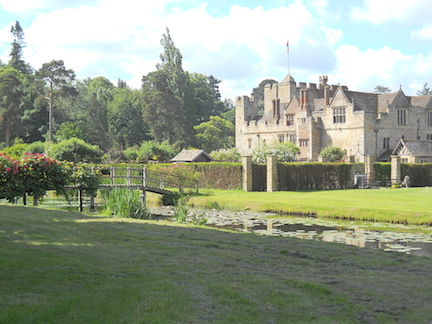
castle5

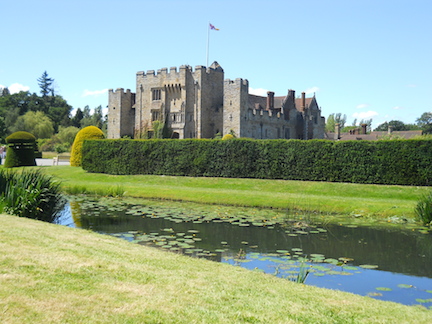
The original defensive castle was started in 1270, and in the 15th and 16th centuries, it became the home of the powerful Bullen (Boleyn) family, who added the Tudor dwelling to the castle. This is where Thomas Boleyn, a diplomat and politician who later became the 1st Earl of Wiltshire and the 1st Earl of Ormond lived with his wife, Elizabeth Howard (daughter of the Duke of Norfolk), and their three surviving children, George, Anne, and Mary.

Anne Boleyn

Anne Boleyn

Anne, of course, was destined to become the second wife of Henry VIII—and the reason for his break from Rome to make himself the Head of the Church of England so that he could grant himself a divorce from his first wife, Catherine of Aragon, who had failed to give him a son. And since Anne herself could only give him a daughter, a pretext had to be found to get rid of her so that he could find a woman who would. She was convicted of adultery and incest with her brother George, and both of them were executed on the block.
Henry VIII

Henry VIII

Very tragic. But it was Anne’s daughter Elizabeth who would become one of the greatest monarchs of England, the Virgin Queen Elizabeth I. And Thomas Boleyn, who lies in the nearby church, is her maternal grandfather.

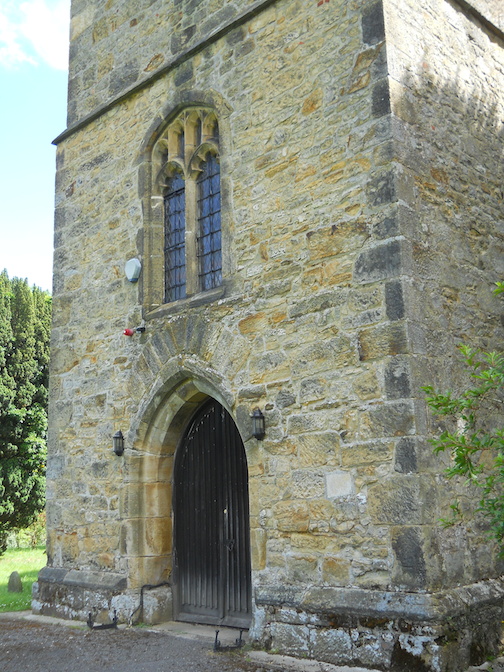
Church where Thomas Boleyn is buried

Church where Thomas Boleyn is buried

Poor Henry is more known for his marital discords than anything else he did, unless it might be destroying England’s greatest monasteries in order to steal their wealth to fund his lifestyle. (Apologies to anyone reading this who might be a Henry VIII fan, but as you can see, I’m not one.) His third wife gave him a son and promptly died, and he had his marriage to Anne of Cleves, annulled. In the annulment document, she was granted Hever Castle, which had come to him at the death of Thomas Boleyn, among other properties.
Anne of Cleves

Anne of Cleves

By the early 20th century, the property was in poor repair and was purchased by the American millionaire, William Waldorf Astoria, for a family residence. He added the Astor Wing, built in Tudor style, which has now become the Hever Castle Luxury Bed & Breakfast. I stayed there and highly recommend it! Be sure to book ahead, as rooms are limited.

astor3

Astor Wing

astor2

Astor Wing

One of the things I noticed here was the large number of families, including seniors in wheelchairs, visiting the castle and grounds. I’m pretty sure the castle isn’t accessible to wheelchairs, but the gardens have ramps so that Granny and Aunt Sally can come to enjoy the beauty of nature. I have also noticed that many of these sites offer playgrounds and activities for children, and that school children come here for field trips. Lucky kids! Imagine how much more knowledgeable and interested in history they will be when they are older than our American kids are!

castle20

Yes, it has a moat and a drawbridge!

Yes, it has a moat and a drawbridge!

courtyard2


Banquet Hall

Banquet Hall

Maze

Maze

garden14

For more photos, check out my Pinterest page.

Hever Castle is near Edenbridge, Kent. And if you go there by train, make sure to have a mobile phone with you, because there is no one, absolutely no one, at the Hever train station!

The Banqueting House: An Artistic and Historical Masterpiece

banqueting8

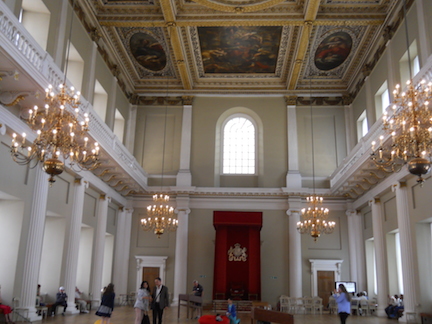
The Banqueting House on Whitehall Street is the only remaining building of the Palace of Whitehall, which was the primary residence of English monarchs for much of the 17th century. In its day, it was the largest palace in Europe, eclipsing even Versailles and the Vatican with its 1500 rooms. Henry VIII married Anne Boleyn and Jane Seymour there (in 1533 and 1536), and it was there where he died in 1547.

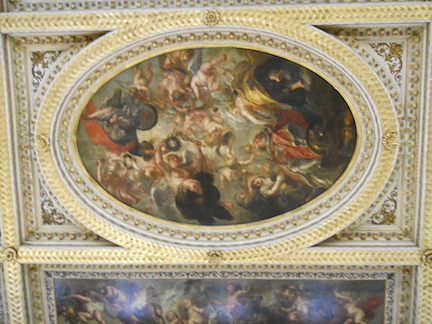
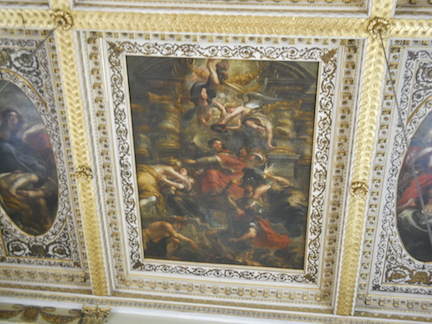
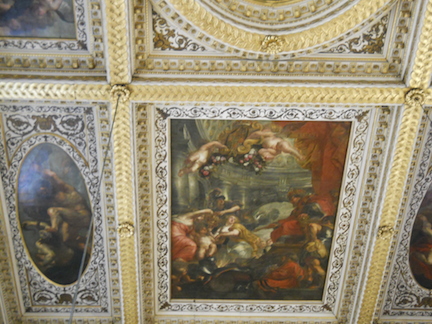
banqueting2In 1622 James I commissioned Inigo Jones to redesign the Banqueting Room, and Charles I was responsible for adding the beautiful ceiling with paintings by Rubens. These paintings, designed to reinforce Charles I’s belief in the divine right of kings, were completed in Antwerp and rolled up for transportation to England, where they were painstakingly laid out and attached to coffers in the ceiling.

Prior to the addition the ceilings, the room was often used for elaborate masques and pageants. Afterward, it was determined that the smoke from the bright lights would damage the ceiling, and it was used primarily for official functions.

It was across this floor that Charles I walked one final time before meeting his fate on the scaffold constructed outside. (So much for the divine right kings.)

banqueting9For some reason, Cromwell chose not to destroy the building as he did so many other buildings symbolic of royal preference. Perhaps because he decided to use it for his own state functions.

Fires in 1691 and 1698 destroyed nearly all the Whitehall Palace buildings, except for this one, probably because Sir Christopher Wren, the reigning architect of the day, had the building next to it blown up to prevent the fire from spreading to the Banqueting House.

A Single Room

While it’s only a single room, it’s definitely something not to be missed. The audio guide that comes with your admission fee is excellent, there are lots of chairs and benches where you sit and gaze at the room while listening, and if you’re very fortunate, you can grab one of the beanbags on the floor and lie prone while admiring the lovely ceiling. When I was there on a Saturday, there weren’t a lot of people there—while I expect everywhere else in Westminster was teeming with crowds as usual—and I could lie there and contemplate the historical and artistic significance of the room in peace.

banqueting3

banqueting5

banquetint4

banqueting6

throne