Archives

Vauxhall Gardens: The Organ, the Turkish Tent, and the Rotunda

vauxhallbook

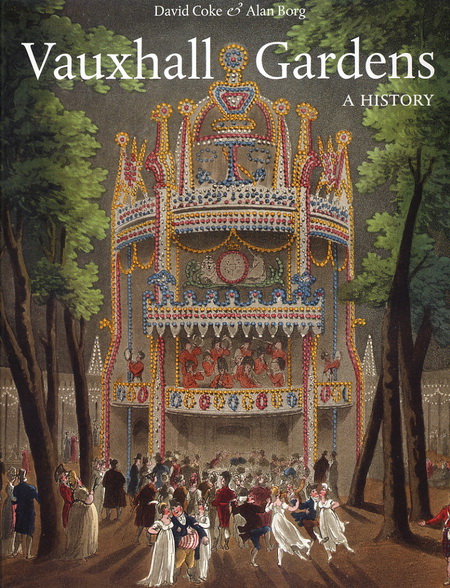
Vauxhall Gardens: A History

David Coke & Alan Borg

The Vauxhall Pleasure Gardens is one of the places I’d love to slip back in time to visit, just to catch a glimpse of what it was like. After recently splurging to buy this lovely coffee-table book, I thought it might make a wonderful subject for a new blog series. But do buy the book too, if you can! The photos are fabulous!

The Organ Building

In 1737, the Organ Building was built, after numerous delays related to “the acoustics and audible range of the organ in this outdoor setting, as well as the damping of the building itself to ensure that no structural vibrations spoiled the sound.”

This square structure was the same width as the Orchestra, and was on three levels; a heavy lower storey supported the first floor where a short bridge joined the two buildings together. This first floor, at the same level as the first floor of the Orchestra, was partly taken up by the organ console and pipes, and partly by a covered open space running all around it. The building then rose to the ‘belfry’, which had louvred semicircular openings on all four faces to project the sound of the organ around the gardens… The lower storey, totally unrelieved by any surface decoration, was pierced by a triple arch on each of its four plain faces, one taller arch flanked by two smaller; the taller central arch on each face was a hybrid triform arch which gave the building a real visual strength and presence.
organ005

Vauxhall and the Weather

The typical rainy English weather, especially on opening day every spring, was a significant problem for an outdoor business such as this one. In 1740, due to the loss in business caused by the poor weather of 1739, Tyers announced “several considerable Additions and Improvements,” which were later described as “Conveniences for receiving Company in cold or rainy Weather,” whatever that means.

Weather-related jokes at Vauxhall’s expense were commonplace; especially popular was the one about a farmer waiting to see when the gardens were going to open, so he would know when to plant his crops, a good few days of drenching rain being assured.
The regularity of rain on Vauxhall’s opening night increased in the nineteenth century; so much so that, at one stage, announcements advertising the forthcoming opening were carried around town printed on umbrellas.

The Three “Tents”

In 1742 Henry Fielding described his impressions on entering the gardens. The first structures he saw there were ‘two similar Tents’ under the trees of the Grove, ‘of such a Contrivance and Form, as a Painter of Genius and Judgement would chuse to adorn his Landscape with.’ If these were, in fact, the shelters that Tyers had announced two years earlier offering protection from cold and wet weather, their position was certainly appropriate, between the Orchestra and the Prince’s Pavilion, and only a few yards from the entrance and the servery. The word ‘tent’ did not specifically apply to a canvas structure; indeed, it could refer to almost any temporary building, especially in a garden.

A “Turkish Tent” was built as an undercover dining area for visitors who could not get a supper-box or wanted to have a more entertaining party. “Its exotic style, more closely associated with Venetian festivals… allowed visitors to act the part of Eastern potentates relaxing on their magnificent bed under a grande baldacchino.

The design of this structure is clearly more informal and frivolous than the strictly classical styles favored by Tyers in his earlier buildings.

The Rotunda

In the 1740’s, other entrepreneurs jumped into the pleasure gardens business, the most successful of which were Ranelagh and Marylebone Gardens.

In the face of serious competition from such places and in view of the unreliable British summer, Tyers was under constant pressure to introduce regular improvements whenever adequate funding was available. At the end of the 1740s he went one step further, and, playing the proprietors of Ranelagh at their own game, installed a major new structure as a grand assembly room and concert hall for use by the band when the weather was too wet or windy.

Variously called the ‘Umbrella Room’, the ‘Music Room’, the ‘Great Room’ or simply the Rotunda, Tyers’s building, with its orchestra stand and organ, was capable of accommodating as many musicians as its outdoor equivalent.

rotunda006

The most remarkable feature of the original Rotunda was undoubtedly the chandelier described by Lockman as having been designed by a gentleman amateur. This chandelier, 11 feet across and with 72 candles, must have been one of the largest in the country, a hugely impressive piece of furniture, and its grandeur was considerably enlightened sometime later by the addition of a plaster sculpture, the Rape of Semele by Jupiter.

The Rotunda was redecorated at intervals… The modelled floral decoration of the ceiling was stripped out in 1765, and the roof re-painted ‘in the resemblance of a shall. For the opening gala of Tuesday 18 May 1790, the Rotunda, growing ever more exotic, was fitted up in imitation of a Persian divan. It was then redecorated several times, becoming by turns a garden tent, a Roman military pavilion, an Indian garden-room and, finally, a circus hippodrome, with two tiers of audience boxes, a proscenium stage and a central ring for displays of horsemanship and circus acts.


Susana’s Vauxhall Blog Post Series

  1. Vauxhall Gardens: A History
  2. Vauxhall Gardens: Jonathan Tyers—“The Master Builder of Delight” 
  3. Vauxhall Gardens: A New Direction
  4. Vauxhall Gardens: The Orchestra and the Supper-Boxes 
  5. Vauxhall Gardens: The Organ, the Turkish Tent, and the Rotunda
  6. Vauxhall Gardens: Three Piazzas of Supper-Boxes
  7. Vauxhall Gardens: “whither every body must go or appear a sort of Monster in polite Company”
  8. Vauxhall Gardens: The Competition
  9. Vauxhall Gardens: The Artwork, Part I
  10. Vauxhall Gardens: The Artwork, Part II
  11. Vauxhall Gardens: The Music, 1732-1859
  12. Vauxhall Gardens: The Business Side
  13. Vauxhall Gardens: Developments from 1751-1786
  14. Vauxhall Gardens: Thomas Rowlandson’s Painting (1785)
  15. ‎Vauxhall Gardens: The Third Generation of the Tyers Family and the Jubilee of 1786
  16. Vauxhall Gardens: An Era of Change (1786-1822), Part I
  17. Vauxhall Gardens: An Era of Change (1786-1822), Part II
  18. Vauxhall Gardens: An Era of Change (1786-1822), Part III
  19. Vauxhall Gardens: The Final Years, Part I
  20. Vauxhall Gardens: The Final Years, Part II
  21. Vauxhall Gardens: The Final Years, Part III
  22. Vauxhall Gardens: The Final Years, Part IV
  23. Vauxhall Gardens: Farewell, for ever
Vauxhall Gardens: The Orchestra and the Supper-Boxes

vauxhallbook

Vauxhall Gardens: A History

David Coke & Alan Borg

The Vauxhall Pleasure Gardens is one of the places I’d love to slip back in time to visit, just to catch a glimpse of what it was like. After recently splurging to buy this lovely coffee-table book, I thought it might make a wonderful subject for a new blog series. But do buy the book too, if you can! The photos are fabulous!

The Orchestra

Across from the Prince’s Pavilion, mentioned in last week’s post, stood the open-air bandstand known as the Orchestra, which opened on 3 June 1735.

There is built in the Grove of the Spring-Gardens at Vaux-Hall, an Octagon Temple, intended to serve as an Orchestra, for a Band of our finest Instrumental Performers; who will play (beginning at Five every Evening during the Summer-Season) the compositions of Mr. Handel, and other celebrated Masters. Upon Trial, the Concert had a wonderful Effect, the Sounds spreading through every Part of this delightful Garden; so that Gentlemen and Ladies, whether walking, or sitting in the Alcoves, may hear it to the greatest Advantage. Though there has not yet been any Thing of this kind exhibited among us, and the Master of the Gardens has put himself to a considerable Expence upon this Occasion, yet nothing will be requir’d for this innocent and elegant additional Entertainment, which will begin Tomorrow at the Hour above-mentioned.

This building, with a base of large blocks of roughened masonry, supported an upper floor, an octagonal room enclosed by eight arches illuminated by a central chandelier. The outer area of the first (second) floor was bounded by a low balustrade.

Although the opening night was plagued with poor weather, a good audience was in attendance.

Yesterday being so rainy, little no Company was expected in the Spring-Gardens at Vaux-Hall, for which reason the Concert was to have been put off till this Evening; but a great Number of Coaches and Persons of the best Fashion coming in, the Concert was open’d; several very fine musical Compositions were perform’d, to the great Satisfaction of the Hearers, and especially of the Judges of Musick, many of whom were present on this Occasion. The Gardens, tho’ so very pleasant in themselves, were yet greatly improv’d by the Harmony, which had different Effects (but all delightful) in the various parts of the Garden; so that all the elegant Company seem’d very desirous of encouraging this rural kind of Opera, which pleas’d no less from the Execution than from the Novelty of it.

As popular as the orchestra music became, it was soon clear that the large number of trees were a detriment to the acoustics. Tyers lost no time in removing “a great Number of Trees… from the Thicket joyning to the Orchestra,” and placing “several Tables and Seats fixed at proper Distances, in the Openings” so that visitors could enjoy refreshments while listening to the music.

The Orchestra itself was able to accommodate, on its upper level, as many as thirty seated and standing musicians. The building’s actual dimensions… judging from the numerous visual sources… measured over 20 feet in diameter and about 25 feet in height to the tip of the conical slated roof—quite a small building, but certainly large enough for its purpose.

bars003

From a satirical pamphet “A Trip to Vaux-hall (1737): Notice the bar in the lower left where waiters went to collect food orders for the visitors. Also, the roof terrace above where Tyers could keep an eye on everything.

The Supper-Boxes

Between September of 1735 and April 1736, during the off-season, more improvements were made.

The Improvements in the Spring-Gardens at Vaux Hall (which have employ’d upwards of 100 Hands ever since last August) being now finish’d, and a Band, consisting of above thirty of the ablest Performers provided, the Musical Assembly will be open’d next Wednesday [19 May]. The Grove, which is considerably enlarged and finely laid out in Gravel Walks, is embellish’d with a great Number of Colonades [the supper-boxes]; and in the Centre is an Edifice, in the Form of a Temple, for the Band, who will play the favourite Pieces of the most eminent Masters. The whole is so advantageously dispos’d, that 3000 Persons may sit at ease, and see one another during the Entertainment. In the Grove, above 300 Glass Lights are set up, all which are illuminated in half a Minute, and have a beautiful Effect on the Verdure. For the better Conveniency of the Company, a great Number of Waiters, &c., are provided; and in order that this innocent and agreeable Entertainment may be conducted with such a Decency, as many induce the politest Persons, and those of the most serious Character to honour it with their Presence, a proper Guard will attend to keep out all lewd and disorderly Persons. —Notwithstanding the very great Expence the Master has been, and must necessarily be at, during the Season, yet it was his intention to have admitted all Persons into his Gardens in the same Manner as last Summer; but as Numbers resorted thither who were no ways qualify’d to intermix with Persons of better Fashion; for this Reason he has been persuaded to let none enter but with Tickets (to be given out at the Door) at One Shilling each, which Ticket will be afterwards taken at the Entertainment in the Gardens, as One Shilling, if desir’d.

The old arbors and rickety supper-boxes in existence before Tyers came upon the scene were tossed away in favor of new and orderly ones arranged outside of the Orchestra. The Vauxhall Fan, which was produced and sold for three consecutive years (1736-8) as new features were introduced (only the first of which still exists) shows the view from the entrance, looking down the Grand Walk, with the Orchestra building on the right.

Many of the trees carry a globe lamp on a bracket, and more lamps hang on lamp-posts and from the ceiling of each supper-box. The edition of 1737 added the organ building behind the Orchestra, and in 1738 Roubiliac’s new statue of Handel was included.

The Vauxhall Fan (1736)

The Vauxhall Fan (1736)

In such a manner,Tyers made use of the popularity and intriguing “language” of the fan as a clever marketing tool.

The north and south ranges of supper-boxes… made up of more than twenty boxes each, were almost 300 feet long and about six to eight feet deep. A shorter range of eight boxes on the far side of the Grove between the two parallel walks, was around 100 feet long, making each box about 12 feet wide. The boxes themselves were initially open on all sides, with only a rail dividing adjacent supper parties from each other, leading to unwonted intimacies between friends and strangers alike. From 1741 or ’42 solid walls divided every box from its neighbour, and each one was roofed with waxed cloth and had a fixed bench around three sides of its table.

The layout of the Grove was remarkably formal and austere, like an ancient Greek agora. Through his arrangement of the boxes Tyers discouraged overtly immoral or intemperate behavior by providing a setting where there were no hidden corners and where the privacy enjoyed by Pepys and his contemporaries was difficult to achieve.

The exact number of supper-boxes in the years before 1751 is difficult to estimate, but it must have been around fifty-five. This rose sharply to over 130 in 1751, reaching a maximum of about 140 around 1800, before falling back to about 90 in the 1840’s.

The many additions to the number of boxes demonstrate that dining space was always at a premium, and that Tyers was under constant pressure to provide additional seating for his visitors wherever he could. This not only boosted his profits from food sales, but also helped his staff earn additional tips by finding more private seating for parties of visitors.

Susana’s Vauxhall Blog Post Series

  1. Vauxhall Gardens: A History
  2. Vauxhall Gardens: Jonathan Tyers—“The Master Builder of Delight” 
  3. Vauxhall Gardens: A New Direction
  4. Vauxhall Gardens: The Orchestra and the Supper-Boxes 
  5. Vauxhall Gardens: The Organ, the Turkish Tent, and the Rotunda
  6. Vauxhall Gardens: Three Piazzas of Supper-Boxes
  7. Vauxhall Gardens: “whither every body must go or appear a sort of Monster in polite Company”
  8. Vauxhall Gardens: The Competition
  9. Vauxhall Gardens: The Artwork, Part I
  10. Vauxhall Gardens: The Artwork, Part II
  11. Vauxhall Gardens: The Music, 1732-1859
  12. Vauxhall Gardens: The Business Side
  13. Vauxhall Gardens: Developments from 1751-1786
  14. Vauxhall Gardens: Thomas Rowlandson’s Painting (1785)
  15. ‎Vauxhall Gardens: The Third Generation of the Tyers Family and the Jubilee of 1786
  16. Vauxhall Gardens: An Era of Change (1786-1822), Part I
  17. Vauxhall Gardens: An Era of Change (1786-1822), Part II
  18. Vauxhall Gardens: An Era of Change (1786-1822), Part III
  19. Vauxhall Gardens: The Final Years, Part I
  20. Vauxhall Gardens: The Final Years, Part II
  21. Vauxhall Gardens: The Final Years, Part III
  22. Vauxhall Gardens: The Final Years, Part IV
  23. Vauxhall Gardens: Farewell, for ever

Vauxhall Gardens: A New Direction

vauxhallbook

Vauxhall Gardens: A History

David Coke & Alan Borg

The Vauxhall Pleasure Gardens is one of the places I’d love to slip back in time to visit, just to catch a glimpse of what it was like. After recently splurging to buy this lovely coffee-table book, I thought it might make a wonderful subject for a new blog series. But do buy the book too, if you can! The photos are fabulous!

William Hogarth Comes to the Rescue

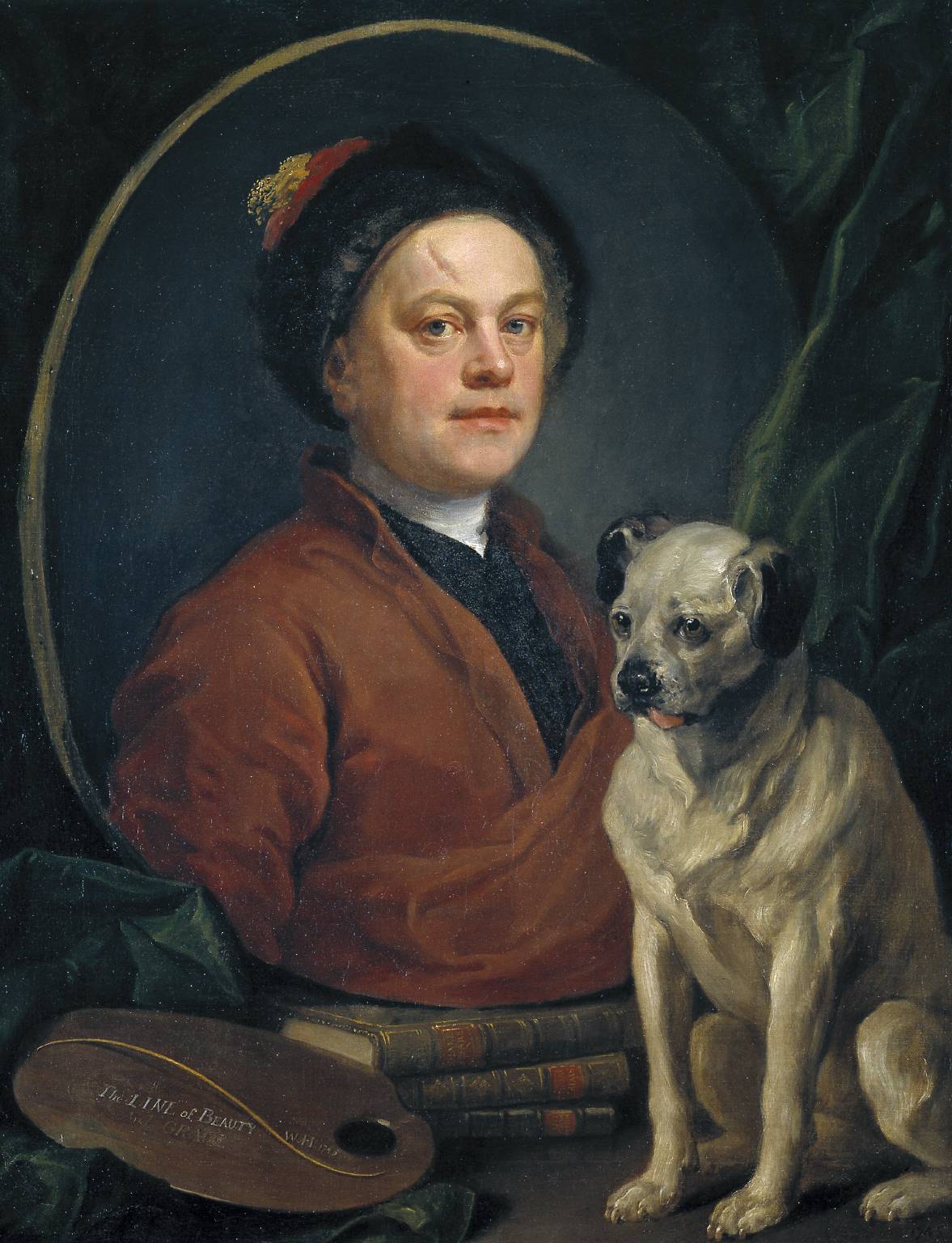
The Painter and his Pug 1745 William Hogarth 1697-1764 Purchased 1824 http://www.tate.org.uk/art/work/N00112

The Painter and his Pug 1745 William Hogarth

In our last installment, Vauxhall mastermind Jonathan Tyers was facing financial ruin when his most recent event wiped away all the profits of his other three. The story goes that his good friend William Hogarth, who still lived nearby, saw Tyers looking very dejected and asked what was the matter. Tyers replied that he was just trying to decide whether hanging himself or drowning was a better way to kill himself. Hogarth convinced him to wait until the following day, when he would share some ideas that might help. It can’t be known for certain what those ideas were, but it is clear that Hogarth was responsible for turning around the situation at Vauxhall.

In 1733 Tyers presented his friend William Hogarth with a solid gold pass to the gardens, giving free entry in perpetuity to a coach full of people. This unique and generous gift was accompanied by something even more precious, a small portrait of Tyers himself, painted when he was a young man visiting Paris, a gesture made in recognition of Hogarth’s many past favours.

hogarth pass

One of Hogarth’s ideas undoubtedly had to do with including contemporary English art, as he was always looking for places to display his own work and that of friends and students. Hogarth also persuaded Tyers to tone down his old-fashioned moralizing and use pleasure and enjoyment as his educational tools.

Early Design and Layout

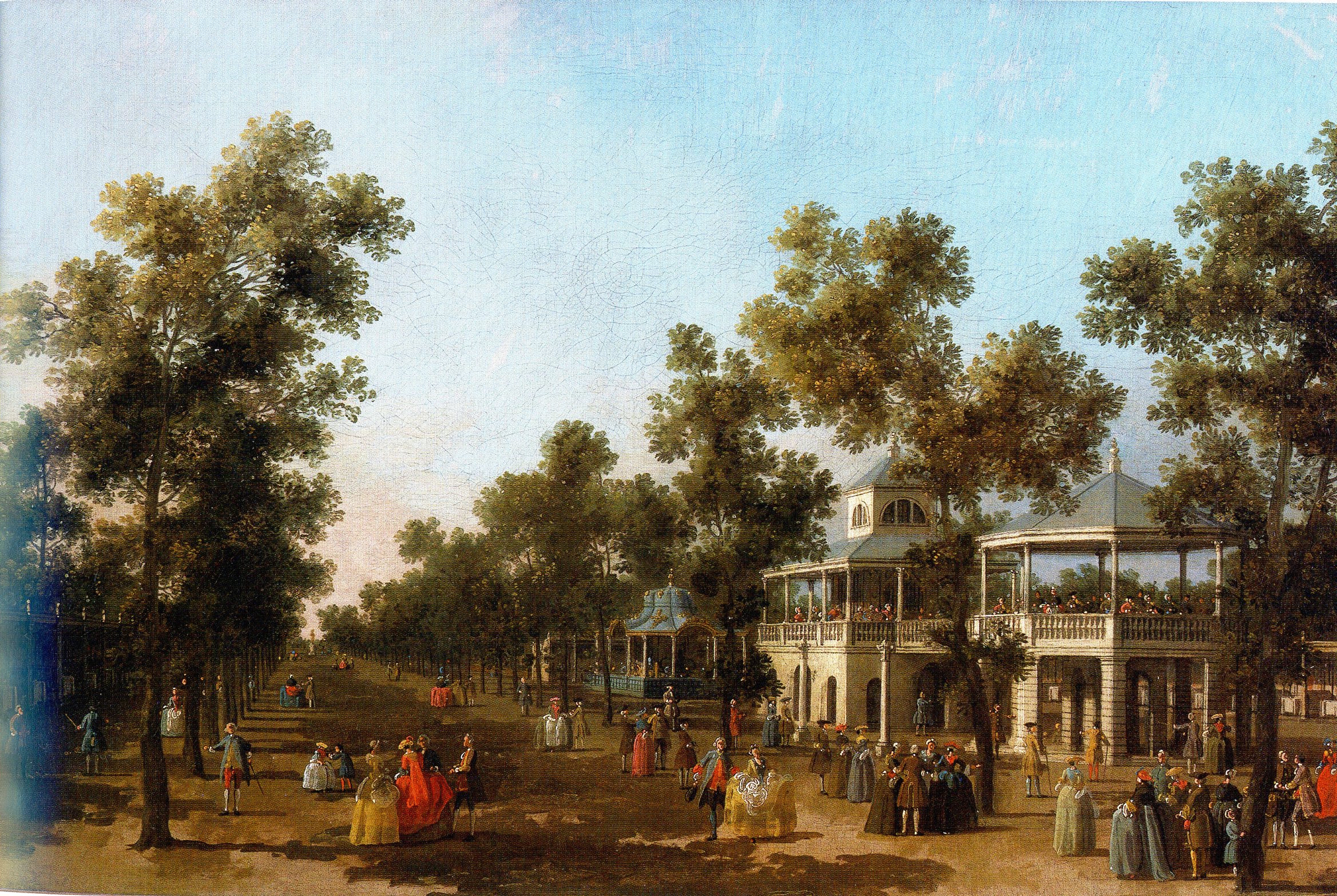
When Jonathan Tyers took on Vauxhall Gardens, the site was more like a densely wooded park than a garden, and was basically a rectangle of mixed deciduous woodland, mainly elm, lime and sycamore, cut through by a grid of several long walks at approximate right angles to each other.

There were in the public areas no bodies of water or fountains, no angles other than right angles, no formal flower beds, no mound, no topiary, no serpentine walks, nor the mazes or grottos…

Sophisticated landscape design played little part in Tyers’s Vauxhall, which was intended to accommodate as many people as possible with seeming overcrowded, while at the same time never appearing too sparsely populated.

The Proprietor’s House: the Entrance to the Gardens

prop001

The Proprietor’s House (right) which served as the entrance to the gardens (Vauxhall is written upon the doorway). The left side may have been the residence of the Tyers family.

The interior of the Proprietor’s House was described in the 1830’s by a writer who called himself the ‘tame cat’ of the gardens. On some of the ceilings ‘there were dim paintings, which the proprietor averred were the works of William Hogarth’. The house also boasted a large ballroom and ten bedrooms on the second floor. On the ground floor, above extensive cellars, there were:

Two handsome Parlours, with Dove and Marble Chimney Pieces, and Folding Doors, with Communication into the Pavilion Supper Rooms, and Private Entrance from the Lane, with Noble Light Staircase, Manager’s Office, and Public Entrance, called the Water Gate, with Money Takers’ Officers; Housekeeper’s Room, with Presses; Spacious Bar fronting the Gardens; Bread Room; Store Room; Pantry; China Room; Chicken Pantry; Glass Room; Punch Room; Pastry Room, with Tiled Bottom, and Confectionary, with Two excellent Ovens, Stewing Stoves, and Dressers, a capital large Paved Kitchen, with Dresser and Shelves; Scullery, with Pump of fine Water; and Yard, with detached Servants’ Dining Room; Pantry; Larder; Boiling House; Ham Room; Shed; and Servants’ Office.

Entering the gardens through this substantial house, at least for the first-time visitor, would have been a thrilling experience. After the discomfort of the journey, the modest entrance door, and the gloomy passage through the house, the first sight of the gardens, with their confusion of noise, colour, smell and movement, would have been breathtaking, like the raising of a curtain in a theatre, immediately transporting the visitor to another world.

The Prince’s Pavilion and Great Room

prince002

Situated adjacent to the Proprietor’s House, and accessible from it, [the Prince’s Pavilion] was a Kentian, classically inspired rectangular building with a portico of four Doric columns, set up on a basement storey, and accessed by a double flight of seven steps over a low arch… At the back of the portico, through a central door, was a single large drawing-room.

The name ‘Prince’s Pavilion’ refers specifically to the broad open-fronted portico at the front of the building… The attached Great Room or Salon was reached through the rusticated central doorway at the back of the portico. This room was richly decorated… It was fitted with fine mirrors, a grand chandelier, and a series of busts of modern worthies, including Isaac Newton, Alexander Pope and Abraham de Moivre.

Regular news reports attest to the prince’s frequent use of the pavilion and the Great Room behind it. On a typical occasion in 1737, a Saturday evening early in the season, the prince and his party, including the Earl of Darnley and the Earl of Crawford, Lord and Lady Torrington, Lady Irwin and Lord Baltimore, danced and supped in the Great Room from seven until midnight, after which their river journey back to Whitehall was accompanied by trumpets and French horns.

Susana’s Vauxhall Blog Post Series

  1. Vauxhall Gardens: A History
  2. Vauxhall Gardens: Jonathan Tyers—“The Master Builder of Delight” 
  3. Vauxhall Gardens: A New Direction
  4. Vauxhall Gardens: The Orchestra and the Supper-Boxes 
  5. Vauxhall Gardens: The Organ, the Turkish Tent, and the Rotunda
  6. Vauxhall Gardens: Three Piazzas of Supper-Boxes
  7. Vauxhall Gardens: “whither every body must go or appear a sort of Monster in polite Company”
  8. Vauxhall Gardens: The Competition
  9. Vauxhall Gardens: The Artwork, Part I
  10. Vauxhall Gardens: The Artwork, Part II
  11. Vauxhall Gardens: The Music, 1732-1859
  12. Vauxhall Gardens: The Business Side
  13. Vauxhall Gardens: Developments from 1751-1786
  14. Vauxhall Gardens: Thomas Rowlandson’s Painting (1785)
  15. ‎Vauxhall Gardens: The Third Generation of the Tyers Family and the Jubilee of 1786
  16. Vauxhall Gardens: An Era of Change (1786-1822), Part I
  17. Vauxhall Gardens: An Era of Change (1786-1822), Part II
  18. Vauxhall Gardens: An Era of Change (1786-1822), Part III
  19. Vauxhall Gardens: The Final Years, Part I
  20. Vauxhall Gardens: The Final Years, Part II
  21. Vauxhall Gardens: The Final Years, Part III
  22. Vauxhall Gardens: The Final Years, Part IV
  23. Vauxhall Gardens: Farewell, for ever

Vauxhall Gardens: Jonathan Tyers— “The Master Builder of Delight”

vauxhallbook

Vauxhall Gardens: A History

David Coke & Alan Borg

The Vauxhall Pleasure Gardens is one of the places I’d love to slip back in time to visit, just to catch a glimpse of what it was like. After recently splurging to buy this lovely coffee-table book, I thought it might make a wonderful subject for a new blog series. But do buy the book too, if you can! The photos are fabulous!

“The Master Builder of Delight”

In 1729, the site of the “Vauxhall Spring-Gardens was leased to a twenty-seven-year-old entrepreneur called Jonathan Tyers, whose goal was to transform it from a sort of seedy rural tavern to a respectable venue for all social classes.

A fellmonger (dealer in animal hides or skins) by trade, Jonathan was not content to continue the family business, successful though it was. Driven by a desire to raise his family’s status—and improve the world as he did so—Tyers believed that culture and pleasurable entertainments should not be the sole prerogative of the upper classes, but that the middle and lower classes deserved to find some enjoyment in their lives as well.

tyers family

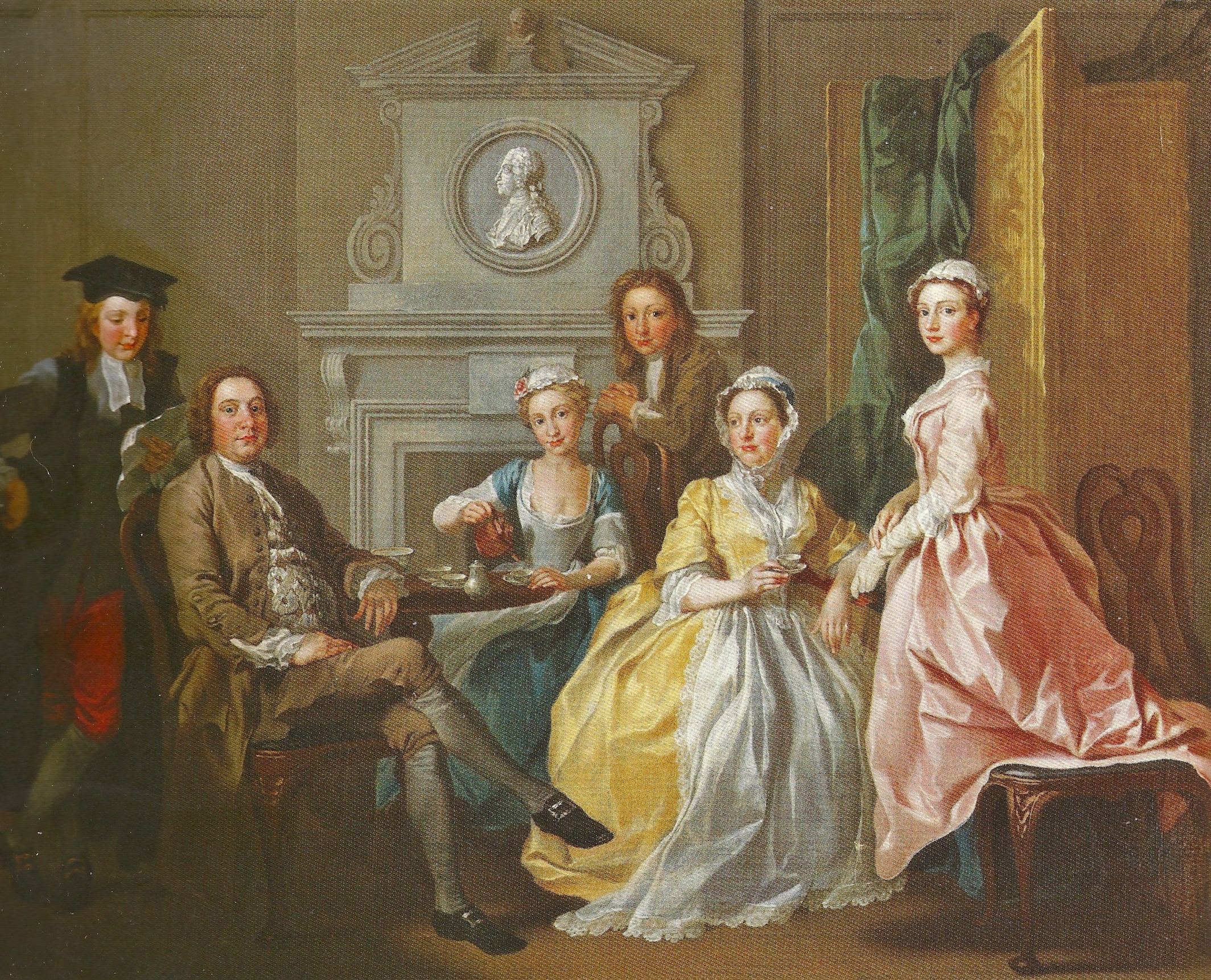
Family portrait by Francis Hayman, Jonathan Tyers and his Family, 1740. Left to right: Elder son Thomas, Jonathan, daughter Elizabeth, son Jonathan, wife Elizabeth, daughter Margaret.

Jonathan Tyers was a very complex character, with more than his fair share of contradictions and eccentricities. Upright, intelligent and self-assured, he also exhibited strains of arrogance and ambition. However, his ambitions were clearly projected chiefly upon his business rather than himself, while his personal aspirations were driven by a wish to raise his own status and that of his family to gentry, an object in which he succeeded at a remarkably early age. (p.35)

Through his association with The Wits’ Club, a social club for freethinkers, scholars, libertarians, and writers, Tyers became good friends with Charles Burney, Henry Fielding, William Hogarth, Harry Hatsell, Edward Moore, Thomas Cooke, Richard Dawson, and Leonard Howard. The club first met at Vauxhall Gardens later moved to a nearby tavern. Many of the ideas behind his development of the gardens came from the discussions at this club.

Although he never managed to mix with fashionable society in his lifetime, he was held in great respect and admiration by his peers, so much so that he was elected to the Royal Society of Arts in 1757, where he would have met many other prominent people, including Benjamin Franklin, when he visited London.

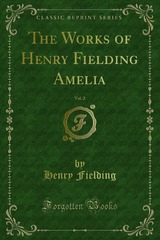
He and his creation were even featured in his friend Henry Fielding’s work of fiction, Amelia (1751).

The extreme Beauty and Elegance of this Place is well known to almost every one of my Readers; and happy is it for me that it is so; since to give an adequate Idea of it, would exceed my Power of Description. To delineate the particular Beauties of these Gardens, would, indeed, require as much pains and as much Paper too, as to rehearse all the good Actions of their Master [Tyers], whose Life proves the Truth of an Observation which I have read in some Ethic Writer, that a truly elegant Taste is generally accompanied with an Excellency of Heart; or in other Words, that true Virtue is, indeed, nothing else but true Taste.

The_Works_of_Henry_Fielding_Amelia_v2_1000373134

Tyers’s Mission

Besides his goal of cleaning up the gardens’ reputation, Tyers hoped to use the venue to improve people’s lives “through contact beauty and quality.” In other words, he planned to provide the lower orders with both art and beauty, and also expose them to “polite society,” who would educate them by example.

His influence on the manners and morals of eighteenth-century society was to be far-reaching, and his patronage of artists and designers would change the face of British art. But it was his ideological beliefs and priorities, his egalitarianism and his conviction that the pursuit of pleasure was a basic human right, and a vital element of the balanced life, that would really motivate his proprietorship of Vauxhall Gardens.

The Ridotto al Fresco

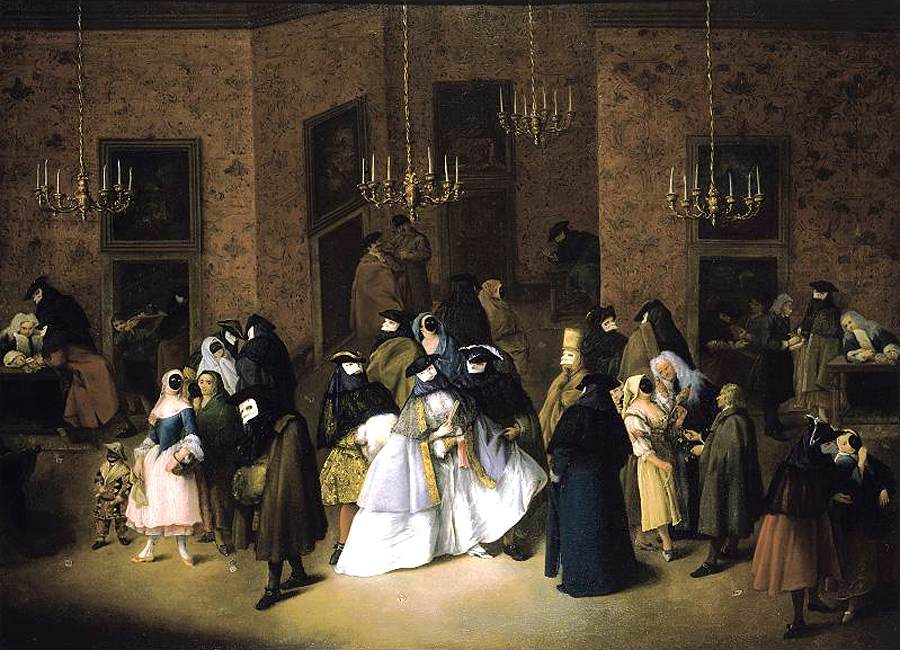
Tyers’s first event at Vauxhall was a masquerade ball in the manner of the Italian carnival in the spring of 1731. Not much is known of this event, except that there was outdoor dancing in masquerade costume and was restricted to the upper classes.

The Ridotto in Venice, Pietro Longhi, 1750's

The Ridotto in Venice, Pietro Longhi, 1750’s

By contrast, his second event in April of 1732, was attended by the poorer class of people, including “an oyster girl, a barber’s apprentice, a lawyer, an army captain, a doctor, a vicar and a number of prostitutes…”

The third event, considered to be the opening ceremony of Tyers’s Vauxhall Gardens, took place on 7 June 1732 and included the presence of Frederick, Prince of Wales. Under the guidance of John James Heidegger, Tyers created an extraordinary event that was talked about for years. A hundred armed soldiers were employed for the security of the distinguished guests, and he “hired the Westminster and Lambeth ferrymen for the whole night to carry his guests across the river and back.” Even with an admission fee of a guinea—which only the wealthy could afford—“between three and four hundred people actually attended the ridotto.” Besides the Prince of Wales’s entourage, the guests included politicians and their friends, “lawyers, bankers, printers, brewers, churchmen, military men and aristocrats.” The party broke up at around four in the morning. “The principal entertainments…were dancing and feasting, combined with the social intercourse between masked guests.”

The Ridotto in Venice, Pietro Longhi, 1750's

The Ridotto in Venice, Pietro Longhi, 1750’s

While by most accounts—particularly in the view of the Prince of Wales—this event was a great success, other accounts indicate that there was a distinct theme of preaching and moralizing via buildings set up to show the misery and pain that result from excessive self-indulgence that may have not gone over too well with the party-minded guests.

In any case, his final ridotto, which was held two weeks later on 21 June, likely at the request of the Prince, who was having the time of his life, was attended by only half as many, which, considering his expenses, would likely have completely wiped out any profits from the four events. No doubt this is the reason Tyers held no such events during 1733 or 1734, although the gardens themselves likely continued to be open to the public.

Susana’s Vauxhall Blog Post Series

  1. Vauxhall Gardens: A History
  2. Vauxhall Gardens: Jonathan Tyers—“The Master Builder of Delight” 
  3. Vauxhall Gardens: A New Direction
  4. Vauxhall Gardens: The Orchestra and the Supper-Boxes 
  5. Vauxhall Gardens: The Organ, the Turkish Tent, and the Rotunda
  6. Vauxhall Gardens: Three Piazzas of Supper-Boxes
  7. Vauxhall Gardens: “whither every body must go or appear a sort of Monster in polite Company”
  8. Vauxhall Gardens: The Competition
  9. Vauxhall Gardens: The Artwork, Part I
  10. Vauxhall Gardens: The Artwork, Part II
  11. Vauxhall Gardens: The Music, 1732-1859
  12. Vauxhall Gardens: The Business Side
  13. Vauxhall Gardens: Developments from 1751-1786
  14. Vauxhall Gardens: Thomas Rowlandson’s Painting (1785)
  15. ‎Vauxhall Gardens: The Third Generation of the Tyers Family and the Jubilee of 1786
  16. Vauxhall Gardens: An Era of Change (1786-1822), Part I
  17. Vauxhall Gardens: An Era of Change (1786-1822), Part II
  18. Vauxhall Gardens: An Era of Change (1786-1822), Part III
  19. Vauxhall Gardens: The Final Years, Part I
  20. Vauxhall Gardens: The Final Years, Part II
  21. Vauxhall Gardens: The Final Years, Part III
  22. Vauxhall Gardens: The Final Years, Part IV
  23. Vauxhall Gardens: Farewell, for ever

Vauxhall Gardens: A History

vauxhallbook

Vauxhall Gardens: A History

David Coke & Alan Borg

The Vauxhall Pleasure Gardens is one of the places I’d love to slip back in time to visit, just to catch a glimpse of what it was like. After recently splurging to buy this lovely coffee-table book, I thought it might make a wonderful subject for a new blog series. But do buy the book too, if you can. The photos are fabulous!

newspringgardensmap

Public Gardens

Royal Parks, such as St. James and Hyde Park, began to open up to the public in the seventeenth century. The first “Spring Garden” was located near St. James Park. Amenities in 1614 included a bathing pond, water fountains, graveled paths and fruit trees, a butt for archery, and a tiltyard. A bowling green was added by Charles II. It also became known for excessive drinking, quarrels, and hopeful prostitutes.

Samuel Pepys and the “Old” and “New” Spring Gardens

But there were also “Spring Gardens” at Vauxhall during the early seventeenth century, and after the Restoration, two of them, one “Old” and one “New” which has caused much confusion over the years. The “Old Spring Garden” was a pleasant place to walk with trees and flowers, with food available that Samuel Pepys spoke of as too “dear”, causing him and his family to eat at a nearby house instead after they had also visited the “New Spring Garden.” The word “New” was used to indicate that it was re-opened after the Restoration. Before 1750, when Westminster Bridge was opened, most visitors arrived by boat.

Taking water for vauxhall - Be careful, my love, don't expose your leg

TAKING WATER FOR VAUXHALL – Be careful, my Love, don’t expose your Leg

An early visitor, Balthasar de Monconys, described it:

We took a boat to the other side of the Thames to see two gardens, where everyone can go and walk, have something to eat in the restaurants or in the cabins in the garden. They are called Spring Gardens, that is to say Jardin du Printemps, and the new one is more beautiful than the old. I admired the beauty of the grassy walks and the niceness of the sanded ones. It is divided into a large number of plots twenty or thirty yards square, enclosed by gooseberry hedges, and these plots are also planted with raspberry bushes, roses, and other shrubs, as well as herbs and vegetables, such as peas, beans, asparagus, strawberries and so on. The walks are bordered with jonquils, gilliflowers or lilies. We returned after we had eaten and went again to Longacre.

Samuel_Pepys

Samuel Pepys

Samuel Pepys

Samuel Pepys was a frequent visitor to the gardens, mentioning it twenty-three times in his Diary from 1662 to July 1668. On one of his earlier visits, he mentions “boys doing tumbling tricks”. In 1665 when the plague began to take hold, he mentions “the ayre and pleasure of the garden, was a great refreshment to me, and methinks, that which we ought to Joy ourselves in.” A month later, he writes:

I to Fox-hall, where to the Spring-garden; but I do not see one guest there, the town being so empty of anybody to come thither. Only, while I was there, a poor woman came to scold with the master of the house that a kinswoman, I think, of hers, that was newly dead of the plague, might be buried in the church-yard; for, for her part, she should not be buried in the Commons, as they said she should.

A year later, Pepys describes visiting the park with a friend and having a sexual encounter with some prostitutes in a private arbor. He also mentions bird (particularly nightingale) and animal calls, an entertainment which was to become customary at Vauxhall. From his writings, one can infer that entrance to the gardens was free, but that food and drink were not. One entry describes a situation where ladies were stalked by drunken men. Pepys says this:

… at last, the ladies did get off out of the house and took boat and away. I was troubled to see them abused so; and could have found my heart, as little desire of fighting as I have, to have protected the ladies.

Another time, when he visited with his wife, he was again troubled by these young rapscallions:

So over the water with my wife and Deb and Mercer to Spring-garden, and there eat and walked, and observe how rude some of the young gallants of the town are become, to go into people’s arbors where there are not men, and almost force the women—which troubled me, to see the confidence of the vice of the age: and so we away by water, with much pleasure home.

Food and Drink at the Spring Gardens

Restoration literature mentions waiters. The food served was usually cold: the very thin ham shavings that Vauxhall was known for, chicken served with salad, and occasionally beef and lobster. Strawberries and cream were popular, the fruit grown in local market gardens. Beverages were wine, beer, and rack punch (a drink from India containing arrack—distilled from coconut sap—hot water, limes, sugar, and spice).

The Great Walk

Tom Brown mentions the Great Walk—the central feature of the gardens—in Amusements, published in 1700.

The ladies that have an inclination to be private take delight in the close walks of Spring Gardens, where both sexes meet and mutually serve one another as guides to lose their way; the windings and turnings in the little wilderness are so intricate that the most experienced mothers have often lost themselves in looking for their daughters.

Much mention is made of intrigues and sexual encounters in the “Spring Gardens,” although it is hinted that such is of a somewhat higher class there than in other public venues. Sir Roger de Coverley complained to the mistress of the house “that he should be a better customer to her garden if there were more nightingales and fewer strumpets” after he was accosted by a “wanton baggage” there.

An escape from the city

The Spring Gardens, although not really the countryside, were far enough away from the dirt and smells of the city that its widely diverse visitors could—at least for a short while—escape their troubles. The following anonymous verses were published in the Gentleman’s Magazine of June 1732:

At Vauxhall Stairs they land, their Passage pay,

And to Spring Gardens, tread the beck’ning way.

‘Hail pleasing Shades! O hail thou secret Grove!

The blest Retreat of Liberty and Love.

All hail, ye Bow’rs! Ye beaut’ous Silvan Scenes,

Ye Grotts, and Mazes of fresh blooming Greens;

Here dwells no Care, no matrimonial Strife,

The peevish Husband, nor the bawling Wife;

Here’s no Restraint to make our Pleasures cloy,

We part at will, and as we please enjoy

See how the Birds by Nature taught to rove,

How sweet they sing, and how like us they love.

With careless Ease they hop from Tree to Tree,

And are as Merry, and as blest as we.

Thrice happy State! Each am’rous Trulla says,

And baits with Poison all the various ways;

The Walks are fill’d with Throngs of different Sort,

From Fleet Street, Drury, and incog., from Court.

To these fair Shades, see Belles and Beaus advance,

Some sigh, some sing, some whistle, and some dance.

Susana’s Vauxhall Blog Post Series

  1. Vauxhall Gardens: A History
  2. Vauxhall Gardens: Jonathan Tyers—“The Master Builder of Delight” 
  3. Vauxhall Gardens: A New Direction
  4. Vauxhall Gardens: The Orchestra and the Supper-Boxes 
  5. Vauxhall Gardens: The Organ, the Turkish Tent, and the Rotunda
  6. Vauxhall Gardens: Three Piazzas of Supper-Boxes
  7. Vauxhall Gardens: “whither every body must go or appear a sort of Monster in polite Company”
  8. Vauxhall Gardens: The Competition
  9. Vauxhall Gardens: The Artwork, Part I
  10. Vauxhall Gardens: The Artwork, Part II
  11. Vauxhall Gardens: The Music, 1732-1859
  12. Vauxhall Gardens: The Business Side
  13. Vauxhall Gardens: Developments from 1751-1786
  14. Vauxhall Gardens: Thomas Rowlandson’s Painting (1785)
  15. ‎Vauxhall Gardens: The Third Generation of the Tyers Family and the Jubilee of 1786
  16. Vauxhall Gardens: An Era of Change (1786-1822), Part I
  17. Vauxhall Gardens: An Era of Change (1786-1822), Part II
  18. Vauxhall Gardens: An Era of Change (1786-1822), Part III
  19. Vauxhall Gardens: The Final Years, Part I
  20. Vauxhall Gardens: The Final Years, Part II
  21. Vauxhall Gardens: The Final Years, Part III
  22. Vauxhall Gardens: The Final Years, Part IV
  23. Vauxhall Gardens: Farewell, for ever
 

A Celebration of Waterloo: Wellington’s Exploring Officers

All the business of war and indeed all the business of life, is to endeavor to find out what you don’t know by what you do: that’s what I call ‘guessing what was on the other side of the hill.’

Arthur Wellesley, 1st Duke of Wellington

 The Business of Spying

Up until the early 19th century, spying was considered an odious and ungentlemanly occupation and few officers would agree to do it.

But by the time the 19th century rolled around, with the spreading of Napoleon’s empire on the continent, General Brownrigg, the Quartermaster-General of the British Army, went to the Commander-in-Chief, Frederick, the Duke of York, to propose that army develop a unit called the Depot of Military Intelligence, and it was done. The problem was—nobody wanted to do it.

Wellington’s Exploring Officers

peninsular war map

When General Wellesley arrived in Portugal, he couldn’t find an accurate map of the country and had to write to his brother-in-law to send him one. Realizing that his lack of information about the movements of the enemy, as well as the terrain and countryside, Wellington established a corps of “Exploring Officers.”

Exploring officers had to be fine horsemen, skilled linguists, and able to express themselves in sketching and writing in the most concise terms. With the assistance of local inhabitants, they would map the countryside four miles to the inch. That done, they would move behind enemy lines, learn troop movements and strategic information, and return to disclose this information to Wellington.

Sir John Waters

Sir John Waters of the Royal Scots

John Waters of the Royal Scots was known as a wily and capable man behind enemy lines. However, he was caught by the French and given up for dead by his regiment. When a man dies, his personal possessions are generally auctioned off to his comrades, but Wellington forbade this, saying that “Waters should be back and would want his things.” And he was right. Waters did come back and supposedly did want his things back.

Most exploring officers wore their uniforms, since soldiers caught behind enemy lines out of uniform was immediately shot as a spy. John Grant was one of the few who went in disguise. He became very friendly with the Portuguese people and adopted their local dress, much to the horror of his fellow officers. After the war, instead of being lauded for their risk-taking, these courageous men were shunned by their former regiments as “gadabouts” who were not really engaged in the business of war.

Colquhoun Grant

From Wikipedia:

Colquhoun Grant, Gentleman Spy

Colquhoun Grant, Gentleman Spy

The youngest of eight brothers in a family from the Scots aristocracy, Grant was commissioned into the 11th Foot in 1795. In 1809 he was posted to the Iberian Peninsula under the command of Arthur Wellesley, who in 1810 appointed him to his personal staff as an exploring officer in the Peninsula Corps of Guides, a special reconnaissance unit who spoke the local languages.

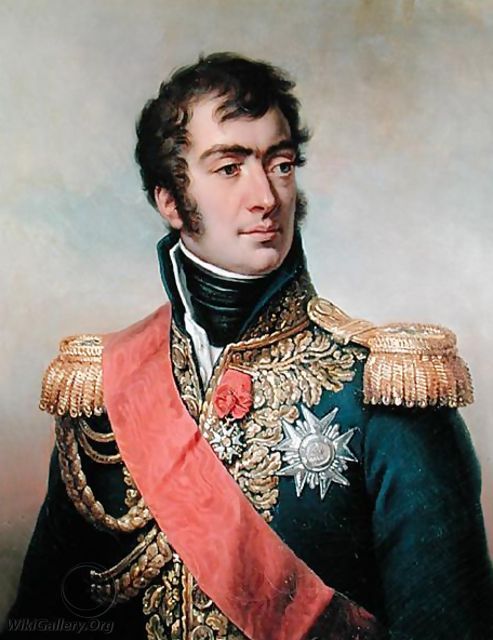
Grant was captured by French forces on 16 April 1812. As he was in uniform he was treated as an officer and gentleman by his captors, who offered him parole, which Grant accepted. Grant was invited to dine with Marshal Marmont who hoped to find out more about Wellington, and who was angered by Grant’s reticence. Marmont had good reason to remain suspicious of Grant, as the latter managed to send and receive secret messages while in captivity.

marmont

Auguste de Marmont

Marmont sent Grant to Paris for interrogation. It is clear from Marmont’s correspondence that he had no intention of exchanging Grant for a prisoner of equal rank among the British, as was the custom of the time, considering him to be a spy. Grant, on seeing a copy of Marmont’s letter, decided that it invalidated his agreement to parole and left him free to escape.

Grant was able to avoid recapture by passing himself off as an American officer, and spent some weeks at liberty in the streets and salons of Paris, sending intelligence reports to Wellington. He then escaped to England, rejoining Wellington in early 1814. Promoted to lieutenant-colonel he was appointed commanding officer of the Corps of Guides and Head of Intelligence for the Peninsular Army.

During the Hundred Days Campaign, Grant was working as intelligence officer in France when Wellington put him in charge of his own intelligence operations. Grant sent in a steady stream of reports regarding the build-up of French troops along the border and returned to Brussels in time to take part in the Battle of Waterloo on 18 June.

Lost and Found Lady

Rupert Ellsworth, the hero in story in the Beaux, Ballrooms, and Battles anthology, is an exploring officer in Wellington’s army in 1812 when he decides to disguise himself as a French soldier following the Battle of Salamanca. Unfortunately, he’s not the greatest horseman and falls off the untrained French horse and hits his head on a rock. Fortunately he is discovered soon after by Catalina, a local girl, who takes it upon herself to nurse him back to health. One thing leads to another and it isn’t long before the pair fall in love. But Catalina is not a whore and Rupert has promised his father to marry a “suitable English girl,” so the future for them looks grim. Between one thing and another, the two are separated… to be reunited several years later in Belgium just as another war is brewing. Circumstances for both of them have drastically changed, and Rupert is bound for the battlefield. Will there be a future for them or is it too late?

waterloo_cover_best web

Amazon.com • Amazon.uk • Amazon.ca • Amazon.au

 Barnes & Noble • iBooks • Kobo

Beaux, Ballrooms, and Battles

Release Day Party: April 1, 2015, 11 a.m. – 11 p.m. EDT

Rafflecopter: ends April 18

Website: www.beauxballroomsandbattles.com

Facebook Page

Jillian Chantal: Jeremiah’s Charge

Emmaline Rothesay has her eye on Jeremiah Denby as a potential suitor. When Captain Denby experiences a life-altering incident during the course of events surrounding the Battle of Waterloo, it throws a damper on Emmaline’s plans.

Téa Cooper: The Caper Merchant

The moon in Gemini is a fertile field of dreams, ideas and adventure and Pandora Wellingham is more than ready to spread her wings. When Monsieur Cagneaux, caper merchant to the rich and famous, introduces her to the handsome dragoon she believes her stars have aligned.

Susana Ellis: Lost and Found Lady

Catalina and Rupert fell in love in Spain in the aftermath of a battle, only to be separated by circumstances. Years later, they find each other again, just as another battle is brewing, but is it too late?

Aileen Fish: Captain Lumley’s Angel

Charged with the duty of keeping his friend’s widow safe, Captain Sam Lumley watches over Ellen Staverton as she recovers from her loss, growing fonder of her as each month passes. When Ellen takes a position as a companion, Sam must confront his feelings before she’s completely gone from his life.

Victoria Hinshaw: Folie Bleue

On the night of the 30th Anniversary of the Battle of Waterloo, Aimée, Lady Prescott, reminisces about meeting her husband in Bruxelles on the eve of the fighting. She had avoided the dashing scarlet-clad British officers, but she could not resist the tempting smile and spellbinding charm of Captain Robert Prescott of the 16th Light Dragoons who—dangerously to Aimée—wore blue.

Heather King: Copenhagen’s Last Charge

When Meg Lacy finds herself riding through the streets of Brussels only hours after the Battle of Waterloo, romance is the last thing on her mind, especially with surly Lieutenant James Cooper. However, their bickering uncovers a strange empathy—until, that is, the lieutenant makes a grave error of judgment that jeopardizes their budding friendship…

Christa Paige: One Last Kiss

The moment Colin held Beatrice in his arms he wanted one last kiss to take with him into battle and an uncertain future. Despite the threat of a soldier’s death, he must survive, for he promises to return to her because one kiss from Beatrice would never be enough.
Sophia Strathmore: A Soldier Lay Dying

Amelia and Anne Evans find themselves orphaned when their father, General Evans, dies. With no other options available, Amelia accepts the deathbed proposal of Oliver Brighton, Earl of Montford, a long time family friend. When Lord Montford recovers from his battle wounds, can the two find lasting love?
David W. Wilkin: Not a Close Run Thing at All

Years, a decade. And now, Robert had come back into her life. Shortly before battle was to bring together more than three hundred thousand soldiers. They had but moments after all those years, and now, would they have any more after?

The York Road: Enfield Chase and the Gunpowder Treason Plot

dust jacket

The following post is the eigthteenth of a series based on information obtained from a fascinating book Susana recently obtained for research purposes. Coaching Days & Coaching Ways by W. Outram Tristram, first published in 1888, is replete with commentary about travel and roads and social history told in an entertaining manner, along with a great many fabulous illustrations. A great find for anyone seriously interested in English history!

The Gunpowder Treason Plot

The conspirators

The conspirators

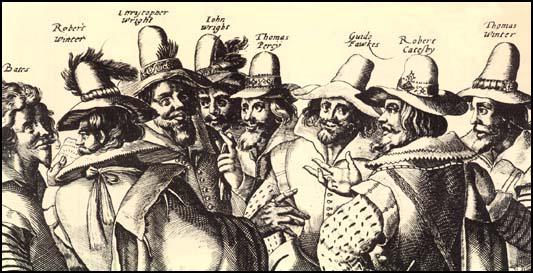
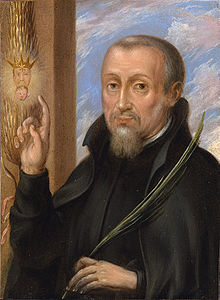
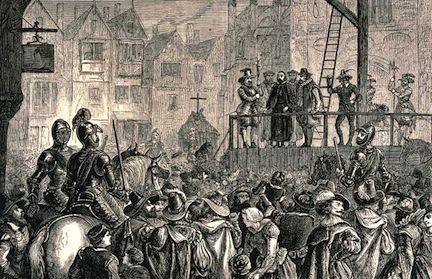
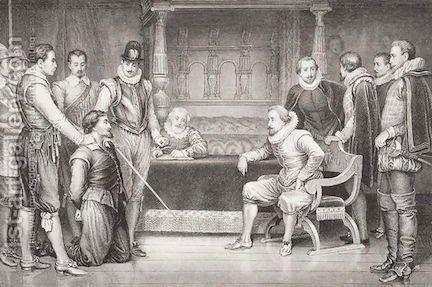
In 1605, a group of English Catholics, led by Robert Catesby, met at a house called White Webbs near Enfield Chase, to plot to assassinate James I and put his daughter Elizabeth on the throne, who, although only nine years old, was to be the Catholic head of state. An anonymous letter galvanized the authorities into action. Guy Fawkes was found in the House of Lords with 36 barrels of gunpowder on October 26, 1605. The other conspirators fled, but were captured, although Catesby was killed in a shootout. The other men, including a Jesuit priest called Father Garnet, were sentenced to be hanged, drawn and quartered. There was speculation that the priest, although he undoubtedly knew of the plot, was innocent because of his vow to the confidentiality of the confessional. Our illustrious author, however, seems to think that Father Garnet was in it up to his eyeballs.

For here, at this lonely house, then in the middle of Enfield Chase, nearly all the actors in the dark catastrophe, imminent at Westminster, at one time or another gathered. Over and over again the ten miles between Enfield Wash and London must have rung to the sound of their horses’ hoofs, as they rode fiercely between White Webbs and London. That Catesby was here ten days before the mediated explosion is evident from Winter’s confession:

“Then was the parliament anew prorogued until the fifth of November, so as we all went down until some ten days before, when Mr. Catesby came up with Mr. Fawkes to an house by Enfield Chase called White Webbs, whither I came to them, and Mr. Catesby willed me to inquire whether the young prince came to the parliament: I tolde him I heard that his grace thought not to be there. ‘Then must we have our horses,’ said Mr. Catesby, ‘beyond the water, and provision of more company to surprise the prince, and leave the duke alone.’”

That a more important factor in the deadly design—if the latest judgment of posterity is to be believed even that Catesby himself was frequently at the old house in Enfield Chase is shown in the examination of James Johnson: that is to say in the examination of Guy Fawkes.

It was stated by him that the place had been taken of Dr. Huicke by his master, Mr. Meaze, of Berkshire, for his sister, Mrs. Perkins (alias Mrs. Ann Vaux); that Mrs. Vaux had spent a month there and mass had been said by a priest whose name deponent did not know.

Father Henry Garnet

Father Henry Garnet

And as Mr. Meaze, of Berkshire, was none other than Henry Garnet, the Provincial of the English Jesuits, the importance of the testimony becomes apparent. And the fact gives birth to a fancy. It is interesting to me to think that Mr. Meaze, of Berkshire, with his candid blue eyes, his fair curling hair, his polished, courteous manners, his form tending to an embonpoint by no means suggestive of asceticism; it is interesting to me, I say, to think that Mr. Meaze of Berkshire, may have been a well-known and respected figure about Enfield Wash. That he may have been recognized as Father Garnet, for the first time as he stood absolutely under the beam on that May morning—”the morrow of the Invention of the Cross”—on the great scaffold at the west of end of old St. Paul’s; that he may have been recognized there by some Enfield yeoman, who had ridden in from Enfield to see the show, little expecting to see in the last victim, in the most distinguished of all the victims perhaps, to a justly outraged justice, the courteous, handsome stranger, who he had so admired and respected down in his quiet Enfield home!

Father Garnet at the gallows

Father Garnet at the gallows

Guy Fawkes Day

Apparently, all that remains of Guy Fawkes Day is an occasional bonfire and the burning of effigies of disliked celebrities, and fireworks. In some places it gets lumped together with Halloween. But it no longer has much to do with religion and politics as it originally did.

Guy Fawkes interrogated by James I

Guy Fawkes interrogated by James I


 Index to all the posts in this series

1: The Bath Road: The (True) Legend of the Berkshire Lady

2: The Bath Road: Littlecote and Wild William Darrell

3: The Bath Road: Lacock Abbey

4: The Bath Road: The Bear Inn at Devizes and the “Pictorial Chronicler of the Regency”

5: The Exeter Road: Flying Machines, Muddy Roads and Well-Mannered Highwaymen

6: The Exeter Road: A Foolish Coachman, a Dreadful Snowstorm and a Romance

7: The Exeter Road in 1823: A Myriad of Changes in Fifty Years

8: The Exeter Road: Basingstoke, Andover and Salisbury and the Events They Witnessed

9: The Exeter Road: The Weyhill Fair, Amesbury Abbey and the Extraordinary Duchess of Queensberry

10: The Exeter Road: Stonehenge, Dorchester and the Sad Story of the Monmouth Uprising

11: The Portsmouth Road: Royal Road or Road of Assassination?

12: The Brighton Road: “The Most Nearly Perfect, and Certainly the Most Fashionable of All”

13: The Dover Road: “Rich crowds of historical figures”

14: The Dover Road: Blackheath and Dartford

15: The Dover Road: Rochester and Charles Dickens

16: The Dover Road: William Clements, Gentleman Coachman

17: The York Road: Hadley Green, Barnet

18: The York Road: Enfield Chase and the Gunpowder Treason Plot

19: The York Road: The Stamford Regent Faces the Peril of a Flood

20: The York Road: The Inns at Stilton

21: The Holyhead Road: The Gunpowder Treason Plot

22: The Holyhead Road: Three Notable Coaching Accidents

23: The Holyhead Road: Old Lal the Legless Man and His Extraordinary Flying Machine

24: The Holyhead Road: The Coachmen “More Celebrated Even Than the Most Celebrated of Their Rivals” (Part I)

25: The Holyhead Road: The Coachmen “More Celebrated Even Than the Most Celebrated of Their Rivals” (Part II)

26: Flying Machines and Waggons and What It Was Like To Travel in Them

27: “A few words on Coaching Inns” and Conclusion

The York Road: Hadley Green, Barnet

dust jacket

The following post is the seventeenth of a series based on information obtained from a fascinating book Susana recently obtained for research purposes. Coaching Days & Coaching Ways by W. Outram Tristram, first published in 1888, is replete with commentary about travel and roads and social history told in an entertaining manner, along with a great many fabulous illustrations. A great find for anyone seriously interested in English history!

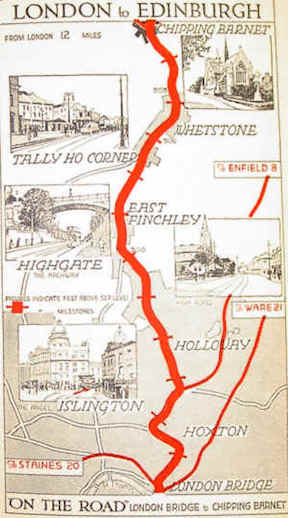
The Great North Road

map

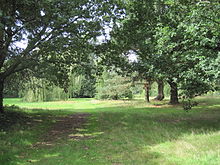
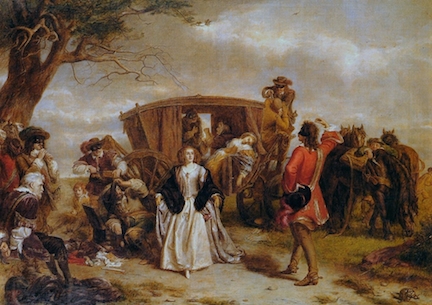
220px-Hadley_GreenAnd Barnet is soon a memory on the great north road. A memory however which shows some claim to “recollection dear”, fixing as it does the site of a great battle and of a highwayman’s exploits, which have occupied almost the same space in history—I mean fiction—No! I mean history. To come to details:—On Hadley Green, half-a-mile to the north of the town, was fought on a raw, cold and dismal Easter Day, in the year 1471, the famous battle between the Houses of York and Lancaster which ended in the death of the king-maker, and established Edward IV on the throne; and behind an oak tree, which still stands opposite the Green Man at the junction of the York and Holyhead Roads, the immortal Dick Turpin used to sit silent on his mare, Black Bess, patiently waiting for some traveller to speak to.

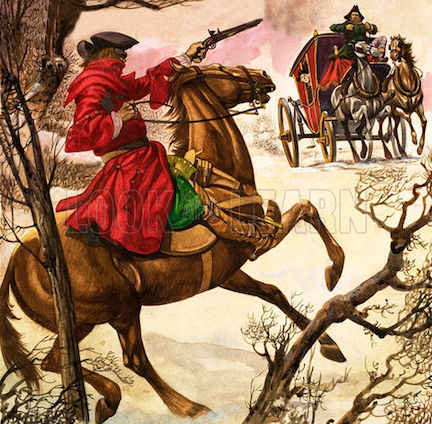
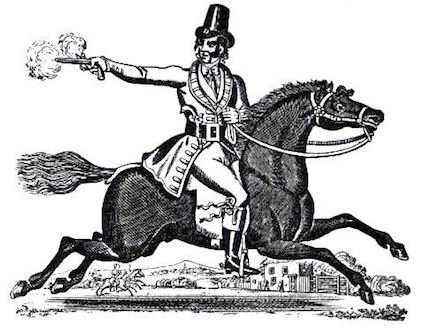
The romanticized Dick Turpin

The romanticized highwayman

A Not-So-Gallant Highwayman

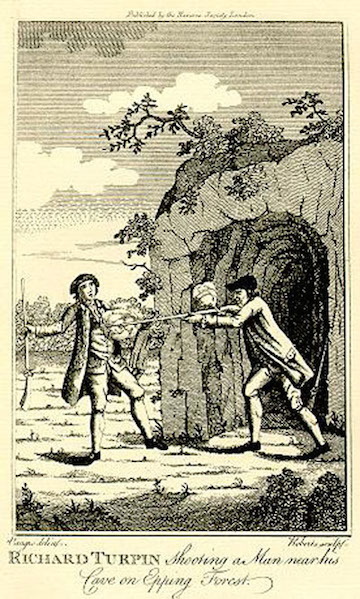
Dick Turpin attacking the mail-coach in Epping ForestLet me preface this by saying that the real Dick Turpin was a violent criminal and not the sort of gallant Robin Hood frequently found in historical romances and in William Harrison Ainsworth’s Rookwood. His gangs robbed, maimed, killed and raped. It was due to men like him that coaches traveling on the highways of England often had armed outriders for protection. Nor was he a particularly handsome fellow. The London Gazette describes him as:

Richard Turpin, a butcher by trade, is a tall fresh coloured man, very much marked with the small pox, about 26 years of age, about five feet nine inches high, lived some time ago in Whitechapel and did lately lodge somewhere about Millbank, Westminster, wears a blue grey coat and a natural wig.

The London Gazette: no. 7379. p. 1. 22 February 1734. )

turpin1

Prior to taking up coach-robbing, Turpin was part of a gang who did what we would call home invasions—beating and torturing the occupants, in one case forcing a bare-buttocked man to sit on the fire. Scenes right out of Criminal Minds! A behavioral analyst would understand this better than I, because I simply cannot imagine why anyone would do this for the piddly amount they came away with—often less than thirty pounds!

That gang—termed the “Essex Gang”—ceased to exist when authorities rounded up and executed many of the members in 1735. That’s when our Dick turned to robbing coaches. He was hiding out in Epping forest when he shot and killed a servant who recognized him.

Dick_turpin_murderer

It having been represented to the King, that Richard Turpin did on Wednesday the 4th of May last, barbarously murder Thomas Morris, Servant to Henry Tomson, one of the Keepers of Epping-Forest, and commit other notorious Felonies and Robberies near London, his Majesty is pleased to promise his most gracious Pardon to any of his Accomplices, and a Reward of 200l. to any Person or Persons that shall discover him, so as he may be apprehended and convicted. Turpin was born at Thacksted in Essex, is about Thirty, by Trade a Butcher, about 5 Feet 9 Inches high, brown Complexion, very much mark’d with the Small Pox, his Cheek-bones broad, his Face thinner towards the Bottom, his Visage short, pretty upright, and broad about the Shoulders.

—The Gentleman’s Magazine (June 1737)

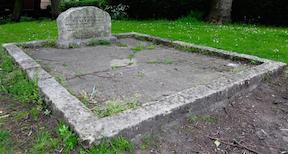
Escaping to the north, he began calling himself Palmer, and under that name, was accused of shooting another man’s cock (a chicken, I believe!) and tossed in the House of Correction at Beverley. Suspected of horse theft, he was transferred to York Castle and sentenced to death for that. It wasn’t until he wrote a letter to his brother-in-law—who promptly refused it—that his true identity was discovered. He was executed at Knavesmire and buried at St. George’s Church in Fishergate. Ironically, his body was robbed by bodysnatchers, who made their living selling bodies to medical schools—but it was recovered soon after and reburied.

Dick-Turpin-Grave

 Index to all the posts in this series

1: The Bath Road: The (True) Legend of the Berkshire Lady

2: The Bath Road: Littlecote and Wild William Darrell

3: The Bath Road: Lacock Abbey

4: The Bath Road: The Bear Inn at Devizes and the “Pictorial Chronicler of the Regency”

5: The Exeter Road: Flying Machines, Muddy Roads and Well-Mannered Highwaymen

6: The Exeter Road: A Foolish Coachman, a Dreadful Snowstorm and a Romance

7: The Exeter Road in 1823: A Myriad of Changes in Fifty Years

8: The Exeter Road: Basingstoke, Andover and Salisbury and the Events They Witnessed

9: The Exeter Road: The Weyhill Fair, Amesbury Abbey and the Extraordinary Duchess of Queensberry

10: The Exeter Road: Stonehenge, Dorchester and the Sad Story of the Monmouth Uprising

11: The Portsmouth Road: Royal Road or Road of Assassination?

12: The Brighton Road: “The Most Nearly Perfect, and Certainly the Most Fashionable of All”

13: The Dover Road: “Rich crowds of historical figures”

14: The Dover Road: Blackheath and Dartford

15: The Dover Road: Rochester and Charles Dickens

16: The Dover Road: William Clements, Gentleman Coachman

17: The York Road: Hadley Green, Barnet

18: The York Road: Enfield Chase and the Gunpowder Treason Plot

19: The York Road: The Stamford Regent Faces the Peril of a Flood

20: The York Road: The Inns at Stilton

21: The Holyhead Road: The Gunpowder Treason Plot

22: The Holyhead Road: Three Notable Coaching Accidents

23: The Holyhead Road: Old Lal the Legless Man and His Extraordinary Flying Machine

24: The Holyhead Road: The Coachmen “More Celebrated Even Than the Most Celebrated of Their Rivals” (Part I)

25: The Holyhead Road: The Coachmen “More Celebrated Even Than the Most Celebrated of Their Rivals” (Part II)

26: Flying Machines and Waggons and What It Was Like To Travel in Them

27: “A few words on Coaching Inns” and Conclusion

The Dover Road: Rochester and Charles Dickens

dust jacket

The following post is the fifteenth of a series based on information obtained from a fascinating book Susana recently obtained for research purposes. Coaching Days & Coaching Ways by W. Outram Tristram, first published in 1888, is replete with commentary about travel and roads and social history told in an entertaining manner, along with a great many fabulous illustrations. A great find for anyone seriously interested in English history!

Comment to enter Susana’s October Giveaway, an Anne Boleyn necklace (see right) from Hever Castle in Kent.

Gad’s Hill Place: A Young Boy’s Dream

Gads-hill620_2032271b

Gad’s Hill Place

John Dickens used to point out this stately home as an incentive to his nine-year-old son Charles to work hard. He meant, of course, that his son might someday own such a home, but his son took it literally and used to walk over from Chatham to inspect his future home.

I used to look at it as a wonderful Mansion (which God knows it is not) when I was a very odd little child with the first faint shadows of all my books in my head – I suppose.

Charles Dickens

Charles Dickens

Years later, after Charles had achieved fame and fortune, he heard the house was for sale and purchased it, and it became his country retreat in 1857.

Here too from his house on Gad’s Hill (and a very hideous house it is) Charles Dickens…gave novel after wonderful novel to an astonished world, which was never sated with a humour and an observation of life which were indeed Shakespearean; but kept craving and calling for more, and more—till the magician’s brain was hurt, and the magic pen began to move painfully and with labour, and the chair on Gad’s Hill was found one June morning to be empty forever.

I remember the shock of that announcement well. It was as if some pulse in the nation’s heart had stopped beating. There was as it were a feeling that some great embodied joy had left the world, and silence had fallen on places of divine laughter… Yes, the feeling was general, I think, that English literature had suffered an irremediable loss by Dickens’s death; and time has confirmed the fear. We have abandoned laughter in these days for documentary evidence, psychology, realism, and other prescriptions for sleep, and have entered on a literary era which has lost all touch and sympathy with Dickens, and is indeed divinely dull.

Mr. Tristram goes on to quote from the numerous works in which Dickens featured Rochester and its environs: The Pickwick Papers, David Copperfield, Great Expectations and Edwin Drood.

According to Wikipedia, Dickens had in his study “dummy” books with titles such as:

  • Socrates on Wedlock

  • King Henry VIII’s Evidences of Christianity

  • The Wisdom of Our Ancestors: I Ignorance, II Superstition, III The Block, IV The Stake, V The Rack, VI Dirt and VII Disease.

  • A very thin volume entitled The Virtues of Our Ancestors

(I’m loving this man’s sense of humor. Aren’t you? I could think of a few such titles for my own office.)

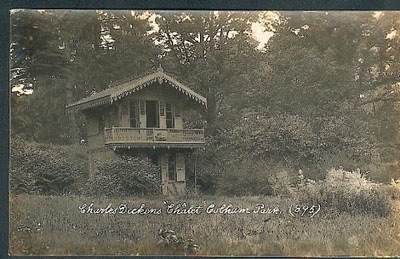
chalet

Dickens’s chalet where he wrote many of his later works on the upper floor

In 1864 his friend, the actor Charles Fechter, gave him a gift of a Swiss chalet, in 94 pieces. Dickens had it assembled across the street and later had constructed a brick-lined tunnel so that he could go back and forth from his house unobserved. His works from then on were written from the upper floor of the chalet.

Note: The chalet was transferred to the now-defunct Dickens Centre at Eastgate House in Rochester, but you can still see the chalet in the garden.

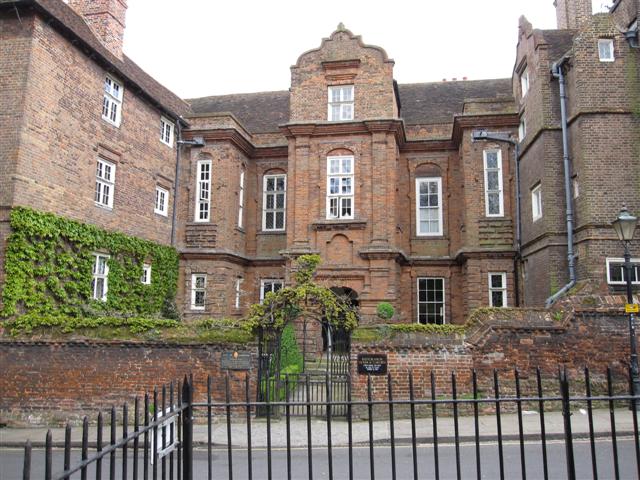
Restoration House in Rochester

There is a passage in Great Expectations referring to this very Restoration House, a place which always took his fancy, and well it might.

restoration-house-satis-house-small

Restoration House, Rochester

“I had stopped,” thus the passage runs, “to look at the house as I passed, and its seared red brick walls, blocked windows, and strong green ivy clasping even the stacks of chimneys with its twigs and tendons, as if with sinewy old arms, made up a rich and attractive mystery.”

This mystery held him to the end. On the occasion of his last visit to Rochester, June 6th, 1870, he was seen leaning on the fence in front of the house, gazing at it, rapt, intent, as if drawing inspiration from its clustering chimneys, its storied walls so rich with memories of the past. It was anticipated, it was hoped, that the next chapter of Edwin Drood would bear the fruits of this reverie. The next chapter was never written.

 Index to all the posts in this series

1: The Bath Road: The (True) Legend of the Berkshire Lady

2: The Bath Road: Littlecote and Wild William Darrell

3: The Bath Road: Lacock Abbey

4: The Bath Road: The Bear Inn at Devizes and the “Pictorial Chronicler of the Regency”

5: The Exeter Road: Flying Machines, Muddy Roads and Well-Mannered Highwaymen

6: The Exeter Road: A Foolish Coachman, a Dreadful Snowstorm and a Romance

7: The Exeter Road in 1823: A Myriad of Changes in Fifty Years

8: The Exeter Road: Basingstoke, Andover and Salisbury and the Events They Witnessed

9: The Exeter Road: The Weyhill Fair, Amesbury Abbey and the Extraordinary Duchess of Queensberry

10: The Exeter Road: Stonehenge, Dorchester and the Sad Story of the Monmouth Uprising

11: The Portsmouth Road: Royal Road or Road of Assassination?

12: The Brighton Road: “The Most Nearly Perfect, and Certainly the Most Fashionable of All”

13: The Dover Road: “Rich crowds of historical figures”

14: The Dover Road: Blackheath and Dartford

15: The Dover Road: Rochester and Charles Dickens

16: The Dover Road: William Clements, Gentleman Coachman

17: The York Road: Hadley Green, Barnet

18: The York Road: Enfield Chase and the Gunpowder Treason Plot

19: The York Road: The Stamford Regent Faces the Peril of a Flood

20: The York Road: The Inns at Stilton

21: The Holyhead Road: The Gunpowder Treason Plot

22: The Holyhead Road: Three Notable Coaching Accidents

23: The Holyhead Road: Old Lal the Legless Man and His Extraordinary Flying Machine

24: The Holyhead Road: The Coachmen “More Celebrated Even Than the Most Celebrated of Their Rivals” (Part I)

25: The Holyhead Road: The Coachmen “More Celebrated Even Than the Most Celebrated of Their Rivals” (Part II)

26: Flying Machines and Waggons and What It Was Like To Travel in Them

27: “A few words on Coaching Inns” and Conclusion

The Dover Road: Blackheath and Dartford

dust jacket

The following post is the fourteenth of a series based on information obtained from a fascinating book Susana recently obtained for research purposes. Coaching Days & Coaching Ways by W. Outram Tristram, first published in 1888, is replete with commentary about travel and roads and social history told in an entertaining manner, along with a great many fabulous illustrations. A great find for anyone seriously interested in English history!

Note: Comment to enter the contest for Susana’s September Giveaway, a lovely necklace from London’s National Gallery (see photo at right).

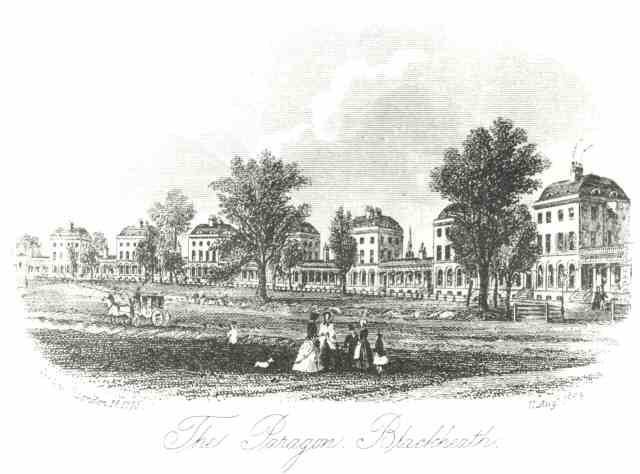
Blackheath: Dark-Colored Heathland

The area of Blackheath is about seven miles from London Bridge. Originally the name of an open space for public meetings of the ancient hundred of Blackheath, this name was also given to the Victorian suburb that was developed later in the 19th century. While this area was certainly used for burial pits for the victims of the Black Death in the 14th century, it was only one of many used for such a purpose in London and was not the source of the name. Blackheath comes from Old English, “dark-colored heathland,” undoubtedly referring to the color of the soil.

Besides a queen devoted to junketings [Queen Caroline, who lived at Montague House], a letter-writing father, bent on directing his son to the deuce [Lord Chesterfield], and a great warrior [Major General James Wolfe, conqueror of Quebec], rebellion has in the good old days…raised its head on this celebrated spot; and it raised its head in the person of Wat Tyler, who was here in 1381 at the head of one hundred thousand other heads (which was wise of him seeing that he had previously cracked a poll-tax collector’s head at Dartford, after drinking too much ale, I suppose, at the celebrated Bull Inn). Another rebel was here, at Blackheath 1497. Lord Audley to wit, who went through the somewhat aimless exercise of bringing troops all the way from Cornwall, pitching their tents, and immediately afterwards suffering defeat at the hands of Henry the Seventh.

Montague House, residence of Queen Caroline

Montague House, residence of Queen Caroline

The Predecessor of Rotten Row?

For this celebrated spot occupied in the annals of England much the same sort of position apparently as Rotten Row occupies in the annals of contemporary fashion. It was the place where kings and ministers met casually on their way to or from London, and babbled of the weather, the price of corn, the latest hanging, the odds on the next bear-fight, the state of the unemployed, or any other kindred subject which might suggest itself to medieval brains, in an open space, where it was not too windy.

blackheath

Henry the Fifth a Spoilsport?

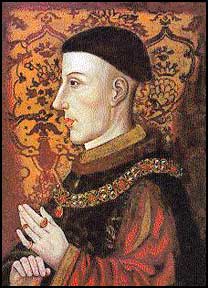
On his return to London, “The Victor of Agincourt” was greeted here by “the mayor and five hundred citizens of London. The mayor and aldermen had prepared an elaborate reception, with wine and scarlet and gold robes and all the trappings. But Henry “nipped all the worthy mayor’s preparations in the bud,” refusing to accept the praise and thanks that should go to God.

A pious decision, but one which must have been extremely unsatisfactory to town councillors who had launched forth in the way of dress and decorations, and to the thousands of Londoners who had flocked out to Blackheath to see the show.

Henry V: not in a proper mood to be fêted

Henry V: not in a proper mood to be fêted

Henry the Eighth: A Guilty Conscience?

It was here on Blackheath that the already muchly married king publicly received his fourth wife, with all due decency and decorum, having already made up his royal mind to put her away privately. For Henry on this occasion did not play fair; and though he pretended to Anne of Cleves herself that it was at this meeting on Blackheath that he had first seen here—in saying so, he said that which was not; for he had already privately inspected her at the Crown Inn at Rochester. It was on this occasion it may be remembered that the bluff Tudor gave way to a regrettable license of speech at first sight of the goods the gods had provided for him, and said many things unfit for publication; which shocked the onlookers, and made Cromwell put his hands to his head to feel if it was still in his shoulders.

Alas, Cromwell, as the advocate for this marriage, paid for his folly with his head. Anne of Cleves, however,

was content to forego the dubious joys of married life for the possession of the several manors in Kent and Sussex that her grateful late lord bestowed upon her. The number of these manors exceeds belief, and at the same time gracefully gauges Henry’s conception of the magnitude of the matrimonial peril past. Indeed, it seems to me that…whenever he had nothing villainous on hand, and was disinclined for tennis, he gave Anne of Cleves a manor or two simply to while away the time.

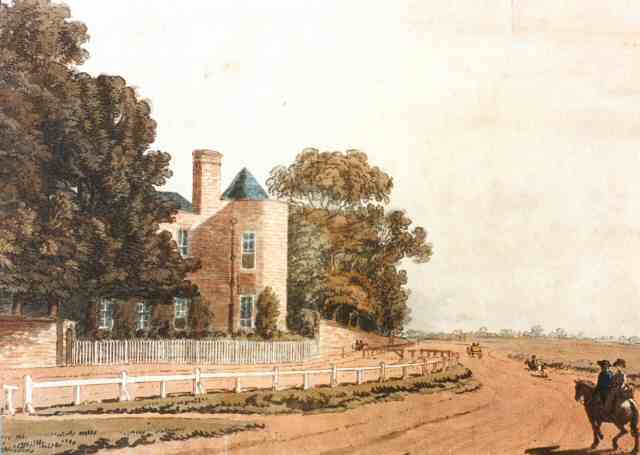
setWidth320-The-Manor-Gatehouse1

The Manor Gatehouse is all that is left of the manor Henry VIII presented to Anne of Cleves as “one of the first manors granted to this little-married but much-dowered lady.”

Charles II’s Triumphant Procession

…it was in 1660 no doubt that the grandest of its historical pageants was to be seen: when the long reaction against Puritanism had suddenly triumphed, and all England went mad on a May morning at the Restoration of her exiled king; when through sixty-one miles as it were of conduits running wine, triumphal arches, gabled streets hung with tapestry—through battalions of citizens in various bands, some arrayed in coats of black velvet with gold chains, some in military suits of cloth of gold or silver—Charles, who had slept at Rochester the night before, rode on to Blackheath between his brothers, the Dukes of York and Gloucester.

Charles II riding into London

Charles II riding into London

Sir Walter Scott, in his novel Woodstock (1826), paints a picture of Charles catching a glimpse of the characters of the novel in the crowd and making a point to dismount, prevent the aged Sir Henry Lee from rising, and ask for his blessing, after which, “his very faithful servant, having seen the desire of his eyes, was gathered to his fathers.”Quite a poignant scene, but could not have happened in real life since Sir Henry had passed away fifty years earlier. Don’t you just love historical fiction?

Charles Dickens: “veritable genius of the road”

His memory burns by the way—as all but the wicked man who has not read Pickwick and David Copperfield will remember—and indeed A Tale of Two Cities. For in the second chapter of that wonderful book the very spirit of the Dover Road in George the Third’s time is caught as if by magic.

A Tale of Two Cities: read Chapter Two here: http://www.online-literature.com/dickens/twocities/2/

Who does not remember these things? Who has not read them again and again? I declare that I think this second chapter of A Tale of Two Cities a picture of the old coaching days more perfect than any that has been painted. Every detail is there in three pages.

tale

George IV Insulted at the Bull Inn

In 1822

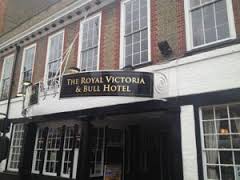
…while the great Fourth George was majestically reposing in his royal post-chaise in front of the old archway he experienced an unpleasant surprise. A very ungentlemanly man named Calligan, a working currier who ought to have known better, suddenly projected his head into the carriage window, and observed in a voice of thunder, “You’re a murderer!” an historical allusion to the king’s late treatment of Queen Caroline, which made the royal widower “sit up”. Upon which a bystander named Morris knocked the personal currier down,and the window of the post-chaise was pulled up, and the post-boy told to drive on as quickly as possible.

The Royal Victoria and Bull Inn (formerly the Bull Inn)

The Royal Victoria and Bull Hotel (formerly the Bull Inn)


 Index to all the posts in this series

1: The Bath Road: The (True) Legend of the Berkshire Lady

2: The Bath Road: Littlecote and Wild William Darrell

3: The Bath Road: Lacock Abbey

4: The Bath Road: The Bear Inn at Devizes and the “Pictorial Chronicler of the Regency”

5: The Exeter Road: Flying Machines, Muddy Roads and Well-Mannered Highwaymen

6: The Exeter Road: A Foolish Coachman, a Dreadful Snowstorm and a Romance

7: The Exeter Road in 1823: A Myriad of Changes in Fifty Years

8: The Exeter Road: Basingstoke, Andover and Salisbury and the Events They Witnessed

9: The Exeter Road: The Weyhill Fair, Amesbury Abbey and the Extraordinary Duchess of Queensberry

10: The Exeter Road: Stonehenge, Dorchester and the Sad Story of the Monmouth Uprising

11: The Portsmouth Road: Royal Road or Road of Assassination?

12: The Brighton Road: “The Most Nearly Perfect, and Certainly the Most Fashionable of All”

13: The Dover Road: “Rich crowds of historical figures”

14: The Dover Road: Blackheath and Dartford

15: The Dover Road: Rochester and Charles Dickens

16: The Dover Road: William Clements, Gentleman Coachman

17: The York Road: Hadley Green, Barnet

18: The York Road: Enfield Chase and the Gunpowder Treason Plot

19: The York Road: The Stamford Regent Faces the Peril of a Flood

20: The York Road: The Inns at Stilton

21: The Holyhead Road: The Gunpowder Treason Plot

22: The Holyhead Road: Three Notable Coaching Accidents

23: The Holyhead Road: Old Lal the Legless Man and His Extraordinary Flying Machine

24: The Holyhead Road: The Coachmen “More Celebrated Even Than the Most Celebrated of Their Rivals” (Part I)

25: The Holyhead Road: The Coachmen “More Celebrated Even Than the Most Celebrated of Their Rivals” (Part II)

26: Flying Machines and Waggons and What It Was Like To Travel in Them

27: “A few words on Coaching Inns” and Conclusion