While I’m a farmer’s daughter, my family were strictly crop farmers; we never had livestock. My maternal grandfather did, though, and both of my parents grew up milking cows. But I learned all I know about cattle breeding from Wikipedia and other online sources.
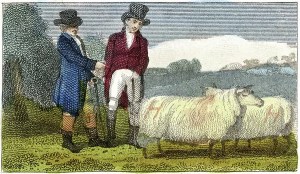
In the mid-18th century, two British agriculturalists, Robert Bakewell and Thomas Coke, introduced selective breeding as a scientific practice and used inbreeding to stabilize certain qualities in order to reduce genetic diversity. Bakewell was also the first to breed cattle to be used primarily for beef. Arguably, his most important breeding program was with sheep.
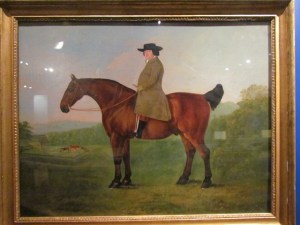
Robert Bakewell
In fact…
There really was a Thomas Paget family who worked with the innovative methods of Robert Bakewell (the elder Thomas in my story was a second cousin of Bakewell) in the Leicester vicinity, and the family really did give up farming for banking. Della’s older brother Thomas (who wasn’t suited for farming in the story) founded the Bank of Paget and Kirby (although I fudged the dates a bit). He became MP for Leicestershire in 1831 and was Mayor of Leicester in 1836-7.
Other than that, the story is entirely my own (LOL). It’s odd how certain things take hold of my imagination and drive me to create a story.
If you haven’t purchased A Christmas Quintet, it’s available here for the pre-order price of $0.99.
Two collections of Revenge of the Wallflowers stories, The Wallflower’s Brazen Revenge, and The Wallflower’s Sassy Revenge. https://books2read.com/u/mqkkLv
Love Will Find You: The Knights of Berwyck, A Quest Through Time (Book 4) on sale for FREE. Sometimes a moment is all we have… Grab the ebook now and enjoy falling back in time! Learn more at https://sherryewing.com/medieval-time…/love-will-find-you/
Susana and her sisters have just discovered that they are going to participate in the Season in York, and they are excitedly planning how to manage wardrobes for the seven older girls when they have scarcely enough money for one. Thankfully, Susana is a quasi-professional dressmaker, and she can help them create a wardrobe that all can share with enough clever disguises.
“You know, Susana, I think there are some gowns and things of Mama’s up in the attic. Perhaps from our stepmothers as well, although I believe Martin removed his mother’s things for Chloe.”
“Well, he can just bring them right back, since our stepsister is to be presented too.” They knew Chloe well; she’d lived with them until her mother’s death, when her brother Martin and their guardian, their mother’s brother, took her in. She visited her half-sisters Emma and Merri occasionally. And Martin, relieved to have Patience take on Chloe’s presentation, had eagerly provided funds to pay for the ball. And her wardrobe, so that was one sister Susana did not have to clothe.
“Let’s take a look.”
It had been years since she had perused her mother’s things. Nine years since her death, when the maids had packed up her possessions and banished them to the attic. And fortunate indeed that they had made their way to Starbrook after the family had been exiled from the main house. No doubt the newest Lady Seahaven would have organized a bonfire for all of her predecessors’ belongings.
Not a nice thought, she chided herself. But it was hard to think well of the usurping Seaheavens, who had inherited and dislodged them from the home they had known all their lives.
Mama, she thought as they opened one of the chests that held her things. You were the same age as Barbara when you left us. How I wish you were still here.
The Lady Seahavens hadn’t moved much in society, as their thoughtless husband saw no need to take them along when he traveled to London, for Parliament, and other things. His ladies had no need of extravagant gowns. But they did socialize with the local gentry, so Doro and Susana did find a few of their mother’s evening gowns. Of course, they were nine years out of fashion, but Susana thought she could make them work with a few alterations. The trims were a bit worse for wear, but there might be a way to revive them.
“Oh, look at this!”
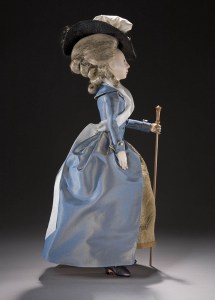
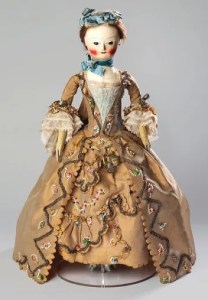
Doro held out a doll, about sixteen inches long, wrapped in delicate tissue paper. The head and body were carved of a single piece of wood; the legs were of wood too but separately attached to the torso. The upper arms were formed of stuffed linen, also attached to the torso, wooden lower arms and hands attached to those.
“I remember this!” cried Susana. “Mama showed it to me once and said it was made to resemble the Duchess of Devonshire. See the hairstyle and the wide bonnet! She has all the undergarments too! And the sash: she’s dressed for the 1784 election campaign. Mama said her grandfather had it made for her. It wasn’t a toy, though. It’s a Pandora. A fashion doll. That’s why she wouldn’t let me play with it.”
“It’s beautiful,” said Doro wistfully. “It shouldn’t be left in old trunk.”
“If we put it out somewhere, we’ll have to be sure Emma and Merri don’t get their hands on it.”
“And Jane,” Doro added absent-mindedly. “Look at the quality of the material—the stockings, the chemise, the petticoats. And there’s a corset too—looks exactly like the real thing!”
Susana ran her finger along the blue silk overdress. “The silk is very fine. I would say French, coming from that era.” She turned to the reverse side and gasped. “It’s English. It’s stamped Macclesfield Silks.”
Macclesfield Silks. Where Blaise had gone to work. With a man called Thomas Pemberton.
“Doro,” she said slowly. “What was our mother’s birth name?”
Doro squeezed her eyes shut. “We never met them, for some reason. Mama never spoke of them. I suppose they disapproved of her marriage, although most people would be over the clouds happy for their daughter to marry an earl.” She grabbed Susana’s arm. “Pemberton! Her name was Maryann Pemberton!”
Susana’s mouth fell open. Could it be true? She and Doro and Barbara related to the Thomas Pemberton of Macclesfield Silks?
“A cup of tea,” she said. “I need a cup of tea.”
Pandora Dolls
Many of you know that I collect fashion prints. I have a ton of them and love them all. But in the time prior to fashion prints, there were fashion dolls. One of them was called a Pandora.
How on earth was a fashionable lady in the 18th century able to keep up with the latest trends? The answer was the Pandora, or miniature dolls dressed up in the latest modes. Keep in mind, this was long before magazines were invented—and the first ones were incredibly rare and expensive, as they were hand-painted by groups of (probably shockingly underpaid) little girls and young women! Clothing was also far more expensive than it is today, so it was important to know all the details of the cut, colour and fabric that you wanted.
In 1712, when Britain and France were at war with each other, Pandora dolls were exempt from the ban on enemy imports, and even received a military escort! Marie-Antoinette, when preparing to go over to France from Austria, got sent a host of these dolls in different fabrics and fashions.
Today, fashion victims use fashion magazines, shows etc. to become informed about fashion news. But what sources did they use in the 18 th century to catch the latest trends when none of these media existed? Long before the first Barbie appeared, there already existed a doll that wore lavish wardrobe and matching accessories but didn’t function as a toy at all. This paper examines how a doll called Pandora was sent abroad by French dressmakers to promote and sell Parisian fashion around the world. First, Pandora had to conquer the royal houses in Europe. Then, she made her way into the department stores and finally into the bourgeois home. Interestingly, her triumphal procession did not stop there: By the middle of the 18th century she had even crossed the Atlantic to be exhibited in Boston and New York….
The doll’s body and head were carved by hand from one piece of wood, which had been turned on a lathe. The legs were made separately and attached at the hips and knees to the Pandora’s body. The lower arms and hands were also crafted of wood; in contrast the upper arms were ‘[…] made of either soft linen fabric or kid leather, attached to the torso’.Most dolls had painted eyes, but some of them had sparkling glass eyes, which was more labour-intensive because for this purpose the doll maker had to carve diamond-shaped holes into the head and then inserted blown glass balls….
Furthermore, the fashion dolls all had either painted hair or wore wigs made of flax or wool. The hair of the dolls was designed to be worn in the popular style of the time because it was absolutely essential that besides wearing the right clothes, the Pandora had the latest hairstyle as well as accessories that matched her wardrobe. Interestingly, although most 18 th century dolls represented women or girls, there also existed male, boy and even infant dolls. Unfortunately, the vast majority of these fashion figures of the late 17 th and early 18 th century have not withstood the test of time. This is due to two reasons: Firstly, the unwieldy size of the dolls and secondly, the material that was used to make them….
An English 18th –century fashion doll in the Fashion Gallery at the V&A. There are 6 fashion dolls in the same room.
Intended as advertisement for the French fashion and the dressmakers, the dolls functioned as mannequins and were dressed in a petite-size version of everything a fashionable woman needed to wear, including the proper foundation garments, which meant that the Pandoras were outfitted head to toe and displayed the latest fashions concerning clothes and hairstyle. ‘By the seventeenth century, when these French figures were known as “Pandora,“the dressing of the head and hair was as important as the garment’. The doll’s outer garment was a dress made of highest quality cloth: linen, cotton, wool brocade or silk, followed by a petticoat or multiple layers of petticoats, which gave the dress or skirt the desired fashionable shape. The hoop petticoat or wicker, also known as panier, was part of the women’s underwear and consisted of a basket. ‘They [the petticoats] could get as wide as 18 feet (5 metres), and satirists talked of hoops of 7 or 8 yards (6 or 7 metres) wide’. The extremely wide framework of the hoop made it difficult for women to walk through the doors, sit down on a chair or in a coach. Some even wore a stomacher, which was in fashion throughout the 17 th and 18 th century in Europe and North America. The stomacher was a v-shaped piece of fabric made either of the same material as the dress or of contrasting materials. It was worn across the chest and stomach and embroidered or decorated with pearls or other gemstones. Other key characteristics of women’s clothing that were also part of the fashion dolls’ outfit were corsets and linen shifts. Knitted stockings, shoes, a muslin cap and jewellery often completed the outfit.
Another question is: who were the potential buyers of the fashion dolls? First, the dressmakers and tailors purchased the fashion doll. Above all the Pandoras functioned as display and show items. Since fashion was extremely expensive, the rich costumers wanted to have a look at what they were going to spend their money on….
The French doll makers received orders from all over the world, since almost every British women of that time wanted to have their one little mannequin to keep abreast with the latest Parisian fashion trends. In the Augustan Age it was very common not only to adopt the French customs, etiquette, lifestyle and manners but also the clothing fashions. It is remarkable how widely the dolls were distributed geographically in the 18 th century. They were not only dispatched throughout Europe but were also shipped across the Atlantic. Travelling around the world in the name of fashion, the Pandoras took over two functions: on the one hand, they were the ideal advertising vehicle for French fashion; on the other hand, they served as a kind of diplomatic representation of France. The fashion doll became one of the most important and popular French export goods.
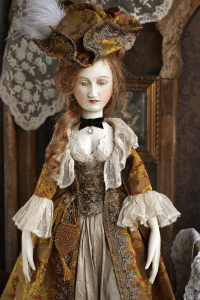
And then I discovered that newly-created French court fashion dolls can be purchased on Etsy. You might have to sell your family heirlooms to buy them, but one can dream!
The annexed print is a view of the great hall, which is conceived with a classic elegance, that does honour to the genius of the late Mr. Holland, who was the architect of Carlton House. The size of the hall is forty-four feet in length and twenty-nine in breadth. The entrance to the hall from the vestibule is by a flight of steps, which gives it an air of uncommon grandeur; it is supported by eight fine columns of the Ionic order, with architrave, frieze, and cornice. The ceiling is coved, and ornamented with plain caissons, and lighted by a skylight of an oval form. The columns are finely executed in scaglioni, of a yellow porphyry; the capitals and bases are bronzed, as are all the ornaments in the hall. In four corresponding niches are casts from the antique, of two Muses, the Antinous and the Discobulus; on the cornice are placed busts, urns, and griffins; over the niches are basso-relievos, which are also bronzed. At each . end of the hall is a stove of a new and elegant construction; six Termini of fine workmanship support a dome or canopy: the whole is executed in cast-iron bronzed. Over each fire-place is an allegorical painting in imitation of bronze basso-relievo, and compartments over the doors in the same manner: the tout-ensemble is striking and impressive. There is in this hall a symmetry and proportion, a happy adjustment of the parts to produce a whole, that are rarely seen; it is considered as the chef d’ oeuvre of Mr. Holland, and would do honour to any architect of any age or country.
Of the print it may be proper to say, that it is drawn with great accuracy and feeling, the perspective is easy and natural, and the general effect broad and simple. The figures are few, but introduced with great taste: it must be obvious, that a greater number would have impaired the general effect of the architectural design.
The new circular dining-room, when completed, will unquestionably be one of the most splendid apartments in Europe: the walls are entirely covered with silver, on which are painted Etruscan ornaments in relief, with vine-leaves, trellis-work, &c. There are eight fine Ionic columns in scaglioni, of red granite; the capitals and bases are silver, as are also the enrichments, moulding. See. of the architrave, frieze, and cornice: the latter is surmounted by an ornament that is somewhat Turkish in its character, and which, if it does not belong to the Ionic order, nevertheless adds to the splendour of the room. There are four immense pier glasses, and under each of them a fine marble chimney-piece of exquisite workmanship. As this sumptuous apartment is not yet completed, it would be improper to attempt a perfect description of it; indeed, almost the whole of Carlton House is undergoing alterations and improvements. On the south side of this apartment a door opens into the ballroom, a most magnificent and princely apartment: the walls are painted white, but the room is nearly covered with a profusion of gilding; the pilasters, architrave, frieze, and cornice are all covered with gold; the ceiling represents a pleasing sky, in which are genii sporting on the clouds; and in the compartments between the pilasters are some Etruscan ornaments, painted with great lightness and delicacy. On the opposite side another door opens into a new room, intended for a drawing-room, and though at present in a very unfinished state, it strikes the eye with the uncommon symmetry and harmony of its proportions.
Amid the curiosity and interest raised by a view of Carlton House, nothing can exceed that which is excited by an examination of
The Armory
This valuable and unique collection is a museum, not of arms only, but of various works of art, dresses, &c.: it is arranged with great order, skill, and taste, under the immediate inspection of His Royal Highness. It occupies five rooms on the attic story; the swords, firearms, &c. are disposed in various figures upon scarlet cloth, and inclosed in glass cases: the whole is kept in a state of the most perfect brightness. Here are swords of every country, many of which are curious and valuable, from having belonged to eminent men: of these the most remarkable is a sword of the famous Chevalier Boyard, the knight sans pear et sans reproche. The noble reply of this illustrious dying soldier, made to the Constable of Bourbon, deserves to be remembered. In the war between the Emperor Charles V. and Francis I. of France, the constable had gone over to the emperor, disgusted at the persecutions he met with in France, from the rage of Louisa of Savoy, the queen mother, whose overtures of marriage he had rejected. The emperor made the constable generalissimo of his armies; and in a battle which was fought in the duchy of Milan, and in which the French were obliged to retreat, the Chevalier Boyard was mortally wounded. Charles of Bourbon seeing him in this state, told him how greatly he lamented his fate. “It is not me” said the dying chevalier, “it is not me you should lament, but yourself, who are fighting against your king and country.” A sword of the great Duke of Marlborough, one of Louis XIV. and one of Charles II.: the two last are merely dress swords. A curious silver-basket-hilted broad sword of the Pretender’s, embossed with figures and foliage. But the finest sword in this collection is one of excellent workmanship, which once belonged to the celebrated patriot Hampden; it was executed by Benvenuto Cellini, a celebrated Florentine, who was much employed by Francis I. and Pope Clement VII.
Peter Torrigiano, who executed the monument of Henry VII. in Westminster abbey, endeavoured to bring over Cellini to England, to assist him; but Cellini disliking the violence of his temper, who used to boast that he had given the divine Michael Angelo a blow in the face with his fist, the marks of which he would carry to the grave*, refused to come with him. Vasari, who was contemporary with Cellini, speaks of him in the highest terms. He was originally a goldsmith and jeweller, and executed small figures in alto and basso-relievo with a delicacy of taste and liveliness of imagination not to be excelled: various coins of high estimation were executed by him for the Duke of Florence; and in the latter part of his life, he performed several large works in bronze and in marble with equal reputation. He wrote his own memoirs, which contain much curious and interesting information relative to the contemporary history of the arts.
The ornaments on the hilt and ferrule of the scabbard of this curious sword are in basso-relievo in bronze, and are intended to illustrate the life of David: it is a most beautiful piece of work, and in the highest preservation; it is kept with the greatest care in a case lined with satin.
In the armory is a youthful portrait of Charles XII. of Sweden, and beneath it is a couteau de chasse used by that monarch, of very rude and simple workmanship. A sword of General Moreau’s, and one of Marshal Luckner’s: but it would be impossible in our limits to notice a hundredth part of what is interesting in this collection.
In another room are various specimens of plate armour, helmets, and weapons; some Indian armour of very curious workmanship, composed of steel ringlets, similar to the hauberk worn by the Knights Templars, but not so heavy, and the helmets are of a different construction. Here are also some cuirasses, as worn at present in Germany; a very curious collection of firearms, of various countries, from the match-lock to the modern improvements in the firelock; air-guns, pistols, &c. In this room are also some curious saddles, Mamaluke, Turkish, &c.; some of the Turkish saddles are richly ornamented with pure gold.
Another room contains some Asiatic chain armour, and an effigy of Tippoo Sultaun on horseback, in a dress that he wore. Here are also a model of a cannon and a mortar on new principles; some delicate and curious Chinese works of art in ivory, many rich eastern dresses, and a palanquin of very costly materials.
In another apartment are some curious old English weapons, battle-axes,maces, daggers, arrows, &c.; several specimens also, from the Sandwich and other South Sea Islands, of weapons, stone hatchets, &c.
Our young men of fashion who wish to indulge a taste for antiquarian researches, may project the revival of an old pattern for that appendage of the leg called boots, from the series of them worn in various ages, which form a singular part of this collection.
In presses are kept an immense collection of rich dresses, of all countries; and indeed so extensive and multifarious are the objects, that to be justly appreciated it must be seen. His Royal Highness bestows considerable attention on this museum, and it has in consequence arrived in a few years to a pitch of unrivalled perfection. Among the dresses are sets of uniforms, from a general to a private, of all countries who have adopted uniforms, and military dresses of those who have not. All sorts of banners, colours, horse-tails, &c.; Roman swords, daggers, stilettoes, sabres, the great two-handed swords, and amongst the rest, one with which executions are performed in Germany, on the blade of which is rudely etched, on one side a figure of Justice, and on the other the mode of the execution, which is thus: — the culprit sits upon a chair, and the executioner comes behind him, and at one blow severs the head from the body. There are also some curious portraits in these apartments; besides the one of Charles XII. there is one of Frederic the Great, and various other princes and great men renowned for their talents in the art of war.
Of the exterior of Carlton House it may be sufficient to observe, that it is situated on the north side of St. James’s Park, and that the principal front faces Pall-Mall*. The portico is a most splendid and magnificent work, of the Corinthian order, enriched with every embellishment that elegant order is capable of receiving. It has been objected, that the other parts of this front are too plain to correspond with so rich a portico: the front is rustic, and therefore does not admit of ornament; but the eye is hurt by the violence of the transition from the most luxuriant decoration to the most rigid plainness. Carlton House, with its court-yard, is separated from Pall-Mall by a dwarf screen, which is surmounted by a very beautiful colonnade. A riding-house and stables, belonging to His Royal Highness, are at the back, immediately contiguous to St. James’s Park. The garden is laid out with the utmost taste and skill of which its limits are capable.
On the 8th of February, 1790, His Royal Highness the Prince of Wales had a state levee, for the first time, at his palace of Carlton House, which was the most numerous of any thing of the kind for many years; and, except the want of female nobility, was more numerous and splendid than the generality of the drawing-rooms even at St. James’s.
Carlton House was a palace belonging to the crown, and presented by His Majesty to His Royal Highness the Prince of Wales, on his coming of age, for his public town residence. The old building being out of repair, it was judged proper by Parliament to enable His Majesty to erect the present noble edifice in its room; and Mr. Holland had the honour of being appointed the architect. There is only one thing wanting in this palace, and which, from the present state of the arts, and still more the liberal manner in which they are at present patronized, we hope it is in His Royal Highness’s contemplation to supply. It is a collection of pictures by living artists; these, selected with His Royal Highness’s well known delicacy of taste and judgment, would complete the decorations of this truly magnificent and princely palace.
* This event happened in the palace of Cardinal di Medici: — Torrigiano being jealous of the superior honours paid to Michael Angelo, brutally struck him in the face; his nose was flattened by the blow: the aggressor fled, and entered into the army, but being soon disgusted with that life, left it and came over to England.
* Pall-Mall was formerly laid out as a walk, or place for the exercise of the mall, a game long since disused; its northern side being bounded by a row of trees, and that to the south by the old wall of St. James’s Park.
Is in the parish of Lambeth, in Surry, and was instituted in the year 1758, for the reception of friendless and deserted girls, the settlement of whose parents cannot be found. It was incorporated in the year 1800.
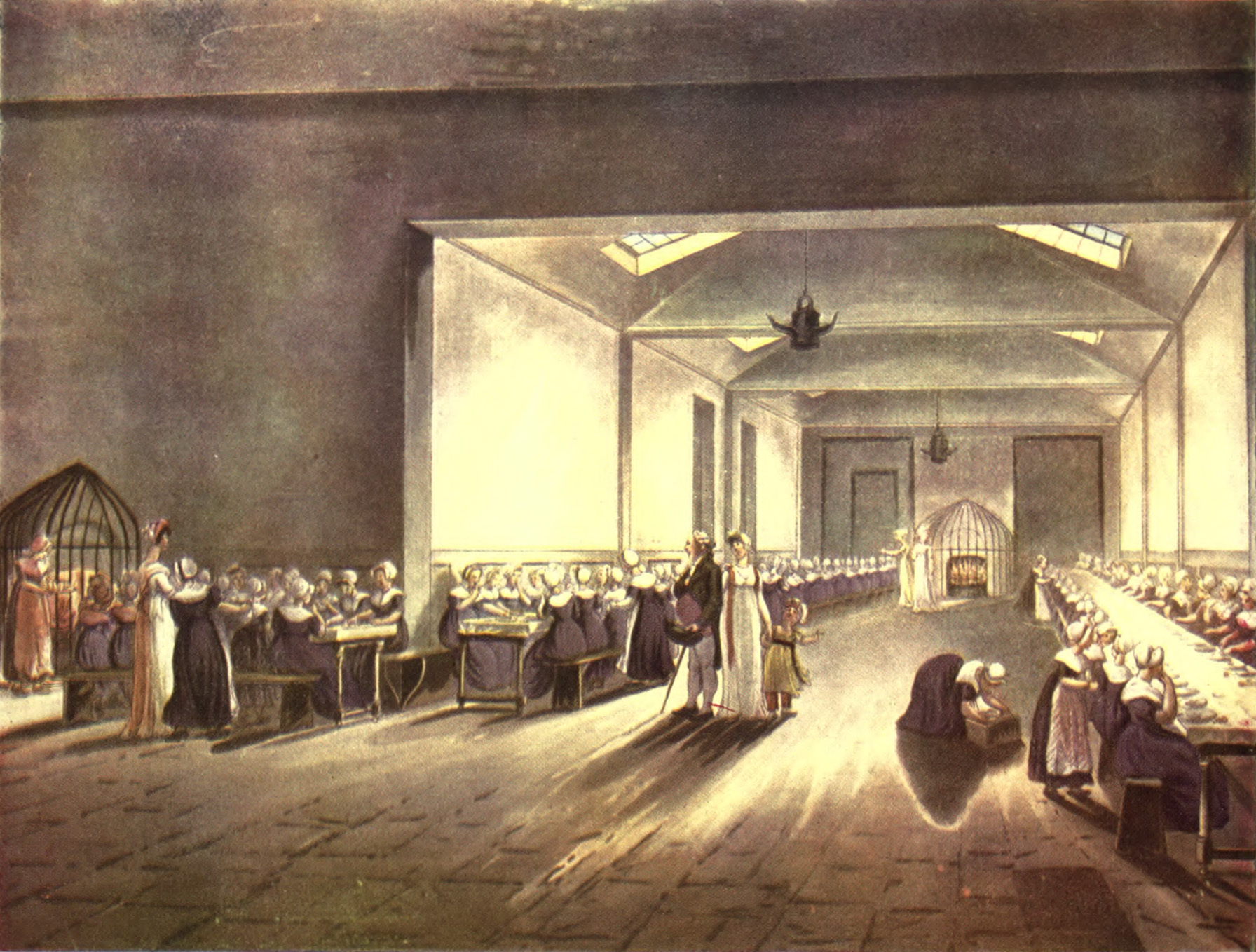
The annexed print is an interesting representation of the objects of this benevolent institution at their repast, in the presence of some of their guardians, who seem to contemplate the good order, cheerfulness, innocence, and comforts of their little wards, with all that interest and delight, that luxury of fine feeling, which irradiates the countenance when the heart is glowing with benevolence, animated with the exercise of an important duty, and gratified by the conviction that their virtuous endeavours are crowned with success. The coup d’ceil of the print is most impressive, and does great honour to’ the talents and feelings of the artists. The sweet innocence of the children, the benevolence of the guardians, and the chaste and matron-like simplicity of the building, aided by a fine breadth of effect, form a whole, which at the same time that the parts are in perfect harmony with each other, is admirably calculated to awaken the tender emotions of the humane heart, and excite the spectator to the exertion of those tender and kindly feelings, which do honour to our nature.
This charity owes its establishment to that vigilant and active magistrate. Sir John Fielding; who had long observed, that though the laws of this kingdom provided a parish settlement for every person, by birth, parentage, apprenticeships, &Y. yet many cases continually occurred, in which such settlements were difficult, if not impossible, to be ascertained; and therefore he and others were solicitous to remove, in part, this source of female wretchedness. By their exertions, and the continued endeavours of those who have hitherto conducted the plan, their benevolent intentions have been rewarded with the most signal success. The generous and discerning public has bestowed the means, which have prospered in the hands of the guardians, by whose care two hundred deserted females are daily sheltered and protected from vice and want, supplied with food and raiment, and taught whatever can render them useful in their situation, or comfortable and happy in themselves.
Carefully instructed in the principles of religion; in reading, writing, needlework, and household business, they are trained to habits of industry and regularity, by which means there is a supply of diligent and sober domestics for the use of that public, which, by its contributions, has so nobly acquired a right to their services.
The particular objects of this charity are, the children of soldiers, sailors, and other indigent persons, bereft of their parents, at a distance from any of their relations; who being too young to afford the necessary information respecting settlements, are often left destitute of protection and support, at an age when they are incapable of earning a subsistence, and contending with surrounding dangers.
Females of this description are, in a particular manner, the objects of compassion, and have also a double claim to the care of the humane and virtuous, from being not only exposed to the miseries of want and idleness, but, as they grow up, to the solicitations of the vicious, and the consequent misery of early seduction.
The following are some of the regulations for the government of this charity, which have been made by the guardians from time to time, and now continue in force.
Qualifications of Guardians.
The qualification of an annual guardian is, a yearly subscription of three guineas or upwards.
The qualification of a perpetual guardian is, a subscription of thirty guineas or upwards.
Legacies bequeathed to the use of this charity of one hundred pounds or upwards, when paid, shall entitle the first-named acting executor to be a perpetual guardian.
The guardians, conceiving it to be very essential for promoting one of the chief objects of this institution, earnestly solicit the ladies, who are particularly qualified for that purpose, frequently to visit the charity, inspect the management of the house, and particularly the employment of the children; also to see that they are properly instructed in housewifery, so as to be qualified for useful domestic servants; and from time to time communicate to the committee, by letter or otherwise, such observations as they shall deem proper to make.
Employment of the Children.
The children are to make and mend their own linen; make shirts, shifts, and table-linen; to do all kinds of plain needle-work, and to perform the business of the house and kitchen; to which latter twelve are appointed weekly, according to their age and abilities, to assist the cook, to wash, iron, and get up all the linen. They are likewise taught to read the Bible, write a legible hand, and understand the first four rules in arithmetic.
All kinds of plain needle-work are taken in at the Asylum, and performed
by the children at certain rates, which are regulated by the committee.
The following ore the Rules for placing out the Children.
They are to be bound apprentices for seven years, at the age of fifteen, or sooner, as domestic servants to reputable families in Great Britain.
No girl shall be apprenticed until the character of the master or mistress applying for the same, shall have been enquired into, and approved of by the committee.
Every person applying for an apprentice must appear at the committee, to give the necessary information respecting their situation, unless such appearance be dispensed with by the committee.
When any girl shall become qualified to be an apprentice, the guardian who presented her shall be acquainted therewith, in order to know if such guardian has any place in view for her.
The guardians, desirous of encouraging the children to serve their apprenticeship faithfully, have empowered the committee to grant any orphan apprenticed from the charity, who shall produce to the committee a certificate, signed by her master or mistress (or both if living), of her good behaviour during her apprenticeship, the sum of five guineas, such orphan having first returned public thanks in the chapel for the protection she has received. The committee are empowered to put out at any time, to any trade they shall think proper, such orphans as may have contracted any disease or infirmity, which may render them incapable of domestic service, with a premium not exceeding ten pounds.
The Establishment is as follows:
Patroness of the Institution.
Her Most Gracious Majesty the Queen of Great Britain
President.
His Royal Highness Prince Adolphus Frederick, Duke of Cambridge.
Vice-Presidents.
The Marquis of Blandford.
Right Honourable Earl Spencer, K. G.
Right Honourable Earl Mansfield.
Right Honourable Admiral Lord Radstock.
Right Honourable Lord Chief Baron.
Sir William Leighton, Knight and Alderman.
A chaplain, a morning preacher, an evening preacher, two physicians, two surgeons, an apothecary, a secretary, messenger, and collector. There are also a treasurer, and a committee consisting of nineteen gentlemen, that are elected annually at the general court held every April. Concerning these for each year, and many other things relative to this praise-worthy institution, every necessary particular may be found in a small abstract account to be had at the Asylum; from which we extracted the following regulations respecting devises or bequests to the charity, as we have much besides in the preceding pages.
Well-disposed persons, who may be inclined to make devises of rent, or bequests of personal property, for the benefit of this charity, being authorised so to do by the act of Parliament whereby it is incorporated, will be pleased to make such devises and bequests to this corporation by the style and title of The President, Vice-presidents, Treasurer, and Guardians of the Asylum for the Reception of Orphan Girls, the Settlement of whose Parents cannot be found.
Bankers and Receivers .
Messrs. Hankey and Co. Fenchurch-street.
Messrs. Drummond, Charing-Cross.
Messrs. Hoares, Fleet-street.
Messrs. Croft and Co. Lombard-street.
Messrs. Vere, Lucadon, and Co. Lombard-street.
Messrs. Sikes, Snaith, and Co. Mansion-house-street.
The committee, who meet at the Asylum every Thursday, at eleven o’clock in the forenoon.
Charles Wright, Esq. treasurer, and The Rev. Mr. Agutter, at the Asylum, chaplain and secretary.
We shall close the account of this benevolent institution with the animated apostrophe of the amiable Pennant.
“It is an institution of a most heavenly nature, calculated to save from perdition of soul and body the brighter part of the creation; those on whom Providence hath bestowed angelic faces and elegant forms, designed as blessings to mankind, but too often debased. The hazards that these innocents are constantly liable to from a thousand temptations, from poverty, from death of parents, from the diabolical procuress, and sometimes from the stupendous wickedness of parents themselves, who have been known to sell their beauteous girls for the purpose of prostitution, induced a worthy hand, in the year 1758, to found the Asylum, or House of Refuge. Long may it flourish, and eternal be the reward of those into whose mind so noble a design entered!”
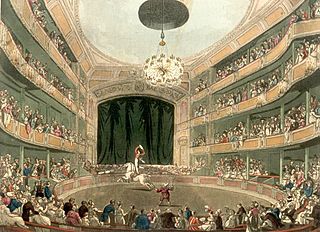
The Amphitheatre at Westminster bridge has, within these twelve years, been twice destroyed by fire; and the expence of rebuilding, & c. &c. to Messrs. Astleys, the two proprietors, has been estimated as amounting to nearly thirty thousand pounds. The present theatre is the most airy, and in some respects the most beautiful, of any in this great metropolis. The building is one hundred and forty feet long; the width of that part allotted to the audience, from wall to wall, sixty-five feet; and the stage is one hundred and thirty feet wide, being the largest stage in England, and extremely well adapted to the purpose for which it was built, the introduction of grand spectacles and pantomimes, wherein numerous troops of horses are seen in what has every appearance of real warfare, gallopping to and fro, &c. &c. The whole theatre is nearly the form of an egg; two thirds of the widest end forms the audience part and equestrian circle, and the smaller third is occupied by the orchestra and the stage. From this judicious arrangement, the whole audience have an uninterrupted prospect of the amusements. It is lighted by a magnificent glass chandelier, suspended from the center, and containing fifty patent lamps, and sixteen smaller chandeliers, with six wax-lights each. The scenery, machinery, decorations, &c. have been executed by the first artists in this country, under the immediate direction of Mr. Astley, jun. who made the fanciful design.
A very good idea of its general appearance, company, &c. is given in the annexed print.
For a looker-on to describe some part of the amusements would be difficult, perhaps impossible; and luckily it is not necessary, for in an advertisement published November 1807, Mr. Astley himself has described one of them in a manner so singularly curious, that we think it ought to be transmitted to posterity; and have therefore inserted it in this volume.
“TO THE EDITOR OF THE MORNING CHRONICLE.
“Sir,
“Having been strongly requested to give some explanation of the utility of the country dances by eight horses, to be performed this and tomorrow evening, I request you will be so obliging as to insert the following hints.
“First, I humbly think that a thorough command and pliability on horseback, is obtained by such noble exercises. Secondly, that in executing the various figures in this dance, the rider obtains a knowledge of the bridle hand, also capacity and capability of the horse, more particularly at the precise time of casting off and turning of partners, right and left, &c. &c. Thirdly, I also conceive that the horseman may be greatly improved when in the act of reducing the horse to obedience on scientific principles! ! ! and not otherwise. Fourth, as a knowledge of the appui in horsemanship is highly desirable, whether on the road, the chase, or field of honour, I expressly composed the various figures in the country dance for this desirable purpose; and which my young equestrian artists have much profited by, as some of them three months since were never on horseback. It was from this observation, during forty-two years practice, that I gave this equestrian ballet the name of L’Ecole de Mars; and I am strongly thankful that my humble abilities have afforded some little information, as well as amusement, to the town in general.
“I am, with respect,
“The public’s most humble and faithful servant,
“Philip Astley.”
Pavilion, Newcastle-street, Strand .”
From all this, a spectator would be almost tempted to think, that, notwithstanding the numerous and learned dissertations of philosophers to exalt their own species, horses rival man in his superior faculties. I have heard a story on this subject, which I believe has not found its way into Joe Miller; but be that as it may, it is a good story, and in a degree illustrates this subject, and I think my reader will not be displeased at the insertion of it.
Some years ago, a very learned and sagacious doctor of the university of Oxford, composed and read a long lecture on the difference of man from beast; and when describing the former, asserted that man was superior to all other animals; because there was no other animal, except man, who either reasoned or drew an inference, as the inferior order of beings were wholly governed by instinct.
On the conclusion of this philosophical discourse, two of the students, who were not quite satisfied of the fact, walked out to converse upon it, and seeing a house with “Wiseman, drawing master,” inscribed upon the sign, went into the shop, and asked the master what he drew? “Men, women, trees, buildings, or any thing else,” was the reply. “Can you draw an inference?” said one of them. The man took a short time to consider it, and candidly replied, that never having seen or heard of such a thing before, he could not. The students walked out of his house, and before they had proceeded far, saw a brewer’s dray with a very fine horse in it.“ A fine horse this,” said one of them to the driver. “A very fine one indeed,” said the fellow.“ Seems a powerful beast,” said the other, “I believe he is indeed,” replied the fellow. “ He can draw a great load, I suppose?” said the Oxonian. “ More than any horse in this county,” answered the drayman. “Do you think he could draw an inference?” said the scholar. “He can draw any thing in reason, I’ll be sworn,” replied the drayman.
The scholars walked back to the lecture room, and found the company still together; when one of them, addressing the doctor with a very grave face, said to him, “Master, we have been enquiring, and find that your definition is naught; for we have found a man, and a wise man too, who cannot draw an inference, and we have met with a horse that can”
Besides the Amphitheatre, Messrs. Astleys have a very elegant Pavilion, for exhibiting amusements of a similar description, which they have lately erected, and fitted out in a most complete style, in Newcastle street in the Strand, and named Astley’s Pavilion.
At this place the horses have displayed some feats of so wonderful a description, as could not easily be conceived unless they were seen. In this place eight horses have lately performed country dances, &c. in a manner that has astonished all the spectators. To this have been added divers horsemanships, the twelve wonderful voltigers, &c.
The annexed print, which is-
A VIEW OF THE AMPHITHEATRE AT WESTMINSTER BRIDGE,
gives a very good idea of the scene. Mr. Rowlandson’s figures are here, as indeed they invariably are, exact delineations of the sort of company who frequent public spectacles of this description; they are eminently characteristic, and descriptive of the eager attention with which this sort of spectators contemplate the business going forward. Small as the figures are, we can in a degree pronounce upon their rank in life, from the general air and manner with which they are marked.
Mr. Pugin is entitled to equal praise, from the taste which he has displayed in the perspective and general effect of the whole, which renders it altogether an extremely pleasing and interesting little print.
With respect to teaching horses to perform country dances, how far thus accomplishing this animal, renders him either a more happy or a more valuable member of the horse community, is a question which I leave to be discussed by those sapient philosophers, who have so learnedly and so long debated this important business, with respect to man.
The school of Jean Jaques Rousseau, who insist upon it, that man, by his civilization, has been so far from adding to his happiness, that he has increased and multiplied his miseries* will of course insist upon it, that a horse in his natural state must be infinitely happier, than he can be with any improvements introduced by man; that all these artificial refinements must tend to diminish, instead of increasing his felicity; and that, as a horse, he had much better be left in a state of nature, than thus tortured into artificial refinement.
The advocates for Swift’s system of the Houyhnhnms, in Gulliver’s Travels, admitting a horse to be superior to a man, even in his natural state, will unquestionably be of the same opinion ; and we must seek farther for the advantages to be derived by introducing a teacher of dancing, and a master of the ceremonies, to this noble and dignified animal.
It is recorded, that at a much earlier period, a right worshipful mayor of Coventry wished to teach his horse good manners. Queen Elizabeth, in one of her progresses to that city, was met, about a mile before she arrived there, by the mayor and aldermen, who desirous of declaring the high honour which they felt she would thus confer on their city, employed the mayor to be their speaker. The mayor was on horseback, and (as the record saith) the queen was also on horseback, behind one of her courtiers. A little rivulet happening to run across the road where they stopped, the mayor’s horse made several attempts to drink; which the queen observing, told his worship, that before he began his oration, she wished he would let his horse take his draught. “That, an please your majesty, he shall not,” replied the mayor, “that he certainly shall not yet. I would have him to know, that it is proper your majesty’s horse should drink first, — and then, he shall.”
The Admiralty is a brick building, containing the office and apartments for the lords commissioners of the Admiralty, who superintend the marine department, and is contiguous to the Horse Guards on the north. With respect to the architecture, the principal front facing Parliament-street displays a proof that the noble lord and board who presided at the time it was built, had objects of more consequence than symmetry and proportion to attend to: it was designed and erected by Shipley. The screen in the front (which was designed and erected by Adams) is so peculiarly elegant, that it in a degree redeems the other part from disgrace. On the top of the Admiralty are erected two telegraphs, the inside of which may be seen by proper application to the porter, or person who works the machine.
The lord high admiral is classed as the ninth and last great officer of the crown; and the honour it conferred, and trust it vested, were formerly considered to be so great, that the post was usually given either to some of the king’s younger sons, near kinsmen, or one of the chief of the nobility. To the lord high admiral belongeth the cognizance of contracts, pleas, or quarrels made upon the sea, or any part thereof which is not within any county of the realm; for his jurisdiction is wholly confined to the sea. The court is provided for the trial and punishment of all offences committed on the high seas, and is a civil court. Courts-martial in the Admiralty have a judge advocate appointed to assist them. The present judge of the Admiralty is the Right Honourable Sir William Scott, Knight, LL. D. the salary 2500/. The present king’s advocate general is Sir John Nicholl, Knight, LL. D.
In King Henry III.’s days, and in the reigns of Edward I. II. and III. Richard II. Henry IV. V. and VI. there were several admirals; for the cautious wisdom of those days would not trust a subject with so great a charge, nor permit any one man to have a certain estate in a post of so great importance. But, nevertheless, in those days there was a great admiral of England.
King Henry VL in the fourteenth year of his reign, constituted John Holland Duke of Exeter, and Henry Holland his son, admirals of England, Ireland, and Aquitaine for life.
The power of this great officer is described in a statute of Charles II.: it is enacted that he may grant commissions to inferior vice-admirals, or commanders in chief of any squadron of ships, to call and assemble courts-martial, consisting of commanders and captains; and no court-martial, where the pains of death are inflicted, shall consist of less than five captains at least; the admiral’s lieutenant to be as to this purpose esteemed as a captain: and in no case when sentence of death shall pass, by virtue of the articles (for regulating and better governing his majesty’s navies, ships of war, and forces at sea,) aforesaid, or any of them (except in case of mutiny), there shall be execution of such sentence of death, without leave of the lord high admiral, if the offence be committed within the narrow seas. But in case any of the offences aforesaid be committed in any voyage beyond the narrow seas, whereupon sentence of death shall be given in pursuance of the aforesaid articles, or any of them, then execution shall be done by order of the commander in chief of that fleet or squadron wherein sentence was passed.
He hath also power to appoint coroners to view dead bodies found on the seacoast or at sea; commissioners or judges for exercising justice in the High Court, of Admiralty; to imprison and to release, &c.
Moreover to him belong, by law and custom, all fines and forfeitures of all transgressors at sea, on the seashore, in ports, and from the first bridge on rivers towards the sea; also the goods of pirates and felons, condemned or outlawed; and all waifs, stray goods, wrecks of sea deodands; a share of all lawful prizes, lagon, jetson, flotson; that is, goods lying in the sea, goods cast by the sea on the shore, not granted formerly, or belonging to lords of manors adjoining to the sea; all great fishes, as sea-hogs, and other fishes of extraordinary bigness, called royal fishes, whales only and sturgeons excepted.
“De sturgeoni observatur quod rex ilua intergram: de balneo vero sufficit si rex habeat caput et reginse candum.” Master William Prynne, who is one of the commentators upon the above curious law, says, that the reason must be, that “our wise and learned lawgivers willed the queen to have the tail of the whale, that her majesty might have whalebone to make her stays forgetting that this was made law upwards of two hundred years before stays were ever worn or thought of. Note farther, that the bone used for stays, is taken out of the head, and not the tail of the fish.
On this ancient law being once mentioned to the late Dr. Buchan, author of Domestic Medicine, ike. &c. he repeated the following little impromptu, which I think has never before been printed:
“If a sturgeon should chance to be cast upon land,
“Honest George, Heaven bless him! the whole may command;
“But if equal misfortune befal a poor whale,
“Let the king have the head, and the queen the tail.”
It is not the object of this volume to say much concerning the great power and interest which the king of England hath in the British seas; and as to the antiquity of the Admiralty Court, and of the name of Admiral, it may be found in a record mentioned by the Lord Chief Justice Coke (Coke’s Institute, p. 142, entitled “De Superioritate Maris Angliae, et Jure Officii Admiralitatis in eodem), said to be among the archives in the Tower of London.
He is called admiral from amir, an Arabic word signifying prefect us, and in Greek marimis. His patent formerly run thus: “Anglise, Hiberniee, et Aquitaiise magnus admirallus, et praTectus generalis clargis et marium dictorum regnorum.”
The various distinguished actions which have been recorded of many of our admirals, and establish the honour and superiority of the British navy, would fill volumes. To enumerate them would occupy more space than can be here allotted to it, and does not come into the plan of this work; but to close the recital of any thing tending to the establishment of our naval character, without inserting the name of the late Lord Nelson, -would be a very improper omission.
Painters have exhausted their art in pictured representations of his actions; sculptors have hewn marble monuments to eternize his heroic professional abilities, which have been placed in the most conspicuous situations in different public buildings throughout the kingdom; and poets have invoked the muse, and exerted their utmost efforts to perpetuate his fame, in praises that, used to any other individual, might have been deemed extravagant panegyric: but the whole nation appear to have been so gratefully alive to his exalted merit, and so highly to revere his memory, that it is hardly deemed equal to what his conduct peremptorily claimed from his surviving countrymen. The Right Honourable Horatio Viscount Nelson, and Duke of Bronte, was a most active, brave, and able officer. He defeated the French fleet in Aboukir Bay, August 1, 1798, and took eight sail of the line; for which he was raised to the peerage. He was second in command at the battle of Copenhagen, where he displayed great courage and conduct; for which he was raised to the dignity of viscount. He completely defeated the combined fleet of France and Spain, off Cape Trafalgar, October 21, 1805, in which he lost his life.
In the advices some of our admirals have transmitted to the Board of Admiralty and others, there is a brevity, which Shakespeare says is the soul of wit; there is, however, a brevity, which is so admirable a model of epistolary writing, that I cannot resist transcribing one or two of them; premising, that as they are taken from memory, they may not do justice to the originals.
The first is from Sir George Rodney to the Governor of Barbadoes, and is as follows:
“Dear General,
“The battle is fought, — the day is ours, — the English flag is victorious; — we have taken the French admiral, with nine other ships, and sunk one. “G. B. R.”
The second letter was, I think, transmitted to the Admiralty.
“We have met the French fleet, and taken, sunk, or destroyed, as per margin.”
The last I shall subjoin is from a foreigner, but seems mixed up with a large portion of British spirit . It was written to Admiral Benbow, who died in October 1702, at Jamaica, of the wounds he received in an engagement with M. du Casse, in the West Indies, off the high land of St. Martha, in the same year.
Soon after Admiral Benbow’s return to Jamaica, he received a letter from M. du Casse, of which the following is a translation:
“Carthagena, August 1702.
“Sir,
“I had little hopes on Monday last but to have supped in your cabin; yet it pleased God to order otherwise: I am thankful for it. As for those cowardly captains who deserted you, hang them up; for, by G — d, they deserve it.
“Du Casse.”
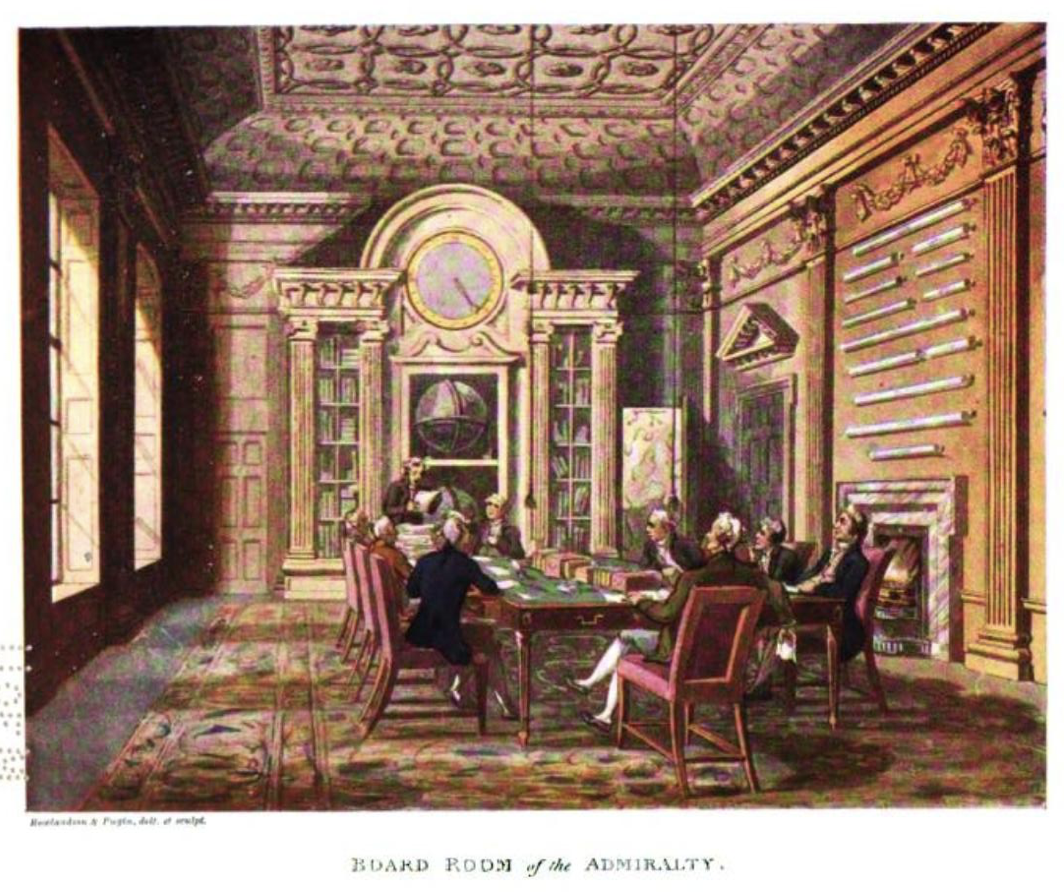
The next print is a correct interior view of THE BOARD ROOM OF THE ADMIRALTY, with its appropriate decorations of globes, books, maps, & c. The lords commissioners are represented as sitting at the table, and may be naturally supposed engaged in some business relative to the naval interest of Great Britain: and considered in that point of view, may be fairly said to be transacting a business of more real importance to this country, than any other subject that could be debated; and if taken in all its nautical relations, the acknowledged preeminence of our navy, and the various appertaining et-ceteras, it is also a matter of infinite importance to all Europe.
After what has been said, it does not seem necessary to make any remarks on the extent of the building; but, as it has been before remarked, that the noble lords were engaged in transactions of more importance than attending to the symmetry and proportion of their house, which was probably left to the architect, who might in many cases leave it to the management of his foreman, it may afford some amusement to our readers, to recite a few sportive sallies of the wits of the time on the brick and mortar of the principal front.
They said, and truly said, that it is a contemptible piece of architecture. Of the portico of this building, composed of four Ionic columns, with a pediment of stone, a story is told, that, from the strange disproportion of the shafts, is highly probable. The architect, Shipley, had made them of a proper length, when it was found that the pediment of one of his shafts had blocked up the window of one of the principal apartments; and he endeavoured to remedy the error, by carrying his columns to the roof of the building: and in truth, in its present state, one is compelled to admit the truth of what was remarked by the late George Selwyn, that though the columns are certainly neither of the Doric, Ionic, or Corinthian order, they would be admirable models to take for a new one, which might be denominated the clis, or disproportioned order; “or,” added he, “if we chose to give it immortality, baptize it with an appropriate title, and name it the Robinsonian order, in honour of Sir Thomas Robinson.”
The figure of Sir Thomas Robinson must be in the recollection of many of our readers; — so long, so lank, so lean, so bony, that he struck every one who saw him, as distinct from all other men, and out of all manner of proportion. When the late Lord Chesterfield was confined to his room by an illness, of which he felt a consciousness that he should never recover, a friend, who visited him in the character of one of Job’s comforters, gravely said, he was sorry to tell his lordship, that every body agreed in thinking he was dying, and that he was dying by inches. “Am I?” said the old peer, “am I indeed? why then I rejoice from the bottom of my soul, that I am not near so tall as Sir Thomas Robinson.”
To return to the building: certain it is that such columns never were seen either in Greece, or Rome, or any other country.
The screen in the front, which was designed and erected by Adams, is so far from being liable to any part of this censure, that it forms a striking contrast, and would, if it were possible, shew in a more glaring light the gross absurdities of the principal front of the building.
On the inside of the Admiralty are two telegraphs, which may be seen by a proper application to the porter, or person who works, the machine.
Previous to the institution of a Royal Academy, there was an exhibition at the Lyceum in the Strand. It was denominated THE SOCIETY OF ARTISTS OF GREAT BRITAIN; and the profits were to be applied to the relief of distressed artists, their widows and children. In this place were exhibited some very fine productions by Mortimer and other of our most celebrated painters.
The princes of the house of Hanover had many virtues of a description that adorn and dignify human nature. George II, was a gentleman of high honour and undeviating integrity; but he possessed no portion of taste for the fine arts, the professors of which were very coldly considered during his reign.
The accession of his present majesty displayed a very different scene, and those who had talents found now a sovereign who had taste to discern and appreciate them, and sought every opportunity of affording them countenance and protection.
The Royal Academy
In the year 1774, old Somerset Place was purchased of the crown, and an act of parliament passed for embanking the river Thames before Somerset House, and for building upon its scite various public offices, &c. The part of the building appropriated to the artists, is the object of our present enquiry.
The room on the ground-floor is allotted to models of statues, plans, elevations, and drawings.
The coved ceiling of the library was painted by Sir Joshua Reynolds and Cipriani. The center is by Sir Joshua, and represents the Theory of the Art, under the form of an elegant and majestic female, seated on the clouds and looking up wards: she holds in one hand a compass, in the other a label, on which is written,
Theory is the knowledge of what is truly nature.
The four compartments in the coves of the ceiling are by Cipriani, and represent Nature, History, Allegory, and Fable. These are well imagined, and sufficiently explain themselves.
The adjoining room, being originally appropriated to models and casts from the antique, of which this society has a most valuable and curious collection, is plain and unornamented.
The council room is more richly decorated ; the stucco is in a good taste, and in the center compartment of the ceiling are five pictures painted by Mr. West. The center picture represents the Graces unveiling Nature; the others display the four elements from which the imitative arts collect their objects, under the description of female figures, attended by genii, with Fire, Water, Earth, and Air, exhibited under different forms and modifications. The large oval pictures which adorn the two extremities of the ceiling, are from the pencil of Angelica Kauffman, and represent Invention, Composition, Design, and Colouring. Besides these nine large pictures, there are in the angles, or ospandrells in the center, four coloured medallions, representing Apelles the painter, Phidias the sculptor, Apollodorus the architect, and Archimedes the mathematician; and round the great circle of the center, eight smaller medallions, held up by lions, on which are represented, in chira-obscuro, Palladio, Bernini, Michael Angelo, Fiamingo, Raphael, Dominichino, Titian, and Rubens; all of which are painted by Rebecca.
Sir Joshua Reynolds was the first president ; and his urbanity of manners, and high rank in the arts, gave him a respectability with the society, which it will not be easy for any of his successors to equal.
It is not proper to pass the name of this great man without some general account of his character:
“His art was nature, and his pictures thought.”
He was born heir to the manor of portrait-painting, the soil of which he has so improved, enriched, and fertilized, as to give this hitherto barren spot in the province of art, an importance it was never before thought capable of receiving. At the hour he began to paint he was the leader of his art, and, whatever improvements were made by his contemporaries, preserved that rank to the last year of his life. He was sometimes praised for excellences which he did not possess, and sometimes censured for errors of which he was not guilty. To analyze his character fairly, it is necessary to consider the state of the arts when he began to paint; and to say a man was superior to the painters who immediately succeeded Hudson, is, with very few exceptions, saying little more than that he was a giant among pigmies. By his fondness for experiments in colours, he frequently used such as vanished before the originals they were designed to commemorate, and many of them the world need not lament.
Every succeeding year of his life he improved; and that some of his later pictures have been painted with colours that fled, every man of true taste will regret; at the same time that the mezzotintoes so frequently engraved from them, shew us in shadow, that such things were. He did not aim at giving a mere ground-plan of the countenance, but the markings of the mind, the workings of the soul, the leading features which distinguish man from man; by which means he has represented real beings with all the ideal graces of fiction, and united character to individuality. Invention and originality have been said to be the leading excellences of a poet or a painter, and the president has been accused of borrowing from the works of others. Let it be remembered, that the merit does not lie in the originality of any single circumstance, but in the conduct and use of all the branches and particular beauties which enter into each composition. Such appropriation has a right to the praise of invention, and to such praise was Sir Joshua entitled. He frequently united the elegance of the French style with the chastity of the Roman; he imitated the brilliant hues of Rembrandt, but never introduced what was either mean or disgusting; he had the richness of colouring of Rubens without his excess and tumult; and by thus judiciously selecting and skilfully blending the colours of the various masters, he has formed a style wholly his own, on the merit of which other painters have separately about as high claim, as the mason who hewed the stones for Whitehall had to the honours due to Inigo Jones.
Considered in every point of view, he has given a new character to portrait-painting, and his pencil may, without exaggeration, be called creative.
The School
The stated professors of painting in its different departments, read lectures to the students in their various branches; and as they possess a most capital collection of casts and models from antique statues, &c. they have what may be fairly deemed a good school for drawing. A school for colouring they still want; and it has been recommended to them to purchase a collection of pictures, to which the students might resort, and compare their own productions with those of the great masters, whose works have stood the test of ages. The Lectures by Sir Joshua Reynolds are published, and are models of elegant composition as well as scientific taste. Those by Mr. Barry were published a few years ago, and contain much original and useful information, blended with some of this singular painter’s peculiarities.
Mr. Sheldon, professor of anatomy, delivers six lectures annually, during the summer season.
Prize medals (of silver), for the best academy figure, are delivered once a year.
Gold medals for historical compositions in painting, sculpture, and designs in architecture, once in two years. The latter are presented to a full assembly, and succeeded by a discourse from the president.
Students have generally during the whole year an opportunity of studying nature from well chosen subjects, and of drawing from the antique casts.
Admission to the lectures is by a ticket signed by an academician; they are held on Monday evenings, at eight o’clock, in Somerset Place.
The annual exhibition generally opens in May, and every person admitted pays one shilling ; and sixpence for a catalogue, if he wishes to have one.
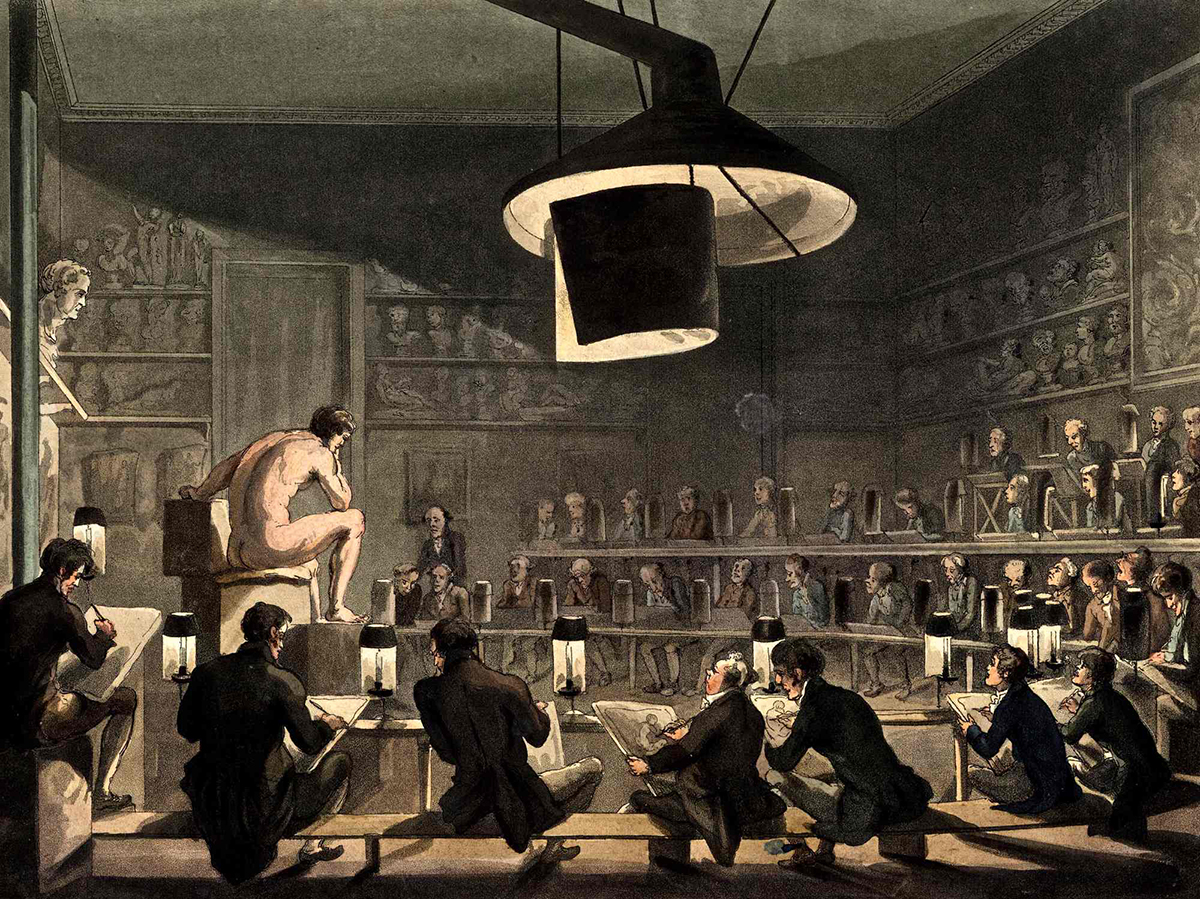
A VIEW OF THE STUDENTS IN THE ROYAL ACADEMY, AT SOMERSET HOUSE, DRAWING FROM THE LIFE.
The room in which this is done we have already described; and by the manner in which it is arranged, and their errors being pointed out, a number of our young students draw with great correctness. It is devoutly to be wished that their colouring was as meritorious as their drawing; but for colouring they have not yet a good school, though several of the royal academicians have made many attempts to obtain it; but, alas! those attempts have not hitherto been crowned with success.
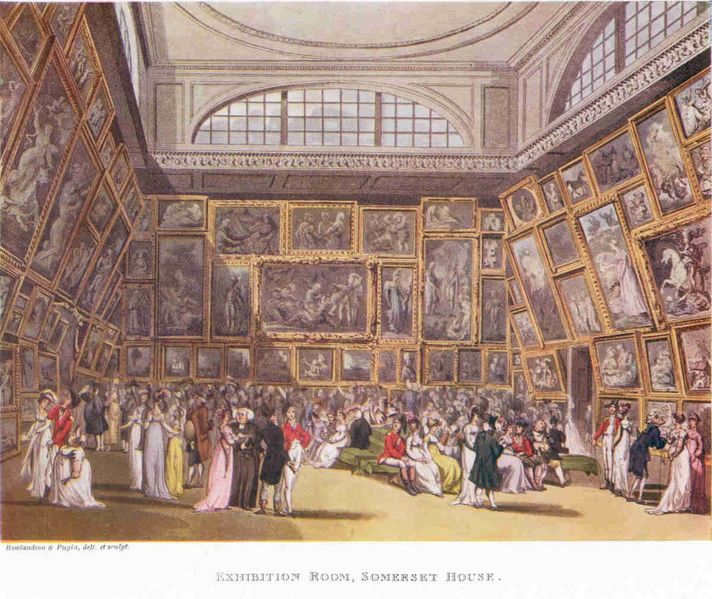
THE GREAT ROOM AT THE ROYAL ACADEMY, AT THE TIME OF AN EXHIBITION.
This most spirited drawing is covered with the representation of pictures and figures, in a manner with which it would not be easy to find one with which it could be paralleled; nor would it be easy to find any other artist, except Mr. Rowlandson, who was capable of displaying so much separate manner in the delineations placed on the walls, and such an infinite variety of small figures, contrasted with each other in a way so peculiarly happy, and marked with such appropriate character. The peculiar mode by which different persons shew the earnestness with which they contemplate what they are inspecting, and display an absorbed attention to the object before them, is incomparably delineated; and the whole forms an admirable little picture of that busy scene, in which such crowds are annually engaged in watching the progress of the fine arts as annually exhibited at the Royal Academy.
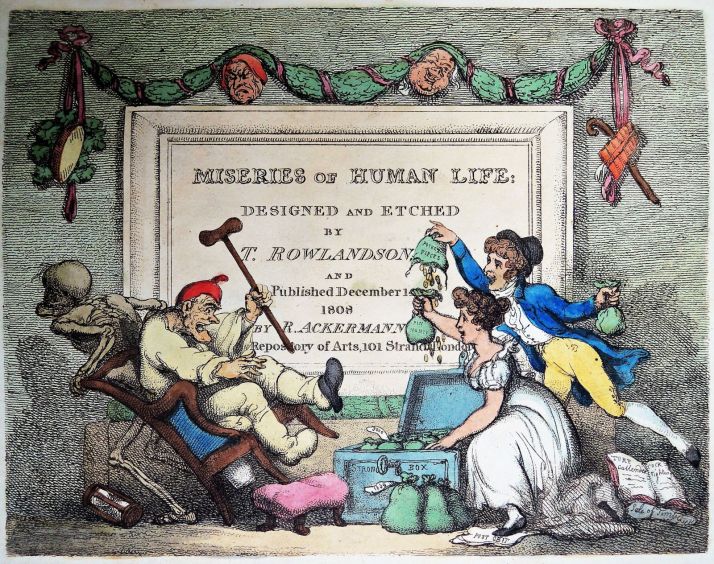
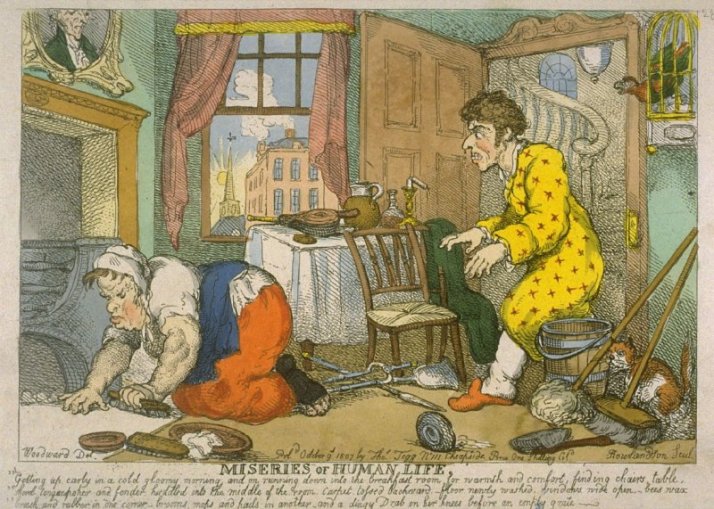
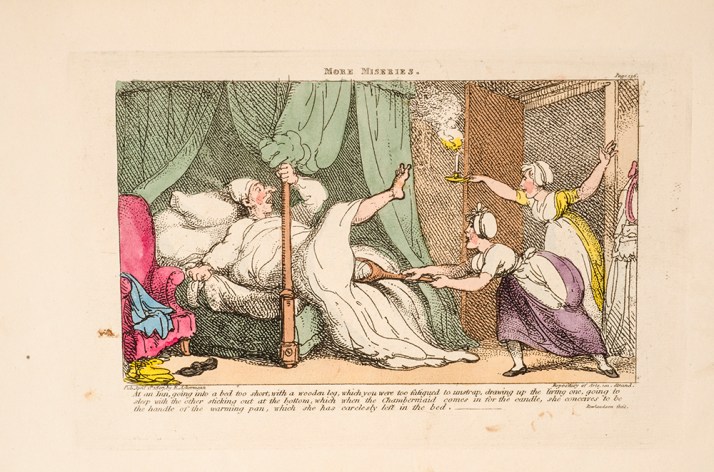
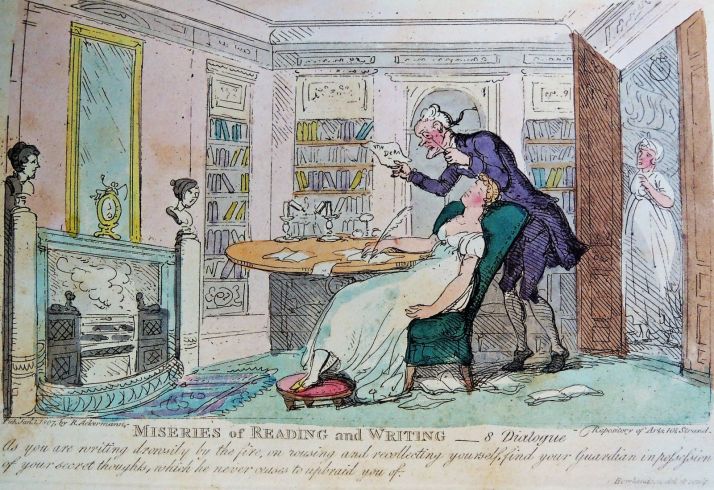
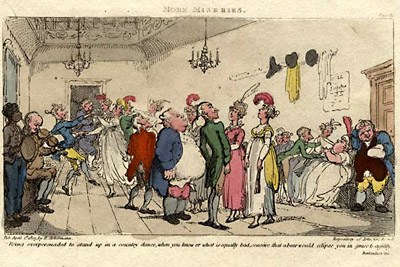
“The Miseries of Human Life, [originally] written in 1806 by James Beresford (1764–1840) of Oxford University, was extraordinarily successful, becoming a minor classic in the satirical literature of the day. In a humorous dialogue between two old curmudgeons, the book details the “petty outrages, minor humiliations, and tiny discomforts that make up everyday human existence.” The public loved it: dozens of editions were published, and printmakers rushed to illustrate their own versions of life’s miseries.
Thomas Rowlandson (1756/57–1827) began drawing scenes based on Beresford’s book as soon as it was published, and after two years the luxury print dealer Rudolph Ackermann selected fifty of his hand-colored etchings for a new edition of Miseries. Many of the now-iconic characters and situations that the artist drew for this project – some based closely on Beresford’s text and others of his own invention–reappeared in later works, with variations on the Miseries turning up until the artist’s death.
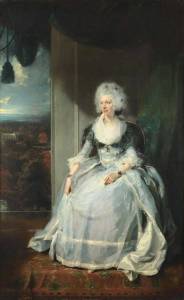
It being the Lord Chamberlain’s orders that the Court mourning is to be changed on the 3rd of January to plain black silk, and grey for undress; and on the 24th to be still further changed, to black silk with coloured ribands, we have endeavoured to procure descriptions of some dresses now preparing for the change of mourning, which we flatter ourselves our fair readers will find worthy of their attention.
The first is a pelisse of fine Merino grey cloth, lined with white sarsnet; it has a plain broad back, which is finished at each side with five or six small plaits of grey satin, close to these plaits on each side, is a row of small jet buttons, which are placed at irregular distances, and are braided with black silk cord. The collar is a full rouleau of grey satin, which is entwined with black silk cord. The fronts are plain and tight to the shape. The sleeve is very long and loose. The shoulder is ornamented with a full rouleau of grey satin to correspond with the collar, it is so contrived as to stand up; the bottom of the sleeve is finished with a rouleau to correspond. The trimming which goes entirely round the pelisse, consists of a row of broad black velvet shells, edged with swansdown. This is one of the most elegant half mourning dresses that we have seen.
We have been favoured also with the sight of an evening dress composed of black velvet; it is cut down very low all round the bust, but an under body of white satin shades the neck sufficiently to prevent any indelicacy. The trimming of the bust is a row of small crape roses without leaves, of that beautiful and vivid red which we term the French rose colour. Short full white satin sleeve, over which is a small half-sleeve composed of black velvet; it is a single deep point, it comes from the back part of the shoulder to the front of the arm, and is trimmed with small roses to correspond with the bust. At the bottom of the skirt, is a deep flounce of black patent net, the edge of the which is slightly finished with rose-colour chenille; this is looped at considerable distances with single roses, which are much larger than those on the neck and sleeves; there is a narrow heading left to the flounce, the edge of which is slightly finished with chenille.
This dress, though celebrated for the latest half mourning, might also, with the greatest propriety, be worn in full dress at any time during the winter months. We must in justice to the eminent house, by whom we were flavoured with a sight of it, and the pelisse, observe that nothing can be more strikingly elegant than the former, or better calculated for grand costume.
White crape toques for evening dress are at present is considerable estimation, and are likely to continue so during the next month. Diadems of crape roses, principally white, are also much worn. The toque cap is likely to be fashionable for half dress; it is extremely novel, the lower part is a mob, the upper a low toque, with a small dome crown; it is usually ornamented with a crape flower in front; the toque part is composed of white satin, and the cornette of crape; it has a very narrow full border, and fastens with a little bow of satin riband under the chin.
A previous post about mourning Queen Charlotte from Ackermann’s Repository is here.
The mourning for our late venerated and beloved Queen is equally deep and general: no wonder indeed that the whole English nation should be eager to pay a tribute of respect to the memory made in the robe form, of a three-quarter height, are very general for morning: they are trimmed all round with a broad border of plain muslin or long lawn, with weepers to correspond; and are worn with lawn or muslin handkerchiefs, and large mourning ruffs, which in general are rounded at the ends, and do not quite meet in front of the throat.
Black bombazine is universally worn for dinner dress, and is also adopted for social evening parties. There is a good deal of variety in the form as well as the trimmings of dinner gowns. Frocks are very general; some are cut quite low and square round the bosom, with very short sleeves, which are formed of full puffings of black crape placed between bands of bombazine. The bust is trimmed with black crape, variously disposed; but ruches, though so long worn, appear to us most prevalent. The bottoms of the skirts are always very full trimmed with black crape; some have a broad band of crape formed into bias flutings, which are placed across; others are trimmed with black crape leaves, of which there are two or three rows placed one above another. Corkscrew rolls of crape, which are very narrow, and always four or five in number, are also a favourite trimming; and we have observed several gowns trimmed extremely high with black crape tucks.
The bodies of other dresses are made partially high round the back of the neck; the back is plain, and buttons up behind with small jet buttons; the front has a little fullness at each side of the shoulder-strap; the middle of the bust is plain, and sloped gradually on each side; the waist is very short, and the bust is trimmed round with a single row of crape disposed in wolves’ teeth. Plain long sleeve, ornamented at the hand to correspond with the bust, and finished at the bottom of the skirt with a similar but broader trimming.
We recommend this dress, at least the manner in which the body part is made, to those of our fair subscribers who are of the middle age; it is at once delicate and becoming. We understand that several matronly ladies of distinction have given orders for dresses made in this style, and we shall be glad to see it generally adopted.
Black crape over black sarsnet is universally adopted for full dress. The most elegant style is that given in our print. We have, however, noticed another, which we consider as very tasteful and worthy of attention: it is a frock; the body, formed of a fullness of crape, is made to fit the shape of the bust by jet beads, which form a kind of stomacher; the back is full; the shape is formed on each side by jet beads, and it is fastened behind with small jet buttons. A short full sleeve, the fullness looped in various places by little jet ornaments. The bottom of the skirt was trimmed with a deep flounce of black crape, which was looped in the drapery style with jet ornaments, and headed by a row of small crape roses.
We understand that it is expected; dresses both of bombazine and black crape, trimmed with white crape, will be worn, particularly by young ladies. We consider this very likely, because it is still very deep mourning, though less gloomy than all black: we have not yet, however, seen any of them.
Several trimmings, composed of black crape and intermixed with scarlet, are we understand in preparation for some very dashing élégantes. This mixture of black and scarlet has of late years have been tolerated even in the deepest mourning; in our opinion it is far from appropriate: we remember upon a late ever-to-be-lamented occasion it was seldom seen, and we believe it is now likely to be confined chiefly to those ladies whom the French would style merveilleuses.
Head-dresses, both for full- and half-dress, are mostly made in white crape. Toques and turban-hats are generally adopted in the former, and caps in the latter; they are always of a round shape, and the cauls low: some have narrow borders; others have no border, but have the head-piece formed in the toque style, that is to say, disposed in very full folds: these last are always ornamented with flowers.
Toques are usually made without any other ornament than the crape tastefully disposed in front. Turban-hats are either ornamented with flowers, or if black, with jet beads. Head-dresses are at present either entirely white or entirely black; and the former, as we have just observed, are most prevalent.
Very young ladies wear jet combs, sprigs, and tiaras, in full-dress; but for dishabille, belles of all ages wear simple undress caps, which are in general muslin, long lawn not being much used.
It is almost superfluous to mention, that all ornaments for the hair &c. at present are composed of jet.
Gloves and shoes are always of black chamois leather.
Evening Dress
A black crape dress over a black sarsnet slip: the body is cut very low and square round the bust, and is tight to the shape; it is trimmed round the bosom and the back with a rouleau of crape intermixed with jet beads: this trimming does not go round the shoulders. The bottom of the waist is finished by rounded tabs. Long sleeve, made very loose, and finished at the band by a rouleau to correspond with the bosom; the fullness of the sleeve is disposed on the shoulder in puffs, which are interspersed with jet beads, some of which also confine it across the arm: this forms a new and elegant style of half-sleeve. The bottom of the skirt is cut in broad scallops, the edges of which are ornamented with narrow black fancy trimming, and an embroidery of crape roses, with branches of crape leaves disposed between each; a second row of this trimming is laid on at a little distance from the first. The front hair is much parted on the forehead, and disposed in light loose ringlets, which fall over each ear. The hind hair is braided, and brought round the crown of the head. Head-dress, a long veil placed at the back of the head, and an elegant jet ornament, consisting of a rose and aigrette, which is also placed far back. Chamois leather gloves and shoes. Ear-rings, necklace, and cross, jet.
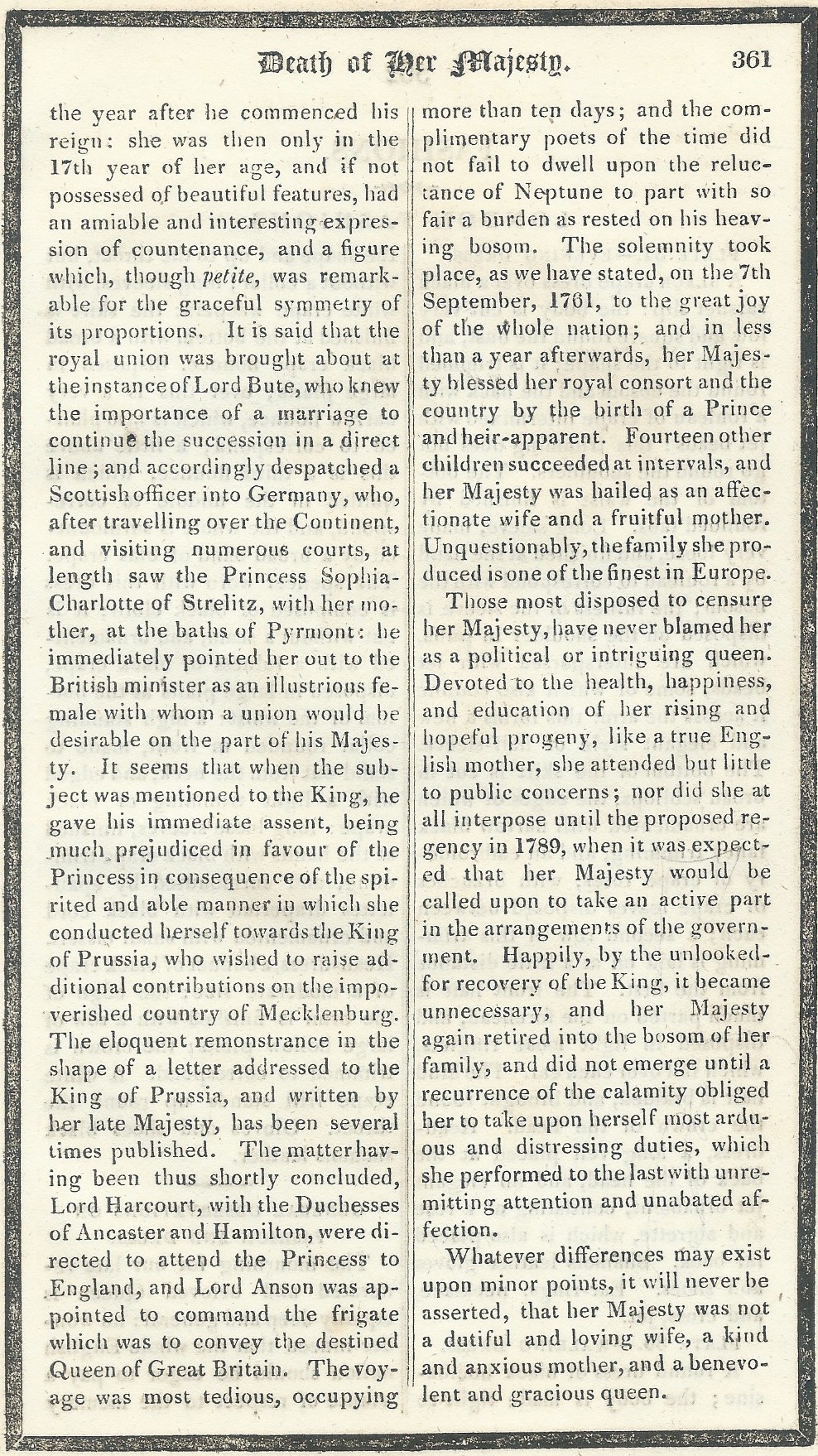
Walking Dress
A round dress of black bombazine; the body is made tight to the shape and up to the throat, but without a collar; long sleeves, with white crape weepers: the skirt is finished at the bottom with a broad black crape flounce, disposed in large plaits; over this is a very narrow flounce, which is also plaited to correspond; a little above this is a third flounce, which is quilled in the middle to correspond, and the whole is surmounted by a broad band of bias crape. The spencer worn with this dress is composed of black clothing; it is cut without a seam, and ornamented with a fullness of black crape, disposed in large plaits at the bottom of the waist: a high standing collar rounded in front, made to stand out from the neck, and edged with a light trimming of black crape: long loose sleeves, finished at the hands with black crape trimming, and surmounted by epaulettes draperied with black cord and ornamented with small tassels. Head-dress, a bonnet of black crape of a moderate size; the edge of the brim is finished with a row of large hollow plaits; the crown is trimmed to correspond. A white crape frill stands up round the throat. Gloves and shoes black chamois leather.











 It being the Lord Chamberlain’s orders that the Court mourning is to be changed on the 3rd of January to plain black silk, and grey for undress; and on the 24th to be still further changed, to black silk with coloured ribands, we have endeavoured to procure descriptions of some dresses now preparing for the change of mourning, which we flatter ourselves our fair readers will find worthy of their attention.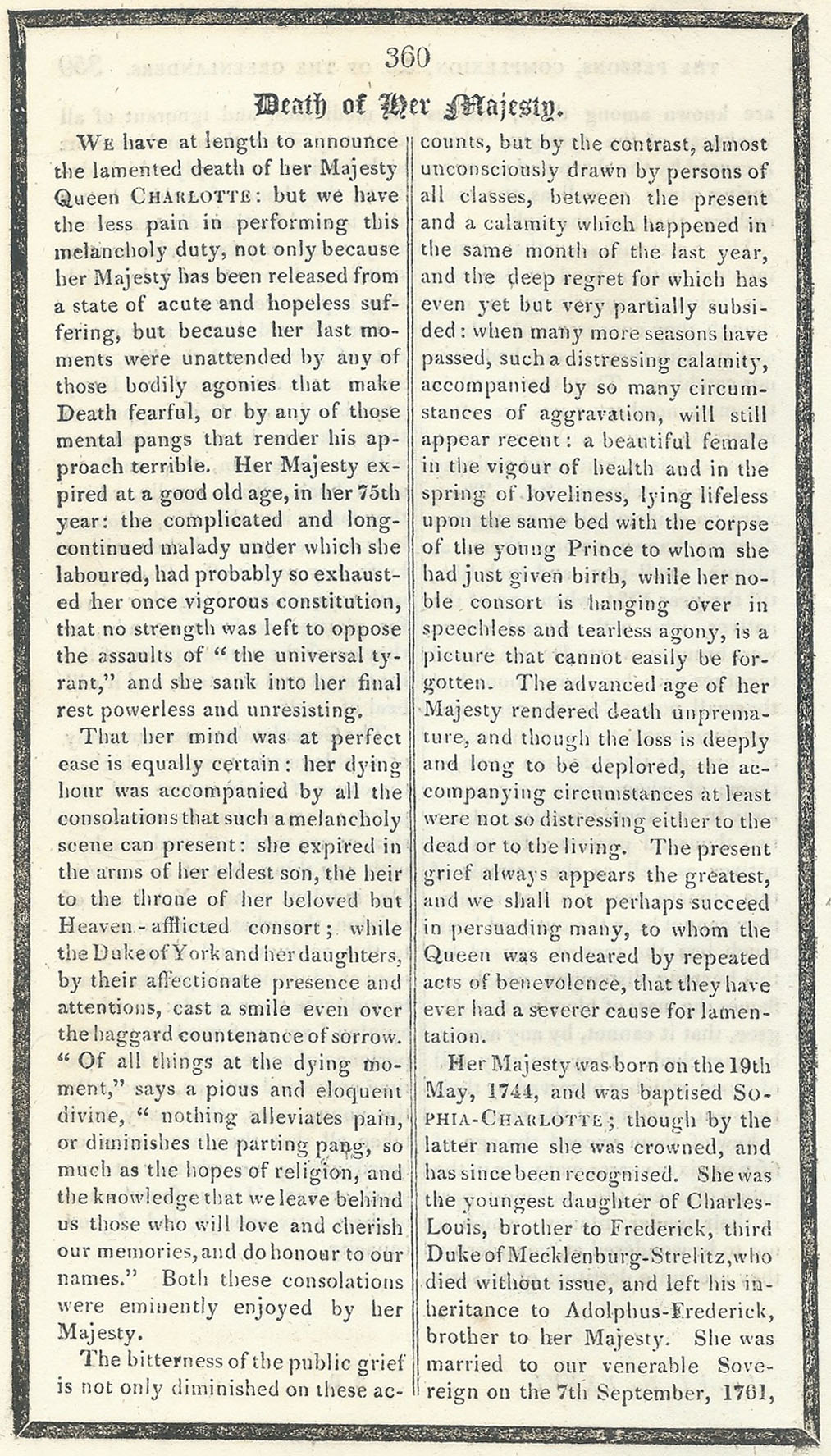

 Susana's Parlour