Archives

Leeds Castle: Castle of Queens

Leeds_Castle_(2004a)

My current WIP is a time travel set in 1817 England, featuring my favorite time-traveling lady, Lady Pendleton, in a role as deux ex machina. She’s helping my 21st century heroine (Helena) adapt to the Regency era while she searches for answers to a mystery regarding her family origins. In Chapter Seven, Helena is serving as a temporary governess to Lady P’s grandchildren in Kent, about two miles from one of the most charming castles in England, Leeds Castle. So why shouldn’t she—accompanied by the hero, of course—take the children on a field trip?

Upon learning of the fabulous maze on the property, I was all set to have my protagonists have a private interlude while the children explore the maze. Until I discovered that the maze wasn’t put in until 1987! (While I adore research, sometimes it can really be a downer!)

I toyed with the idea of doing it anyway—how many of my readers will know this? The problem is—I would know it! However, the idea occurred to me of my heroine—who had visited the castle in the 21st century—mentioning the maze and getting blank stares from everyone, and then the current owner stroking his chin and saying what a good idea that would be! And my heroine as usual wondering if her mistakes—and she makes them frequently—might have some horrific effect on the time-space continuum. Something my intrepid Lady P doesn’t believe in.

Anyway, I thought my readers at Susana’s Parlour might enjoy the results of some of my research on Leeds Castle. It’s very visitor-friendly—I’ll be including it on my list for my own trip this summer.

Origins

leeds-castle-lightboxlarge-427

Originally a Norman stronghold, the first structure was built almost a thousand years ago, in 1119. In 1278, King Edward I expanded it, creating the lake that now surrounds it and building a barbican (a fortified outpost or gateway) that spans three islands and a gloriette (pavilion or other structure built in a garden) with apartments from the king and queen. In 1519, Henry VIII remodeled it for his first wife, Catherine of Aragon.

The Queens

Catherine of Aragon, Spanish Princess

Catherine of Aragon, Spanish Princess

  • Eleanor of Castile, first wife Edward I, bought it in 1278.
  • Margaret of France, second wife of Edward I, was given the castle after Eleanor’s death.
  • Following the death of Edward II, his wife Queen Isabella held it until it passed to Edward III on her death.
  • Richard II gave it to his wife, Anne of Bohemia,
  • in 1382.Henry IV gave it to his wife, Joan of Navarre, in 1403.
  • Henry V left it to his wife, Catherine of Valois in 1422.
  • Her grandson, Henry VIII, gave it to his wife, Catherine of Aragon, in 1500.
  • Elizabeth I was imprisoned there during her sister Mary’s reign.
  • George III and Queen Charlotte visited there in 1778.

Georgian Period

Fiennes Wykeham (later Martin was added) took possession in 1793, selling the family estates in Virginia in order to make extensive renovations of the property in Tudor style, which were completed in 1823. Fiennes Wykeham was the son of Mary Fox, daughter of Charles Fox, the colorful Whig leader. This turned out to be quite fortuitous, since I had set up my hero to be a distant relative of the Melbourne family, who were prominent Whigs as well. Turns out Fiennes Wykeham was a friend of his and quite amenable to the idea of the visit to the property—still under renovation in 1817—in Chapter 7. (I love it when a plan comes together!)

Planning a Visit?

Be careful—Leeds Castle is not anywhere near the major English city of Leeds in the north. It’s near the village of Leeds, about five miles from Maidstone in Kent. There are bus tours, or you can drive or take a train/bus combination—it’s about two hours from London. You’ll find lots to do there for adults or children. In the center of the maze is the entrance to a mysterious grotto. There’s a dog collar museum—yes, that’s right—and you can even book overnights there for special events, such as an opulent Valentine’s Dinner with your special Significant Other, and a great 1920’s House Party in April. Here’s the brochure: http://user-3vovb8a.publ.com/Leeds-Castle-Dine-Sleep-Events-2014#8. There’s a golf course, a playground for children, falconry displays, and you can even punt on the moat. Click here for more information.

leeds_castle460_1390295c

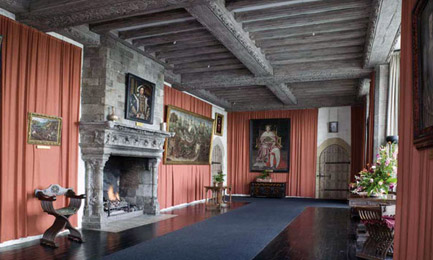
Banquetting Hall of Henry VIII

Banqueting Hall of Henry VIII

Tudor Courtyard

Tudor Courtyard

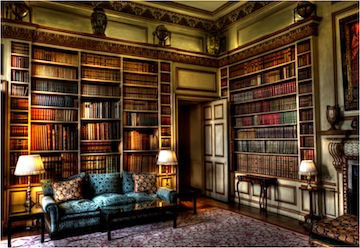
Library

Library

Cozy room

Cozy room

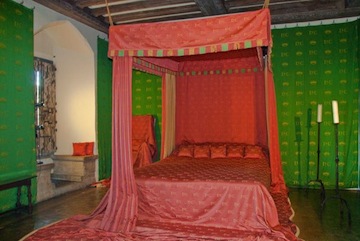
Bedroom

Bedroom

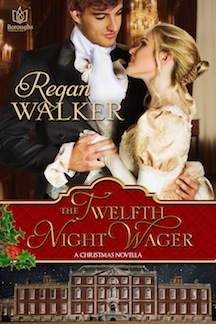
Regan Walker and “The Twelfth Night Wager”

VBT The Twelfth Night Wager Banner copy

Regan will be awarding a copy of three (3) of her books, Racing with the Wind, The Holly and the Thistle and The Shamrock and the Rose to one randomly drawn commenter during the tour. Click on the banner above to follow the tour and increase your chances of winning.

Interview with Regan Walker

Your new novella, The Twelfth Night Wager, begins as two men in White’s, one of the men’s clubs in Regency England, are discussing marriage (“the leg shackled state”). Then one of them challenges the other to a wager, that he must seduce, bed and leave a certain unnamed lady (and she is a lady) by Twelfth Night, or January 5th. I found this intriguing…how did you conceive of this?

Well, in my research about the lives of men and women during that period in England’s history (from 1811-1820) when the Prince Regent reigned, I discovered they loved to wager. About almost anything. And in some clubs, such as White’s (a very old club) they kept a book where the wagers were entered. Such occurred the evening my story begins: two men drinking at White’s and one, a bit bored, agrees to an outrageous wager. He’s a rake after all, known for his conquests. How difficult could it be to seduce one widow? Seemed like an interesting beginning to me, and apparently it did to Christopher St. Ives, Viscount Eustace, too.

Is this your first holiday themed story?

No, actually I have three—all set in the same year, 1818. First is The Shamrock & The Rose, a short story that takes place around Valentine’s and St. Patrick’s Day (with an Irish hero). Then there’s the novella, The Twelfth Night Wager, that begins in October and extends through the New Year, capturing the fall season of house parties, fox hunting, pheasant shooting, Christmas and, of course, Twelfth Night. And on the tale of that comes The Holly & The Thistle, a short story that features Lady Emily Picton, introduced in the novella, and a Scot hero. All three have as a character Muriel, the Dowager Countess of Claremont, an infamous matchmaker.

What are you working on now?

Having finished the third in my Agents of the Crown trilogy, Wind Raven (which should be released early spring), I turned back to a project I started a few years ago, a medieval titled The Red Wolf’s Prize. It’s set in England just after William the Conqueror claimed the land for his own. I’m about mid way through the novel and deep into a siege scene at the moment when William faced the rebellious English at Exeter in 1068. Researching is a love of mine but going all the way back to the 11th century is a huge challenge, I must say.
 
What are you reading now?

I have a blog for lovers of historical romance, Regan’s Romance Reviews, and January is Viking month. So, I’m deep into some Viking romances that I’ll be reviewing for an update of my Best Viking Romances list. I love a good Viking raid, don’t you? All those handsome, conquering hunks towering over the fair maidens. Ah yes…at least in fiction it can end happily, no?

What author or authors have most influenced your writing?

It would be the classic romance authors I still read and re-read today. All have been featured on my blog. Their books (along with those of some newer authors) can be found on my “best lists.” But my short list would be Penelope Williamson, Elizabeth Stuart, Jan Cox Speas, Virginia Henley, Shirlee Busbee, Heather Graham (aka Shannon Drake), Meagan McKinney, Kathleen Woodiwiss and Marsha Canham to name a few. They tell sweeping sagas based on solid research for a great love story. And they are the ones I want my work to be like. I want to sweep the reader away and I want her to feel like she knows the characters, like she’s traveled with them. And, in the end, I want the reader to enjoy the happily ever after.

If your publisher offered to fly you anywhere in the world to do research on an upcoming project, where 
would you mostly likely want to go? Why?

I’m thinking Istanbul. It has a fascinating history and I can so see a romance set there. And though I’ve been to 40 countries, including Turkey (more than once), I’ve never been to Istanbul. I would love it. Yet I must add that after I finish my medieval, I’m going to write the prequel to my trilogy, To Tame the Wind, and that novel begins in France in the late 18th century. So, while I’ve been to Paris, a trip to northern France would not go amiss.

What’s your social media of choice and why?

It would have to be Facebook. I love the pictures, the conversations I strike up with my Facebook friends and the general sharing we indulge in. It’s the way I connect with readers most of the time, though some contact me via my blog, too. I spend at least an hour each day on FB and love it when my friends tell me my posts meant much to them or a particular picture I posted inspired them. I love to get new friends, too, so I encourage your followers to find me on Facebook (see below).

About The Twelfth Night Wager

On a dull day at White’s, the Redheaded Rake agreed to a wager: seduce and abandon the lovely Lady Leisterfield by Twelfth Night. After one taste of her virtue, he will stop at nothing less than complete possession.

Available

AmazonBarnes & Noble

Excerpt

MEDIA KIT Book CoverSoon he was escorted into the gilded green dining room and to his place. The other guests had already been seated. Across from him sat Alvanley and Lady Ormond, and on either side of him a lady new to him. Neither, he reflected sadly, was the beautiful blonde who occupied his thoughts.

A few places down the table he saw her sitting next to Ormond. There was a gallant on her other side with whom she was conversing. The shimmering coral gown she wore embraced her curves, modestly revealing the creamy mounds of her full breasts. Would that she was close enough he could speak to her. Close enough he could inhale her delicate scent. Memories of their morning ride assailed him—

Perhaps it was just as well she was not so close. His fervent interest in the lady might be too apparent, which would not do.

Lord Ormond, seeing the direction of Christopher’s gaze, raised an eyebrow. Christopher forced a smile and dipped his head in greeting, just as Lady Ormond sitting across from him drew his attention.

“Good eve to you, Lord Eustace.”

“And to you, my lady. And you, Alvanley.”

Introducing himself briefly to the two brunettes on either side of him, Christopher attempted to keep the conversation moving along through dinner. One was the daughter of a fellow Whig and companion of the other, who was young and apparently unattached by the way she was flirting with him. Carrying on with many women while desiring only one was proving to be exhausting. Generally he took women on one at a time. Not so this game. He was forced to at least appear to pursue several at once.

About the Author

MEDIA KIT Author PhotoAs a child Regan Walker loved to write stories, particularly about adventure-loving girls, but by the time she got to college more serious pursuits took priority. One of her professors thought her suited to the profession of law, and Regan realized it would be better to be a hammer than a nail. Years of serving clients in private practice and several stints in high levels of government gave her a love of international travel and a feel for the demands of the “Crown” on its subjects. Hence her romance novels often involve a demanding Prince Regent who thinks of his subjects as his private talent pool.

Contacts

WebsiteBlogTwitter • Facebook

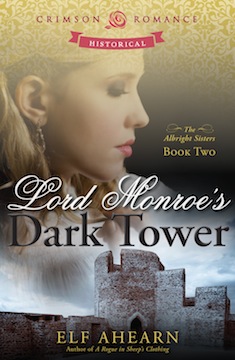
Elf Ahearn and “Lord Monroe’s Dark Tower”

Susana, I’m so pleased to be invited to post on your blog today. You do great service to us Regency romance writers and readers.

The first thing I heard when I set out to become an author was, “Write what you know.”  Tough to do since the Regency occurred about 200 years ago, but I’ve always been accused of having an old soul. I feel most comfortable around antique things – furniture that shows the dents and cracks of use, books marred by the crayon scrawls of children. Signs of life thrill me. So the challenge I set myself when I wrote Lord Monroe’s Dark Tower was to make it seem “lived in.” To this end, my heroine, Claire was inspired by my sister Jenny, and the book’s hero, Flavian, by a feline who was everything she ever wanted in a man (except shedding).

Flavian was a striped tabby who walked like a truck driver but meowed like a soprano – all high and tweety. You will not find these character traits in the book, but you will find other similarities.

We always had a running tab of two to three dogs and four to five cats in the house along with four excitable girls and my excitable parents. At dinner the whole mess of us would crowd into the kitchen. My mother would feed us the human food and the animals would square off over their bowls. Dogs growled, cats hissed—but Flavian was unflappable. If he wanted Friskies, he just walked up to the bowl, nudged whoever was in the way, and got it. No fuss, no buss. All the animals respected Flavian, not because they were afraid, but because he exuded that kind of authority.

Jenny was mad for Flavian and he was mad for her. If he needed a warm lap she was there; if the night were cold, her bed was where he’d find warmth; should he need a treat, she’d give it to him, and when she required a dead mouse, he would provide it.

In the early stages of writing Lord Monroe’s Dark Tower, I thought, what would it be like if Jenny could have her ideal love without four legs and a tail? What would that man be like and how would my sweet, quiet sister, who, like Claire, is a healer, react to such a person? And so, the love story was born.

Now that I’ve confessed the origins of Lord Monroe’s main characters, for a chance at winning a free download of the novel, I’d like to know, have you ever had a pet you wished were human?

About Lord Monroe’s Dark Tower

roses2Two years of bewildering silence have passed since Claire Albright’s passions were first inflamed by powerful, brooding, Lord Flavian Monroe. On the brink of her London debut he unexpectedly summons her, asking for help to cure his ward’s hoarding. Embroiled in a desperate attempt to curb the child’s destructive madness, Claire struggles to understand why Flavian’s kisses veer from burning desire to icy rejection. Can she reach his heart before the child’s insanity undoes their chance at love?

When he was fourteen, Flavian made a mistake so devastating it ruined all hope for happiness. Years later, he’s still paying for his sin. But before his ward’s troubled mind destroys his home and family, he must see Claire once more. Vowing to keep their relationship professional—she the healer, he the guardian—he finds the bonds of his resolve snapping. Somehow, he must content himself with the love that could have been, but he cannot resist . . . one final embrace . . .

Available at Amazon.com and Barnes & Noble

A Snippet From Lord Monroe’s Dark Tower

“Claire!” Half way around the lake, he finally heard her answering call. His heart lurched when he caught sight of her. Dressed in pale green, she stood surrounded by a sea of yellow flowers. A straw bonnet shaded the perfect oval of her face. His eyes scrolled down her bodice. Between her breasts, she’d tucked a tiny bouquet of wild flowers: purple, pink, yellow, and white. He swallowed.

As he strode toward her, she said, “This spot has enough St. John’s wort to supply…” He crushed the end of her sentence with a kiss.  All the frustration, all the passion he’d whipped back since she’d come to Bingham Hall, broke free the instant his mouth met hers. He tipped her till her bonnet came off and dangled by the string around her throat. His tongue parted her reluctance and demanded her participation while he explored the wet grotto of her mouth.

On the verge of lowering her to the ground, she put both hands to his shoulders and pushed. “Flavian, wait.” Her cool fingers went to each side of his face, and her gaze burrowed into the furthest recesses of his mind. He felt the question in her body, the beseeching touch of her fingertips: ‘I am the lamb, you, the lion. What will you do with me?’ He understood the question, but couldn’t bring himself to answer. Valencia’s eyes, like black bottomless pools, flickered in his thoughts. So many years ago, he’d asked that same question of her. Being a lion, she consumed him. And then, when she so desperately needed his help, he’d been powerless . . . worse, he’d been reluctant. He stepped out of Claire’s grasp. “I wasn’t thinking.”

Fire leapt in her eyes. “Not thinking?” She ran several paces away. Pointing at him, she cried, “You make a mockery of my heart. One moment your lips burn against mine, the next, you ignore me.”

“I . . . I’m sorry.”

Doubled over with frustration, she yanked on the skirts of her dress. “I don’t want your apology. I want your love.”

“You have it.” Before he could retract the words, they hovered in the air between them. All went still. Even the birds ceased their song. Claire clutched her heart. “Why would you say that?”

“I love you.” He stepped toward her, though his chest ached and his throat went dry. “God help you, but I love you.” At her feet he dropped to his knees, hat in hand. “I love you.”

About the Author

Elf CloseupElf Ahearn, yes, that is her real name, lives in New York with her wonderful husband and a pesky (yet irresistible) cat. She came to romance late in life because she had to meet the right guy before any of that love stuff made sense. Before meeting the man of her dreams, Elf was a journalist, a corporate communications specialist, an actor, an insurance underwriter (which amuses her friends because she can’t add two numbers together to save her life), and a Lithuanian vampiress. (Not really but if you’re still reading I wanted to give you a thrill.) Like many romance authors, Elf was nuts for horses, though now she’s turned to cats. (They’re not as easy to ride, but they eat less hay.) In fact, the temptation to write a horse story is what lured her into romance writing in the first place. (See A Rogue in Sheep’s Clothing, the first book in the Albright Sisters series; there’s a really hot stallion in it.) Thanks for taking the time to read this post, and I hope you win the free download of Lord Monroe’s Dark Tower!

Elf’s Previous Post on Susana’s Parlour:

Regency Romance With a Gothic Twist:

Elf Ahearn and “A Rogue in Sheep’s Clothing”

Diane Farr: Adventures in Audiobookland

I write (mostly) romantic tales set in Regency England. But even if you know my books, you might not know that my first artistic career wasn’t on a page, but on the stage! Years of training, a degree in Drama, a move to Hollywood, an actual union card…so yeah, seriously, I was an actress. And more to the point, in addition to my stage work, I did voiceovers. I had something called “instant talent”—a knack for picking up a script and reading it “cold,” switching regional accents on command, that sort of thing.

You’ll notice I am using the past tense. I’ve been out of the business for a long time now, writing. But I’ve often thought it would be fun to record my books. And when Amazon acquired Audible, and then launched the Audiobook Creation Exchange (ACX)—bringing their expertise in self-publishing to the production of audiobooks—I knew it was just a matter of time before I jumped on the bandwagon.

I jumped in 2013.

And discovered that producing one’s own audiobook is just a tad different from walking into a studio, grabbing a script, putting on a pair of headphones and following someone else’s direction. I’d always thought that voiceover work was the easiest gig in show business. I now learned that what made it so easy was all the heavy lifting being done by the people surrounding the actor! In the brave new world of indie publishing, I had to do all the hard stuff in addition to the easy stuff.

And the easy stuff wasn’t that easy, either. I began with a novella—a lightweight bit of romantic fluff called Dashing Through the Snow—because, duh, it was the shortest piece I had. I thought of it as a sort of warm-up exercise. But I soon realized that a sustained reading of 20,000 words is a bit more difficult than voicing a 30-second commercial.

I swallowed. I breathed. I muffed my words from time to time. My voice cracked. Once I accidentally bonked the microphone with my tea cup. A couple of times I had to stop to clear my throat. All this vocal crapola had to be carefully edited out, and I didn’t have an editor. Or a recording engineer. Or a director. Or a sound technician. I had to wear all the hats. It’s tough to read out loud for hours on end while wearing multiple hats.

Oh, and did I mention that I don’t happen to own a recording studio? I have two cats, a husband and a washing machine, all reliably making noise at varying levels. The farthest point from the action in my house is the master bathroom. I closed the bedroom door and the bathroom door, huddled on a stool, and read into my newly-acquired Porta-Booth—which was balanced on a second stool, facing me.

With all this going on, I wasn’t able to tackle the gigantic problem rearing its hoary head—the one that had kept me from trying this during all the time I had wished I could. I am (a) female and (b) American. Many of my most important characters are (a) male and (b) English.

The marketing geniuses at ACX assured me that their audience wanted to hear books read by the author, no matter what. In their view, the fact that the narrator had also written the book outweighed any trifling consideration of accent or gender. So I forged ahead, perched in my bathroom with hot tea at my elbow and a microphone seated in a foam box before my face.

And then spent many an evening going over the recording with a fine-toothed comb, editing out the pops and gaps and odd noises, watching (and then applying) “how-to” videos on audio compression, and equalization, and blah-blah-blah. I got pretty good at blah-blah-blah.

dashingWould I recommend the experience to other authors? Yes and no. Yes, if you are technologically savvy or don’t mind becoming technologically savvy. And if you like to read out loud. And if other people enjoy hearing you read out loud. And if you’re a total cheapskate who would rather do all the work yourself than pay someone else to do it for you.

If you answer “no”—or even “I’m not sure”—to any of those questions, my recommendation would be to visit ACX and offer your books to the hungry voiceover actors who may audition for you. There are actors who are willing to read your book for a share of your royalties. There are even producers who are willing to produce said actor’s work for a share of your royalties.

Dashing through the Snow went on sale through Audible, Amazon and iTunes on November 1, 3013 and I received my first royalty check yesterday—with no share deducted for anyone other than myself. So for me, was it worth the hours spent cursing under my breath and hating the sound of my own voice? I would have to say yes!

Available

Audible

About the Author

diane_headshotDiane Farr was first published at the age of eight when the Bakersfield Californian printed one of her poems. She has spent most of her life with her nose in a book — sometimes reading, sometimes writing. Eventually she produced eight historical romances and a novella, all published by Signet Books, a division of Penguin Putnam. Her latest adventure is a teen paranormal series: The Spellspinners. All her books are now available as e-books as well as in print.

Lydia M. Sheridan: Wodehouse and Benson, Unsung Masters of Regency Style

Wodehouse and Benson, Unsung Masters of Regency Style

As much as I adore Jane Austen, she is not necessarily my favorite authoress of traditional, or classic, Regency romances.  I think this largely stems from one too many male profs having no idea, firstly, that there were any other female writers worth a second glance (they were wrong, of course), and secondly, heaven forbid they should be forced to consider tales of love and romance which ended in happily-ever-afters as Great and Powerful Litrachaw of the ages.  Jane, therefore, became a great contemporary writer of biting satire and witty social commentary.  No doubt true, but we all know she was really writing about the trials and tribulations of young women finding love.  The satire and commentary were just super-fun extras.  (N.B.  These profs were the same ones who insisted that the Wonderful Wizard of Oz was about the social upheaval and financial catastrophe of the early 20th century, insisting that the Wicked Witch of the West’s silver shoes were a parody of the gold and silver monetary standard of the time.  [insert eyeroll here] Every woman on the face of the earth, of course, knows that Baum’s stories were about the strength and beauty of home, family, and friendship.  Oh, and shoes!  There’s a reason MGM changed the silver to ruby.  No wonder I only managed a C in that class.  Yeesh.)

If I had to choose my favorite Regency authors, they would be Georgette Heyer (all hail), Joan Smith (Aunt Sophie’s Diamonds never fails to make me snort), P.G. Wodehouse, and E.F. Benson.  The first two authors are obvious:  Heyer is the godmother of us all.  Her books are hysterically funny (The Talisman Ring), blueprints on what traditional Regency plots should be (Frederica), and, unlike Austen, concocted the amazing, colorful language of the Regency genre.  I might be wrong, but I can’t think of a single instance in which Jane used slang or thieves’ cant in her works. I’m sure Mr. Darcy was bit by the barn mouse on occasion during his time at university, and Captain Wentworth certainly did the blanket hornpipe before meeting Marianne, but as we are not privy to those moments, we are not treated to the richness and variety of the vulgar tongue.

Heyer, on the other hand, gloried in it.  Her heroines, of course, are never caught out in such appalling lapses of “bloody” this or “bugger” that.  Had they done so, they would have been instantly ostracized by society and considered no better than they should be.  Subsequently, they are invariably limited to an occasional “fiddle.”  But no such restrictions are laid upon the men in her books.  From Jimmy Yarde, the petty thief in The Corinthian, to virtually any of the teenage boys in her books who are anxious to be all the crack, the gentlemen are allowed the use of the most colorful slang terms of the time.  Heyer incorporated the 1811 Dictionary of the Vulgar Tongue so skillfully into her books that her style and word choices have become the expectation of readers of classic Regencies.

Pelham Granville Wodehouse, of course, was by no stretch of the imagination a Regency writer.  However, he managed to create a world which never truly existed, but which is so charming, that we have come to think of whenever we think of England.  In his eternally carefree, upper-crust world of aristocrats and devoted servants, Wodehouse fashioned what we have come to regard as the classic English society.  In this world, gentlemen are chaps, valets rally around, and aunts are appalling.  His stories have that light, frothy touch of a classic Regency, in which a world which never existed has come to be considered the truest of British society, one which we admire and want desperately to live in, or at least visit.

E.F. Benson, perhaps the least known of the lot, is the author of the delightful Lucia series.  In these six books, Benson has also created a world which has become more real than reality.  While not the pinnacle of a brilliant, delightfully silly society, Lucia, Georgie, Miss Mapp, et al, are upper-crust enough to consider anything other than a life of leisure an appalling misfortune.  Dahlia, poor enough to barely afford a maid, is the only one who needs money badly enough that she takes a job.  She opens a tea shop, as genteel an occupation as one might find, and one which affords her the leisure to spend large amounts of time drinking tea and playing cards.  The fascinating part of Benson’s creation is that we find out what people actually do all day when they don’t have jobs, don’t have to do housework, and who live in, if not Society, certainly on its fringes.  They shop, gossip, play bridge, gossip, golf, gossip, play piano, gossip, and engage in metaphorically bloody battles of social one-upmanship.  And all of this is done, once again, with the deftest of light touches.

As a reader, I go back time and again to these authors and revel in their fizzy, frothy worlds.  As a writer, I try to absorb and reproduce their light, bubbly cadence and phrasing which bring to life the worlds they created, and which bring us so much vicarious pleasure.  When your stock of Regencies runs low, do give them a try.

Available Books

Ventre a Terre

coverWhen the schemes of Miss Rosamund Hilliard are discovered, she must outwit her two suitors in order to safeguard her reputation — and stay out of Newgate Prison.

Ventre a Terre is a humorous, traditional Regency short story of approximately 16,000 words, or forty-one pages.

The Counterfeit Cavalier, Volumes 1-4

cover_counterfeitUtter mayhem breaks out when the Grey Cavalier once more robs and plunders near the village of Oaksley. The villagers could not be more delighted, since tourists and their money are now pouring in, including the mysterious Mr. Dalrymple. Unfortunately, this good news for the village is bad news for the Lady Katherine Thoreau, especially when the unthinkable happens. She and Mr. Dalrymple must work together to save an innocent from the gallows, and ensure their own future in the midst of highwaymen, counterfeiters, dragoons, and performing pigs.

Q & A with Lydia M. Sheridan

Q:  Why did you want to write?

A:  When I was a kid, I really wanted to be Judy Garland and go to Oz.  (My mother swore up, down, and sideways that the movie was all true and I believed her until, well, along about last year).  I still intend to be a big band singer or a concert pianist, but until those miracles happen, I write.

Q:  Why is Lord Philip such a goober?

A:  Poor Philip! [laughter]  He’s not a goober!  He’s just an extremely young man who is smart, but very bored, and subsequently gambles, boozes, and tries very hard to wench, except that he has no luck whatsoever with women.  He first appears in Ventre a Terre (a story I’m embarrassed to say begins with vomit and ends with horse manure) and continues his gooberness in The Companion.

Q:  Will he ever find love?

A:  Yes, I promise!  On January 18th, to be precise.  Philip grows up and falls in love for the last time (I hope, but you never know with that man) in School for Scandal.

Q:  Do you have a website?

A:  Er – probably I should do that, except Hostgator and I have developed a deep and meaningful loathing of one another.

Q:  How can folks get a hold of you if they have a comment or question?

A:  I’m on Facebook, or they can contact me at lydiam.sheridan@yahoo.com.

Q:  What’s next on the agenda for Lydia?  Assuming the concert pianist thing doesn’t work out.

A:  Hey!  [more laughter]  Next up is a six-book series about six sisters and a castle, unless I change that to five sisters, because that’s just way too many s-es.  I refuse to give up on the castle, however. That stays!

Q:  Anything else you’d like us to know?

A:  The Counterfeit Cavalier, a book which I literally wrote twenty-five years ago and had to piece together from three different computers and bits of dog-eared papers all over the place, is on sale at Amazon through January 6th.

Q:  Thanks for being with us today, Lydia.

A:  My pleasure.  Thank you for having me!

About the Author

author photoLydia M. Sheridan has yet to fulfill her childhood dreams of becoming a gold medal-winning figure skater, wicked-famous opera singer, or archaeologist, but she has written a couple of books, and that’s pretty cool, too. Her hobbies include losing at Scrabble, scarfing Milk Duds, and wearing extremely bright lipstick.

Contacts

EmailFacebook

Meredith Bond Talks About Historical Research

I don’t think there could be anything more enjoyable than writing a historical novel. Honestly! Actually, it’s not just writing the novel. Actually, writing the actual novel isn’t the most fun part (I’m a little embarrassed to admit). It’s the research.

Doing research is definitely the most fun part of writing historical novels. I’ve got a whole bookshelf filled with books on the Regency. I’ve gone to England and walked the gardens of grand estates and royal parks. I’ve walked through houses which were lived in by the aristocracy of the Regency. It’s amazing to feel the history there – and you can really feel it!

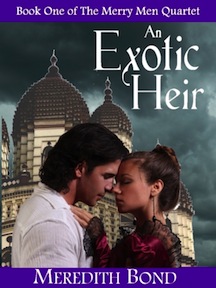
P1020122But not all of my books are set in England. A good half of An Exotic Heir takes place in Calcutta, and boy did I have a great time doing research for that! Travelling around Kolkata (as it has been renamed), walking through the Victoria Memorial’s museum which gives a wonderfully thorough history of the city, reading diaries of the English who lived in Calcutta during the Regency period. All that history is just seeped into those buildings, those letters and diaries! You can feel it just walking the streets of what was known as the city of palaces because of all the beautiful, huge homes built by the British when they lived there.

And then it struck me, as I accompanied my mother-in-law to the bazaar one morning to buy fish and vegetables: vendors have been hawking their wares in bazaars in exactly the same way for over 250 years! Yes. When you go to buy vegetables, they are frequently laid out on the ground on banana leaves just as they have been for hundreds of years. Sellers still weight the fruits and vegetables using hand-held scales dropping weights on one side to balance the precariously heaped vegetables on the other. There are only two adaptations which I have seen – bare electric light bulbs which are strung up in the evenings (although not all sellers have them, some still sell by candle light) and the cell phone which is tucked away under the seller’s legs because everybody has cell phones in India!

Exotic Heir Cover 6x8I had so much fun exploring the city, delving into its history and exploring the way people lived 250 years ago. I tried to infuse some of that into An Exotic Heir, to give a flavor of life during the British Raj. I hope you can feel it when you read the book, and I hope that you enjoy it as much as I loved writing it.

If you do, tell me! I love hearing from readers. I can be found on Facebook at meredithbondauthor, on Twitter @merrybond or you can email directly at merry@meredithbond.com.

AmazonBarnes & Noble

About A Dandy in Disguise

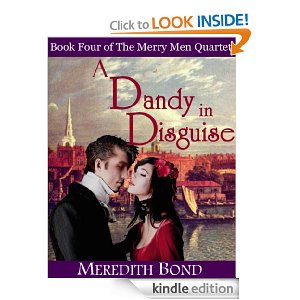
dandySt. John Fotheringay-Phipps has nearly forgotten who he truly is. As the dashing, amusing dandy known to all in society as Fungy, he has hidden himself behind a mask of merriment. But he is reminded that there are pleasures beyond society — when he finds himself feeling responsible for the innocently lovely and fiercely intellectual Rose, the daughter of a famed archaeologist, and her charming, if socially inept, family.
Rose Grace knows that she cannot gamble with her future. She has suddenly been thrust into the role of mother to her two young sisters, companion to her brilliant, distracted father –and family savior.  She needs to do the right thing — to forget her own desires and quickly find a wealthy husband before the creditors come beating at their door. Then why is she distracted by the foppishly handsome Fungy, who seems so very irresponsible and pleasure-loving?  Surely he’s the last person whose advice she should follow!
Available
About the Author
Meredith Bond is an award-winning author of a series of traditionally published Regency romances and indie-published paranormal romances. Known for her characters “who slip readily into one’s heart,” Meredith’s heart belongs to her husband and two children. Meredith’s second favorite pastime is teaching others to write.

Short and Sweet Holiday Treats

If you’re looking for a quick HEA fix for the holiday season, here are some suggestions. Not all are holiday-related and not all are sweet, heat-wise, but all are bargains and great reading!

A Holiday Anthology, Vol. 1 by Rose Anderson

holiday anthologyA Holiday Anthology, Vol. 1 is a  FREE collection of short Christmas stories By Exquisite Quills Authors and Friends. It has been written for adults who love romance stories but is family friendly. Each story is unique and is meant to give a sampling of the writing of that author. From contemporary to historical, the Exquisite Quills authors and friends wish you a happy holiday filled with wonderful books.

  • Christmas Knight by Victoria Adams
  • Star of Wonder by Rose Anderson
  • The Kissing Ball by E. Ayers
  • The Christmas Risk by Beverley Bateman
  • Fallen in Love by Helena Fairfax
  • Snow Job by J.D. Faver
  • Christmas Miracle by Jennifer Garcia
  • Highland Hogmanay by Romy Gemmell
  • Almost Christmas by Vonnie Hughes
  • The Unexpected Christmas Gift by Susan Jaymes
  • Shooting Star Holiday Express by Gemma Juliana
  • The Christmas Gift by Jean Lamb
  • A Faery’s Wish by Jane Leopold Quinn
  • Joyeux Noel by Zanna Mackenzie
  • Gifts to Treasure by Kaye Spencer

Free download on Smashwords.

**********

A Grosvenor Square Christmas by Shana Galen, Vanessa Kelly, Anna Campbell, and Kate Noble

Four breathtakingly romantic tales of a Regency Christmas from four bestselling romance authors.

Down through the years, enchantment touches a tall gray house in Grosvenor Square. The legend of Lady Winterson’s Christmas ball promises true love and happiness to one lucky couple. Who will feel the magic this winter?

1803 – The Seduction of a Duchess by Shana Galen

Rowena Harcourt, the Duchess of Valère, never forgot the handsome footman who helped her escape the French Revolution. For fourteen years, Gabriel Lamarque has loved Rowena—now at Lady Winterson’s Christmas ball, has fate finally delivered a chance to win her hand?

1818 – One Kiss for Christmas by Vanessa Kelly

Nigel Dash is London’s most reliable gentleman, a reputation he never minded until he fell in love with beautiful Amelia Easton. Unfortunately, Amelia sees Nigel as a dependable friend, not a dashing suitor. At Lady Winterson’s famous Christmas ball, Nigel vows to change Amelia’s mind—by sweeping her off her feet.

1825 – His Christmas Cinderella by Anna Campbell

At the season’s most glittering ball, a girl who has never dared to dream of forever after discovers a Christmas miracle.

1830 – The Last First Kiss by Kate Noble

Susannah Westforth has always loved Sebastian Beckett – but he’s only ever seen her as a friend. When Sebastian takes his Grand Tour, Susannah transforms herself into a woman he’ll notice. Now Sebastian is back, just in time for Lady Winterson’s Christmas ball – but the last thing he expects to see is his little Susie, all grown up…

You’re invited to join the whirling dance at Lady Winterson’s sparkling Christmas ball, where miracles happen and true love shines forever. How can you resist?

**********

Mischief and Mistletoe by Tanya Anne Crosby

Suspecting he can never be the man Emma Peters wishes him to be, Lucien Morgen, the fifth duke of Willyngham, decides to break off their long-standing engagement… only to discover the innocent fiancé he set aside for years has unexpectedly blossomed into a passionate, irresistible woman.

As the family counts down to Christmas, everyone else seems to realize Lucien and Emma are truly meant to be–except the oblivious couple. With the help of some very mischievous children, Emma and Lucien are about to discover that a little mischief beneath the mistletoe might just open their hearts to love.

**********

Christmas Roses: Love Blooms in Winter by Mary Jo Putney, Patricia Rice and Susan King

Love Blooms in Winter. Three rare, historical romance novellas by acclaimed writers Patricia Rice, Mary Jo Putney, and Susan King are collected together here for the first time in this exclusive eBook, Christmas Roses. “The Snow Rose”, “The Black Beast of Belleterre”, and “The Kissing Bough” weave tales of the joy of unexpected Love, at a special time of year, Christmas – as only these talented writers can. Discovery in the midst of a clash of clans, hidden desires from an unexpected suitor, and a love once lost and found combine for a truly romantic journey through history. This tantalizing collection of historical romances also includes all-new introductions and recipes to add to the delight of the season.

**********

The Gladiator’s Girl by Amy Hearst

Rue, a slave girl in an ancient Roman ludus, has been searching for love all her life. Her mistress often gives her to victorious gladiators for pleasure at their school as a reward for competence in the arena.But Rue has only experienced cruelty from men until she meets Ducius,a muscled and handsome gladiator who relishes their love and revives Rue’s wilting spirit. He treats her gently and nurtures her, and Rue begins to believe in the future again.Their relationship grows ever deeper each time they come together. But the shadow of death haunts them whenever Ducius sets foot upon the sands of the arena, and Rue is certain she will never escape the bonds of slavery. They both search for a path to permanent happiness, a path that can only be determined by their master.

**********

A Winning Streak by Téa Cooper

Will the path of true love incur the wrath of the virgin Goddess Artemis?

Abandoned at birth, Atalante, protege of the goddess Artemis, is forced into an untenable position by her estranged father, the King of Arcadia—renege on her vow of virginity or condemn her suitors to a sacrificial death. The aristocratic courtier, Melanion, cannot believe anyone would be foolish enough to put their life on the line for the dirty little predator whose reputation for speed and cruelty is legendary. That is until he falls under Atalante’s spell.

Consumed by desire and jealousy, Melanion is determined to win Atalante’s hand or die trying. He calls upon Aphrodite to assist him, little realizing that her noisome brat, Eros, has the pair of them in his sights and is determined to inject a little spice into their lives. Spice that will devastate the path of true love and incur the wrath of the virgin Goddess Artemis.

**********

Kisses, She Wrote: A Christmas Romance by Katharine Ashe

Christmas in town has never been so steamy . . .

Handsome as sin and scandalously rakish, Cam Westfall, the Earl of Bedwyr, is every young lady’s wickedest dream. Shy wallflower Princess Jacqueline of Sensaire knows this better than anyone, because her dreams are full of the breathtaking earl’s kisses. And not only her dreams—her diary, too.

But when Cam discovers the maiden’s not-so-maidenly diary, will her wildest Christmas wishes be fulfilled in its pages . . . or in his arms?

**********

Her New Year’s Knight by Selene Grace Silver

The holidays are a time for family. So what if Darla doesn’t have one. She’s a trained psychologist and well-versed in all the dangers of inflating the importance of one week of the year. Besides, she has her clients who need her. Unfortunately, one of them seems to have a dangerous obsession for her. She doesn’t need Santa to bring her a family. What she really needs to find under the tree is a strong protector.

This novella runs 110 pages. It contains explicit descriptions of sex. Recommended for mature (17+) readers only.

**********

All That’s Unspoken by Constance Phillips

After eight years, Hailey is back in Caseville, Michigan. Just months after her mother’s death, her siblings want to put their father in a nursing home and rent out the family farm. If that wasn’t enough, the prospective tenant is Nate, the high school crush she left behind the day after they acted on their mutual attraction.

After high school, Nate Jenkins planned to leave small town behind, but life dealt him a different hand of cards. He’s now back in Caseville, raising his daughter and running his family’s diner. His daughter’s speech disorder has been improved by therapeutic horse riding and if he can lease the old Lambert farm, he can get her a horse of her own. The only thing standing in the way is Hailey, the same woman who left him eight years ago without even saying goodbye.

Can they get over all that’s unspoken between them?

**********

Council Courtship by Constance Phillips

When Tristan Ipsly becomes eligible to fill a vacated Council seat, he thinks his chances are non-existent. Especially since he is the sole member to a house the fell to the revolution and his contender Edwin Vettore is an elder from a house that adheres to Canon teachings.

If fairykind has a chance at survival, it will come on Tristan’s wings of change. Or so Quinn Vettore believes. But voicing her support for Tristan will anger her grandfather, and he’s the one man who can stand in the way of a courtship between Quinn and Tristan.

Will Edwin successfully keep both Quinn and the position out Tristan’s grasp, or will the Council yield to change?

**********

Twelfth Night Wager by Regan Walker

THE REDHEADED RAKE
It was a dull day at White’s the day he agreed to the wager: seduce, bed and walk away from the lovely Lady Leisterfield, all by Twelfth Night. But this holiday season, Christopher St. Ives, Viscount Eustace, planned to give himself a gift.

THE VIRTUOUS WIDOW
She was too proper by half—or so was the accusation of her friends, which was why her father had found her a husband. But Lord Leisterfield was now gone a year, and Grace was at last shedding the drab colors of mourning. The house felt empty, more so during the coming Christmastide, and so tonight would begin with a scandalous piece of theater. The play would attract rogues, or so promised her friend the dowager countess. Rogues, indeed. The night would preface the greatest danger—and the greatest happiness—that Grace had ever known.

**********

The Holly and the Thistle by Regan Walker

A chance meeting at Berry’s wine shop, a misunderstanding and Christmastide all come together to allow the most handsome Scot in London to give Lady Emily Picton the best Christmas gift ever: a marriage not of convenience, but of love.

**********

Three Timeless Loves by Claire Delacroix, Terri Brisbin, Eliza Knight

Not short, but a great deal, especially if you like Scottish time travels!

**********

The Christmas Cuckoo by Mary Jo Putney

Major Jack Howard, a weary veteran of the Peninsular Wars, has just returned to England and intends to travel to an unwelcoming family home for Christmas. But when a pompous secretary gives him too many orders, Jack hops on the next stagecoach leaving the London inn, not caring where it’s going. Too much whisky to stave off freezing leaves him sleeping it off in a different inn, and when an attractive young woman asks if he’s Jack Howard, he happily goes home with her.

Despite vile weather, Meg Lambert drives to the local inn to collect her brother’s friend Jack Howard, but since she’s never met the man, she doesn’t realize that she’s brought home the wrong Jack Howard. Jack realizes her mistake when he awakes the next morning with an aching head—but he finds a warmth and welcome with Meg and her family that he’s yearned for all his life. He can’t bring himself to admit that he’s a cuckoo in her nest—but what will happen when Meg’s brother and the right Jack Howard turn up for Christmas???

**********

A Lass For Christmas by Jane Charles

Lady Madeline Trent had grand plans for her future until she learned her family’s awful secret. When a fall through an icy lake lands her in the arms of a handsome Scot, her future is more unsure than ever.

Lachlan Grant, the Marquess of Brachton, may hold an English title, but he’s a Scot through and through. He’s bound and determined to marry a lass just as Scottish as he is, at least until his fate is altered one snowy night.

A Lass for Christmas is a novella of approximately 27,000 words and the fourth story in the Tenacious Trents series.

**********

Mistletoe and Magic by Katie Rose

SusanaSays3SUSANA SAYS: A delightful holiday romance: 4/5 stars

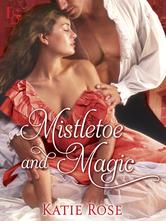
Penelope Appleton has an unusual gift—that of seeing visions of the future. Among other things, she foresaw both of her older sisters’ love matches, and then, finally, she sees her own.

When she and Jared Marton clasp eyes on each other at the Christmas Ball, they both know they are destined for each other. Unfortunately, Penelope sees something else as well—a newspaper headline proclaiming Jared’s death on Christmas Eve.

In an attempt to protect her heart from the devastating blow of losing her true love, Penelope determines to avoid Jared. But the smitten attorney doesn’t give up easily. No matter what Penelope contrives to discourage him, he manages to find a way to counteract it. And Penelope finds herself falling for him in spite of herself.

Mistletoe+and+Magic+(Novella)But Penelope’s visions have always come true, so she can’t help becoming more and more anxious as Christmas Eve approaches.

This novella is a sequel to Rose’s “Courting Trouble” and “A Hint of Mischief.” “Mistletoe and Magic” stands by itself, however, which I can verify since I have not read either of the preceding novels.

“Mistletoe and Magic” is a delightful Christmas read that will no doubt spur other readers on to obtain the first two stories and discover how Penelope’s sisters met their matches.

Available

AmazonBarnes & NobleKobo

**********

Cotillion Christmas Traditions series

cotillionchristmastraditions                    printbook copy2

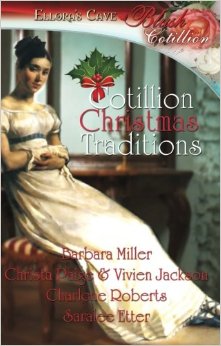
This series of eight sweet Regency novellas has previously been featured on this blog. These stories are also available in two print volumes: Cotillion Christmas Traditions and Cotillion Christmas Celebrations.

**********

A Regency Christmas Collection by Hetty St. James

Three Regency Christmas stories available in digital form as well as print and large print. Previously featured on this blog.

Mary’s Merry Christmas and Birthday Giveaway Hop

blog hop button

Happy Birthday, Mary!

Merry Christmas, Everybody!

Click on the above banner to follow the tour and increase your chances of winning one of the fabulous prizes! Click here for the Rafflecopter!

Christmas in Regency Times

Celebrated since medieval times, the Twelve Days of Christmas was a time of celebration, feasting and dancing that began on December 26 and ended on January 6 (which much later become known as Epiphany). (Christmas Day is not part of the Twelve Days because it is considered a holy day and meant for solemn reflection instead of wild partying.)

Where did the Twelve Days come from? Apparently it took the Three Kings twelve days to find the Christ Child…and the twelfth day—January 6th—is when they gave Him their gifts. In Hispanic countries, January 6—el Día de los Reyes Magos—is when people exchange gifts, not on December 25th.

During the Twelve Days, neighbors would visit each other and share traditional holiday foods such as mince pie and wassail, and entertain themselves with games and songs. Other than caring for livestock, farm laborers and peasants took this time off as well to celebrate with their families and friends.

Many Christmas traditions were pagan in origin, however.  Wassail, which was an ale-based drink with spices and honey, was used in a ceremony to sprinkle on the roots of apple trees to ensure a good crop. People would shoot off guns and make a lot of noise to scare away the demons and wake up the tree spirit. A pretty girl was selected to place cider-soaked pieces of toast in the tree branches. Then everyone would chant and sing traditional wassail songs. Although this is still practiced today in some areas, wassailing in the Regency had evolved into more of a “caroling”-type event, which you will see in my novella, A Twelfth Night Tale.

Regency Christmases tended to be more laid-back and relationship-oriented than our Christmases today. Decorations of holly and greenery, candles, roaring fires, the smells of Christmas goose and pudding, games of hoodman blind and charades, singing carols around the pianoforte, King Cake, helping others less fortunate, and engaging in lots of interaction with family and friends were the heart of Regency Christmas traditions.

No frenzied shopping, constant pressure to outdo everyone else, wearing oneself out so as to be too exhausted to enjoy the actual event. Also no Christmas trees or stockings (German traditions that came to England much later) or Christmas cards.

Wouldn’t it be great if Christmas were to return to the relaxed, people-oriented celebration it once was instead of the commercial hustle-bustle that causes stress and, eventually, credit-card shock? Or do you think it’s too late for that?

A random commenter on this post will win a Twelfth Night Tale Christmas charm bracelet.

bracelet2

About A Twelfth Night Tale

A wounded soldier and the girl next door find peace and love amidst a backdrop of rural Christmas traditions

Without dowries and the opportunity to meet eligible gentlemen, the five Barlow sisters stand little chance of making advantageous marriages. But when the eldest attracts the attention of a wealthy viscount, suddenly it seems as though Fate is smiling upon them.

twelfthnighttale_4inchLucy knows that she owes it to her younger sisters to encourage Lord Bexley’s attentions, since marriage to a peer will secure their futures as well as hers. The man of her dreams has always looked like Andrew Livingston, her best friend’s brother. But he’s always treated her like a child, and, in any case, is betrothed to another. Perhaps the time has come to put away childhood dreams and accept reality…and Lord Bexley.

Andrew has returned from the Peninsula with more emotional scars to deal with than just the lame arm. Surprisingly, it’s his sister’s friend “Little Lucy” who shows him the way out of his melancholy. He can’t help noticing that Lucy’s grown up into a lovely young woman, but with an eligible viscount courting her, he’ll need a little Christmas magic to win her for himself.

Available

Ellora’s CaveAmazonBarnes & NobleKoboSonyARe

Elizabeth Bailey and “Adoring Isadora”

Don’t put your daughter on the stage, Mrs Worthington.

When Noel Coward wrote that song, the profession of acting had acquired a certain cachet of glamour. Actresses, however, were still not respectable, and the stage-door Johnnies could still hope for the ultimate reward if they wined and dined their favourites.

Society had become much more integrated by then, but the middle classes were offended by theatrical morals and the bohemian lifestyle. This attitude did not much affect the male of the species, of course, although the well-born young man about town would encounter strong opposition if he attempted to take to the stage. An actor, however, might be accepted into exclusive circles, where his female counterpart would be firmly kept out.

Even when I trod the boards in the late sixties and seventies, there was a faint whiff of disapproval and suspicion. I remember my grandmother, on hearing I was an actress, saying to me, “But wouldn’t you rather be a secretary?” to which the short answer was “No!” What she meant was that I really ought to be doing something rather more respectable.

As the 19th century wore on, some actresses made the successful jump from stage to respectability, burying the past as “Lady” Someone or Other, but these were few and far between.

However, in the 18th century, my historical period, any female who set foot on the boards could kiss goodbye to any hope of respectability. All actresses then either got married or assumed married names, because that gave them a slight advantage and room for doubt. Sarah Siddons was probably one of the few actresses who were genuinely respectable and did not fall victim to “vice”.

To be honest, Society was not really to be blamed. The acting lifestyle provided endless opportunities for dalliance, secret assignations, intimate moments and the opportunity to enrich oneself at the expense of a generous protector. The temptation to stray was endemic, as the famous Perdita Robinson bore witness with her affair with the Prince of Wales, later Prince Regent.

Adoring Isadora3a reduced 700 x 500My heroine from Adoring Isadora knows full well what it would mean to plunge into a theatrical career, but this does not prevent her from hankering after the professional stage and making secret plans to take up a theatrical career. Isadora is hopelessly naïve, however, for she has no real idea of what such a life would mean, weaving dreams of success as a tragedienne taking the Ton by storm.

When the new head of the family, Viscount Roborough, appears, she is brought swiftly down to earth. Not that Isadora gives up easily. But questions concerning the probable earnings of an actress daunt her; nor can she ignore the potential for scandal that would come back on the family should she carry out her design.

I have to wonder if the taint of wickedness has an appeal in terms of glamour. Despite all these disadvantages, ever since women were at last allowed to appear in the theatre, replacing the young boys who had played female roles in Shakespeare’s time, the lure of the stage has always drawn the naïve, the reckless, the rebellious and the ambitious, as well as the genuinely talented.

About Adoring Isadora

Isadora’s secret plan to save her family is frustrated by the arrival of the Errant Heir, with plans of his own. As Isadora prepares to thwart him, Lord Roborough’s friendliness and warmth undermines her determination—until she discovers he is a hardened gamester.

As Roborough struggles to recover a wasted inheritance and counter Isadora’s attempts at sabotage, he is both intrigued and infuriated by her mercurial temperament. Bitterly hurt by her lack of trust, he despairs of a happy outcome.

Will the truth serve to effect a reconciliation? Or will Isadora’s outrageous plot signal the end of all hope?

Available

Amazon

About the Author

Elizabeth Bailey close-up reducedElizabeth Bailey grew up in Africa with unconventional parents, where she loved reading and drama. On returning to England, she developed her career in acting, theatre directing and finally writing. Elizabeth has 18 novels published by Harlequin Mills & Boon and recently began a Georgian historical crime series of which the first two books were published by Berkley (Penguin US). But since she still loves romance, Elizabeth is delighted with the opportunity to publish her work independently.

Contacts

Website • Facebook • Twitter • Blog

Susana Interviews Mrs. Barlow, the Mother of the Heroine of “A Twelfth Night Tale”

Susana is going all out to celebrate the release of A Twelfth Night Tale!

giant_treasure

Besides the Grand Prize—a Giant Treasure Box—she is giving away a Twelfth Night Tale Christmas charm bracelet (silver-plated) for one random commenter on each of the twelve stops of the tour.

Click here for the Rafflecopter for the Giant Treasure Box!

A Twelfth Night Tale Giant Treasure Box*

  • lovely gift box
  • A Twelfth Night Tale Christmas charm bracelet (silver-plated)
  • Father Christmas figurine
  • Three Wise Men figurine
  • Thomas Kinkade photo collage
  • Treasuring Theresa mug
  • Treasuring Theresa necklace
  • Treasuring Theresa keychain
  • two Christmas ornaments from Scotland (Mary Queen of Scots and fleur-de-lys)
  • two decks of Ellora’s Cave playing cards
  • two perfumed soaps from Scotland
  • fizzing bath salts from Scotland
  • Celtic pen from Scotland
  • “jeweled” soap
  • nail clipper keychain from London
  • stuffed toy bear

*In lieu of the treasure box, a winner from outside the U.S. will receive a gift card from the book retailer of their choice.

My time-traveling Regency lady, Lady Pendleton, came down with a stomach ailment and was unable to travel to Oxfordshire to complete the series of interviews she agreed to before returning to the 21st century. (Prior to that, however, she did manage to interview Jane Livingston, the hero’s sister, while they were both enjoying the Little Season in London.) And she somehow contrived to send Mrs. Barlow, Lucy’s mother, to me at my winter home in Florida for a brief interview. Someday I’m going to get her to tell me how she does these things. (And get her to take her back to Regency England with her—wouldn’t that be a historical researcher’s dream?)

Susana: Welcome to Florida, Mrs. Barlow. I hope you enjoy your stay. May I offer you some refreshments?

Mrs. Barlow: [looking around her in wonder] No thank you, Miss Ellis. My stomach is still a bit queasy from the journey.

Susana: Oh dear, I hope you are not coming down with the same ailment that has sidelined my friend Lady Pendleton.

Mrs. Barlow: Lady Pendleton? Oh yes, the…uh…woman who sent me here. She’s a bit…eccentric, is she not?

Susana: [hiding a smile] Indeed she is, Mrs. Barlow. But kindhearted and quite harmless, really.

Mrs. Barlow: [looking relieved] I’m glad to hear it, Miss Ellis. This is all quite a shock, you know. She said you wished to inquire about my daughter Lucy?

Susana: Er, yes. It’s research for a story I’m writing. I understand you have five daughters?

Mrs. Barlow: [Sighing] Indeed I do. Five daughters to marry off and no sons.

Susana: And Lucy is the eldest?

Mrs. Barlow: Yes, she is already eight and ten years of age and of an age to make her bow to Society, but unfortunately, her father and I have not the means to stake her. [Shaking her head] A house in London with servants is enormously expensive. We cannot even stand the cost of providing her with a suitable wardrobe. [Sighing] It is very sad, really. Lucy is a delightful girl who would be a splendid wife, but there are few eligible gentlemen here in Charlbury.

Susana: I understand the young man next door recently returned from service in the Peninsula. Livingston, I believe. Andrew Livingston. Could he be a prospect, do you think?

Mrs. Barlow: [Sighing deeply] No, unfortunately he’s betrothed to some London chit. Since before he took up his colors two years ago. I suppose they’ll be marrying posthoste now that he’s returned. A shame really, because Lucy has always had a tendre for him. The Livingstons are an unexceptionable family and quite well-to-heel, and it would be a great thing if Lucy were to be settled so near—but no, he’s never seen Lucy as anything but a child, and besides, he’s spoken for.

Susana: What a conundrum! Are there no other ways for young ladies to meet eligible gentlemen in the country?

Mrs. Barlow: Occasionally, someone’s cousin or nephew comes to town for a visit, but there are few eligibles in that lot. There are assemblies, of course. Oh, that reminds me. [Perking up] There was a quite agreeable viscount at the last assembly who seemed quite taken with Lucy. He danced twice with her. Perhaps he will come to call soon. Oh my, that would be a marvelous thing for my girls! To have their sister a viscountess who can sponsor them in London when the time comes! I must urge Lucy to encourage him!

Susana: Was she equally taken with him, then?

Mrs. Barlow: [shrugging] These things resolve themselves over time. I don’t believe she was repulsed by him. He looked well enough, for an older gentleman, and his manners were unexceptionable. It is said that he was a considerate husband to his late wife, and seems to be devoted to his three daughters.

Susana: Oh, he’s a widower. No doubt looking for a mother for his daughters.

Mrs. Barlow: And an heir, of course. He still needs a son to inherit, and Lucy is young enough to manage that.

Susana: [Doubtfully] I suppose so, and yet…one could wish a love match for her.

Mrs. Barlow: [Stiffening] Lucy is a practical girl, and not at all the sort to waste time dreaming of the impossible. She will make a wonderful wife and mother and take great pleasure in using her elevated circumstances to assist her sisters.

Susana: I’m sure she will, Mrs. Barlow. I did not mean to imply otherwise. Please forgive me if I offended you.

Mrs. Barlow: [Relaxing] Of course. I’m afraid this is a topic about which Mr. Barlow and I frequently cross swords. He says Lucy is still young and will find her own way. But he’s never been the most practical man, and I suspect he’d be just as glad to have all of them at home with us forever.

Susana: An indulgent father then. [Glances at the clock]. Oh dear, it’s almost time for our visit to end. I wonder if you’d like to take a walk around the park, Mrs. Barlow. It’s such a lovely day, and you might enjoy the flora and fauna here in central Florida. Perhaps we’ll even see an alligator in the lake.

Mrs. Barlow: An alligator! Goodness!

Susana: From a distance, of course. But there are palm trees and snake birds, and plenty of sun to warm you before you go back to chilly England

Mrs. Barlow: [shivering] Chilly indeed! The weather has been exceptionally cold this year. By all means, let us walk a bit in the sunshine.

And so ends the interview. It may interest you to know that the winter of 1813-1814, when A Twelfth Night Tale takes place, was one of the coldest on record, so much so that in February the Thames froze and a frost fair was held for four days, during which an elephant was led across the river under Blackfriars Bridge. 

About A Twelfth Night Tale
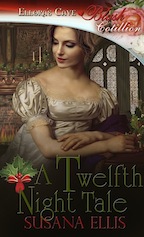
twelfthnighttale_4inchA wounded soldier and the girl next door find peace and love amidst a backdrop of rural Christmas traditions.

Without dowries and the opportunity to meet eligible gentlemen, the five Barlow sisters stand little chance of making advantageous marriages. But when the eldest attracts the attention of a wealthy viscount, suddenly it seems as though Fate is smiling upon them.

Lucy knows that she owes it to her younger sisters to encourage Lord Bexley’s attentions, since marriage to a peer will secure their futures as well as hers. The man of her dreams has always looked like Andrew Livingston, her best friend’s brother. But he’s always treated her like a child, and, in any case, is betrothed to another. Perhaps the time has come to put away childhood dreams and accept reality…and Lord Bexley.

Andrew has returned from the Peninsula with more emotional scars to deal with than just the lame arm. Surprisingly, it’s his sister’s friend “Little Lucy” who shows him the way out of his melancholy. He can’t help noticing that Lucy’s grown up into a lovely young woman, but with an eligible viscount courting her, he’ll need a little Christmas magic to win her for himself.

Available

Ellora’s CaveAmazonBarnes & NobleKobo

Excerpt

Jane was chatty as usual, prattling on about the wedding, her latest letter from Theodore and the coming events for the Christmas holidays.

“We are expecting you all at our house for Christmas dinner as usual,” Lucy broke in. “Mama has a new recipe for plum pudding and she’s anxious to see what you think of it.”

The Livingstons had been guests of the Barlows for every Christmas dinner since Mrs. Livingston’s death. Jane and Andrew’s mother had been a wonderful hostess and a great advocate for the Yuletide traditions, and after she had passed away,

Mrs. Barlow had begun the practice of sharing the family Christmas with their good friends and neighbors. There was never a dull moment in a household with five such lively daughters as the Barlow girls, and the Livingstons were not allowed the luxury of brooding over the past during a time of year meant to be joyful.

“Yes indeed,” piped up Mr. Livingston. “Your mother sets a fine table and it’s always a pleasure to be among so many pretty young lasses, is it not, Andrew?”

“Most assuredly,” said Andrew, with an appreciative smile at Lucy. “If Miss Barlow here is any indication, the Barlow girls must be growing up quite agreeably.”

Lucy flushed. “You must come to the church tomorrow night for the Christmas Eve pageant,” she put forward. “My sisters and I are all in the play, and Jane will need an escort.”

Andrew raised his eyebrows. “You are all five in the play? I don’t recall so many females involved in the nativity.”

Lucy laughed. “I’m the director,” she said. “Laura plays the part of Mary, Lydia is one of the wise men, Louisa is a shepherd, and Lila is a camel.” She grinned. “The script originally called for domestic animals, but Lila being Lila, refused to settle for anything so mundane.”

“Who, then, is the Christ Child?” inquired Andrew after the laughter had subsided.

“Louisa’s cat, Beau,” Lucy told him. “We meant to use the Tadsens’ baby in the beginning, but he wouldn’t stay still and kept crying, so we tried several dogs and cats for the part, and Beau was the most cooperative.”

More smiles circled the table, and Andrew agreed that he would be pleased to escort Jane to the pageant.

“How could I possibly refuse? This production is certain to be the highlight of the county. You should accompany us, Papa,” he said, turning to his father.

“Perhaps I shall,” said Mr. Livingston.

Jane and Lucy excused themselves, leaving the two gentlemen to their port.

“Oh Lucy!” Jane said when they reached the drawing room. “I’ve had the most marvelous idea! Well, it was your doing, really.”

“Me? What did I do?” Lucy was mystified.

“You invited Andrew to the pageant! Brilliant thinking! He’s been holed up in his bedchamber like a grumpy bear for weeks now, even before Cecilia jilted him. We need to get him out of the house. Encourage him to meet other people and stop feeling sorry for himself.”

She gave Lucy a speculative look. “And now that I think about it, you would be the best person to do it. Cheer him up, I mean. I haven’t seen Andrew in such a lively frame of mind since…well, before he went off to war.”

Lucy was horrified…and hopeful. “You want me to be in charge of cheering up Andrew? Why not you? You are his sister.”

“I’ve tried everything I know, and it’s no use. You are with him for an hour and he’s laughed twice!” She grasped Lucy’s shoulder. “Look, I’m not asking you to marry Andrew or anything like that. All you have to do is come for visits, bring your sisters, persuade him to get out of the house, things like that. You can do that, can’t you? For my sake?”

“Well…” said Lucy doubtfully.

“You do like Andrew, don’t you? Want him to regain his spirits?”

“Of course.” That was the problem. She liked him far too much. It wouldn’t do to get her hopes up and then have them dashed to pieces.

“Then it’s settled.”

And in spite of everything, Lucy was glad that it was.

Contacts

Web site • Email • Facebook • Twitter • Linked In • Pinterest • Google+Goodreads

Susana’s Parlour (Regency Blog) • Susana’s Morning Room (Romance Blog)