Archives

Amy Quinton: What the Marquess Sees

Thanks, Susana, for having me on your site today.

And hello, dear Readers. Thanks for helping me celebrate my latest release, What the Marquess Sees, and for tuning in to my silliness. I cannot believe the day has come! I never thought it would be quite so long between books 1 and 2. I don’t plan to allow quite so much time between books 2 and 3.

What the Marquess Sees is the second book in my Agents of Change series and tells the story of love and intrigue for two very different, yet very interesting characters, Lady Beatryce Beckett and Clifford Ross, 7th Marquess of Dansbury. Both characters appeared in the first book of the Agents of Change series, What the Duke Wants. In What the Duke Wants, Dansbury was quite the charmer and best friend to my main character, the Duke of Stonebridge. Lady Beatryce – was the duke’s betrothed and definitely not nice… and she tried everything in her power to see that she, and only she, would be marrying the Duke of Stonebridge.

Needless to say, her efforts did not play out as she’d hoped. However, I doubt now that she’s sorry she lost now…

Here’s a quick summary of what book 2, What the Marquess Sees, is about:

England 1814: He is a marquess with a woman to protect and an assassin to thwart. She is…not nice.
hrwhatthemarquesseesThe Marquess of Dansbury is a strong, charismatic man living a charmed life as an agent for the crown. His past isn’t without tragedy, but he is too amiable to allow misfortune to mar his positive outlook on life. Until now…when he finds himself tasked with protecting the one woman in the world he actively disdains, Lady Beatryce Beckett.

Lady Beatryce Beckett is mean. She ruins other women on purpose. She lies. She cheats. She even steals. And she takes particular pleasure in provoking a certain marquess. In short, she’ll do anything to get what she wants: freedom from her abusive father. But she is strong (she’s had to be), worthy (who’d have thought it), and in love… Wait, what?

It will take a special man to see the true woman beneath the surface…and a strong woman to allow him that glimpse. Is the Marquess of Dansbury up to the task?

Recently, I was able to catch up with Lady Beatryce and Dansbury and ask them some questions about their story and their life. Here’s what they had to say:

Amy Quinton, author: Lady Beatryce, Dansbury – it’s great to see you…. It’s been a while.

Lady Beatryce: Thank you.

Dansbury: It’s a pleasure to see you again. How are you?

Amy Quinton, author: Still the charmer, I see. I’m fine Dansbury. Working with a couple of your friends on my next story, Book 3 of the Agents of Change series.

Dansbury: Excellent. Can you give us some hints?

Lady Beatryce: D… Let her ask her questions…

Amy Quinton, author: Thanks Lady Beatryce. So Lady Beatryce, Dansbury – tell us about the first time you met.

An uncomfortable silence ensues. Dansbury clears his throat, no longer quite at ease.

Lady Beatryce: It’s rather a sore topic of conversation.

Lady Beatryce looks over at D who is still ill at ease and then turns back to me. She folds her hands and lifts her chin. Confidence is her forte.

Lady Beatryce: It was a black moment in my life. He caught me at a low point. I had just ruined a girl, on purpose, you see… I don’t regret my actions; I had my reasons, but there it is…

Dansbury: I must admit, for a moment there, I questioned your decision to throw us together, Mrs. Quinton… though I’m glad you did, of course.

Lady Beatryce: He hated me.

Dansbury: Actually, that wasn’t my very first reaction, my urges where far more, er… base, but then when I overheard you and Lord Middlebury…

Dansbury’s hands turn white as he clenches them into fists. His voice takes on a rough edge.

… then, yes, I did hate – well, I’ll admit to strongly disliked – her.

Lady Beatryce just raises her brow in question…

…right, then. Yes, I hated her.

He looks at Beatryce…

…But you were exactly who I needed you to be…

Dansbury reaches over to Lady Beatryce and squeezes her hands. My God, he loves that woman.

Amy Quinton, author: Honestly, I didn’t like her either. Sorry, Lady Beatryce. But I began to learn (while working on the Stonebridge’s story (What the Duke Wants)) that she was more than the mask she presented to the world. And I realized that of everyone, you, Dansbury, were the one man capable of seeing the woman beneath the surface…. So it was inevitable. And truthfully, you were simply too charming to fail.

Dansbury: Aw, Mrs. Quinton, if you’re not careful you’ll make me blush.

Amy Quinton, author: *laughing* I won’t tell. I admit I was also surprised that your story turned out to be so much more… erotic… and used far more adult… um language, if you will, than my first book.

Dansbury: Now I am blushing. But we aren’t anything like Grace and Stonebridge, are we? We’re both very passionate people and we genuinely hated each other… but then you threw us together, on the run from a madman, no less – against our expressed wishes – so, things were bound to be explosive.

Lady Beatryce: La, that is certainly true.

Amy Quinton, author: Lady Beatryce, we learn early on in this story that you have quite a sense of humor lurking beneath the surface. And you’re awfully good at impersonations – you’re especially good at impersonating Dansbury here. Care to give us a demonstration?

Dansbury: Wait… when did this happen?

Amy Quinton, author: Chapter 1 – didn’t you read the book?

Silence…

Amy Quinton, author: I’ll take that as a no. But I’m surprised, Dansbury. It’s your story. Why wouldn’t you want to read it?

Dansbury: I lived it – I don’t need to read it. And perhaps I don’t honestly wish to relive those early days. I admit that I could have been a touch nicer to Bea.

He looks over at Beatryce and cracks a smile.

Amy Quinton, author: OK – now that’s sweet. That’s fine, we’ll skip the impersonations for now… hopefully our readers will enjoy reading them in the story.

Lady Beatryce, in the first book, you took your cousin’s journal, something very personal and important to her, and threw it in the fire. Right in front of her. I admit, that’s cold. Now, knowing everything you do, do you regret that?

Lady Beatryce: No

Amy Quinton, author: Wow, no hesitation there. And I see Dansbury is tensing up again…

Lady Beatryce: La, how could I possibly express regret – even now? Everything I’ve done – good or bad—has lead me to where I am now. It brought me to you, Dansbury. I would not rewrite a single moment of my past for fear that I would lose you in the process.

Amy Quinton, author: Wow that is saying something. Dansbury you are a fortunate man. She loves you very much.

One side of his mouth quirks up in a very charming way, the result a shy but charismatic grin.

Dansbury: I know it.

Of course, he isn’t looking at me when he speaks – he only has eyes for Lady Beatryce. But I’m not pulling my punches either.

Amy Quinton, author: Dansbury. Why did you ask Miss Grace Radclyffe to marry you?

And Lady Beatryce looks like she’s going to kill me now, but I’m just going to ignore her for the moment.

Dansbury: Mrs. Quinton you like to live dangerously. Let me see. I respected her, Grace, that is. And it was the only thing I could think to do at the time to protect her from the fallout of Stonebridge’s idiotic behavior. I do know, now, it would have been a dreadful mistake. Fortunately, Grace is smarter than I and refused me.

Amy Quinton, author: Thanks, Dansbury. That reminds me, you know your actions nearly had you stealing the show in book 1… I had reader after reader tell me how much they liked you… it was very naughty of you.

Dansbury: *laughing* Stonebridge expects no less from me.

Amy Quinton, author: I’m sure. I need to start wrapping this up, so let’s get a few more quick questions in… Lady Beatryce have you come to terms with your past? Have you forgiven yourself?

Lady Beatryce: I lapse from time to time, still. Old habits are difficult to break, but I try my best.

Amy Quinton, author: I turn to look at Dansbury… Plans for the future? What about the investigation?

Beatryce: We cannot discuss it at this time.

Amy Quinton, author: Lady Beatryce, I’m surprised by your response –really, by the fact that you responded. Are you going to take a more active role moving forward?

Lady Beatryce: Possibly… we will simply have to wait and see, shall we?

Amy Quinton, author: Interesting… Lady Beatryce, in the blurb, it mentions that you lie, you cheat, you even steal… Is this an accurate description of your character?

Lady Beatryce: Perhaps…

Amy Quinton, author: And Steal? I don’t recall you stealing anything in the book, per se… So can you tell us more? What have you stolen? Inquiring minds want to know…

Lady Beatryce: Hmmm all of them – er… all of the things I’ve stolen?

Amy Quinton, author: So it’s happened more than once? I see. Um, no just give us a “for instance”.

Lady Beatryce: La, let me think… I’ve stolen the odd bobble and ribbon from one of my sisters, of course, but that hardly signifies. We were siblings.

Look. Let’s just say I have stolen some valuable things from other people in the aristocracy. The reasons are many and various. I’m not sure it’s a good idea to divulge the details, but I can say that no one has unreasonably suffered due to my thieving. And I refuse to say more.

Amy Quinton, author: All right, fair enough. Now, Beatryce, in the story, we learn that you are a runner. And while exercise as it pertains to engaging in a physical activity dates back to the 17th century, it’s not very common for woman during your time. What or who turned you on to running and working your muscles for relieving stress?

Lady Beatryce: No one really. I just ran a lot as a child and realized that I always felt better afterwards… so I simply never stopped. And it came in very useful when I became a woman… I needed it… the release. I never realized just how much it would help me later in life; I’m thankful I never stopped.

Amy Quinton, author: So any plans for the future you’d like to share?

Lady Beatryce: For the moment, the investigation is our only priority.

Amy Quinton, author: Dansbury, are you going to allow her to continue working on the case?

Dansbury: Do you think I’d even try to stop her? You should know my wife better than that… so, no, not a chance.

Amy Quinton, author: Good. How about we give the readers an excerpt from the story now?

Lady Beatryce, Dansbury: Sure.

Amy Quinton, author: How about the Goat Scene?

Dansbury: Absolutely not.

Amy Quinton, author: What are you worried about – it’s hysterical and they’re going to read it eventually.

Dansbury: Yes, but not while I’m present for the reading.

Amy Quinton, author: All right. I’ve got one. It’s personal and deep – and Dansbury, you’re not being too much of a dummy.

Dansbury: Thanks?

Ah, the beast awakens.

“For the sake of your life, I am going to pretend you didn’t just ask me that question.” His eyes narrowed. “But I’m thinking you’re doing it on purpose?” He looked deep and peeked into her soul. He was the only one who might be capable. The only one who’d ever tried.

“Are you, Beatryce? Are you intentionally being disgusting and low simply to infuriate me?”

“Oh, Dansbury,” she laughed in an attempt to distract him from looking too close, “you do think highly of yourself, don’t you? Besides, I can’t imagine why I would want to do a silly thing like that.”

If anything, he leaned closer. “Can’t you, Lady Beatryce?” He placed one hand at the base of her neck and slid up until he cupped her chin in the palm of his hand. “Truly, Bea? Perhaps…Hmmm…” He closed his eyes and inhaled a long, drawn-out breath, and when he opened his eyes, she nearly drowned in their brown and gold-flecked depths. She unconsciously leaned into him. “Perhaps it’s you who is scared.” His voice was a whisper now. “Perhaps you yearn…to trust…me…”

He was far too close to the truth, damn his perceptive eyes. She shook off whatever magic spell he wove over her analytical mind. It wasn’t easy.

“Dansbury, I couldn’t even trust my own father. My. Own. Father! The one person in the world I should have been able to trust. Everyone else was…dead. So, no. I will never be able to trust you, or anyone else for that matter. Because when it comes down to it, we’re all just looking out for ourselves.”

His eyes softened, a response she could not have predicted.

“Can you not see that your past is coloring your perceptions of everything and everyone around you?”

“Of course it does, I am my past. I cannot divorce myself from it.”

“Sure, sure, but you can choose to not let it define your future. You can choose to look for the good in others.”

“That’s easy for you to say.”

“This isn’t about me. Somehow, someway you are going to have to learn to put your past behind you if you ever want to have a future with any remote chance of happiness.”

“But I don’t know how to be any other way! My father abused me. Abused. Me.” She slammed her fist into her chest to drive home the point. “His own daughter. And he allowed others to do so as well. How in the hell could I possibly trust anyone besides myself?”

“Oh, Bea…”

“No! Don’t ‘Oh, Bea’ me. Don’t pity me. And you sure as hell better not trust me.”

“Oh, I definitely don’t pity you. But I am frustrated to see the pain reflected in your eyes. To see the hint of doubt in yourself.”

“I will never doubt myself.”

He didn’t swallow the lie. “You say you are strong. You act like you are strong.

Now, you must believe it too! What is this if not doubt in yourself?”

“I never doubted myself before I met you!”

“Never?”

Slap.

Amy Quinton, author: Well, I suppose you deserved that one, Dansbury.

Dansbury: Indeed.

Amy Quinton, author: Well, thank you Lady Beatryce, Dansbury, for giving our dear readers a chance to hear you guys speak about your story, and for being so honest with some of my more probing questions.

Dansbury: The pleasure is all ours.

Lady Beatryce: It was good to see you again, Mrs. Quinton. Let us not wait so long between visits, yes?

Amy Quinton, author: Definitely. I’m sure we’ll talk from time to time while I work through Alaistair MacLeod’s story.

Lady Beatryce: Indeed.

*˜*

Dear Readers, thank you so much for considering reading What the Marquess Sees. I have additional excerpts and buy links on my website at www.amyquinton.net if you are interested.

I hope you enjoy reading What the Marquess Sees, and I look forward to hearing what you thought about the Lady Beatryce and Dansbury’s story.

Amazon • Barnes & Noble • Kobo

About the Author

AuthorPhoto_WhatTheDukeWants copyAmy Quinton is an author and full time mom living in Summerville, SC. She enjoys writing (and reading!) sexy, historical romances. She lives with her English husband, two boys, and two cats. In her spare time, she likes to go camping, hiking, and canoeing/kayaking… And did she mention reading? When she’s not reading, cleaning, or traveling, she likes to make jewelry, sew, knit, and crochet (Yay for Ravelry!).

Amy has lived in or around the Charleston, SC area her entire life. When she’s not home, at the beach (weather permitting), or camping in and around the Great Smoky Mountains (Check out Mile High Campground and Devils Fork State Park!), she loves to visit the United Kingdom. She loves the history, the culture, and the people—hence her love for Scottish and Regency Romances. She especially loves to visit the Isle of Skye—in the Highlands of Scotland—where the scenery is both rugged and breathtaking.

Amy graduated from the College of Charleston, a liberal arts college located in beautiful, historic Charleston, SC. She worked 10 years in the computer industry as a software designer before becoming a full time mom and now, a full time novelist.

WebsiteFacebookTwitter


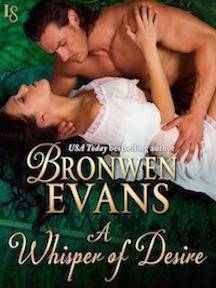
Bronwen Evans: A Whisper of Desire (Giveaway)

I’m so excited to be in Susana’s Parlour today. My new Regency romance, A Whisper of Desire, released this week. It’s book #4 in my Disgraced Lord series but it can be read as a standalone. I thought I’d take the opportunity to interview my heroine, Lady Marisa Hawkestone. We ladies like to chat, but as I live in New Zealand I don’t get the opportunity to visit England very often.

About A Whisper of Desire

Sensual heat melts the ice in the new Disgraced Lords novel from USA Today bestselling author Bronwen Evans, as a marriage of convenience leads to delightful pleasure—and mortal danger.

A Whisper of Desire_200x267 copyLady Marisa Hawkestone’s nightmare is just beginning when she wakes up naked, with no memory of the night before, lying next to Maitland Spencer, the Duke of Lyttleton—a man so aloof and rational he’s nicknamed “the Cold Duke.” A scandal ensues, in which Marisa’s beloved beau deserts her. As a compromised woman, Marisa agrees to marry Maitland. But on her wedding night, Marisa discovers the one place the duke shows emotion: in the bedroom, where the man positively scorches the sheets.

Taught from a young age to take duty seriously, Maitland cannot understand his new wife’s demands on his love and affection. Marisa’s hot-blooded spirit, however, does have its attractions—especially at night. In retrospect, it seems quite silly that he didn’t marry sooner. But being one of the Libertine Scholars requires constant vigilance, even more so when the enemy with a grudge against his closest friends targets Marisa. Now Maitland must save the woman who sets his heart aflame—or die trying.

Interview

Bron: Welcome, Marisa. Tell us a little about yourself.

Marisa: Good afternoon. Thank you for visiting with me today. Would you like some tea? (Me: yes, I’m a big tea drinker. Thank you). Hmmm, what shall I reveal?

I’m the eldest daughter of the late Marquis of Coldhurst. Both my parents are dead. They died in a carriage accident when I was young, and Sebastian, my elder brother, is now the Marquis, brought us up. I have a younger sister Helen.

Bron: Did you have a happy childhood?

Marisa: (sigh) No, not really. I had Helen. She’s only eighteen months younger than me but my brother is ten years older and he was rarely around. He was the lucky one. He could escape.

Bron: Escape what?

Marisa: My parent’s terrible altercations and even physical fights. You see, their marriage was a ‘supposed’ love match. The were both of them consumed with jealousy, accusing each other of infidelity. The fights were awful. Helen and I used to hide in our rooms.

Bron: That must have had a dreadful affect on you?

Marisa: It did. If this was love I wanted nothing to do with it.

Bron: You’re married now­—you had to marry. Is that still the case?

Marisa: (shakes her head) No. When Sebastian married Beatrice (Book #2 A Promise of More), I learned what true love means. It’s about trust, friendship, loyalty, real love doesn’t hurt. I thought I’d found that with Lord Rutherford but he was a liar and manipulator and I’m so thankful that my husband, the Duke of Lyttleton was set up to compromise me.

Bron: Do you love your husband?

Marisa: With every breath I take. He’s taught me about all those things I mentioned – loyalty, friendship and trust.

Bron: Does he love you?

Marisa: (gives a big smile) Unconditionally. If you read the book you’ll learn why, to me, his love for me is such a blessing.

Bron: Thank you for opening up your personal life to us. I look forward to hearing more of your story in the follow up books to A Whisper of Desire.

AmazonAmazonUKBarnes & NobleiBooksKoboGoogle Play

Excerpt

Maitland had hero-worshipped Marisa’s brother for many years. He’d been able to repay Sebastian, and the other Libertine Scholars, with his uncanny investment ability. Numbers had always made more sense to him than people. Numbers didn’t lie. They were logical, rational, and impossible to manipulate, if you were smart.

“I will agree that you can ask Rutherford if he will still marry you, even though you’re now compromised.” He looked at Marisa. Really looked. “Shall we make a pact to be friends? Regardless of the outcome of your talk with Rutherford, I shall count you as my good friend as I would Sebastian.”

“If you were my friend you’d tell me what you know about Rutherford. I bet you’ll tell Sebastian.”

She was right. If he were her friend he would tell her. He was certainly going to tell Sebastian. “I knew you were intelligent. I’ve walked right into your trap.”

She rolled onto her side, facing him, and the quilt dropped dangerously low. He could almost see one nipple as his eyes roamed over the swell of her breast. Her eyes twinkled and her smile tugged a reluctant upturn of his lips in return.

“As your friend, tell me.”

He pushed a stray piece of hair behind her ear, the urge to touch her too strong. “I don’t want to hurt you. Rutherford should be man enough to tell you himself, but as I know he’s deceiving you, I doubt the boy knows what the word ‘truthful’ means.” She pulled her bottom lip between her teeth and began to chew on it. At her silence, he looked her in the eye and told her what he knew. “He was in the garden tonight while I was smoking a cheroot and he was not alone.”

He watched her swallow back a curse.

“He was with a woman?”

Maitland nodded.

One lucky commenter will win a digital copy of one of Bronwen’s backlist.

Bronwen is giving away a gift basket full of surprises, along with a Kindle Fire. Click here for the Rafflecopter.

About the Author

Bron_300x421-2 copyUSA Today bestselling author, Bronwen Evans grew up loving books. She writes both historical and contemporary sexy romances for the modern woman who likes intelligent, spirited heroines, and compassionate alpha heroes. Evans is a three-time winner of the RomCon Readers’ Crown and has been nominated for an RT Reviewers’ Choice Award. She lives in Hawkes Bay, New Zealand with her dogs Brandy and Duke.

EmailWebsiteFacebookTwitter


Catherine Lloyd: Death Comes To Kurland Hall (Giveaway)

I have the great pleasure of writing Regency-set historical mysteries for Kensington Publishing under the Catherine Lloyd name and book three of The Kurland St. Mary mysteries Death Comes To Kurland Hall just came out. They are quite different to write than my romances, move at a slower pace and require a lot more upfront plotting than I am used to.

It is nice to write Major Robert Kurland, a less romantic and more realistic heroic kind of hero who has a bad temper, is an invalid after the Battle of Waterloo and a bit of an all round grump. Likewise, my heroine Miss Lucy Harrington is neither beautiful nor malleable, and is rather too strong-willed to settle for a lifetime in service to the men in her family.

I grew up in England so I also get a great deal of pleasure in writing about places I am familiar with including London, my home town, Brighton, Bath and various local villages. On a trip back for a wedding this summer I had a lovely time jotting down the names of various villages we passed through on our way through Suffolk for future reference.

Even more thrilling, for a history nerd was the chance to actually sit down and eat lunch (gammon, eggs, chips and peas) in the actual inn The Swan in Thaxted that appears in my third book! I always try and use the real pub names because an amazing amount of them have survived for centuries.

So if you enjoy cozy Regency mysteries, give the Kurland St. Mary series a try. As an incentive, I’ll be giving away 3 copies, (print or digital) of Book One, Death Comes to the Village.

What’s your favorite place to visit in England?

DEATHCOMESTOKURLAND copy

About Death at Kurland Hall

As wedding bells chime in Kurland St. Mary, a motley group of visitors descends on the village—and with a murderer on the prowl, some of them may not be returning home…

Lucy Harrington has returned to Kurland St. Mary to help with her friend Sophia Giffin’s wedding. But her homecoming is made disagreeable by the presence of Major Robert Kurland, whose bungled proposal has ruffled Lucy’s composure, and a meddling widow who has designs on her father, the village rector.

Wary of the cloying Mrs. Chingford from the start, Lucy has doubts about the busybody’s intentions with her father. But everyone else seems to think they make an ideal match—until the courtship is curtailed when Mrs. Chingford is found dead at the bottom of a staircase. It’s clear that it wasn’t an accident, and in hopes of finding the culprit, Lucy and Robert call a truce and begin scrutinizing the wedding guests.

But the widow left behind plenty of enemies, and when one of them is the next to turn up dead, Lucy and Robert discover that the truth is far more scandalous than anyone could have imagined…

Amazon • Barnes & Noble • Kobo

About the Author

IMG_1504 copyCatherine Lloyd was born just outside London, England into a large family of dreamers, artists and history lovers. She completed her education with a master’s degree in history at the University College of Wales, Aberystwyth, and currently lives in Hawaii with her husband and fourth child.

Website FacebookNewsletter


Louisa Cornell: Christmas Revels II (Giveaway)

How to Survive a Regency Family Christmas

With Christmas a little over a month away, the thoughts of any lady of the house must turn to…

“Who invited all of these people and how will I keep them entertained?”

There are all sorts of possibilities available to the discerning hostess of today. Many guests simply require a place to plug in their phone or their laptop. A television and a stack of Christmas DVD’s can provide hours of amusement to guests of all ages. Video games, board games, bowl games, and music to suit every ear and every pair of dancing feet can be provided at the mere touch of a button. And let us not forget, if all else fails, a nice Christmas punch laced with a suitable spike can keep those hard to please guests quiet if not entertained.

Think of the dilemma faced by the mistress of the house in England two hundred years ago. Unpredictable weather, no electronic options, and each and every friend, acquaintance, and relation looking to be fed, housed, and amused. What is a Regency era lady of the manor to do? Fortunately there are a number of Regency Christmas traditions designed to keep the guests occupied and the lady’s reputation as the consummate hostess secure.

As many Christmas gatherings might last as long as a month (from St. Nicholas Day to Epiphany or Twelfth Night,) a good hostess had to provide a bounty of entertainment for her guests. Trapped in a house, no matter how large and stately, with friends and relatives for an entire month could be trying at best and akin to a wartime siege at worst. In addition to the usual Regency party games – charades and whist, here are a few sources of entertainment common to a Regency Christmas.

On St. Nicholas Day (December 6th) small gifts were exchanged among friends. This marked the official beginning of the Christmas season. After this the rounds of Christmas balls, parties and visits ensued.

While Christmas carols might be sung around the piano by friends and family, caroling as we know it was not something members of the ton did, save perhaps a group of young people out for a lark.

However, while there were no Christmas carolers in Regency England, there were wassail groups who would go from house to house singing begging songs in the hope of receiving food, drink, and money. Wassail was a mixture of beer, wine and brandy and was usually served to the singers at each house.

The house was not decorated for Christmas until Christmas Eve. To do so earlier was thought to bring bad luck. Whilst servants often “brought in the greens,” as it was called, a more creative hostess might send her guests, especially the younger ones, to make up a party and go out into the estate’s forests and woodlands in search of greenery to festoon the manor. The guests enjoyed a bit of fresh air and exercise and there were many opportunities for young men and women to end up under the mistletoe for a surreptitious kiss as they cut it for kissing boughs to be hung in each open doorway and out of the way corner for later “accidental” meetings. Men had the opportunity to show off for the ladies as they dragged the yule log into the house to be lit from a stub from last year’s log and burnt in the hearth until Twelfth Night.

Another source of entertainment were troupes of players called mummers, a tradition dating back to the medieval era. These varied from professional players to groups of lower class men who went from door to door asking if mummers were wanted. A good hostess might even hire a specific troupe to stop and entertain her guests. They were dressed in elaborate costumes with high paper caps – gilded and spangled, and ribbons of every color tied to their clothes. The characters of St. George and the Prince were also armed with ten swords. Their performance was called a “mysterie,” a very specific sort of play, which ended with a song and the collection of funds from those who had enjoyed the performance.

It is thought these mummers’ plays were the forerunners of a Regency tradition still alive today in England – the Christmas pantomime. It usually opened on Boxing Day (December 26th) and was performed in local theatres. Drury Lane hosted one in London and even Astley’s Amphitheatre held a special Christmas spectacular.

Another Boxing Day activity for the men in attendance, and some of the more adventurous ladies, was fox hunting. The Boxing Day Hunt was a long standing tradition, one I observed when I lived in England as a child.

Under the heading of a Regency version of “Hey y’all, watch this!” comes the Christmas game of Snapdragon. Raisins were soaked in brandy in a large shallow bowl. The lights were snuffed out, and the brandy lit. People had to try and grasp a raisin and eat it without burning themselves. I think you’d have to soak me in brandy to get me to try it!

A more tame version of the game was called bullet pudding and is described here in a letter from Jane Austen’s niece, Fanny Knight, to a friend.

Godmersham Park, 17 January 1804

…I was surprised to hear that you did not know what a Bullet Pudding is, but as you don’t I will endeavour to describe it as follows:

You must have a large pewter dish filled with flour which you must pile up into a sort of pudding with a peek at top. You must then lay a bullet at top and everybody cuts a slice of it, and the person that is cutting it when it falls must poke about with their noses and chins till they find it and then take it out with their mouths of which makes them strange figures all covered with flour but the worst is that you must not laugh for fear of the flour getting up your nose and mouth and choking you: You must not use your hands in taking the Bullet out.

I think this might be a successful game even today. It sounds like a great deal of fun.

Christmas trees were not prevalent during the Regency, although some houses were known to put up small ones bedecked with small gifts. They were made more popular in England by Queen Victoria and Prince Albert in the middle of the 19th century. However, on Epiphany Eve, men would gather round a tree, usually in an orchard, with cider and guns. In an ancient ceremony, they would drink to the tree and fire the guns to drive away evil spirits and promote the vigor of the trees. Horn-blowing was an alternative to firing guns. One would hope the lady had a physician in attendance, just in case.

A more ambitious hostess might engage her guests in performing their own Christmas play. With a month to write and rehearse it, some of these plays were quite elaborate. And on Twelfth Night (the official end of the Christmas season) gifts were exchanged again and a masquerade party was held. To add to the fun, guests sometimes had to search the house for elements of their costumes. Sometimes they would draw names of characters they were to play throughout the party. The characters’ names usually described the sort of person the guest was to portray. Mrs. Candor – a lady who always speaks with perfect frankness. Miss Tittletattle, who speaks nothing but gossip. Lord Bumblefoot, who trods on ladies’ toes when dancing. The character must be maintained throughout the party.

Once the Twelfth Night festivities were over it was time to take your leave until next year. As you can see, a lack of electronic devices did not hinder the ladies and gentlemen of the Regency era from celebrating Christmas with a great deal of laughter, joy, friendship, and love. Exactly what I wish for each of you during this most wonderful of seasons!

Do you have any unique Christmas traditions or forms of entertainment enjoyed by your friends and family? Tell us about them! A random commenter will receive an e-copy of either Christmas Revels or Christmas Revels II – winner’s choice.

CR - ebook cover copy

About Christmas Revels II

Let the Revels begin—again! Four new stories with four distinctive voices:

The Vicar’s Christmas by Anna D. Allen

Margaret Trent never needs anything or anyone, but when two London solicitors show up on her doorstep, she needs a hero. Enter Henry Ogden, mild-mannered village vicar. Hardly the stuff of heroes . . . until adversity brings out unexpected talents.

A Christmas Equation by Hannah Meredith

A chance meeting between a reluctant viscount and a self-effacing companion revives memories of their shared past—a time when they were very different people. With secrets to keep, Sarah Clendenin wishes Benjamin Radcliff gone . . . but he’s making calculations of his own.

Crimson Snow by Kate Parker

A trail of blood drops leads Jane Merrywether to a wounded stranger—the only person standing in the way of her wicked guardian becoming an earl. John Rexford, long-thought dead, has returned to claim his inheritance and his promised bride . . . if he can survive a murderous Christmas.

A Perfectly Unregimented Christmas by Louisa Cornell

After years at war, Viscount Pennyworth returns to his ancestral home to find some peace and quiet and to avoid the holiday he loathes. But four naughty boys, a bonnet-wearing goat, a one-eyed cat, a family secret, and one Annabelle Winters, governess, make this a Christmas he’ll never forget.

AmazonBarnes & Noble iBooks • Kobo


Excerpt

A Perfectly Unregimented Christmas

“And what of Christmas, my lord? Are the boys to have no part of the holiday?”

“I have not celebrated Christmas in twenty years, Mrs. Winters. Soldiers seldom have much chance on the battlefield.”

“This is not a battlefield, my lord. This is your home. And theirs while they remain.”

He crossed the room to where she sat. Putting one hand on the table and the other on the back of her chair, he leaned over her. The scent of soap, leather, and cloves made her want to move closer, but she did not dare.

“I have been pelted with snow-covered potatoes, knocked down the stairs, attacked by some unidentified one-eyed creature—”

“Attila. He’s a cat.”

“By what right does that thing call himself a cat? I have had my breakfast poisoned, my patience tried, and my sanity called into question. What would you call it, if not a battlefield? There will be no Christmas in this house.” He blinked. Slowly removed his hands. And took a step back. With a brief nod he turned to go.

“We’ll just see about that,” Belle muttered.

“Do not go to war with me, madam. I have years of experience and tricks you cannot begin to imagine.” He threw open the parlor door and stalked down the corridor, his boots delivering a ringing celebration of his temper.

“So do I, Colonel Miserington. So. Do. I.”


About the Author

100_0239[1] (3) Revise2 copyLouisa Cornell read her first historical romance novel, Jane Austen’s Pride and Prejudice, at the age of nine. This inspired her to spend the next three years writing the most horrible historical romance novel ever created. Fortunately, it has yet to see the light of day. As Louisa spent those three years living in a little English village in Suffolk (thanks to her father’s Air Force career), it is no surprise she developed a lifelong love of all things British, especially British history and Regency-set romance novels. (And Earl Grey tea!)

During those same three years, Louisa’s vocal talent was discovered. Her study of music began at the London College of Music and continued once she returned to the States. After four music degrees and a year of study at the Mozarteum in Salzburg, Austria, Louisa was fortunate enough to embark on a singing career in opera houses in Germany, Austria, and most of Eastern Europe. As a traveling diva, Louisa discovered playing a role costumed in lingerie in March can be a chilling experience, and in most Romanian B&B’s hot water is strictly a matter of opinion.

Now retired from an active career in opera, Louisa has returned to her first love— writing Regency-set historical romance. Her publishing debut, A PERFECTLY DREADFUL CHRISTMAS (from the anthology Christmas Revels,) won the 2015 Holt Medallion for Best Romance Novella.

Two time Golden Heart finalist, three time Daphne du Maurier winner, and three time Royal Ascot winner, Louisa lives in LA (Lower Alabama) with Frodo, a Chihuahua so grouchy he has been banned from six veterinary clinics, several perfectly amiable small dogs, one large, goofy dog named Duke, and a cat who terminates vermin with extreme prejudice.

WebsiteFacebookTwitter


Caroline Warfield: Dangerous Weakness (Giveaway)

DANGEROUS WEAKNESS2 (5) copy 

Night Owl Reviews, in reviewing Dangerous Works, said, “There is nothing so entertaining as watching a man who is always in control lose that control.” I was delighted because that is exactly what I tried to accomplish in that story. The Marquess of Glenaire, cool, calm and in control, managed the lives of his friends through two novels and a novella. I was determined to muss his hear, rip his suit, and throw him into the unknown.

How about you? Do you like to see a man is just too perfect lose it?  I’ll give a Kindle copy of Dangerous Works to one person who comments.

About Dangerous Weakness

If women were as easily managed as the affairs of state—or the recalcitrant Ottoman Empire—Richard Hayden, Marquess of Glenaire, would be a happier man. As it was the creatures—one woman in particular—made hash of his well-laid plans and bedeviled him on all sides.

Lily Thornton came home from Saint Petersburg in pursuit of marriage. She wants a husband and a partner, not an overbearing, managing man. She may be “the least likely candidate to be Marchioness of Glenaire,” but her problems are her own to fix, even if those problems include both a Russian villain and an interfering Ottoman official.

Given enough facts, Richard can fix anything. But protecting that impossible woman is proving to be almost as hard as protecting his heart, especially when Lily’s problems bring her dangerously close to an Ottoman revolution. As Lily’s personal problems entangle with Richard’s professional ones, and she pits her will against his, he chases her across the pirate-infested Mediterranean. Will she discover surrender isn’t defeat? It might even have its own sweet reward.

Amazon US http://amzn.to/1L8IDXp

Amazon UK http://amzn.to/1JYxerM

Amazon Canada http://amzn.to/1NwQmMt

Amazon Euro http://amzn.to/1PrxeAQ

Amazon India http://amzn.to/1hdwC6C

Amazon Aus http://bit.ly/1NikayC

Excerpt

“Who invited Lilias Thornton?” Richard demanded under his breath. His eyes followed a slender young woman who paced out the steps of the Quadrille across the parquet floor of the earl’s ballroom.

“No ‘thank you for turning your country seat into a diplomatic snake pit for an entire week so the haut ton can mingle with exotic visitors from the East while the foreign secretary manages the fate of Greece over Brandy and cards?’” Will demanded.

Richard looked at his friend, one eyebrow raised. “Chadbourn Park fit the need precisely. I thanked your Catherine this morning.”

Will grunted. “My Catherine worked miracles when Sahin Pasha showed up with six extra people in his party.”

“We can’t predict how many retainers the Turks will impose,” Richard growled. The Ottomans danced to their own tune; the Foreign Office never knows what to expect. Richard loathed the unpredictable. He went back to surveying the overheated ballroom.

“Who invited Lilias Thornton?” he repeated while he moved along the mirrored wall of the earl’s spectacular ballroom to a position next to a massive marble urn that gave him a better view of his quarry. His eyes never left the dancers.

Will snatched two glasses of champagne from a footman stationed discreetly along the softly flocked wall, tray in hand. He handed one to Richard who took it without looking.

“Catherine also had to scurry when your mother demanded that she invite three more marriageable young ladies and their eager mamas,” Will complained.

“I would rather that she refused.”

“Refuse the Duchess of Sudbury? Surely you jest.”

Richard nodded without taking his gaze from the dancers. “I jest. I have less control over my mother than I do Sahin Pasha.” He loathed loss of control even more than unpredictability. He had been forced to sidestep the marriage-minded chits for two days.

Right now only one woman interested him, Lilias Thornton. He watched her throw her head back, send auburn curls bouncing, and laugh up at her partner. She dances with grace, I’ll give her that—grace and unbridled joy. A man could lose his senses over that look. The last thing he needed was to lose his senses.

Will followed his friend’s line of sight. “Beautiful woman,” he acknowledged. “Catherine called her dress ‘beyond perfection.’”

That dress radiates so damned much continental sophistication she makes the women around her look countrified, my esteemed mother’s protégées included. The woman laughed freely again, and Richard felt himself harden in spite of his determination; the surge of attraction irritated him. I have no time for such nonsense.

“Who invited her?” he demanded. “It’s a matter of some urgency.”

Will shrugged. “I believe Catherine included some regular attendees at your sister’s literary salon. She must be one of those. You said to invite women who could provide intelligent conversation to members of the diplomatic corps.”

“So I did. My men tell me she has been in conversation with Konstantin Volkov three times these past two days.”

“You’re tracking her conversations?”

“Volkov’s. He has no official role, yet he follows the Russian delegation and slinks through society in the shadows. I want to know who he works for, why he sought an invitation, and what he intends.”

The entire house party had been arranged to provide a discreet opportunity for the foreign secretary—or more precisely, Richard, his second—to persuade Ottoman officials to moderate their suppression of revolutionary rumbling in Greece. England did not want the kind of chaos that would tempt Russia. Expansionist Russia threatened all of Europe. The weak and floundering Ottoman Empire did not.

“Ask him,” Will suggested. “Unless diplomacy requires a more devious approach.”

“Lilias Thornton accompanied her father to St. Petersburg three years ago. The crown appointed him to the trade delegation at our embassy there,” Richard explained. “She returned without him rather abruptly in early January. I wonder why. Volkov arrived shortly after. It puzzles me.” He did not like puzzles.

“It isn’t unusual for a young woman of marriageable age to seek London before the Season starts,” a woman’s voice cut in. Catherine Landrum, Will’s countess, reached for her husband’s glass and took a sip. She tasted it slowly, seemed to pronounce it fit, and handed the glass back. “Lilias made it clear she’s seeking a good marriage,” the countess told Richard. “Who is Volkov?”

“She’s well beyond the age,” he answered. He ignored her question about the Russian.

“Surely not!” Catherine laughed. “Twenty-two may be somewhat older than the norm . . .” She paused when a young woman of seventeen pranced by and smiled coyly at the marquess over her partner’s shoulder.

“Well, perhaps quite a bit older,” she acknowledged when they passed.

“She served as her father’s hostess in his postings abroad since she turned sixteen. She has shown no interest in the marriage mart until this year,” Richard said. “I don’t care about the gossip. I want to know about her connection to Konstantin Volkov.”

“Ask her,” the countess suggested.

“I intend to,” Richard said as the last notes of the dance faded. He set out in the woman’s direction.

About the Author

Carol Roddy - Author

Carol Roddy – Author

Caroline Warfield has at various times been an army brat, a librarian, a poet, a raiser of children, a nun, a bird watcher, an Internet and Web services manager, a conference speaker, an indexer, a tech writer, a genealogist, and, of course, a romantic. She has sailed through the English channel while it was still mined from WWII, stood on the walls of Troy, searched Scotland for the location of an entirely fictional castle (and found it), climbed the steps to the Parthenon, floated down the Thames from the Tower to Greenwich, shopped in the Ginza, lost herself in the Louvre, gone on a night safari at the Singapore zoo, walked in the Black Forest, and explored the underground cistern of Istanbul. By far the biggest adventure has been life-long marriage to a prince among men.

She sits in front of a keyboard at a desk surrounded by windows, looks out at the trees and imagines. Her greatest joy is when one of those imaginings comes to life on the page and in the imagination of her readers.

WebsiteFacebookTwitterEmail • Newsletter

Dangerous Weakness Pinterest Board

Bluestocking Belles • Bluestocking Bookshop

Other Books by Caroline

Dangerous Works

Dangerous Secrets

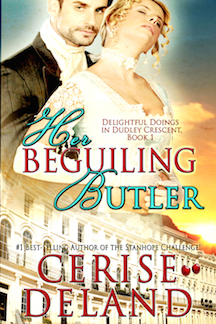
Cerise DeLand: Her Beguiling Butler (Giveaway)

About Historical Accuracy…

$_57 copy

With your romance, do you crave accurate history? A sense of time and place? Cerise tells all about Her Beguiling Butler!

Say you like historicals and you often wonder what’s true and what isn’t?

I can’t speak for other authors, but I do desperately try to bring you The Real Stuff.

For example, what’s real in Her Beguiling Butler?

You see a date at the beginning of the book, January 17, 1820. Why?

Because when I plotted the book, I wanted to note precisely when George III (he of the American Revolution!) died and what happened.

So I had to work backwards from that.

Yes. You need to read the book to learn how and when the news reached London!

The Prince of Wales is not considered a fine fellow by most people in the novel. Is that true?

Yes. Prinny, by the time of his ascent to his father’s throne (not official by the way until a year later at his coronation) was considered a spendthrift and profligate. He’d had so many mistresses and appealed to Parliament to spend so much on his homes and his clothes (as well as other debts), many in the Realm were not happy.

In fact, they rather liked old George, his father.

Lady Ranford is being considered by the courts to assume a title on her own. Is that possible for a woman to inherit a title in her own right?

Yes. And hopefully you’ll read the book to learn how that’s done!

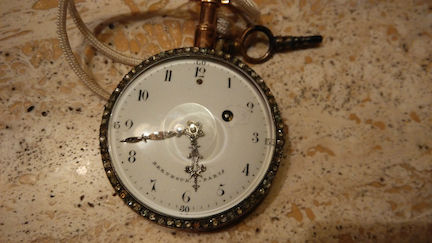
The chiming watch piece that Finnley carries around with him to make certain the house runs on time was a real time piece. I did not invent it.

It was delicately made by Ferdinand Berthoud. His work was very popular, aside from being very expensive.

The mourning practices for King George III that most noblemen observed did indeed happen.

What sorts of observances did they have to employ?

Ah. Do read the book for a description!

Does Dudley Crescent exist?

No. I made it up!  I also made up the man who was given the land by Charles II!

So what is the picture on the front cover of the novel?

What do you think it is? Comment here and win a digital copy of Her Beguiling Butler!

Do look for #2 and #3 in series when I give you a governess and a maid who are more than they appear to be!

giveaway

One lucky commenter wins a swag pack containing a Susana Ellis mug and other goodies!

Her Beguiling Butler by Cerise DeLand copy

About Her Beguiling Butler

The lovely widow at No. 10 Dudley Crescent hopes to lead a merry life without any husband to replace the elderly one she recently buried. Yet Lady Ranford finds herself in a pickle. Her new butler, Finnley, is not only the most obstinate man she’s ever met, but he’s a virile enigma.

She’s never been lured to naughtiness with a man. Heaven knows, she certainly shouldn’t fantasize about the tall, dark, scowling creature who runs her household like a finely tuned clock.

But she can’t help herself. She needs to taste him—or dismiss him.
Finnley, poor fellow, has a few risqué dreams of his own about how he’d like to handle the delectable widow. Alone in his rooms, he resolves to deny how her humor riddles his mind and how her beauty steals his breath away.

None of his solutions are proper.

All of his desires are quite…dear me…scandalous.
But what’s a butler to do when the very life of his beloved employer is at stake? And he cannot control his need to protect her and…ahem…bed her?

AMAZON  • ARe  • NOOK  • KOBO

About the Author

Cerise DeLand is #1 bestselling author of Regency romances! And a top selling author of contemporaries too!

WebsiteTwitterNewsletter

His Naughty Maid by Cerise DeLand copy

His Tempting Governess by Cerise DeLand copy

Sherry Ewing: A Knight To Call My Own

A Knight to Call my own cover

About A Knight To Call My Own

When your heart is broken, is love still worth the risk?

Lynet of Clan MacLaren knows how it feels to love someone and not have that love returned. After waiting for six long years, she has given up hope of Ian’s return. Her brother-in-law, the Devil’s Dragon of Berwyck, is tired of waiting for her to choose a husband and has decided a competition for the right to wed Lynet is just the thing his willful charge needs to force her hand.

Ian MacGillivray has returned to Berwyck Castle in search of a bride and who better than the young girl who cared for him all those years ago. But Lynet is anything but an easy conquest and he will need more than charm to win her hand in marriage.

From the English borders to the Highlands of Scotland, the chase is on for who will claim the fair Lynet. The price paid will indeed be high to ensure her safety and even higher to win her love.

Don’t miss out on Sherry’s other novels: If My Heart Could See You, a medieval romance and the beginning of her series; For All of Ever: The Knights of Berwyck, A Quest Through Time Novel (a medieval time travel romance) and Only For You, its sequel.

Amazon • Barnes & NobleKobo iBooks

Excerpt

About the Author

sherrySherry Ewing picked up her first historical romance when she was a teenager and has been hooked ever since. A bestselling author, she writes historical & time travel romances to awaken the soul one heart at a time. Always wanting to write a novel but busy raising her children, she finally took the plunge in 2008 and wrote her first Regency. She is a member of Romance Writers of America, The Beau Monde & The Bluestocking Belles. Sherry is currently working on her next novel and when not writing, she can be found in the San Francisco area at her day job as an Information Technology Specialist. You can learn more about Sherry and her published work at www.SherryEwing.com.

Website & BlogFacebookTwitterPinterest


Heather Boyd: Miss Merton’s Last Hope (Giveaway)

Interview with Heather Boyd

Susana: Tell us about yourself.

MEDIA KIT Author ImageHeather: Greetings. I’m a regency historical romance author, indie published, and sole female in a testosterone fueled household. (Even the cat is male) I love old books, old furniture and houses and research — regency era of course.

Susana: Do you ever wish you were someone else? Who?

Heather: No. I’m pretty comfortable with myself and my life. Of course I still wish for that big lottery win, the ability to clone myself when overworked, and a years worth of coffee and chocolate in perpetuity – much like everyone else I expect.

Susana: Do you have any phobias?

Heather: Spiders and snakes, which is stupid considering I live in Australia where you can’t step out your front door without being attacked by one. Just kidding. They wait until the second step before they land on you with evil intentions.

Susana: Have you ever had an imaginary friend?

Heather: All my friends are imaginary. I’m a writer. LOL I spend so much time with my characters they become very real to me.

Susana: Take us through a typical writing day for you.

Heather: I work at my writing career full time so after I gently guide the family out the door to school and work I usually grab a coffee and settle in to write as many words as I can before midday. After lunch, words are often much slower to come by but I persist until I finish the chapter or scene I’m working on. After that I answer emails, read industry related blogs. I’m self-published so there is always something new to discover and talk about with friends. Late afternoon is spent with my family. I don’t like to write my stories late at night. I find it hard to switch off and go to sleep because my characters keep talking. Somewhere in there I’m also on Facebook or Twitter or my posting updates on website. If I’m preparing for a new release I work weekends.

Susana: How would you describe the characters in your books?

Heather: Sexy, sometimes damaged, occasionally dangerous but always willing to connect with others and take a chance they’ll find love.

About Miss Merton’s Last Hope

Book Three, Miss Mayhem Series

MMLH_DC200Over the years, Melanie Merton has used every trick and ruse to repel overeager gentlemen callers without ever revealing the real reason she won’t say yes to an offer of marriage. When neighbor Walter George jumps to her defense against slurs cast by suitor number twelve, he also pries into her past—uncovering the circumstances around a tragic loss in her childhood and her aversion to being touched by anyone. But even protective Walter must be kept at a distance for his own good, because despite a growing attraction between them, Melanie must deny him too.

Unlike other men his age in Brighton, Walter George hadn’t considered Melanie Merton for a wife because he was convinced he’d never have a chance to impress his haughty neighbor. But that was before he understood her better, before he uncovered why she kept friends and suitors alike at bay. The right husband could restore the woman he sees into some semblance of the fun-loving child of his memory, but would Walter stand a chance or become just another unlucky suitor?

AmazoniBooksKoboBarnes & Noble

Add to Goodreads Shelf

Excerpt

“Why do you think I invite you along to dine with us so often?” Valentine slapped Walter’s shoulder. “You seem to be the only man within three miles who hasn’t the least bit of interest in Melanie romantically. I am always assured Melanie has an enjoyable evening in your company.”

Walter was surprised by that claim. He had always assumed his presence made little impression on her mood. He could have stood on his head, for all the notice she took of him. “Who else is on the guest list?”

“Mr. Hartwood and his wife have consented to come.”

“I know them well, but they are an unusual choice as Julia’s first dinner guests.”

“The choice was my sister’s suggestion, actually,” Valentine confessed. “She thought a series of small, informal dinners would strike the right note to win back goodwill. Plus it’s an opportunity to casually promote the shop to someone with funds to spare.”

“Clever thinking.” Despite the frost in her manner, her choosiness about finding a husband, Melanie was well regarded by the older set of their town. She had certainly been of help in improving Valentine and Julia’s standing in society of late. “As good a place to expend the effort as any I can think of.”

“She is determined that Julia make a good impression.”

His mind jerked back to Melanie Merton and her refused suitors. Why did she not want a husband of her own yet? As far as he could tell, she rebuffed all romantic overtures. Had any of those fellows ever stood a chance to win her affections? Had any of them kissed her?

She could probably use a good kiss to loosen her corset strings. Walter imagined…

“Why are you pursing your lips?” Valentine asked suddenly.

“What?” He quickly adopted a thoughtful expression. “Oh, just thinking an idea through. There’s a factory in Portslade I heard about. Could be a good investment.”

Valentine stopped and stared at him. “How do you have money to spare for another investment already? I swear, everything you touch must turn to gold.”

“Not quite.” He grinned. “I am still eating off porcelain dinnerware.”

Valentine questioned him about the property while Walter scolded himself silently. It was a very bad idea to turn his mind to Melanie Merton, a woman who had hurt his sister so very badly in the past. Despite the friendly façade he affected before others, he was still extremely annoyed with her.

So tell me what is the sweetest thing someone has done for you? I’d like to offer an ecopy of Miss George’s Second Chance to two random commenters.

About the Author

Bestselling historical author Heather Boyd believes every character she creates deserves their own happily-ever-after, no matter how much trouble she puts them through. With that goal in mind, she writes sizzling regency romance stories that skirt the boundaries of propriety to keep readers enthralled until the wee hours of the morning. Heather has published over twenty novels and shorter works. Catch her latest news http://www.heather-boyd.com. She lives north of Sydney, Australia, and does her best to wrangle her testosterone-fuelled family (including cat Morpheus) into submission.

WebsiteTwitterFacebook

Mailing List

Judith Laik: The Lady Protests

Terriers in Great Britain during the Regency period

by Judith Laik

The British Isles have been the flowering place for a disproportionate number of breeds that we know today. Even given the US ties to Britain, which might have predisposed early settlers to favor dogs from there, as the years have gone on and more breeds have been introduced from once-exotic places, it must be noted that the cluster of islands off the northwest coast of Europe has proven to be especially rich soil for the development of dogs.

This is especially true for the group of dogs known as Terriers. Among the thirty breeds currently recognized by the American Kennel Club, only four have an origin other than the British Isles!

That means that as writers who set our novels in England, Scotland, Wales, and Ireland, we have a wide selection of dog breeds to use. However, one caution: until around the middle of the nineteenth century, people did not think of specific breeds of dogs in the same way we do today. Previous to and during the Regency, dogs were bred more for function that to maintain a pure strain.

Though a number of breeds had been bred “true” – to a conformation and behavioral type – these were more likely to be dogs whose function benefited the aristocracy, such as Foxhounds, Greyhounds, and Sporting or Gun dogs. Paintings of the time show that these dogs could easily be compared with their counterparts today.

However, the more lowly, working breeds, such as herding dogs, were not uniform in type until later in the century. Terriers also ranked mostly as “dogs of the people.” People of all ranks owned Terriers. They were literally the “in the trenches” fighters against the most populous and harmful of humankind’s enemies. And they were the “dog of all work” – guarding the homestead, tending flocks, hunting rabbits and other small game – for the family who couldn’t afford to keep a separate dog for every purpose. As well, the larger landholder frequently used Terriers as an adjunct to his other dogs. They accompanied the Foxhounds on the hunt, Gundogs on a shoot.

And a few lucky terriers did end up becoming pampered pets. Because of their smaller size, they could be easily fitted into a house and live a life of leisure, their only work to serve as companions to their masters and mistresses.

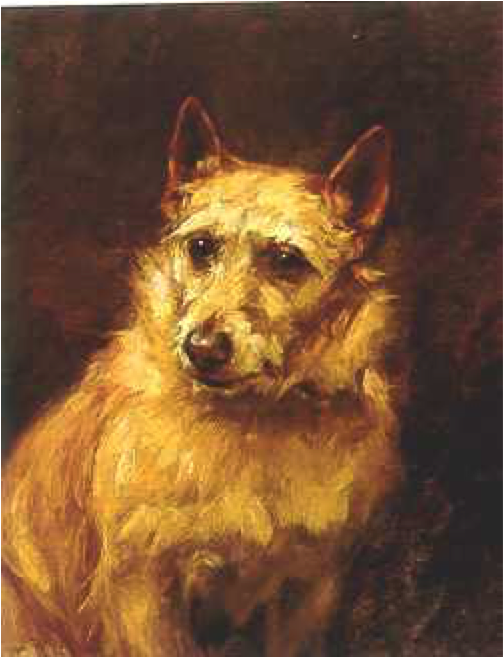
So, when I needed my secondary heroine to adopt a stray dog in my story, The Lady Protests, a Terrier seemed to be a perfect choice. I could easily see it having gotten lost from a careless, or perhaps even abusive master, and it wasn’t too large to conveniently (or not so conveniently, in this case!) travel with the heroine in a coach. But, I never named his breed in the story, only describing his brown coat color and shagginess.

Here’s an image of what Rags might look like:

No.1

Image from A BREED APART: The Art Collections of the American Kennel Club and the American Kennel Club Museum of the Dog, William Secord, 1988; the painting is by Maud Earl, a famous late-nineteenth century dog artist

And, yes, this painting came from well past our era. It’s hard to find images of Terriers earlier in the century. What follows are some from the late eighteenth century to around 1830.

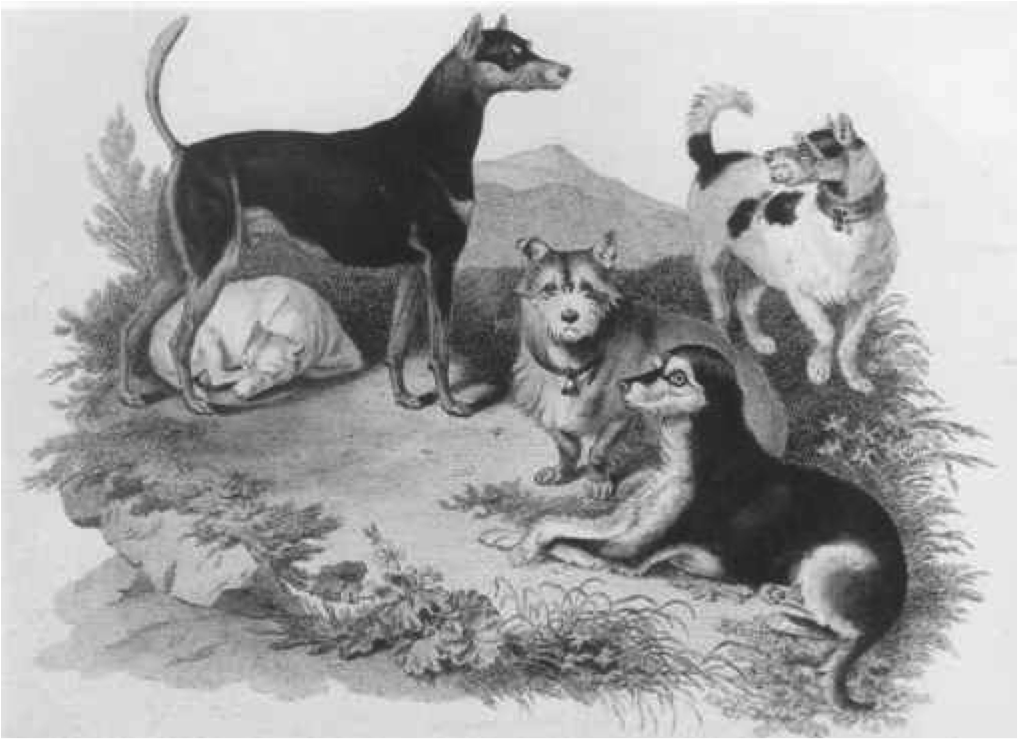
One of the best sources for the history of dogs in the British Isles is the Cynographia Britannia, published in several parts from 1799-1805. The image below is of the Terrier group, by Sydenham Edwards. From Collection American Kennel Club. Photography by Dave King. DOG PAINTING, 1840-1940 by William Secord, 1992*:

No.2

This is a good representation of Terrier breeds one could have seen early in the nineteenth century. The smooth-coated dog on the left was a Smooth Black-and-Tan Terrier. The breed name was later changed to Manchester Terrier; it also became an ancestor in other breeds. Sleeping underneath him is a White English Terrier, which also was an important ingredient in several breeds, but which is now extinct. In the center, by my guess, is an example of the old Scotch Terrier, from which all the Scottish terrier breeds descended; or it could be an early Norwich Terrier. At back on the right, I believe, is an early Wire Fox Terrier. And in the foreground is a Wire Black-and-Tan Terrier, or early Welsh Terrier.

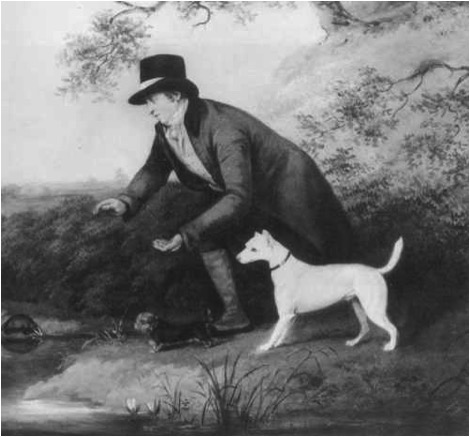
Warning: some of the following paintings may offend our modern-day sensibilities!

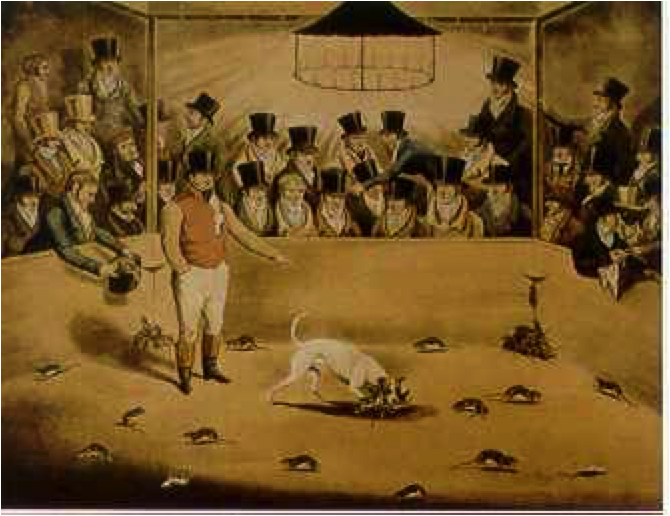
Billy, the rat-killing terrier. Coloured engraving from The Kennel Club’s Art Collection Catalogue. Note: The Kennel Club is the English equivalent of the American Kennel Club, the chief registry for purebred dogs in the country.

No.4

The caption states: “The Phenomenon of the Canine Race, and Superior Vermin killer of his day having killed nearly 4,000 rats in about Seven Hours.” From a broadsheet for the Westminster Pit in March 1825.

Here’s another image, also described as a rat terrier, which illustrates that in this time a “breed” was what its function was, not what it looked like:

NO.5

Rat Terrier in an Interior, 19th Century, English School. Oil on panel. Private Collection. DOG PAINTING: The European Breeds, William Secord, 2000.

Secord says: Many of the early Terriers evolved from what was known as the English Black-and-tan Terrier (now called the English Toy Terrier), a rough-coated little dog noted for its ability to catch vermin. This one is depicted in a barn-like interior, where his abilities would have been very much needed.

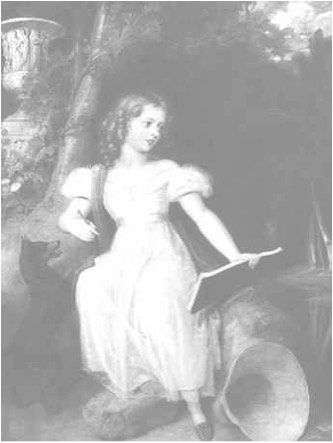
Here’s an image of a very young Princess (later Queen) Victoria. It’s not the best quality, and the little black dog at the left is hard to see, but it’s from not much past our time. Victoria was an avid lover of dogs, and owned many breeds in her lifetime, often leading to a huge bump in the popularity of a particular breed.

Young Victoria With Nellie, Her Black and Tan Terrier, 1830, Richard Westall. Oil on canvas. Collection: Her Majesty the Queen. DOG PAINTING, 1840-1940, William Secord, 1992.

Young Victoria With Nellie, Her Black and Tan Terrier, 1830, Richard Westall. Oil on canvas. Collection: Her Majesty the Queen. DOG PAINTING, 1840-1940, William Secord, 1992.

Later in the century, this breed would be renamed the Manchester Terrier, with standard and toy varieties. Secord notes that Westall was known mostly as a watercolourist and book illustrator who exhibited actively at the Royal Academy, and the drawing master to Princess Victoria. Nellie was one of Victoria’s first dogs; she showed her love of animals early.

Viper, by Sartorius, 1796. Catalogue, temporary exhibit of The Kennel Club Art Gallery.

Viper, by Sartorius, 1796. Catalogue, temporary exhibit of The Kennel Club Art Gallery.

A very early image of a Smooth Fox Terrier. The painting may not be that anatomically correct; the head looks very small for the size of its body.

Smooth Fox Terrier, c. 1790, John Boultbee. Oil on canvas. Private Collection. Photography by Grant Taylor. DOG PAINTING, 1840-1940, William Secord, 1992.

Smooth Fox Terrier, c. 1790, John Boultbee. Oil on canvas. Private Collection. Photography by Grant Taylor. DOG PAINTING, 1840-1940, William Secord, 1992.

Secord says: Reputed to be the first known painting of a Smooth Fox Terrier, this painting is typical of the work of Boultbee. Influenced by the paintings of George Stubbs, Boultbee was known as a horse and animal painter with a highly finished, polished style.

Compare with the dog below, listed as a White English Terrier:

No.9

Secord’s caption reads: The now extinct White English Terrier and other early Terriers were often used to catch foxes and badgers, the latter being seen in the left middleground of this painting. Notice the small size of the little dog at the sportsman’s foot, a Terrier of unknown origin.

I think the smaller dog in the painting could be a Waterside Terrier, an early ancestor of the Yorkshire Terrier, or a small rough-coated Black-and-Tan.

Vixen, 1824, Edwin Henry Landseer. Oil on panel. Collection Ruth Havemeyer Norwood. DOG PAINTING: The European Breeds, William Secord, 2000.

Vixen, 1824, Edwin Henry Landseer. Oil on panel. Collection Ruth Havemeyer Norwood. DOG PAINTING: The European Breeds, William Secord, 2000.

About this painting, Secord says: Described as a ‘thorough-bred Scotch Terrier’, a pet of Mrs. W.W. Simpson, this painting was published in 1824 in a sporting magazine with twenty lines of descriptive text. It was later etched by Jessica Landseer, the artist’s sister. Very small in scale, the painting was completed when the artist was only twenty-two years old.

Landseer was a noted painter of dogs, a favorite artist of Queen Victoria, painting many of her pets through the years. Note that, although the caption says Vixen is a pet, it still is living up to the terrier reputation as a killer of vermin.

The following information about the history of the Scottish breeds came from the West Highland White Terrier Club of America, which I found there when I was researching for a class on dog breeds in the Regency in 2005. Unfortunately they have considerably changed their site and the history of the Westie now is very brief. Here’s the older entry, as I think it is informative:

The short-legged terriers of Scotland are now recognized as the Scottish, Skye, Cairn, Dandie Dinmont, and West Highland White Terriers. All undoubtedly descend from the same roots. All of these dogs were valued as intrepid hunters of small game. Originally, their coat colors ranged from black to red to cream or white.

There does not seem to be any consensus as to how the five breeds evolved. Information I found led me around in a circle.

Here is an image of two more dogs described as Scotch Terriers:

Terriers Fighting Over a Rabbit, Martin T. Ward (1799-1874), oil on canvas. Collection AKC. A BREED APART: The Art Collections of the American Kennel Club and the American Kennel Club Museum of the Dog, William Secord, 1988.

Terriers Fighting Over a Rabbit, Martin T. Ward (1799-1874), oil on canvas. Collection AKC. A BREED APART: The Art Collections of the American Kennel Club and the American Kennel Club Museum of the Dog, William Secord, 1988.

Secord, in the text near this painting, says: While the terriers are certainly cleaned up, with none of the dirt or burrs in their coats that one would expect, they are nevertheless depicted as working terriers, rather than pets. The West Highland White Terrier-type dog with the cropped ears, for instance, is shown with a wild, determined expression, his teeth firmly planted in the black and tan terrier’s ear. The object of their attention lies dead beneath them, his eyes lifeless and blood trickling from his nose on to the ground.

I don’t have any early images of these breeds, but Wire Fox Terriers, and the Wire or Rough Black and Tan Terrier would have been in existence early in the century.

This is information I found on the Border Terrier club in 2005, which was removed when I looked again a few years later:

The BT is one of several working terrier breeds to emerge along the borders of England and Scotland where terriers have been used to hunt fox, otter, and vermin for centuries. The Border, the Bedlington, and the Dandie Dinmont are thought to have a common ancestor. A soft top knot, characteristic of the Bedlington and the Dandie Dinmont, is seen sometimes in the Border along with white on the chest and the occasional white on the foot. The Border has rarely been sought out for his appearance. However, his plain brown coat and self-effacing manners in public disguise a cheerful and sensible companion for those who enjoy a terrier bred to think for himself.

Note that this contradicts what I quoted above as the ancestry of the Dandie Dinmont Terrier, which grouped it with the other Scottish breeds. I don’t know what the truth is in this case.

The BT can be identified in hunting scenes painted in the eighteenth century, bringing up the rear behind horses and the hounds, obviously determined to get there on his sturdy legs in time to help with the action.

I haven’t found any of those hunting scenes in my research.

The Lakeland Terrier originated in the Lake District of Cumberland, England near the Scottish border in the 1800’s. He is related to several terrier breeds and is one of the oldest working terrier breeds still in use today. His diverse ancestors include the now extinct Old English Black and Tan terrier, the early Dandi Dinmont, Bedlington and Border Terriers. He probably existed in extremely early form, if at all, in the first years of the century.

Sealyham Terriers were developed in mid-19th century in Wales by a Capt. John Edwards, so wouldn’t have been around during the Regency. And the Airedale Terrier developed too late to use one of our books. If you find a silhouette of each breed, you can see that the body and head type of the Airedale, Lakeland, Fox (both smooth and wire), Irish, and Welsh Terriers is very similar. Early types of some of these breeds would have existed.

My evidence suggests Staffordshire Terriers and Bull Terriers, although in the Terrier group now, would still be considered “crossbreeds” during the Regency. The Parson Russell Terriers and Russell Terriers have a fascinating story, but their development, as an offshoot of Fox Terriers, was in the mid-19th century.

DNA testing would probably settle the questions about how the various breeds developed. I haven’t come across any information that suggests such testing has been done. For our purposes as writers, it suffices to get some idea of whether the various breeds would have existed in our time, and how they looked.

* William Secord was the founding director of the AKC’s Museum of the Dog, and owns a gallery in New York City specializing in dog and other animal art. He is considered “the recognized expert on 19th century dog paintings.”

Most of the images in this article, except the two from a catalogue of an exhibit of art by The Kennel Club, are from one of three gorgeous coffee-table books, authored by Secord, with fantastic illustrations and a great deal of information about the dogs, the art, and the artists. They are a rich source of images of the dogs of the past:

A BREED APART: The Art Collections of the American Kennel Club and the American Kennel Club Museum of the Dog, by William Secord, Antique Collectors’ Club ltd, Woodbridge, Suffolk, England, ©2001, ISBN 1-85149-400-6

DOG PAINTING, 1840-1940, A Social History of the Dog in Art, by William Secord, Antique Collectors’ Club, ©1992, ISBN 1-85149-139-2

DOG PAINTING: The European Breeds, by William Secord, Antique Collectors’ Club, ©2000, ISBN 1-85149-238-0

About The Lady Protests (Coming Soon)

Book Three in the Unsuitable Brides series

Pageflex Persona [document: PRS0000038_00074]

A Lady in Charge

Since the death of her musician stepfather, Beatrice Foxworth has struggled to hold her remaining family together: her innocent, head-in-the-clouds stepsister, Arietta; and her devastated mother. When Arietta is abducted, Beatrice must save her from ruin – or worse

A Pleasure-seeking Gentleman

Philip Hollesley carelessly promised a friend to oversee his naïve younger brother’s first essay into London bachelorhood. When Jasper Linton elopes with an unsuitable young woman, the last thing Philip wants to do is become involved. But he gave his word, so it’s up to him to chase down the young fool before he can tie the knot in Gretna Green.

Adversaries Turned Reluctant Allies

But there never was so strange a pursuit. Beatrice and Philip, chaperoned by her devious mother, discover an odd assortment of humanity is also tracking them: a rejected suitor, a debauched lord, an aging demimondaine and her aristocratic lover, a group of rowdy young bucks, and a mysterious man.

The Lady Protests

Beatrice and Philip can’t agree on anything – except the necessity to overtake Jasper and Arietta – and to fight their inconvenient attraction to each other.

Excerpt

Jasper Linton’s mistaken assumption about the beautiful musician Arietta Foxworth’s lack of virtue forces him to insist that they must be married. He’s not swayed by her insistence that she doesn’t want to marry him, and they find themselves on the road to Gretna Green, where a series of misadventures leaves them with no traveling money. Now he has to depend on her ability to make money by singing and playing her violin in the public squares of the towns on their way. In Mansfield, she adopts a starving, abused little dog, who takes violent exception to their attempt to clean him up with a nice bath and runs away again. The story picks up the next morning as a broken-hearted Arietta prepares to continue their journey:

Listlessly, Arietta prepared to travel to Chesterfield, and entertain the good folk after they arrived there. She donned her new gown and bonnet, and decided she looked more like her usual style than she had at any time since Jasper had carried her off. Except for the dark marks under her eyes, and the skin still slightly mottled from crying.

Her new gown didn’t give her spirits a lift, however. What she really wished for was to stay in bed with Jasper’s arms around her, and never have to face such a cruel world again.

Descending to breakfast in the common room at the inn with him, she made an indifferent meal despite his coaxing. His worried gaze followed her, and when he at last gave up and asked if she were ready to travel, she apathetically agreed.

They walked out of the inn and crossed the courtyard to where their coach stood waiting. Just as Jasper gave her a hand to step up into the carriage, a small form darted from the shadows and leaped at her.

She gave a small scream, and then recognized the little dog from the day before. Clasping him to her breast, she sobbed, “Oh, Rags, you’ve come back to me!” and buried her face in his still matted, still damp, not-too-clean ruff. He twisted about in her arms, trying to lick her face, as enthusiastic and happy as she.

“‘Rags?’” Jasper queried.

“Yes, I had decided yesterday that is the name I would give him, but when he ran away it hardly seemed worth mentioning.” She sniffed, but felt a huge grin splitting her face at the same time.

“No doubt he realized his best chance of getting his next meal was to wait in hopes you’d come back outside.”

“Oh! Yes, I’m very sure he is starving! Jasper, please go back to the pie lady and buy more pies for Rags!”

“Oh, very well,” he said, pretending annoyance, but he had a huge smile on his face as well. “You get in the carriage and hold on to him, especially when I come back. If he runs off again, we’re not staying in town to look for him.”

While she clutched the dog to her, Jasper boosted her into the carriage and slammed the door behind her. Rags began wriggling to get free, and she spoke soothingly to him, but he kept up the struggles. She needed a leash, but where could she procure one?

Knowing it would take Jasper several minutes to reach the pie stall and return again, she let Rags free. The ribbons on her new bonnet flopped forward as she set him on the carriage floor, which gave her an idea. Pulling off the hat, she tore the ribbons loose and tied them together, then fastened the joined ribbon around the dog’s neck. He didn’t care for that either, but she placed him on the seat beside her and stroked him, speaking in a consoling voice, and he quieted.

To ensure he didn’t pull his improvised leash out of her hands, she tied the loose end to her own wrist. Now all she had to worry about was whether the ribbon was strong enough to hold when Rags pulled on it.

She was about to find out. Apparently, the process of getting the ribbons off her hat and onto Rags had taken longer than she realized, because Jasper’s voice came to her from immediately outside the carriage. “I’m back. Hold on to the dog.” A small pause, and he opened the door.

Rags barked and growled fiercely and threw himself at Jasper, who reflexively stepped back, leaving a gap between him and the door. The dog’s leap took him to full extension of the ribbons and they parted.

By this time, however, Rags had caught the scent of pies, and instead of escaping, he leaped at Jasper again, trying to procure a pie. Arietta caught the little dog, Jasper entered the carriage, and gave Rags one of the pies as he closed the door.

“If he’s been starving, we don’t want to feed him too much at once or he’ll become ill. I have six, and we’ll parcel them out during the day,” he said, sitting across from Arietta.

Rags had other ideas, though. He bolted down the pie, lunged for the nearest in Jasper’s hands, and proceeded to make short work of it also.

Arietta and Jasper both laughed at the dog’s eagerness. Jasper said, “I shall have to place the rest out of his reach.” Keeping a firm grip on the remaining pies, he called out to Cobleigh, “Hand me my portmanteau.” When the coachman obliged, Jasper tucked the pies away securely inside and handed the case to Cobleigh to stow. “My clothes will smell like beef pies, but that can’t be helped.”

He looked at the broken-apart ribbons and said, “The ribbons didn’t tear; they just came untied. They should work as a leash with a better knot.” He refastened them and ordered Cobleigh to proceed. Arietta heard the coachman give orders to the post boys, and the carriage moved off. Rags whined and jumped at the window, but she petted and soothed him, and he settled down again in her lap and went to sleep.

By the time Arietta and Jasper arrived in Chesterfield, they had fed Rags two more meat pies in an attempt to keep him quiet. Jasper and Arietta finished off the other two pies themselves.

Rags, although still disgracefully matted and dirty, appeared to have already filled out, his abdomen bulging with food. To Arietta’s eyes, his ribs seemed to stick out noticeably less, although she could not be sure whether that was wishful thinking on her part.

After the fourth pie, he finally curled up on the seat next to her and snoozed. He roused when the coach arrived in Chesterfield, jumping up with his front paws on the window edge and peered out.

The coach pulled into the yard of yet another inn. Jasper stepped down and made arrangements for the carriage to remain there while he and Arietta performed in the Market Place, although he seemed not to feel it necessary to inform the landlord of their purpose.

When he tried to leave Rags in the care of Cobleigh, however, his coachman and Arietta both protested quite vocally. Cobleigh didn’t wish to be saddled with the pup, and Arietta refused to be parted from him.

So, with Arietta holding the blue ribbon attaching her to the dog and Jasper carrying her violin case, they made their way to the Market Place.

“Maybe we should see if there’s another pie seller here before we set up to entertain. Rags will want more pies, and I will be hungry again when I finish.”

“Good idea,” Jasper nodded, and they began a tour of the stalls in the market. An hour later, they had found the pie seller and stocked up on pies.

Finally, they found a good place for Arietta to sing. Jasper handed her the violin and took Rags’ leash so she could concentrate on playing.

She set to tuning the violin. With the first notes, Rags yelped loudly and sat, tearing at his right ear with the back paw. Arietta stopped, and the dog cast an offended look her way. She hurried over to pet Rags, but the hurt expression in his eyes did not offer absolution for Arietta’s crime.

“What am I to do?” she asked, turning her attention to Jasper. “I have to play. We need the money.”

“Keep going. He’ll get used to the sound. Dogs have sensitive ears.”

Doubtfully, Arietta picked up the violin again and continued tuning it.

Rags lay on the ground, a pitiful series of groans and growls issuing forth, while it appeared he tried to cover his ears with his front paws.

To top Arietta’s humiliation, a crowd began to gather, laughing and pointing at Rags.

“Start playing a tune,” Jasper suggested. “He’ll like that better. Most people don’t much care for the sound of tuning an instrument either.”

She launched into a soft melody.

Rags did not like it any better.

The crowd grew, along with the laughter.

Nearly crying now, Arietta bravely kept playing.

Rags continued making pathetic sounds as if he were being tortured. “Ow-wow-wow-grrrrr-uff-ow-grr-wow-wow-grrrrr-uff!” He apparently had not found a way to cover both ears with his paws at the same time, so he twisted from side to side, placing a paw over his left ear, then the right.

Arietta brought the song to a premature end. “I cannot do this.”

“Try just singing with no accompaniment,” Jasper suggested.

Arietta set the violin aside, and Rags quieted, although his eyes still held accusation. Arietta began to sing, starting out softly, “‘The water is wide, I can-not cross o’er. And neither have I the wings to fly.’”

Fortunately, Rags did not seem to mind her voice quite so much. Although he turned her back to Arietta and lay in a position that indicated disapproval, he at least did not express it vocally.

Arietta sang more strongly, noticing gratefully that the crowd lingered, even without the hilarious sight and sound of the music-critic dog. “While there’s breath in my body, he’s the one that I love still,” she finished, looking at Jasper.

She sang a few more songs, although having to ignore shouts from the audience to “play the violin again!” Eventually she felt obliged to answer them. “I would not be so cruel to my poor little dog, or to you, as to play my instrument again!”

She took some comfort from the fact that her voice had returned to normal, all trace of her cold gone. And even more that it seemed despite what she felt was the ruin of her performance by Rags’ adamant displeasure, it appeared a good many people had contributed to the pile of coins in the violin case. Jasper again put them into his purse, packed the violin away, and gave an arm to her to leave the square.

About the Author

I live on a mini-farm near Seattle with my husband, daughter, some horses (only two are ours), two cats, and a number of Collies — we’re a dog show family.

Our vintage farmhouse needs constant upkeep, which we can barely keep up with, since it always needs new paint or new fences or…Luckily the most recent thing we repaired is the plumbing, so that’s working pretty well these days. With us living out in the country, we experience frequent power outages. There’s nothing more romantic than huddling under blankets in front of a cozy fire in the fireplace, with more blankets blocking the drafts from the other rooms in the house. The downside is that without power the well doesn’t work, either.

My husband and I like to get away as often as we can, taking off for a few days at the ocean or the lake. I usually bring my laptop with me on these excursions, working on whatever my current writing project is. I love to travel to more faraway places also. Our big adventure this year was a family trip to my husband’s birthplace, Estonia with all three of our children and two of the grandchildren. We visited beautiful places all around the country and had a couple of gatherings of relatives. We received the most amazing welcome from them. I know now what it’s like to be treated like royalty!

My favorite destination, though, is England. My most recent trips there, in 2003 and 2005, were with groups equally fascinated with the Regency period, and we visited many sites with associations to that time. Heaven! There’s nothing like actually seeing the locations where my stories took place, even if altered to varying degrees by the 200-some years since those events happened. As a bonus, the gift shops at many of the museums and historic sites have more lovely books that I would never have come across at home!

Sasha Cottman: The Duke’s Daughter

From the Regency Kitchen

Lemon Cheesecake

DSC_0876 (800x402) copy

This lemon cheesecake recipe dates all the way back to Hannah Glasse’s The Art of Cookery Made Plain & Easy, published in 1747.

Ingredients

  • 2 lemons
  • 12 eggs (12 egg yolks and 6 egg whites will be used in the custard part of the recipe)
  • 225 g brown caster sugar (I used raw caster sugar instead).
  • 6 tablespoons of cream (save a little for serving with the lemon cheese cake)
  • 225g butter
  • Shortcrust pastry sheets (or, you can make it, see below).

Method

  1. Preheat the oven to 190C/374F.
  2. Grate the lemon zest. Put the zest and the juice of 1 lemon into a mixing bowl. Add the caster sugar and mix with a wooden spoon. Beat the egg yolks and add them to the mix.
  3. Beat the egg whites until they are frothy. This must have been a hard task in the 18th century when it would have to have been done by hand! Fortunately I could reach for my trusty electric beater. Add the frothy egg whites to the rest of the cheesecake mix.
  4. Combine the butter and cream and over a low heat, until the butter is melted. Add the butter and cream to the rest of the cake mix and beat it for a minute.
  5. Pour combined mixtures into a medium sized saucepan and heat over a medium heat, stirring until the custard is thick enough to coat the back of a wooden spoon. This takes about 8 minutes on my stovetop.
  6. Place the pastry sheet over a flan pan (or pie dish), making sure the pastry covers the sides of the pan (there is quite a lot of custard mix).
  7. Take the mix off the heat and pour over the pastry base. You may have some left, so feel free to pour this into a bowl and eat it before anyone else notices.
  8. Bake the lemon cheese cake for 30 mins or until the filling has set. In my oven it takes about 35 minutes. Cool and serve with cream.

Shortcrust pastry (if you want to make from scratch) 

  • 1 egg yolk
  • 225 g chilled butter
  • 1 1/3 cups of plain flour

Method

  1. Process flour and butter in a food processor. Add the egg yolk and 2 tsps. of cold water.
  2. Once mix is worked through, take it out of the bowl and knead it on a board. Roll into a ball and let rest in the fridge for 30 mins. Then roll out flat when preparing to use it in the pie.

The Duke's Daughter - hi res cover copy

About The Duke’s Daughter

When handsome army officer Avery Fox unexpectedly inherits a fortune, he instantly becomes one of the season’s most eligible bachelors. More accustomed to the battlefield, he has no patience with the naive debutantes who fill the ballrooms of London.

Honest and impetuous Lady Lucy Radley is a breath of fresh air, guiding him through the season and helping him to avoid any traps. So when Avery is left with little option but to marry Lucy, he can’t help but feel he’s been manipulated. Nor can he shake the feeling that a duke’s daughter should be out of his reach.

From the wildly beautiful Scottish Highlands to the elegant soirees of Paris, Avery and Lucy go on a journey that is full of surprises for them both.  But will their feelings for each other be strong enough to overcome the circumstances of their marriage and survive the ghosts of Avery’s past?

Amazon • Kobo • Amazon.auAmazon.caAmazon.uk

The Duke of Strathmore Series:

Letter from a Rake

An Unsuitable Match

The Duke’s Daughter

Excerpt

Chapter One

By every measure of her own behaviour, Lady Lucy Radley knew this was the worst.

‘You reckless fool,’ she muttered under her breath as she headed back inside and into the grand ballroom.

The room was a crush of London’s social elite. Every few steps she had to stop and make small talk with friends or acquaintances. A comment here and there about someone’s gown or promising a social call made for slow going.

Finally she spied her cousin, Eve. She fixed a smile to her face as Eve approached.

‘Where have you been, Lucy? I’ve been searching everywhere for you.’

‘I was just outside admiring the flowers on the terrace.’

Eve frowned, but the lie held.

Another night, another ball in one of London’s high-society homes. In one respect Lucy would be happy when the London social season ended in a few weeks; then she would be free to travel to her family home in Scotland and go tramping across the valleys and mountain paths, the chill wind ruffling her hair.

She puffed out her cheeks. With the impending close of the season came an overwhelming sense of failure. Her two older brothers, David and Alex, had taken wives. Perfect, love-filled unions with delightful girls, each of whom Lucy was happy to now call sister.

Her newest sister-in-law, Earl Langham’s daughter Clarice, was already in a delicate condition, and Lucy suspected it was only a matter of time before her brother Alex and his wife Millie shared some good news.

For herself, this season had been an unmitigated disaster on the husband-hunting front. The pickings were slim at best. Having refused both an earl and a viscount the previous season, she suspected other suitable gentlemen now viewed her as too fussy. No gentleman worth his boots wanted a difficult wife. Only the usual group of fortune-hunters, intent on getting their hands on her substantial dowry, were lining up at this stage of the season to ask her to dance. Maintaining her pride as the daughter of a duke, she refused them all.

Somewhere in the collective gentry of England there must be a man worthy of her love. She just had to find him.

What a mess.

‘You are keeping something from me,’ Eve said, poking a finger gently into Lucy’s arm.

Lucy shook her head. ‘It’s nothing. I suspect I am suffering from a touch of ennui. These balls all begin to look the same after a while. All the same people, sharing the same gossip.’

‘Oh dear, and I thought I was having a bad day,’ Eve replied.

‘Sorry, I was being selfish. You are the one who needs a friend to cheer her up,’ Lucy replied. She kissed her cousin gently on the cheek.

Eve’s brother William had left London earlier that day to return to his home in Paris, and she knew her cousin was taking his departure hard.

‘Yes, well, I knew I could sit at home and cry, or I could put on a happy face and try to find something to smile about,’ Eve replied.

Eve’s father had tried without success to convince his son to return permanently to England. With the war now over and Napoleon toppled from power, everyone expected William Saunders to come home immediately, but it had taken two years for him to make the journey back to London.

‘Perhaps once he gets back to France and starts to miss us all again, he shall have a change of heart,’ Lucy said.

‘One can only hope. Now, let’s go and find a nice quiet spot and you can tell me what you were really doing out in the garden. Charles Ashton came in the door not a minute before you, and he had a face like thunder. As I happened to see the two of you head out into the garden at the same time a little while ago, I doubt Charles’ foul temper was because he found the flowers not to his liking,’ Eve replied.

It was late when Lucy and her parents finally returned home to Strathmore House. The Duke and Duchess of Strathmore’s family home was one of the largest houses in the elegant West End of London. It was close to the peaceful greenery of Hyde Park, and Lucy couldn’t imagine living anywhere else.

As they came through the grand entrance to Strathmore House she was greeted by the sight of her eldest brother David seated on a low couch outside their father’s study. He was clad in a heavy black greatcoat and his hat was in his hand.

‘Hello, David; bit late for a visit this evening. I hope nothing is wrong,’ said Lord Strathmore.

‘Clarice?’ asked Lady Caroline.

‘She’s fine, sleeping soundly at home,’ he replied.

Lucy sensed the pride and love for his wife in her brother’s voice. He had found his true soulmate in Lord Langham’s daughter.

David stood and came over. When he reached them, he greeted his mother and sister with a kiss. His dark hair was a stark contrast to both Lady Caroline’s and Lucy’s fair complexions.

He turned to his father. ‘Lord Langham’s missing heir has been found, and the news is grave. My father-in-law asked that I come and inform you before it becomes public knowledge. A rather horrid business, by all accounts.’

‘I see. Ladies, would you please excuse us? This demands my immediate attention,’ Lord Strathmore said.

As Lucy and Lady Caroline headed up the grand staircase, he and David retired to his study. As soon as the door was closed behind them, David shared the news.

‘The remains of Thaxter Fox were retrieved from the River Fleet a few hours ago. His brother Avery, whom you met at my wedding ball a few weeks ago, has formally identified the body. Lord Langham is currently making funeral arrangements,’ David said.

His father shook his head. It was not an unexpected outcome of the search for the missing Thaxter Fox.

He wandered over to a small table and poured two glasses of whisky. He handed one to David.

‘Well, that makes for a new and interesting development. I don’t expect Avery Fox had ever entertained the notion before today that he would one day be Earl Langham,’ Lord Strathmore replied, before downing his drink.

‘Perhaps, but he had to know the likelihood of finding his brother in one piece was slim at best. From our enquiries, it was obvious Thaxter had a great many enemies,’ David replied.

‘Including you,’ said the duke.

David looked down at his gold wedding ring. It still bore the newlywed gleam, which made him smile.

‘He and I had come to a certain understanding. If he stayed away from Langham House and Clarice, I would not flay the skin off his back. No, someone else decided to make Thaxter pay for his evil ways.’

The Langham and Radley families held little affection for the recently deceased heir to the Langham title. After Thaxter had made an attempt to seize Clarice’s dowry through a forced marriage, both families had severed all ties. Thaxter had disappeared not long after.

David would do everything in his power to protect Clarice. With a baby on the way, he was fully prepared to stare down the rest of the town if it meant keeping his wife safe. As the illegitimate, but acknowledged, son of the duke, David had overcome many of society’s prejudices in order to successfully woo and wed Lord Langham’s only daughter.

‘Unkind as it sounds, I doubt many at Langham House will be mourning the demise of the eldest Mr Fox,’ his father replied.

‘No.’

About the Author

sasha cottman author pic copyBorn in England, but raised in Australia, Sasha has a love for both countries. Having her heart in two places has created a love for travel, which at last count was to over 55 countries. A travel guide is always on her pile of new books to read.

Her first published novel, Letter from a Rake, was a finalist for the 2014 Romantic Book of the Year. 

Sasha lives with her husband, teenage daughter and a cat who demands a starring role in the next book. She has found new hiding spots for her secret chocolate stash. On the weekends Sasha loves walking on the beach while trying to deal with her bad knee and current Fitbit obsession.

WebsiteBlogTwitterFacebook • Goodreads • Pinterest