Archives

Vauxhall Gardens: Three Piazzas of Supper-Boxes

vauxhallbook

Vauxhall Gardens: A History

David Coke & Alan Borg

The Vauxhall Pleasure Gardens is one of the places I’d love to slip back in time to visit, just to catch a glimpse of what it was like. After recently splurging to buy this lovely coffee-table book, I thought it might make a wonderful subject for a new blog series. But do buy the book too, if you can! The photos are fabulous!

A Splash of the Exotic

The… striking similarity between the Grove and travellers’ descriptions of the great piazza of San Marco in Venice, where citizens were able to arrive by water, take refreshments, listen to music and watch street entertainers, would have highlighted Vauxhall’s exotic pedigree, evoking images of faraway places. This fusion of the familiar with the foreign, a constant feature of the gardens, is likely to have been a deliberate move to give visitors the thrill of romantic and magical scenes without the discomfort of distant travel.

In contrast to the aristocratic or amateur owners of great private gardens, whose wealth allowed them to indulge themselves with indiscriminate allusions to the classical past, ancient mythologies and dreamworlds, Tyers’s overriding consideration in all his investments at Vauxhall was the commercial imperative. Providing that it also furthered his aims, every improvement had to attract more people and increase his profits if it was to justify itself. The sales of food and drink represented the bulk of his income, so the more people he could persuade to purchase refreshments in the gardens, the better it was for his business. Increasing the number of supper-boxes by inserting several sweeping ‘piazzas’, or crescents of supper-boxes, was a very effective and elegant way of achieving this.

The Temple of Comus (later the Chinese Pavilions)

The Temple of Comus was named… after the god of cheer and good food… Ben Jonson described Comus as the ‘Prime master of arts, and the giver of wit;’ he is also associated with music and with floral decorations. The god thus encompassed all the purposes of the new building, which, although primarily devoted to dining, allowed for the appreciation of the arts and music as well as polite conversation in civilised surroundings.
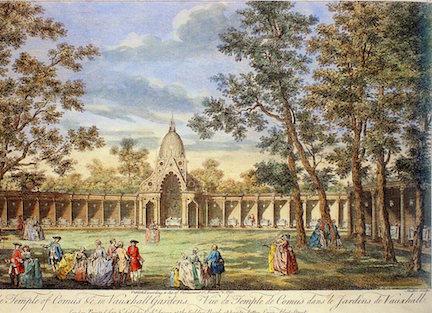
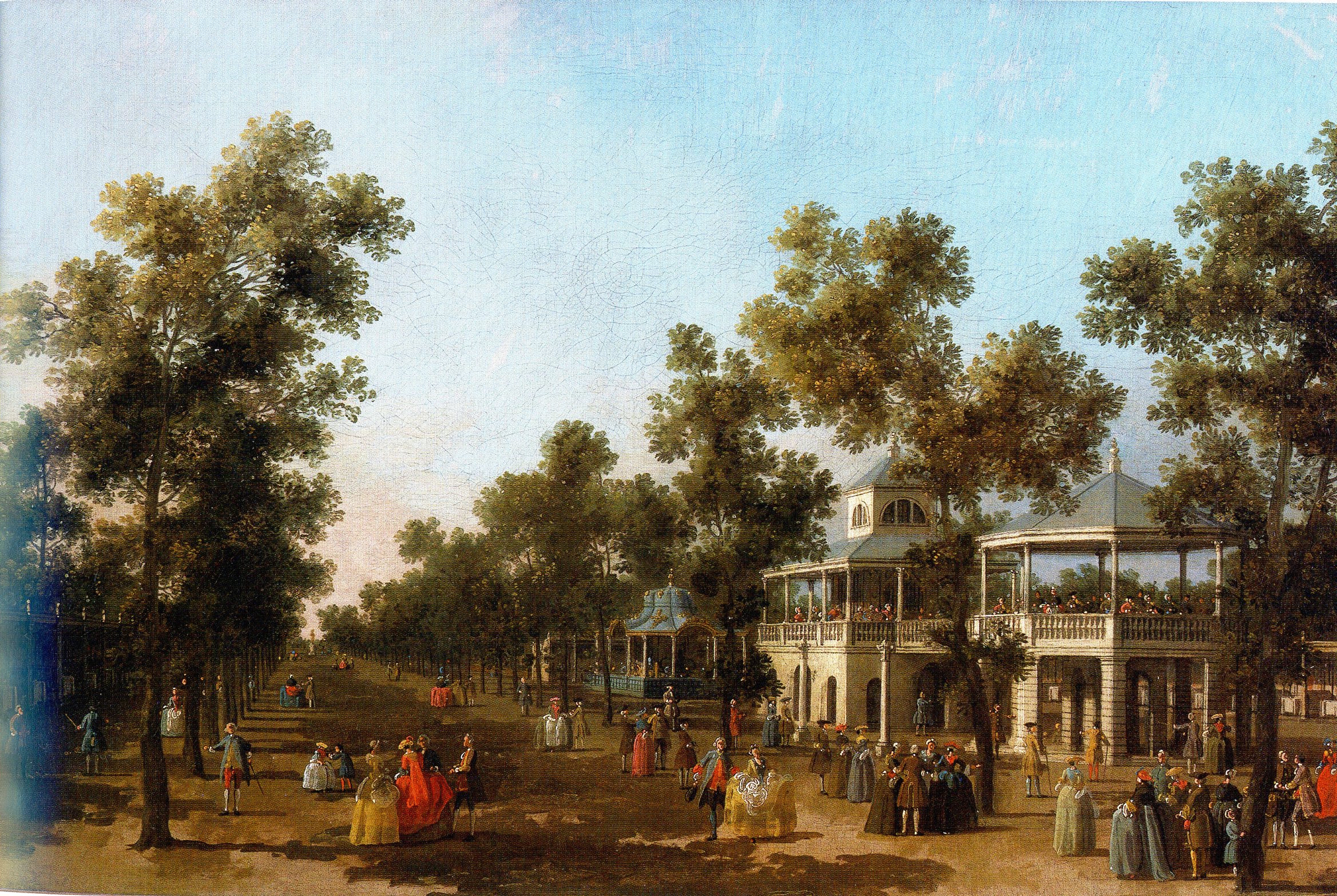
J.S. Muller after Canaletto, A View of the Temple of Comus &c. in Vauxhall Gardens, an engraving hand-colored, 1751 (David Coke's collection). Families with small children are promenading in the foreground.

J.S. Muller after Canaletto, A View of the Temple of Comus &c. in Vauxhall Gardens, an engraving hand-colored, 1751 (David Coke’s collection). Families with small children are promenading in the foreground.

Initially, the building was “classical in style, with a colonnade of Ionic columns supporting a straight entablature, topped with urn finials; the semicircle flowed in a smooth curve out of the straight colonnade of the northern range of supper-boxes.” However, the designer also incorporated Gothic arches and “broad-ramped scrolls [that] acted as buttresses for the dome” and other unorthodox details. “The apparent breaking of architectural rules, mingling different styles in the same building, was deliberate and entirely typical of the unorthodox design of the English Rococo, which aimed to create playful, light-hearted works.”

piazza002 copy

T. Bowles after S. Wale. A View of the Chinese Pavillions and Boxes in Vaux Hall Gardens, engraving. c. 1840 (David Coke’s collection). This is a reprint of Bowles’ plate of 1751, published by Francis West, a Fleet Street optician and printseller who acquired many original plates of London views, probably after the sale of trade stock by Robert Wilkinson, Bowles’ successor, in 1825. The buildings of the Temple of Comus are shown with their newly applied elaborate surface decoration.

The Handel Piazza
piazza003 copy

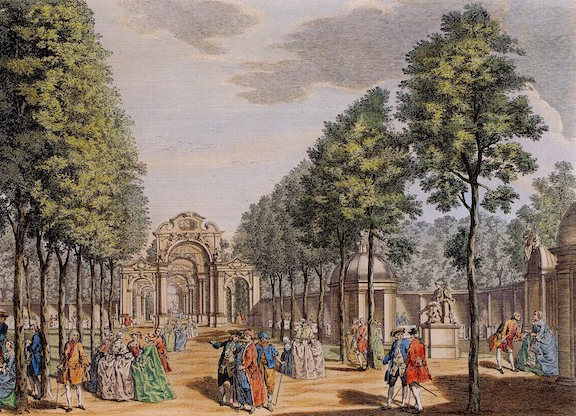
J.S. Muller after S. Wale, The Triumphal Arches, Mr. Handel’s Statue &c. in the South Walk of Vauxhall Gardens, engraving, c. 1840 (David Coke’s collection). The early version of the Handel Piazza.

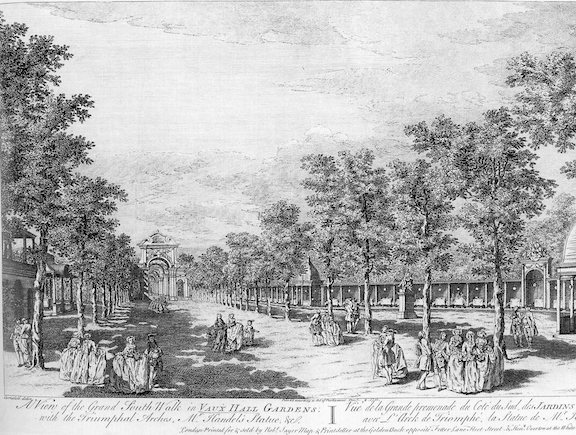
The Handel Piazza on the Grand South Walk started life as a small semicircular colonnade of plain boxes, little more than an open setting for Roubiliac’s statue of the composer… The piazza was built in the simplest Doric order, although the domes of the two terminal pavilions were topped with Gothic lanterns. The rebuilding of 1750-51 created a much broader colonnade, with twenty-two flat-roofed boxes, still of the Doric order, but with urn finials on the roof over each column. As in the Temple of Comus, the central pavilion was more elaborate, marked out by the use of the Ionic order, with swagged decorations between the columns, but here in the Handel Piazza the classical order and restraint were maintained… This new structure added considerably to the number of supper-boxes available on the Grand South Walk… The opposing arrangement and contrasting decorative styles of the Chinese Pavilions and the Handel Piazza epitomise Tyers’s ideological belief in the balance between excess and moderation, with Comus appropriately representing pleasure and excess, and Handel, in his simpler classical architectural setting, representing virtuous sobriety.
piazza004 copy

J.S. Muller after Canaletto, A View of the Grand South Walk in Vaux Hall Gardens, with the Triumphal Arches, Mr. Handel’s Statue, &c. Engraving, 1751 (British Library, London). On the right is the second version of the Handel Piazza, with more supper-boxes.

The Gothic Piazza

The Gothic Piazza, looking down the Grand South Walk from its western end, is not shown from the front in any engraving of Vauxhall, although Wale’s General Prospect shows it from the back just to the south (right) of the Prince’s Pavilion). It is, however, fully described in Lockman’s Sketch, as

a little Semi-circle of Pavillions, in an elegant Gothic Style […}. At each Foot of this Semi-Circle, stands a lofty Gothic Tent, each having a fine Glass Chandelier, the Lamps in which are of a very peculiar frame, as are those in the grand Tent, built in the Grove, &c. In the Center of this Semi-Circle is a Pavilion, with a Portico before it; and over the Pavillion, a kind of Gothic Tower, with a Turret at Top. Here a Glass Moon was to have been seen; but its Light was found too dazzling for the Eye. Those who survey’d the Alley, the Grove, &c. thro’ this Glass, saw a lovely Representation of them in Miniature. As the painted triumphal Arches before mentioned are in the Grecian Style, and these Pavillions in the Gothic, they form a very pleasing Contrast.

…The implication is that visitors could climb to the top of the central pavilion of this piazza, to look down on the gardens through an optical device or lens during daylight, and after that, after dark, a light was shone through it towards visitors in the Grove, possibly spotlighting courting couples. [Scandal!]

“A remarkable body of original and innovatory architecture”

The group of structures in and around the Grove at the end of the 1740’s, comprising the Orchestra and organ buildings, the supper-boxes and three piazzas, the Prince’s Pavilion, the Turkish Tent and the Rotunda, represent a remarkably body of original and innovatory architecture that was both decorative and practical, achieved by Tyers and his team in the space of just thirteen years. Few other patrons could boast of such a diverse collection of modern works of architecture. The sheer expense incurred in this building spree is evidence of the level of Tyers’s income; as Hogarth’s friend the enameller Jean-André Rouquet wrote at the time, ‘The director of the entertainments of this garden acquires and expends very considerable sums of money there every year. He was born for undertakings of this kind. He is a man of an elegant and bold taste; afraid of no expence, when the point is to divert the public’—or rather, to attract the paying public to Vauxhall.

The fact that this elegant and bold taste was devoted to a pleasure garden, and that the buildings no longer exist, should not detract from their importance in the context of the development of British architecture, and in particular, of British interior design in the eighteenth century. They would have been some of the best-known modern buildings in the country, seen by tens of thousands of visitors every year.

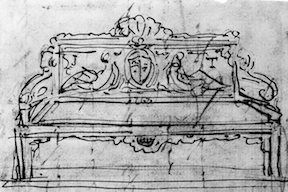
Supper-Box Furniture
furniture001 copy

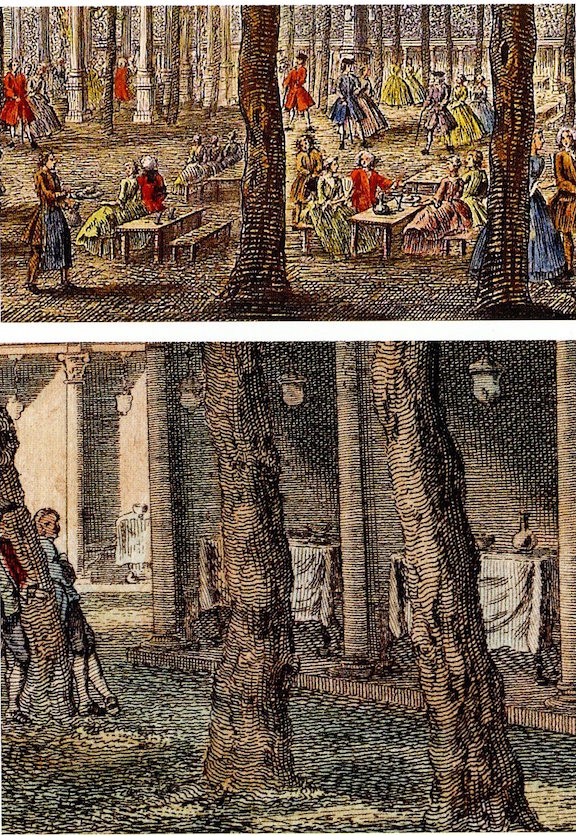
In the 1730’s and 1740’s, furniture at Vauxhall… was plain and serviceable, the tables usually covered with baize on linen. Rectangular square-legged farmhouse tables and foxed plain benches served the supper-boxes, with free-standing backless benches and plain tables out in the Grove. The Grove also boasted a number of slatted wooden garden seats, their circular inward-facing form, accessed through a single opening, providing the ideal setting for polite conversation for an intimate rendezvous.
furniture002

By the early 1750’s, however, contemporary engravings show a number of more elaborate and expensive tables and benches in the supper-boxes. The carved Rococo table-legs, showing below the tablecloths, appear to be ornamented with double-C scrolls.

After this brief period, however, the furniture again reverted to a simple farmhouse style. Indeed, it would be unsurprising if the carved Rococo tables of the 1750’s were found to be too delicate for the abuse they would have received at Vauxhall from the visitors and weather.

Susana’s Vauxhall Blog Post Series

  1. Vauxhall Gardens: A History
  2. Vauxhall Gardens: Jonathan Tyers—“The Master Builder of Delight” 
  3. Vauxhall Gardens: A New Direction
  4. Vauxhall Gardens: The Orchestra and the Supper-Boxes 
  5. Vauxhall Gardens: The Organ, the Turkish Tent, and the Rotunda
  6. Vauxhall Gardens: Three Piazzas of Supper-Boxes
  7. Vauxhall Gardens: “whither every body must go or appear a sort of Monster in polite Company”
  8. Vauxhall Gardens: The Competition
  9. Vauxhall Gardens: The Artwork, Part I
  10. Vauxhall Gardens: The Artwork, Part II
  11. Vauxhall Gardens: The Music, 1732-1859
  12. Vauxhall Gardens: The Business Side
  13. Vauxhall Gardens: Developments from 1751-1786
  14. Vauxhall Gardens: Thomas Rowlandson’s Painting (1785)
  15. ‎Vauxhall Gardens: The Third Generation of the Tyers Family and the Jubilee of 1786
  16. Vauxhall Gardens: An Era of Change (1786-1822), Part I
  17. Vauxhall Gardens: An Era of Change (1786-1822), Part II
  18. Vauxhall Gardens: An Era of Change (1786-1822), Part III
  19. Vauxhall Gardens: The Final Years, Part I
  20. Vauxhall Gardens: The Final Years, Part II
  21. Vauxhall Gardens: The Final Years, Part III
  22. Vauxhall Gardens: The Final Years, Part IV
  23. Vauxhall Gardens: Farewell, for ever

Vauxhall Gardens: The Organ, the Turkish Tent, and the Rotunda

vauxhallbook

Vauxhall Gardens: A History

David Coke & Alan Borg

The Vauxhall Pleasure Gardens is one of the places I’d love to slip back in time to visit, just to catch a glimpse of what it was like. After recently splurging to buy this lovely coffee-table book, I thought it might make a wonderful subject for a new blog series. But do buy the book too, if you can! The photos are fabulous!

The Organ Building

In 1737, the Organ Building was built, after numerous delays related to “the acoustics and audible range of the organ in this outdoor setting, as well as the damping of the building itself to ensure that no structural vibrations spoiled the sound.”

This square structure was the same width as the Orchestra, and was on three levels; a heavy lower storey supported the first floor where a short bridge joined the two buildings together. This first floor, at the same level as the first floor of the Orchestra, was partly taken up by the organ console and pipes, and partly by a covered open space running all around it. The building then rose to the ‘belfry’, which had louvred semicircular openings on all four faces to project the sound of the organ around the gardens… The lower storey, totally unrelieved by any surface decoration, was pierced by a triple arch on each of its four plain faces, one taller arch flanked by two smaller; the taller central arch on each face was a hybrid triform arch which gave the building a real visual strength and presence.

organ005

Vauxhall and the Weather

The typical rainy English weather, especially on opening day every spring, was a significant problem for an outdoor business such as this one. In 1740, due to the loss in business caused by the poor weather of 1739, Tyers announced “several considerable Additions and Improvements,” which were later described as “Conveniences for receiving Company in cold or rainy Weather,” whatever that means.

Weather-related jokes at Vauxhall’s expense were commonplace; especially popular was the one about a farmer waiting to see when the gardens were going to open, so he would know when to plant his crops, a good few days of drenching rain being assured.
The regularity of rain on Vauxhall’s opening night increased in the nineteenth century; so much so that, at one stage, announcements advertising the forthcoming opening were carried around town printed on umbrellas.

The Three “Tents”

In 1742 Henry Fielding described his impressions on entering the gardens. The first structures he saw there were ‘two similar Tents’ under the trees of the Grove, ‘of such a Contrivance and Form, as a Painter of Genius and Judgement would chuse to adorn his Landscape with.’ If these were, in fact, the shelters that Tyers had announced two years earlier offering protection from cold and wet weather, their position was certainly appropriate, between the Orchestra and the Prince’s Pavilion, and only a few yards from the entrance and the servery. The word ‘tent’ did not specifically apply to a canvas structure; indeed, it could refer to almost any temporary building, especially in a garden.

A “Turkish Tent” was built as an undercover dining area for visitors who could not get a supper-box or wanted to have a more entertaining party. “Its exotic style, more closely associated with Venetian festivals… allowed visitors to act the part of Eastern potentates relaxing on their magnificent bed under a grande baldacchino.

The design of this structure is clearly more informal and frivolous than the strictly classical styles favored by Tyers in his earlier buildings.

The Rotunda

In the 1740’s, other entrepreneurs jumped into the pleasure gardens business, the most successful of which were Ranelagh and Marylebone Gardens.

In the face of serious competition from such places and in view of the unreliable British summer, Tyers was under constant pressure to introduce regular improvements whenever adequate funding was available. At the end of the 1740s he went one step further, and, playing the proprietors of Ranelagh at their own game, installed a major new structure as a grand assembly room and concert hall for use by the band when the weather was too wet or windy.

Variously called the ‘Umbrella Room’, the ‘Music Room’, the ‘Great Room’ or simply the Rotunda, Tyers’s building, with its orchestra stand and organ, was capable of accommodating as many musicians as its outdoor equivalent.

rotunda006

The most remarkable feature of the original Rotunda was undoubtedly the chandelier described by Lockman as having been designed by a gentleman amateur. This chandelier, 11 feet across and with 72 candles, must have been one of the largest in the country, a hugely impressive piece of furniture, and its grandeur was considerably enlightened sometime later by the addition of a plaster sculpture, the Rape of Semele by Jupiter.

The Rotunda was redecorated at intervals… The modelled floral decoration of the ceiling was stripped out in 1765, and the roof re-painted ‘in the resemblance of a shall. For the opening gala of Tuesday 18 May 1790, the Rotunda, growing ever more exotic, was fitted up in imitation of a Persian divan. It was then redecorated several times, becoming by turns a garden tent, a Roman military pavilion, an Indian garden-room and, finally, a circus hippodrome, with two tiers of audience boxes, a proscenium stage and a central ring for displays of horsemanship and circus acts.


Susana’s Vauxhall Blog Post Series

  1. Vauxhall Gardens: A History
  2. Vauxhall Gardens: Jonathan Tyers—“The Master Builder of Delight” 
  3. Vauxhall Gardens: A New Direction
  4. Vauxhall Gardens: The Orchestra and the Supper-Boxes 
  5. Vauxhall Gardens: The Organ, the Turkish Tent, and the Rotunda
  6. Vauxhall Gardens: Three Piazzas of Supper-Boxes
  7. Vauxhall Gardens: “whither every body must go or appear a sort of Monster in polite Company”
  8. Vauxhall Gardens: The Competition
  9. Vauxhall Gardens: The Artwork, Part I
  10. Vauxhall Gardens: The Artwork, Part II
  11. Vauxhall Gardens: The Music, 1732-1859
  12. Vauxhall Gardens: The Business Side
  13. Vauxhall Gardens: Developments from 1751-1786
  14. Vauxhall Gardens: Thomas Rowlandson’s Painting (1785)
  15. ‎Vauxhall Gardens: The Third Generation of the Tyers Family and the Jubilee of 1786
  16. Vauxhall Gardens: An Era of Change (1786-1822), Part I
  17. Vauxhall Gardens: An Era of Change (1786-1822), Part II
  18. Vauxhall Gardens: An Era of Change (1786-1822), Part III
  19. Vauxhall Gardens: The Final Years, Part I
  20. Vauxhall Gardens: The Final Years, Part II
  21. Vauxhall Gardens: The Final Years, Part III
  22. Vauxhall Gardens: The Final Years, Part IV
  23. Vauxhall Gardens: Farewell, for ever

Vauxhall Gardens: The Orchestra and the Supper-Boxes

vauxhallbook

Vauxhall Gardens: A History

David Coke & Alan Borg

The Vauxhall Pleasure Gardens is one of the places I’d love to slip back in time to visit, just to catch a glimpse of what it was like. After recently splurging to buy this lovely coffee-table book, I thought it might make a wonderful subject for a new blog series. But do buy the book too, if you can! The photos are fabulous!

The Orchestra

Across from the Prince’s Pavilion, mentioned in last week’s post, stood the open-air bandstand known as the Orchestra, which opened on 3 June 1735.

There is built in the Grove of the Spring-Gardens at Vaux-Hall, an Octagon Temple, intended to serve as an Orchestra, for a Band of our finest Instrumental Performers; who will play (beginning at Five every Evening during the Summer-Season) the compositions of Mr. Handel, and other celebrated Masters. Upon Trial, the Concert had a wonderful Effect, the Sounds spreading through every Part of this delightful Garden; so that Gentlemen and Ladies, whether walking, or sitting in the Alcoves, may hear it to the greatest Advantage. Though there has not yet been any Thing of this kind exhibited among us, and the Master of the Gardens has put himself to a considerable Expence upon this Occasion, yet nothing will be requir’d for this innocent and elegant additional Entertainment, which will begin Tomorrow at the Hour above-mentioned.

This building, with a base of large blocks of roughened masonry, supported an upper floor, an octagonal room enclosed by eight arches illuminated by a central chandelier. The outer area of the first (second) floor was bounded by a low balustrade.

Although the opening night was plagued with poor weather, a good audience was in attendance.

Yesterday being so rainy, little no Company was expected in the Spring-Gardens at Vaux-Hall, for which reason the Concert was to have been put off till this Evening; but a great Number of Coaches and Persons of the best Fashion coming in, the Concert was open’d; several very fine musical Compositions were perform’d, to the great Satisfaction of the Hearers, and especially of the Judges of Musick, many of whom were present on this Occasion. The Gardens, tho’ so very pleasant in themselves, were yet greatly improv’d by the Harmony, which had different Effects (but all delightful) in the various parts of the Garden; so that all the elegant Company seem’d very desirous of encouraging this rural kind of Opera, which pleas’d no less from the Execution than from the Novelty of it.

As popular as the orchestra music became, it was soon clear that the large number of trees were a detriment to the acoustics. Tyers lost no time in removing “a great Number of Trees… from the Thicket joyning to the Orchestra,” and placing “several Tables and Seats fixed at proper Distances, in the Openings” so that visitors could enjoy refreshments while listening to the music.

The Orchestra itself was able to accommodate, on its upper level, as many as thirty seated and standing musicians. The building’s actual dimensions… judging from the numerous visual sources… measured over 20 feet in diameter and about 25 feet in height to the tip of the conical slated roof—quite a small building, but certainly large enough for its purpose.

bars003

From a satirical pamphet “A Trip to Vaux-hall (1737): Notice the bar in the lower left where waiters went to collect food orders for the visitors. Also, the roof terrace above where Tyers could keep an eye on everything.

The Supper-Boxes

Between September of 1735 and April 1736, during the off-season, more improvements were made.

The Improvements in the Spring-Gardens at Vaux Hall (which have employ’d upwards of 100 Hands ever since last August) being now finish’d, and a Band, consisting of above thirty of the ablest Performers provided, the Musical Assembly will be open’d next Wednesday [19 May]. The Grove, which is considerably enlarged and finely laid out in Gravel Walks, is embellish’d with a great Number of Colonades [the supper-boxes]; and in the Centre is an Edifice, in the Form of a Temple, for the Band, who will play the favourite Pieces of the most eminent Masters. The whole is so advantageously dispos’d, that 3000 Persons may sit at ease, and see one another during the Entertainment. In the Grove, above 300 Glass Lights are set up, all which are illuminated in half a Minute, and have a beautiful Effect on the Verdure. For the better Conveniency of the Company, a great Number of Waiters, &c., are provided; and in order that this innocent and agreeable Entertainment may be conducted with such a Decency, as many induce the politest Persons, and those of the most serious Character to honour it with their Presence, a proper Guard will attend to keep out all lewd and disorderly Persons. —Notwithstanding the very great Expence the Master has been, and must necessarily be at, during the Season, yet it was his intention to have admitted all Persons into his Gardens in the same Manner as last Summer; but as Numbers resorted thither who were no ways qualify’d to intermix with Persons of better Fashion; for this Reason he has been persuaded to let none enter but with Tickets (to be given out at the Door) at One Shilling each, which Ticket will be afterwards taken at the Entertainment in the Gardens, as One Shilling, if desir’d.

The old arbors and rickety supper-boxes in existence before Tyers came upon the scene were tossed away in favor of new and orderly ones arranged outside of the Orchestra. The Vauxhall Fan, which was produced and sold for three consecutive years (1736-8) as new features were introduced (only the first of which still exists) shows the view from the entrance, looking down the Grand Walk, with the Orchestra building on the right.

Many of the trees carry a globe lamp on a bracket, and more lamps hang on lamp-posts and from the ceiling of each supper-box. The edition of 1737 added the organ building behind the Orchestra, and in 1738 Roubiliac’s new statue of Handel was included.

The Vauxhall Fan (1736)

The Vauxhall Fan (1736)

In such a manner,Tyers made use of the popularity and intriguing “language” of the fan as a clever marketing tool.

The north and south ranges of supper-boxes… made up of more than twenty boxes each, were almost 300 feet long and about six to eight feet deep. A shorter range of eight boxes on the far side of the Grove between the two parallel walks, was around 100 feet long, making each box about 12 feet wide. The boxes themselves were initially open on all sides, with only a rail dividing adjacent supper parties from each other, leading to unwonted intimacies between friends and strangers alike. From 1741 or ’42 solid walls divided every box from its neighbour, and each one was roofed with waxed cloth and had a fixed bench around three sides of its table.

The layout of the Grove was remarkably formal and austere, like an ancient Greek agora. Through his arrangement of the boxes Tyers discouraged overtly immoral or intemperate behavior by providing a setting where there were no hidden corners and where the privacy enjoyed by Pepys and his contemporaries was difficult to achieve.

The exact number of supper-boxes in the years before 1751 is difficult to estimate, but it must have been around fifty-five. This rose sharply to over 130 in 1751, reaching a maximum of about 140 around 1800, before falling back to about 90 in the 1840’s.

The many additions to the number of boxes demonstrate that dining space was always at a premium, and that Tyers was under constant pressure to provide additional seating for his visitors wherever he could. This not only boosted his profits from food sales, but also helped his staff earn additional tips by finding more private seating for parties of visitors.

Susana’s Vauxhall Blog Post Series

  1. Vauxhall Gardens: A History
  2. Vauxhall Gardens: Jonathan Tyers—“The Master Builder of Delight” 
  3. Vauxhall Gardens: A New Direction
  4. Vauxhall Gardens: The Orchestra and the Supper-Boxes 
  5. Vauxhall Gardens: The Organ, the Turkish Tent, and the Rotunda
  6. Vauxhall Gardens: Three Piazzas of Supper-Boxes
  7. Vauxhall Gardens: “whither every body must go or appear a sort of Monster in polite Company”
  8. Vauxhall Gardens: The Competition
  9. Vauxhall Gardens: The Artwork, Part I
  10. Vauxhall Gardens: The Artwork, Part II
  11. Vauxhall Gardens: The Music, 1732-1859
  12. Vauxhall Gardens: The Business Side
  13. Vauxhall Gardens: Developments from 1751-1786
  14. Vauxhall Gardens: Thomas Rowlandson’s Painting (1785)
  15. ‎Vauxhall Gardens: The Third Generation of the Tyers Family and the Jubilee of 1786
  16. Vauxhall Gardens: An Era of Change (1786-1822), Part I
  17. Vauxhall Gardens: An Era of Change (1786-1822), Part II
  18. Vauxhall Gardens: An Era of Change (1786-1822), Part III
  19. Vauxhall Gardens: The Final Years, Part I
  20. Vauxhall Gardens: The Final Years, Part II
  21. Vauxhall Gardens: The Final Years, Part III
  22. Vauxhall Gardens: The Final Years, Part IV
  23. Vauxhall Gardens: Farewell, for ever

Bath: a guide for readers of The Third MacPherson Sister

BTP_BathCityCentreMap_V2

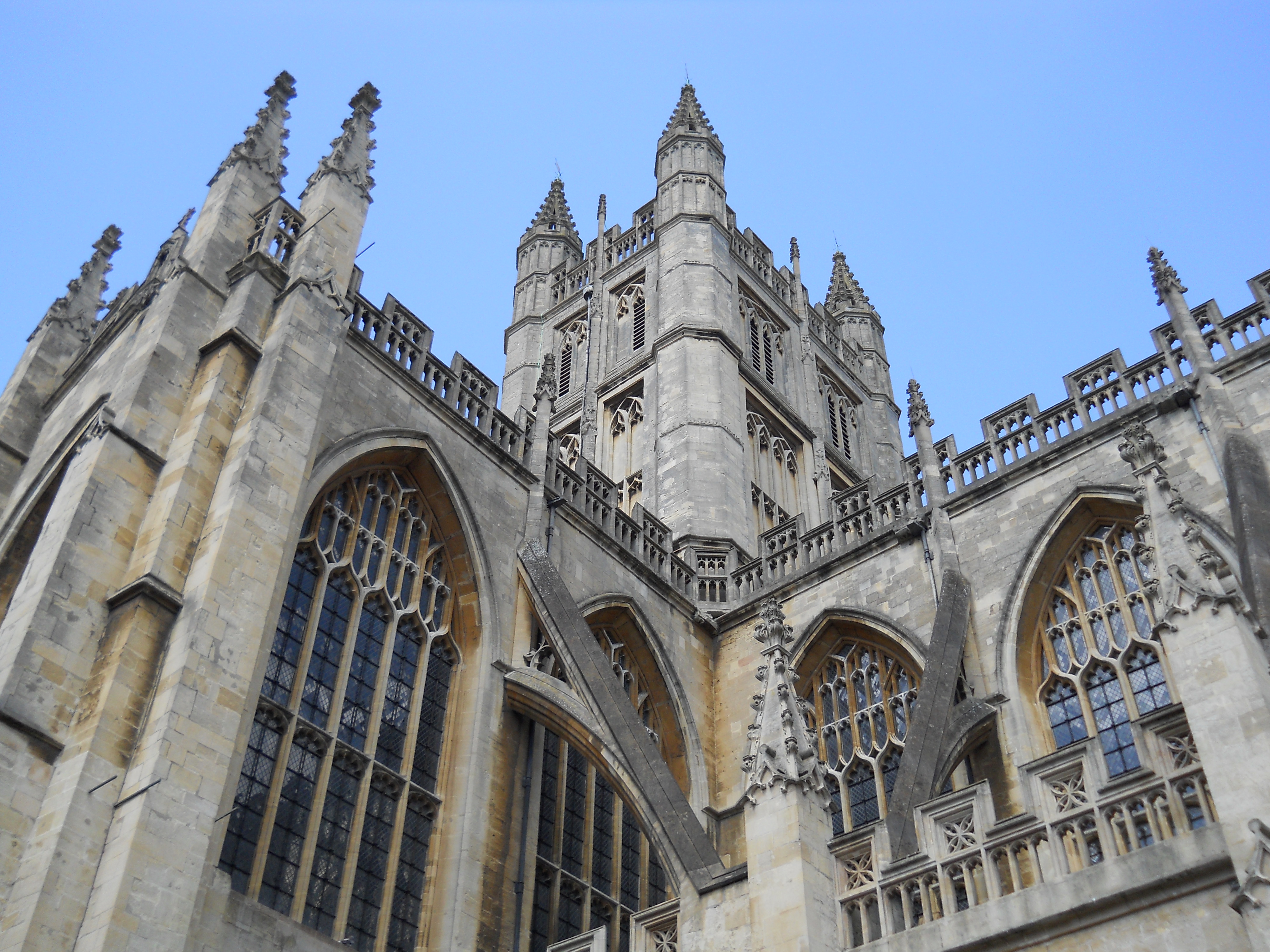
Bath Abbey

Five things to know about Bath Abbey*

  • Three different churches have occupied the site of today’s Abbey since 757 AD. First, an Anglo-Saxon monastery which was pulled down by the Norman conquerors of England; then a massive Norman cathedral which was begun about 1090 but lay in ruins by late 15th century; and finally, the present Abbey Church as we now know it.
  • The first King of all England, King Edgar was crowned on this site in 973 (as shown above). The service set the precedent for the coronation of all future Kings and Queens of England including Elizabeth II.
  • The first sight most visitors have of Bath Abbey is the West front, with its unique ladders of Angels. The story behind this is that the Bishop of Bath, Oliver King, is said to have had a dream of angels ascending and descending into heaven which inspired the design and which also inspired him to build a new Abbey church – the last great medieval cathedral to have been built in England.
  • After the dissolution of the monasteries in 1539 by order of King Henry VIII, the Abbey lay in ruins for more than 70 years. It wasn’t until 1616, that much of the building we see today was repaired and in use as a parish church and over two hundred years later, in the 1830s, that local architect George Manners added new pinnacles and flying buttresses to the exterior and inside, built a new organ on a screen over the crossing, more galleries over the choir and installed extra seating.
  • The Abbey as we know it is the work of Sir George Gilbert Scott, who from 1864 to 1874, completely transformed the inside of the Abbey to conform with his vision of Victorian Gothic architecture. His most significant contribution must surely be the replacement of the ancient wooden ceiling over the nave with the spectacular stone fan vaulting we see today.

*http://www.bathabbey.org/history

Photo by Barbara S. Andrews

Photo by Barbara S. Andrews

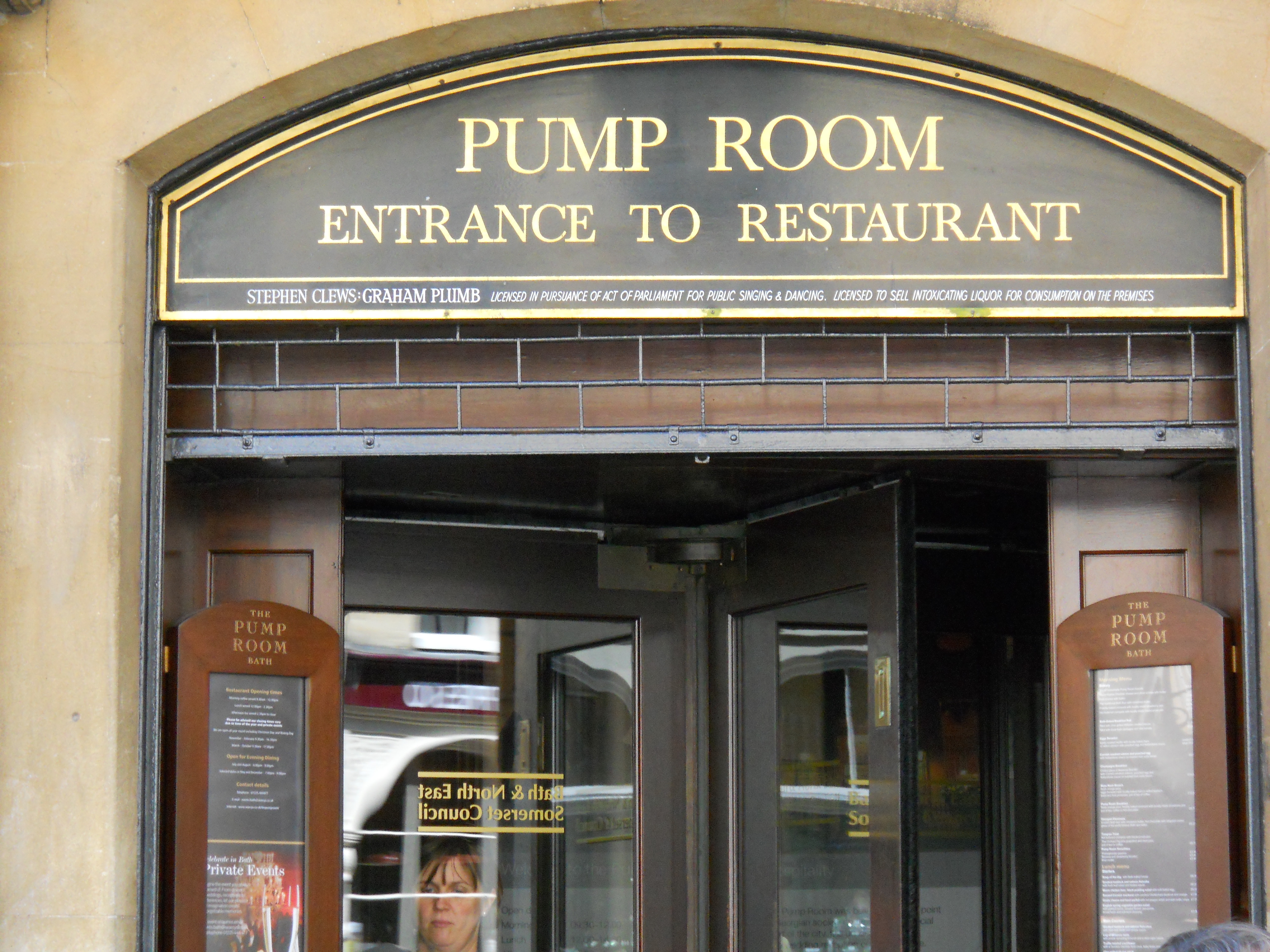
The Pump Room

Situated next to main street entrance to the Roman Baths, visitors can sample the waters from the warm spring which fills the Roman Baths. The building also houses a restaurant, where it is popular to sample the afternoon tea.

pumproomsign

Photo by Barbara S. Andrews

The Roman Baths

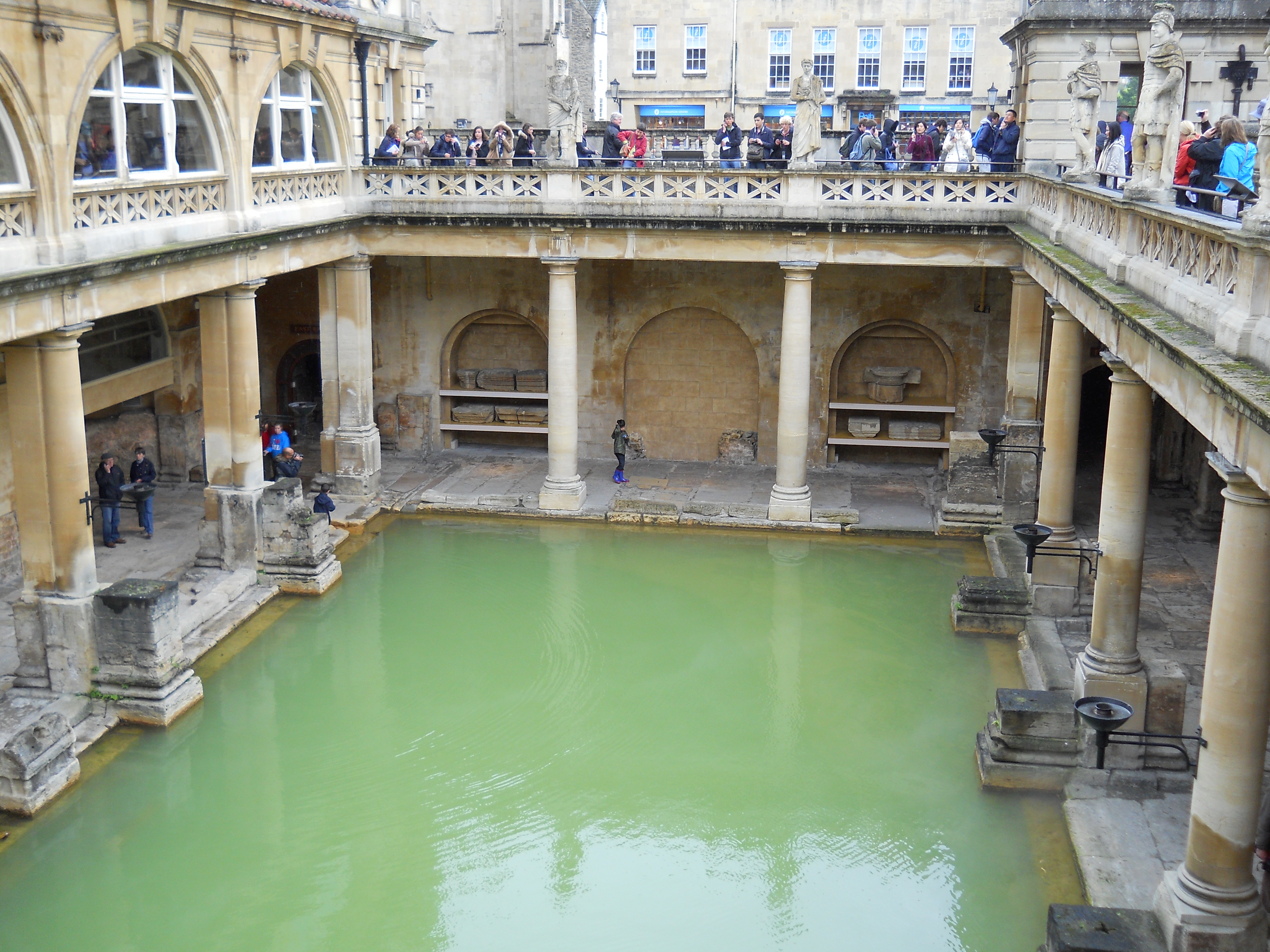
The house is a well-preserved Roman site for public bathing. The Roman Baths themselves are below the modern street level. There are four main features: the Sacred Spring, the Roman Temple, the Roman Bath House and the Museum holding finds from Roman Bath. The buildings above street level date from the 19th century.

Photo by Barbara S. Andrews

Photo by Barbara S. Andrews

The Pulteney Bridge

The bridge features two ranges of shops designed in the Palladian style c. 1770, between them forming a narrow street over the bridge. The street and buildings sit above three segmental arches of equal span.

The shops on the north side have cantilevered rear extensions. Consequently the northern external façade of the bridge is asymmetrical, much altered and of no architectural merit, whereas the southern external side clearly shows the hand of Robert Adam.

Shops on the Pulteney Bridge  By Erebus555 at English Wikipedia [CC BY-SA 3.0 (http://creativecommons.org/licenses/by-sa/3.0) or GFDL (http://www.gnu.org/copyleft/fdl.html)], via Wikimedia Commons

Shops on the Pulteney Bridge
By Erebus555 at English Wikipedia [CC BY-SA 3.0 (http://creativecommons.org/licenses/by-sa/3.0) or GFDL (http://www.gnu.org/copyleft/fdl.html)%5D, via Wikimedia Commons

Sydney Gardens (formerly Bath Vauxhall Gardens)

The Sydney Gardens are the only remaining 18th century pleasure gardens in England.

The gardens were constructed in the 1790s opening in 1795 as a commercial pleasure grounds, following the development of Bathwick by Sir William Pulteney, 5th Baronet across the River Avon from the city centre. The original plans were by Thomas Baldwin and completed by Charles Harcourt Masters who included a maze or labyrinth, grotto, sham castle and an artificial rural scene with moving figures powered by a clockwork mechanism. The gardens were illuminated by over 15,000 “variegated lamps”. Around 1810 the Kennet and Avon Canal was built through the gardens.

Sydney Gardens  By Plumbum64 (Own work) [CC BY-SA 3.0 (http://creativecommons.org/licenses/by-sa/3.0)], via Wikimedia Commons

Sydney Gardens
By Plumbum64 (Own work) [CC BY-SA 3.0 (http://creativecommons.org/licenses/by-sa/3.0)%5D, via Wikimedia Commons

The Sydney Hotel

The Sydney Hotel was built within the gardens. The original design for the hotel, prepared by Thomas Baldwin in 1794, was a two-storey building which would serve the pleasure gardens. After Baldwin was bankrupted his design for the hotel was not implemented. Instead a three-storey building was designed by Charles Harcourt Masters. The foundation stone was laid in 1796 and the building was ready by 1799. Visitors entered the gardens through the Hotel. Projecting from the rear of the building at first floor level was a conservatory and a semi-circular Orchestra with a wide covered loggia below. Two semi-circular rows of supper boxes projected from the sides of the building. The gardens were used daily for promenades and public breakfasts which were attended by Jane Austen among others. At public breakfasts tea, coffee, rolls and Sally Lunn buns were served at about midday, followed by dancing. There were generally three evening galas each summer, usually on the birthdays of George III and the Prince of Wales, and in July to coincide with the Bath races. During these galas the gardens were lit with thousands of lamps and the guests took supper accompanied by music and fireworks. Breakfasts, coffee-drinking, newspaper-reading and card-playing took place in the ground floor of the Hotel and dancing in a ballroom on the first floor. All the rooms could be hired for private parties and meetings.

The Assembly Rooms

The Assembly Rooms formed the hub of fashionable Georgian society in the city, the venue being described as “the most noble and elegant of any in the kingdom” They were originally known as the Upper Rooms as there was also a lower assembly room in the city, which closed soon after the Upper Rooms opened. They served the newly built fashionable area which included The Circus, Queen Square and the Royal Crescent.

People would gather in the rooms in the evening for balls and other public functions, or simply to play cards. Mothers and chaperones bringing their daughters to Bath for the social season, hoping to marry them off to a suitable husband, would take their charge to such events where, very quickly, one might meet all the eligible men currently in the City.

Photo by Barbara S. Andrews

Photo by Barbara S. Andrews

The Theatre Royal

The present main entrance to the Theatre Royal, in Sawclose, was built in 1720 by Thomas Greenway, and was Beau Nash’s first house. The exterior of the building, with arches, pilasters, garlands and ornaments, which is visible from Beauford Square, was designed by George Dance the Younger and erected by John Palmer.

The theatre itself was erected in 1805, replacing the Old Orchard Street Theatre which was also called the Theatre Royal, which is now a Freemason’s Hall.

The theatre is said to be haunted by The Grey Lady, who was an actress centuries ago. She has been seen watching productions in the Grey Lady Box, and she leaves the distinctive scent of Jasmine. She has been seen and scented in recent years.

Theatre Royal, Bath   By MichaelMaggs (Own work) [CC BY-SA 2.5 (http://creativecommons.org/licenses/by-sa/2.5)], via Wikimedia Commons

Theatre Royal, Bath
By MichaelMaggs (Own work) [CC BY-SA 2.5 (http://creativecommons.org/licenses/by-sa/2.5)%5D, via Wikimedia Commons

Text from Wikipedia.

About The Third MacPherson Sister (part of the Sweet Summer Kisses anthology)

TheThirdMacPhersonSister2inchAfter a disastrous fourth Season in London, Rebecca and her mother take refuge in Bath to determine their next course of action. Rebecca has always known she’ll never be able to measure up to her older sisters, the “Golden Twins,” who were the reigning queens of the ton in their day, but surely there is a gentleman somewhere capable of appreciating her finer qualities.

Miles Framingham, Duke of Aylesbury, finds himself in need a wife… although he doesn’t really want one. Burdened with the responsibilities of a dukedom from a young age, what he really yearns for is freedom. Marriage to the right woman, though, might not be such an onerous task.

When the hapless Rebecca finds herself pushed into the lap of this eminently eligible duke in the nave of Bath Abbey, a match between them seems ordained by the heavens… except for the little matter of his past history with her sisters.

SweetSummerKisses2med

Bluestockings and wallflowers seek happily-ever-afters. Only handsome, respectable and deeply romantic persons need apply. Dukes and marquesses will be given special consideration. Apply within.  

This anthology contains nine fun, heart-tugging, and wholesomely romantic Regency novellas that are as sigh-worthy as they are sweet, brought to you by USA Today and national bestselling, award-winning authors.

AmazonBarnes & NobleKoboiBooks • Google

Vauxhall Gardens: Jonathan Tyers— “The Master Builder of Delight”

vauxhallbook

Vauxhall Gardens: A History

David Coke & Alan Borg

The Vauxhall Pleasure Gardens is one of the places I’d love to slip back in time to visit, just to catch a glimpse of what it was like. After recently splurging to buy this lovely coffee-table book, I thought it might make a wonderful subject for a new blog series. But do buy the book too, if you can! The photos are fabulous!

“The Master Builder of Delight”

In 1729, the site of the “Vauxhall Spring-Gardens was leased to a twenty-seven-year-old entrepreneur called Jonathan Tyers, whose goal was to transform it from a sort of seedy rural tavern to a respectable venue for all social classes.

A fellmonger (dealer in animal hides or skins) by trade, Jonathan was not content to continue the family business, successful though it was. Driven by a desire to raise his family’s status—and improve the world as he did so—Tyers believed that culture and pleasurable entertainments should not be the sole prerogative of the upper classes, but that the middle and lower classes deserved to find some enjoyment in their lives as well.

tyers family

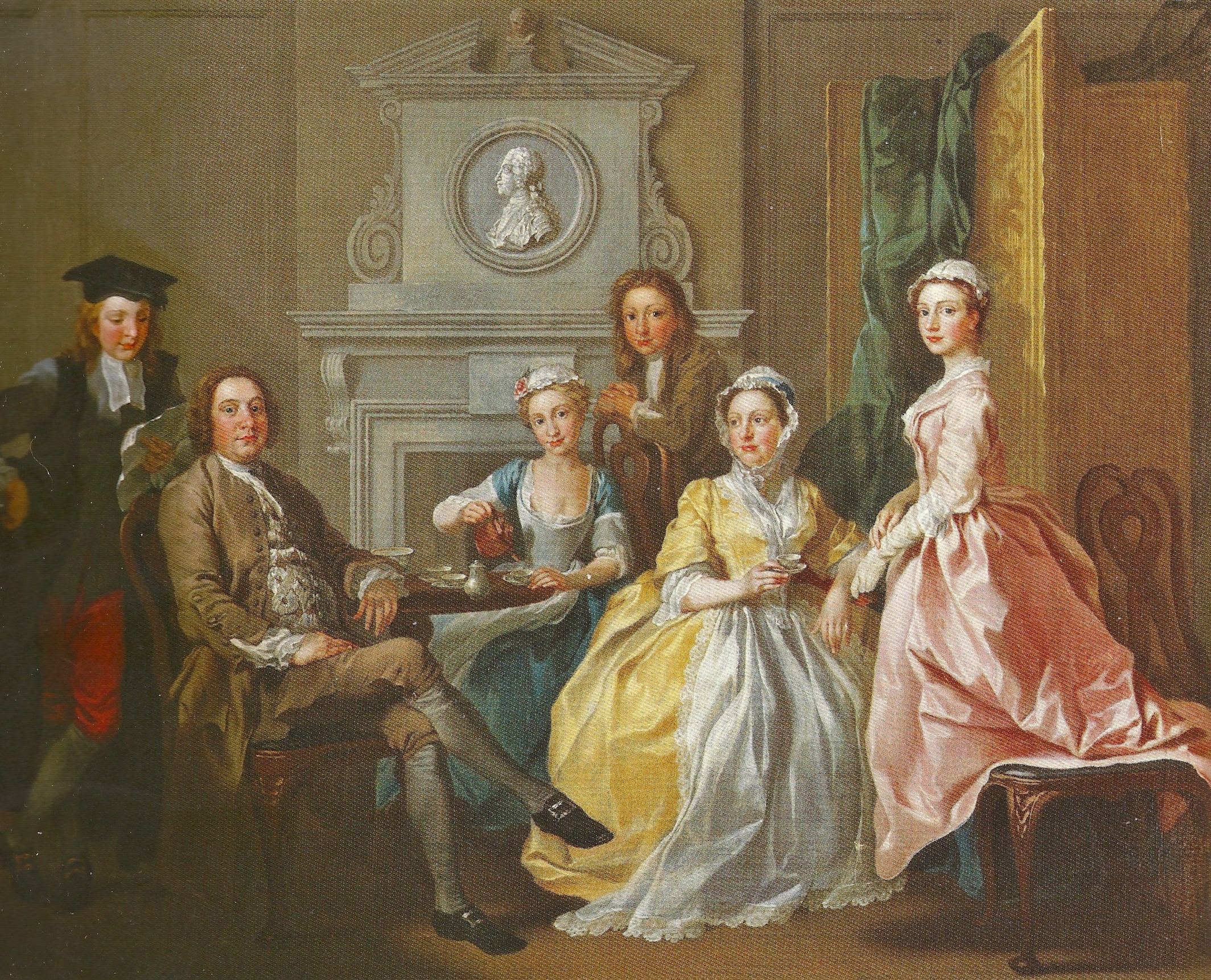
Family portrait by Francis Hayman, Jonathan Tyers and his Family, 1740. Left to right: Elder son Thomas, Jonathan, daughter Elizabeth, son Jonathan, wife Elizabeth, daughter Margaret.

Jonathan Tyers was a very complex character, with more than his fair share of contradictions and eccentricities. Upright, intelligent and self-assured, he also exhibited strains of arrogance and ambition. However, his ambitions were clearly projected chiefly upon his business rather than himself, while his personal aspirations were driven by a wish to raise his own status and that of his family to gentry, an object in which he succeeded at a remarkably early age. (p.35)

Through his association with The Wits’ Club, a social club for freethinkers, scholars, libertarians, and writers, Tyers became good friends with Charles Burney, Henry Fielding, William Hogarth, Harry Hatsell, Edward Moore, Thomas Cooke, Richard Dawson, and Leonard Howard. The club first met at Vauxhall Gardens later moved to a nearby tavern. Many of the ideas behind his development of the gardens came from the discussions at this club.

Although he never managed to mix with fashionable society in his lifetime, he was held in great respect and admiration by his peers, so much so that he was elected to the Royal Society of Arts in 1757, where he would have met many other prominent people, including Benjamin Franklin, when he visited London.

He and his creation were even featured in his friend Henry Fielding’s work of fiction, Amelia (1751).

The extreme Beauty and Elegance of this Place is well known to almost every one of my Readers; and happy is it for me that it is so; since to give an adequate Idea of it, would exceed my Power of Description. To delineate the particular Beauties of these Gardens, would, indeed, require as much pains and as much Paper too, as to rehearse all the good Actions of their Master [Tyers], whose Life proves the Truth of an Observation which I have read in some Ethic Writer, that a truly elegant Taste is generally accompanied with an Excellency of Heart; or in other Words, that true Virtue is, indeed, nothing else but true Taste.

The_Works_of_Henry_Fielding_Amelia_v2_1000373134

Tyers’s Mission

Besides his goal of cleaning up the gardens’ reputation, Tyers hoped to use the venue to improve people’s lives “through contact beauty and quality.” In other words, he planned to provide the lower orders with both art and beauty, and also expose them to “polite society,” who would educate them by example.

His influence on the manners and morals of eighteenth-century society was to be far-reaching, and his patronage of artists and designers would change the face of British art. But it was his ideological beliefs and priorities, his egalitarianism and his conviction that the pursuit of pleasure was a basic human right, and a vital element of the balanced life, that would really motivate his proprietorship of Vauxhall Gardens.

The Ridotto al Fresco

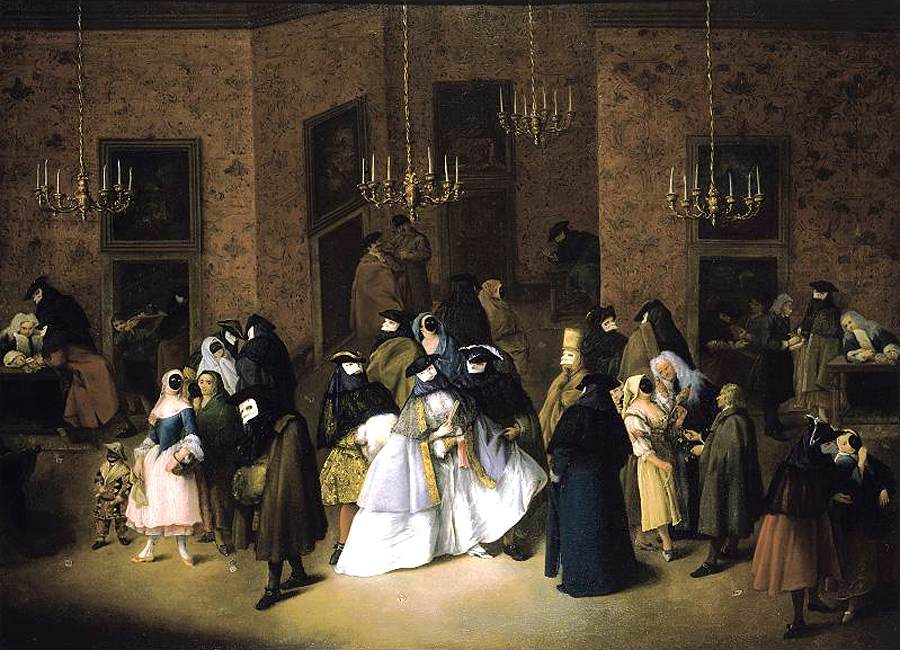
Tyers’s first event at Vauxhall was a masquerade ball in the manner of the Italian carnival in the spring of 1731. Not much is known of this event, except that there was outdoor dancing in masquerade costume and was restricted to the upper classes.

The Ridotto in Venice, Pietro Longhi, 1750's

The Ridotto in Venice, Pietro Longhi, 1750’s

By contrast, his second event in April of 1732, was attended by the poorer class of people, including “an oyster girl, a barber’s apprentice, a lawyer, an army captain, a doctor, a vicar and a number of prostitutes…”

The third event, considered to be the opening ceremony of Tyers’s Vauxhall Gardens, took place on 7 June 1732 and included the presence of Frederick, Prince of Wales. Under the guidance of John James Heidegger, Tyers created an extraordinary event that was talked about for years. A hundred armed soldiers were employed for the security of the distinguished guests, and he “hired the Westminster and Lambeth ferrymen for the whole night to carry his guests across the river and back.” Even with an admission fee of a guinea—which only the wealthy could afford—“between three and four hundred people actually attended the ridotto.” Besides the Prince of Wales’s entourage, the guests included politicians and their friends, “lawyers, bankers, printers, brewers, churchmen, military men and aristocrats.” The party broke up at around four in the morning. “The principal entertainments…were dancing and feasting, combined with the social intercourse between masked guests.”

The Ridotto in Venice, Pietro Longhi, 1750's

The Ridotto in Venice, Pietro Longhi, 1750’s

While by most accounts—particularly in the view of the Prince of Wales—this event was a great success, other accounts indicate that there was a distinct theme of preaching and moralizing via buildings set up to show the misery and pain that result from excessive self-indulgence that may have not gone over too well with the party-minded guests.

In any case, his final ridotto, which was held two weeks later on 21 June, likely at the request of the Prince, who was having the time of his life, was attended by only half as many, which, considering his expenses, would likely have completely wiped out any profits from the four events. No doubt this is the reason Tyers held no such events during 1733 or 1734, although the gardens themselves likely continued to be open to the public.

Susana’s Vauxhall Blog Post Series

  1. Vauxhall Gardens: A History
  2. Vauxhall Gardens: Jonathan Tyers—“The Master Builder of Delight” 
  3. Vauxhall Gardens: A New Direction
  4. Vauxhall Gardens: The Orchestra and the Supper-Boxes 
  5. Vauxhall Gardens: The Organ, the Turkish Tent, and the Rotunda
  6. Vauxhall Gardens: Three Piazzas of Supper-Boxes
  7. Vauxhall Gardens: “whither every body must go or appear a sort of Monster in polite Company”
  8. Vauxhall Gardens: The Competition
  9. Vauxhall Gardens: The Artwork, Part I
  10. Vauxhall Gardens: The Artwork, Part II
  11. Vauxhall Gardens: The Music, 1732-1859
  12. Vauxhall Gardens: The Business Side
  13. Vauxhall Gardens: Developments from 1751-1786
  14. Vauxhall Gardens: Thomas Rowlandson’s Painting (1785)
  15. ‎Vauxhall Gardens: The Third Generation of the Tyers Family and the Jubilee of 1786
  16. Vauxhall Gardens: An Era of Change (1786-1822), Part I
  17. Vauxhall Gardens: An Era of Change (1786-1822), Part II
  18. Vauxhall Gardens: An Era of Change (1786-1822), Part III
  19. Vauxhall Gardens: The Final Years, Part I
  20. Vauxhall Gardens: The Final Years, Part II
  21. Vauxhall Gardens: The Final Years, Part III
  22. Vauxhall Gardens: The Final Years, Part IV
  23. Vauxhall Gardens: Farewell, for ever
Vauxhall Gardens: A History

vauxhallbook

Vauxhall Gardens: A History

David Coke & Alan Borg

The Vauxhall Pleasure Gardens is one of the places I’d love to slip back in time to visit, just to catch a glimpse of what it was like. After recently splurging to buy this lovely coffee-table book, I thought it might make a wonderful subject for a new blog series. But do buy the book too, if you can. The photos are fabulous!

newspringgardensmap

Public Gardens

Royal Parks, such as St. James and Hyde Park, began to open up to the public in the seventeenth century. The first “Spring Garden” was located near St. James Park. Amenities in 1614 included a bathing pond, water fountains, graveled paths and fruit trees, a butt for archery, and a tiltyard. A bowling green was added by Charles II. It also became known for excessive drinking, quarrels, and hopeful prostitutes.

Samuel Pepys and the “Old” and “New” Spring Gardens

But there were also “Spring Gardens” at Vauxhall during the early seventeenth century, and after the Restoration, two of them, one “Old” and one “New” which has caused much confusion over the years. The “Old Spring Garden” was a pleasant place to walk with trees and flowers, with food available that Samuel Pepys spoke of as too “dear”, causing him and his family to eat at a nearby house instead after they had also visited the “New Spring Garden.” The word “New” was used to indicate that it was re-opened after the Restoration. Before 1750, when Westminster Bridge was opened, most visitors arrived by boat.

Taking water for vauxhall - Be careful, my love, don't expose your leg

TAKING WATER FOR VAUXHALL – Be careful, my Love, don’t expose your Leg

An early visitor, Balthasar de Monconys, described it:

We took a boat to the other side of the Thames to see two gardens, where everyone can go and walk, have something to eat in the restaurants or in the cabins in the garden. They are called Spring Gardens, that is to say Jardin du Printemps, and the new one is more beautiful than the old. I admired the beauty of the grassy walks and the niceness of the sanded ones. It is divided into a large number of plots twenty or thirty yards square, enclosed by gooseberry hedges, and these plots are also planted with raspberry bushes, roses, and other shrubs, as well as herbs and vegetables, such as peas, beans, asparagus, strawberries and so on. The walks are bordered with jonquils, gilliflowers or lilies. We returned after we had eaten and went again to Longacre.

Samuel_Pepys

Samuel Pepys

Samuel Pepys

Samuel Pepys was a frequent visitor to the gardens, mentioning it twenty-three times in his Diary from 1662 to July 1668. On one of his earlier visits, he mentions “boys doing tumbling tricks”. In 1665 when the plague began to take hold, he mentions “the ayre and pleasure of the garden, was a great refreshment to me, and methinks, that which we ought to Joy ourselves in.” A month later, he writes:

I to Fox-hall, where to the Spring-garden; but I do not see one guest there, the town being so empty of anybody to come thither. Only, while I was there, a poor woman came to scold with the master of the house that a kinswoman, I think, of hers, that was newly dead of the plague, might be buried in the church-yard; for, for her part, she should not be buried in the Commons, as they said she should.

A year later, Pepys describes visiting the park with a friend and having a sexual encounter with some prostitutes in a private arbor. He also mentions bird (particularly nightingale) and animal calls, an entertainment which was to become customary at Vauxhall. From his writings, one can infer that entrance to the gardens was free, but that food and drink were not. One entry describes a situation where ladies were stalked by drunken men. Pepys says this:

… at last, the ladies did get off out of the house and took boat and away. I was troubled to see them abused so; and could have found my heart, as little desire of fighting as I have, to have protected the ladies.

Another time, when he visited with his wife, he was again troubled by these young rapscallions:

So over the water with my wife and Deb and Mercer to Spring-garden, and there eat and walked, and observe how rude some of the young gallants of the town are become, to go into people’s arbors where there are not men, and almost force the women—which troubled me, to see the confidence of the vice of the age: and so we away by water, with much pleasure home.

Food and Drink at the Spring Gardens

Restoration literature mentions waiters. The food served was usually cold: the very thin ham shavings that Vauxhall was known for, chicken served with salad, and occasionally beef and lobster. Strawberries and cream were popular, the fruit grown in local market gardens. Beverages were wine, beer, and rack punch (a drink from India containing arrack—distilled from coconut sap—hot water, limes, sugar, and spice).

The Great Walk

Tom Brown mentions the Great Walk—the central feature of the gardens—in Amusements, published in 1700.

The ladies that have an inclination to be private take delight in the close walks of Spring Gardens, where both sexes meet and mutually serve one another as guides to lose their way; the windings and turnings in the little wilderness are so intricate that the most experienced mothers have often lost themselves in looking for their daughters.

Much mention is made of intrigues and sexual encounters in the “Spring Gardens,” although it is hinted that such is of a somewhat higher class there than in other public venues. Sir Roger de Coverley complained to the mistress of the house “that he should be a better customer to her garden if there were more nightingales and fewer strumpets” after he was accosted by a “wanton baggage” there.

An escape from the city

The Spring Gardens, although not really the countryside, were far enough away from the dirt and smells of the city that its widely diverse visitors could—at least for a short while—escape their troubles. The following anonymous verses were published in the Gentleman’s Magazine of June 1732:

At Vauxhall Stairs they land, their Passage pay,

And to Spring Gardens, tread the beck’ning way.

‘Hail pleasing Shades! O hail thou secret Grove!

The blest Retreat of Liberty and Love.

All hail, ye Bow’rs! Ye beaut’ous Silvan Scenes,

Ye Grotts, and Mazes of fresh blooming Greens;

Here dwells no Care, no matrimonial Strife,

The peevish Husband, nor the bawling Wife;

Here’s no Restraint to make our Pleasures cloy,

We part at will, and as we please enjoy

See how the Birds by Nature taught to rove,

How sweet they sing, and how like us they love.

With careless Ease they hop from Tree to Tree,

And are as Merry, and as blest as we.

Thrice happy State! Each am’rous Trulla says,

And baits with Poison all the various ways;

The Walks are fill’d with Throngs of different Sort,

From Fleet Street, Drury, and incog., from Court.

To these fair Shades, see Belles and Beaus advance,

Some sigh, some sing, some whistle, and some dance.

Susana’s Vauxhall Blog Post Series

  1. Vauxhall Gardens: A History
  2. Vauxhall Gardens: Jonathan Tyers—“The Master Builder of Delight” 
  3. Vauxhall Gardens: A New Direction
  4. Vauxhall Gardens: The Orchestra and the Supper-Boxes 
  5. Vauxhall Gardens: The Organ, the Turkish Tent, and the Rotunda
  6. Vauxhall Gardens: Three Piazzas of Supper-Boxes
  7. Vauxhall Gardens: “whither every body must go or appear a sort of Monster in polite Company”
  8. Vauxhall Gardens: The Competition
  9. Vauxhall Gardens: The Artwork, Part I
  10. Vauxhall Gardens: The Artwork, Part II
  11. Vauxhall Gardens: The Music, 1732-1859
  12. Vauxhall Gardens: The Business Side
  13. Vauxhall Gardens: Developments from 1751-1786
  14. Vauxhall Gardens: Thomas Rowlandson’s Painting (1785)
  15. ‎Vauxhall Gardens: The Third Generation of the Tyers Family and the Jubilee of 1786
  16. Vauxhall Gardens: An Era of Change (1786-1822), Part I
  17. Vauxhall Gardens: An Era of Change (1786-1822), Part II
  18. Vauxhall Gardens: An Era of Change (1786-1822), Part III
  19. Vauxhall Gardens: The Final Years, Part I
  20. Vauxhall Gardens: The Final Years, Part II
  21. Vauxhall Gardens: The Final Years, Part III
  22. Vauxhall Gardens: The Final Years, Part IV
  23. Vauxhall Gardens: Farewell, for ever
 

“A few words on Coaching Inns” and Conclusion

dust jacket

The following post is the twenty-seventh and final of a series based on information obtained from a fascinating book Susana obtained for research purposes. Coaching Days & Coaching Ways by W. Outram Tristram, first published in 1888, is replete with commentary about travel and roads and social history told in an entertaining manner, along with a great many fabulous illustrations. A great find for anyone seriously interested in English history!

“…And now a few words on the Coaching Inns”

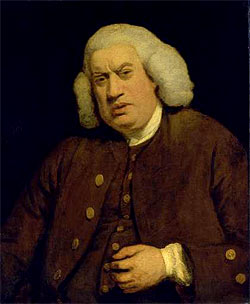
Dr. Samuel Johnson

Dr. Samuel Johnson

“There is no private house,” said Johnson—it was in the Old Chapel House inn in Oxfordshire, on the Birmingham Road, that he gave vent to the profundity—“there is no place,” he said, at which people can enjoy themselves as well as at a capital tavern like this. Let there be ever so great a plenty of good things, ever so much grandeur, ever so much elegance, ever so much desire that every guest should be easy, in the nature of things it cannot be. There must always be some degree of care and anxiety. The master of the house is anxious to entertain his friends; these in their turn are anxious to be agreeable to him, and to no one but a very impudent dog can as freely command what is in another man’s house as if it were his own. Whereas at a tavern there is a general freedom from anxiety. You are sure you are welcome, and the more noise you make the more trouble you give, the more good things you call for, the welcomer you are. No servants will attend you with the alacrity which waiters do, who are incited by the prospect of an immediate reward in proportion as they please. No, sir; there is nothing which has been contrived by man by which so much happiness is produced as by a good tavern or inn.”

Lamenting the loss of the “finest examples of this hospitable sort of architecture”

Hear, hear! say I; but while on the subject of inns may remark that I have been much disappointed in my ramblings; in truth began some six years too late from this point of view. For in that interval the country has been deprived of many of its finest examples of this hospitable sort of architecture. Of those fine examples—few and far between—which still remain, many are now sinking into a state of irremediable disrepair—witness the great inn at Stilton for one—and will in the near fulness of time doubtless be improved altogether off the face of the earth.

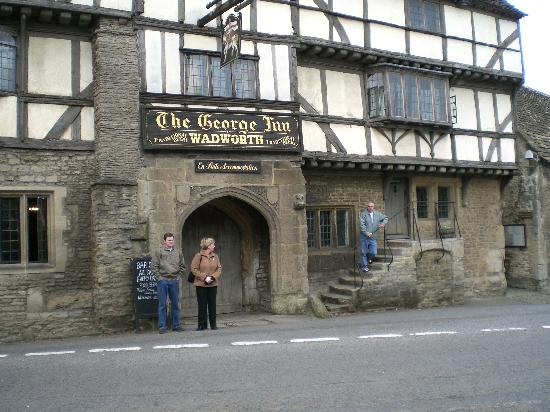
george inn norton st philip

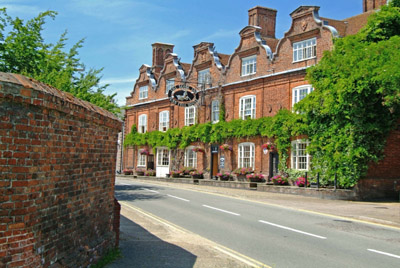
The George Inn, Norton St. Philip (near Bath)

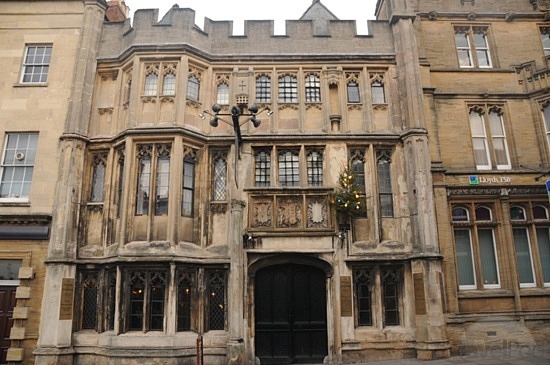
At Norton St. Philip, then, in Somersetshire, seven miles south-east of Bath, there still stands in the George Inn, a half-timbered, fifteenth century house, of the finest possible type. Monmouth passed the night of June 26th, 1685 at this George…At Glastonbury, in the same county, an inn of the same name—the George—with front one splendid mass of panelling, pierced where necessary for windows, the finest piece of domestic work in one of the most entrancing towns in England from an antiquary’s point of view, dates from the fourth Edward; while, to go further afield for a fine specimen of a different period, at Scole in Suffolk, the White Hart, erected in 1655 by John Peck, merchant, of Norwich, still retains some fine carving, and had till the end of the last century an enormous sign containing many figures—Diana and Actaeon, Charon, Cerberus, and sundry other worthies, carved in wood by Fairchild, at a cost of 1057 pounds.

george-pilgrims-hotel-1492-glastonbury-n1-st-fillans

The George & Pilgrim Hotel, Glastonbury

Conclusion

If a minor measure of success attends my enterprize I shall be content—content, that is to say, if I have caught some flavour of the romance of the Great Roads of England from the time when the Flying Machine of Charles the Second’s age lumbered out of the Belle Savage Yard, up to the day when the Holyhead Mail via Shrewsbury, timed at eleven miles an hour, was our fathers’ wonder, and the pride of this perfect road— “Mr. Bicknell’s spicy team of greys.”

scole-scole-inn-5279

The Scole Inn, Suffolk (formerly White Hart)

scole_inn_stairs

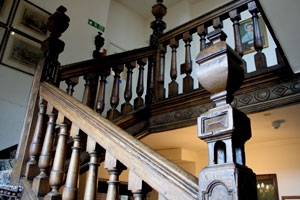
Stairs at the Scole Inn


 Index to all the posts in this series

1: The Bath Road: The (True) Legend of the Berkshire Lady

2: The Bath Road: Littlecote and Wild William Darrell

3: The Bath Road: Lacock Abbey

4: The Bath Road: The Bear Inn at Devizes and the “Pictorial Chronicler of the Regency”

5: The Exeter Road: Flying Machines, Muddy Roads and Well-Mannered Highwaymen

6: The Exeter Road: A Foolish Coachman, a Dreadful Snowstorm and a Romance

7: The Exeter Road in 1823: A Myriad of Changes in Fifty Years

8: The Exeter Road: Basingstoke, Andover and Salisbury and the Events They Witnessed

9: The Exeter Road: The Weyhill Fair, Amesbury Abbey and the Extraordinary Duchess of Queensberry

10: The Exeter Road: Stonehenge, Dorchester and the Sad Story of the Monmouth Uprising

11: The Portsmouth Road: Royal Road or Road of Assassination?

12: The Brighton Road: “The Most Nearly Perfect, and Certainly the Most Fashionable of All”

13: The Dover Road: “Rich crowds of historical figures”

14: The Dover Road: Blackheath and Dartford

15: The Dover Road: Rochester and Charles Dickens

16: The Dover Road: William Clements, Gentleman Coachman

17: The York Road: Hadley Green, Barnet

18: The York Road: Enfield Chase and the Gunpowder Treason Plot

19: The York Road: The Stamford Regent Faces the Peril of a Flood

20: The York Road: The Inns at Stilton

21: The Holyhead Road: The Gunpowder Treason Plot

22: The Holyhead Road: Three Notable Coaching Accidents

23: The Holyhead Road: Old Lal the Legless Man and His Extraordinary Flying Machine

24: The Holyhead Road: The Coachmen “More Celebrated Even Than the Most Celebrated of Their Rivals” (Part I)

25: The Holyhead Road: The Coachmen “More Celebrated Even Than the Most Celebrated of Their Rivals” (Part II)

26: Flying Machines and Waggons and What It Was Like To Travel in Them

27: “A few words on Coaching Inns” and Conclusion

Flying Machines and Waggons and What It Was Like To Travel in Them

dust jacket

The following post is the twenty-sixth of a series based on information obtained from a fascinating book Susana obtained for research purposes. Coaching Days & Coaching Ways by W. Outram Tristram, first published in 1888, is replete with commentary about travel and roads and social history told in an entertaining manner, along with a great many fabulous illustrations. A great find for anyone seriously interested in English history!

Portrait of a Flying Machine

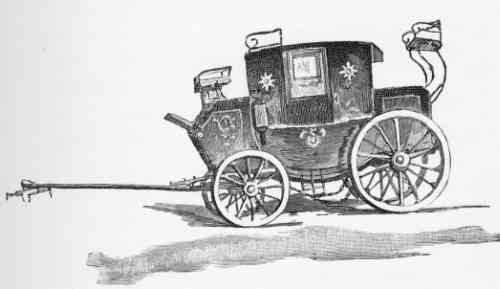
…they were principally composed of a dull black leather, thickly studded by way of ornament with broad black-headed nails, tracing out the panels in the upper tier of which were four oval windows, with heavy red wooden frames, or leather curtains. Upon the doors were displayed in large characters the names of the places whence the coach started, and where it was going to—another matter. The shape of the Flying Machine was a matter left much open to choice. You could ride in one shaped like a diving bell; or in one the exact representation of a distiller’s vat, hung equally balanced between immense back and front springs; or in one made after the pattern of a violoncello case—past all comparison the most fashionable shape. If my readers are tempted to cry why this thusness, I can only say because these violoncello-like Flying Machines hung in a more graceful posture—namely, inclining on to the back springs—and gave those who sat within it “the appearance of a stiff Guy Fawkes uneasily seated.” But this is a satiric touch, surely. To get on to the roofs, however. These generally rose into a swelling curve, which was sometimes surrounded by a high iron guard, after the manner of our more modern four-wheeled cabs. The coachman and the guard (who always held his carbine ready cocked upon his knee—an attitude which must have made inside passengers wish they had insured their lives) then sat together over a very long and narrow boot which passed under a large spreading hammercloth hanging down on all sides, and furnished with a most luxuriant fringe. Behind the coach was the immense basket, stretching far and wide beyond the body in which it was attached by long iron bars or supports passing beneath it. I am not surprised to learn that these baskets were never very great favourites, though their difference of price caused them to be frequently filled—but another proof of needs must when the devil drives—. And as for the notion of these Flying coaches when well on the road, it was “as a ship rocking or beating against a heavy sea’ straining all her timbers, with a low moaning sound as she drives over the contending waves.” With which extraordinary simile we may leave Flying Machines behind us—and any description of their successors too. For are not the models of the crack coaches in coaching’s primest age to be seen every day in Piccadilly? They are—and some very delightful rides can be had in them too.

old English flying mail coach

old English flying mail coach

The experience of “travelling in one of these perfected turn-outs”

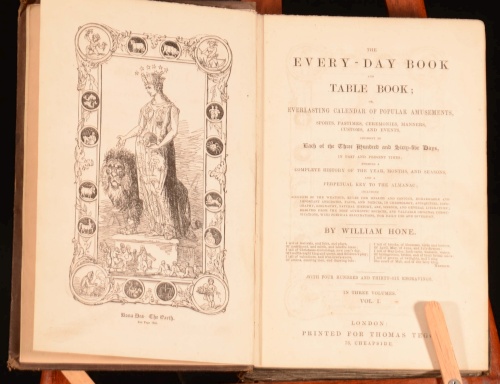
Not that travelling in these perfected turn-outs was always like riding on a bed of roses, as I have had occasion frequently to point out, which consideration brings me to the inevitable comparison of the advantages of rail versus road. On which great subject much can be said on both sides, as a celebrated Attorney-General for Honolulu once remarked. De Quincey, for instance, may talk of the “fine fluent motion of the Bristol Mail,” and call up recollections in our minds of the modern Bristol Mail’s motion as anything but fluent; he may glorify “the absolute perfection of all the appointments about the carriage and the harness, their strength, their brilliant cleanliness, their beautiful simplicity, the royal magnificence of the horses; “but here is another side to the picture. I quote from Hone’s Table-books, an extract in the style of Jingle, and worthy of him.

HONE'S BOOK

Hone’s Every-Day Book and Table Book

“STAGE COACH ADVENTURES.

“INSIDE.—Crammed full of passengers—three fat fusty old men—a young Mother and sick child—a cross old maid—a poll parrot—a bag of red herrings—double-barrelled gun (which you are afraid is loaded)—and a snarling lap dog in addition to yourself. Awake out of a sound nap with the cramp in one leg and the other in a lady’s bandbox—pay the damage (four or five shillings) for gallantry’s sake—getting out in the dark at the half-way house, in the hurry stepping into the return coach and finding yourself next morning at the very spot you had started from the evening before—not a breath of air—asthmatic old woman and child with the measles—window closed in consequence—unpleasant smell—shoes filled with warm water—look up and find it’s the child—obliged to bear it—no appeal—shut your eyes and scold the dog—pretend sleep and pinch the child—mistake—pinch the dog and get bit.—Execrate the child in return—black looks—no gentleman—pay the Coachman and drop a piece of gold in the straw—not to be found—fell through a crevice—Coachman says ‘He’ll find it.’—Can’t—get out yourself—gone—picked up by the Ostler—no time for blowing up—Coach off for next stage—lose your money—get in—lose your seat—stuck in the middle—get laughed at—lose your temper—turn sulky—and turned over in a horse-pond.

William Hone

William Hone

“OUTSIDE.—Your eye cut out by the lash of a clumsy Coachman’s whip—hat blown off into a pond by a sudden gust of wind—seated between two apprehended murderers and a noticed sheep-stealer in irons—who are being conveyed to gaol—a drunken fellow half asleep falls off the Coach—and in attempting to save himself drags you along with him into the mud—musical guard, and driver horn mad—turned over.—One leg under a bale of cotton—the other under the Coach—hands in breeches pockets—head in hamper of wine—lots of broken bottles versus broken heads.—Cut and run—send for surgeons—wounds dressed—lotion and lint four dollars—take post-chaise—get home—lay down—and laid up.”

coach

stage coach and mail

Stage coach and mail


Mail coach

Mail coach


 Index to all the posts in this series

1: The Bath Road: The (True) Legend of the Berkshire Lady

2: The Bath Road: Littlecote and Wild William Darrell

3: The Bath Road: Lacock Abbey

4: The Bath Road: The Bear Inn at Devizes and the “Pictorial Chronicler of the Regency”

5: The Exeter Road: Flying Machines, Muddy Roads and Well-Mannered Highwaymen

6: The Exeter Road: A Foolish Coachman, a Dreadful Snowstorm and a Romance

7: The Exeter Road in 1823: A Myriad of Changes in Fifty Years

8: The Exeter Road: Basingstoke, Andover and Salisbury and the Events They Witnessed

9: The Exeter Road: The Weyhill Fair, Amesbury Abbey and the Extraordinary Duchess of Queensberry

10: The Exeter Road: Stonehenge, Dorchester and the Sad Story of the Monmouth Uprising

11: The Portsmouth Road: Royal Road or Road of Assassination?

12: The Brighton Road: “The Most Nearly Perfect, and Certainly the Most Fashionable of All”

13: The Dover Road: “Rich crowds of historical figures”

14: The Dover Road: Blackheath and Dartford

15: The Dover Road: Rochester and Charles Dickens

16: The Dover Road: William Clements, Gentleman Coachman

17: The York Road: Hadley Green, Barnet

18: The York Road: Enfield Chase and the Gunpowder Treason Plot

19: The York Road: The Stamford Regent Faces the Peril of a Flood

20: The York Road: The Inns at Stilton

21: The Holyhead Road: The Gunpowder Treason Plot

22: The Holyhead Road: Three Notable Coaching Accidents

23: The Holyhead Road: Old Lal the Legless Man and His Extraordinary Flying Machine

24: The Holyhead Road: The Coachmen “More Celebrated Even Than the Most Celebrated of Their Rivals” (Part I)

25: The Holyhead Road: The Coachmen “More Celebrated Even Than the Most Celebrated of Their Rivals” (Part II)

26: Flying Machines and Waggons and What It Was Like To Travel in Them

27: “A few words on Coaching Inns” and Conclusion

The Holyhead Road: The Coachmen “More Celebrated Even Than the Most Celebrated of Their Rivals” (Part II)

dust jacket

The following post is the twenty-fifth of a series based on information obtained from a fascinating book Susana obtained for research purposes. Coaching Days & Coaching Ways by W. Outram Tristram, first published in 1888, is replete with commentary about travel and roads and social history told in an entertaining manner, along with a great many fabulous illustrations. A great find for anyone seriously interested in English history!

Sam Hayward: “An artist of a finer mould”

An artist of a finer mould was Sam Hayward, who drove the Wonder from Shifnal to Shrewsbury (18 miles). Not only was he a fine performer on the Road—but he did a deed in the usual way of business when he got into Shrewsbury which made spectators stare. The Lion yard is just on the top of the hill in Shrewsbury, and is so placed that to coachmen not demigods, to turn into it off a sharpish pitch with a heavy load was to attempt the impossible to an accompaniment of breaking poles and shrieking passengers. All other coaches coming from London went in therefore ignominiously by the backway, though they came out at the usual entrance. Not so Sam Hayward on the Wonder. Secure in the knowledge of accomplished strength he smilingly hugged the kerbstone on the near side, passed the entrance for a few yards—but yards accurately calculated—then described a round and imperial circle, and shot in under the archway a victorious, a classic charioteer. People at first thought him mad—I read, when they saw him thus as it were defying the thunder—but they soon saw that he knew what he was doing, and could do it.

Winterbotham: “amazing fresh”

Of quite a different type was one Winterbotham—who drove the Holyhead Mail four stages out of Holyhead and who on one occasion when Mr. Birch Reynardson—the great authority in this part of the world—approached the coach, was described to him by the guard as being “amazing fresh.” “Amazing fresh” is not only good in my eyes: it is delicious. And how when Winterbotham presently put in an appearance did he answer to this poetic description? Why, amazingly. “He approached rolling about like a seventy-four in a calm: or as if he were walking with a couple of soda-water bottles tied under his feet.” The peculiarity of this gait, which might have been much appreciated on the Metropolitan boards as an eccentric dancer’s new departure, did not appeal to the teller of this tale as prophetic of safety from the box-seat of a crack coach. So Winterbotham in all the meridian of his freshness was included, a solitary passenger in the stuffy inside—and Mr. Birch Reynardson himself assumed the ribbons. At the change near St. Asaph, sixty miles from Holyhead, inquires were made after Winterbotham’s condition. But all his freshness had deserted the cooped-up charioteer! He was however found fairly rational though excessively dejected, and expressed himself thus on an unique experience— “Well I think I’d better get outside now! I aren’t used to this. Well! This is traveling like a gentleman, and inside the Mail to be sure! Well! I never travelled inside a Mail or a coach before; and I dare say I never shall again! I don’t think I like the inside of a coach much; and so I’d better get out now! it feels wonderful oldd somehow to be inside the Mail; and I really hardly know how I got there.”

Dan Herbert: “perfected in his quiet method of driving bad teams without punishing them”

On the same coach, but further up the road, Dan Herbert did his twenty-four miles between Eccleshall and Lichfield with two changes, and his twenty-four miles back the same day,—an artist perfected in the quiet method, driving bad teams punctually without punishing them, rather by the medium of fine hands and temper coaxing them along. He was upwards of thirty years on the Chester and Holyhead Mail, and in consideration of his faithful and correct attention to business was awarded a scarlet coat on every anniversary of the King’s birthday.

mail coach?

George Clark: “an artist of the same calibre and of like style”

And George Clarke was an artist of the same calibre and of like style. He took the Umpire at Newport Pagnell (fifty-one miles from London), and met the down coach at Whetstone returning about nine o’clock. The most valuable of servants, because the first coachman in England for bad horses. Having always had weak horses to nurse, the ordeal had worn him down to a pattern of patience. With these and other great weights upon severe ground, he was steady, easy and economical in thong and cord, very light-handed, and sometimes even playful!

John Marchant and Bob Snow: “demigods whose steel nerves their passengers implicitly trusted”

…these men [John Marchant of the Manchester Telegraph and Bob Snow of the Defiance] drove opposition coaches, in which speed was the one thing looked up to, associated in a mild degree with a more or less reasonable amount of safety. And they drove furiously to beat the record—careful of nothing so long as the coach kept on its wheels, demi-gods whose steel nerves their passengers implicitly trusted, well knowing as they did that if those steel nerves had for an instant failed their owners the whole stock and lot would have gone to the Deuce in an instant.

'The Opposition Coaches', 1837 (1927).Artist: Charles Cooper Henderson

‘The Opposition Coaches’, 1837 (1927).Artist: Charles Cooper Henderson

It was this sort of fiery opposition kept up between the two crack Manchester coaches which called forth some such comment as the following, comments constantly to be culled from contemporary magazines:—

“Whoever takes up a newspaper in these eventful times it is even betting whether an accident by a coach or a suicide first meets his eye. Now really as the month of November is fast approaching, when from foggy weather and dark nights, both these calamities are likely to increase, I merely suggest the propriety of any unfortunate gentleman resolved on self-destruction, trying to avoid the disgrace attached to it by first taking a few journeys by some of these Dreadnought, Highflyer, or Tally-ho coaches; as in all probability he may meet with as instant a death as if he had let off one of Joe Manton’s pistols in his mouth, or severed his head from his body with one of Mr. Palmer’s best razors.”

mr. palmer's razors

Trade card of Mr. Palmer, cutler and razor-maker


 Index to all the posts in this series

1: The Bath Road: The (True) Legend of the Berkshire Lady

2: The Bath Road: Littlecote and Wild William Darrell

3: The Bath Road: Lacock Abbey

4: The Bath Road: The Bear Inn at Devizes and the “Pictorial Chronicler of the Regency”

5: The Exeter Road: Flying Machines, Muddy Roads and Well-Mannered Highwaymen

6: The Exeter Road: A Foolish Coachman, a Dreadful Snowstorm and a Romance

7: The Exeter Road in 1823: A Myriad of Changes in Fifty Years

8: The Exeter Road: Basingstoke, Andover and Salisbury and the Events They Witnessed

9: The Exeter Road: The Weyhill Fair, Amesbury Abbey and the Extraordinary Duchess of Queensberry

10: The Exeter Road: Stonehenge, Dorchester and the Sad Story of the Monmouth Uprising

11: The Portsmouth Road: Royal Road or Road of Assassination?

12: The Brighton Road: “The Most Nearly Perfect, and Certainly the Most Fashionable of All”

13: The Dover Road: “Rich crowds of historical figures”

14: The Dover Road: Blackheath and Dartford

15: The Dover Road: Rochester and Charles Dickens

16: The Dover Road: William Clements, Gentleman Coachman

17: The York Road: Hadley Green, Barnet

18: The York Road: Enfield Chase and the Gunpowder Treason Plot

19: The York Road: The Stamford Regent Faces the Peril of a Flood

20: The York Road: The Inns at Stilton

21: The Holyhead Road: The Gunpowder Treason Plot

22: The Holyhead Road: Three Notable Coaching Accidents

23: The Holyhead Road: Old Lal the Legless Man and His Extraordinary Flying Machine

24: The Holyhead Road: The Coachmen “More Celebrated Even Than the Most Celebrated of Their Rivals” (Part I)

25: The Holyhead Road: The Coachmen “More Celebrated Even Than the Most Celebrated of Their Rivals” (Part II)

26: Flying Machines and Waggons and What It Was Like To Travel in Them

27: “A few words on Coaching Inns” and Conclusion

The Holyhead Road: The Coachmen “More Celebrated Even Than the Most Celebrated of Their Rivals” (Part I)

dust jacket

The following post is the twenty-fourth of a series based on information obtained from a fascinating book Susana obtained for research purposes. Coaching Days & Coaching Ways by W. Outram Tristram, first published in 1888, is replete with commentary about travel and roads and social history told in an entertaining manner, along with a great many fabulous illustrations. A great find for anyone seriously interested in English history!

Poor Jack Matthews

…to begin with—speaking of coachmen’s fate—few I should surmise have met a more ignobly ironical one from a coachman’s point of view than did poor Jack Matthews, who drove the Oak and Nettle coaches from Welshpool to Liverpool, which were run in opposition to the Holyhead Mail and were often too fast to be safe. For poor Jack fell no willing victim to his own indiscretion, but was killed—it is with a blush for the departed that I write it—in a railway accident. In a foolish moment he took it into his head to go to Liverpool for a day’s outing, in a foolisher moment, if there be such a word, he got on the railway which was only half finished. He got on to this railway at Wrexham, intending to go as far as Chester. This feat the unfinished railway accomplished him, only however to throw him off a bridge (unfinished too, I suppose) when he got there. Well may his biographer exclaim, “Poor Jack! He would have been safer driving the Nettle Coach, in all probability!” (which “in all probability” gives us a very fair idea of the safety of the Nettle Coach! But this is a digression.) And Jack was as pretty a coachman as ever had four horses in hand. “A good workman in all respects, smart as a new pin.”

REYNARDS008871-1

Dick Vickers: “fell a victim to agriculture”

Another celebrated coachman on this road met as sad, but more consistent a fate, this was Dick Vickers, who drove the Mail between Shrewsbury and Holyhead. He fell a victim to agriculture. That is to say that though in stature he was so little “that he had to get on to six-pennyworth of coppers to look on to the top of a Stilton cheese” yet the deluded man pined to be a farmer. And he was fond of fishing too, a much more profitable pastime. However, a farmer Vickers became, in spite of his friends’ entreaties, who after a reasonable interval of anxiety found him sus per coll [hung by the neck]. This Vickers, not content with the lack of judgment he displayed while on earth, is said to haunt the scene of his indiscretion still. Though the Mail which he used to drive has long ceased to exist, they do say that at times a rambling is heard—and so on. Mr. Birch Reynardson, to get to something more tangible about Vickers, knew him well, as he seems to have known most of the crack coachmen on the Holyhead Road, through Shrewsbury, and has described them as well as he knew them in his Down the Road. The ill-fated Vickers, he writes, was a good little fellow, always civil, always sober, always most obliging, and a friend of every one along the road. And Mr. Reynardson had some opportunity of studying his model’s characteristics, particularly I should conceive on that one celebrated occasion chronicled, when he sat by him on the box-seat and saw him deal with a team comprised of the engaging attributes of “Three blind ‘uns and a bolter”, or in the coachman’s own words “Four horses, but they’ve only got two eyes among ’em, and it would be quite a well if that horse had not any so far as I know—for he makes shocking bad use of ’em at all times I can tell you.”

REYNARDSON

Old John Scott: “Hit ’em sly—hit ’em sly!”

A differently organized team was equally successfully coped with by one known to fame as Old John Scott. He drove the Chester and Holyhead Mail, and remarked to Mr. Reynardson, who was using all his art to boil up a trot going up Penmaenmawr (thirty-six miles from Holyhead), “Hit ’em sly—hit ’em sly!” And on being asked the reason for this dark advice alleged that if this particular team heard the whip before they felt it, they would never be got up Penmaenmawr at all. Nor was “hitting ’em sly” with the whip the ingenious Old John Scott’s sole method of dealing on heavy ground with this extremely sticky lot. No. He was accustomed, when the crisis came, and the coach threatened to come to a full stop where there was no proper halting place, to play a sort of rat-tat-tat with both feet on the foot-board—and lo! the sticky ones sprang up to their collars at once, as if the author of all evil was behind them. Much exercised by this extraordinary phenomenon, Mr. Reynardson with a praiseworthy impulse to arrive at the dark truth, remarked, “Well! that’s a curious dodge! What do they think is coming?” Upon which Old John Scott, saying, “Wait a pit. I’ll soon let you see what they think is coming,”—stooped down and produced from the boot a most respectable and persuasive looking “Short Tommy”. This sounds rather like a case for the Society for the Prevention of Cruelty to Animals—did we not have it on the best authority that Old John Scott was a worthy, good little, stout-made fellow, whose B was sounded like a P, and who when he said “Shall” pronounced it like Sall.

Next week: more noteworthy coachmen on this noteworthy road

Down the Road: Reminiscences of a Gentleman Coachman, by C.T.S. Birch Reynardson

BOOK

 Index to all the posts in this series

1: The Bath Road: The (True) Legend of the Berkshire Lady

2: The Bath Road: Littlecote and Wild William Darrell

3: The Bath Road: Lacock Abbey

4: The Bath Road: The Bear Inn at Devizes and the “Pictorial Chronicler of the Regency”

5: The Exeter Road: Flying Machines, Muddy Roads and Well-Mannered Highwaymen

6: The Exeter Road: A Foolish Coachman, a Dreadful Snowstorm and a Romance

7: The Exeter Road in 1823: A Myriad of Changes in Fifty Years

8: The Exeter Road: Basingstoke, Andover and Salisbury and the Events They Witnessed

9: The Exeter Road: The Weyhill Fair, Amesbury Abbey and the Extraordinary Duchess of Queensberry

10: The Exeter Road: Stonehenge, Dorchester and the Sad Story of the Monmouth Uprising

11: The Portsmouth Road: Royal Road or Road of Assassination?

12: The Brighton Road: “The Most Nearly Perfect, and Certainly the Most Fashionable of All”

13: The Dover Road: “Rich crowds of historical figures”

14: The Dover Road: Blackheath and Dartford

15: The Dover Road: Rochester and Charles Dickens

16: The Dover Road: William Clements, Gentleman Coachman

17: The York Road: Hadley Green, Barnet

18: The York Road: Enfield Chase and the Gunpowder Treason Plot

19: The York Road: The Stamford Regent Faces the Peril of a Flood

20: The York Road: The Inns at Stilton

21: The Holyhead Road: The Gunpowder Treason Plot

22: The Holyhead Road: Three Notable Coaching Accidents

23: The Holyhead Road: Old Lal the Legless Man and His Extraordinary Flying Machine

24: The Holyhead Road: The Coachmen “More Celebrated Even Than the Most Celebrated of Their Rivals” (Part I)

25: The Holyhead Road: The Coachmen “More Celebrated Even Than the Most Celebrated of Their Rivals” (Part II)

26: Flying Machines and Waggons and What It Was Like To Travel in Them

27: “A few words on Coaching Inns” and Conclusion