Archives

Episode #2: Lady P Talks About… Pride and Prejudice?

Lady Pendleton, who is visiting Susana from the 19th century, is the aunt of Damian Ashby, the Earl of Granville, the hero of Treasuring Theresa. In last week’s installment, Lady P agreed to assist Susana in her project of creating a Regency ball gown, and they have included a trip to the linen-draper’s—that is, Joanne’s—in the near future. In the meantime, Lady P, when not experimenting with modern-day gadgets, entertains us with tales of life in Regency England…and a myriad of other things we’d never have thought to ask. Enjoy!

Lady P:

Goodness, I hardly know where to start. I’ve never done this before, of course. I suppose I should mention that Susana could not be with us this morning because she has an appointment with…oh dear, I can’t seem to recall his name—some Italian fellow, a bone doctor, I believe—for a consultation. I told her physicians are nearly always quacks and offered her some of the special elixir my apothecary mixes up for me, but she insisted she’d rather get the quack’s opinion first. Ah well, so be it. I did offer, after all.

Although… I think I’ll have a dose or two of Mr. Mullens’s miraculous potion before I continue my commentary. Always seems to clear my head.

Ah, yes. Much better. Well, Susana thought I might talk about that most excellent novel, Pride and Prejudice, by Miss Austen. As a matter of fact, I started to watch the—uh—play—on that curious picture machine, but I discovered I could not manage to operate it in her absence, so I found a copy of the book instead. Such a delightful story, as I recall.

My good friend Sally Jersey recommended the novel to me as superior over Mrs. Radcliffe’s, so I purchased the three volumes at Hatchard’s. I recall that I was visiting Granville Manor at the time I started reading it—my nephew Damian and his wife had invited me for the Christmas holidays and I was laid up for a time after a fall. Little Amelia’s nursemaid had neglected to put away the child’s toys, you know, and I did give her quite a scolding about it, but Theresa had it in mind to pardon her—she’s far too tenderhearted, especially when she is enceinte, but there it is.

In any event, I took the opportunity to begin reading the first volume, and I found it so engrossing that I did not wish to stop. That Mrs. Bennet—the girls’ mother, you know—was such a character. I suppose most people know someone like that, silly and frivolous and without the least knowledge of how to get on in society. My husband’s mother was such a one. Always railing at someone—usually her husband—although he quite deserved it, the way he treated her. What chance did she have to become anything other than what she was? Pendleton and I avoided her as much as possible, but there were always holidays, and then when she took ill and came to live with us…well, the servants took the brunt of it, I’m afraid. I made sure to give them extra vails at Christmastime.

Of course, I was a much more sensible woman, more like Miss Elizabeth herself, I daresay. Which is undoubtedly why Pendleton and I rubbed along so well together. He enjoyed his clubs and sporting events and left the rest to me. Why, many a time he said to me, “My dear Agatha, I could not have found a better wife had I been looking for one,” and quite true it was, too. His mother was pushing the Notting heiress at him, and had I not stepped in to rescue him, it’s quite probable my daughters would have had a fool for a mother.

Ah well, where was I? Oh yes, Miss Austen’s novel. So true to life. My older sister Edith—Damian’s mother, you know—was much like Elizabeth’s sister Jane, although her husband was a great deal more sensible than Bingley…much more like Mr. Darcy. And Lady Catherine de Bourgh reminded me so much of my Great-Aunt Harriet. Her husband was only a baronet, but you would think she was a duchess for all that she lorded it over the rest of us…boasting about those children of hers—such a shame that she passed away and can’t see what a scapegrace that Richard of hers has turned out to be.

Oh dear, was that the clock chiming? How the time has flown! I’m afraid I must be going now. Susana will be home at any moment and she has agreed to teach me how to drive a motor vehicle! Of course, she wasn’t particularly enthusiastic about it, but I simply would not take no for an answer. These 21st century vehicles are far superior to the horse-drawn carriages from my era. The speed alone…and well, no indelicate odors from the horses to deal with! I insist on learning to operate one. Why, I could drive a curricle with nearly as much skill as my nephew, and he was a member of the Four-in-Hand Club. This is just a machine, after all, not a live horse with a mind of its own. I’m sure I shall be a true proficient after a bit of practice.

Susana’s turn:

After the experience with the Russian exchange student, I promised myself I’d never teach another person to drive again, but Lady P has a mind of her own. I’ll take her over to the shopping center parking lot—early, when no one else is there—and keep my foot as near the brake as I can. There’s no way she’s going anywhere near the road. I’m not that crazy. Besides, she’ll never get a driver’s permit without a birth certificate, and even if they issued them in 1755, there would be a lot of raised eyebrows at the DMV when she produced it.

We’ll be back next week. We’ve decided to hold off on the shopping expedition because Joanne’s has announced a big sale toward the end of the month, so that Lady P can have a new gown as well. I’m afraid her grasp of economizing is bit sketchy…she doesn’t quite grasp that the MasterCard eventually has to be paid and is not just a magical piece of plastic.

As always, please comment if you have anything you’d like Susana to ask Lady P while she’s here.

The Lady P Series

Episode #1: Susana’s Adventures With Lady P: The Introduction

Episode #2: Lady P Talks About… Pride and Prejudice?

Episode #3: Lady P and the Duchess Who Lost a Billion Dollars

Episode #4: Lady P and the Face On the $100 Bill

Episode #5: In Which Lady P Discovers Sparkly Fabrics and Ponders Violating the Prime Directive

Episode #6: Lady P Dishes the Dirt on the Duchess of Devonshire

Episode #7: The Political Exploits of Lady P and the Duchess of Devonshire

Episode #8: Lady P and the Prince Regent’s Illicit Marriage

Episode #9: In Which Lady P Depletes the Cooking Sherry During Her Discussion of Caroline of Brunswick

Episode #10: Lord Byron: Mad, Bad, and Dangerous to Know

Episode #11: In Which Lady P Talks About Hannah More and the Rights of Women

Episode #12: Lady P’s Revelations Regarding George III and His Peculiar Progeny

Episode #13: Lady P Discusses the Luddite Uprising, the Assassination of Spencer Perceval, and the General Unfairness of Life

Episode #14: In Which Leticia, Lady Beauchamp, Pops In For an Interview On Her Personal Acquaintance With Princess Charlotte of Wales

Episode #15: Lady P On Assignment in 1814 Kent

Lady P Quizzes Jane Livingston, the Hero’s Sister From “A Twelfth Night Tale”

Guest Interview: Author Cecilia Gray

ebook-delightful-arrangement-hi-resToday I’m pleased to introduce Cecilia Gray, author of The Gentlemen Next Door, a series of delightful Regency novellas, and also a series of YA romances, The Jane Austen Academy.

Welcome, Cecilia!

Thank you so much for having me! I read through your blog and saw your Deal Breakers and confess to possibly having broken one or two. Even though I am in complete agreement with them!

Tell us something about your newest release that is NOT in the blurb.

The heroine of A FLIRTATIOUS RENDEZVOUS is my most traditional regency-style heroine. My other heroines are ahead of their time (although not quite anachronistic!) in their pursuit of engineering or business, Hanna has few pursuits beyond that of the boy next door.

When I started writing Hanna, I thought I was crazy because how could a reader like a character with little individual identity? But I found myself charmed with the idea that her entire sense of herself is based on how much she loves her family and especially how much she loves Hayden Banks. I really did end up feeling protective of her and wanting her to find happiness.

(I know that makes me sound crazy, to talk about her like she’s real and like I had no control over her fate.)

Are you working on something at present you would like to tell us about?

Yes! While The Gentlemen Next Door series is complete, I’ve become fascinated with one of the side characters. I’ve since imagined her entire life and I think she deserves her own book—with a hero that doesn’t live next door and may not be so gentlemanly.

What are you reading now?

I’m reading Days of Blood and Starlight by Laini Taylor, the second book in a superb fantasy series about an epic battle between angels and demons that spills out of their world into ours.

What is your work schedule like when writing?

Unfortunately I don’t spend a lot of time writing because of other obligatons during the week—like my job! I spend a lot of time thinking about writing but usually won’t write actual words until midight and even then only for an hour. Once a month I’ll get away for a weekend and write my ass off. If it weren’t for those weekends, then I’d probably only release a book every decade.

The Gentlemen Next Door series are historical regency romance novellas. The entire series, including the latest release, A FLIRTATIOUS RENDEZVOUS, is available now.

Book #1 A DELIGHTFUL ARRANGEMENT is currently free at Apple, Kobo and Google and just 99 Cents at other retailers:

Phillip has a duty to marry Francesca. He has always protected his former neighbor and childhood companion, and now that she is of marriageable age, he will give her what she needs most – a real home where she is welcome and wanted.

Unfortunately for him….she is done with being dutiful.

After years of being an obedient daughter to a hateful father, Francesca jumps into her first Season. Francesca is ready to dance every dance, flirt with every bachelor and snatch what she wants most – a man she loves who will make her swoon.

Unfortunately for her…he now sees making her swoon as his duty, too.

And Phillip takes his duties very seriously.

amazonbutton

B&Nbutton

Applebutton

googlebutton

kobobutton

http://www.ceciliagray.com


Win a $20 Amazon Gift Card!

treasuringtheresa_1.75

To Celebrate the Release of Treasuring Theresa 

January 3, 2013 at Ellora’s Cave

Susana is hosting a series of contests for the month of January!

All you have to do is answer a question about the Regency period (and/or Tweet about this contest) and your name will be entered for the next drawing!

Free Bonus Reads Available!

  • in-depth character sketches of Lady Theresa and Damian, Lord Clinton
  • an extra scene and an epilogue, both not included in the published story

Feel free to tell all your friends!

Winners will be chosen on January 9, 16, 23, and 31.

Theresa_contest_ad

http://www.susanaellis.com

New Year’s and Twelfth Day Traditions

Happy New Year - champagne and party decoration

It’s only been since 1752 when England adopted the Gregorian calendar that January 1st was considered the first day the year. Until then, Lady Day (March 25) had that honor. In Regency times, New Year’s was considered rather a minor holiday between two major holidays—Christmas and Twelfth Night.

New Year’s was associated with superstition. The family would sit around in a circle before midnight, and when the clock struck, the head of the family would go to the door and open it and usher in the New Year. People would clear their homes of old scraps and perishable food so as not to carry it over into the new year and court bad luck.

The singing of Aulde Lang Syne, which is loosely translated as “days gone by,” began as a Scottish celebration which traveled to England when Robert Burns published the lyrics in 1796.

Twelfth Day was the twelfth day of Christmas, or Epiphany, when the three wise men and shepherds came to honor the Christ child. In many parts of the world, January 6 is the day presents are exchanged, since that was the day the young Christ child received his gifts. Twelfth Night is considered by some to be the night before Twelfth Day, thus January 5.

On Twelfth Night, a special “king” cake is baked containing a bean and a pea. The person who finds the bean in his/her piece is the king of the evening’s festivities and whoever finds the pea is the queen. Check out this king cake recipe by Emeril Lagasse. The king cake started out as an English/French tradition, but has spread to Spain and other countries. In New Orleans, Twelfth Night or Epiphany is considered to be the beginning of Carnival, which culminates at Mardi Gras, where the king cake remains an important tradition today. During the Carnival season, people hold weekly king cake parties, and whoever finds the small baby token (representing the Christ child) has to hold next week’s party.

Off With the Old, On With the New

The old year, with its struggles and heartaches, is gone, and the new year, with all of its hopes and possibilities, is in front of us. No doubt that is why many of us tend to use this time to reflect on the past year and plan some “course corrections” for the future. When you look back on 2013 a year from now, what would you like to have accomplished?

Because once the year is over, you won’t be getting it back to do over. Keep that goal in front of you at all times and whatever happens, enjoy the journey as well as the destination.

A toast to a prosperous 2013 to each and every one of you!

 Carrie Ann’s New Year’s Blog Hop & Contest

One lucky commenter—chosen at random—will win a $20 Amazon gift card at the end of the blog hop. Be sure to include your email address in the comment so that I can contact you (and to be eligible for Carrie Ann’s Grand Prizes, which include a Kindle Fire or Nook Tablet, a $300 Amazon or B & N gift card, and a swag pack of books and all kinds of goodies (the swag pack is US only; the others are international).

January 7, 2013: Congrats to latishajean, who is the winner of the $20 Amazon gift from Susana’s Parlour. Happy reading!

Susana’s Treasuring Theresa Weekly Giveaways Begin January 3

Win a $20 Amazon Gift Card!

To celebrate the release of Treasuring Theresa, Susana is hosting a series of contests on her web site (http://www.susanaellis.com) for the month of January. All you have to do is answer a question about the Regency period and your name will be entered for the next drawing. Winners will be chosen on January 9, 16, 23, and 31.

To continue on your journey through Carrie Ann’s New Year’s Blog Hop, click below.

Floral Background in Black and Gold Colors

Episode #1: Susana’s Adventures With Lady P: The Introduction

Susana (to the Reader): I first met Lady Pendleton when I was writing Treasuring Theresa: The Epilogue, where Theresa—now Lady Granville—accompanies her husband to London to take up their social duties. Theresa did not have a successful Season seven years before when she first came out, and she was definitely not looking forward to this one. Her own Great-Aunt Tabitha was elderly and not in health, so Damian’s Aunt Agatha—his mother’s younger sister—came to the rescue. She accompanied Theresa on her rounds to the modiste’s and the linen-draper’s and the other shops in order to acquire a wardrobe suitable for a countess. While Lady Pendleton’s sense of fashion may be a bit on the outrageous side, she did give Theresa much to think about when she suggested that it was her own immaturity that was to blame for her unsuccessful Season.

Lady Pendleton: Well, really, Miss Ellis. Do you consider that a proper introduction? You say my fashion sense is outrageous, when what you are wearing—well, in my day a young lady would never have been seen wearing trousers, let alone skin-tight hose like Henry VIII used to wear—or so I’m told. I’m not quite that old, you know.

Susana: I do apologize, my lady. Please call me Susana. I was simply referring to your… uh… unusual color choices and spectacular headwear. You were rather… ahead of your time, I believe.

Lady P: How would you know? You were not born yet. I lived it!

Susana: Well, I’ve read quite a lot of Regency romance novels, you see, and—

Lady P: Romance novels, indeed! I used to find them in my daughter’s room and took them for myself. (Completely unsuitable for a young girl, doncha know?) Have you read A Sicilian Romance? The Mysteries of Udolpho? No? Mrs. Radcliffe had much more of a sense of the dramatic than your… what was her name… Nora Roberts? Where are the castles? The dark, mysterious barons? The exotic locales? Not to mention innocent young girls. In my day—

Susana: But surely Georgette Heyer’s Regencies—

Lady P: Pshaw. Her stories never had any drama. Although I did rather like that Frederica character a great deal. Had spunk, that girl. Reminds me of my niece-by-marriage, Theresa. And myself, of course, when I was younger. We make our own style, you know, while the others merely follow it.

Susana: I see. Well, if that’s the case, perhaps you could help me in a little sewing project I’m planning. A Regency gown with a matching pelisse. I’ve purchased the pattern already.

Lady P: The pattern? Oh, I see. Rather a plain style, but I suppose with the right material—and some ruffles and bows—we can remedy that quite easily. Do you sew, my dear?regencypattern

Susana: Well, I have a sewing machine, but I’m a better cook than seamstress.

Lady P: A machine? For sewing? Preposterous! In my day, all young ladies could sew a fine seam, although I own that I never made my own gown. Mostly handkerchiefs and doll’s clothing until I got older and worked my own chair covers. But…you say you can cook? I don’t suppose you have some tea and biscuits handy, have you? I’m sharp-set and parched after traveling two centuries through time! Quite exhausting, really.

Susana: Well, I have some chai tea and a package of Oreos…

Lady P: I suppose that will have to do. Although I have to say I have never heard of chai tea, and…what else did you mention?

Susana: Oreos. A sort of cookie…I mean biscuit. Chocolate with vanilla in the center.

Lady P: Chocolate? In a biscuit? Singular. Well, get on with it, girl, and afterward, we shall head for the linen-draper’s to look over his selection of material for your gown. I think bright orange might do well for you…

To be continued

Next installment: Lady Pendleton and Susana search for appropriate fabrics at Joanne’s in Toledo, Ohio. While you’re waiting, take a look at Susana’s “Regency Fabrics” board on Pinterest.

The Lady P Series

Episode #1: Susana’s Adventures With Lady P: The Introduction


Episode #2: Lady P Talks About… Pride and Prejudice?

Episode #3: Lady P and the Duchess Who Lost a Billion Dollars

Episode #4: Lady P and the Face On the $100 Bill

Episode #5: In Which Lady P Discovers Sparkly Fabrics and Ponders Violating the Prime Directive

Episode #6: Lady P Dishes the Dirt on the Duchess of Devonshire

Episode #7: The Political Exploits of Lady P and the Duchess of Devonshire

Episode #8: Lady P and the Prince Regent’s Illicit Marriage

Episode #9: In Which Lady P Depletes the Cooking Sherry During Her Discussion of Caroline of Brunswick

Episode #10: Lord Byron: Mad, Bad, and Dangerous to Know

Episode #11: In Which Lady P Talks About Hannah More and the Rights of Women

Episode #12: Lady P’s Revelations Regarding George III and His Peculiar Progeny

Episode #13: Lady P Discusses the Luddite Uprising, the Assassination of Spencer Perceval, and the General Unfairness of Life


Episode #14: In Which Leticia, Lady Beauchamp, Pops In For an Interview On Her Personal Acquaintance With Princess Charlotte of Wales

Episode #15: Lady P On Assignment in 1814 Kent

Lady P Quizzes Jane Livingston, the Hero’s Sister From “A Twelfth Night Tale”

Breaking the Rules: Why Some Authors Get Away With It

Rules are made to be broken.

If every historical romance author took notice of my twelve “historical romance deal breakers” and endeavored to avoid them all, would their books be better…or just boring?

I think probably both would happen.

Many of my favorite books use a well-worn plot and make it unique and different by creating lovable, memorable characters and settings that draw me into the story with them. The author doesn’t need to break a rule to keep me turning the pages. Even though I know there’s going to be a Happy-Ever-After ending—that’s why I read romance novels, after all—I am still eagerly anticipating the scene where the hero and heroine discover their feelings are returned and anticipate a long life together.

On the other hand, some of my favorite books break some of the rules—and I love them just as much! Does this make me schizophrenic? Indecisive? Hypocritical? Maybe. Maybe not.

So what’s the difference? Why will I rant over one book with a ditzy heroine, and rave over another with a similar problem? My intuition tells me it’s the skill of the author that makes the difference.

If the ditzy heroine stays ditzy and gets the hero anyway, I’m disappointed with both—the heroine because she hasn’t grown or matured during the story, and the hero because he is stupid enough to fall for a ditzy heroine who will probably be ditzy her whole life. Yeah, I know—it happens. But not in the romance stories I enjoy. I want my hero and heroine to be worthy of each other. Not perfect, but moving in that direction, at least.

Most heroines aren’t ditzy, but they still have much potential for growth. I read a story recently where the heroine started out being very superficial and unsympathetic. To be frank, I almost couldn’t believe she was the heroine and kept looking for someone more worthy to come along. It seemed to get worse before it got better. But with the right man, she gradually began to evolve into a mature, caring woman, and I found myself applauding for her. Doesn’t everyone like to see an underdog win in the end?

Character is the key.

Diana Gabaldon is a case in point. There are many things in her books that I don’t particularly care for, such as violence, long separations, rape, infidelity (although I still can’t decide if it’s infidelity if your husband hasn’t been born yet—or died 200 years ago), and lots of information about 18th century medicine that I never really thought I wanted to know. But instead of wanting to throw the book against the wall—and if I did it would probably damage the wall—I lap it all up. Why? It’s the characters. I love Jamie and Claire. They seem like real people to me. I want to read everything about them, even the not-so-pretty aspects of life. Diana can put them through the wringer—and she does—and they still emerge victorious, together, and stronger than ever. After the first book in the series, they are middle-aged, soon-to-become grandparents. And we readers love them more than ever!

Characterization is important in any novel, but in romance novels it is particularly important. Who wants to read a romance between unlikable and/or cardboard characters? If the reader doesn’t care about them, she won’t be motivated to finish the story. The author has to make me care whether or not the prince proposes to Cinderella. If I think Cinderella is going to turn out to be nag or the prince is going to be a tyrant, well, the whole “sailing into the sunset” thing doesn’t seem quite believable.

Authors: whether you decide to follow or ignore my twelve “deal breakers,” make sure your characters are compelling and readers will buy your book in droves.

That’s my opinion…and I’m sticking to it.

What do you think about rule-breaking? Do you have some favorite authors who can get away with it? Or do you have some rules of your own not mentioned here?

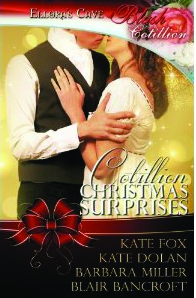
Featured Regency Anthology: A Christmas Cotillion Surprise

An Amazon Traditional Regency Anthology

by

Blair Bancroft, Barbara Miller, Kate Fox, Kate Dolan

Amazon Buy Link

Untitled-1

The Last Surprise by Blair Bancroft

http://www.blairbancroft.com/

Not all surprises are good ones. In the midst of a glorious first season, Lady Christine Ashford’s life is wholly disrupted by tragedy. The death of her father, the Earl of Bainbridge, leaves herself and her younger sisters summarily exiled from the family estate to distant relatives in Yorkshire to wait for the return of the elusive heir to her father’s title. There, life quickly becomes untenable.

The new earl’s return from the colonies gives Christine and her sisters a chance to escape their scheming Yorkshire relatives, but only through an unexpected marriage to this new, unknown man who has taken her father’s title and his lands. As the year turns to Christmas, the season of new life and joy, Christine must decide if she can embrace the spirit of the season—and her new husband.

Christmas Bequest by Barbara Miller

Blush sensuality level: This is a sweet romance (kisses only, no sexual content).

The shocking news comes right before Christmas—Patience Mayhew’s beloved brother Jack was lost in the Battle of Nivelle. Since his son is but a toddler, Jack left his estate in trust to his best friend Stuart—the man who, years ago, broke Patience’s heart.

Stuart Marsh is just as shocked as Patience at Jack’s bequest. How can he possibly run Heatherfield when Jack’s widow resents him and sister detests him? But as he settles in and sees how much work Heatherfield needs, he realizes it’s his chance to prove himself to Patience all over again. He wants nothing more than to lift the burden from her shoulders and prove that Christmas miracles exist—and that love, real love, never truly fades away.

A Blush® romance from Ellora’s Cave 

Double Masquerade by Kate Fox

Blush sensuality level: This is a sweet romance (kisses only, no sexual content).

Jane, the Honorable Miss Lumley, is in a bind. She can’t help boasting about her friendship with author Mr. Michael Girard, whose sweeping new series of adventurous tales set on the high seas have fetched a high price at a Nottingham book auction.

Darkly debonair bookseller Lachlan, Lord Stathmore, finds Girard’s stories improbable but knows they will sell. When Jane’s impassioned defense wins him over, he asks her to arrange a meeting with the mysterious Mr. Girard.

But how can she, when she herself is the stories’ scribe and she is forced to keep the real seafarer’s identity secret? A Christmas cotillion offers a solution. But while men’s clothes and a mask might be enough to hide her identity, will her double masquerade be enough to conceal her rising passion?

A Change Of Address by Kate Dolan

http://www.katedolan.com

Blush sensuality level: This is a sweet romance (kisses only, no sexual content).

Jane, the Honorable Miss Lumley, is in a bind. She can’t help boasting about her friendship with author Mr. Michael Girard, whose sweeping new series of adventurous tales set on the high seas have fetched a high price at a Nottingham book auction.

Darkly debonair bookseller Lachlan, Lord Stathmore, finds Girard’s stories improbable but knows they will sell. When Jane’s impassioned defense wins him over, he asks her to arrange a meeting with the mysterious Mr. Girard.

But how can she, when she herself is the stories’ scribe and she is forced to keep the real seafarer’s identity secret? A Christmas cotillion offers a solution. But while men’s clothes and a mask might be enough to hide her identity, will her double masquerade be enough to conceal her rising passion?

Historical Romance Deal Breaker #12: Excessively Cruel Heroes/Heroines

This is the last of the series of what I call “deal breakers”—characteristics that make a book a wall-banger instead of a pleasurable diversion. 

In my next post I plan to explore why it is that some of my favorite books are guilty of breaking some of my most heinous rules. Why can some authors get away with it and others not? The author in me wants to know!

Overview of Susana’s Historical Romance Deal Breakers

  1. Reluctant Heroes
  2. Adultery
  3. Anachronistic Behavior and Historical Inaccuracies
  4. Cliffhanger Endings
  5. Unattractive or Drop-Dead Gorgeous Heroines
  6. Heroes With Mistresses or Who Sleep With Servants
  7. Drop-Dead Gorgeous Heroes
  8. Promiscuous Heroines
  9. Contrived Endings
  10. Waifs and Silly Heroines
  11. Long Separations
  12. Excessively Cruel Heroes and Heroines
  13. Breaking the Rules: Why Some Authors Get Away With It

As fond as I am of happy endings, they have to be convincing happy endings. And although it’s natural for couples to quarrel and subsequently reconcile, I agree with my friend, author Selene Grace Silver, that in cases where a couple has parted due to betrayal or excessive cruelty on the part of one or both, it’s difficult to believe that such a thing would not occur again. It would require a great deal of groveling on the part of the guilty party to satisfy me.

Do such things happen in real life? Of course. But even Richard Burton and Elizabeth Taylor couldn’t make it work the second time, no matter how much they loved each other. It would be nice if love were enough to ensure a happy ending, but alas, it is not. There has to be trust. And true forgiveness. And whatever separated them the first time needs to be dealt with, whether it be alcoholism or infidelity or out-of-control anger.

Some examples I’ve run into in historical novels:

  • A hero discovers on his wedding night that his wife is not a virgin and repudiates her publicly without allowing her a chance to explain. Hypocritical judge and jury.
  • A hero suspects his wife of sleeping with his best friend, so he divorces her and leaves her penniless. She is forced to marry the best friend to give her child  (the hero’s since she never did commit adultery) a home. Then the hero finds out the child is his and wants her back. (Shaking my head in disgust at this one.) Loser.
  • A husband who has been estranged from his wife decides she needs to give him an heir and forces her to live with him; however, she has to sleep in the nursery because he shares the master bedroom with his mistress. No kidding. Jerk.
What do you think? What examples have you found of excessively cruel heroines? I confess the more memorable ones for me involve cruel heroes.
*Disclaimer: This series of “deal breakers” is meant to refer to books labeled historical romances, and not to erotica, which is a completely separate sub-genre and has an entirely different purpose.

Historical Romance Deal Breaker #11: Long Separations

Literally decades of reading historical romances have led me to develop strong opinions of what defines a truly satisfying story, so the other day I set about making a list of characteristics that turn a potential five-star read into a one- or two-star. Admittedly, there are some skillful authors who manage to successfully incorporate one or more of these scenarios in their books; however, I have run across quite a few more who in my opinion haven’t quite managed it.

These are what I call “deal breakers”—characteristics that make a book a wall-banger instead of a pleasurable diversion. Not surprisingly, many involve character, particularly, the character of the hero and heroine. They have to be likable. They have to be three-dimensional, i.e., well-drawn-out characters with flaws, not fairy princesses. And they have to be able to fall in love, convincingly, the head-over-heels kind of love.

Overview of Susana’s Historical Romance Deal Breakers

  1. Reluctant Heroes
  2. Adultery
  3. Anachronistic Behavior and Historical Inaccuracies
  4. Cliffhanger Endings
  5. Unattractive or Drop-Dead Gorgeous Heroines
  6. Heroes With Mistresses or Who Sleep With Servants
  7. Drop-Dead Gorgeous Heroes
  8. Promiscuous Heroines
  9. Contrived Endings
  10. Waifs and Silly Heroines
  11. Long Separations
  12. Excessively Cruel Heroes and Heroines
  13. Breaking the Rules: Why Some Authors Get Away With It

Historical Romance Deal Breaker #11: Long Separations

When the hero and heroine are apart for years at a time—I’ve seen couples separated for as long as ten years—a reconciliation just does not seem likely.

For one thing, can you really expect them to be celibate for so long a time? Even if the heroine does manage it, it’s not likely that the hero will, and I find it difficult to believe that a man can be sexually active with other women for a long period of time and still be “in love” with the woman he can’t have. After awhile, the memory of the previous love fades in comparison with the real woman in front of him. And the woman left behind has to worry about the ticking of that biological clock. Can she afford to wait an indefinite number of years for a man who may never return?

Secondly, it detracts from the romance if the couple spend too much time apart. One feels regret at the wasted years, the unhappiness and tragedies suffered during their long separation. And if their separation was caused by arguments or incompatibility, well, you have to wonder if those same problems will return to plague them again. (Like Richard Burton and Liz Taylor. The second time definitely was not a charm.)

On the other hand, if the characters have matured during their time apart, it is possible for this scenario to work. Too many times, however, little has changed except their circumstances, and one is left feeling as though something is lacking in the HEA.

Scenarios I’ve seen that I didn’t care for:

  • The hero goes off to war and the heroine’s father forces her to marry another.
  • The hero and heroine marry and separate/divorce and then get back together years later.
  • The hero has no way of supporting a wife, so he goes off to seek his fortune while the heroine has no idea whether he will ever return.

I have to admit, however, that some of my favorite books do incorporate long separations, such as Diana Gabaldon’s Outlander series. In the case of Jamie and Claire, there was no alternative but to separate, and although some of the events that occurred during their separation caused them both much pain, the joy of their reconciliation more than made up for it. Frankly, I’ll read everything Gabaldon writes about Jamie and Claire. Some of the more tender scenes between them make me want to swoon! (How in the heck does she do that? The writer in me wants to know.)

What do you think about long separations? 

*Disclaimer: This series of “deal breakers” is meant to refer to books labeled historical romances, and not to erotica, which is a completely separate sub-genre and has an entirely different purpose.

Historical Romance Deal Breaker #10: Waifs and Silly Heroines

Literally decades of reading historical romances have led me to develop strong opinions of what defines a truly satisfying story, so the other day I set about making a list of characteristics that turn a potential five-star read into a one- or two-star. Admittedly, there are some skillful authors who manage to successfully incorporate one or more of these scenarios in their books; however, I have run across quite a few more who in my opinion haven’t quite managed it.

These are what I call “deal breakers”—characteristics that make a book a wall-banger instead of a pleasurable diversion. Not surprisingly, many involve character, particularly, the character of the hero and heroine. They have to be likable. They have to be three-dimensional, i.e., well-drawn-out characters with flaws, not fairy princesses. And they have to be able to fall in love, convincingly, the head-over-heels kind of love.

Overview of Susana’s Historical Romance Deal Breakers

  1. Reluctant Heroes
  2. Adultery
  3. Anachronistic Behavior and Historical Inaccuracies
  4. Cliffhanger Endings
  5. Unattractive or Drop-Dead Gorgeous Heroines
  6. Heroes With Mistresses or Who Sleep With Servants
  7. Drop-Dead Gorgeous Heroes
  8. Promiscuous Heroines
  9. Contrived Endings
  10. Waifs and Silly Heroines
  11. Long Separations
  12. Excessively Cruel Heroes and Heroines
  13. Breaking the Rules: Why Some Authors Get Away With It

Historical Romance Deal Breaker #10: Waifs and Silly Heroines

Okay, I’ll admit to a partiality for feisty heroines who aren’t willing to stand aside and let themselves be walked on. However, a spoiled, selfish, immature heroine who heedlessly seeks out disaster without any concern for the consequences just makes me want to scream.

There’s something about a helpless waif that tugs at my heartstrings. However, a heroine who remains dependent on others—parents, lover, friends, etc.—seems rather gutless to me. I realize that, historically, women were expected to always be dependent, “protected,” by men, but a woman who consistently allows herself to be guided by the will of the others—in spite of her own wishes—can only end up with a satisfactory HEA through luck, i.e., her “protector” turning out to be considerate of her happiness. While waif-like heroines can be acceptable, I always wonder what would have happened if her luck had not been so good and she’d ended up with a bully.

And that’s why I prefer my waif heroines to evolve into spunky kid heroines. From being kind, passive, and insecure in the beginning, she begins to show some spirit, become defiant, and realize that she has the internal strength to make her own way in the world. And even if she ends up with an alpha hero, I know she won’t be a complete pushover, that he will have to respect her opinions in the years ahead.

So yeah, I love a good spunky heroine. But when does “spunk” become foolhardiness? Let’s talk about Lydia Bennet, the ultimate in silly heroines, from one of my favorite classics, Pride and Prejudice.

Lydia is the quintessential hormonal teenager. She drools over the handsome soldiers with her sister, thriving on their attention. To her, it’s a popularity contest, the more attention—whether good or bad—the better. She doesn’t care that she’s making herself look ridiculous or that “her way of getting a husband” may not turn out so well in the long run. If she had not been so fortunate as to have Mr. Darcy—along with her father and uncle—to bribe Wyckham to marry her, what would have become of her (not to mention the stain on her sisters)? Would she have become a courtesan or a prostitute? Starved to death? (There wasn’t any sort of “safety net” for spoiled, willful heroines in the 19th century.)

Her youth is a mitigating circumstance, along with her parents’ indulgence. But she did have older sisters who tried to rein her in, and she not only ignored them, but ridiculed them for not attracting as many beaux as she did. Even fifteen-year-olds have choices in life, and she made all the wrong ones.

Yet it is still possible that she could evolve into a satisfactory heroine. After she matured and repented of her youthful mistakes and put her life back on track. Considering that there was virtually no chance in those days of divorcing her husband, however, it would be a difficult path to take unless he conveniently died, which would also be problematic, since she and any children would undoubtedly be left penniless. So. . . how do you historically redeem a heroine like Lydia Bennet Wyckham without resorting to contrivances such as a sudden inheritance or a chance encounter with the perfect hero? Could she emigrate to America as an indentured servant and redeem herself through hard work? It’s hard for me to see the Lydia I know doing that, but I suppose it is a possibility.

While I have read stories where such deeply-flawed characters have been satisfactorily redeemed, they are few and far between. Most of the time, I end up in a state of disbelief, wanting to throw my Kindle against the wall because the author relied on some form of contrivance to get there, instead of convincing me of the character’s genuine transformation.

What kind of heroines do you prefer?

*Disclaimer: This series of “deal breakers” is meant to refer to books labeled historical romances, and not to erotica, which is a completely separate sub-genre and has an entirely different purpose.