Archives

Riding to the Hounds

jumping

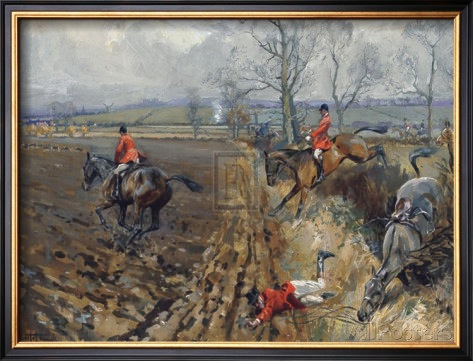
The changes that took place in the Georgian era had the effect of making the Regency era the Golden Age of Foxhunting. Faster hounds and horses that could jump at a gallop made the sport more exciting and more dangerous. Instead of foxhunters having to dig the fox out of its hole, the faster hounds would chase him up a tree—treeing—so that he could be thrown down to the dogs below. The first man up to the kill—the brusher—received the brush of the fox for his efforts. The brusher would be capped by the other hunters, that is he would collect half a crown or so for his triumph.

Black and White Treeing_small

Foxhunting was not only for the upper classes. Mr. Gunter, the London confectioner known for his ices, was a foxhunting fiend. Captain Gronow says:

“Everybody knows the story of Gunter the pastry-cook. He was mounted on a runaway horse with the King’s hounds, and excused himself for riding against Alvanley by saying, ‘O my lord, I can’t hold him, he’s so hot!’ ‘Ice him, Gunter—ice him’ was the consoling rejoinder.”

The Duke of Rutland's hounds

The journalist Nimrod in Sporting Magazine wrote that what is needed to be a good foxhunter is a good seat and a light hand. Also important is cool confidence and perception. A good foxhunter was “game to the back bone.”

An article in The Beau Monde in 1807 stated that:

“The duration of the chace should never be less than one hour, nor ought it to exceed two, which will, in most cases, be found sufficiently long if properly followed. Indeed, very few fox-chaces would ever exceed two hours if there were not a fault somewhere, either in the day, the huntsman, or the hounds.”

Some devoted foxhunters rode to the hounds six days a week. The best foxhunting was during January, February, and March, because the fox left the strongest scent during the cold weather.

foxhunt

The Duke of Wellington kept a stud of eight horses and hunted nearly every day on the Peninsula. He wore a blue frock coat given him by Lady Salisbury instead of the traditional red. Beau Brummell was an indifferent hunter, because he couldn’t bear to sully his rig with mud.

The Belvoir Estate

The Belvoir Estate

The enormous expense of maintaining a pack of hounds made private packs out of reach for most. The Duke of Rutland was one exception, but most people paid a subscription fee to a master who organized hunts. The Quorn might have around 200 subscribers, while smaller packs might have 50. In general, the neighborhood supported their hunting meets, but if the master allowed the hunters to destroy fields without compensating the local farmers, he might find his foxes hunted and killed by angry farmers in retribution.

Fox hunts normally started at ten or eleven in the morning, with hunters, horses, hounds, and liveried servants gathering at inns, markets, crossroads, or the lawns of stately homes. Hunters could wear what they chose, but the traditional dress was a red or black coat with white leather breeches, top boots, and a silk hat.

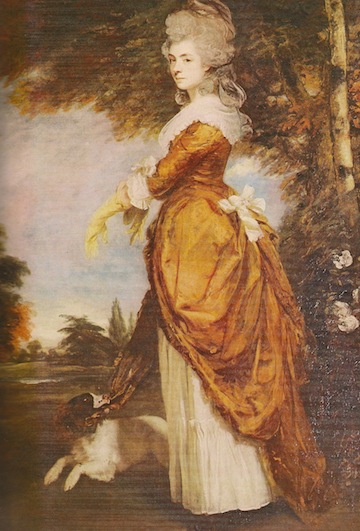
Regency ladies did not ride to the hunt in general, because the sidesaddle used at the time was not steady enough to be safe for galloping over bullfinches and hedgerows. This changed in the 1830’s after the development of a sidesaddle with three crutches that would secure the thigh. Exceptions were Lady Laetitia Lade and Lady Salisbury. But the truth is, most men didn’t want to hunt with the ladies because they were either too slow or better than the men, which was not acceptable either.

Lady-Salisbury

Marchioness of Salisbury

Laudermilk, Sharon H. and Hamlin, Theresa L., The Regency Companion, Garland Publishing, 1989.

The Regency Gentleman series

The Regency Gentleman: His Upbringing

The Fashionable Gentleman

The Rise and Fall of Beau Brummell 

Gentlemen’s Clubs in Regency London

Captain Who?

Gentlemen’s Sports in the Regency

The Gentleman’s Passion for Horses

Riding to the Hounds

The Regency Gentleman’s Passion for the Turf

Gentlemen’s Sports in the Regency

True Regency gentlemen did not sully their hands with work—that was for the lower classes. An exception to that rule would be managing his estates. Although he would generally have an estate manager or steward to handle the day-to-day tasks, the supervision of that employee would fall to him.

If all was in order, however, the Regency gentleman was fortunate to possess a considerable amount of free time, particularly the younger generation whose fathers yet survived, leaving them at liberty to seek their own pleasures, often referred to as attaining one’s “Town bronze.”

A previous post touched on the gentlemen’s clubs and gaming hells. Drinking, gambling and wenching were all popular pastimes for the gentlemen with time on their hands, especially for the young “cubs” or “greenhorns” who had yet to learn to be wary of pitfalls, such as “Captain Sharps” out to relieve them of their money by nefarious means. But when they weren’t indulging in the Regency era’s form of “partying,” they would likely engage in sporting events.

Boxing

A true gentleman had to be “good with his fists,” so many a gentleman frequented such pugilistic clubs as Gentleman Jackson’s on Bond Street, the Daffy Club, Limmer’s Hotel, Offley’s, and the Puglistic Society.

jackson-john-111

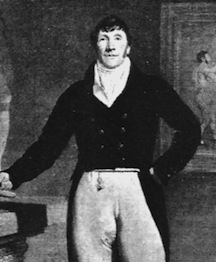
Gentleman Jackson was a former champion who enjoyed the respect and admiration of English society. His boxing academy on Number 13 Bond Street was a popular location for gentlemen who wished to improve their pugilistic skills. Jackson was instrumental in organizing the Pugilistic Society, which was formed at Thatched House Tavern in May 1814. The Pugilistic Society had the effect of lending respectability to the sport.

Offley’s was a sporting hotel in Henrietta Street that was known for its excellent beefsteak and ale. The Daffy Club, originally held at the Castle Tavern in Holborn, was an informal club reputed for the quantities of “blue ruin” (homemade gin).

mendoza_32-530x317

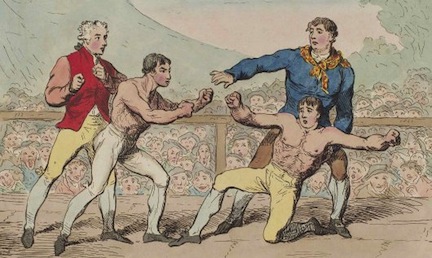
Prize fights or “mills” were usually held just outside of cities and towns where organizers could avoid the many laws regulating the sport. As soon as a fight was announced, hordes would swarm the town well in advance in order to secure accommodations. Those who arrived after every public house and inn was occupied either had to try to sleep in their carriages amidst all the racket in the street or stay up all night.

Fencing

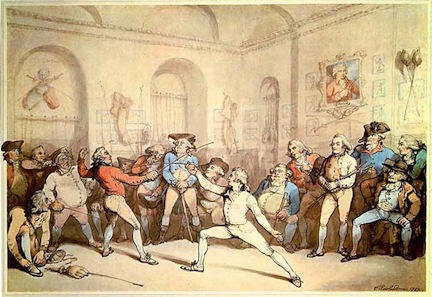
Angelo’s School of Arms

henry_angeloIn 1755, an Italian riding and fencing master by the name of Dominico Angelo Malevolti Tremamondo came to London and earned a reputation for extraordinary fencing skills. He opened “Angelo’s School of Arms,” first at Carlisle House, and then the Opera House Buildings in Haymarket. Angelo’s was a popular place for gentlemen to socialize, watch exhibitions of master fencers, and perfect their own equestrian and fencing skills. Angelo’s son Henry took over operations in 1785, and in 1817, he turned it over to his own son, also Henry. The elder Henry played a pivotal role in assisting his friend Gentleman Jackson establish his own boxing salon.

Blood Sports

The Royal Cockpit

Of all the violent animal sports—which included bear baiting and bull baiting—cock fighting was by far the most popular. The Birdcage Walk and the Royal Cockpit were two of the special indoor arenas where crowds gathered to gamble on the outcomes and watch the fights. The birds were armed with sharp spurs and the cruelty and violence was extreme. (No hero of mine will ever enjoy this sport, I assure you!)

Laudermilk, Sharon H. and Hamlin, Theresa L., The Regency Companion, Garland Publishing, 1989.

The Regency Gentleman series

The Regency Gentleman: His Upbringing

The Fashionable Gentleman

The Rise and Fall of Beau Brummell 

Gentlemen’s Clubs in Regency London

Captain Who?

Gentlemen’s Sports in the Regency

The Gentleman’s Passion for Horses

Riding to the Hounds

The Regency Gentleman’s Passion for the Turf

Wareeze Woodson and “An Enduring Love”

VBT_AnEnduringLove_Banner

Wareeze will be awarding a $25 Amazon GC to a randomly drawn commenter during the tour, and an ebook of An Enduring Love Worth Keeping will be awarded to two randomly drawn commenters during the tour. Click on the banner to follow the tour and increase your chances of winning.

About An Enduring Love

Born and raised in Latvia, Rebecca Balodis marries Rhys Sudduth, an English diplomat. Shortly thereafter, he is summoned home to attend his father’s death-bed. Rebecca cannot accompany him at the time and becomes trapped in the turmoil plaguing her country. He is informed she died in the upheaval.

Nearly four years later, she escapes and arrives in London with their son in tow. Arriving in the middle of his sister’s ball is very awkward, especially since Rhys plans to announce his betrothal to a young debutante later in the evening.

Trouble, tangled in suspense and danger, follow her from Latvia. Can this pair ever find or even recognize an enduring love? Is it worth keeping?

Excerpt

Cover_An Enduring LoveThe gangplank of the Dragon’s Stirr had been lowered ready for Latvian passengers to board. The creak of the ropes tying the vessel to the dock rasped Rebecca’s nerves, reminding her that soon Rhys would sail back to England without her. Devastated by the thought of such a loss and at such a time, she swallowed hard. How can I bare to let him leave me behind?

Standing on the dock in the mid-day sun, she tried to hold back her sobs and for a moment, she feared her knees might give way beneath her. She clinched her jaw, trying to hold steady and caught the lapels of Rhys’s finely tailored jacket with trembling fingers. A rising ocean breeze stirred his dark hair and swirled her skirts about her ankles as he placed his hand over hers.

When Rebecca gazed into Rhys’ deep blue eyes, Gorgi Weister’s words intruded. Sudduth is almost believable when he claims undying devotion. I admire his talent. Her chest burned with apprehension and she gulped a deep breath. What if Weister is correct? Does Rhys wish to abandon me as Weister implied?

Weister’s sly innuendoes and the sound of his mocking laughter circled in her mind, but she pushed such negative views aside. Guilt for allowing a moment of doubt to fester filled her with shame, but that too, she brushed aside. Ne! I refuse to believe Rhys would desert me. Although we have only been married a few months his love is strong and will endure forever, as will mine. Nevertheless, doubt crawled into her head, impossible to completely deny. Still, why would a government official such as Gorgi Weister attempt to stir trouble with lies? It made no sense!

About the Author

AuthorpicI am a native of Texas and still live in this great state. I married my high school sweetheart, years and years ago. We raised four children and have eight grandchildren, and grandchildren are Grand. At the moment, all my children and my grandchildren live within seventy miles of our home, lots of visits. My husband and I still love each other after all these years the stuff romance is made of, Happy Ever After!

Website Facebook • Twitter • Blog


Were They Waltzing in 1811? Ally Broadfield and Just a Kiss

Just a Kiss Banner

Ally is giving away a $25 Amazon Gift Card and some surprise swag. Click here for the Rafflecopter. Through May 9th.

Thank you for inviting me to your Parlour today, Susana. I’m delighted to share a bit about my debut release with you. One of the many reasons I like to write historical romance set during the Regency is that the social rules provide a perfect framework within which to tell a story. And of course, we have Jane Austen’s wonderful stories to serve as an authentic guide to the period.

One area that is not quite so clear is date when the waltz was introduced to Regency society. Though Just a Kiss takes place early in the Regency period, I wanted to have my characters waltzing. The other dances of the time, such as the quadrille and country dances, didn’t lend themselves to private conversations and close proximity like the waltz. Could my characters have danced the waltz in 1811? Perhaps.

Just-A-Kiss_750The waltz became fashionable in Vienna in the 1780s, and according to Nancy Mayer, the Regency Researcher, Byron said the waltz came to England in 1811. In an article entitled The History of the Waltz from JaneAusten.co.uk, it is said that, “While the English Country Dance is most associated with Jane Austen’s novels, many will be surprised to discover that by the early 1800′s the waltz had also made it’s [sic] way across the channel and was being danced by the more progressive of the Beau Monde.” All Things Austen states that that waltz arrived in England in “…about 1812 , but bits and pieces of the dance had been trickling in for years and adopted as figures in other dances, while the music for waltzes was often played, not as an accompaniment to the waltz but as the background to country dancing.” Certainly the waltz had not been performed at Almack’s by 1811, but I believe it is possible, and even probable that it was danced at private parties. Which is lucky for my hero and heroine, because they waltz several times during the story.

Resources:

http://www.janeausten.co.uk/the-history-of-the-waltz/

http://www.regencyresearcher.com/pages/dance1.html

Olsen, Kirsten. All Things Austen: An Encyclopedia of Austen’s World, Volume I. Connecticut: Greenwood Press, 2005.

About Just a Kiss

Charlotte Lightwood has one season to find a husband or she’ll be forced to marry her guardian’s loathsome cousin. With no title or dowry, she doesn’t have much hope of making a good match. Sebastian Wilkinson, the Earl of Marley, has been the most eligible bachelor on the marriage mart for more years than he cares to count and is very aware of his duty to marry a woman who will add to the wealth and stature of his title. Sebastian makes Charlotte an offer she can’t refuse: he will pretend to court her to help her attract more suitors in exchange for her advice about which ladies he should pursue. As they work together, their mutual attraction grows. When they realize they just might be perfect for one another, they must decide whether to bow to the dictates of society or follow their hearts.

Amazon | Barnes & Noble | Kobo | iTunes | Amazon.uk

Amazon.ca | Google BooksAll Romance ebooks | Goodreads

About the Author

bio pic largeAlly lives in Texas and is convinced her house is shrinking, possibly because she shares it with three kids, five dogs, a cat, a rabbit, and several reptiles. Oh, and her husband.  She likes to curse in Russian and spends most of her time letting dogs in and out of the house and shuttling kids around. She writes historical romance set in Regency England and Imperial Russia.

She loves to hear from readers and you can find her on her website, Facebook, Goodreads, and Twitter, though she makes no claims of using any of them properly.

WebsiteFacebookTwitterGoodreads • Youtube

Book Trailer

:

Captain Who?

Rees Howell Gronow

Rees Howell Gronow

The Welsh-born Rees Howell Gronow attended Eton with Percy Bysshe Shelley. The young Gronow’s military career began in 1813, when he was sent to Spain with a detachment from his regiment, where his participation in military endeavors was significant. After being posted to London a year later, he became known as one of the primary dandies of his time, being one of the few officers ever admitted to Almack’s, the exclusive assembly rooms on King Street. Neither titled nor wealthy, Gronow was considered one of the most handsome gentlemen of the ton, and that, together with the fact that he was a meticulous dresser, was enough to elevate him into the highest circles of London society. His portrait appeared in shop windows along with other famous gentlemen of the time, such as the Regent, Alvanley, Brummell, etc. He was an excellent shot, second only to the famous Captain Ross, and participated in many duels.

Although not called by the War Office for service on the continent, Gronow used 600 pounds won at the gambling tables to equip himself with a horse and gear and took himself off anyway. He participated in France at Quatre Bras and Waterloo, and was soon after made a lieutenant, and later, captain, of his regiment. He continued with his regiment in England until 1821, when he retired.

In 1821 he spent a short time in debtors’ prison. In 1825, he married an opera dancer. He made his home in London, where he mixed with the highest echelons of society, for many years afterward. During that time he ran unsuccessfully for Parliament on three occasions. Eventually, he moved to Paris. where, in 1858 when he was 63, he married the daughter of a Breton aristocratic who was young enough to be his granddaughter. They had four children together, for which he failed to provide after his death at age 70, according to the Morning Post.

bookToday, Gronow is mostly known for his Reminiscences, in which he discusses his military service, his personal experiences with many prominent Regency-era personages, as well as life in Restoration France. He is frequently quoted in The Regency Companion, from which I’ve been gleaning historical tidbits of interest to fans of the Regency period. The Kindle edition of his book is available for free on Amazon. (See below)

Reminiscences of Captain Gronow

Laudermilk, Sharon H. and Hamlin, Theresa L., The Regency Companion, Garland Publishing, 1989.

The Regency Gentleman series

The Regency Gentleman: His Upbringing

The Fashionable Gentleman

The Rise and Fall of Beau Brummell 

Gentlemen’s Clubs in Regency London

Captain Who?

Gentlemen’s Sports in the Regency

The Gentleman’s Passion for Horses

Riding to the Hounds

The Regency Gentleman’s Passion for the Turf

Sabrina York and “Brigand” (Book Four in the Scorching “Noble Passions” Series)

The Fourth Book in the Scorching

Noble Passions Series by Sabrina York Releases!

Fans of Sabrina York’s steamy Regency series have been eagerly awaiting the release of, the fourth book (following award winning Folly, Dark Fancy and the scorching Dark Duke) which follows the adventures of Violet Wyeth who is captured by a vengeful Scottish Brigand…only to discover he is none other than Ewan St. Andrews, the boy she once loved.

Noble Passions: Follow the decadent exploits of friends and enemies as they find love and passion in the glittering world of the Regency—and its dark underbelly. Each book is a stand-alone read.

If you’re new to the series, download Sabrina’s free teaser book at http://sabrinayork.com/home-2/sabrina-yorks-teaser-book/ to read blurbs and excerpts for this popular series. Each book in the series is a stand-alone story.

About Brigand

brigand_msrKidnapped and held prisoner by menacing Scottish brigand, the notorious McCloud, Violet Wyeth does her best to persevere…and resist his rakish charms. But when she realizes The McCloud is really Ewan St. Andrews, the boy who once saved her life, the boy who once kissed her and made her heart flutter, she is lost.

Ewan has every intention of marrying Lady Kaitlin MacAllister. He desperately needs the entrée into the ton this bride can provide. But when his bride is delivered—bound and gagged—it’s not Kaitlin. It’s Violet Wyeth—the girl who betrayed him and ruined his life when he was a boy. He keeps her, determined to punish her for her sins. But when he discovers the truth about what really happened so long ago, and seething passion rises between them, he can no longer hold on to his rusty grudge. By the time he realizes how much he loves Violet—that he always has—he’s lost her.

All he can do is follow her. Follow her into the bowels of hell—and partake in the torment of the glittering London Season, where the harpies are far more dangerous than a Scottish brigand.

Amazon

Excerpt

By reading any further, you are stating that you are at least 18 years of age.If you are under the age of 18, please exit this site.

An Excerpt From: BRIGAND

Copyright © SABRINA YORK, 2014

All Rights Reserved, Ellora’s Cave Publishing, Inc.

Holy Heaven. She would never take a bath for granted again.

Violet stumbled on the stairs and the contents of the heavy bucket sloshed, dousing her with hot water. She sucked in a breath as pain seared. She set the bucket on the landing and pulled her skirts up. Her skin was red. She ruffled the tatters of her petticoats, waiting for the sting to subside.

The door to the Laird’s solar swung open. She stepped back so it wouldn’t hit her and it slammed into the wall. The McCloud glowered down at her. His gaze stalled on her bare legs. It was riveted—until she dropped her skirts—then he snapped, “What the hell is taking so long?” His glanced back at her damp skirts and his frown darkened. He picked up the last bucket and carried it to the tub, dumping it in himself. “For god’s sake. How long does it take to bring a few measly buckets up from the kitchen?”

A few measly buckets? It had taken twelve trips, each with a bucket that weighed near as much as she. Violet glared at him. “Is that enough?” She probably didn’t need to clip the words quite so much but she had already worked for hours. She was tired and sweaty and her skin ached and Morna was waiting for her to come help prepare dinner.

He swished his hand in the water. “Yes. I suppose that will do.”

Not a thank you. Not a smile. Nothing.

She whirled and started for the door.

“Where do you think you’re going?” His voice rumbled, a deep tenor. Her steps slowed.

“Back to the kitchen.” She frowned at him over her shoulder. “I have work to do.”

“You have work to do here.”

“I beg your pardon?” What did he want her to do now, wash his bottom?

“You’re going to bathe me.”

Her heart stilled at his words, his intent, and especially his expression. “Wh-what?”

“Come now, Violet. The laird of the manor can’t be expected to scrub his own back, can he now? Be a good girl, close the door and come over here.”

She gaped at him. Gaped. He expected her to remain in a room with a naked man? He expected her to touch him?

“Close your mouth. You look like a trout.”

“But…I c-can’t. I can’t b-bathe you.”

“You can. And you will.” His eyes glimmered with something other than humor. The unspoken threat hummed in the stony chamber. “You may want to turn around while I undress, unless you want an early education.” He began to unbutton his shirt.

With an undignified eep, Violet whirled and showed him her back until she heard the splash and his gusty sigh.

“All right, girl. Get to work. Scrub my back.” He gestured to a chunk of soap and a sponge on a small table. She picked them up, approached the tub and knelt behind him, trying not to stare at the bunching muscles, the broad expanse of tanned skin. She couldn’t help but notice it was covered with scars. Long and short, crisscrossing over one another. As though he’d been brutally beaten and lashed time after time after—“Did you close the door?”

Her bubbling sympathy evaporated in a rush. She stuck her tongue out at him, but only because he couldn’t see. Then, with a heavy sigh, she levered herself off the floor and closed the door. Well, slammed it.

His chuckle annoyed her more.

He leaned forward and peeped at her over his shoulder. “Come along now. My back isn’t going to scrub itself.”

She took her place behind him again, being very careful not to look at his broad, be-furred chest as she approached. She wet the soap and sponge and created a lather. Being very careful not to touch him, she began to scour his back. He winced. “Not so hard.”

His plaintive tone probably shouldn’t have sent a shard of evil satisfaction through her, but it did. This man had been a boor to her from the moment he’d found her on the floor in Callum MacAllister’s cottage. She dug deeper.

He lurched forward. “Ouch!”

“Hold still,” she muttered, making a wide swath across the ridged skin. “You’re filthy. I need to scrub.”

“I am not filthy.”

“You are. Stop wriggling.”

Amazingly, he did, though her efforts bordered on abuse. But my, it felt good.

When she started on his neck and ears, he caught her wrist. “All right. I think that’s enough.”

“I’m not done.”

“Oh, you’re not done.” He tugged her around to the side of the tub so she faced him. She focused on his crooked nose, schooled her attention not to drift lower. “Now it’s time for you to scrub my front.”

She really disliked his tone. There was mischief—and something much darker—coiling in there. “Fine.” She dropped to her knees and wet the sponge again, but rather than dunking it, merely skimmed the surface of the water.

Fortunately the bath was murky, so she couldn’t see anything. But she knew what was down there and she didn’t want to find it by accident. She trained her attention on his chest, and her heart lurched.

A long, nasty scar scored him. Like a puckered lightning bolt, it made its jagged way from his left nipple down to his belly. Her pulse skittered. Her breath snagged in her throat. She’d only ever seen a scar like that once before.

A scar exactly like that.

Her gaze snapped back to his face. She looked at him. Really looked at him, perhaps for the first time. Her mouth went dry. The gray eyes laced by thick black lashes. The broad, smiling mouth. The curve of his jaw.

It couldn’t be. Could it?

“W-where did you get that scar?”

He glanced down and stilled. Annoyance flickered across his features. “Every man has scars.”

“Not-not like that.” She sat back on her haunches. She didn’t realize she was squeezing the sponge until water seeped through her skirts.

“All right. A knife fight.”

“Knives don’t cut like that.” It was uneven and rippled, as though the flesh and been shorn off in places and sliced in others.

“Well, it was a goddamn knife fight. I was in a vicious battle with a man in an alley. I gutted him.” His lip curled into a sneer. “Does it frighten you, my lady?”

“No.” But that was a lie. It did frighten her. Because Ewan, her friend, the boy who had saved her, had gotten an eerily similar wound rescuing her from a watery grave. And surely this wasn’t Ewan. It couldn’t be.

Ewan was gentle and sweet. He had liked her, maybe loved her. He had kissed her. And this man… This man had taken her prisoner and mauled her and put her to work.

And she hated him.

He couldn’t be Ewan. He couldn’t. It would break her heart.

“Goddamn it, girl, finish washing me. The water’s getting cold,” he barked

But she couldn’t. She needed to know. She had to know.

“It wasn’t a knife. It was ice.” A whisper, but he heard it. He froze, his gaze locked to hers. “You jumped in and found me in the water. Lifted me out. But you couldn’t get out yourself.”

“I don’t know what you’re babbling about.”

But he did. She could see it in his eyes. There, for a flash of an instant, she saw that boy in his eyes.

She licked suddenly dry lips. “Ewan? Is it you?”

He rose from the tub in an unholy rush. She didn’t have time to glanced away. The vision of his naked body, hard and lean, scarred and perfect, burned on her brain. He grabbed a cloth and covered his loins.

“This bath is over. Get out.”

She stood. Tried desperately not to tremble. “It is you. It is.”

“Get out. Go!”

“What happened to you, Ewan?”

A dark cloud lowered on his already stormy brow. “What happened to me? You mean how did I become the beast that I am?” The vitriol in his voice made her shake, but she didn’t back down.

“No, Ewan. Where did you go? No one would tell me and I always wondered…”

Every muscle in his body tensed, vibrated. Violet knew, because she could see them all, a magnificent panoply.

She should have been afraid. She should have been horrified. She should have skittered away like a frightened little rabbit. But she wasn’t afraid. She didn’t run.

She knew—knew—her Ewan would never hurt her.

Indeed, as he stared at her, his fury passed. He scrubbed a palm over his broad face. “Go,” he croaked. His tone was laced with an emotion she couldn’t decipher. Desolation? Grief? “Just go.”

This time, she did.

About Sabrina York

Sabrina_head_smHer Royal Hotness, Sabrina York is the award winning author of over 20 hot, humorous stories for smart and sexy readers. Her titles range from sweet & sexy erotic romance to scorching BDSM. Connect with her on twitter @sabrina_york, on Facebook or on Pinterest. Check out Sabrina’s books and read an excerpt on Amazon or wherever e-books are sold. Visit her webpage at www.sabrinayork.com to check out her books, excerpts and contests. Free Teaser Book: http://sabrinayork.com/home-2/sabrina-yorks-teaser-book/ And don’t forget to enter to win the royal tiara!

Current Promotions

Free Teaser Book: http://sabrinayork.com/home-2/sabrina-yorks-teaser-book/

Newsletter & contest: http://sabrinayork.com/sabrinas-contest-and-newsletter/

Previous posts by Sabrina York on Susana’s Parlour

Dark Duke • Dark Fancy

Cheryl Holt’s Reluctant Brides Blog Tour

RELUCTANT BRIDES…When love is the key and dowry the bait, who can predict what a woman might do?

blogtour

Click here for the Rafflecopter.

DAY FOUR

At Miss Peabody’s, there had been few chances for privacy, and with modesty expected at all times, Rose rarely had the opportunity to be totally alone and do whatever she liked. She couldn’t recall when she’d previously shed every stitch, and there was a heady freedom in the act that surprised her.

She slipped into her robe, relishing how the slinky material slithered over her bare skin. She didn’t tie the belt and let the lapels flop open so her front was visible.

In the mirror, she studied herself, and it wasn’t vanity to acknowledge that she was pretty.

Her eyes were green, merry and arresting, her face heart shaped and inviting, with two pert dimples curving her cheeks. She was five feet five in her shoes, her body shapely and rounded in all the right spots, and she prayed Mr. Oswald would be pleased with the bride he’d found.

Her hair was an unusual shade of auburn, and when she was younger, she’d fussed and fumed and hid it under scarves and bonnets. Every other girl in her world had seemed to be blond, but she wasn’t, and the odd difference had vexed her.

But as she’d grown older, she’d realized the color was striking and remarkable, and she told herself she’d inherited it from her deceased mother whose features she didn’t recollect.

There was a brush on the dresser—another of her mother’s belongings. She pulled the pins from her chignon, the lengthy tresses swinging down her back, then she grabbed the brush and began tugging the bristles through her hair. As she wandered toward the bedchamber, she quietly mused, “Oh, I hope he likes me.”

“I’m sure he will,” a male voice replied. “He’s never met a female he didn’t try to seduce.”

She halted, frowned, her mind struggling to register the fact that someone had spoken. Had she imagined it? It was an ancient mansion. Were there ghosts?

She tiptoed to the door that separated the two rooms and peeked out. Her brush fell to the floor with a muted thump. Frantically, she yanked at the lapels of her robe, tied the belt with a tight knot.

She wasn’t hallucinating. A man—a very handsome, very roguish man—had made himself at home in her bedchamber. He lounged on the chair by the bed, slouched down, his legs stretched out.

He was about her same age of twenty-five, but there was a hard edge to him, as if he’d seen trouble in his life, as if he’d persevered through adversity. But there was mischief lurking too, as if he would engage in any tomfoolery and enjoy it very much.

His hair was dark, worn too long and in need of a trim, and his eyes were incredibly blue, his gaze curious and bored. He hadn’t shaved so his cheeks were shadowed, giving him a reckless, negligent air.

Attired in a flowing white shirt, tan breeches, knee-high black boots, his color was high, as if he’d been out riding.

He appeared lazy and windswept and dangerous, and she probably should be terrified, but she sensed no menace. He was watching her as intently as she was watching him.

“I believe you’ve wandered into the wrong room,” she sputtered.

“I don’t think so,” he responded. “This has been my room since I was a boy. I’m positive I’m not mistaken.”

“No, you’re wrong,” she firmly said. “The maid brought me here directly from the coach. I’m certain she wasn’t mistaken. She was very clear. This is my room.” She made a shooing motion with her fingers. “You have to leave.”

“I could say the same to you.”

“Listen, Mr.—”

“Talbot. James Talbot.”

“I’m only newly arrived at Summerfield, and I’m not dressed. If you were any sort of gentleman, you’d do as I’ve requested.”

“There’s the rub for you, darling. I’m not a gentleman, and I’ve never aspired to gallant tendencies.”

“You sound proud of it.”

“I guess I am.”

“What type of person would boast of low character?”

“My type, I suppose.”

“I say it again. Go away!”

“No.”

There was a decanter of liquor on the table next to him, and he poured himself a glass and sipped at the amber liquid. He looked vain and imperious and completely in the right, and she had no idea how to proceed.

As an orphan, then a spinster schoolteacher at an all-girls academy, she’d had very restricted interactions with men. It was a rare occasion when a male crossed her path. She’d never been kissed, had never walked down the lane with a sweetheart. She’d never ordered a man to do something and had him do it.

How did a woman make a man behave? Rose had never been told how it was accomplished. In her humble and somewhat limited opinion, men were obstinate, arrogant, and overbearing. They shouted and blustered and acted however they wished. Women had few weapons to fight against their worst conduct.

She should have hurried into the dressing room and put on her clothes, but she was already sufficiently unclad and didn’t want to exacerbate the situation. Her other option was to stomp out, to summon help, but she didn’t dare inform the servants that there was a stranger in her room.

She hadn’t met Mr. Oswald yet. If he learned of the scandalous exchange, what would he think? Her betrothal would end before it began.

She pulled herself up to her full height and mustered her most condemning expression.

“Mr. Talbot, we’re at an impasse.”

“Yes, we are.”

“I’m not in any condition to receive you.”

“I see that.”

His hot gaze took a slow meander down her body, lingering at several spots where he had no business lingering, and her cheeks flushed bright red. She’d never been ogled, and she scowled and stood even straighter.

“You must depart,” she fumed. “I’ll repair myself, and then we’ll call on the housekeeper to resolve our quarrel. I’m sure she knows to which rooms we’ve been assigned.”

“I wouldn’t agree to that.”

“Why not?”

“I don’t need that old biddy scolding me because I’m sitting in my own room. Nor do I need her to tell me where my bed is located.”

“Mr. Talbot! Please!”

“I love it when a woman begs.”

reluctant

wantonwickedwonderful

About Cheryl Holt

Cheryl Holt is a New York Times and USA Today bestselling author of thirty-nine novels. She’s also an Amazon “Top 100” author.

She’s also a lawyer and mom, and at age 40, with two babies at home, she started a new career as a commercial fiction writer. She’d hoped to be a suspense novelist, but couldn’t sell any of her manuscripts, so she ended up taking a detour into romance, where she was stunned to discover that she has an incredible knack for writing some of the world’s greatest love stories.

cheryl-portraitHer books have been released to wide acclaim, and she has won or been nominated for many national awards. She is particularly proud to have been named “Best Storyteller of the Year,” by the trade magazine, Romantic Times BOOK Reviews.

Her hot, sexy, dramatic stories of passion and illicit love have captivated fans around the world, and she’s celebrated as the Queen of Erotic Romance, which is currently the fastest selling subgenre of women’s fiction. Due to the ferociousness of some of her characters, she’s also known as the International Queen of Villains.

She received degrees in music, languages, and education, from South Dakota State University, and her juris doctorate was obtained at the University of Wyoming. Her colorful and chaotic employment history includes such variety as public school teacher, cook, bartender, lobbyist, and political activist. She also did brief stints in metro-Denver as a deputy district attorney and administrative law judge.

Cheryl lives and writes in Hollywood, California.

Other Stops on the Blog Tour:

Be My Bard – April 21st
Manic Readers – April 22nd
Night Owl Reviews – April 23rd
Susana’s Parlour – April 24th
Stuck in Books – April 25th
Romancing the Book – April 28th
My Life, One Story at a Time – April 29th
Reader’s Entertainment – April 30th
Novels Alive TV – May 1st

The Rise and Fall of Beau Brummell

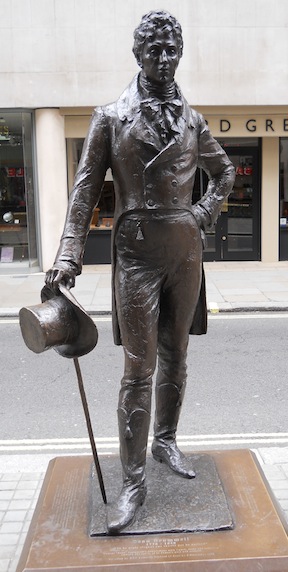
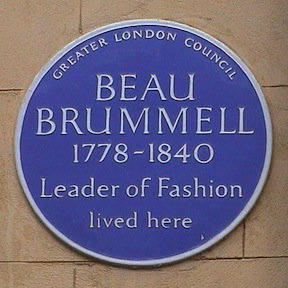
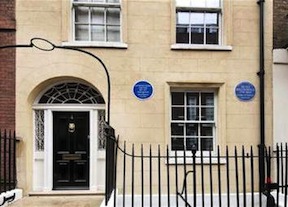
The epitome of a Regency dandy was a young man by the name of George Brummell. George did not grow up in the lap of luxury—his grandfather was rumored to be a personal servant—but his father was secretary to Lord North, and he was sent to Eton at the age of twelve in 1790, where he became very popular. Because of his attention to fashion and grooming, it wasn’t long before he became a great friend of the Prince Regent, who, in 1794, gave him a commission in his own regiment, the 10th Hussars. Brummell, nicknamed “Buck” by his intimates, spent most of his time on military leave, until he inherited 30,000 pounds and resigned, setting up his own household in 1798 at No. 4 Chesterfield Street.

BEAUBRUMMELL copy

Brummell decreed that cut and fit in a gentleman’s clothing were more important than elaborate fabrics. His insistence on cleanliness had the effect of pulling English gentlemen out of the stables and into the baths, and then poured into closely-fitting, well-cut clothing, including snow-white neckcloths tied into elaborate knots, smoothly shaved faces, and hair that required three hairdressers—one for the front, one for the sides and one for the back.

“The Beau” was known for his audacious wit and his condescending comments centering on the bad taste of others, men and women alike. A set-down from him could ruin a young person’s reputation and send them running from London in shame. Brummell and his dandies made it unfashionable to show emotion or any concern for the consequences of their actions. Although he had no social standing of his own, he had even the highest-ranked gentlemen admiring and copying his dress and behavior. Along with Lord Alvanley, Henry Pierpont and Henry Mildmay, he was part of the “Dandy Club” of Watier’s.

Unfortunately, Brummell’s extravagance, gambling and sharp tongue also led to his downfall. In 1813 at a party, the Prince Regent snubbed Brummell and Mildmay, staring them in the face while refusing to speak to them. Brummell quipped to Alvanley, “Who is your fat friend?” and that was the beginning of the end for Brummell.

In 1816 he fled to Calais where he lived in poverty until his death of syphilis in 1840.

londonrem

#4 chesterfield st.

No. 4 Chesterfield Street

Laudermilk, Sharon H. and Hamlin, Theresa L., The Regency Companion, Garland Publishing, 1989.

The Regency Gentleman series

The Regency Gentleman: His Upbringing

The Fashionable Gentleman

The Rise and Fall of Beau Brummell 

Gentlemen’s Clubs in Regency London

Captain Who?

Gentlemen’s Sports in the Regency

The Gentleman’s Passion for Horses

Riding to the Hounds

The Regency Gentleman’s Passion for the Turf

The Fashionable Gentleman

complete

Regency gentlemen had a serious obsession with fashion, especially after Beau Brummell arrived on the London scene. More about him next week.

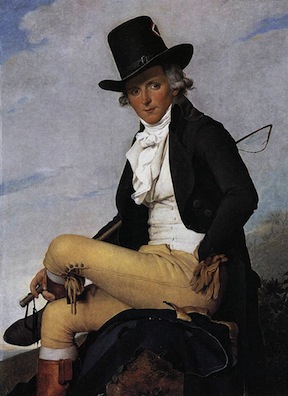
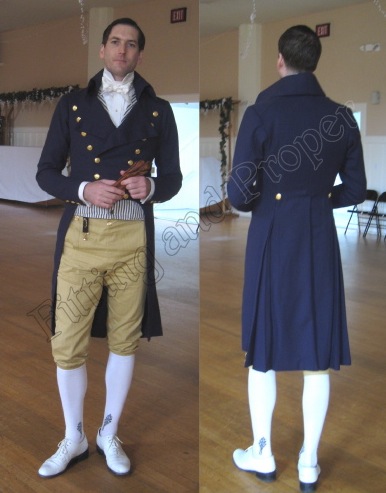
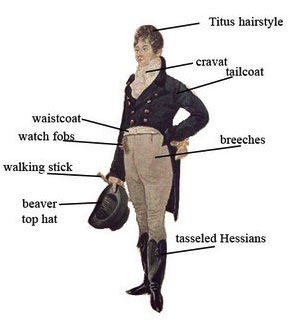
During the Regency, knee breeches gave rise to trousers, although it was a good long time before trousers were accepted at Almack’s Assembly Rooms. By 1816, after Brummell’s flight to the continent, trousers became all the rage, with breeches reserved for very formal occasions (except for older gentlemen who did not adapt well to change).

Pantaloons and trousers were made of light colors, such as buff or yellow, and clung tightly to the body. Pantaloons had side slits with buttons to keep them tight, and straps under the instep to keep them in place.

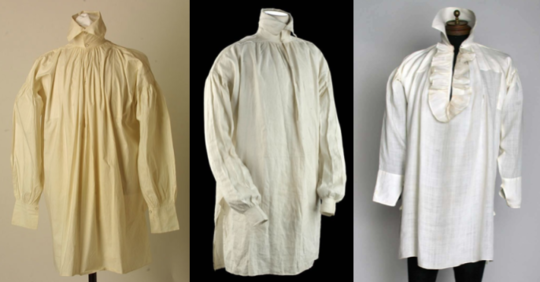
shirts

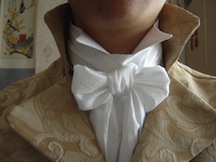
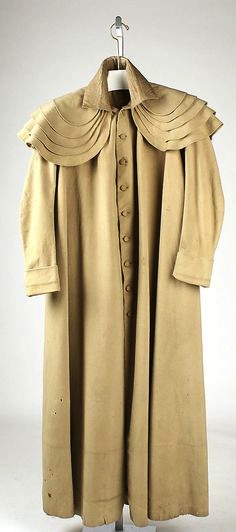
A gentleman’s shirt tended to be long, shapeless, and white. Over the shirt would go the waistcoat (white for evening wear, colorful and eye-catching for day wear). An elaborately-tied cravat would spill over the shirt and waistcoat. Over that would be a dress coat with tails—cut in a straight line from the waist down), or a morning coat or riding coat, which also sported tails, but was cut away in front. Following Waterloo, a frock coat with a military design became popular for informal occasions. Over all of this would be a great coat, worn all year round, often with capes of various lengths along the top.

cravat

greatcoat

greatcoat

morning coat or riding coat

morning coat or riding coat

Black boots were the daytime shoes of choice for a Regency gentleman, particularly Hessians, which were knee boots that sported a tassle in front. Hessians were worn over the trousers, but at the end of the Regency, Wellington boots, which were worn under breeches, which were tied at the foot, became popular. For evening wear, black pumps—perhaps made of the new patent leather—and silk stockings were worn. Hoby was the bootmaker of choice.

Regency gentlemen wore top hats of various shapes and sizes, and hats made of beaver were quite popular. Lock’s was the hatter of choice for the exclusive Regency gentleman. Gloves, jewelry (cravat pins, rings, and fobs), snuff boxes, quizzing glasses, and scents were also important to a gentleman’s toilette. Thanks to Beau Brummell’s fastidious cleanliness, bathing also become de rigueur in the Regency.

Beau Brummell

Beau Brummell

Just as Regency ladies required a personal maid or abigail to assist them with dressing and care for their wardrobe, gentlemen required the services of a valet.

For further information:

Kristen Koster

Laudermilk, Sharon H. and Hamlin, Theresa L., The Regency Companion, Garland Publishing, 1989.

The Regency Gentleman series

The Regency Gentleman: His Upbringing

The Fashionable Gentleman

The Rise and Fall of Beau Brummell 

Gentlemen’s Clubs in Regency London

Captain Who?

Gentlemen’s Sports in the Regency

The Gentleman’s Passion for Horses

Riding to the Hounds

The Regency Gentleman’s Passion for the Turf

A Regency Gentleman: His Upbringing

Privileged children were born at home, typically with the aid of a midwife, and immediately handed over to a wet nurse, since upper class ladies did not nurse their own children. Brought up by servants or dependent relatives, children saw their parents rarely, always accompanied by servants.

Later, a young gentleman might be tutored by a local clergyman or by a hired tutor or governess. When he could read and write, he would be sent off to public school, such as Eton, Rugby, Harrow, Westminster, Winchester and Charterhouse. The course of study centered on the classics, the French language (used often in polite society when servants were present), drawing and fencing. However, life at public schools could be traumatic.

Eton

Eton

In spite of the outlandish fees charged by these exclusive schools, the accommodations were abominable. Sleeping chambers were cold and damp, food barely edible and scant, and the older boys bullied the younger ones unmercifully. The older—and bigger—boys forced the younger ones as servants—a system known as fagging—and often such treatment resulted in revenge against a headmaster who allowed such brutal bullying to occur. Headmasters, too, were known to cane a boy’s bare buttocks until it bled.

The idea was that a boy who could survive public school and learned the meaning of obedience could be trusted to command—servants or regiments— or succeed in whatever place in Regency society he was fated to take.

Following public school, our young man could go on to Oxford or Cambridge, although he could devote himself to other pleasures—eating, drinking and wenching—as well. Most university students did a fair amount of both.

On the Town

Prior to the Napoleonic Wars, a young man would go on a tour of Europe with a tutor (“bear-leader”) to sample the pleasures of Europe. During the Regency, a young man was more likely to take up a commission in the army (particularly if he was a younger son) or simply learn his way around London, therefore earning his “town bronze.”

A young gentleman was expected to be skilled in fighting with fists, swords, and firearms, as well as gaming. Coolness, courage, and a “stiff, upper lip” were essential for a young man about town. He was also expected to be stylish enough to be accepted into gentlemen’s clubs and ballrooms, including Almack’s Assembly Rooms. Gentlemen, too, were scrutinized by the patronesses before being issued the coveted vouchers.

Other frequent amusements by young bucks might be parading up and down Bond Street and “accidentally” tripping people with their canes, catching the edge of a lace gown with their spurs, or quizzing people with their quizzing glasses. These young men “raising Cain” were the scourge of the night watchmen with their tricks on unwary passers-by.

And then there were their “bits of muslin” or wenches. A young man was expected to marry for money or connections, make sure his heir was his, and then proceed to find passion with a series of mistresses. While discretion was expected, most of society turned a blind eye to these foibles, at least on the part of gentlemen. Ladies’ behavior was much more closely scrutinized.

Laudermilk, Sharon H. and Hamlin, Theresa L., The Regency Companion, Garland Publishing, 1989.

The Regency Gentleman series

The Regency Gentleman: His Upbringing

The Fashionable Gentleman

The Rise and Fall of Beau Brummell 

Gentlemen’s Clubs in Regency London

Captain Who?

Gentlemen’s Sports in the Regency

The Gentleman’s Passion for Horses

Riding to the Hounds

The Regency Gentleman’s Passion for the Turf