Archives

Alicia Quigley: Lady Morgan’s Revenge: Letitia’s Naughty Novella

Experimenting With Books: How Do We Get It “Just Right?”

by Alicia Quigley

Thank you for giving me a chance to be a guest blogger at Susana’s Parlour again!

Today I want to talk a bit about experimenting with our work, and how that is a big part of where I am in my writing. I started writing Regency romances almost twenty years ago, but it was just so hard in those days to get published that although I had a few houses take a second look, I never got a book contracted. So, when I decided that the indie author route was interesting, I had quite a few manuscripts to work with. But, they were kind of dated. They needed some rework, and one of the questions I had was whether I wanted to do sweet traditionals, or handle sex in the more modern “pull up a chair next to the bed and get some popcorn” kind of way. In the end, the answer was “both” as I mentioned in my previous guest post.

What I’ve learned from that experiment so far is that the plot and the characters seem to dictate which stories will sell best in which format. So, in the Bluestocking series, which begins with The Secret Bluestocking (Traditional) and A Lady of Passion (After Dark), and continues with The Yuletide Countess (Traditional, no After Dark version) and most recently An Honest Deception (Traditional)/An Indecent Charade (After Dark) the sweet traditional version of the book has outsold the more modern one. These stories are all driven by the heroine, and her need for independence as well as love and the financial security that marriage was the only real provider of for women in the early 19th century. However, A Collector’s Item (After Dark) far outsold That Infamous Pearl (Traditional) in the first book of the Arlingbys series, which will all include a little suspense or intrigue as well as romance. As a result, there will probably not be a Traditional version of the second book, The Contraband Courtship, which I expect to release in the first half of June. It seems that romantic intrigue/suspense is a lot more interesting to readers when the sexual tension is overt.

Right now, I’m interested in whether there is a “just right” length for a romance as well. In December, I released my first novella, The Yuletide Countess, which was the #1 Historical Fiction book on Amazon in the US and UK for about a week, and a top seller for most of December and January. I wonder if this was related to the length, or just enthusiasm for Christmas-themed books. It definitely seems that shorter format works are growing more and more popular, especially in e-books. This makes sense for a lot of reasons – costs to produce and publish aren’t affected by length in e-books, and readers may find novellas more user-friendly if they are taking their e-reader on a road trip or just want something quick and easy to read on the airplane. They can also be priced well, which gets them a lot of promotion on sites that feature low cost books.

We received some feedback that An Indecent Charade was too long and slow, and that the troubles the heroine’s deceased husband and living male relatives cause her in the story detracted from the love element with the hero. So, as an experiment, we decided to do a third treatment of this book, which is titled Lady Morgan’s Revenge and we are subtitling it Letitia’s Naughty Novella because who doesn’t love alliteration? and some sex scenes that were “left on the cutting room floor” as being perhaps a bit too spicy for Letty’s character, have been included in this one. It comes in at a slim 47,000 words instead of 82,000, like the original book, so it is also an experiment in the shorter format.

We made these decisions after considering what readers said, and thinking that a stronger, more independent, take-charge Letitia might have greater appeal for our After Dark audience. So, we focused entirely on the hero/heroine relationship, as well as putting the “extra spicy” back in the text. We want to make an offer, by the way to any readers of this post who have purchased An Honest Deception or An Indecent Charade, and don’t feel they should have to buy the novella as well in order to enjoy the limited new content: email us at aheyerlove@gmail.com and we will send you a free copy of Lady Morgan’s Revenge.

Traditional publishers are finding that their business model, which doesn’t always serve authors or readers that well, but does seem to serve highly paid editors and executives with lovely offices in expensive cities very nicely, is being disrupted. Indie and small press authors are inventing a new business model, and I am all in favor of using the speed and lack of friction in e-book platforms to understand better what readers enjoy, what suits the amount of time they have in their lives to devote to books and to experiment with providing them those things.

To that end, I invite your readers (and their friends) to take the following survey. Their answers will be very valuable in helping me plot out (no pun intended) the course of my books for this year and beyond. As a thank you for participating, I’ll be randomly selecting five (5) survey takers and sending them a free copy of The Contraband Courtship when it launches in June. Thank you in advance and have a lovely summer!

Click here for the survey!

About Lady Morgan’s Revenge: Letitia’s Naughty Novella

Author’s Note: This version of the story is a “modified” version of An Indecent Charade. You spoke, we listened: you said that An Indecent Charade was too long and that Letty’s interfering male relatives bogged down the story. We agree! We want to present you with Lady Morgan’s Revenge: Letitia’s Naughty Novella, in which the bumbling idiot relatives have been removed, the hot sex scenes kept (one even extended!) and the inclusion of a very hot scene that was left on the cutting-room floor.

If you want the Traditional, no sex version, please see An Honest Deception: Letitia’s Traditional Regency Romance.
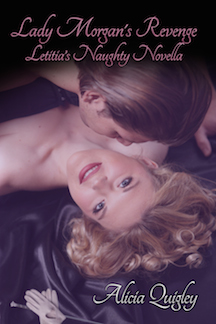
Lady Morgan's Revenge Cover copyWill passion purge her long-suffering heart of the sorrow from her previous marriage?

After the death of her wastrel husband, Alfred, Lady Letitia Morgan wants nothing more than to settle into the peaceful life of a widow. Her limited finances are enough to provide Letty and her two children that simple life.

Phillip Masham, Marquess of Eynsford and long-time friend of Francis, Lord Exencour, finds himself very much interested in Letty. Unfortunately for him, Letty’s opinion of men of the ton was quite soured by the late Baron Morgan. Not one to give up, the creative marquess becomes Mr. Phillip Markham, a solicitor in the Inner Temple, in hopes that Letty will get to know him for who his is, beyond his title. Letty and Phillip embark upon an affair that may deepen into love, but will it survive the truth?

More importantly, will Letty’s revenge for Phillip’s deception satisfy her and open her heart to happily ever after?

Find out in the latest by Alicia Quigley, chart-topping author of The Yuletide Countess and The Secret Bluestocking.

Amazon

Excerpt

Letty turned away, tears welling up in her eyes. “I have tried to tell you that I am too recently widowed, and that Alfred’s behavior and your deception make it impossible for me to know my true feelings toward you, but you will not listen to me!” she cried. “These past moments are the some of the first we have spent together since I became aware of the truth, and – and – and this what happened! I know no more about you than I did an hour ago, but I have learned I cannot trust myself near you. If you cannot wait for me, perhaps I am better off without you.”

“This happens” Phillip growled, “Because we love each other, even though you will not admit it.”

Letty gazed speculatively at Phillip. “So, you think I should simply forgive you for your deception,” she snapped.

He faced her squarely. “Yes, I do. I acknowledge my faults in pursuing your acquaintance before you were ready, and lying to you about my name and occupation, but I am in earnest when I say I love you and want your forgiveness.”

“What if I am not in the mood to just let bygones be bygones?” she asked, arching a brow at him enquiringly.

“Take some revenge on me then,” he exclaimed. “I hurt and disappointed you; what would make you in turn feel that the score is settled between us?”

Letitia pondered his words.   Her body still felt a lingering arousal from the lovemaking they had shared, and a pulse beat in her breasts and between her legs, a drumbeat reminding her of the desire his caresses always provoked in her. There was no denying that she missed Phillip’s company in bed as much as his conversation, and that she wished for a permanent break from their relationship as little as he professed to. So what might effectively banish the specter of his betrayal?

“What punishment would fit your crime?” she wondered aloud. Phillip eyed her from under his lashes.   How daring might his delightful Letitia be, he wondered.   As memories of her enthusiasm during their trysts ran through his thoughts, it occurred to him that she might be quite inventive, if given enough encouragement.

“I have gravely insulted you, Lady Morgan,” he responded. “You may need to discipline me rather, ah, severely.”

Letty looked somewhat surprised as he answered her, but she noted a bit of smirk on his handsome face, and a sudden recollection of her cousin’s complaints about discipline at his boarding school arose in her mind. “Indeed I may,” she answered coolly, allowing herself to look him slowly up and down, with a considering gaze.

Her insolent inspection sent a frisson of arousal through Phillip, and he felt himself begin to harden again as he waited, silent and impassive, for her to speak. Letty, who had noted his excitement, allowed her eyes to linger on his crotch just long enough to make him even more uncomfortable, before looking up at him.

“Very well,” she said imperiously. “You may present yourself at my house for your punishment in the afternoon, two days hence. Do not attempt to contact me before we meet.” She turned her back on him and walked out of the little passage, closing the door behind her. Phillip stood looking after her, astonished at the way their conversation had ended.

About the Author

AQ Twitter Avi copyAlicia Quigley is a lifelong lover of romance novels, who fell in love with Jane Austen in grade school, and Georgette Heyer in junior high.  She made up games with playing cards using the face cards for Heyer characters, and sewed Regency gowns (walking dresses, riding habits and bonnets that even Lydia Bennett wouldn’t have touched) for her Barbie.  In spite of her terrible science and engineering addiction, she remains a devotee of the romance, and enjoys turning her hand to their production as well as their consumption.

  WebsiteTwitter

A Word About the Status of Catholics in Regency England

Painting-of-a-martyr-on-the-rack_large

“Sorry, but King Henry says your religion, which until very recently was King Henry’s religion, as well as our religion, as it had been for 9 centuries, is alien and un-English”

It wasn’t until recently when I read Philippa Carr’s Miracle at St. Bruno’s that I began to feel the English people’s pain as they were forced from Catholicism to Protestantism to Catholicism again and then finally back to Protestantism at the whim Henry VIII and his offspring. The heroine’s devout Catholic father must either accept his sovereign’s “reforms”—devised solely for the purpose of enabling him to divorce his wife—or offer his head on the block. Following Henry VIII’s death, his eldest daughter—granddaughter to the originators of the Inquisition, Ferdinand and Isabella of Spain—demanded that everyone revert back to Catholicism or likewise suffer the severing of their heads. When Bloody Mary died and was replaced with her Protestant sister Elizabeth, Catholicism was abolished. No more of this religious switching back and forth, chopping off heads of devout people who happened to align themselves with the “wrong” religion.

Sir Thomas More (by Hans Holbein): refused to accept Henry VIII as Head of the Anglican Church, was convicted of treason and beheaded

Unfortunately, that meant many years of religious persecution for the Catholics. Masses had to be said it secret. Priests had to be trained abroad, and if they were caught, it meant execution for them and those who harbored them. “Priest holes” or secret hiding places were constructed in homes harbor them in case of a search.

Persecution eased a bit when Charles II took the throne; he had a Catholic wife. By the 18th century there was much more social acceptance of Catholics—they were allowed to worship at the Embassies of Catholic nations in London, for example. In 1785, the Prince of Wales (later George IV) illegally married a divorced Catholic woman, Maria Fitzherbert (never officially acknowledged). Catholics were excluded from Parliament, magistristracies, military commissions, and universities, but most other fields were open to them. Catholic worship became legal in 1791, so Catholics no longer had to have masses performed secretly in their homes.

During the Regency, a Catholic could be an officer in the army or navy, but not hold a seat in Parliament. Catholic marriages had to be performed in an Anglican church with an Anglican minister in order to be valid, although a Catholic ceremony could be held afterward (doing it first could leave them open to fines). A mixed marriage with a Catholic wife was more easily accepted in Society than one with a Catholic husband. (Although, to be fair, the Catholics didn’t approve of mixed marriages either.) The Protestant husband had to take an oath abjuring the Pope, and generally, the children were to be brought up Protestant, although in some cases, the boys were Catholic and the girls Protestant.

Catholics could go about their business much the same way as Protestants, although there was still plenty of prejudice against them. Generally, most Protestant families steered their marriageable children away from Catholics, and vice versa.

In Lost and Found Lady, Catalina, born and bred in Spain, is a devout Catholic. Rupert has promised his father he will choose a “suitable wife,” so when sparks begin to fly between him and the lovely girl who saved his life, he has to keep his emotions in check because Catalina is in no way the sort of wife his father would accept. But as their relationship grows, Rupert finally realizes that his heart has already made the choice for him.

 waterloo_cover_best web

Our Stories

Jillian Chantal: Jeremiah’s Charge

Emmaline Rothesay has her eye on Jeremiah Denby as a potential suitor. When Captain Denby experiences a life-altering incident during the course of events surrounding the Battle of Waterloo, it throws a damper on Emmaline’s plans.

Téa Cooper: The Caper Merchant

The moon in Gemini is a fertile field of dreams, ideas and adventure and Pandora Wellingham is more than ready to spread her wings. When Monsieur Cagneaux, caper merchant to the rich and famous, introduces her to the handsome dragoon she believes her stars have aligned.

Susana Ellis: Lost and Found Lady

Catalina and Rupert fell in love in Spain in the aftermath of a battle, only to be separated by circumstances. Years later, they find each other again, just as another battle is brewing, but is it too late?

Aileen Fish: Captain Lumley’s Angel

Charged with the duty of keeping his friend’s widow safe, Captain Sam Lumley watches over Ellen Staverton as she recovers from her loss, growing fonder of her as each month passes. When Ellen takes a position as a companion, Sam must confront his feelings before she’s completely gone from his life.

Victoria Hinshaw: Folie Bleue

On the night of the 30th Anniversary of the Battle of Waterloo, Aimée, Lady Prescott, reminisces about meeting her husband in Bruxelles on the eve of the fighting. She had avoided the dashing scarlet-clad British officers, but she could not resist the tempting smile and spellbinding charm of Captain Robert Prescott of the 16th Light Dragoons who— dangerously to Aimée— wore blue.

Heather King: Copenhagen’s Last Charge

When Meg Lacy finds herself riding through the streets of Brussels only hours after the Battle of Waterloo, romance is the last thing on her mind, especially with surly Lieutenant James Cooper. However, their bickering uncovers a strange empathy – until, that is, the lieutenant makes a grave error of judgment that jeopardizes their budding friendship…

Christa Paige: One Last Kiss

The moment Colin held Beatrice in his arms he wanted one last kiss to take with him into battle and an uncertain future. Despite the threat of a soldier’s death, he must survive, for he promises to return to her because one kiss from Beatrice would never be enough.

Sophia Strathmore: A Soldier Lay Dying

Amelia and Anne Evans find themselves orphaned when their father, General Evans, dies. With no other options available, Amelia accepts the deathbed proposal of Oliver Brighton, Earl of Montford, a long time family friend. When Lord Montford recovers from his battle wounds, can the two find lasting love?

David W. Wilkin: Not a Close Run Thing at All

Years, a decade. And now, Robert had come back into her life. Shortly before battle was to bring together more than three hundred thousand soldiers. They had but moments after all those years, and now, would they have any more after?

About Lost and Found Lady

On April 24, 1794, a girl child was born to an unknown Frenchwoman in a convent in Salamanca, Spain. Alas, her mother died in childbirth, and the little girl—Catalina—was given to a childless couple to raise.

Eighteen years later…the Peninsular War between the British and the French wages on, now perilously near Catalina’s home. After an afternoon yearning for adventure in her life, Catalina comes across a wounded British soldier in need of rescue. Voilà! An adventure! The sparks between them ignite, and before he returns to his post, Rupert promises to return for her.

But will he? Catalina’s grandmother warns her that some men make promises easily, but fail to carry them out. Catalina doesn’t believe Rupert is that sort, but what does she know? All she can do is wait…and pray.

But Fate has a few surprises in store for both Catalina and Rupert. When they meet again, it will be in another place where another battle is brewing, and their circumstances have been considerably altered. Will their love stand the test of time? And how will their lives be affected by the outcome of the conflict between the Iron Duke and the Emperor of the French?

Amazon.com • iBooks • Kobo • Barnes & Noble

Amazon.uk • Amazon.ca • Amazon.au

Amazon Print

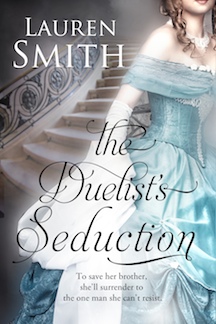
Lauren Smith: The Duelist’s Seduction

The Duelist’s Seduction Playlist

Have you ever heard a song that just fills your mind with images? That’s how music is for me. I can be standing in a crowded mall and hear the faint strains of a song and it just captures me. I see things, scenes, characters, stories not yet told, as they unfurl like brightly colored flags in my mind.

Music is true inspiration. For every song you can dream up a thousand stories. Music enchants us, spellbinds us, weaves emotions and tones into a beautiful symphony that leaves us bewitched. Because this connection for me and music is so incredibly powerful, I make sure to create a playlist for every story I write. Some characters have their own theme music, some scenes have a particular song, or the hero and heroine together have a song or songs that help me channel the emotions and the plot points of the story. In other words, music is magic for a writer like me.

When I set out to write my Regency romance novella The Duelist’s Seduction, I knew I’d need a special blend of songs because the hero, Gareth is dark and brooding, and the heroine, Helen is young and innocent, but full of love and hope.

So dear readers, settle back in your favorite armchair, with a cup of hot chocolate, your e-reader and your mp3 player and settle in for a great playlist!

The List:

  • Bad Company by Bad Company
  • Don’t Deserve You by Plumb
  • Elements (Orchestral Version) by Lindsey Stirling
  • Dead in the Water by Ellie Goulding
  • You Can Go Your Own Way by Lissie
  • Feel Me by Mecca Kalani
  • New York by Snow Patrol
  • Young and Beautiful by Lana Del Rey

Hope you all enjoyed the songs and get a chance to check out my novella, The Duelist’s Seduction, the first in the sexy Seduction series!

Meme1 copy

About The Duelist’s Seduction

Helen Banks is going to die. When her twin brother gambles away their fortune, she must save his life and take his place in a duel to satisfy the honor of a man her brother couldn’t pay. Disguised as her brother, Helen faces the one man she’s admired from afar, a widower with a dark past and eyes that scorch her very soul.

Since Gareth Fairfax lost his wife, the darkness in his heart continues to grow. Lashing out at anyone who opposes him, Gareth is stunned to face a lovely young woman opposite his dueling pistol. After discovering Helen’s deception, he offers her a choice: become his mistress or her brother dies.

Their devil’s bargain turns into a slow, sweet, intoxicating seduction. With each passing hour, Helen uncovers Gareth’s secret heartbreak and yet she can’t help but fall for the man who has ruined her. With Helen in his arms, Gareth wonders if he might yet be saved. All it takes is one passionate embrace, a kiss from the depths of his soul and a night of wild abandon.

 AmazonBarnes & NobleKobo • iBooks

Excerpt

Chapter 1

The predawn sky shone brightly with flickering stars as Helen Banks readied herself for the duel. Her hair was coiled and pinned tightly against her head, concealing its thick mass and giving her a boyish look—a disguise she prayed would last. Checking the black mask covering her face, she resumed walking. She took a deep, steadying breath as she adjusted her breeches and the black coat she’d pinched from her brother’s wardrobe.

The open field near the spa city of Bath was quiet. Two coaches waited in the distance along the roadside, and ahead of her, two men waited, watching her approach. Not even a breeze dared rustle the knee-high grass as Helen walked up to her enemy and his second. Both men also wore masks to conceal their identities should someone witness the illegal duel. The paling skies played with the retreating shadows of night, lending a melancholy air to the moment she stopped inches from the men.

perf5.500x8.500.indd“You are late, Mr. Banks,” the taller of the two men announced coldly.

With his broad shoulders and muscular body, Gareth Fairfax cut an imposing figure. He seemed perpetually tense, as though ready to strike out at anyone who might offend him. Dark hair framed his chiseled features, and the eyes that glowered from between the spaces of his mask were a fathomless blue. They were the sort of eyes a woman lost herself in, like gazing into a dark pool of water that seemed to sink endlessly, drawing her in until she can’t find her way back to the surface. She recognized the sensual, full lips, now thinned by anger, and the gleam of his eyes on her. She was never more thankful that the early morning’s pale light did not expose her as being a woman.

If he ever discovered she was a woman, he would be appalled and furious. Especially given that she was only dueling him to save her brother’s life.

She briefly studied her opponent’s second. He was just as tall, his features nearly as striking as Gareth’s.

Helen choked down a shaky breath. “I was waylaid.” She prayed her voice sounded gruff and masculine.

Gareth’s eyes were dark orbs, burning with thinly controlled anger. He shifted restlessly on his feet, his imposing form momentarily revealed by the dark blue coat that contoured to his shape.

“Is this your second?” His growl sent shivers down her spine as his glaze flicked to the squat man in his mid-thirties standing behind her. She glanced over her shoulder, widening her eyes in silent encouragement for her second to come closer.

“I am,” Mr. Rodney Bennett replied and bowed.

“Mr. Banks, I am Mr. Ambrose Worthing,” Gareth’s second announced politely.

Well, finally someone was acting like a gentleman. “Mr. Worthing,” Helen said, making sure to keep her voice low. “Allow me to introduce my second, Mr. Rodney Bennett.”

Bennett passed by Helen, and he and Worthing shook hands. Bennett offered the pistols to Worthing for inspection. Since Gareth and Worthing had not brought the weapons, that duty fell to her as the challenged party. As the two men drew apart from her and Gareth, she tried not to stare at him. He was impossibly handsome, in that dark, mysterious sort of way that a woman simply couldn’t ignore. Like gazing upon a visage of an angry god, all fire and might, ready to burn her to ash with passion.

Her opponent glowered at her. “I suppose I should trust that you’ve not tampered with my pistol?”

His icy tone made her bristle with indignation. “You have my word it shoots fair,” Helen snapped. The nerve of the man to accuse her of cheating!

“Your word? We would not be here if I could trust your word. A man who does not honor his debts may not find it necessary to honor the rules of a duel,” Gareth retorted.

She wanted to scream. Her fists clenched at her sides. Her nails dug painfully into her palms as she struggled to calm down. She wanted to throttle her brother, whose rash and inconsiderate behavior had gotten her into this mess.

“Easy, Fairfax. Both pistols appear to be in working order,” Worthing announced as he and Bennett rejoined them.

Helen breathed a sigh of relief as Bennett resumed his position behind her. She’d paid him the last bit of money she’d had for him to appear as her second. She didn’t really know the man, having only met him briefly when she’d had to drag her brother away from the card tables a few nights ago. When she first approached Bennett with her plan, he had tried to talk her out of it, but when she offered money, he couldn’t refuse and had agreed to help her take her brother’s place in the duel. Even though he was a gentleman, the gambler inside him craved any bit of money he could get his hands on to return to the tables. She was lucky he hadn’t gambled away his pair of pistols, or else she would have been completely humiliated to turn up at a duel without weapons.

“Now,” Mr. Worthing said, “before we settle this, is it possible that you and Mr. Banks can reconcile the dispute?”

Helen started to nod, wanting desperately to find a way to settle the problem without bloodshed, but Gareth spoke up, stilling the bobbing of her head.

“Mr. Banks has run up a debt to me of over a thousand pounds. He has not been able to pay it back to me over the last three months. Furthermore, he created an additional liability of five hundred pounds last evening when he played with money he did not have.”

Helen swallowed hard, a painful lump in her throat choking her. Martin, you damned fool…

“Why did you accept his vouchers then?” Rodney spoke up. “I saw you agree to play with him. You didn’t have to.”

“Banks had money on him. I assumed he’d replenished his funds and would settle his debts to me.” Gareth shot a withering look in Helen’s direction. “Shooting him will be a bonus.”

A man who would now take her life as payment for a debt she didn’t owe. But what else could she do? She couldn’t let Martin die. A man had options to survive, a woman did not, at least not one that wouldn’t make her despise herself for the rest of her life.

Her memory of the previous night was tinged with fury and disappointment in Martin. Her heart had plummeted into the pit of her stomach when she’d retired for the evening and found his room empty. All of her hopes were dashed the moment she’d learned he’d gone back to the gambling tables.

She’d hidden in the shadows outside the gambling hell, trying not to be seen by anyone passing by. The smell of alcohol stung her nose, and the raucous laughter echoing from the entrance sent chills of trepidation down her spine. It would ruin her completely if she were witnessed outside such an establishment. Bennett had promised to bring Martin out to her, but when Martin emerged, he was being roughly hauled out by a dark-haired gentleman, a man she recognized, a man she’d admired for the last few months from afar.

About the Author

Lauren_Smith_2014 copyLauren Smith is an attorney by day, author by night, who pens adventurous and edgy romance stories by the light of her smart phone flashlight app. She’s a native Oklahoman who lives with her three pets—a feisty chinchilla, sophisticated cat and dapper little schnauzer. She’s won multiple awards in several romance subgenres including being an Amazon.com Breakthrough Novel Award Quarter-Finalist and a Semi-Finalist for the Mary Wollstonecraft Shelley Award.

Check her out at http://www.laurensmithbooks.com. You can sign up for her newsletter at her website, follow her on Facebook at http://www.facebook.com/LaurenDianaSmith and on Twitter at @LSmithAuthor. Her blog is http://theleagueofrogues.blogspot.com.

Collette Cameron: Wagers Gone Awry (Conundrums of the Misses Culpepper, Book 1)

Interview with Heath, Earl of Ravensdale

Wagers Gone Awry

Conundrums of the Misses Culpepper, Book 1

Susana: Tell us about yourself, please.

Heath gives a brief bow. “Thank you for your kind invitation to visit with you at Susana’s Parlour. That’s a lovely blue gown you’re wearing. It reminds me of Brooke’s eyes.”

He settles into an armchair.

“Always a bit awkward, talking about oneself, especially when one has been born into a life of privilege but cannot boast ancestors one is proud of. I don’t suppose you’d be happy with I loathe kidney pie and flowers make me sneeze?”

“Hmph, I thought not.” He crosses his legs and drums his fingers on the chair’s arm.

“I’m the eighth Earl of Ravensdale and have had to leave the comforts of London to travel to a remote dairy farm I won in a wager. Well, at least I thought I won the blasted thing, but it seems I only won a portion of the place.”

He leans forward a bit.

“Have you any idea how smelly a dairy is? And the flies…hoards of the pesky things.” He flicks his hand toward the window. “And this farm is run by a troupe of sassy women. Beautiful women, I might add.”

Susana: So, what do you want to do about it?

Heath chuckles.

“Ah, that’s an age-old question. What do I want? To sell that farm, but if I do, I’ll render the Culpepper misses, not to mention their staff and pets, homeless. Makes me rather a cur, doesn’t it?”

His gaze drops to his lap.

“No, what I really want is Brooke Culpepper, but she cannot abide me, and I doubt an offer of marriage would tempt her. Besides, the Ravensdales up to now, haven’t exactly exemplified fidelity or marital bliss, so I plan on enjoying a few more years of freedom before buckling under the responsibilities of the earldom and acquiring a wife and producing an heir.”

Susana: Ah, so you have a bit of a conundrum yourself, don’t you?

“In a nutshell, yes. As I mentioned before, I need to sell that parcel of green hell so that I can return to London’s civilization.

Heath shakes his head then winces. “And, after Brooke’s over-zealous servant took it upon himself to crack me on my head, I’m under doctor’s orders not to travel until I’ve recovered fully.”

He winks. “He doesn’t know I’m here today. Trust me, having Brooke under the same roof is causing me much more discomfort than my aching head is.”

Susana: You’ve been born into a position of power and privilege. Still, are there any areas of self-doubt or areas you are skilled at?

“Do you know a man or woman alive that doesn’t have some degree of self-doubt?”

Heath gazes into space for a long moment. A small smile quirks his mouth before he shrugs.

“I can barely read, and it’s a secret I’ve kept close to my chest since my youth. I trust you’ll not bandy it about indiscreetly. I also have a terrible sweet tooth. The Culpeppers make the most delicious shortbread biscuits.”

He grins then and taps his temple with his forefinger.

“As for skills, I have quite a memory for numbers, and can recall every card dealt in a game.”

Susana: You’ve shared your self-doubts, but what it is you fear most?

“I fear I’ve lost Brooke because of the wager between us.”

He glances up, his expression troubled.

“She lost, you know, and she should have won. Would have won if outside forces hadn’t interfered.”

He uncrosses his legs and sighs.

“I’m also afraid I’m stuck with this farm, and I detest country life.”

Heath makes a small gesture with his hand. “It’s a childhood thing, the story much too long and boring to tell.”

Susana: Does your story have a happy ending?

Heath grins. “Oh, it has a happy ending, though my author manipulated me mightily. Authors seem to enjoy doing that, pushing us characters around and torturing us a bit.”

His grin slips.

“I did end up keeping the confounded dairy farm, and obtained guardianship of the younger Culpeppers. I’m going to have my hands full with that lot. Speaking of which, I need to discover what mischief they’ve gotten themselves into in my absence.”

Heath stands and bows. “I thank you for having me as your guest. I’d be honored to return anytime.”

About Wagers Gone Awry

UPDATEDWagersGoneAwry_600x900 copyBrooke Culpepper resigned herself to spinsterhood when she turned down the only marriage proposal she’d likely ever receive to care for her family. After her father dies, a distant cousin inherits the estate and becomes their guardian but permits Brooke to act in his stead.

Heath, Earl of Ravensdale is none-too-pleased to discover five young women call the dairy farm he won and intends to sell, their home. Desperate, pauper poor, and with nowhere to go, Brooke proposes a wager. His stakes? The farm. Hers? Her virtue. The land holds no interest for Heath, but Brooke does and he accepts her challenge.

Brooke loses, and her devastation is compounded when the cousin arrives, intending to haul the Culpepper misses off to London. Heath astounds himself and proposes in order to apply for guardianship of the other girls. Does Brooke dare marry the handsome stranger who’d been bent on compromising her? Will Heath regret his impulsive gesture, or will unexpected love flourish?

Win a $25.00 gift card or one of two autographed copies of Wagers Gone Awry.

http://www.rafflecopter.com/rafl/display/ffec6dd36/

AmazonBarnes & NobleKobo iBooks

Excerpt

“Here are my terms, my lord, and they are not negotiable.” She shut her eyes for a second before snapping them open. She launched her battle plan. “Should I lose, I will accompany you to London as your mistress, but you will allow everyone else to remain here, including the servants. You will bestow generous marriage settlements on the four girls, and arrange for sponsors for their come outs as well as permit Esherton to retain the proceeds from the dairy and farm.”

Heath folded his arms. Came up with that too damn quick for his liking. “Is that all?”

“No.” She scowled and pushed her wayward hair behind her ear again. “Mabry will carry on as overseer, and you will permit me to hire a respectable woman of quality to act as a companion to my sister and cousins, both here and when they are in London. An annual allowance to further the estate’s recovery wouldn’t be amiss either.”

She paused, appearing deep in thought, her brows drawn together. “Oh, and I shall be permitted at least two extended visits to Esherton Green annually.”

Heath should have suspected Brooke wouldn’t acquiesce without a skirmish. He didn’t half mind her terms except keeping the blasted farm stipulation. But if he didn’t have to manage the place, he would concede the point.

“And if you win?” He braced himself for her demands.

Your ballocks fried to a crisp.

“If I win the wager, you sign over to me, free and clear, the lands you won from Sheridan.”

That’s all she wanted? No bulging purse, new wardrobe, household furnishings … or the hundred other things she and the others lacked?

She extended her hand. “Agreed?”

Heath clasped her roughened palm. It fit neatly within his grasp, as if it had been molded to nestle there. “Yes, the instant you win.”

He wouldn’t allow her the victory. They had yet to decide on what game to play, but it mattered not. He didn’t lose at the tables. He might not be able to read worth a damn, but he remembered every playing card dealt.

Across the expanse of deep green, three figures separated from the house and moved toward the barns. Leventhorpe and two of the other Culpepper misses. At this distance, which two he couldn’t discern. “What’s your pleasure?”

“Excuse me?” Her back to the house, Brooke squinted up at him from where she squatted beside the dog, now lying with is feet in the air, eyes closed, enjoying a tummy rub.

“My pleasure?” She almost choked on the words. “Awfully confident you’ll be the vanquisher, aren’t you? Pride goeth before a fall, my lord.”

He chuckled. Never short on pithy remarks, was she? “What game of cards do you prefer?”

Her chagrin transformed to cunningness. A shrewd smile bent her mouth. “I never agreed to a card game.”

About the Author

Collette CameronBestselling, award-winning author, Collette Cameron, has a BS in Liberal Studies and a Master’s in Teaching. Author of the Castle Brides Series. Highland Heather Romancing a Scot Series, and Conundrums of the Misses Culpepper Series, Collette writes Regency and Scottish historicals and makes her home in the Pacific Northwest with her husband and five mini-dachshunds. Mother to three and a self-proclaimed Cadbury Chocolate chocoholic, Collette loves a good joke, inspirational quotes, flowers, trivia, and all things shabby chic and cobalt blue. You’ll always find dogs, birds, quirky—sometimes naughty—humor, and a dash of inspiration in her novels.

Her motto for life? You can’t have too much chocolate, too many hugs, or too many flowers or books. She’s thinking about adding shoes to that list.

 WebsiteBlogTwitterFacebookPinterest

GoodreadsAmazon Author Page


The Holyhead Road: Three Notable Coaching Accidents

dust jacket

The following post is the twenty-second of a series based on information obtained from a fascinating book Susana recently obtained for research purposes. Coaching Days & Coaching Ways by W. Outram Tristram, first published in 1888, is replete with commentary about travel and roads and social history told in an entertaining manner, along with a great many fabulous illustrations. A great find for anyone seriously interested in English history!

london-st albans

As soon as 1742, the North-western Roads were already famous for speed.

…it came to pass in 1754 that a company of Manchester merchants, having considered how Time flew, and to what a degree the success or non-success of commercial speculation coincided with the flight of Time, bethought them how most nearly in their passage to and from London they might fly themselves. To which end they started a new sensation called a “Flying Coach.” And they carefully put forward in a well-weighed prospectus the claims of their invention to the title, stating that there was non nonsensical pretence about the thing this time, but that in point of honest fact they seriously contemplated running their machine at the accelerated speed of five miles an hour; and that however incredible it might appear, the coach would actually, barring accidents, arrive in London four days and a half after leaving Manchester!

Before the days of MADD (Mothers Against Drunk Driving)

Bar-room_Scene,_William_Sidney_Mount,_1835

Bar-room Scene, William Sidney Mount, 1835

The first casualty to be noticed on the North-western Road occurred… so near to London indeed as Finchley Common (which is about a mile and a half beyond Highgate Archway), though the cause of the accident, the first cause, originated at a place called Redbourn, twenty-one miles down the road. And in this wise: Owing to an obstruction below Dunstable—in point of fact to heavy snow-drifts—four or five coaches started together thence. They all went at a fair pace, not racing, but passing each other at the different stages, till they reached the Green Man at Fincley, where according to immemorial prescription the four coachmen alighted for a drink, or rather for four. And now “a change came o’er the spirit of the scene.” In other words, one “Humpy,” so called either from his driving the Umpire (but I hope not) or from his having a hump on his back, which is more probably, was discovered to have taken too much spirits. For he was very noisy and shouted and hallooed at the top of his voice, though at what it is impossible to conjecture. However, the old coachman who tells the story… suspected that something would happen. So he kept behind, and waited to see what he would see. He first of all saw one of the three coaches by a fence opposite a public-house… he saw a coach lying on its side—the Manchester Umpire in fact—the coach of the too demonstrative Humpy… The forepart of the coach was broken, the luggage was scattered all over the road, also the passengers, who, thus agreeably circumstances, improved the shining hour by bewailing their bruises and cursing the conduct of Humpy. This was rather unchivalrous of them as it turned out, thus to rail against; for Humpy was also on his back perfectly helpless, “like a large black beetle,” moaning and groaning most hideously, and certainly more injured that anybody else… From Humpy himself therefore no explanation of how things had occurred was naturally forthcoming. But there were not wanting men unkind enough to allege that this complete turnover resultted from now more intricate a fact than that of the miserable Humpy having his leaders’ reins wrongly placed between his fingers, which was done when he took them from his box-passenger, after the last, the fatal, brandy and water. The natural but very embarrassing consequence was that when Humpy suddenly discovered that he was too near the fence, he pulled the wrong rein, and there they were—on their backs in the road.

No speed limits either?

'The Opposition Coaches', 1837 (1927).Artist: Charles Cooper Henderson

The Opposition Coaches, 1837, Charles Cooper Henderson (1927)

A more serious accident than this, inasmuch as one of the unfortunate passengers was killed, happened to the Holyhead Mail, a little further down the road, a mile indeed on the London side of St. Albans. This arose from the exciting but highly dangerous pastime of racing. The Holyhead Mail, via Shrewsbury, attempted to pass the Chester Mail by galloping furiously by on the wrong side of the road. The coachman of the Chester Mail resented the indignity, and pulled his leaders across his rival’s—a heap of stones conveniently placed by the road side did the rest of the business, and in a moment converted two spick and span turn-outs, full of passengers more or less alive and alarmed, into a mass of struggling horseflesh, splintered wood and groaning wounded. The inquest on the victim of this rivalry among coachmen was held at the Peahen inn in St. Albans, and a verdict of manslaughter was returned against both artists. Abundant subsequent opportunity was afforded them of meditating on their sins, for they were kept in irons in St. Albans for six months before they were tried at Hertford—in which town they enjoyed a further twelve months’ imprisonment in the county gaol.

Duty wins over heroism (unless the ladies are attractive)

The Louth Mail Accident

The Louth Mail Accident

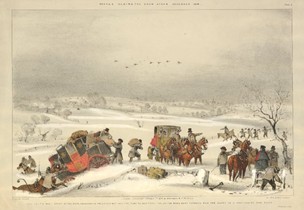
A snow effect is the next coaching incident to be chronicled in this neighbourhood of St. Albans, richer surely in its agreeably diversified crop of casualties than any other place in England. The North-western coaches… seem to have got the full benefit of the historic snow-storm of 1836. This visitation lasted the best part of a week and has never been equalled in England before or since. The drifts in some hollows were said to be twenty feet deep—which caused some passengers not unnaturally to report that they were “mountains high,” and some coachmen to state that the snow in some places was higher than their heads as they sat on the box. “Never before,” writes a correspondent of the Times of that day (quoted by Captain Malet in his Annals of the Road)—“never before within recollection was the London Mail stopped for a whole night at a few miles from London, and never before have we seen the intercourse between the southern shores of England and the metropolis interrupted for two whole days.”

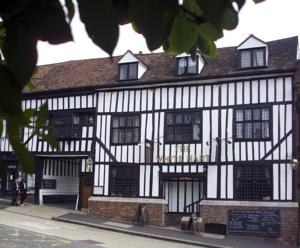
White Hart Inn, St. Albans

White Hart Inn, St. Albans

…many mails and coaches remained hopelessly stuck, able neither to get up the road nor down it—a state of affairs which must have caused many passengers to use srange words, and the landlords of the Angel, White Hart, and Woolpack to make hay while the snow fell. And some people were not so fortunate as to be stuck fast in a picturesque place where there was something eat, as Burdett, the guard of the Liverpool Mail, was able to testify. For on Tuesday, December 27, of this memorable year, this guard from his vnatage point, beheld a chariot buried in the snow and without horses, safely at anchor at about a mile on the London side of St. Albans. And he had no sooner seen it—and two elderly ladies inside it, who rent the welkin with clamorous cries for help—than he found, by being suddenly precipitated head firstinto twelve feet of snow, that his coach had got into a drift too. Having recovered his perpendicular, and emptied his mouth, a natural curiosity prompted Burdett to cross-examine the ladies on their somewhat forlorn position. They told him that their post-boy and left them for St. Albans to get fresh cattle, and had been gone two hours—no doubt having elected to get brandy for himself instead. Meanwhile, there they were—and in a very deplorable plight surely. But will it be believed that this heart-moving vision of beauty in distress did not move the guard of the Liverpool Mail in the least! No! He proceeded stolidly in the plain path which is duty’s—a fact whih tends to the suspicion that the ladies cannot have been beauties. But whether they were or no, Burdett, after having heard their story, turned a deaf ear to their appeals for help. He just helped his coachman, his passengers, and his four horses on to their feet—(for the horses too had assumed a recumbent position)—and having extricated his mail, by the help of his tools, curses, and other expedients not mentioned in the text, pursued his journey to London, leaving the chariot and the ladies to their fate.

Mail Coach in a Snowstorm c.1835-40 by Charles Cooper Henderson 1803-1877

Mail Coach in a Snowstorm c. 1835-40, Charles Cooper Henderson


 Index to all the posts in this series

1: The Bath Road: The (True) Legend of the Berkshire Lady

2: The Bath Road: Littlecote and Wild William Darrell

3: The Bath Road: Lacock Abbey

4: The Bath Road: The Bear Inn at Devizes and the “Pictorial Chronicler of the Regency”

5: The Exeter Road: Flying Machines, Muddy Roads and Well-Mannered Highwaymen

6: The Exeter Road: A Foolish Coachman, a Dreadful Snowstorm and a Romance

7: The Exeter Road in 1823: A Myriad of Changes in Fifty Years

8: The Exeter Road: Basingstoke, Andover and Salisbury and the Events They Witnessed

9: The Exeter Road: The Weyhill Fair, Amesbury Abbey and the Extraordinary Duchess of Queensberry

10: The Exeter Road: Stonehenge, Dorchester and the Sad Story of the Monmouth Uprising

11: The Portsmouth Road: Royal Road or Road of Assassination?

12: The Brighton Road: “The Most Nearly Perfect, and Certainly the Most Fashionable of All”

13: The Dover Road: “Rich crowds of historical figures”

14: The Dover Road: Blackheath and Dartford

15: The Dover Road: Rochester and Charles Dickens

16: The Dover Road: William Clements, Gentleman Coachman

17: The York Road: Hadley Green, Barnet

18: The York Road: Enfield Chase and the Gunpowder Treason Plot

19: The York Road: The Stamford Regent Faces the Peril of a Flood

20: The York Road: The Inns at Stilton

21: The Holyhead Road: The Gunpowder Treason Plot

22: The Holyhead Road: Three Notable Coaching Accidents

23: The Holyhead Road: Old Lal the Legless Man and His Extraordinary Flying Machine

24: The Holyhead Road: The Coachmen “More Celebrated Even Than the Most Celebrated of Their Rivals” (Part I)

25: The Holyhead Road: The Coachmen “More Celebrated Even Than the Most Celebrated of Their Rivals” (Part II)

26: Flying Machines and Waggons and What It Was Like To Travel in Them

27: “A few words on Coaching Inns” and Conclusion

Angelina Jameson: A Lady’s Addiction

Untitled1

Alcohol abuse in the Regency era

The heroine of my book A Lady’s Addiction has a problem with alcohol. Anna used it to self-medicate, to deal with the disgusting attentions from her husband. Now a widow, Anna struggles to rid herself of her nightly ritual of drinking a bottle of wine to dull her senses.

The term alcoholism wasn’t around in the Regency era and wasn’t coined until 1852. Reformers labeled those who often drank in excess as habitual drunkards. At the time habitual drunkenness wasn’t seen as a disease. I portrayed Anna as an alcohol abuser not an alcoholic. She uses alcohol to de-stress. If she continues on this path she would most likely become an alcoholic.

Anna’s drink of choice was wine. Wine was plentiful in upper class Regency households. Wine was a gentlemanly drink. It was imported and expensive, perfect as a posh drink for the upper classes. During the years of war between France and England it was harder to get French wine. The English turned to new favorite wines from Spain, and Portugal. These wines were Madeira, Malaga, port, or sherry. The hero in my book refers to Portuguese wine in the first chapter.

During the Gin Craze in 18th century London binge drinking became a huge social problem. Gin was cheap and readily available to the lower classes. The heavy consumption of alcohol continued during the Regency. In the Reminisces of Captain Gronow, the author stated: “Drinking was the fashion of the day.”

It is well known that George IV drank heavily. Did George’s excessive drinking reflect current fashion or set it? I think both. Drinking played an extremely important social role in eighteenth century England. Anyone who reads Regency historical novels has heard of gout. The high consumption of port and fortified wines led to the upper class disease of gout.

What about women drinking in the Regency era? While there are many cartoons and articles from the Regency showing excess drinking by men, it was much harder to find information about those Regency women who may have abused alcohol. Lady Caroline Lamb was known to be addicted to alcohol and laudanum near the end of her life. It is taken for granted that women of society drank to relieve the boredom and monotony of their lives. Women drank wine with their meals and drank sherry in the drawing room after dinner. It is not hard to imagine women overindulging with all the alcohol surrounding them.

What do you think of a romance heroine dealing with alcohol abuse? Would you prefer the hero to be the one dealing with such a struggle? One reader who leaves a comment on this blog post will receive a $10 Amazon gift card.

ALadysAddiction_w9353_2_850 copy

About A Lady’s Addiction

Anna, a widow battling alcohol addiction is convinced she is worthless unless she bears a child. She hires a lover to prove she is not frigid and may marry again and have children.

Devlyn, sterile from an accident, has returned from an assignment for the Foreign Office and inadvertently becomes Anna’s lover.

Anna and Devlyn join forces to protect an innocent child from a blackmailer. Can they come to terms not only with their feelings for each other but whether they will allow society to dictate the true significance of life?

Excerpt

She couldn’t remember the question she’d asked. His nearness unsettled her. Her entire body had flared into wakefulness the moment he entered her room. Cecily could be right; this man might be able to help with her problem.

Tonight she would play a part. She would emulate the sophisticated façade her friend Cecily Pickerel displayed. The scandalous nightgown underneath her thin robe was in fact a gift from Cecily. She would never have had enough courage to buy such a shocking garment for herself.

“You are discreet?”

“What is your name?” Franco asked, ignoring her question.

Somewhere in the back of her mind she remembered Cecily telling her she needn’t share personal information. She would never see this man again. He didn’t move in her circles. With the slightest of shrugs, she answered truthfully, “Anna.”

“Anna,” he said in a husky rasp. The way her name rolled off his tongue sent the lightest frisson along her skin. “It is a graceful, pretty name. It suits you.”

“There is no need to flatter me.” She felt heat on her cheeks. “It is a common enough name.”

“Despite our current situation, my dear, I do not believe you are at all common.”

 AmazonThe Wild Rose PressBarnes & Noble

US 99 cents to 30 April 2015

US $4.99 from 1 May 2015

About the Author

Untitled2I joined the US Air Force to see the world. My dreams of visiting the United Kingdom were fulfilled when I was stationed at RAF Lakenheath in the beautiful countryside of Suffolk, England. Five years later I returned to the states having acquired a wonderful husband and a love of all things British. I began writing as a hobby when my husband was remote to Honduras for a year. I found RWA and a local New Mexico chapter, LERA, and my hobby developed into a dream of sharing my stories with others. I currently live in the great state of Alaska with my wonderful husband and our two teenage boys.

FacebookTwitterWebsite

A Celebration of Waterloo: The Prince of Orange

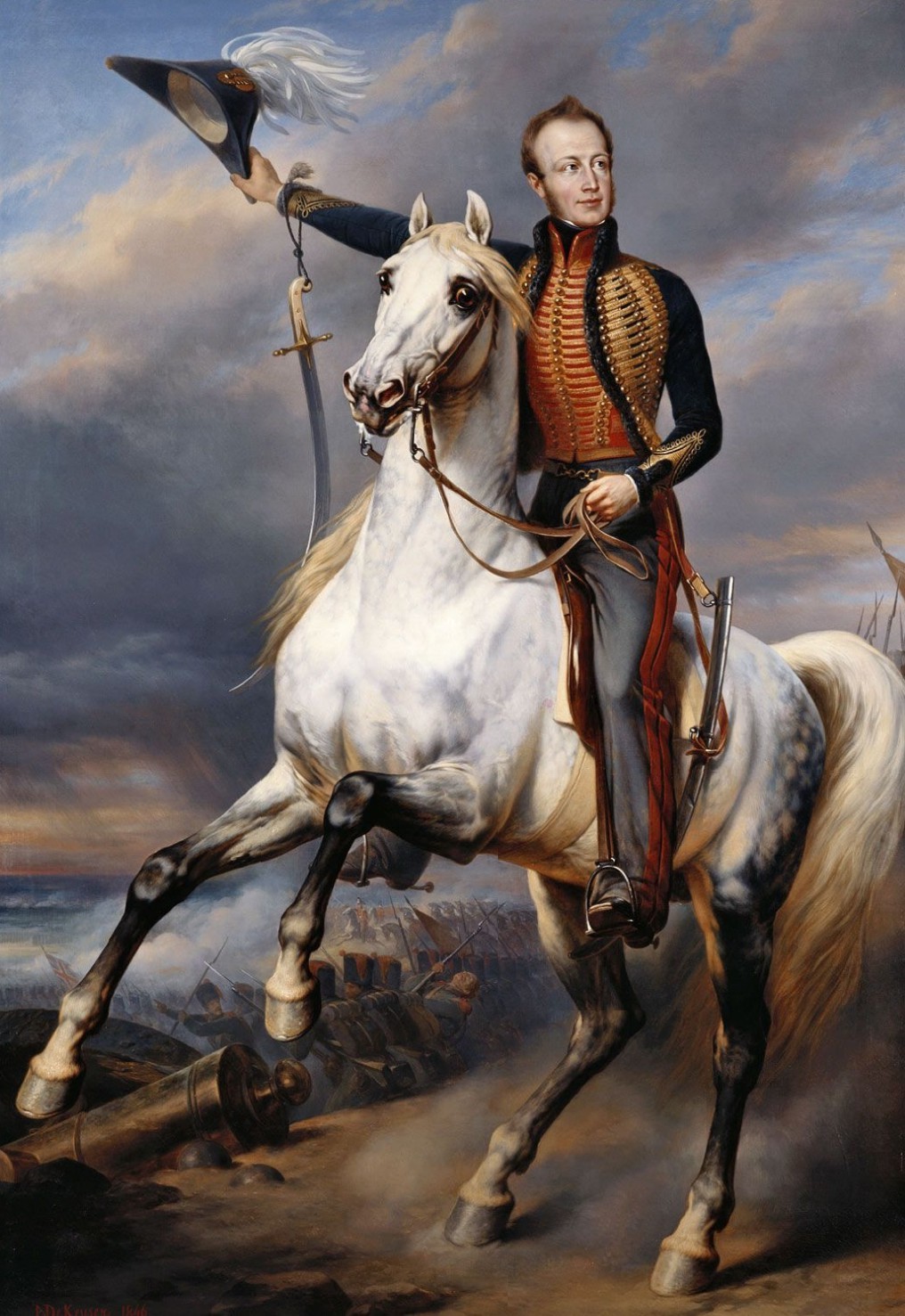
The young Prince of Orange

The young Prince of Orange

About the Prince

William Frederick George Louis was the son of William I of the Netherlands and Wilhelmina of Prussia. When his father proclaimed himself king in 1815 (16 March), he became Prince of Orange. After his father’s abdication in 1840, he became King William II of the Netherlands.

Avid readers of Regency historical fiction might recognize him as the rejected suitor of Princess Charlotte. The Prince Regent arranged the match, but his estranged wife opposed it, and when Charlotte finally met him, she did as well. Whether the problem lay with his personal qualities or the necessity of having to live in the Netherlands or both, the young princess eventually had her way, and married Prince Leopold of Saxe-Coburg-Saalfield (later King of Belgium) in 1816.

PRINCE OF ORANGE ON HORSEAt the age of two, William fled with his family from the French to Prussia, where he had a military education and served in the Prussian army. Then he studied at the University of Oxford, where he was quite popular and nicknamed “Slender Billy” by the English public. As a result of his ex-patriot upbringing, there were complaints when he eventually returned to the Netherlands that he seemed more foreign than Dutch.

William joined the British army and became aide-de-camp to Wellington in the Peninsular War in 1811 when he was only nineteen years old. In 1815 he joined the Allied Coalition for the final confrontation with Napoleon at Waterloo, where he commanded the I Allied Corps, which was a conglomeration of armies from Britain, Hanover, the Netherlands, Nassau, and Belgium.

This mishmash included many Belgian soldiers who had formerly fought in Napoleon’s Grand Armée—some of whom wore the same uniforms. A source of confusion? Indeed yes, but what was worse was that some allegiance to France still remained, as well as a very real fear of fighting against their former emperor. Communication between all these nationalities was also a problem. Wellington knew he had a problem there, but with rumors abounding of the swelling numbers of Napoleon’s troops, he couldn’t afford to be too selective as he was hastily assembling his own forces.

The Controversy

At 23, the Prince was considered by many to be too young to have the rank of Major-General and given an entire Corps to command. It was said that he was assigned this position because Wellington desperately needed the 30,000 Dutch-Belgian troops and that his son’s promotion was the price of the Dutch king’s cooperation.

The traditional (i.e., British) view was that 200 of the Dutch-Belgian troops took off in the opposite direction when faced by the French. Non-British sources protest, however, that newly-arrived British infantrymen, confused by the similarity of the French and Dutch uniforms, opened fire on them both, causing the Dutch-Belgians to lose a large number of horses, which caused these unmounted soldiers to fall back and not be available for active duty.

From The Cowards at Waterloo (a Dutch account of the battle: http://www.napolun.com/mirror/napoleonistyka.atspace.com/Waterloo_Cowards.html)

Unfortunately most of the British accounts have tended to magnify out of all proportion the accomplishments of the very modest numbers of British soldiers. These authors are unashamedly biased, their troops are super-human, the Duke practically a deity. Below is a fragment of hugely popular in English speaking countries book “Waterloo” by Cornwell (the adventures of super-soldier Major Sharpe). The readers are fed with some colorful descriptions of Belgian cowardice and ‘Dutch courage’. The Belgians and Dutch flee without fight, their commander Prince Orange is “little Dutch boy” etc. In contrast the British soldiers are all-conquering heroes, and their commanders are either tough as a nail or geniuses (or both).

Where does the truth lie? Probably somewhere in the middle. The Prince of Orange acquitted himself well in the Peninsula as aide-de-camp to Wellington, and he was certainly not the first young man his age to have such a high rank. The language problem throughout the conflict was not limited to his troops, and wasn’t his fault. Prejudice on both sides had to be a factor as well. Just as there are some who say the Prussians under Ziethen did come through in the end and should be given some credit for the victory. It’s hardly surprising that the British accounts give the British the lion’s share, but at the same time it’s advisable to take some conclusions with a grain of salt.

Lost and Found Lady

With that in mind, I had just read Bernard Cornwell’s Waterloo prior to writing this story, so my portrayal of the Prince of Orange and the Dutch-Belgian troops conforms to the traditional views. So keep in mind when you read it that the Prince was likely not a cartoon-character of a man at all, in spite of the way he has been characterized over the years.

waterloo_cover_best web

Our Stories

Jillian Chantal: Jeremiah’s Charge

Emmaline Rothesay has her eye on Jeremiah Denby as a potential suitor. When Captain Denby experiences a life-altering incident during the course of events surrounding the Battle of Waterloo, it throws a damper on Emmaline’s plans.

Téa Cooper: The Caper Merchant

The moon in Gemini is a fertile field of dreams, ideas and adventure and Pandora Wellingham is more than ready to spread her wings. When Monsieur Cagneaux, caper merchant to the rich and famous, introduces her to the handsome dragoon she believes her stars have aligned.

Susana Ellis: Lost and Found Lady

Catalina and Rupert fell in love in Spain in the aftermath of a battle, only to be separated by circumstances. Years later, they find each other again, just as another battle is brewing, but is it too late?

Aileen Fish: Captain Lumley’s Angel

Charged with the duty of keeping his friend’s widow safe, Captain Sam Lumley watches over Ellen Staverton as she recovers from her loss, growing fonder of her as each month passes. When Ellen takes a position as a companion, Sam must confront his feelings before she’s completely gone from his life.

Victoria Hinshaw: Folie Bleue

On the night of the 30th Anniversary of the Battle of Waterloo, Aimée, Lady Prescott, reminisces about meeting her husband in Bruxelles on the eve of the fighting. She had avoided the dashing scarlet-clad British officers, but she could not resist the tempting smile and spellbinding charm of Captain Robert Prescott of the 16th Light Dragoons who— dangerously to Aimée— wore blue.

Heather King: Copenhagen’s Last Charge

When Meg Lacy finds herself riding through the streets of Brussels only hours after the Battle of Waterloo, romance is the last thing on her mind, especially with surly Lieutenant James Cooper. However, their bickering uncovers a strange empathy – until, that is, the lieutenant makes a grave error of judgment that jeopardizes their budding friendship…

Christa Paige: One Last Kiss

The moment Colin held Beatrice in his arms he wanted one last kiss to take with him into battle and an uncertain future. Despite the threat of a soldier’s death, he must survive, for he promises to return to her because one kiss from Beatrice would never be enough.

Sophia Strathmore: A Soldier Lay Dying

Amelia and Anne Evans find themselves orphaned when their father, General Evans, dies. With no other options available, Amelia accepts the deathbed proposal of Oliver Brighton, Earl of Montford, a long time family friend. When Lord Montford recovers from his battle wounds, can the two find lasting love?

David W. Wilkin: Not a Close Run Thing at All

Years, a decade. And now, Robert had come back into her life. Shortly before battle was to bring together more than three hundred thousand soldiers. They had but moments after all those years, and now, would they have any more after?

About Lost and Found Lady

On April 24, 1794, a girl child was born to an unknown Frenchwoman in a convent in Salamanca, Spain. Alas, her mother died in childbirth, and the little girl—Catalina—was given to a childless couple to raise.

Eighteen years later…the Peninsular War between the British and the French wages on, now perilously near Catalina’s home. After an afternoon yearning for adventure in her life, Catalina comes across a wounded British soldier in need of rescue. Voilà! An adventure! The sparks between them ignite, and before he returns to his post, Rupert promises to return for her.

But will he? Catalina’s grandmother warns her that some men make promises easily, but fail to carry them out. Catalina doesn’t believe Rupert is that sort, but what does she know? All she can do is wait…and pray.

But Fate has a few surprises in store for both Catalina and Rupert. When they meet again, it will be in another place where another battle is brewing, and their circumstances have been considerably altered. Will their love stand the test of time? And how will their lives be affected by the outcome of the conflict between the Iron Duke and the Emperor of the French?

Amazon.comiBooksKoboBarnes & Noble

Amazon.uk Amazon.caAmazon.au

Amazon Print

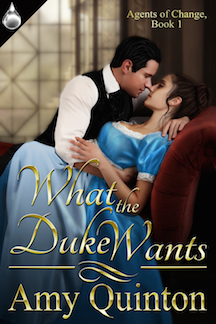
Amy Quinton: What the Duke Wants

BBT_TourBanner_WhatTheDukeWants copy

Amy Quinton will be awarding a heart shaped enamel, kiln fired copper charm on a leather corded necklace (US ONLY) to a randomly drawn commenter via Rafflecopter during the tour. Prize is designed and made by Keri Sereika at Pink Lemonade (http://www.pinklemonade.typepad.com/) Click here for the Rafflecopter. Click the banner above to follow the tour and increase your chances of winning.

MediaKit_CommenterPrize copy

About What the Duke Wants

Upstanding duke desperately seeks accident-prone wife from trade…

England 1814: Miss Grace (ha!) Radclyffe is an oftentimes hilariously clumsy, 20-year-old orphan biding her time living with her uncle until she is old enough to come into her small inheritance. Much to her aunt’s chagrin, she isn’t: reserved (not with her shocking! tendency to befriend the servants), sophisticated (highly overrated), or graceful (she once flung her dinner into a duke’s face). But she is: practical and in love… maybe… perhaps… possibly…

The Duke of Stonebridge is an agent for the Crown with a tragic past. His father died mysteriously when he was 12 years old amid speculation that the old duke was ‘involved’ with another man. He must restore his family name, but on the eve of his engagement to the perfect debutante, he meets his betrothed’s cousin, and his world is turned inside out… No matter, he is always: logical (men who follow their hearts are foolish) and reserved (his private life is nobody’s business but his own). And he isn’t: impulsive or in love… maybe… perhaps… possibly…

Can he have what he wants and restore his name? Can she trust him to be the man she needs?

E-book

LS BooksAmazonBarnes & NobleKobo • Google Play • iBooks

 Print

AmazonBarnes & NobleCreateSpace

Excerpt

A knowledgeable lady understands that, typically, the best way to make a good first impression is not to fall bottom first into a puddle of mud. Alas, Grace Radclyffe, with her inclination towards unfortunate mishaps, found this knowledge to be generally useless in the reality of her everyday life.

Therefore, despite the uncomfortable feeling of wetness seeping through her gown and the faint-though-nearby sound of dripping mud, she did what any sensible lady of good upbringing would do in less than ideal circumstances. She cursed. With conviction.

BookCover_WhatTheDukeWants copy“Bloody hell. Not again.”

So maybe she didn’t say that. But it was something she occasionally thought in her mind, though only in her mind.

In actuality, she chuckled lightheartedly (because it’s always best to set yourself and any potential rescuers at ease in awkward situations) and graciously procured the proffered handkerchief dangling over her left shoulder. Then, after clearing the mud from her face so she could actually see and with cheeks tinged only slightly from embarrassment (because, really, that kerchief hadn’t been dangling over her shoulder on its own), she peered up to thank her would-be rescuer and

Gasped. Out loud.

For staring down at her with one eyebrow lifted in question, were a pair of eyes—emerald green eyes to be more precise. The most deeply penetrating emerald green eyes she had ever seen in all of her near twenty-one years.

About the Author

AuthorPhoto_WhatTheDukeWants copyAmy Quinton is an author and full time mom living in Summerville, SC. She enjoys writing (and reading!) sexy, historical romances. She lives with her English husband, two boys, and two cats. In her spare time, she likes to go camping, hiking, and canoeing/kayaking… And did she mention reading? When she’s not reading, cleaning, or traveling, she likes to make jewelry, sew, knit, and crochet (Yay for Ravelry!).

Amy has lived in or around the Charleston, SC area her entire life. When she’s not home, at the beach (weather permitting), or camping in and around the Great Smoky Mountains (Check out Mile High Campground and Devils Fork State Park!), she loves to visit the United Kingdom. She loves the history, the culture, and the people—hence her love for Scottish and Regency Romances. She especially loves to visit the Isle of Skye—in the Highlands of Scotland—where the scenery is both rugged and breathtaking.

Amy graduated from the College of Charleston, a liberal arts college located in beautiful, historic Charleston, SC. She worked 10 years in the computer industry as a software designer before becoming a full time mom and now, a full time novelist.

EmailWebsiteFacebookTwitterGoogle+

PinterestTumblrAmazon Author PageGoodreadsTsu

Beaux, Ballrooms, and Battles: Jillian Chantal and Jeremiah’s Last Charge

Thanks, Susana, for allowing me to come by and share a little about my story for the Beaux, Ballrooms, and Battles anthology. When I first started thinking about what I wanted to focus on in my style, I knew I wanted a sassy, feisty heroine because they are always fun to write. Of course, when I chose such a heroine, I knew she would have to get in some kind of trouble and what better scandal than to make a spectacle of herself at Lady Richmond’s ball?

I also wanted a hero who could bring balance to the heroine’s life. Jeremiah is a strong, silent type but I think they go well together. She takes him out of his comfort zone and he reins her in. Well, no, not really. He doesn’t. Ha ha.

One of the things I’ve always found intriguing about the run up to the battle is the fact that Lady Richmond had this gala right on the eve of the engagement and Wellington was encouraging her to go forward. Of course, today, we know he was doing that so people wouldn’t panic and try to evacuate thus clogging the roads and holding up the troops. Jeremiah wonders about the Duke’s motive in allowing the ball to occur in this story. He thinks they should be readying for battle, not flirting and dancing but he’d never question his commanding officer.

About Jeremiah’s Last Charge

A chance encounter during the battle of Quatre Bras changes Captain Jeremiah Denby’s life forever. A member of Wellington’s staff, he fulfills his duties to king and country through the surrender of Boney at Waterloo but then must decide how to reconcile his new life with his old.

Emmaline Rothesay has a battle of her own to fight. To her lady mother’s dismay, Emmaline has had her eye on Captain Denby as a potential suitor. Now that his changed circumstances after Waterloo could cause a scandal, Lady Rothesay is even more set against any relationship her daughter desires with the man. Emmaline finds herself at war with her mother and maybe even the captain himself.

Amazon.com • Kobo • iBooks • Barnes & Noble

Amazon.ca • Amazon.au • Amazon.uk

Excerpt

“Napoleon is on the march. He’s outside the city. The Prince of Orange has already left—before supper even—and the rest of the men will be reporting to their units soon.”

Emmaline gasped. “Outside the city?” Her gut clenched. This was way too close. Being this near to a battle site was horrifying. Her eyes darted around the room until they found Captain Denby. She turned her gaze to the others standing beside her. “I’ll be right back.”

She strode off with Lydia behind her asking, “Where are you going?”

Not responding to her friend, Emmaline made a beeline toward where Jeremiah stood with two other officers in the same regimental uniform as he. Once she reached him, she touched the sleeve of his coat. “May I speak to you for a moment?”

“I’m sorry, Miss Rothesay, I’m on my way out.”

“It’ll just take a second.”

He turned to his companions. “Excuse me.”

Leaving Lydia behind, Emmaline pulled Jeremiah to one side and once they stood close to the wall she pulled her lace-edged hanky from her where she’d tucked it in the end of her sleeve and tried to hand it to him.

“What’s this?” He stared at it as it hung in the air between them held up by her index finger and thumb.

“Back in the middle ages and in the time of Henry VIII, a knight asked a lady for her colors to wear into the joust. For good luck, you know. I’d like you to wear mine in the battle ahead.”

“Do you think it proper? We hardly know one another.”

“Proper or not, I’m offering this to you as a token of good will and my hope that you will survive the next days. Surely you won’t turn me down?” Tears welled in her eyes, blurring her vision. Had she misunderstood the way he’d looked at her? Did he hold her in no regard at all?

Jeremiah’s face turned red. Emmaline couldn’t tell if it was from embarrassment or anger. A little intimidated, she took a half step back and almost collided with one of Lady Richmond’s friends.

AuthorPicAbout the Author

Jillian Chantal is multi-published in the romance genre. She’s a lawyer by day and writer, amateur photographer and history buff by night. Jillian lives on the beautiful gulf coast of Florida and loves her little slice of paradise. But not too much to enjoy world-wide travel every chance she gets. After all, a writer and photographer needs new and exciting places to go and capture in order to stay fresh, right? And there’s nothing quite like seeing historical places in person, is there?

Jillian loves to hear from readers.

 WebsiteFacebook Twitter

Her books are available at

AmazonBarnes & NobleAllRomance eBooks 

Beaux, Ballrooms, and Battles:

A Celebration of Waterloo

waterloo_cover_best web

June 18, 1815 was the day Napoleon Bonaparte’s Grande Armée was definitively routed by the ragtag band of soldiers from the Duke of Wellington’s Allied Army in a little Belgian town called Waterloo. The cost in men’s lives was high—22,000 dead or wounded for the Allied Army and 24,000 for the French. But the war with Napoleon that had dragged on for a dozen years was over for good, and the British people once more felt secure on their island shores.

The bicentenary of the famous battle seemed like an excellent opportunity to use that setting for a story, and before we knew it, we had nine authors eager to join in, and on April 1, 2015 our Waterloo-themed anthology was released to the world.

You are all invited to

Our Stories

Jillian Chantal: Jeremiah’s Charge

Emmaline Rothesay has her eye on Jeremiah Denby as a potential suitor. When Captain Denby experiences a life-altering incident during the course of events surrounding the Battle of Waterloo, it throws a damper on Emmaline’s plans.

Téa Cooper: The Caper Merchant

The moon in Gemini is a fertile field of dreams, ideas and adventure and Pandora Wellingham is more than ready to spread her wings. When Monsieur Cagneaux, caper merchant to the rich and famous, introduces her to the handsome dragoon she believes her stars have aligned.

Susana Ellis: Lost and Found Lady

Catalina and Rupert fell in love in Spain in the aftermath of a battle, only to be separated by circumstances. Years later, they find each other again, just as another battle is brewing, but is it too late?

Aileen Fish: Captain Lumley’s Angel

Charged with the duty of keeping his friend’s widow safe, Captain Sam Lumley watches over Ellen Staverton as she recovers from her loss, growing fonder of her as each month passes. When Ellen takes a position as a companion, Sam must confront his feelings before she’s completely gone from his life.

Victoria Hinshaw: Folie Bleue

On the night of the 30th Anniversary of the Battle of Waterloo, Aimée, Lady Prescott, reminisces about meeting her husband in Bruxelles on the eve of the fighting. She had avoided the dashing scarlet-clad British officers, but she could not resist the tempting smile and spellbinding charm of Captain Robert Prescott of the 16th Light Dragoons who— dangerously to Aimée— wore blue.

Heather King: Copenhagen’s Last Charge

When Meg Lacy finds herself riding through the streets of Brussels only hours after the Battle of Waterloo, romance is the last thing on her mind, especially with surly Lieutenant James Cooper. However, their bickering uncovers a strange empathy – until, that is, the lieutenant makes a grave error of judgment that jeopardizes their budding friendship…

Christa Paige: One Last Kiss

The moment Colin held Beatrice in his arms he wanted one last kiss to take with him into battle and an uncertain future. Despite the threat of a soldier’s death, he must survive, for he promises to return to her because one kiss from Beatrice would never be enough.

Sophia Strathmore: A Soldier Lay Dying

Amelia and Anne Evans find themselves orphaned when their father, General Evans, dies. With no other options available, Amelia accepts the deathbed proposal of Oliver Brighton, Earl of Montford, a long time family friend. When Lord Montford recovers from his battle wounds, can the two find lasting love?

David W. Wilkin: Not a Close Run Thing at All

Years, a decade. And now, Robert had come back into her life. Shortly before battle was to bring together more than three hundred thousand soldiers. They had but moments after all those years, and now, would they have any more after?

Amazon • Barnes & Noble • Kobo • iBooks

Beaux, Ballrooms, and Battles: Heather King and Copenhagen’s Last Charge

Copenhagen. The very name of the Danish capital conjures exotic images of a bustling, modern city with an infamous red light district; a centuries-old port, evolved from a fortification built in 1167 to protect a ferry crossing; battles on the high seas and an international political centre.

It was also the name of a horse.

That horse was not just any old horse, though. He was the famed mount of a revered general. He was the war horse of no less a personage than the Duke of Wellington and carried his master throughout the whole of the Battle of Waterloo.

Copenhagen’s story begins at the siege of the city which gave him his name. His dam was the half-bred mare, Lady Catherine, bred by Thomas Grosvenor and, it is believed, ridden by him during that conflict. Lady Catherine’s dam was by the Rutland Arabian, ‘out of a hunting mare not thorough-bred’ according to The General Stud Book and was put to the successful racehorse and stallion, John Bull. This meant that although John Bull was full Thoroughbred and Copenhagen was sired by Meteor, second in the Derby of 1786 and son of the legendary Eclipse, Copenhagen was not eligible for the General Stud Book because of his grand-dam’s hunter blood. Lady Catherine is the only half-bred mare included in the stud book ‒ in deference to his honourable military career.

Meteor was tiny by today’s standards, measuring about fourteen hands, but Copenhagen took after his grandsire in colour, height and temperament. Foaled in 1808, he was chestnut (as was his father), stood about fifteen hands high (a hand is four inches, a horse being measured to the base of the neck where it joins the body) and could be bad-tempered, being prone to lashing out with a hind leg. He is described as being muscular and compact, having two white heels, a hollow back and poor shoulders… and, conversely, as being a handsome horse. He was painted by Thomas Lawrence and Samuel Spode as a rich, dark chestnut, but with dissimilar white leg markings. In the Spode painting, he has one white sock on his near (left) hind leg. There are no obvious white markings on his legs in the Lawrence depiction and in a painting of the pair at Waterloo by Robert Hillingford, he would appear to have four white socks. We shall never know, now, which is the most accurate, but one thing is certain. The stallion had a quality which drew the eye and fired the imagination.

In all three paintings, he is a striking individual, his proud bearing, fine legs and sturdy conformation clearly reflecting his Arabian bloodlines. The qualities of the ‘Oriental’ horse were appreciated by the knowledgeable cavalry soldier, for on campaign, horses may receive little in the way of fodder while enduring the harshest of conditions. Toughness was a prime requisite. Wellington is quoted as saying of his famous horse: ‘There may have been many faster horses, no doubt many handsomer, but for bottom and endurance I never saw his fellow.’ Such stamina is the hallmark, not only of the Thoroughbred, but of the three Arab stallions from whom the breed evolved.

However, the Duke of Wellington and his illustrious horse had yet to meet. Despite his lack of a full pedigree, Thomas Grosvenor had bred Copenhagen to race, but although a quick colt, he had not inherited either Meteor’s or Eclipse’s speed. He did not run as a two-year-old and his two seasons were undistinguished at best, resulting in only two wins. He retired from racing in 1812, at the end of his four-year-old season and was sold to Sir Charles Stewart, (later the Marquis of Londonderry) who took the stallion to the Peninsula.

Not a favourite of the future Duke of Wellington, Sir Charles fell foul of the Field Marshal on several occasions, finally, so the story goes, being reduced to tears for remarks made in the Morning Chronicle. Soon after, Stewart was offered a post as Minister to Prussia – possibly through the good offices of his half-brother and Foreign Secretary, Lord Castlereagh. However that may be, towards the end of 1813, Sir Charles, being short of funds and no longer in need of a stable of horses, sold Copenhagen and one other to Colonel Charles Wood (or Colonel Alexander Gordon) on behalf of one Arthur Wellesley.

When Copenhagen arrived in the Marquis’ stables (Wellington was not made a duke until 1814) he caused no small amount of concern. Not only was his temperament uncertain, he had a particularly unusual idiosyncrasy. All horses will lie down in their stable, given that the bed is deep enough and they are comfortable in their surroundings. However, they eat standing up; hay from a hay rack or net, feed from a manger or bucket. Copenhagen had a hearty appetite, for corn feed especially, but he would eat it whilst lying down. Until they determined that there was nothing wrong with their expensive new charge, he no doubt gave the Marquis’ grooms many a sleepless night!

A true horseman, Wellington quickly realized that his chestnut charger needed plenty of occupation. He already maintained his own pack of hounds as well as a pair of hunters for his leisure hours in the Peninsula, since his battle horses were not suitable for the sport. Copenhagen, on the other hand, revelled in the work and the freedom from his stable. The discipline of standing quietly and then galloping when hounds set off developed the five-year-old’s fitness and hardened his legs and tendons. Days in the field developed a relationship between horse and rider which was to be indispensable. The two seasons Copenhagen had spent on the race courses of England had accustomed him to noise and clamour. The pieces of the jigsaw were fitting together to create a legend; a horse whose name would go down in history.

In her diary, Lady Frances Shelley states that: ‘On the day before the battle, the Duke rode Copenhagen to the Prussian headquarters, to ascertain whether he might depend on old Blücher’s co-operation.’ This belief is also reflected by the Reverend Charles Young, who was staying with the Rt. Hon. Henry Pierrepoint in 1833 when the Duke himself apparently related the tale. The Duke is reported to have said, ‘Before ten o’clock I got on Copenhagen’s back… I never drew bit, and he never had a morsel in his mouth, till 8pm, when Fitzroy Somerset came to tell me dinner was ready in the little neighbouring village – Waterloo.’ He went on to claim that he sent Fitzroy Somerset off on an errand, ‘ordered Copenhagen to be re-saddled’ and himself rode out some fourteen miles and back to confirm how matters stood. Some modern historians believe this tale to be a fabrication and that an aide-de-camp made the journey and returned with the message promising assistance from the Prussians. It is a more likely version of events, but if not… the possibility of having carried his master another twenty-eight miles on top of his day’s work and then be ridden the following day during the battle itself, adds to Copenhagen’s considerable lustre and reputation for bottomless endurance.

What is irrefutable fact, however, is that while Napoleon rode probably three or four horses during the battle and covered considerably less ground, the cranky chestnut stallion was Wellington’s sole mount for the whole of that long, momentous day – a stretch of almost eighteen hours. Calm and composed amidst the smoke and mayhem of the battlefield, the very sight of the powerful horse and his rider cheered the Allied forces into greater endeavours and helped them stand firm when the odds were against them. It is little wonder that the illustrious pair were fêted by all and sundry when they finally arrived home victorious.

In due course, the Duke moved to Paris and thence to Chambrai in his role as Commander-in-Chief of the Army of Occupation, taking Copenhagen with him. He rented a house in Mont St. Martin and took his old friend hunting when his duties permitted. Wellington held house parties, mock battles and military ceremonials, and both man and horse enjoyed the attentions of the ladies, both English and French.

This continued when the army at last returned to England, the Duke acquiring Apsley House from his brother. Wellington kept and rode Copenhagen in London until he became too busy, when he sent him to his Hampshire home, Stratfield Saye.

Copenhagen enjoyed a peaceful retirement and was finally laid to rest with full military honours in his paddock near the Ice House. Mrs. Apostles, the Duke’s housekeeper, planted the Turkey Oak which now casts shade over the stallion’s grave. The marble stone was laid some years following the Duke’s death, by the second Duke.

I will be telling Copenhagen’s story in more detail on my Blog A Regency Reticule, later in the year. http://regencywriter-hking.blogspot.co.uk

waterloo_cover_best web

June 18, 1815 was the day Napoleon Bonaparte’s Grande Armée was definitively routed by the ragtag band of soldiers from the Duke of Wellington’s Allied Army in a little Belgian town called Waterloo. The cost in men’s lives was high—22,000 dead or wounded for the Allied Army and 24,000 for the French. But the war with Napoleon that had dragged on for a dozen years was over for good, and the British people once more felt secure on their island shores.

The bicentenary of the famous battle seemed like an excellent opportunity to use that setting for a story, and before we knew it, we had nine authors eager to join in, and on April 1, 2015 our Waterloo-themed anthology was released to the world.

You are all invited to

About Copenhagen’s Last Charge

When Meg Lacy meets a broodingly handsome Light Dragoon at the Duchess of Richmond’s grand ball, she little expects that in the early hours of June 19th she will be accompanying him around the streets of Brussels after the Duke of Wellington’s horse, Copenhagen.

Lieutenant James Cooper is surly and unhelpful, but Meg senses the Dragoon will need her help to catch the valuable horse before he injures himself. As they bicker their way around the narrow streets in Copenhagen’s wake, a strange empathy develops as gradually glimpses of the man beneath start to be revealed. Meg finds herself drawn to that person, but when they finally return the horse to the Duke and Cooper assumes the credit, Meg is so incensed she vows to have nothing further to do with him.

Fate, it seems, has other ideas…

Amazon.com • Kobo • iBooks • Barnes & Noble

Amazon.ca • Amazon.au • Amazon.uk

Excerpt

Something was about to unfold, Meg thought, barely suppressing a shiver of apprehension. All these handsome, jolly young men were dancing, drinking and enjoying themselves with a new fervour which was almost a desperation… She must make sure to tell Papa how much she loved him.

“Georgy, my dear. Why are you not dancing?” Wellington, spotting them, had come forward, a charming smile curving his lean lips. In an aside over his shoulder, he said to Richmond, “If you could lay hands on that map, I should be obliged.”

“Oh, your Grace, please allow me to present to you my good friend, Miss Margaret Lacy.”

Heart pounding, Meg sank into a deep curtsey, but was both surprised and reassured to perceive a twinkle in the Duke’s eye when he helped her to rise and then carried her hand to his lips. She felt the burn of his swift appraisal bloom in her cheeks.

“I am charmed, Miss Lacy. Would you be related to Major-General Sir Vincent Lacy?”

“He is my father, sir.”

“Ah. A fine officer and a gentleman.”

Meg dipped her head. “Thank you, your Grace.”

Wellington wagged his finger jovially. “No need for ceremony, my dear young lady. I have every respect for your father. He is also a consummate horseman.”

Georgy took Meg’s arm, infinitesimally drawing her closer to the Duke.

“Meg – Miss Lacy – has inherited her papa’s skill, sir. She has a high regard for Copenhagen. Might we be allowed to visit him in the stables?”

One of the family’s black-liveried footmen appeared at the Duke’s elbow and bowed, presenting a piece of folded paper on a silver salver.

“Excuse me, ladies.” Wellington took the missive and glanced at its contents. “And risk dirtying your pretty gowns? I shall not hear of it.” He nodded to the man. “Have someone send to the stables. I wish my horse brought up at once.”

The Field Marshal was a particularly imposing gentleman, Meg decided, considering him from the corner of her eye while he paused to comment in the ear of one of his aides. It was more than just his proud bearing and handsome features; he possessed an air of invincibility and self-belief which to some probably appeared to be arrogance. To her, it was more the attitude of a man – a general – who knew what he had to do and was determined to do it. If anyone could stop Napoleon Bonaparte, then surely it was he.

They paused at the top of the steps at the main entrance. Meg had noticed a considerable number of the guests slipping away; certainly the company in the ballroom had thinned. Unbidden, a thought for the brooding Hussar popped into her head and she offered a silent prayer for all those who were about to fight. The image of the dark-visaged young man lingered… and then she realized he was real.

Standing in the road at the bottom of the steps, he held Wellington’s famous war horse, Copenhagen, by the bridle. The near-thoroughbred, chestnut stallion was equally as imposing as his master. He stood just over fifteen hands at the base of his neck, but with his head held high and ears pricked in a state of readiness, he seemed far bigger. A trumpet sounded in the distance and he neighed, an ear-splitting vibration of notes that had Georgy covering her ears. Even the horse was challenging the French Emperor. Copenhagen skipped sideways, his iron-shod hoofs clattering on the cobbles. The young man, who was now clad in a navy coat with buff facings, cursed and pulled at the reins, his boots clutching ineffectively for a purchase on the uneven surface…

Our Stories

Jillian Chantal: Jeremiah’s Charge

Emmaline Rothesay has her eye on Jeremiah Denby as a potential suitor. When Captain Denby experiences a life-altering incident during the course of events surrounding the Battle of Waterloo, it throws a damper on Emmaline’s plans.

Téa Cooper: The Caper Merchant

The moon in Gemini is a fertile field of dreams, ideas and adventure and Pandora Wellingham is more than ready to spread her wings. When Monsieur Cagneaux, caper merchant to the rich and famous, introduces her to the handsome dragoon she believes her stars have aligned.

Susana Ellis: Lost and Found Lady

Catalina and Rupert fell in love in Spain in the aftermath of a battle, only to be separated by circumstances. Years later, they find each other again, just as another battle is brewing, but is it too late?

Aileen Fish: Captain Lumley’s Angel

Charged with the duty of keeping his friend’s widow safe, Captain Sam Lumley watches over Ellen Staverton as she recovers from her loss, growing fonder of her as each month passes. When Ellen takes a position as a companion, Sam must confront his feelings before she’s completely gone from his life.

Victoria Hinshaw: Folie Bleue

On the night of the 30th Anniversary of the Battle of Waterloo, Aimée, Lady Prescott, reminisces about meeting her husband in Bruxelles on the eve of the fighting. She had avoided the dashing scarlet-clad British officers, but she could not resist the tempting smile and spellbinding charm of Captain Robert Prescott of the 16th Light Dragoons who— dangerously to Aimée— wore blue.

Heather King: Copenhagen’s Last Charge

When Meg Lacy finds herself riding through the streets of Brussels only hours after the Battle of Waterloo, romance is the last thing on her mind, especially with surly Lieutenant James Cooper. However, their bickering uncovers a strange empathy – until, that is, the lieutenant makes a grave error of judgment that jeopardizes their budding friendship…

Christa Paige: One Last Kiss

The moment Colin held Beatrice in his arms he wanted one last kiss to take with him into battle and an uncertain future. Despite the threat of a soldier’s death, he must survive, for he promises to return to her because one kiss from Beatrice would never be enough.

Sophia Strathmore: A Soldier Lay Dying

Amelia and Anne Evans find themselves orphaned when their father, General Evans, dies. With no other options available, Amelia accepts the deathbed proposal of Oliver Brighton, Earl of Montford, a long time family friend. When Lord Montford recovers from his battle wounds, can the two find lasting love?

David W. Wilkin: Not a Close Run Thing at All

Years, a decade. And now, Robert had come back into her life. Shortly before battle was to bring together more than three hundred thousand soldiers. They had but moments after all those years, and now, would they have anymore after?

About the Author

Heather King newHeather has always been a dreamer, going off for hours into a make-believe world peopled by imaginary characters. From the age of about seven, when she won a third prize for a story written at school, she has enjoyed writing almost as much as reading. Devouring a book in one sitting is nothing new to her. Already keen on history, when she read her first Georgette Heyer Regency novel in her teens, she was at once hooked on the era and the genre.

Nowadays she divides her time between her animals, beta reading/critiquing for other authors, writing historical romantic fiction and short stories for magazines. Writing as Vandalia Black, she has recently released a collection of Vampire Romance short stories which includes a novella set in the English Civil War.

Website • Facebook • Goodreads

Amazon Author Page

Other Releases

An Improper Marriage

Marriage to dull ironmaster Jeremiah Knight would be awful enough, but when Eleanor Honeybourne discovers an injured man at a ball, she uncovers a web of intrigue that puts her own and her stepfather’s lives at risk. Meeting again her childhood hero, Charles Ribblesford, she is forced into a situation which could well spell her ruin, unless they can solve the mystery and unmask the villain.

 Amazon.ukAmazon.com

The Middle Of The Day

Lottie Morgan loves all things Regency, but would she like to live in the early nineteenth century, married to a baron? A strange thing happens while she is visiting Berrington Hall; she finds herself confronting George, Lord Rodney and she is a newly-wed!

 Amazon.ukAmazon.com

Writing as Vandalia Black:

Vampires Don’t Drink Coffee And Other Stories

This collection of fourteen tales brings together irresistible heroes and memorable heroines who battle against demons, muggers, lost loves, loneliness and unholy thirst to find their true loves. Tortured and honourable vampire heroes and one lady for whom the search for her mortal love has lasted centuries, will sweep you away into a paranormal world where eternal love means exactly that.

 Amazon.ukAmazon.com