The annexed print gives an accurate and interesting view of this abode of wretchedness, the Pass-Room. It was provided by a late act of Parliament, that paupers, claiming settlements in distant parts of the kingdom, should be confined for seven days previous to their being sent off to their respective parishes; and this is the room appointed by the magistracy of the city for one class of miserable females. The characters are finely varied, the general effect broad and simple, and the perspective natural and easy.
Bridewell, as early as King John, was a royal palace, formed partly out of the remains of an ancient castle, the western Arx Palatina of the city, and the residence of several of our monarchs; but in process of time became neglected: till, in 1522, Henry VIII. rebuilt it in a most magnificent manner, for the reception of the Emperor Charles V. who in that year paid him a visit: Charles was, however, lodged in Black Friars, and his suite in the new palace. A gallery of communication was thrown over Fleet-Ditch, and a passage cut through the city wall to the emperor’s apartments. Henry often lodged here, particularly in 1529, when the question of his marriage with Queen Catherine was agitated in Black Friars. It fell afterwards to decay, and was begged by the pious Prelate Ridley from Edward VI. to be converted to some charitable purpose: that of a house of correction for vagabonds of each sex and all denominations was determined on. It also answers another purpose; it is a foundation for youth who are bound apprentices to different trades under what are called Arts-Masters*; and forms part of the great plan of benevolence adopted by the amiable Edward VI. when he endowed the city hospitals, of which this is one. It is situated in Bridge-street, Black Friars, and gives the name to Bridewell precinct in the neighbourhood; the whole building forms a square, consisting of the houses of the arts-masters, who are six in number, the prisons for the men and women, the committee-room, and a chapel.
The men’s prison is a good brick building, on the western side, consisting of thirty-six sleeping-rooms, and seven other apartments. Every man has a room to himself, containing a bedstead, straw in a sacking, a blanket, and coverlet. The other rooms consist of workshops, a sick-room, which is a very comfortable apartment, and a larger, in which idle apprentices are confined separate from the other prisoners. In the working-room are junk and oakum, which the prisoners pick, and mills where they grind corn. The task-master’s apartments, and the women’s prison, which is separate from the men’s, are on this western side. The committee-room is on the south side, where a committee of the governors meet every week to examine the prisoners. There are excellent regulations to this prison: in the cellar is a bath, in which the prisoners are occasionally washed; but there is no yard for them to walk in, which is a great defect in any house of this description.
The original plan of this hospital, combined and incorporated with the hospitals of Christ and St. Thomas, was so benevolent, and of such comprehensive utility, that it is worthy to be followed, improved, and completely executed, by the wisest and best of men, in the wisest and best of times. It was to “train up the beggar’s child to virtuous industry, so that from him no more beggars should spring; to succour the aged and the diseased; to relieve the decayed housekeeper and the indigent; and to compel the wretched street-walker and the vagabond to honest labour.” Its design was, to include every class of the unfortunate, the helpless, and the depraved. To effect this, the governors were instituted, and are, as a body corporate, empowered to make* “all manner of wholesome and honest ordinances, statutes, and rules, for the good government of the poor in Bridewell.” Many very important alterations have taken place in this hospital within the last century, particularly in the years 1792 and 1793. Pennant, whose account of London was published in 1793, states the number of arts-masters at twenty; they are now reduced to six. The number of apprentices taught and maintained, he does not state; in the year 1717, they amounted to one hundred and three received within the year, and in 1718, to ninety-four. — Vide Speed. The apprentices are now reduced to thirty.
The late improvements in the buildings at Bridewell have been very great. The entrance is by a very noble front, of the Doric order; on the key-stone of the arch is a head of the illustrious founder. The apartments in this center are destined for the residence of the chamberlain of the city of London, who is also treasurer. Adjoining this building are six new houses, corresponding with the other houses in Bridge-street, the back parts of which occupy what was before a court-yard, in which resided several of the arts-masters. A new chapel, and a very noble apartment called the committee-room, complete the improvements on the eastern and principal side. On the north have been some alterations. The male prisoners are removed to a new building erected on the western side; and the arts-masters, who lived on that site, are removed to houses erected for them on the north side.
The court-room is an interesting piece of antiquity, as on its site were held courts of justice, and probably parliaments, under our early kings. At the upper end are the old arms of England; and it is wainscotted to a certain height with English oak, ornamented with carved work. This oak was formerly of that solemn colour which it attains by age, and was relieved by the carving being gilt. It must have been no small effort of ingenuity to destroy at one stroke all this venerable time-honoured grandeur: it was, however, happily achieved by daubing over with paint the fine veins and polish of the old oak, to make a very bad imitation of the pale modern wainscot; and other decorations are added in a similar taste.
On the upper part of the wall are the names, in gold letters, of benefactors to the hospital: the dates commence with 1565 and end with 1713. This is said to have been the court in which the sentence of divorce was pronounced against Catherine of Arragon, which had been concluded on in the opposite monastery of the Black Friars.
From this room is the entrance into the hall, which is a very noble one: at the upper end is a picture, by Holbein, representing Edward VI. delivering the charter of the hospital to Sir George Barnes, then lord mayor; near him are William, Earl of Pembroke, and Thomas Goodrich, Bishop of Ely. There are ten figures in the picture, besides the king, whose portrait is painted with great truth and feeling: it displays all that languor and debility which mark an approaching dissolution, and which unhappily followed so soon after, together – with that of the painter, that it has been sometimes doubted whether the picture was really painted by Holbein: his portrait, however, is introduced; it is the furthest figure in the corner on the right hand, looking over the shoulders of the persons before him.
On one side of this picture is a portrait of Charles II. sitting, and on the other that of James II. standing; they are both painted by Sir Peter Lely. Round the room are several portraits of the presidents and different benefactors, ending with that of Sir Richard Carr Glyn. The walls of this room are covered with the names of those who have been friends to the institution, written in letters of gold.
The new committee-room is finely proportioned, and in a very good style of architecture; as is the new chapel, which is divided from it by the portico, and which together occupy the whole back front of the eastern range of buildings.
The following is a list of the present officers of this hospital and Bethlem, founded by Edward VI. 1553:
President of both Hospitals, Sir Richard Carr Glyn, Bart. Alderman.
Treasurer to ditto, Richard Clark, Esq. Chamberlain of the city of London.
Chaplain at Bridewell, Rev. Henry Budd, B. A.
Physician to both, Thomas Munro, M. D.
Surgeon to ditto, Bryan Crowther, Esq.
Apothecary to ditto, Mr. John Haslam.
Clerk to ditto, Mr. John Poynder.
Steward to Bridewell, accomptant and receiver to both, Air. Bolton Hudson.
Porter to Bridewell, Richard Weaver.
Matron to ditto, Mary Rundle.
* These arts-masters were originally decayed tradesmen, and consisted of shoemakers, taylors, flax-dressers, orris and silk-weavers, &c. The apprentices used to be distinguished by a blue jacket and trowsers, and a white hat: their dress is now in the form of other people’s, distinguished only by a button bearing the head of the founder.
The annexed print gives an accurate representation of this celebrated office at the time of an examination: the characters are marked with much strength and humour, and the general effect broad and simple.
This office has the largest jurisdiction of any in the metropolis, its authority extending to every part of his majesty’s dominions, except the city of London, which is governed by its own magistrates.
Bow-street is, in a peculiar sense, the government office, besides acting as a police office in concert with the others, whose power extends only within a certain district. The police of this country has hitherto been very imperfect: the celebrated Henry Fielding was the first, who, by his abilities, contributed to the security of the public, by the detection and prevention of crimes. In August 1753, while a Bow-street magistrate, he was sent for by the Duke of Newcastle, on account of the number of street-robberies and murders committed nightly, and desired by the duke to form some plan for the detection and dispersion of the dreadful gangs of robbers by whom they were committed. Fielding wrote a plan, and offered to clear the streets of them, if he might have 600/. at his own disposal. The duke approved of his plan; and in a few days after he had received 200/. of the money, the whole gang was entirely dispersed; seven of them were in actual custody, and the rest driven, some out of town, and others out of the kingdom; and so fully had his plan succeeded, that in the entire freedom from street-robberies and murders, the winter of 1753 stands unrivalled during a course of many years. At this time the only profit arising to the magistrate was from the fees of his office: of the profits arising from these sources, however. Fielding had no very high opinion; after complaining that his maladies were much increased by his unremitted attention to his public duties, and having at that time a jaundice, a dropsy, and an asthma, he retired into the country, and from thence went to Lisbon, where he died. The following extract presents an agreeable specimen of that lively writer, still animated in all his sufferings, and it also gives a correct idea of the business of an active and upright magistrate at that time.
Fielding had been advised to try the Bath waters, but in consequence of the message from the Duke of Newcastle, and his exertions to free the metropolis from the desperate gangs of villains that infested it, his health considerably declined, and his was no longer a case in which the Bath waters are considered efficacious. The following account of himself and his office is from his Voyage to Lisbon:
“I had vanity enough to rank myself with those heroes of old times, who became voluntary sacrifices to the good of the public. But lest the reader should be too eager to catch at the word vanity, I will frankly own, that I had a stronger motive than the love of the public to push me on: I will therefore confess to him, that mv private affairs, at the beginning of the winter, had but a gloomy appearance; for I had not plundered the public or the poor of those sums which men who are always ready to plunder both of as much as they can, have been pleased to suspect me of taking; on the contrary, by composing the quarrels of porters and beggars, which I blush to say hath not been universally practised, and by refusing to take a shilling from a man who most undoubtedly would not have had another left, I had reduced an income of about 500/.* a year of the dirtiest money upon earth, to little more than 300/. an inconsiderable proportion of which remained with my clerk; and indeed if the whole had done so, as it ought, he would have been ill paid for sitting sixteen hours in the twenty-four in the most unwholesome as well as nauseous air in the universe.”
That this was the practice of Fielding, there can be no doubt: but that the conduct of some other justices was very flagrant, is equally indisputable; and the memory of the trading justices of Westminster, and Clerkenwell in particular, are handed down with abhorrence and contempt.
To Henry Fielding succeeded his brother, Sir John, who was many years an able and active magistrate.
Patrick Colquhoun, Esq. in his excellent work on the Police, exposed the defects of the system, and the necessity of a reform. It was taken into consideration by Parliament, and in 1792 an act was passed for that purpose, which established seven offices, besides Bow-street and the Marine Police; settled salaries were appointed to the magistrates, and the fees and penalties of the whole paid into the hands of a receiver, to make a fund for the paying these salaries and other incidental expences. This act of the 32d Geo. III. was amended by an act of the 37th, and by another of the 42d.
The present magistrates of Bow-street Office, 1808, are,
James Reed, Esq… £1000 per annum.
Aaron Graham, Esq.… 500
John Nares, Esq.… 500
Three clerks and eight officers.
It is impossible to make many extracts from Mr. Colquhoun’s valuable book. It is the basis of his system, that the numerous tribes of receivers in this metropolis are the great cause of the vice and immorality so widely prevalent, by the easy mode they hold out to the pilferer of disposing of what he has stolen, without his being asked any questions. There are upwards of three thousand receivers of stolen goods in the metropolis alone, and a proportionate number dispersed all over the kingdom.
Impressed with a deep sense of the utility of investigating the nature of the police system, the select committee of the House of Commons on finance turned their attention to this, among many other important objects, in the session of the year 1798; and after a laborious investigation, during which Mr. Colquhoun was many times personally examined, they made their final report; in which they recommended it to Parliament to establish funds, to be placed under the direction of the receiver-general of the police offices, and a competent number of commissioners: these funds to arise from the licensing of hawkers and pedlars, and hackney coaches, together with other licence duties proposed, fees, penalties, &c.; their payments subject to the approbation of the lords commissioners of the Treasury: the police magistrates to be empowered to make bye-laws, for the regulation of the minor objects of the police, such as relate to the controul of all coaches, carts, drivers, &c. and the removal of all annoyances, &c. subject to the approbation of the judges.
They recommended also the establishment of two additional police offices in the city of London, but not without the consent of the lord mayor, aldermen, and common council being previously obtained; and their authority to extend over the four counties of Middlesex, Kent, Essex, and Surry; and that of the other eight offices over the whole metropolis and the four counties also.
“It is proposed to appoint counsel for the crown, with moderate salaries, to conduct all criminal prosecutions.
“The keeping a register of the various lodging-houses.
“The establishment of a police gazette*, to be circulated at a low price, and furnished gratis to all persons under the superintendence of the board, who shall pay a licence duty to a certain amount.”
The two leading objects in the report are:
1st. The prevention of crimes and misdemeanours, by bringing under regulations a variety of dangerous and suspicious trades†, the uncontrouled exercise of which by persons of loose conduct, is known to contribute in a very high degree to the concealment, and by that means, to the encouragement and multiplication of crimes.
2d. To raise a moderate revenue for police purposes from the persons who shall be thus controuled, by means of licence duties and otherwise, so managed as not to become a material burden; while a confident hope is entertained, that the amount of this revenue will go a considerable length in relieving the finances of the country of the expences at present incurred for objects of police; and that in the effect of the general system a considerable saving will arise, in consequence of the expected diminution of crimes, particularly as the chief part of the expence appears to arise after the delinquents are convicted*.
As the leading feature of the report is the security of the rights of the innocent with respect to their life, property, and convenience, this will not only be effected by increasing the difficulty of perpetrating offences, through a controul over those trades by which they are facilitated and promoted; but also by adding to the risk of detection, by a more prompt and certain mode of discovery wherever crimes are committed. Thus must the idle and profligate be compelled to assist the state by resorting to habits of industry, while the more incorrigible delinquents will be intimidated and deterred from pursuing a course of turpitude and criminality, which the energy of the police will render too hazardous and unprofitable to be followed as a trade; and the regular accession of numbers to recruit and strengthen the hordes of criminal delinquents who at present infest society, will be in a great measure prevented.
Of the vigilance of the French system of police just before the Revolution, Mr. Colquhoun speaks highly. This system, which though neither necessary nor even proper to be copied as a pattern, might nevertheless furnish many useful hints, calculated to improve ours, and perfectly consistent with the existing laws; it might even extend and increase the liberty of the subject, without taking one privilege away, or interfering in the pursuits of any one class, except those employed in purposes of mischief, fraud, and criminality.
An anecdote related, on the authority of a foreign minister long resident at Paris, by Mr. C. will give a good idea of the secrecy of their system.
“A merchant of high respectability in Bourdeaux, had occasion to visit the metropolis upon commercial concerns, carrying with him bills and money to a very large amount.
“On his arrival at the gates of Paris, a genteel-looking man opened the door of his carriage, and addressed him to this effect: — ‘Sir, I have been waiting for you some time: according to my notes, you were to arrive at this hour; and your person, your carriage, and your portmanteau, exactly answering the description I hold in my hand, you will permit me to have the honour of conducting you to Monsieur de Sartine’.
“The gentleman, astonished and alarmed at this interruption, and still more so at hearing the name of the lieutenant of the police mentioned, demanded to know what M. de Sartine wanted with him; adding, at the same time, that he never had committed any offence against the laws, and that they could have no right to interrupt and detain him.
“The messenger declared himself perfectly ignorant of the cause of this detention; stating, at the same time, that when he had conducted him to M.de Sartine, he should have executed his orders, which were merely official.
“After some further explanations, the gentleman permitted the officer to conduct him to M. de Sartine, who received him with great politeness, and requesting him to be seated, to his great astonishment, described his portmanteau, and told him the exact sum in bills and specie which he had brought to Paris, where he was to lodge, his usual time of going to bed, and a number of other circumstances, which the gentleman had conceived could only be known to himself.
“M. de Sartine having thus excited attention, put this extraordinary question to him, ’Sir, are you a man of courage?’ The gentleman, still more astonished at the singularity of such an interrogatory, demanded the reason why he put such a strange question; adding, at the same time, that no man ever doubted his courage. M. de Sartine replied, ‘Sir, you are to be robbed and murdered this night! If you are a man of courage, you must go to your hotel, and retire to rest at the usual hour; but be careful that you do not fall asleep; neither will it be proper for you to look under your bed, or into any of the closets which are in your bedchamber: you must place your portmanteau in its usual situation near your bed, and discover no suspicion: — leave what remains to me.If, however, you do not feel your courage sufficient to bear you out, I will procurea person who shall personate you, and go to bed in your stead.’
“The gentleman being convinced, in the course of the conversation, that M. de Sartine’s intelligence was accurate in every particular, refused to be personated, and formed an immediate resolution literally to follow the directions he had received. He accordingly went to bed at his usual hour, which was eleven o’clock: at half past twelve (the time mentioned by M. de Sartine), the door of the bedchamber was burst open, and three men entered with a dark lantern, daggers, and pistols. The gentleman, who was awake, perceived one of them to be his own servant. They rifled his portmanteau undisturbed, and settled the plan of putting him to death. The gentleman, hearing all this, and not knowing by what means he was to be rescued, it may naturally be supposed was under great perturbation of mind during this awful interval; but at the moment the villains were prepared to commit the murder, four police officers, acting under M. de Sartine’s orders, who were concealed under the bed and in the closet, rushed out and seized the offenders with the property in their possession, and in the act of preparing to complete their plan.”
* “A predecessor of mine used to boast, that he made 1000/. a year in his office; but how he did it, is to me a secret. His clerk, now mine, told me I had had more business than he had ever known there; I am sure I had as much as any man could do. The truth is, that the fees are so very low, when any are due, and so much is done for nothing, that if a single justice of the peace had business enough to employ twenty clerks, neither he nor they would get much by their labour. The public will not therefore, I hope, think I betray a secret when I inform them, that I received from government a yearly pension out of the public service money; which I believe indeed would have been larger, had my great patron been convinced of an error which I have heard him utter more than once: — that he could not indeed say that the acting as a principal justice in Westminster was on all accounts very desirable, but that all the world knew it was a very lucrative office. Now to have shewn him plainly, that a man must be a rogue to make a very little this way, and that he could not make much by being as great a rogue as he could be, would have required more confidence than I believe he had in me, and more of his conversation than he chose to allow me; I therefore resigned the office, and the farther execution of my plan,to my brother.”
* This paper is called The Public Hue and Cri /, a police gazette, published every third Saturday in the month, at No. 240, Strand, and sent to the principal magistrates gratis.
† The trades alluded to are the following:
1. Wholesale and retail dealers in naval stores, hand-stuff, and rags.
2. Dealers in old iron and other metals.
3. Dealers in second-hand wearing apparel, stationary and itinerant.
4. Founders and others using crucibles.
5. Persons using draught and truck carts for conveying stores, rags, and metals.
6. Persons licensed to slaughter horses.
7. Persons keeping livery stables and letting horses for hire.
8. Auctioneers who hold periodical or diurnal sales.
The new revenues are estimated to yield 64,000/. The increase of the existing revenues is stated at 19,467/. Total, 83,467/.
* The amount of the general expence of the criminal police of the kingdom, is stated by the committee as follows:
1st. The annual average of the total expence of the seven public offices in the metropolis, from the institution in August 1792, to the end of the year 1797 . £ 18,281 18 6
2d. Total expence of the office in Bow-street in the year 1797, including remunerations to the magistrates in lieu of fees, perquisites, &c. and the expence of a patrol of sixty-eight persons 7,901 7 7
Total for the metropolis 26,183 6 1
The other expences incurred for the prosecution and conviction of felons, the maintenance, clothing, employment, and transportation of convicts, to which may be added the farther sums annually charged on the county rates, amounted in 1797 to 215,869 13 10|
The annexed print represents the greatest public exhibition made by this noble charity, on St. Matthew’s day, September 21st.
Two orations are annually pronounced in praise of this institution, one in Latin and the other in English, by two of the senior boys, called Grecians, who receive a superior education, being designed to complete their studies at the universities, one of them being sent annually to Cambridge, and every three years one is sent to Oxford. The orations are delivered in the presence of the governors and their friends, and the masters of the various schools, &c. in the great hall, a very noble apartment; the scene is truly impressive and solemn. The artists have exerted great ability and judgment in the disposition of such a numerous assemblage of people, in the distribution of the light and shade, and the truth of the perspective. The sketch of the very large picture in the hall adds to the interest.
In the year 1224, eighth Henry III. nine friars of the order of St. Francis arrived at Dover; five of them remained at Canterbury, the other four came to London, where they had so much influence on the piety or the superstition of the people, that in the following year John Ewin, mercer, purchased for them a piece of waste land within Newgate, on which, in about twenty years, rose the house and church of the Grey Friars; The church was one of the most superb of the conventual kind, and was erected by the contributions of the opulent devout. Margaret, second queen to Edward I. in 1306, began the choir, giving in her lifetime 2000 marks, and 100 marks by her testament. Isabella, queen to Edward II. gave 70/. and queen Philippa, wife to Edward III. 62/. towards the building. John de Britagne built the body of the church at a vast expense: Gilbert de Clare, Earl of Gloucester, gave twenty great beams out of his forest at Tunbridge. No order of monks seem to have had powers of persuasion equal to these poor friars: they raised vast sums for their buildings among the rich; and there were few of their admirers, when they came to die, who did not console themselves with the thoughts of lying within their expiating walls, and if they were particularly wicked, thought themselves secure from the assault of the devil, if their corpse was wrapped in the habit and cowl of a friar. Multitudes, therefore, of all ranks were crowded in this holy ground: it boasts of receiving four queens, Margaret and Isabella above-mentioned; Joan, daughter to Edward II. and wife of Edward Bruce, king of Scotland; and to make the fourth, Isabella, wife to William Warren, titular King of Man, is named. Of these, Isabella, whom Gray so strongly stigmatizes
“She-wolf of France, with unrelenting fangs,
That tear’st the bowels of thy mangled mate,”
I hope was wrapped in the friar’s garment, for few stood more in need of a daemonifuge. With wonderful hypocrisy, she was buried with the heart of her murdered husband on her breast.
John, Due de Bourbon, one of the noble prisoners taken at the battle of Agincourt, after eighteen years imprisonment, in 1443 here found a tomb.
In the same ground lies Thomas Burdett, Esq. ancestor of the present Sir Francis Burdett. He had a white buck, which he was particularly fond of: this the king, Edivard IV. happened to kill. Burdett, in anger, wished the horns in the person’s body who advised the king to it: for this he was tried, as wishing evil to his sovereign, and for this only, lost his head.
To the regret of the lovers of antiquity, all these ancient monuments and gravestones were sold, in 1545, by Sir Martin Bowes, lord mayor, for about 501.
The library founded here in 1429, by the munificent Whittington, must not be forgotten: it was 129 feet long, 31 broad. In three years it was filled with books to the value of 5561. of which Sir Richard contributed 400/. and Dr. Thomas Winchelsey, a friar, supplied the rest. This was about thirty years before the invention of printing.
On the dissolution, this fine church, after being spoiled of its ornaments for the king’s use, was made a storehouse for French prizes, and the monuments either sold or mutilated.
Henry, just before his death, touched with remorse, granted the convent and church to the city, and caused the church to be opened for divine service.
The building belonging to the friars was by Edward VI. applied to this useful charity. That amiable young prince did not require to be stimulated to good actions; but it is certain, that, after a sermon of exhortation by Ridley, bishop of London, he founded the three great hospitals in this city, judiciously adapted to provide for the necessities of the poor, divided into three classes:
Christ-Church Hospital for the orphan, St. Thomas’s Hospital for the diseased, and Bridewell for the thriftless. After the sermon, Edward ordered the good bishop to attend him. The account of this interview is very interesting, and as Stow relates it as a matter of fact from the word of the bishop, I shall extract a part of it verbatim.
“As soon as the sermon was ended, the king willing him not depart until that he had spoken to him, and this that I now write was the very report of the said Bishop Ridley, who, according to the king’s command, gave his attendance; and so soon as the king’s majesty was at leisure, he called for him to come unto him in a great gallery at Westminster; where, to his knowledge, and the king told him so, there was present no more persons but they two, and therefore made him sit down in one chair, and he himself in another, which, as it seemed, were before the bishop purposely set, and caused the bishop, maugre his teeth, to be covered, and then entered communication with him in this manner:
“First giving him hearty thanks for his sermon and good exhortation for the relief of the poor, ‘But, my lord,’ quoth he, ‘you willed such as are in authorityto be careful thereof, and to devise some good order for their relief, wherein I thinkyou mean me, for I am the first that must make answer to God for my negligence, if I should not be careful therein, knowing it to be the express command of Almighty God to have compassion of his poor and needy members, for whom we must make account unto him. And truly, my lord, I am before all things else most toil ling to travail that way; and I, doubting nothing of your long and approved wisdom and learning, who having such good zeal as wisheth help unto them, but also that you have had some conference with others what ways are best to be taken therein, the which I am desirous to understand, and therefore I pray you to say your mind.’
“The bishop was so amazed and astonished at the goodness and earnest zeal of the king, that he could not tell what to say: but, after some pause, advised him to begin with the city of London; and requested the king to direct his gracious letters to the lord mayor, to consult with such assistants as he thought fit on what might best be done, the bishop promising to assist them in their deliberations.
“To this the king agreed, but made the bishop wait till the letter was written, which having signed and sealed, he gave it to the bishop, desiring him to make all convenient speed, and to let him know the result as early as possible. The bishop the same night delivered the king’s letter to the then mayor. Sir Richard Dobbs, Knight; who the next day sent for two aldermen and six commoners, which were afterwards increased to twenty-four, who, with the good bishop, after various consultations, composed a book on the state of the poor in London.
“This book was presented to the king, who immediately founded the three royal hospitals. For the maintenance of Christ’s Hospital, he gave some lands of the value of 600/. per annum, which had been given to the Savoy, a house founded by Henry VII. for the lodging of pilgrims and strangers, but had declined from its original intention, and had become the resort of vagabonds, who strolled about the fields all day, and were harboured there at night. And for a further relief, a petition being presented to the king for a licence to take in mortmain lands to a certain yearly value, he ordered the patent to be brought to him, and with his own hand filled the blank space with 4000 marks by the year; and then said, in the hearing of his council, ‘Lord, Iyield thee most hearty thanks, that thou hast given me life thus long to finish this work to the glory of thy name.”
In two days after this excellent youth expired, in the sixteenth year of his age and the seventh of his reign, not without suspicion of his end being hastened by the ambitious Northumberland.
“All the English historians dwell with pleasure on the excellent qualities of this young prince. The flattering promises of hope, joined to many real virtues, made him an object of tender affection to the public: he possessed mildness of disposition, application to study and business, a capacity to learn and judge, and an attachment to equity and justice.” — Hume.
Christ’s Hospital, Bridewell, and St. Thomas the Apostle in Southwark, are incorporated by the name of, “The Mayor, Commonalty, and Citizens of the Cityof London, Governors of the Possessions, Revenues, and Goods of the Hospitals of Edward VI. King of England.”
It was not till the year 1552, five years after the king’s grant, that the house of the Grey Friars was fitted up for the reception of the children: they completed it in the same year, and called it Christ’s Hospital; and in September, they took in near four hundred orphans, and clothed them in russet; but ever after they wore blue cloth coats, their present habit, which consists of a blue cloth coat, close to the body, having petticoat skirts to the ankle, yellow under-petticoat, yellow stockings, and a flat round worsted cap: their shoes are tied with strings, from the quantity of which the various classes are distinguishable. In addition to this catalogue of their dress, they have of late years added a pair of breeches made of ticken, for which indulgence the boys gave up their meat suppers, to which they were before entitled, and have bread and cheese instead. Their fare is plain and wholesome, and they sleep in wards kept in a very clean state. There are at present about one thousand boys on this establishment, distributed into thirteen wards. The governors have established a school at Hertford, to which they send the youngest of the children, generally to the number of three hundred, who are taken into the house as room is made by apprenticing off the elder. It is between thirty and forty years since the girls were removed from London to be wholly educated at Hertford: all the girls are educated at this school.
At the instigation of Sir Robert Clayton, lord mayor, who was a great benefactor, Charles II. founded the mathematical school, to which he granted 7000/. to be paid out of a certain fund at 500/. per annum, for the educating forty boys for the sea: of these boys, ten are yearly put out apprentices to merchant vessels, and in their places ten more received.
Another mathematical school, for thirty-seven other boys, was afterwards founded by Mr. Travers; but these boys are not obliged to go to sea. Many able mathematicians and seamen have sprung from these institutions.
The hospital being nearly destroyed by the fire of London, the greater part was rebuilt under the direction of Sir Christopher Wren. The* writing school was founded in 1694, by Sir John Moor, alderman, who is honoured with a statue in front of the building. It is altogether a very extensive building, consisting of many irregular parts; the south front, adjoining Newgate-street, is perhaps the best. The cloisters, the only remains of the conventual house, serve for a thoroughfare, and for a place for the boys to play in. The great hall, a spacious and noble room, was built, after the fire of London, at the sole charge of Sir Joshua Frederic, alderman of London, and cost him 5000/.:
it is 130 feet long, 34 wide, and 44 in height. In this hall is an extraordinary large picture, by Verrio, of King James II. amidst his courtiers, receiving the president of this hospital, several of the governors, and numbers of the children, all kneeling: one of the governors with a grey head, and some of the children, are admirably painted. The history of this picture is curious: it was intended to have represented Charles II. who founded the mathematical school; but he dying while the picture was in hand, James, who never did any thing for the charity, had his own portrait introduced, together with that of the execrable Jefferies, then lord chancellor: Verrio has introduced his own portrait in a long wig. The founder is represented in another picture giving the charter to the governors, who are in their red gowns kneeling; the boys and girls are ranged in two rows: a bishop, probably Ridley*, is in the picture. If this was the work of Holbein, it has certainly been much injured by repair. There is also a fine picture of Charles II. in his robes, with a great flowing black wig: at a distance is a sea view, with shipping; and about him a globe, sphere, telescope, &c.: it was painted by Sir Peter Lely, in 1662.
In this hall the children are daily assembled to their meals: prayers are read by one of the senior boys, and hymns are sung by the children, for which purpose it is furnished with a pulpit; and an organ is played during the time of supper. These public suppers commence the first Sunday after Christmas, and end on Easter Sunday: the time of supping is from six o’clock till half past seven.
The following order has been recently hung up near the entrance of the hall:
Public Suppers
“Ordered, That no person be admitted within the great hall unless introduced by a governor.”
But the grand anniversary held in this hall is on St. Matthew’s day, an account of which accompanies the print.
In the court-room is a three-quarters length of Edward VI. a most beautiful portrait, and indisputably by Holbein.
In this room are also the portraits of two great benefactors to this hospital, and persons of the most enlarged and general benevolence. Sir Wolstan Dixie, lord mayor of London 1585, and Dame Mary Ramsay, wife of Sir Thomas Ramsay, lord mayor 1557.
In a room entirely lined with stone, are kept the records, deeds, and other writings of the hospital. One of the books is a curious piece of antiquity; it is the earliest record of the hospital, and contains the anthem sung by the first children, very beautifully illuminated.
The writing school is a handsome modern building of brick, supported by pillars, forming a spacious covered walk.
The grammar school is a plain brick building, more recently erected.
The permanent revenues of Christ’s Hospital are great, from royal and private donations in houses and lands; but without voluntary subscriptions they are inadequate to the present establishment.
By the grant of the city, the governors license the carts allowed to ply in the city, to the number of two hundred and forty, who pay a small sum for this privilege. They also receive a duty of about three farthings upon every piece of cloth brought to Blackwell Hall, granted by acts of common council.
The expenditure of this hospital is immense, being at present about 30,000/. per annum.
The governors, who choose their own officers and servants, are unlimited in their number. A donation of 400/. makes a governor: formerly the sum was less, but the office of governor being one of great trust, and of serious importance in its effect to the public, an enlargement of the sum was wisely adopted.
The governors of Christ’s Hospital have been made trustees to several other extensive charities by their founders. Among these charities, there is one of 10/. each, for life, to four hundred blind men. This ought to be known, because these funds have been often confounded with those of Christ’s Hospital, which they do not in the least augment, the governors not being at liberty to apply such funds to any of the uses of the hospital.
The greater part of the buildings belonging to this noble institution being through age in a state of irreparable decay, the governors have lately resolved to rebuild the whole upon a plan of uniformity and magnificence.
The present officers of Christ’s Hospital are,
President, Sir John William Anderson, Bart. Alderman.
Treasurer, James Palmer, Esq.
Physician, Richard Budd, M. D.
Surgeon, Thomas Ramsden, Esq.
Apothecary, Mr. Henry Field.
Chief clerk, Richard Corp, Esq.
Receiver, Mr. Thomas Whilby.
Assistant clerks, Mr. Matthew Cotton and Mr. James White.
Grammar master, Rev. Arthur William Trollop, M. A.
Under grammar master, Rev. L. P. Stephens, M. A.
Master of the reading school, Ralph Peacock, M. A.
Master of the mathematics, Mr. Lawrence Gwynne.
Master of the mathematics on Mr. Travers’s foundation, Rev. Thomas Edwards, M. A.
Writing masters, Mr. J. Allen and Mr. T. Goddard.
Drawing master, Mr. John Wells*.
Music master, Mr. Robert Hudson.
Steward, Mr. Matthew Hathaway.
AT HERTFORD.
Grammar master and catechist. Rev. F. W. Franklin, M. A.
Steward and upper writing master, Mr. Benjamin Flude.
Second writing master, Mr. Henry Rix Whittel.
Surgeon and apothecary, Mr. Colbeck.
Matron, Mrs. Royd.
Girls’ schoolmistress, Mrs. Ann Sparrow,
Second ditto. Miss Eliza Payne.
On the admission of a governor, the following serious and impressive charge is solemnly given him, in the presence of the president, or treasurer, and other governors assembled in court:
“Worshipful!
“The cause of your repair hither at this present is, to give you knowledge, that you are elected and appointed by the lord mayor and court of aldermen, to the office, charge, and governance of Christ’s Hospital.
“And, therefore, this is to require you and every of you, that you endeavour yourselves, with all your wisdom and power, faithfully and diligently to serve in this vocation and calling, which is an office of high trust and worship: for ye are called to be the faithful distributors and disposers of the goods of Almighty God to his poor and needy members; in the which office and calling if ye shall be found negligent and unfaithful, ye shall not only declare yourselves to be the most unthankful and unworthy servants of Almighty God, being put in trust to see the relief and succour of his poor and needy flock; but also ye shall shew yourselves to be very notable and great enemies to that work, which most highly doth advance and beautify the commonwealth of this realm, and chiefly of the city of London.
“These, therefore, are to require you, and every of you, that ye here promise, before God and this assembly of your fellow-governors, faithfully to travail in this your office and calling, that this work may have his perfection, and that the needy number committed to your charge be diligently and wholesomely provided for, as you will answer before God at the hour and time when you and we shall stand before him, to render an account of our doings. And this promising to do, you shall be now admitted into this company and fellowship.”
* So dreadful is the rage of religious persecution, that even this benevolent and virtuous prelate could not escape its fury: he was burnt for heresy at Oxford, together with J^atimer, bishop of Worcester, by order of Mary, 1555.
* About the year 1721, a drawing master was added to the establishment: Mr. Bernard Lens was the first; to him succeeded the late Mr. Green; the present gentleman is the third who has held the office.
The print annexed is a spirited representation of that interesting scene, a public auction. The various effect which the lot (a Venus) has on the company, is delineated with great ability and humour. The auctioneer, animated with his subject, seems to be rapidly pouring forth such a torrent of eloquence as cannot fail to operate on the feelings of his auditors; indeed, having two of their senses enlisted in his favour, there seems to be little doubt that he will succeed. The eloquence of the rostrum is of a peculiar nature, Foote, who delineated every object that he chose with an astonishing truth and felicity, has, in his Minor, drawn an auctioneer with so much whim and drollery, and which, if a little outré, possesses so many striking characteristics, that it may serve for a portrait of the whole. Our animated auctioneer, adorning his Venus with all the flowers of rhetoric, seems to be saying, with Smirke in the Minor, “A-going for five and forty, — no body more than five and forty? — Pray, ladies and gentlemen, look at this piece! — quite flesh and blood, and only wants a touch from the torch of Prometheus, to start from the canvass and fall a-bidding!” And these flowers are not scattered in vain; (‘for,” continues Smirke, “a general plaudit ensued, — I bowed, and in three minutes knocked it down at sixty-three — ten”
The tout-ensemble of this print is marked with propriety and interest. The great variety of character, the masses of light and shade judiciously opposed to each other, the truth of the perspective, and the felicity of touch which the artist has adopted to give the idea of old pictures in the back ground, hwe the happiest effect imaginable.
That in the rage for purchasing old pictures the craft of experienced dealers should frequently impose upon those who might think it necessary to appear to have, what nature had denied them, taste and judgment, is not to be wondered at. All living genius was discouraged, or only found patrons in these dealers if they would condescend to manufacture for them Raphaels and Claudes, Corregios and Salvator Rosas. That they could not always get a sufficient supply of copies from Italy, the following extract from a valuable work may give some idea: — “Among the papers of a lately deceased virtuoso, I met with a few manuscript sheets, entitled ‘Hints for a History of the Arts in Great Britain, from the Accession of the Third George.’ The following extract proves, that painting pictures called after the ancient masters, was not confined to Italy: we had in England some industrious and laborious painters, who, like the unfortunate Chatterton, gave the honours of their best performances
To others. To the narrative there is no date, but some allusions to a late sovereign determine it to be a short time before we discovered that there were, in the works of our own poets, subjects as well worthy of the pencil as any to be found in the idle tales of antiquity, or the still more idle legends of Popery.
“The late edict of the emperor for selling the pictures of which he has despoiled the convents, will be a very fortunate circumstance for many of the artists in this country, whose sole employment is painting of old pictures; and this will be a glorious opportunity for introducing the modern antiques into the cabinets of the curious.
“A most indefatigable dealer, apprehensive that there might be a difficulty and enormous expence in procuring from abroad a sufficient quantity to gratify the eagerness of the English connoisseurs, has taken the more economical method of having a number painted here. The bill of one of his workmen, which came into my hands by an accident, I think worth preservation, and I have taken a copy for the information of future ages. Every picture is at present most sacredly preserved from the public eye, but in the course of a few months they will be smoked into antiquity, and roasted into old age, and may probably be announced in manner and form following:
‘To the Lovers of Virtu.
‘Mr. — has the heartfelt pleasure of congratulating the lovers of the fine arts upon such an opportunity of enriching their collections, as no period, from the days of the divine Apelles to the present irradiated era, ever produced; nor is it probable that there ever will be in any future age so splendid, superb, brilliant, and matchless ail assemblage of unrivalled pictures, as he begs leave to announce to the connoisseurs, are now exhibiting at his great room in; being the principal part of that magnificent bouquet, which has been accumulating for so many ages, been preserved with religious care, and contemplated with pious awe, while they had an holy refuge in the peaceful gloom of the convents of Germany. By the edict of the emperor, they are banished from their consecrated walls, and are now emerged from their obscurity with undiminished lustre! with all their native charms mellowed by the tender softening- pencil of time, and introduced to this emporium of taste! this favourite seat of the arts! this exhibition-room of the universe! and need only to be seen to produce the most pleasing and delightful sensations.
‘When it is added, that they were selected by that most judicious and quick-sighted collector. Monsieur D, it will be unnecessary to say more; his penetrating eye and unerring judgment, his boundless liberality and unremitting industry, have insured him the protection of a generous public, ever ready to patronise exertions made solely for their gratification.
‘N. B. Descriptive catalogues, with the names of the immortal artists, may be had as above.’
“THE BILL.
‘Monsieur Varnish, To Benjamin Bistre, Dr.
‘To painting the Woman caught in Adultery, on a green ground, by Hans Holbein £3 3 0
‘To Solomon’s wise Judgment, on pannel, by Michael Angelo . 2 12 6
‘To painting and canvass for a naked Mary Magdalen, in the undoubted style of Paul Veronese 2 2 0
‘To brimstone for smoking ditto 0 2 6
‘Paid Mrs. W for a live model to sit for Diana bathing, by Tintoretto 0 16 8
‘Paid for the hire of a layman, to copy the Robes of a Cardinal, for a Vandyke 0 5 0
‘Portrait of a Nun doing Penance, by Albert 0 2 2
‘Paid the female figure for sitting thirty minutes in a wet sheet, that I might give the dry manner of Vandyke* 0 10 6
‘The Tribute Money rendered with all the exactness of Quintin Mestius, the famed blacksmith of Antwerp 2 12 6
‘To Ruth at the Feet of Boaz, on an oak board, by Titian 3 3 0
‘St. Anthony preaching to the Fishes, by Salvator Rosa 3 10 0
‘The Martyrdom of St. Winifred, with a view of Holy well Bath, by Old Frank 1 11 6
‘To a large allegorical Altar-piece, consisting of Men and Angels, Florses and River-gods; ’tis thought most happily hit off for a Rubens 5 5 0
‘To Susannah bathing; the two Elders in the back ground, by Castiglione 2 2 0
‘To the Devil and St. Dunstan, high finished, by Teniers 2 2 0
‘To the Queen of Sheba falling down before Solomon, by Murillio 2 12 6
‘To Judith in the Tent of Holofernes, by Le Brun 1 16 0
‘To a Sisera in the Tent of Jael, its companion, by the same 1 16 0
‘Paid for admission into the House of Peers, to take a sketch of a great character, for a picture of Moses breaking the Tables of the Law, in the darkest manner of Rembrandt, not yet finished 0 2 6
It is to be hoped, that a general knowledge and taste for the arts are now so far diffused among us, that the nobility and gentry are awake to living merit, and can properly appreciate those powers by which the old masters have acquired their high reputation. They are no longer to be imposed on by the stale tricks of those jugglers in picture-craft, who made large fortunes by their ill-reposed confidence. A few recent examples will suffice to prove the increased taste and judgment of the public.
In March 1795, the very fine collection of pictures by the ancient masters, the property of Sir Joshua Reynolds, was sold by auction for 10,319/. 2s. 6d .; and in April 1796, various historical and fancy pieces of his own painting, together with some unclaimed portraits, were sold for 4505/. 18s. His very valuable collection of drawings and prints is not yet disposed of.
In April 1806, thirty-two choice Flemish pictures were sold by auction, and produced 6733 guineas. One of them, by Paul Potter, was knocked down at 1450 guineas; though this, it is said, was bought in.
But it is only for works of the very first-rate excellence, which, in the present state of pictorial knowledge, the nobility and gentry will be liberal; and many speculators in second and third-rate pictures have been miserably disappointed, notwithstanding the pompous and high-sounding names with which they crowded their catalogues. In the year 1802, Count Hagen consigned to England a collection of pictures, the catalogue of which announced a most select assemblage of the very first masters; and the prices they were valued at raised the expectation of cognoscent to the highest pitch: their number was about sixty, and their value he estimated at 20,000/. After many consultations whether they should be exhibited and sold by private contract, or public auction, the latter were as determined on; and that Mr. Christie, instead of two days’ view, should allow a week for their exhibition. This being settled, the sale came on, and the produce did not nearly cover the expences: it is true, that four of the best were bought in and sent back to Dresden; but the proprietor had a deficit to pay upon the others amounting to 183/. 16s. besides the freight, &c. for the return of the four unsold: so that he paid for selling his pictures, and gave them into the bargain.
About the same time a Mr. Lemmer arrived with another cargo from Vienna. This was a smaller collection, amounting to about thirty: it was generally supposed that they belonged to Count Harrach. This collection, however, met with no better success: for, after a long private exhibition, a public sale was resorted to; and the result was, that Mr. Lemmer let his rubbish go for whatever it would fetch, and bought in all the pictures that were tolerable. This mad speculation, considering the great distance, the travelling of three people in a carriage built on purpose, and drawn by six horses, and a residence of above eight months in London, could not have cost the noble speculator less than 12 or 1500/.
The fate of the Truschessian gallery is still a stronger proof of the absurd notions which foreigners entertain of the knowledge and judgment of English collectors. The count brought over a collection consisting of above one thousand pictures: and that among them were several chefs d’oeuvres, cannot be denied; but he asserted that the whole were unique, and of themselves sufficient to form a splendid national gallery; and, by his estimation, at a fourth part of their real value, they were worth 60,000/. But as Messrs. Fries, bankers at Vienna, had advanced 27,000/. to the count, and taken this collection as a security, after many unsuccessful endeavours to dispose of it, the mortgager determined to sell by public auction those not sold by private sale. These pictures were publicly exhibited for about two years: of course their merits and demerits would be fully ascertained. The net produce of the public and private sale did not amount to more than 18,000/.: and here it must be observed, that the mortgagees bought in more than twenty of the best, which they accounted for to the proprietor at the sums the auctioneer knocked them down at, and which are included in the 18,000/.
By the statute 19th Geo. III. c. 56. s. 3. it is provided, that no person shall exercise the trade or business of an auctioneer, or seller by commission, at any sale of estate, goods, or effects whatsoever, whereby the highest bidder is deemed the purchaser, without taking out a licence; which, if it is in the bills of mortality, shall be granted by the commissioners of excise, and elsewhere by the collectors, supervisors, & c.; for which licence to sell by auction in any part of England or Wales, shall be paid the sum of twenty shillings, and elsewhere five shillings; and the said licence shall be renewed annually, ten days at least before the expiration of the former; and if any person shall act without such licence, he shall forfeit 100/. if it is within the bills, and elsewhere 50/.
All kinds of property sold by auction, except cloth wove in this kingdom, and sold in the piece as taken from the loom, and in lots of 20/. or upwards, pays a duty of seven-pence in the pound; and the auctioneer shall give a bond on receiving his licence, with two sureties in 5000/. that he will, within fourteen days after every such sale, deliver an account thereof at the next excise-office, and will not sell any goods contrary to the directions of this act, 27th Geo. III. c. 13. &c.
Christie’s Auction Room
*Some of the ancient masters acquired a dry manner of painting from studying after wet drapery. WEBB on painting.
Previous to the institution of a Royal Academy, there was an exhibition at the Lyceum in the Strand. It was denominated THE SOCIETY OF ARTISTS OF GREAT BRITAIN; and the profits were to be applied to the relief of distressed artists, their widows and children. In this place were exhibited some very fine productions by Mortimer and other of our most celebrated painters.
The princes of the house of Hanover had many virtues of a description that adorn and dignify human nature. George II, was a gentleman of high honour and undeviating integrity; but he possessed no portion of taste for the fine arts, the professors of which were very coldly considered during his reign.
The accession of his present majesty displayed a very different scene, and those who had talents found now a sovereign who had taste to discern and appreciate them, and sought every opportunity of affording them countenance and protection.
The Royal Academy
In the year 1774, old Somerset Place was purchased of the crown, and an act of parliament passed for embanking the river Thames before Somerset House, and for building upon its scite various public offices, &c. The part of the building appropriated to the artists, is the object of our present enquiry.
The room on the ground-floor is allotted to models of statues, plans, elevations, and drawings.
The coved ceiling of the library was painted by Sir Joshua Reynolds and Cipriani. The center is by Sir Joshua, and represents the Theory of the Art, under the form of an elegant and majestic female, seated on the clouds and looking up wards: she holds in one hand a compass, in the other a label, on which is written,
Theory is the knowledge of what is truly nature.
The four compartments in the coves of the ceiling are by Cipriani, and represent Nature, History, Allegory, and Fable. These are well imagined, and sufficiently explain themselves.
The adjoining room, being originally appropriated to models and casts from the antique, of which this society has a most valuable and curious collection, is plain and unornamented.
The council room is more richly decorated ; the stucco is in a good taste, and in the center compartment of the ceiling are five pictures painted by Mr. West. The center picture represents the Graces unveiling Nature; the others display the four elements from which the imitative arts collect their objects, under the description of female figures, attended by genii, with Fire, Water, Earth, and Air, exhibited under different forms and modifications. The large oval pictures which adorn the two extremities of the ceiling, are from the pencil of Angelica Kauffman, and represent Invention, Composition, Design, and Colouring. Besides these nine large pictures, there are in the angles, or ospandrells in the center, four coloured medallions, representing Apelles the painter, Phidias the sculptor, Apollodorus the architect, and Archimedes the mathematician; and round the great circle of the center, eight smaller medallions, held up by lions, on which are represented, in chira-obscuro, Palladio, Bernini, Michael Angelo, Fiamingo, Raphael, Dominichino, Titian, and Rubens; all of which are painted by Rebecca.
Sir Joshua Reynolds was the first president ; and his urbanity of manners, and high rank in the arts, gave him a respectability with the society, which it will not be easy for any of his successors to equal.
It is not proper to pass the name of this great man without some general account of his character:
“His art was nature, and his pictures thought.”
He was born heir to the manor of portrait-painting, the soil of which he has so improved, enriched, and fertilized, as to give this hitherto barren spot in the province of art, an importance it was never before thought capable of receiving. At the hour he began to paint he was the leader of his art, and, whatever improvements were made by his contemporaries, preserved that rank to the last year of his life. He was sometimes praised for excellences which he did not possess, and sometimes censured for errors of which he was not guilty. To analyze his character fairly, it is necessary to consider the state of the arts when he began to paint; and to say a man was superior to the painters who immediately succeeded Hudson, is, with very few exceptions, saying little more than that he was a giant among pigmies. By his fondness for experiments in colours, he frequently used such as vanished before the originals they were designed to commemorate, and many of them the world need not lament.
Every succeeding year of his life he improved; and that some of his later pictures have been painted with colours that fled, every man of true taste will regret; at the same time that the mezzotintoes so frequently engraved from them, shew us in shadow, that such things were. He did not aim at giving a mere ground-plan of the countenance, but the markings of the mind, the workings of the soul, the leading features which distinguish man from man; by which means he has represented real beings with all the ideal graces of fiction, and united character to individuality. Invention and originality have been said to be the leading excellences of a poet or a painter, and the president has been accused of borrowing from the works of others. Let it be remembered, that the merit does not lie in the originality of any single circumstance, but in the conduct and use of all the branches and particular beauties which enter into each composition. Such appropriation has a right to the praise of invention, and to such praise was Sir Joshua entitled. He frequently united the elegance of the French style with the chastity of the Roman; he imitated the brilliant hues of Rembrandt, but never introduced what was either mean or disgusting; he had the richness of colouring of Rubens without his excess and tumult; and by thus judiciously selecting and skilfully blending the colours of the various masters, he has formed a style wholly his own, on the merit of which other painters have separately about as high claim, as the mason who hewed the stones for Whitehall had to the honours due to Inigo Jones.
Considered in every point of view, he has given a new character to portrait-painting, and his pencil may, without exaggeration, be called creative.
The School
The stated professors of painting in its different departments, read lectures to the students in their various branches; and as they possess a most capital collection of casts and models from antique statues, &c. they have what may be fairly deemed a good school for drawing. A school for colouring they still want; and it has been recommended to them to purchase a collection of pictures, to which the students might resort, and compare their own productions with those of the great masters, whose works have stood the test of ages. The Lectures by Sir Joshua Reynolds are published, and are models of elegant composition as well as scientific taste. Those by Mr. Barry were published a few years ago, and contain much original and useful information, blended with some of this singular painter’s peculiarities.
Mr. Sheldon, professor of anatomy, delivers six lectures annually, during the summer season.
Prize medals (of silver), for the best academy figure, are delivered once a year.
Gold medals for historical compositions in painting, sculpture, and designs in architecture, once in two years. The latter are presented to a full assembly, and succeeded by a discourse from the president.
Students have generally during the whole year an opportunity of studying nature from well chosen subjects, and of drawing from the antique casts.
Admission to the lectures is by a ticket signed by an academician; they are held on Monday evenings, at eight o’clock, in Somerset Place.
The annual exhibition generally opens in May, and every person admitted pays one shilling ; and sixpence for a catalogue, if he wishes to have one.
A VIEW OF THE STUDENTS IN THE ROYAL ACADEMY, AT SOMERSET HOUSE, DRAWING FROM THE LIFE.
The room in which this is done we have already described; and by the manner in which it is arranged, and their errors being pointed out, a number of our young students draw with great correctness. It is devoutly to be wished that their colouring was as meritorious as their drawing; but for colouring they have not yet a good school, though several of the royal academicians have made many attempts to obtain it; but, alas! those attempts have not hitherto been crowned with success.
THE GREAT ROOM AT THE ROYAL ACADEMY, AT THE TIME OF AN EXHIBITION.
This most spirited drawing is covered with the representation of pictures and figures, in a manner with which it would not be easy to find one with which it could be paralleled; nor would it be easy to find any other artist, except Mr. Rowlandson, who was capable of displaying so much separate manner in the delineations placed on the walls, and such an infinite variety of small figures, contrasted with each other in a way so peculiarly happy, and marked with such appropriate character. The peculiar mode by which different persons shew the earnestness with which they contemplate what they are inspecting, and display an absorbed attention to the object before them, is incomparably delineated; and the whole forms an admirable little picture of that busy scene, in which such crowds are annually engaged in watching the progress of the fine arts as annually exhibited at the Royal Academy.
“The Miseries of Human Life, [originally] written in 1806 by James Beresford (1764–1840) of Oxford University, was extraordinarily successful, becoming a minor classic in the satirical literature of the day. In a humorous dialogue between two old curmudgeons, the book details the “petty outrages, minor humiliations, and tiny discomforts that make up everyday human existence.” The public loved it: dozens of editions were published, and printmakers rushed to illustrate their own versions of life’s miseries.
Thomas Rowlandson (1756/57–1827) began drawing scenes based on Beresford’s book as soon as it was published, and after two years the luxury print dealer Rudolph Ackermann selected fifty of his hand-colored etchings for a new edition of Miseries. Many of the now-iconic characters and situations that the artist drew for this project – some based closely on Beresford’s text and others of his own invention–reappeared in later works, with variations on the Miseries turning up until the artist’s death.
“… an attempt to survey the amusements of Londoners during a period which began… with the Restoration of King Charles the Second and ended with the accession of Her Majesty Queen Victoria.”
Hazard, the precursor of crap) was a game of pure chance where all players had a fairly equal chance of winning. But as it spread into the lower classes, “organized cheating at low taverns and gaming-houses became a regular profession.” Loaded dice was one way, but there were plenty of other ways. The often violent responses to cheating are illustrated in Rowlandson’s “Kick up at a Hazard Table.”
The game of hazard first became popular in the late 17th century at the coffee-houses, such as (Mrs.) White’s Chocolate House and The Cocoa Tree. Early in the next century, the more fashionable gentlemen at White’s, wishing to avoid the card sharps and other unpleasant types that were inevitably present at these places, formed a more exclusive, private club, “where they could lose fortunes to each other in all privacy and decorum.” Considered by critics to be a “pit of destruction,” White’s saw many fortunes change hands at the turn of a dice.
Young Mr. Harvey of Chigwell, for instance, lost £100,000 to Mr. O’Birne, an Irish gamester. “You can never pay me,” said O’Birne. “Yes, my estate will sell for the money,” was the spirited reply. “No,” said O’Birne, “I will win but ten thousand, and you shall throw for the odd ninety.” They did so and Harvey won, lived to become an admiral, and to fight under Nelson at Trafalgar.
The Georges and Gaming at Court
It was a necessary qualification of a courtier of George the Second to be prepared to sit down with that monarch and the Suffolks and Walmodens and the other picturesque appanages of the court and lose a comfortable sum. Twelfth Night was always a fixture for a sitting of more than ordinary importance at St. James’s. On one of these occasions luck was in favour of Lord Chesterfield, who won so much money that he was afraid to carry it home with him through the streets, and was seen by Queen Caroline from a private window of the palace to trip up the staircase of the Countess of Suffolk’s apartments. He was never in favour at court afterwards.
George III, on the other hand, banished gaming at court and even White’s gambling became quite tame, which is why Almack’s (later Brooks’s) was opened as a venue for serious gamesters, such as Charles James Fox, who was known for playing carelessly “for the excitement alone,” without any concern for the consequences. On one particular day in 1771, after playing hazard for twenty-two hours and losing £11,000, he gave a speech at Westminster, went to White’s and drank until seven in the morning, and then to Almack’s, where he won £6,000, and later in the afternoon took off for Newmarket. A week later, he was back in London and lost £10,000.
Faro
The game of Faro evolved from a game called “basset,” played in the Stuart courts.
Faro was played between the dealer or keeper of the “bank” and the rest of the company, and, like hazard, it gave excitement to as many people as could find room round the table… Each of the company placed his stake upon any card of the thirteen he chose, and when the stakes were all set the dealer took a full pack and dealt it into two heaps, one on his right hand the other on his left, two cards at a time. He paid the stakes placed on such cards as fell on the right-hand pack, and received those of such as fell on his left hand. The dealing of each pair of cards was called a “coup,” and the dealer paid or received such stakes as were decided after each coup… [t]he odds were enormously in favour of the dealer. He claimed all ties, that is, when the same card appeared on both packs, the last card but one of the pack delivered its stake to him upon whichever hand it fell, and there was the impalpable but very real advantage of which was known as the “pull of the table” in his favour.
At Brooks’s, where faro reigned supreme, Charles James Fox and Richard Fitzpatrick (a Whig associate) had a very successful partnership. Lord Robert Spencer’s partnership with Mr. Hare enabled him to win £100,000, whereupon he gave up gambling entirely and purchased an estate in Sussex. “The success of the faro banks at Brooks’s was such that it led to the game being forbidden at White’s by a special rule of the managers.”
Faro, however, was played at many of the great houses and by women of fashion, who would “hire a dealer at five guineas a night to conduct operations, and to suggest that the profits of the table went to him and not to the hostess… to disguise the commercial nature of the transaction…”
Following the 1797 public scandal in the courts where three society ladies were each fined £50 for playing at a public gaming-table—and the popularity of Mr. Gillray’s prints, such as “Pharaoh’s daughters in the pillory and at the cart tail”—the game lost much of its following.
E.O.
E.O., a type of of roulette with a ball and a special table, called roly-poly, from the Continent, found at race meetings, country fairs, and the streets of London, lent itself well to cheating. Colonel O’Kelly, the eventual owner of Eclipse set himself up in business by winning at E.O.
Gaming Houses and the Damage They Caused
Cheap gaming houses all over town featured hazard, roulette, rouge et noir, and macao for small stakes. Frequent raiding did not discourage them, since fines were easily paid.
A hazard table at Crockford’s
The mischief these places did is almost incalculable; bankruptcies, embezzlements, duels, and suicides resulting from gaming were of weekly occurrence, and it would seem that half the tradesmen and clerks of London were before the magistrates or the coroners of the last years of [the 18th] century and the first quarter of [the 19th].
Hazard and faro had gone out of the older clubs, and club gaming of the [early 19th century] was represented by extremely deep play at whist at White’s and Brook’s. Macao flourished for a while at Wattiers, where the members lived on each other for some eight or ten years until their estates disappeared and the club expired by the flight of its supporters to Boulogne.
Such were the houses in which round games flourished after their decline at the great clubs. They steadily drained the pockets of the aristocracy of England for nearly half a century, and there is scarcely a great family to-day which does not still feel the effects of the play that went on within their doors sixty years ago.
Crockford’s Club
William Crockford, a fishmonger who had a shop in the Strand near Temple Bar, made a killing on a turf transaction and rose from partnerships in shady gaming establishments to spending £94,000 to open his own fashionable club, Crockford’s Club, in 1827.
There is one thing, and one only, to be said in favour of Mr. Crockford’s enterprise, which, is that this establishment did away with the practice of gentlemen playing against each other for large sums. At Crockford’s, the game was one of Gentlemen versus Players, the players being always Mr. Crockford’s officials at the French hazard table, and the sole object of his business was to win the money of his patrons.
A committee of gentlemen was given charge of accepting and rejecting members, with the effect of making “entry to Crockford’s as difficult as to White’s or Brooks’s.” The price of subscription to Crockford’s establishment was low, but “in exchange for the princely accommodation of his house, and such fare as was unobtainable at any other club, Crockford asked for nothing in return that gentlemen should condescend to take a cast at his table at French hazard.” This incarnation of the old game required a fee called “box money” and “the pull of the table” that went directly into the coffers of the house.
The men who walked into Crockford’s with their eyes open to encounter these odds were the pick of the society of the day, the men who had fought the battles of the country under Wellington, and men who were making great reputations at Westminster, as well as mere butterflies like the Dandies who loafed through life at White’s. They were most of them men of exceptional parts, and distinguished for shrewdness and ability in one walk of life or another, and yet in the short space of ten years, between the opening of the club in 1827 and the succession of her Majesty, their losses converted Mr. Crockford into a millionaire at least. There is absolutely no record of any considerable sum of money ever won at the place by a player.
The second Earl of Sefton lost £200,000 in his lifetime. His son, after paying off the debt, lost another £40,000. Sir Godfrey Webster lost £50,000 at a sitting. Other losers of enormous sums: Lord Rivers, Lord Chesterfield, Lord Anglesey, Lord D’Orsay.
Even before the Gaming Act of 1845, Crockford, having pretty much won all the money to be won, started consolidating and concealing his assets with a view toward retirement. When called to give evidence, he claimed that increasing age caused him to give over the management to the committee of gentlemen tasked with running the membership of the club.
“High play in England, as we believe, burnt itself out in those orgies at Crockford’s.”
The Scandal at Graham’s Club
Another reason for the decline of serious gaming in England was the cheating scandal at Graham’s Club in St. James’s Street.
…a man of an old and honoured name was detected cheating at whist, and was denounced as a dishonest trickster in a newspaper, the Satirist. He brought an action against his accusers, failed in it, went abroad, and died… the details of the trial disclosed ugly features in the circumstances which had much interest for thoughtful people, and undoubtedly tended to bring the whole institution of play for high stakes between gentlemen into great disrepute.
Witnesses at the trial testified that they had witnessed him cheating in any number of ways a hundred times and more, and not only did not turn him in, but continued to sit down with him to play at private clubs. Undoubtedly, many of them were cheating themselves, and thus had no wish to have their play scrutinized. Packs of his marked cards were produced in court. His hacking cough, which always resulted in producing a king of trump, became known as “—’s king cough.”
Since those days of Crockford’s and Graham’s and the Gaming Act, high play has ceased to be any considerable part of the social life of London at clubs or elsewhere.
The Gaming Act of 1845
made a wager unenforceable as a legal contract and stood as law, though amended, until 2007.
Crockford’s today is an exclusive casino in Mayfair
The Vauxhall Pleasure Gardens is one of the places I’d love to slip back in time to visit, just to catch a glimpse of what it was like. After recently splurging to buy this lovely coffee-table book, I thought it might make a wonderful subject for a new blog series. But do buy the book too, if you can! The photos are fabulous!
I’m so excited! I just bought a mounted poster of this painting in color from art.com to hang in my bedroom/office here in Florida.
By the time this painting appeared, Jonathan Tyers had died and Vauxhall Gardens passed on to his wife and children, but it was his son Jonathan Tyers Jr.—that n’er-do-well younger son who wed a widowed lady much older than he and caused a giant rift among his parents—who assumed his father’s role in managing the park.
In the supper-box on the left we see, reading left to right, James Boswell, Mrs Thrale (who appears twice), Dr. Johnson, and Oliver Goldsmith.
The ‘macaroni’ Captain Edward Topham (scandalmonger to The World) is quizzing Georgiana, Duchess of Devonshire and her sister Lady Duncannon (Sheridan’s Lady Bessborough), watched by a naval figure with an eye patch and a wooden leg (not included in the Mellon version), always called Admiral Paisley, but Paisley did not lose his leg and eye until 1st June 1794, so it cannot be him. To the left of him, a young girl (a young boy in the Mellon version) holding the hand of a man who could be the comic actor, William Parsons, or Rowlandson’s friend Jack Bannister.
Peering at the two ladies from behind a tree is a figure traditionally, though improbably, identified as Sir Henry Bate-Dudley, the ‘Fighting Parson’, editor of the Morning Herald; he is more likely to be Thomas Tyers (son of Jonathan Tyers the great entrepreneur and proprietor of Vauxhall Gardens from 1729 until 1767) who stands next to the Scotsman James Perry, editor of the London Gazette. The couple on their right could well be the artist himself and his current girlfriend. and to the right of them stands the actress Mary ‘Perdita’ Robinson, with her husband on her right and the Prince of Wales (later George IV) on her left.
Looking up at the singer, the couple on the extreme left, have been identified as the actress Miss Hartley, in company with one of her many admirers, possibly Mr. Colman, but, suggested by their position apart from the crowd, they could also be members of the Tyers family (most likely Jonathan jr. and his wife Margaret, or their son-in-law Bryant Barrett and his wife Elizabeth. The large lady seated at the table on the right is Mrs Barry, the old Madam of Sutton Street, Soho, with two of her customers and one of her girls.
In the orchestra, we can see Jacob Nelson, the tympanist, who had played at Vauxhall since 1735, and died there after fifty years’ performing, Mr Fisher on oboe, probably Hezekiah Cantelo and Mr. Sargent on trumpet, and Barthélemon, the leader, who retired in 1783. James Hook, the composer, organist, musical director and prolific song-writer, may be seen between Barthelemon and the singer, the 38-year-old Frederika Weichsell, who was Rowlandson’s next-door neighbour in Church Street, and the mother of Mrs. Elizabeth Billington. Elizabeth had just (aged 18) married James Billington, a double-bass player, in 1783, much against her parents’ wishes.
A number of those present in this scene had already died by the time Rowlandson produced the painting, and the affair between the Prince and Perdita Robinson was already over.
Although there is no direct evidence for this, it seems likely, because of the dating, and because of the central position of the singer, that the painting was created by Rowlandson as a retirement gift for Frederika Weichsel, whether from him personally, or specially commissioned by the proprietors of the gardens.

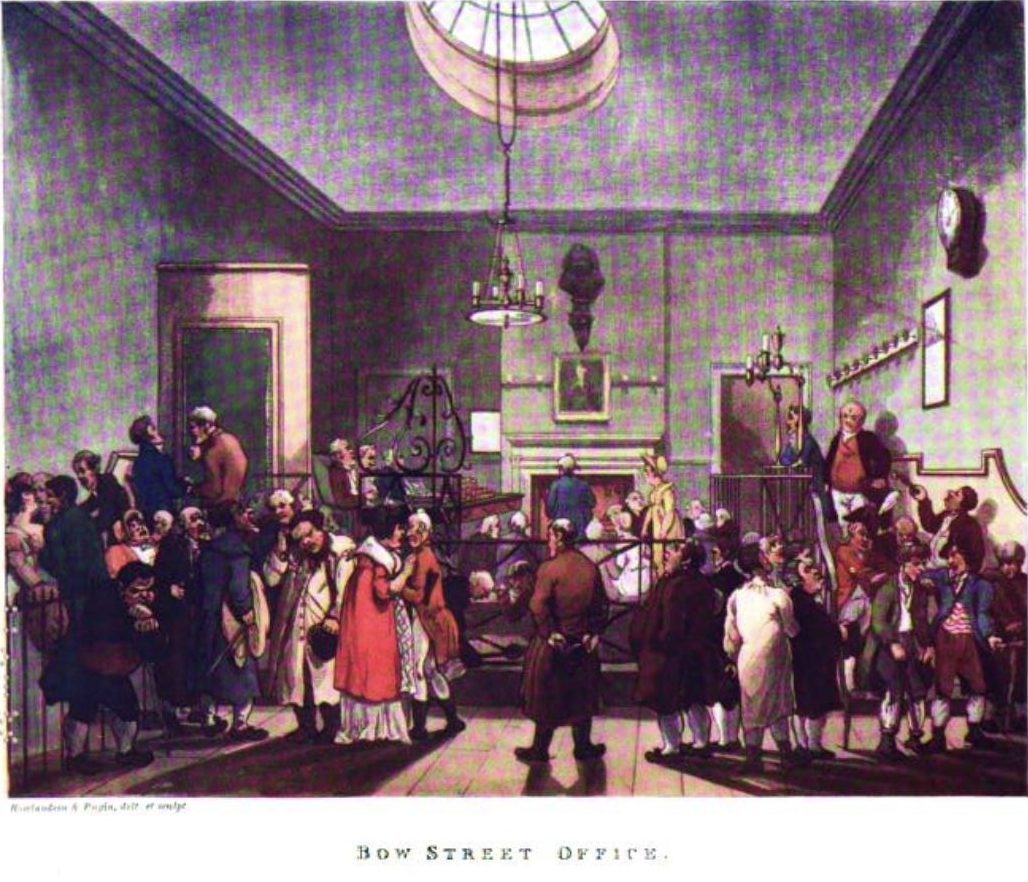

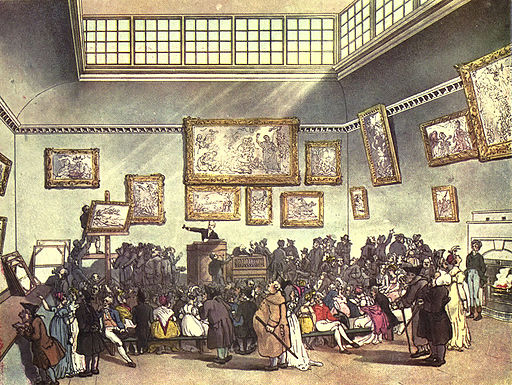
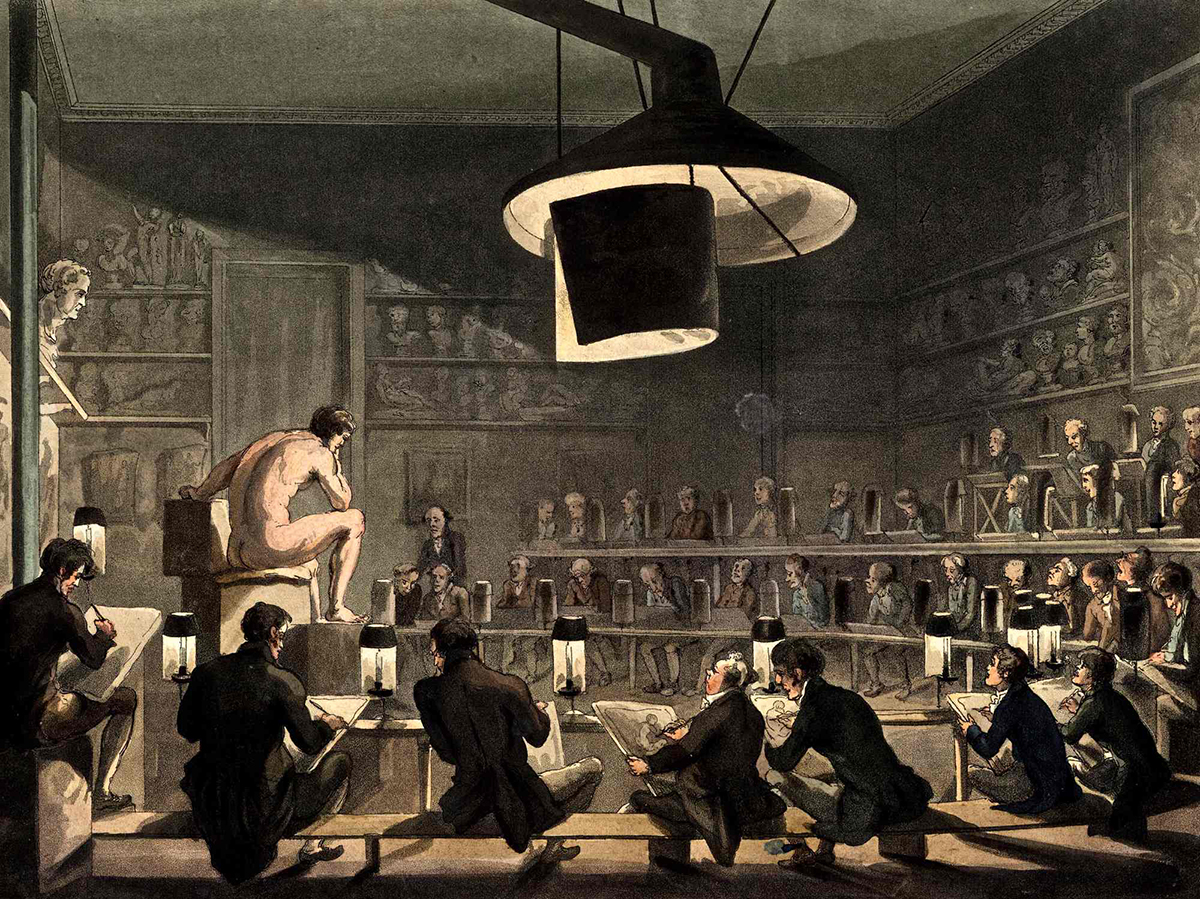
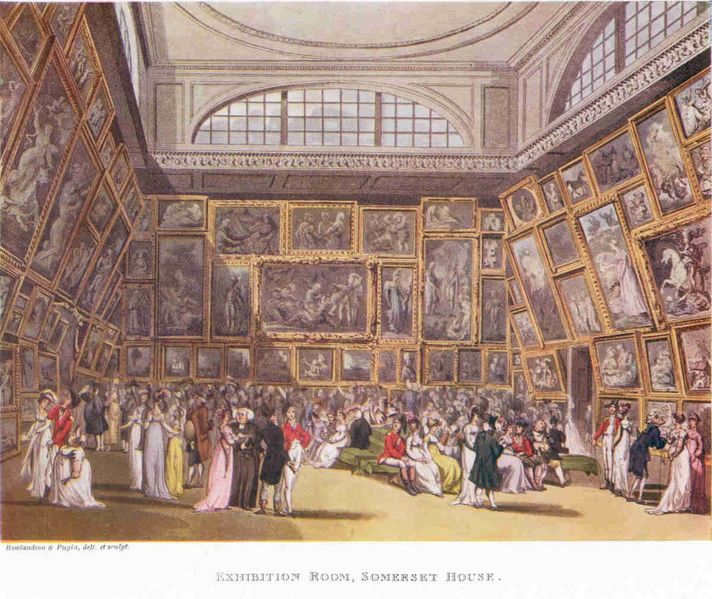

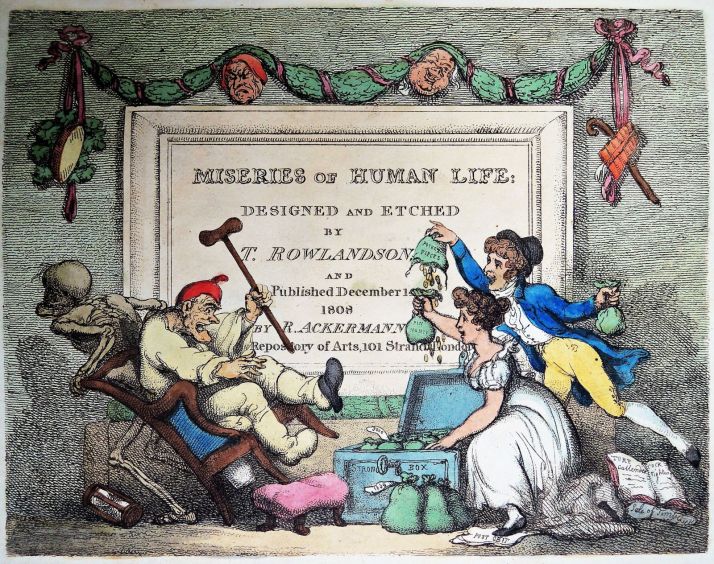

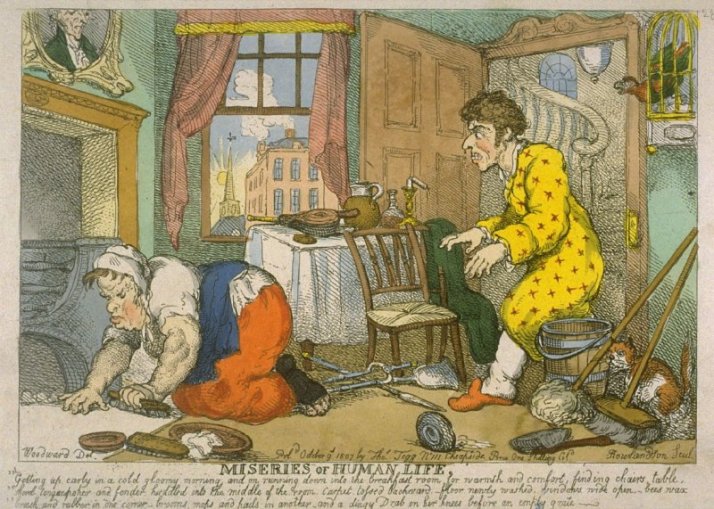
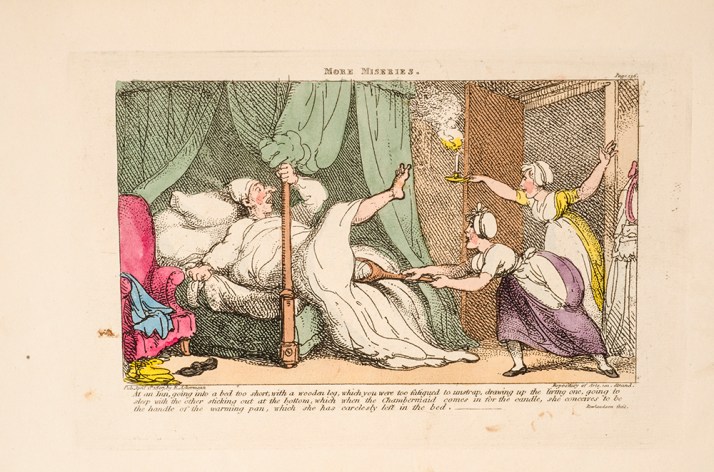

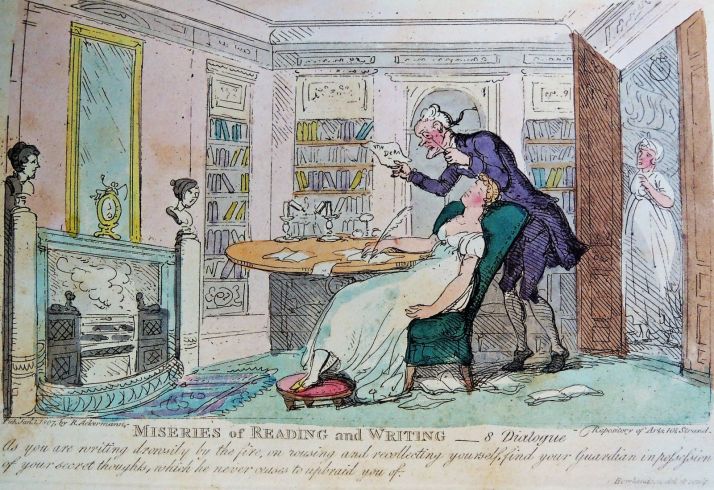


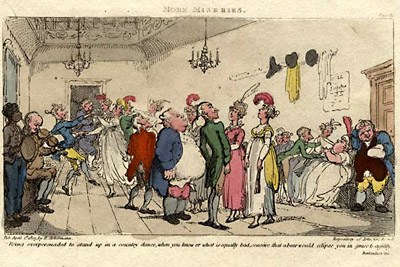
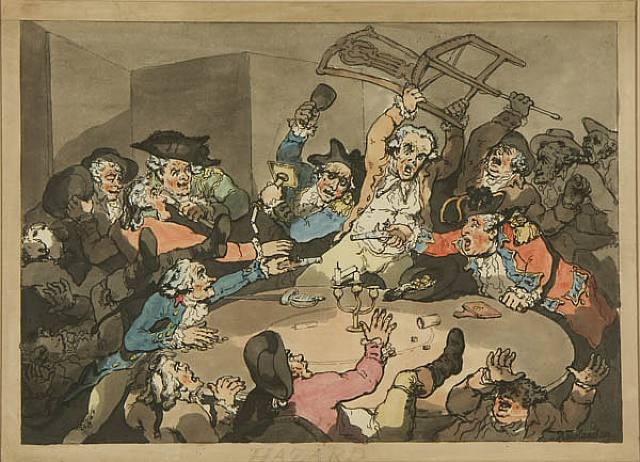
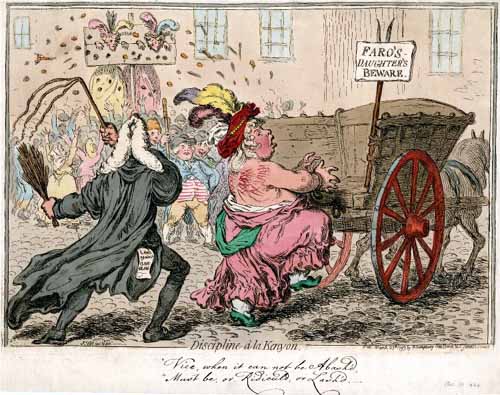
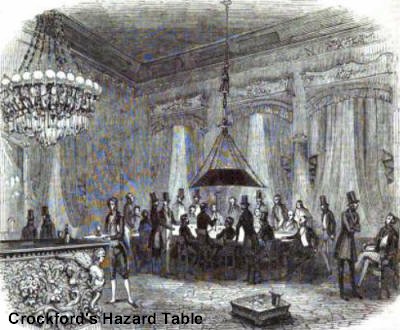

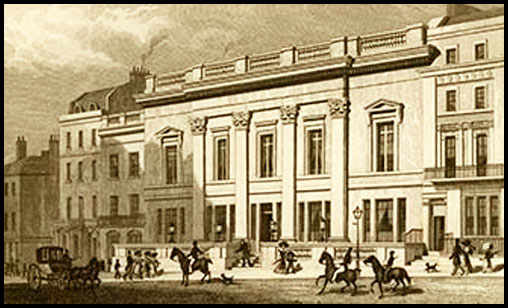
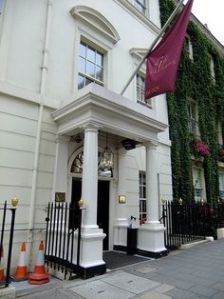


 Susana's Parlour