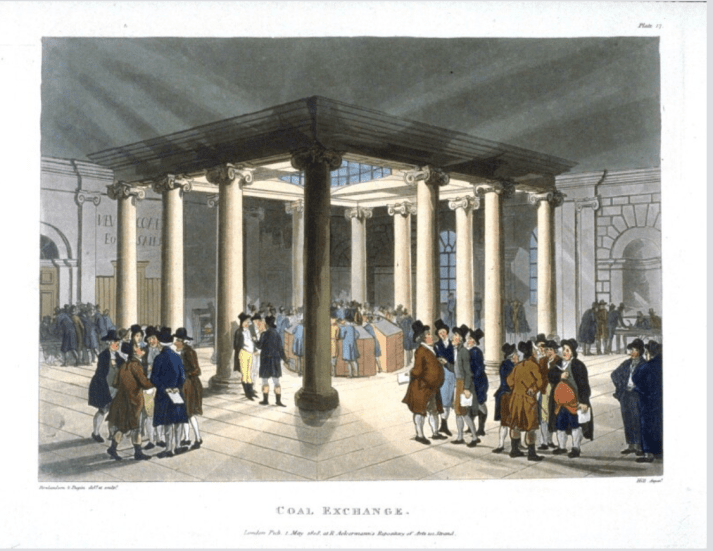
The print of the Coal Exchange is intended to represent that busy period of the day when buyers and sellers meet for the purpose of completing their old bargains, and making new ones. The groups are disposed with so much felicity, that they form a pleasing foreground, and break in the architectural perspective without diminishing its effect. A collection of individuals, meeting with a view to their separate interests, necessarily describe the same passions, varied only by the difference of character upon which they operate; but the artist has given an expression to the group on the left hand very different from either of the groups on the right: the simplicity which distinguishes one of the figures is highly characteristic. The tall figure with a paper in his hands behind him, appears intended to represent a trader of the old school, and forms an admirable contrast to the buckish nonchalance of the more modern merchant leaning against a pillar. The aldermanic figure which appears to be resisting the eloquence of an inferior tradesman, is happily contrasted with the spare and meagre figures which compose that group. There’s an arch simplicity in the countenance of the orator with a pen in his hand, that seems to bespeak confidence as well as attention. There is a chaste correctness in the whole picture, highly creditable to the taste of the artists, and it produces altogether an effect which the subject scarcely promised.
This building was purchased, in the year 1805, by the corporation of the city of London, from the merchants and factors whose private property it had been, for the sum of 25,400/. in pursuance of an act of the 43d George III. intituled. An Act for establishing a free Market in the City of London for theSale of Coals, and for preventing Frauds and Impositions in the Vend and Deliveryof all Coals brought into the Port of London, within certain Places therein mentioned.The powers granted by this act have been altered and enlarged by subsequent acts of the 44th, 46th, and 47th George III. The property of the land and building is vested in the lord mayor, who is empowered to receive a duty of one penny per chaldron (or ton, if sold by weight,) on all coals, CINDERS, or CULM, brought to the port of London: the object of this duty is to repay the purchase money, and to support the expences of the establisment; when a sufficient sum for this* purpose has been raised, the duty is to cease. The business of the Coal Exchange is conducted by fifteen gentlemen, called the Board of Sea-Coal Meters. In their office is taken the metage duty above-mentioned; and also the orphan duty, which is collected by the principal clerk (as deputy for Mr. Alderman Newnham). There are two clerks in this office, and about one hundred ship-meters, assisted by labouring meters. The duty on metage is one shilling, to be paid for every live chaldrons or one vat, which is paid into the Chamber of London by the meters upon oath. Their business is, to deliver all coal-ships that come into the port of London. Every ship, within twenty-four hours after her arrival at or to the westward of Gravesend, is obliged to send an affidavit of the quantity and quality of her cargo; which, unless freighted for government, must be sold in the open market. Any merchant or owner may bring their own coals into this market, without the intervention of a factor or middle man, in quantities not less than twenty-one chaldrons. Every sale must be in the regular appointed hours, from twelve to two; and the price of the coals, with the name at full length, of both buyer and seller, entered in a book, a copy of which must be given to the clerk of the market, who is to keep a register of each sale: the penalty for not delivering such copy to the clerk, is not exceeding 100/. nor less than 20/.: any fraudulent bargain, such as the making an entry of one price in the market, and agreeing upon some deduction or abatement to be allowed afterwards, subjects the offender to a like penalty.
The Land-Coal Meters is another department: there are three principal meters for the city of London at present, but the establishment will be reduced to two at the death of any one of the present holders of that office. Their business is, to inspect by themselves, or by their deputies and labouring meters cause to be inspected, the admeasurement of coals sold by wharf measure. Others are appointed for Surry and for the city of Westminster. In London, the principal meters are appointed by the lord mayor and court of aldermen, and are liable to be fined or discharged for neglect of duty or malversation in their office: their jurisdiction extends over the city of London and its liberties, and from the Tower to Limehouse-Hole. The principal meters for Surry are elected by the churchwardens of the different parishes, and are, for neglect or other offences, under the controul of the quarter sessions for the county: their jurisdiction extends over all the parishes on the southern banks of the Thames, from Egnam to Rotherhithe. The principal meter for Westminster is appointed by the king, and under the controul of the magistrates. There are three clerks of the market, and also a beadle, who resides in the house.
It is impossible in our limits to enter into the minutiae, but a general idea of the extent of this important trade may be formed from an average estimate taken from the books, by favour of Mr. W. Drummer, principal clerk in the Sea-Coal-Ship Meters’ Office, and deputy receiver of the orphan duty. The number of the ships employed are from three hundred and fifty to five hundred, which make about four thousand seven hundred voyages, and bring to the port of London the amazing quantity of 960,000 chaldrons of coals, yearly.
A duty of one shilling per chaldron on all coals brought from Newcastle-upon-Tyne to the port of London, was granted by King Charles II. to Charles Lenox, Duke of Richmond, his natural son by Lady Louisa Renne de Pennecourt, a lady who was brought over by his sister, the Duchess of Orleans, in the year 1760, for the express purpose of making a conquest of that amorous monarch, with a view to confirm him in the French interest: in this project she completely succeeded, and retained her ascendency over him till she died. Charles created her Duchess of Portsmouth, Countess of Farnham, and Baroness Petersfield: Louis XIV. also, at his request, conferred on her the title of Duchess of Aubigny.
In the year 1799, government thought proper to purchase of the late duke his right to the duty on coals above-mentioned. It appears, from the books in the Sea-Coal-Meters’ Office, that it brought in to the duke from 22,000/. to 24,000/. per annum: he, however, agreed to accept from government an annuity of 20,000/. for his own life and that of the present duke.
St. Paul’s Cathedral was principally built by several duties on coals. By the 22d Charles II. from 1670 to 1677, two shillings per chaldron was laid on coals, from thence to 1680, three shillings per chaldron, one fourth to be applied to the building St. Paul’s; 1st James II. from 1687 to 1700, one shilling and sixpence per chaldron, two thirds towards the building; 8th William III. from 1700 to 1708, twelve shillings per chaldron, two thirds for the use of St. Paul’s; 1st Anne, for eight years from 1708, two shillings per chaldron, the whole for this great purpose.
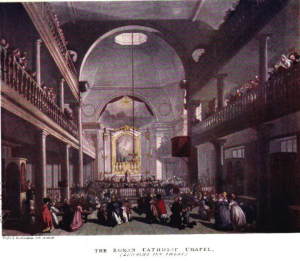
The annexed print is a very accurate and interesting view of this celebrated chapel: the general effect of the architecture is simple and agreeable. There is a singularity in the pillars; those in the second range in the galleries do not stand perpendicularly upon those under them, but are removed a little more backward: this is mentioned to account for the singular appearance they have in the view, and which might otherwise have been supposed to have proceeded from some error in the artist: in truth, the perspective in this, as in every production of Mr. Pugin’s, is always accurate, and conducted with real taste and elegance. The various groups of figures are designed with great spirit, and are highly characteristic of the groups we usually meet with in a Catholic chapel: the general effect of light and shade is broad and simple; the principal light being thrown upon the altar is highly judicious, and is productive of the happiest effect: the picture by Rigaud is in his best style, and the other decorations of the altar are extremely elegant.
The Catholic Chapel in Duke-street, Lincoln’s Inn Fields, was first opened in the reign of James II. and has continued ever since, with very little interruption, as a place of worship for the Catholics.
In the year 1762 it was burned down by accident, and soon after the present structure was erected, at the expence of the King of Sardinia, from a plan by Signor Jean Baptist Jaque, an amateur of architecture, and secretary of Count Vizi, the Sardinian envoy to the British court.
His Sardinian majesty was at all the expence of this chapel till he lost Savoy and Piedmont by the French revolution: at present it is principally supported by voluntary contributions.
The dreadful riots. of June 1780, were produced by the misguided zeal of Lord George Gordon, who having held out to the populace, that the church was in danger from an act which was passed, affording some relief to the Catholics, called a meeting of the Protestants in St. George’s Fields; and they, to the number of fifty thousand, signed a petition for the repeal of the act, and a 2 went in a body, with Lord George Gordon at their head, to present their petition to the House of Commons: they called themselves The Protestant Association. These people, though perhaps mistaken, were however generally respectable and orderly; but the cry of “No Popery” had spread among the lower orders of the people, who, incited by a set of abandoned and desperate wretches, involved the metropolis in all the horrors of anarchy and disorder.
Ignatius Sancho, in his letters, gives a very lively and animated description of that dreadful period. On the 2d of June, the day appointed for the consideration of the wished-for repeal. Lord North just got to the house a quarter of an hour before the associators arrived in Palace-yard. By the evening there were at least an hundred thousand poor, miserable, ragged rabble, from twelve to sixty years of age, with blue cockades in their hats, besides half as many women and children, all parading the streets, the bridge, and the park, ready for any and every mischief. Lord Sandwich was wounded by them, but was rescued by the guards. A large party of them went about two in the afternoon to visit the king and queen, and entered the park for that purpose, but found the guard too numerous to be forced, and after some useless attempts, gave it up. The Catholic Chapel, the subject of this article, was attacked by the mob and materially injured: with much other valuable property, they destroyed a fine-toned organ, and a very fine altar-piece, painted by Casali: the Sardinian ambassador offered live hundred guineas to the rabble, to save the picture and the organ; but they told him, they would burn him if they could get at him, and instantly destroyed them both.
These dreadful scenes continued to disgrace the metropolis till the 9th of June, when the rioters were suppressed, after having destroyed the premises of Mr. Langdale, an eminent distiller, on Holborn-Hill; numbers of them miserably perished in the flames, intoxicated to stupefaction with the spirituous liquors, which were set running down the kennels.
The mischief executed by these wicked and infatuated wretches was enormous. The Fleet prison, the Marshalsea, King’s Bench, both compters, and Tothill Fields, with Newgate, were forced open; Newgate partly burned, and three hundred felons, from thence only, let loose upon the world. The King’s Bench also was burned. The insurgents visited the Tower, but found it too strong for them. But so supine and feeble was the government of the city under Braek Kennett, then lord mayor, that the mob succeeded at the Artillery-ground, where they found, and took to their use, five hundred stand of arms. The Bank was threatened, but preserved by a detachment of the guards. Lord Mansfield’s house was completely destroyed; and, to the irreparable loss of learning and science, his valuable library and collection of manuscripts, which had been the labour of many years and great expence to bring together, devoted without mercy to the devouring flames.
The military power at last restored the affrighted capital to order. The obnoxious bill was repealed; many of the rioters were hanged, and Lord George Gordon committed to the Tower: he was afterwards tried and acquitted, hut was put in charge of his friends as a lunatic. It is whimsical, that this hero of the Protestant religion, when he was some years after confined in Newgate for a libel on the Queen of France, turned Jew.
To return to the chapel: it was again restored. The picture was replaced by one painted by John Francis Rigaud, R. A.; it represents Christ taken down from the cross, and is one of the best productions of his pencil. The new organ is much esteemed by connoisseurs; it was built by England.
All the church service, except the sermon, is in Latin. The masses are sung by the choir, which is under the direction of the organist, who is generally the composer of the music performed there. This chapel can boast of having had some of the most eminent British musicians for the directors of the choir, among whom the celebrated Dr. Arne was organist for several years. Mr. Samuel Webbe now holds that situation, a gentleman who is not only eminent for the grave and solemn style of his church music, but has also gained high reputation for the beauty and sprightliness of his lighter compositions.
The annexed print gives an accurate and interesting view of this abode of wretchedness, the Pass-Room. It was provided by a late act of Parliament, that paupers, claiming settlements in distant parts of the kingdom, should be confined for seven days previous to their being sent off to their respective parishes; and this is the room appointed by the magistracy of the city for one class of miserable females. The characters are finely varied, the general effect broad and simple, and the perspective natural and easy.
Bridewell, as early as King John, was a royal palace, formed partly out of the remains of an ancient castle, the western Arx Palatina of the city, and the residence of several of our monarchs; but in process of time became neglected: till, in 1522, Henry VIII. rebuilt it in a most magnificent manner, for the reception of the Emperor Charles V. who in that year paid him a visit: Charles was, however, lodged in Black Friars, and his suite in the new palace. A gallery of communication was thrown over Fleet-Ditch, and a passage cut through the city wall to the emperor’s apartments. Henry often lodged here, particularly in 1529, when the question of his marriage with Queen Catherine was agitated in Black Friars. It fell afterwards to decay, and was begged by the pious Prelate Ridley from Edward VI. to be converted to some charitable purpose: that of a house of correction for vagabonds of each sex and all denominations was determined on. It also answers another purpose; it is a foundation for youth who are bound apprentices to different trades under what are called Arts-Masters*; and forms part of the great plan of benevolence adopted by the amiable Edward VI. when he endowed the city hospitals, of which this is one. It is situated in Bridge-street, Black Friars, and gives the name to Bridewell precinct in the neighbourhood; the whole building forms a square, consisting of the houses of the arts-masters, who are six in number, the prisons for the men and women, the committee-room, and a chapel.
The men’s prison is a good brick building, on the western side, consisting of thirty-six sleeping-rooms, and seven other apartments. Every man has a room to himself, containing a bedstead, straw in a sacking, a blanket, and coverlet. The other rooms consist of workshops, a sick-room, which is a very comfortable apartment, and a larger, in which idle apprentices are confined separate from the other prisoners. In the working-room are junk and oakum, which the prisoners pick, and mills where they grind corn. The task-master’s apartments, and the women’s prison, which is separate from the men’s, are on this western side. The committee-room is on the south side, where a committee of the governors meet every week to examine the prisoners. There are excellent regulations to this prison: in the cellar is a bath, in which the prisoners are occasionally washed; but there is no yard for them to walk in, which is a great defect in any house of this description.
The original plan of this hospital, combined and incorporated with the hospitals of Christ and St. Thomas, was so benevolent, and of such comprehensive utility, that it is worthy to be followed, improved, and completely executed, by the wisest and best of men, in the wisest and best of times. It was to “train up the beggar’s child to virtuous industry, so that from him no more beggars should spring; to succour the aged and the diseased; to relieve the decayed housekeeper and the indigent; and to compel the wretched street-walker and the vagabond to honest labour.” Its design was, to include every class of the unfortunate, the helpless, and the depraved. To effect this, the governors were instituted, and are, as a body corporate, empowered to make* “all manner of wholesome and honest ordinances, statutes, and rules, for the good government of the poor in Bridewell.” Many very important alterations have taken place in this hospital within the last century, particularly in the years 1792 and 1793. Pennant, whose account of London was published in 1793, states the number of arts-masters at twenty; they are now reduced to six. The number of apprentices taught and maintained, he does not state; in the year 1717, they amounted to one hundred and three received within the year, and in 1718, to ninety-four. — Vide Speed. The apprentices are now reduced to thirty.
The late improvements in the buildings at Bridewell have been very great. The entrance is by a very noble front, of the Doric order; on the key-stone of the arch is a head of the illustrious founder. The apartments in this center are destined for the residence of the chamberlain of the city of London, who is also treasurer. Adjoining this building are six new houses, corresponding with the other houses in Bridge-street, the back parts of which occupy what was before a court-yard, in which resided several of the arts-masters. A new chapel, and a very noble apartment called the committee-room, complete the improvements on the eastern and principal side. On the north have been some alterations. The male prisoners are removed to a new building erected on the western side; and the arts-masters, who lived on that site, are removed to houses erected for them on the north side.
The court-room is an interesting piece of antiquity, as on its site were held courts of justice, and probably parliaments, under our early kings. At the upper end are the old arms of England; and it is wainscotted to a certain height with English oak, ornamented with carved work. This oak was formerly of that solemn colour which it attains by age, and was relieved by the carving being gilt. It must have been no small effort of ingenuity to destroy at one stroke all this venerable time-honoured grandeur: it was, however, happily achieved by daubing over with paint the fine veins and polish of the old oak, to make a very bad imitation of the pale modern wainscot; and other decorations are added in a similar taste.
On the upper part of the wall are the names, in gold letters, of benefactors to the hospital: the dates commence with 1565 and end with 1713. This is said to have been the court in which the sentence of divorce was pronounced against Catherine of Arragon, which had been concluded on in the opposite monastery of the Black Friars.
From this room is the entrance into the hall, which is a very noble one: at the upper end is a picture, by Holbein, representing Edward VI. delivering the charter of the hospital to Sir George Barnes, then lord mayor; near him are William, Earl of Pembroke, and Thomas Goodrich, Bishop of Ely. There are ten figures in the picture, besides the king, whose portrait is painted with great truth and feeling: it displays all that languor and debility which mark an approaching dissolution, and which unhappily followed so soon after, together – with that of the painter, that it has been sometimes doubted whether the picture was really painted by Holbein: his portrait, however, is introduced; it is the furthest figure in the corner on the right hand, looking over the shoulders of the persons before him.
On one side of this picture is a portrait of Charles II. sitting, and on the other that of James II. standing; they are both painted by Sir Peter Lely. Round the room are several portraits of the presidents and different benefactors, ending with that of Sir Richard Carr Glyn. The walls of this room are covered with the names of those who have been friends to the institution, written in letters of gold.
The new committee-room is finely proportioned, and in a very good style of architecture; as is the new chapel, which is divided from it by the portico, and which together occupy the whole back front of the eastern range of buildings.
The following is a list of the present officers of this hospital and Bethlem, founded by Edward VI. 1553:
President of both Hospitals, Sir Richard Carr Glyn, Bart. Alderman.
Treasurer to ditto, Richard Clark, Esq. Chamberlain of the city of London.
Chaplain at Bridewell, Rev. Henry Budd, B. A.
Physician to both, Thomas Munro, M. D.
Surgeon to ditto, Bryan Crowther, Esq.
Apothecary to ditto, Mr. John Haslam.
Clerk to ditto, Mr. John Poynder.
Steward to Bridewell, accomptant and receiver to both, Air. Bolton Hudson.
Porter to Bridewell, Richard Weaver.
Matron to ditto, Mary Rundle.
* These arts-masters were originally decayed tradesmen, and consisted of shoemakers, taylors, flax-dressers, orris and silk-weavers, &c. The apprentices used to be distinguished by a blue jacket and trowsers, and a white hat: their dress is now in the form of other people’s, distinguished only by a button bearing the head of the founder.
The annexed print represents the greatest public exhibition made by this noble charity, on St. Matthew’s day, September 21st.
Two orations are annually pronounced in praise of this institution, one in Latin and the other in English, by two of the senior boys, called Grecians, who receive a superior education, being designed to complete their studies at the universities, one of them being sent annually to Cambridge, and every three years one is sent to Oxford. The orations are delivered in the presence of the governors and their friends, and the masters of the various schools, &c. in the great hall, a very noble apartment; the scene is truly impressive and solemn. The artists have exerted great ability and judgment in the disposition of such a numerous assemblage of people, in the distribution of the light and shade, and the truth of the perspective. The sketch of the very large picture in the hall adds to the interest.
In the year 1224, eighth Henry III. nine friars of the order of St. Francis arrived at Dover; five of them remained at Canterbury, the other four came to London, where they had so much influence on the piety or the superstition of the people, that in the following year John Ewin, mercer, purchased for them a piece of waste land within Newgate, on which, in about twenty years, rose the house and church of the Grey Friars; The church was one of the most superb of the conventual kind, and was erected by the contributions of the opulent devout. Margaret, second queen to Edward I. in 1306, began the choir, giving in her lifetime 2000 marks, and 100 marks by her testament. Isabella, queen to Edward II. gave 70/. and queen Philippa, wife to Edward III. 62/. towards the building. John de Britagne built the body of the church at a vast expense: Gilbert de Clare, Earl of Gloucester, gave twenty great beams out of his forest at Tunbridge. No order of monks seem to have had powers of persuasion equal to these poor friars: they raised vast sums for their buildings among the rich; and there were few of their admirers, when they came to die, who did not console themselves with the thoughts of lying within their expiating walls, and if they were particularly wicked, thought themselves secure from the assault of the devil, if their corpse was wrapped in the habit and cowl of a friar. Multitudes, therefore, of all ranks were crowded in this holy ground: it boasts of receiving four queens, Margaret and Isabella above-mentioned; Joan, daughter to Edward II. and wife of Edward Bruce, king of Scotland; and to make the fourth, Isabella, wife to William Warren, titular King of Man, is named. Of these, Isabella, whom Gray so strongly stigmatizes
“She-wolf of France, with unrelenting fangs,
That tear’st the bowels of thy mangled mate,”
I hope was wrapped in the friar’s garment, for few stood more in need of a daemonifuge. With wonderful hypocrisy, she was buried with the heart of her murdered husband on her breast.
John, Due de Bourbon, one of the noble prisoners taken at the battle of Agincourt, after eighteen years imprisonment, in 1443 here found a tomb.
In the same ground lies Thomas Burdett, Esq. ancestor of the present Sir Francis Burdett. He had a white buck, which he was particularly fond of: this the king, Edivard IV. happened to kill. Burdett, in anger, wished the horns in the person’s body who advised the king to it: for this he was tried, as wishing evil to his sovereign, and for this only, lost his head.
To the regret of the lovers of antiquity, all these ancient monuments and gravestones were sold, in 1545, by Sir Martin Bowes, lord mayor, for about 501.
The library founded here in 1429, by the munificent Whittington, must not be forgotten: it was 129 feet long, 31 broad. In three years it was filled with books to the value of 5561. of which Sir Richard contributed 400/. and Dr. Thomas Winchelsey, a friar, supplied the rest. This was about thirty years before the invention of printing.
On the dissolution, this fine church, after being spoiled of its ornaments for the king’s use, was made a storehouse for French prizes, and the monuments either sold or mutilated.
Henry, just before his death, touched with remorse, granted the convent and church to the city, and caused the church to be opened for divine service.
The building belonging to the friars was by Edward VI. applied to this useful charity. That amiable young prince did not require to be stimulated to good actions; but it is certain, that, after a sermon of exhortation by Ridley, bishop of London, he founded the three great hospitals in this city, judiciously adapted to provide for the necessities of the poor, divided into three classes:
Christ-Church Hospital for the orphan, St. Thomas’s Hospital for the diseased, and Bridewell for the thriftless. After the sermon, Edward ordered the good bishop to attend him. The account of this interview is very interesting, and as Stow relates it as a matter of fact from the word of the bishop, I shall extract a part of it verbatim.
“As soon as the sermon was ended, the king willing him not depart until that he had spoken to him, and this that I now write was the very report of the said Bishop Ridley, who, according to the king’s command, gave his attendance; and so soon as the king’s majesty was at leisure, he called for him to come unto him in a great gallery at Westminster; where, to his knowledge, and the king told him so, there was present no more persons but they two, and therefore made him sit down in one chair, and he himself in another, which, as it seemed, were before the bishop purposely set, and caused the bishop, maugre his teeth, to be covered, and then entered communication with him in this manner:
“First giving him hearty thanks for his sermon and good exhortation for the relief of the poor, ‘But, my lord,’ quoth he, ‘you willed such as are in authorityto be careful thereof, and to devise some good order for their relief, wherein I thinkyou mean me, for I am the first that must make answer to God for my negligence, if I should not be careful therein, knowing it to be the express command of Almighty God to have compassion of his poor and needy members, for whom we must make account unto him. And truly, my lord, I am before all things else most toil ling to travail that way; and I, doubting nothing of your long and approved wisdom and learning, who having such good zeal as wisheth help unto them, but also that you have had some conference with others what ways are best to be taken therein, the which I am desirous to understand, and therefore I pray you to say your mind.’
“The bishop was so amazed and astonished at the goodness and earnest zeal of the king, that he could not tell what to say: but, after some pause, advised him to begin with the city of London; and requested the king to direct his gracious letters to the lord mayor, to consult with such assistants as he thought fit on what might best be done, the bishop promising to assist them in their deliberations.
“To this the king agreed, but made the bishop wait till the letter was written, which having signed and sealed, he gave it to the bishop, desiring him to make all convenient speed, and to let him know the result as early as possible. The bishop the same night delivered the king’s letter to the then mayor. Sir Richard Dobbs, Knight; who the next day sent for two aldermen and six commoners, which were afterwards increased to twenty-four, who, with the good bishop, after various consultations, composed a book on the state of the poor in London.
“This book was presented to the king, who immediately founded the three royal hospitals. For the maintenance of Christ’s Hospital, he gave some lands of the value of 600/. per annum, which had been given to the Savoy, a house founded by Henry VII. for the lodging of pilgrims and strangers, but had declined from its original intention, and had become the resort of vagabonds, who strolled about the fields all day, and were harboured there at night. And for a further relief, a petition being presented to the king for a licence to take in mortmain lands to a certain yearly value, he ordered the patent to be brought to him, and with his own hand filled the blank space with 4000 marks by the year; and then said, in the hearing of his council, ‘Lord, Iyield thee most hearty thanks, that thou hast given me life thus long to finish this work to the glory of thy name.”
In two days after this excellent youth expired, in the sixteenth year of his age and the seventh of his reign, not without suspicion of his end being hastened by the ambitious Northumberland.
“All the English historians dwell with pleasure on the excellent qualities of this young prince. The flattering promises of hope, joined to many real virtues, made him an object of tender affection to the public: he possessed mildness of disposition, application to study and business, a capacity to learn and judge, and an attachment to equity and justice.” — Hume.
Christ’s Hospital, Bridewell, and St. Thomas the Apostle in Southwark, are incorporated by the name of, “The Mayor, Commonalty, and Citizens of the Cityof London, Governors of the Possessions, Revenues, and Goods of the Hospitals of Edward VI. King of England.”
It was not till the year 1552, five years after the king’s grant, that the house of the Grey Friars was fitted up for the reception of the children: they completed it in the same year, and called it Christ’s Hospital; and in September, they took in near four hundred orphans, and clothed them in russet; but ever after they wore blue cloth coats, their present habit, which consists of a blue cloth coat, close to the body, having petticoat skirts to the ankle, yellow under-petticoat, yellow stockings, and a flat round worsted cap: their shoes are tied with strings, from the quantity of which the various classes are distinguishable. In addition to this catalogue of their dress, they have of late years added a pair of breeches made of ticken, for which indulgence the boys gave up their meat suppers, to which they were before entitled, and have bread and cheese instead. Their fare is plain and wholesome, and they sleep in wards kept in a very clean state. There are at present about one thousand boys on this establishment, distributed into thirteen wards. The governors have established a school at Hertford, to which they send the youngest of the children, generally to the number of three hundred, who are taken into the house as room is made by apprenticing off the elder. It is between thirty and forty years since the girls were removed from London to be wholly educated at Hertford: all the girls are educated at this school.
At the instigation of Sir Robert Clayton, lord mayor, who was a great benefactor, Charles II. founded the mathematical school, to which he granted 7000/. to be paid out of a certain fund at 500/. per annum, for the educating forty boys for the sea: of these boys, ten are yearly put out apprentices to merchant vessels, and in their places ten more received.
Another mathematical school, for thirty-seven other boys, was afterwards founded by Mr. Travers; but these boys are not obliged to go to sea. Many able mathematicians and seamen have sprung from these institutions.
The hospital being nearly destroyed by the fire of London, the greater part was rebuilt under the direction of Sir Christopher Wren. The* writing school was founded in 1694, by Sir John Moor, alderman, who is honoured with a statue in front of the building. It is altogether a very extensive building, consisting of many irregular parts; the south front, adjoining Newgate-street, is perhaps the best. The cloisters, the only remains of the conventual house, serve for a thoroughfare, and for a place for the boys to play in. The great hall, a spacious and noble room, was built, after the fire of London, at the sole charge of Sir Joshua Frederic, alderman of London, and cost him 5000/.:
it is 130 feet long, 34 wide, and 44 in height. In this hall is an extraordinary large picture, by Verrio, of King James II. amidst his courtiers, receiving the president of this hospital, several of the governors, and numbers of the children, all kneeling: one of the governors with a grey head, and some of the children, are admirably painted. The history of this picture is curious: it was intended to have represented Charles II. who founded the mathematical school; but he dying while the picture was in hand, James, who never did any thing for the charity, had his own portrait introduced, together with that of the execrable Jefferies, then lord chancellor: Verrio has introduced his own portrait in a long wig. The founder is represented in another picture giving the charter to the governors, who are in their red gowns kneeling; the boys and girls are ranged in two rows: a bishop, probably Ridley*, is in the picture. If this was the work of Holbein, it has certainly been much injured by repair. There is also a fine picture of Charles II. in his robes, with a great flowing black wig: at a distance is a sea view, with shipping; and about him a globe, sphere, telescope, &c.: it was painted by Sir Peter Lely, in 1662.
In this hall the children are daily assembled to their meals: prayers are read by one of the senior boys, and hymns are sung by the children, for which purpose it is furnished with a pulpit; and an organ is played during the time of supper. These public suppers commence the first Sunday after Christmas, and end on Easter Sunday: the time of supping is from six o’clock till half past seven.
The following order has been recently hung up near the entrance of the hall:
Public Suppers
“Ordered, That no person be admitted within the great hall unless introduced by a governor.”
But the grand anniversary held in this hall is on St. Matthew’s day, an account of which accompanies the print.
In the court-room is a three-quarters length of Edward VI. a most beautiful portrait, and indisputably by Holbein.
In this room are also the portraits of two great benefactors to this hospital, and persons of the most enlarged and general benevolence. Sir Wolstan Dixie, lord mayor of London 1585, and Dame Mary Ramsay, wife of Sir Thomas Ramsay, lord mayor 1557.
In a room entirely lined with stone, are kept the records, deeds, and other writings of the hospital. One of the books is a curious piece of antiquity; it is the earliest record of the hospital, and contains the anthem sung by the first children, very beautifully illuminated.
The writing school is a handsome modern building of brick, supported by pillars, forming a spacious covered walk.
The grammar school is a plain brick building, more recently erected.
The permanent revenues of Christ’s Hospital are great, from royal and private donations in houses and lands; but without voluntary subscriptions they are inadequate to the present establishment.
By the grant of the city, the governors license the carts allowed to ply in the city, to the number of two hundred and forty, who pay a small sum for this privilege. They also receive a duty of about three farthings upon every piece of cloth brought to Blackwell Hall, granted by acts of common council.
The expenditure of this hospital is immense, being at present about 30,000/. per annum.
The governors, who choose their own officers and servants, are unlimited in their number. A donation of 400/. makes a governor: formerly the sum was less, but the office of governor being one of great trust, and of serious importance in its effect to the public, an enlargement of the sum was wisely adopted.
The governors of Christ’s Hospital have been made trustees to several other extensive charities by their founders. Among these charities, there is one of 10/. each, for life, to four hundred blind men. This ought to be known, because these funds have been often confounded with those of Christ’s Hospital, which they do not in the least augment, the governors not being at liberty to apply such funds to any of the uses of the hospital.
The greater part of the buildings belonging to this noble institution being through age in a state of irreparable decay, the governors have lately resolved to rebuild the whole upon a plan of uniformity and magnificence.
The present officers of Christ’s Hospital are,
President, Sir John William Anderson, Bart. Alderman.
Treasurer, James Palmer, Esq.
Physician, Richard Budd, M. D.
Surgeon, Thomas Ramsden, Esq.
Apothecary, Mr. Henry Field.
Chief clerk, Richard Corp, Esq.
Receiver, Mr. Thomas Whilby.
Assistant clerks, Mr. Matthew Cotton and Mr. James White.
Grammar master, Rev. Arthur William Trollop, M. A.
Under grammar master, Rev. L. P. Stephens, M. A.
Master of the reading school, Ralph Peacock, M. A.
Master of the mathematics, Mr. Lawrence Gwynne.
Master of the mathematics on Mr. Travers’s foundation, Rev. Thomas Edwards, M. A.
Writing masters, Mr. J. Allen and Mr. T. Goddard.
Drawing master, Mr. John Wells*.
Music master, Mr. Robert Hudson.
Steward, Mr. Matthew Hathaway.
AT HERTFORD.
Grammar master and catechist. Rev. F. W. Franklin, M. A.
Steward and upper writing master, Mr. Benjamin Flude.
Second writing master, Mr. Henry Rix Whittel.
Surgeon and apothecary, Mr. Colbeck.
Matron, Mrs. Royd.
Girls’ schoolmistress, Mrs. Ann Sparrow,
Second ditto. Miss Eliza Payne.
On the admission of a governor, the following serious and impressive charge is solemnly given him, in the presence of the president, or treasurer, and other governors assembled in court:
“Worshipful!
“The cause of your repair hither at this present is, to give you knowledge, that you are elected and appointed by the lord mayor and court of aldermen, to the office, charge, and governance of Christ’s Hospital.
“And, therefore, this is to require you and every of you, that you endeavour yourselves, with all your wisdom and power, faithfully and diligently to serve in this vocation and calling, which is an office of high trust and worship: for ye are called to be the faithful distributors and disposers of the goods of Almighty God to his poor and needy members; in the which office and calling if ye shall be found negligent and unfaithful, ye shall not only declare yourselves to be the most unthankful and unworthy servants of Almighty God, being put in trust to see the relief and succour of his poor and needy flock; but also ye shall shew yourselves to be very notable and great enemies to that work, which most highly doth advance and beautify the commonwealth of this realm, and chiefly of the city of London.
“These, therefore, are to require you, and every of you, that ye here promise, before God and this assembly of your fellow-governors, faithfully to travail in this your office and calling, that this work may have his perfection, and that the needy number committed to your charge be diligently and wholesomely provided for, as you will answer before God at the hour and time when you and we shall stand before him, to render an account of our doings. And this promising to do, you shall be now admitted into this company and fellowship.”
* So dreadful is the rage of religious persecution, that even this benevolent and virtuous prelate could not escape its fury: he was burnt for heresy at Oxford, together with J^atimer, bishop of Worcester, by order of Mary, 1555.
* About the year 1721, a drawing master was added to the establishment: Mr. Bernard Lens was the first; to him succeeded the late Mr. Green; the present gentleman is the third who has held the office.
The accompanying print represents, with great humour and animation, a scene in this renowned school of British oratory, an academy from which many illustrious orators, both of the bar and the senate, have derived that energetic and forcible manner, which, in honour of the original seminary, is so emphatically termed Bilingsgate. The power of their eloquence has raised such a tempest and whirlwind of passion in the gentle bosoms of two fair disputants, that, forgetting or laying aside the native softness and delicacy of their sex, they have engaged in furious combat. One of them is just overthrown by her more fortunate adversary, but though fallen, her spirit seems to rise above her fate, and she yet dares the conflict and hopes for victory. Their sister Naiads on either side encourage and foment the immortal strife: one of them has fallen with inconceivable fury on a wretch, who is possibly a Frenchman and a fiddler, and has probably raised this storm by either undervaluing the fair one’s fish, or having made some mal-a-propos observation on its degree of freshness; be this as it may, he seems to be nearly in as bad a situation as Orpheus,
"When, by the rout that made the hideous roar,
His goary visage down the stream was sent,
"Down the swift Hebrus to the Lesbian shore.”
It appears highly probable that the ladies who used poor Orpheus so cruelly, were Grecian Billingsgates; and as they were votaries of Bacchus, and acted under his divine impulse, it seems to strengthen the opinion: certain it is, that the English poissardes are as jealous devotees of the jolly god, as the Grecian Mcenades could be for their lives, and quite as apt to be quarrelsome in their cups: but this point may be left to the learned to settle. In the foreground of this print, one of the ladies is so overcome that she is quite insensible to the kindness of a fisherman, who is entreating her to drink another cup of comfort; she is equally insensible to the robbery a dog is committing on her basket of fish. The old citizen buying a turbot, and the various groups of market people, are delineated with great spirit and fidelity. The buildings are extremely accurate, the perspective easy and natural, and the tout-ensemble interesting and animated.
“Billingsgate, or, to adapt the spelling to the conjectures of antiquaries, who go ‘ beyond the realms of chaos and old night/ Belin’s-gate, or the gate of Belinus, king of Britain, fellow-adventurer with Brennus, king of the Gauls, at the sacking of Rome, three hundred and sixty years before the Christian sera: I submit to the etymology, but must confess there does not appear any record of a gate at this place. His son Lud was more fortunate, for Ludgate preserves his memory to every citizen who knows the just value of antiquity. Gate here signifies only a place where there was a concourse of people*, a common quay or wharf, where there is a free going in and out of the same*. This was a small port for the reception of shipping, and for a considerable time the most important place for the landing of almost every article of commerce. It was not till the reign of William III. that it became celebrated as a fish-market; he, in 1699, by act of Parliament, made it a free port for fish. This act also settled the tolls and duties to be taken, appoints a fine of 20/. to be levied on any fishmonger convicted of engrossing, and permits the sale of mackarel on Sundays. The practice of engrossing and regrating still increasing, it was thought necessary, by an order of the lord mayor, 1707, to endeavour to remedy this abuse. The order states, that, Whereas in and by an act of Parliament made in the tenth and eleventh years of the reign of King William III. entitled “An act to make Billingsgate a free market for fish, &c. it was provided, that any person might buy or sell any kind of fish in the said market, and sell them again in any other market by retail. But the fishmongers bought up the cargoes of the fishermen, and sold them again in the same market, which considerably enhanced the price to the consumer: it was therefore ordered, that no fishmonger, or other person, should sell, or expose to sale, any fish at Billingsgate market; only fishermen, their wives, apprentices, or servants, were to be permitted to sell in the market by retail, that the citizens might have the fish at first hand, according to the true meaning of the law. It was ordered also, that the hours for the fish-market should be, from Lady-day to Michaelmas, at four o’clock in the morning, and from Michaelmas to Lady-day, at six o’clock; that none presume to buy or sell any fish before those hours, except herrings, sprats, mackarel, and shell-fish, on pain of being proceeded against as forestalled of the market. Notice of the opening of the market is given by the ringing of a bell; the market continues open till twelve o’clock, when the business closes for two hours, after which it again commences, and continues till five in the evening. The whole is under the jurisdiction of the lord mayor and court of aldermen. A clerk of the market attends to receive the tolls, &c.; and he has authority to order, that all the fish brought into the port shall be sold in the market, and all fish that he shall deem putrid and unwholesome, by his order must be destroyed. The business of the market is now conducted by salesmen, to whom the cargoes of the boats are consigned by the owners; great quantities of fish are also brought from the coast by land carriage. About fourteen or fifteen years since, commenced the practice of bringing fresh salmon from Newcastle and Berwick, enclosed in boxes of ice, by which excellent contrivance the inhabitants of London are supplied with that fish extremely reasonable and in the greatest perfection.
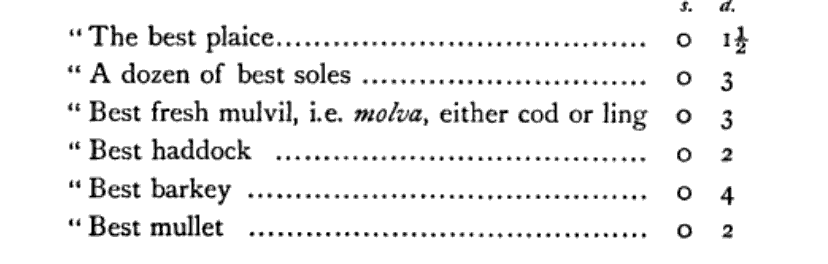
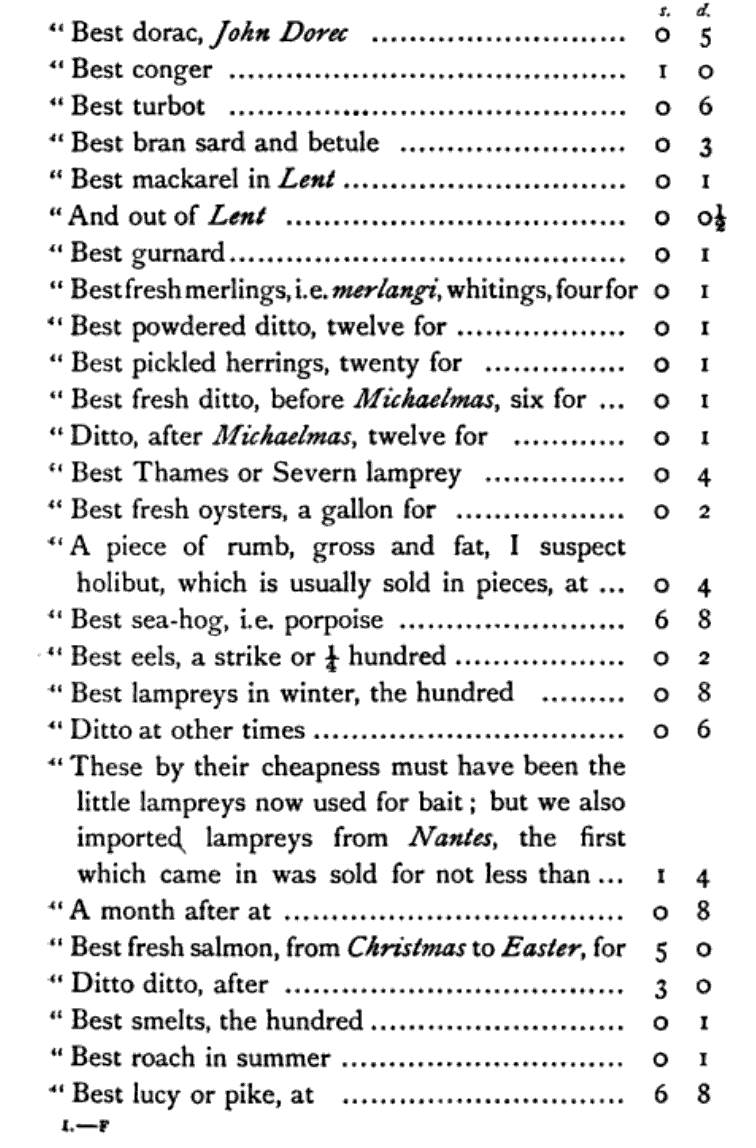
Pennant gives a curious list of the fish brought to market in the reign of Edward I. who descended even to regulate the prices.
“Among these fish, let me observe the conger is at present never admitted to any good table; and to speak of serving up a porpoise whole, or in part, would set your guests a-staring; yet such is the difference of taste, that both these fish were in high esteem. King Richard’s master cooks have left a most excellent receipt for congur in sawsc*; and as for the other great fish, it was either to be eaten roasted or salted, or in broth, or furmente with porpesse. The learned Doctor Caius even tells us the proper sauce, and says, that it should be the same with that for a dolphin; another dish unheard of in our days. From the great price the lucy or pike bore, one may reasonably suspect it was at that time an exotic fish, and brought over at a vast expence. To this list of sea-fish, which were in those days admitted to table, may be added the sturgeon and ling; and there is twice mention, in Archbishop Nevill’s great feast, of a certain fish, both roasted and baked, unknown at present, called a thirl-poole.”
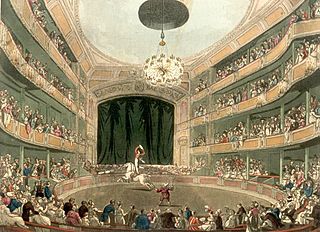
The Amphitheatre at Westminster bridge has, within these twelve years, been twice destroyed by fire; and the expence of rebuilding, & c. &c. to Messrs. Astleys, the two proprietors, has been estimated as amounting to nearly thirty thousand pounds. The present theatre is the most airy, and in some respects the most beautiful, of any in this great metropolis. The building is one hundred and forty feet long; the width of that part allotted to the audience, from wall to wall, sixty-five feet; and the stage is one hundred and thirty feet wide, being the largest stage in England, and extremely well adapted to the purpose for which it was built, the introduction of grand spectacles and pantomimes, wherein numerous troops of horses are seen in what has every appearance of real warfare, gallopping to and fro, &c. &c. The whole theatre is nearly the form of an egg; two thirds of the widest end forms the audience part and equestrian circle, and the smaller third is occupied by the orchestra and the stage. From this judicious arrangement, the whole audience have an uninterrupted prospect of the amusements. It is lighted by a magnificent glass chandelier, suspended from the center, and containing fifty patent lamps, and sixteen smaller chandeliers, with six wax-lights each. The scenery, machinery, decorations, &c. have been executed by the first artists in this country, under the immediate direction of Mr. Astley, jun. who made the fanciful design.
A very good idea of its general appearance, company, &c. is given in the annexed print.
For a looker-on to describe some part of the amusements would be difficult, perhaps impossible; and luckily it is not necessary, for in an advertisement published November 1807, Mr. Astley himself has described one of them in a manner so singularly curious, that we think it ought to be transmitted to posterity; and have therefore inserted it in this volume.
“TO THE EDITOR OF THE MORNING CHRONICLE.
“Sir,
“Having been strongly requested to give some explanation of the utility of the country dances by eight horses, to be performed this and tomorrow evening, I request you will be so obliging as to insert the following hints.
“First, I humbly think that a thorough command and pliability on horseback, is obtained by such noble exercises. Secondly, that in executing the various figures in this dance, the rider obtains a knowledge of the bridle hand, also capacity and capability of the horse, more particularly at the precise time of casting off and turning of partners, right and left, &c. &c. Thirdly, I also conceive that the horseman may be greatly improved when in the act of reducing the horse to obedience on scientific principles! ! ! and not otherwise. Fourth, as a knowledge of the appui in horsemanship is highly desirable, whether on the road, the chase, or field of honour, I expressly composed the various figures in the country dance for this desirable purpose; and which my young equestrian artists have much profited by, as some of them three months since were never on horseback. It was from this observation, during forty-two years practice, that I gave this equestrian ballet the name of L’Ecole de Mars; and I am strongly thankful that my humble abilities have afforded some little information, as well as amusement, to the town in general.
“I am, with respect,
“The public’s most humble and faithful servant,
“Philip Astley.”
Pavilion, Newcastle-street, Strand .”
From all this, a spectator would be almost tempted to think, that, notwithstanding the numerous and learned dissertations of philosophers to exalt their own species, horses rival man in his superior faculties. I have heard a story on this subject, which I believe has not found its way into Joe Miller; but be that as it may, it is a good story, and in a degree illustrates this subject, and I think my reader will not be displeased at the insertion of it.
Some years ago, a very learned and sagacious doctor of the university of Oxford, composed and read a long lecture on the difference of man from beast; and when describing the former, asserted that man was superior to all other animals; because there was no other animal, except man, who either reasoned or drew an inference, as the inferior order of beings were wholly governed by instinct.
On the conclusion of this philosophical discourse, two of the students, who were not quite satisfied of the fact, walked out to converse upon it, and seeing a house with “Wiseman, drawing master,” inscribed upon the sign, went into the shop, and asked the master what he drew? “Men, women, trees, buildings, or any thing else,” was the reply. “Can you draw an inference?” said one of them. The man took a short time to consider it, and candidly replied, that never having seen or heard of such a thing before, he could not. The students walked out of his house, and before they had proceeded far, saw a brewer’s dray with a very fine horse in it.“ A fine horse this,” said one of them to the driver. “A very fine one indeed,” said the fellow.“ Seems a powerful beast,” said the other, “I believe he is indeed,” replied the fellow. “ He can draw a great load, I suppose?” said the Oxonian. “ More than any horse in this county,” answered the drayman. “Do you think he could draw an inference?” said the scholar. “He can draw any thing in reason, I’ll be sworn,” replied the drayman.
The scholars walked back to the lecture room, and found the company still together; when one of them, addressing the doctor with a very grave face, said to him, “Master, we have been enquiring, and find that your definition is naught; for we have found a man, and a wise man too, who cannot draw an inference, and we have met with a horse that can”
Besides the Amphitheatre, Messrs. Astleys have a very elegant Pavilion, for exhibiting amusements of a similar description, which they have lately erected, and fitted out in a most complete style, in Newcastle street in the Strand, and named Astley’s Pavilion.
At this place the horses have displayed some feats of so wonderful a description, as could not easily be conceived unless they were seen. In this place eight horses have lately performed country dances, &c. in a manner that has astonished all the spectators. To this have been added divers horsemanships, the twelve wonderful voltigers, &c.
The annexed print, which is-
A VIEW OF THE AMPHITHEATRE AT WESTMINSTER BRIDGE,
gives a very good idea of the scene. Mr. Rowlandson’s figures are here, as indeed they invariably are, exact delineations of the sort of company who frequent public spectacles of this description; they are eminently characteristic, and descriptive of the eager attention with which this sort of spectators contemplate the business going forward. Small as the figures are, we can in a degree pronounce upon their rank in life, from the general air and manner with which they are marked.
Mr. Pugin is entitled to equal praise, from the taste which he has displayed in the perspective and general effect of the whole, which renders it altogether an extremely pleasing and interesting little print.
With respect to teaching horses to perform country dances, how far thus accomplishing this animal, renders him either a more happy or a more valuable member of the horse community, is a question which I leave to be discussed by those sapient philosophers, who have so learnedly and so long debated this important business, with respect to man.
The school of Jean Jaques Rousseau, who insist upon it, that man, by his civilization, has been so far from adding to his happiness, that he has increased and multiplied his miseries* will of course insist upon it, that a horse in his natural state must be infinitely happier, than he can be with any improvements introduced by man; that all these artificial refinements must tend to diminish, instead of increasing his felicity; and that, as a horse, he had much better be left in a state of nature, than thus tortured into artificial refinement.
The advocates for Swift’s system of the Houyhnhnms, in Gulliver’s Travels, admitting a horse to be superior to a man, even in his natural state, will unquestionably be of the same opinion ; and we must seek farther for the advantages to be derived by introducing a teacher of dancing, and a master of the ceremonies, to this noble and dignified animal.
It is recorded, that at a much earlier period, a right worshipful mayor of Coventry wished to teach his horse good manners. Queen Elizabeth, in one of her progresses to that city, was met, about a mile before she arrived there, by the mayor and aldermen, who desirous of declaring the high honour which they felt she would thus confer on their city, employed the mayor to be their speaker. The mayor was on horseback, and (as the record saith) the queen was also on horseback, behind one of her courtiers. A little rivulet happening to run across the road where they stopped, the mayor’s horse made several attempts to drink; which the queen observing, told his worship, that before he began his oration, she wished he would let his horse take his draught. “That, an please your majesty, he shall not,” replied the mayor, “that he certainly shall not yet. I would have him to know, that it is proper your majesty’s horse should drink first, — and then, he shall.”
The Admiralty is a brick building, containing the office and apartments for the lords commissioners of the Admiralty, who superintend the marine department, and is contiguous to the Horse Guards on the north. With respect to the architecture, the principal front facing Parliament-street displays a proof that the noble lord and board who presided at the time it was built, had objects of more consequence than symmetry and proportion to attend to: it was designed and erected by Shipley. The screen in the front (which was designed and erected by Adams) is so peculiarly elegant, that it in a degree redeems the other part from disgrace. On the top of the Admiralty are erected two telegraphs, the inside of which may be seen by proper application to the porter, or person who works the machine.
The lord high admiral is classed as the ninth and last great officer of the crown; and the honour it conferred, and trust it vested, were formerly considered to be so great, that the post was usually given either to some of the king’s younger sons, near kinsmen, or one of the chief of the nobility. To the lord high admiral belongeth the cognizance of contracts, pleas, or quarrels made upon the sea, or any part thereof which is not within any county of the realm; for his jurisdiction is wholly confined to the sea. The court is provided for the trial and punishment of all offences committed on the high seas, and is a civil court. Courts-martial in the Admiralty have a judge advocate appointed to assist them. The present judge of the Admiralty is the Right Honourable Sir William Scott, Knight, LL. D. the salary 2500/. The present king’s advocate general is Sir John Nicholl, Knight, LL. D.
In King Henry III.’s days, and in the reigns of Edward I. II. and III. Richard II. Henry IV. V. and VI. there were several admirals; for the cautious wisdom of those days would not trust a subject with so great a charge, nor permit any one man to have a certain estate in a post of so great importance. But, nevertheless, in those days there was a great admiral of England.
King Henry VL in the fourteenth year of his reign, constituted John Holland Duke of Exeter, and Henry Holland his son, admirals of England, Ireland, and Aquitaine for life.
The power of this great officer is described in a statute of Charles II.: it is enacted that he may grant commissions to inferior vice-admirals, or commanders in chief of any squadron of ships, to call and assemble courts-martial, consisting of commanders and captains; and no court-martial, where the pains of death are inflicted, shall consist of less than five captains at least; the admiral’s lieutenant to be as to this purpose esteemed as a captain: and in no case when sentence of death shall pass, by virtue of the articles (for regulating and better governing his majesty’s navies, ships of war, and forces at sea,) aforesaid, or any of them (except in case of mutiny), there shall be execution of such sentence of death, without leave of the lord high admiral, if the offence be committed within the narrow seas. But in case any of the offences aforesaid be committed in any voyage beyond the narrow seas, whereupon sentence of death shall be given in pursuance of the aforesaid articles, or any of them, then execution shall be done by order of the commander in chief of that fleet or squadron wherein sentence was passed.
He hath also power to appoint coroners to view dead bodies found on the seacoast or at sea; commissioners or judges for exercising justice in the High Court, of Admiralty; to imprison and to release, &c.
Moreover to him belong, by law and custom, all fines and forfeitures of all transgressors at sea, on the seashore, in ports, and from the first bridge on rivers towards the sea; also the goods of pirates and felons, condemned or outlawed; and all waifs, stray goods, wrecks of sea deodands; a share of all lawful prizes, lagon, jetson, flotson; that is, goods lying in the sea, goods cast by the sea on the shore, not granted formerly, or belonging to lords of manors adjoining to the sea; all great fishes, as sea-hogs, and other fishes of extraordinary bigness, called royal fishes, whales only and sturgeons excepted.
“De sturgeoni observatur quod rex ilua intergram: de balneo vero sufficit si rex habeat caput et reginse candum.” Master William Prynne, who is one of the commentators upon the above curious law, says, that the reason must be, that “our wise and learned lawgivers willed the queen to have the tail of the whale, that her majesty might have whalebone to make her stays forgetting that this was made law upwards of two hundred years before stays were ever worn or thought of. Note farther, that the bone used for stays, is taken out of the head, and not the tail of the fish.
On this ancient law being once mentioned to the late Dr. Buchan, author of Domestic Medicine, ike. &c. he repeated the following little impromptu, which I think has never before been printed:
“If a sturgeon should chance to be cast upon land,
“Honest George, Heaven bless him! the whole may command;
“But if equal misfortune befal a poor whale,
“Let the king have the head, and the queen the tail.”
It is not the object of this volume to say much concerning the great power and interest which the king of England hath in the British seas; and as to the antiquity of the Admiralty Court, and of the name of Admiral, it may be found in a record mentioned by the Lord Chief Justice Coke (Coke’s Institute, p. 142, entitled “De Superioritate Maris Angliae, et Jure Officii Admiralitatis in eodem), said to be among the archives in the Tower of London.
He is called admiral from amir, an Arabic word signifying prefect us, and in Greek marimis. His patent formerly run thus: “Anglise, Hiberniee, et Aquitaiise magnus admirallus, et praTectus generalis clargis et marium dictorum regnorum.”
The various distinguished actions which have been recorded of many of our admirals, and establish the honour and superiority of the British navy, would fill volumes. To enumerate them would occupy more space than can be here allotted to it, and does not come into the plan of this work; but to close the recital of any thing tending to the establishment of our naval character, without inserting the name of the late Lord Nelson, -would be a very improper omission.
Painters have exhausted their art in pictured representations of his actions; sculptors have hewn marble monuments to eternize his heroic professional abilities, which have been placed in the most conspicuous situations in different public buildings throughout the kingdom; and poets have invoked the muse, and exerted their utmost efforts to perpetuate his fame, in praises that, used to any other individual, might have been deemed extravagant panegyric: but the whole nation appear to have been so gratefully alive to his exalted merit, and so highly to revere his memory, that it is hardly deemed equal to what his conduct peremptorily claimed from his surviving countrymen. The Right Honourable Horatio Viscount Nelson, and Duke of Bronte, was a most active, brave, and able officer. He defeated the French fleet in Aboukir Bay, August 1, 1798, and took eight sail of the line; for which he was raised to the peerage. He was second in command at the battle of Copenhagen, where he displayed great courage and conduct; for which he was raised to the dignity of viscount. He completely defeated the combined fleet of France and Spain, off Cape Trafalgar, October 21, 1805, in which he lost his life.
In the advices some of our admirals have transmitted to the Board of Admiralty and others, there is a brevity, which Shakespeare says is the soul of wit; there is, however, a brevity, which is so admirable a model of epistolary writing, that I cannot resist transcribing one or two of them; premising, that as they are taken from memory, they may not do justice to the originals.
The first is from Sir George Rodney to the Governor of Barbadoes, and is as follows:
“Dear General,
“The battle is fought, — the day is ours, — the English flag is victorious; — we have taken the French admiral, with nine other ships, and sunk one. “G. B. R.”
The second letter was, I think, transmitted to the Admiralty.
“We have met the French fleet, and taken, sunk, or destroyed, as per margin.”
The last I shall subjoin is from a foreigner, but seems mixed up with a large portion of British spirit . It was written to Admiral Benbow, who died in October 1702, at Jamaica, of the wounds he received in an engagement with M. du Casse, in the West Indies, off the high land of St. Martha, in the same year.
Soon after Admiral Benbow’s return to Jamaica, he received a letter from M. du Casse, of which the following is a translation:
“Carthagena, August 1702.
“Sir,
“I had little hopes on Monday last but to have supped in your cabin; yet it pleased God to order otherwise: I am thankful for it. As for those cowardly captains who deserted you, hang them up; for, by G — d, they deserve it.
“Du Casse.”
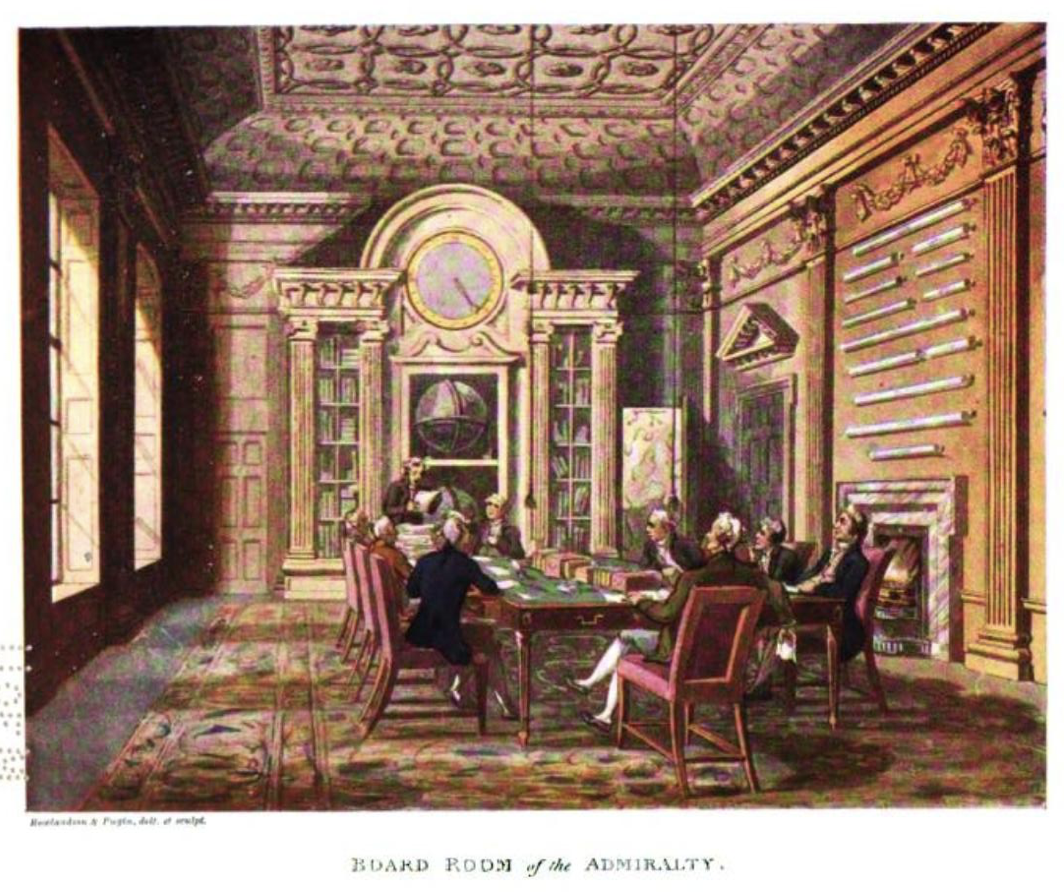
The next print is a correct interior view of THE BOARD ROOM OF THE ADMIRALTY, with its appropriate decorations of globes, books, maps, & c. The lords commissioners are represented as sitting at the table, and may be naturally supposed engaged in some business relative to the naval interest of Great Britain: and considered in that point of view, may be fairly said to be transacting a business of more real importance to this country, than any other subject that could be debated; and if taken in all its nautical relations, the acknowledged preeminence of our navy, and the various appertaining et-ceteras, it is also a matter of infinite importance to all Europe.
After what has been said, it does not seem necessary to make any remarks on the extent of the building; but, as it has been before remarked, that the noble lords were engaged in transactions of more importance than attending to the symmetry and proportion of their house, which was probably left to the architect, who might in many cases leave it to the management of his foreman, it may afford some amusement to our readers, to recite a few sportive sallies of the wits of the time on the brick and mortar of the principal front.
They said, and truly said, that it is a contemptible piece of architecture. Of the portico of this building, composed of four Ionic columns, with a pediment of stone, a story is told, that, from the strange disproportion of the shafts, is highly probable. The architect, Shipley, had made them of a proper length, when it was found that the pediment of one of his shafts had blocked up the window of one of the principal apartments; and he endeavoured to remedy the error, by carrying his columns to the roof of the building: and in truth, in its present state, one is compelled to admit the truth of what was remarked by the late George Selwyn, that though the columns are certainly neither of the Doric, Ionic, or Corinthian order, they would be admirable models to take for a new one, which might be denominated the clis, or disproportioned order; “or,” added he, “if we chose to give it immortality, baptize it with an appropriate title, and name it the Robinsonian order, in honour of Sir Thomas Robinson.”
The figure of Sir Thomas Robinson must be in the recollection of many of our readers; — so long, so lank, so lean, so bony, that he struck every one who saw him, as distinct from all other men, and out of all manner of proportion. When the late Lord Chesterfield was confined to his room by an illness, of which he felt a consciousness that he should never recover, a friend, who visited him in the character of one of Job’s comforters, gravely said, he was sorry to tell his lordship, that every body agreed in thinking he was dying, and that he was dying by inches. “Am I?” said the old peer, “am I indeed? why then I rejoice from the bottom of my soul, that I am not near so tall as Sir Thomas Robinson.”
To return to the building: certain it is that such columns never were seen either in Greece, or Rome, or any other country.
The screen in the front, which was designed and erected by Adams, is so far from being liable to any part of this censure, that it forms a striking contrast, and would, if it were possible, shew in a more glaring light the gross absurdities of the principal front of the building.
On the inside of the Admiralty are two telegraphs, which may be seen by a proper application to the porter, or person who works, the machine.


 Susana's Parlour