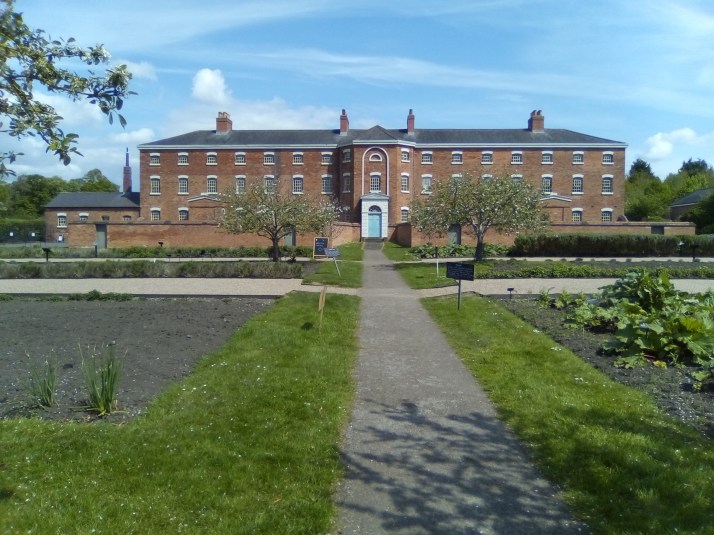
The Workhouse, Southwell
One of the first stops on my recent sojourn in the UK was this 1824 workhouse, near Nottingham. I was staying in Leicester at the time, so I arrived there by rail and taxi, in time for a fabulous tour by a knowledgeable guide. I expected to hear terrible stories about suffering and starving and desperate, mistreated inhabitants. Surprisingly, that was not the case.
While workhouse life was no picnic for its inmates, it was almost certainly better than the alternative; starving to death, dying of exposure, and having to watch your children and family suffer along with you. Before workhouses, the needs of the poor were to be attended to by the local parish. No doubt this system offered assistance to many, but it often came with resentment by the better-situated residents who had to fork up the funds to pay for it. Nobody likes to pay taxes, no matter what their economic situation. But if you’re working your butt off and just managing to get by, you might well resent some people getting taken care of with your money.
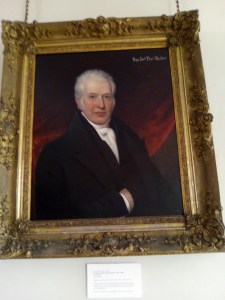
Dr. J.T. Becher, Founder
Then came the Rev. John Thomas Becher. He was Vicar-General of Southwell Minster from 1818-1840. A social reformer, he was instrumental in the creation of this prototype of 19th century workhouse that was cited by the Royal Commission on the poor law as the best example among the existing workhouses, before the New Poor Law of 1834 led to the construction of workhouses across the country. (Wikipedia)
The purpose of the workhouse was to provide an institution to feed, clothe, and house the poor in one place, which would supposedly be a significant savings to the parish. Which it did.
But, you ask, wasn’t it a horrible, prison-like existence to be an inmate there? Well, no. It wasn’t a prison at all. You could leave at any time, if you thought you could fare better elsewhere. And if you were wrong and wanted to come back, they might even take you back.
It wasn’t an easy life, but you had your basic needs met, and maybe even a few more. Many children did not go to school in those days (if they did they went on Sundays only and worked at home or at outside jobs the rest of the week), but this workhouse provided a school and a teacher for the children who lived there. These children would have a better chance to survive on their own when they were old enough to leave.
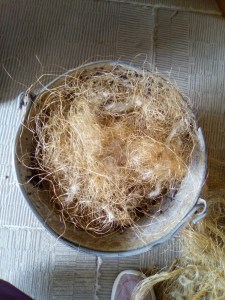
A pail of oakum
Of course, everyone who was able-bodied did have to work. Hard. Some of the work could be caring for those who were not able-bodied. Or it might be cooking or sewing or cleaning or laundry, if you were female. The males did the vegetable gardening and maintenance tasks. In the fall, they were sometimes hired (at cheap wages) by local farmers to bring in the harvest. Profits from their activities came back to the workhouse coffers. One particularly odd task suited for men and women who were incapable of hard physical work was to recycle old cords from sailing ships by “picking” (untangling) them. It was slow, tedious, and hard on thumbs and fingers. Men were assigned to pick 4-1/2 lbs. a day and women 3-1/2. Can you imagine? But pretty much everyone had to do their part. Because, you know, it brought in money, and they can’t be a burden on the taxpayers, can they?
The men, women, and children were segregated at Southwell’s workhouse. Which doesn’t mean they didn’t see each other. The women had to go into the men’s quarters to clean, and they may have glimpsed each other at meals. But they all had separate living and sleeping quarters and separate outside patios. No hanky panky here, even for married couples.
Except for the Master and Matron. This married couple who presided over the workhouse had their own separate living quarters. They managed the finances (although the advisory board made most of the decisions), kept records, and pretty much kept things running smoothly.
The building was in use up to the 1990’s, not as workhouse, but as a temporary residence for mothers and children. The National Trust acquired it after that, and had it renovated in the early 2000’s until it was opened to the public in 2002.
That’s not to say that all workhouses were similar to this one. It’s quite likely that many were as horrific as we assume them to be. I’m sure I’d rather not be inmate of any workhouse. But it provided help for many people who needed it at the time.
More photos available here.
 Susana's Parlour