published by Rudolph Ackermann in 3 volumes, 1808–1811.
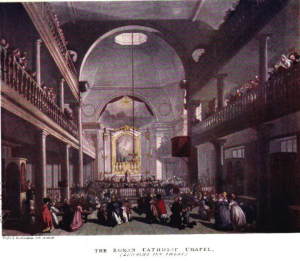
THE ROMAN CATHOLIC CHAPEL
LINCOLN’S INN FIELDS.
The annexed print is a very accurate and interesting view of this celebrated chapel: the general effect of the architecture is simple and agreeable. There is a singularity in the pillars; those in the second range in the galleries do not stand perpendicularly upon those under them, but are removed a little more backward: this is mentioned to account for the singular appearance they have in the view, and which might otherwise have been supposed to have proceeded from some error in the artist: in truth, the perspective in this, as in every production of Mr. Pugin’s, is always accurate, and conducted with real taste and elegance. The various groups of figures are designed with great spirit, and are highly characteristic of the groups we usually meet with in a Catholic chapel: the general effect of light and shade is broad and simple; the principal light being thrown upon the altar is highly judicious, and is productive of the happiest effect: the picture by Rigaud is in his best style, and the other decorations of the altar are extremely elegant.
The Catholic Chapel in Duke-street, Lincoln’s Inn Fields, was first opened in the reign of James II. and has continued ever since, with very little interruption, as a place of worship for the Catholics.
In the year 1762 it was burned down by accident, and soon after the present structure was erected, at the expence of the King of Sardinia, from a plan by Signor Jean Baptist Jaque, an amateur of architecture, and secretary of Count Vizi, the Sardinian envoy to the British court.
His Sardinian majesty was at all the expence of this chapel till he lost Savoy and Piedmont by the French revolution: at present it is principally supported by voluntary contributions.
The dreadful riots. of June 1780, were produced by the misguided zeal of Lord George Gordon, who having held out to the populace, that the church was in danger from an act which was passed, affording some relief to the Catholics, called a meeting of the Protestants in St. George’s Fields; and they, to the number of fifty thousand, signed a petition for the repeal of the act, and a 2 went in a body, with Lord George Gordon at their head, to present their petition to the House of Commons: they called themselves The Protestant Association. These people, though perhaps mistaken, were however generally respectable and orderly; but the cry of “No Popery” had spread among the lower orders of the people, who, incited by a set of abandoned and desperate wretches, involved the metropolis in all the horrors of anarchy and disorder.
Ignatius Sancho, in his letters, gives a very lively and animated description of that dreadful period. On the 2d of June, the day appointed for the consideration of the wished-for repeal. Lord North just got to the house a quarter of an hour before the associators arrived in Palace-yard. By the evening there were at least an hundred thousand poor, miserable, ragged rabble, from twelve to sixty years of age, with blue cockades in their hats, besides half as many women and children, all parading the streets, the bridge, and the park, ready for any and every mischief. Lord Sandwich was wounded by them, but was rescued by the guards. A large party of them went about two in the afternoon to visit the king and queen, and entered the park for that purpose, but found the guard too numerous to be forced, and after some useless attempts, gave it up. The Catholic Chapel, the subject of this article, was attacked by the mob and materially injured: with much other valuable property, they destroyed a fine-toned organ, and a very fine altar-piece, painted by Casali: the Sardinian ambassador offered live hundred guineas to the rabble, to save the picture and the organ; but they told him, they would burn him if they could get at him, and instantly destroyed them both.
These dreadful scenes continued to disgrace the metropolis till the 9th of June, when the rioters were suppressed, after having destroyed the premises of Mr. Langdale, an eminent distiller, on Holborn-Hill; numbers of them miserably perished in the flames, intoxicated to stupefaction with the spirituous liquors, which were set running down the kennels.
The mischief executed by these wicked and infatuated wretches was enormous. The Fleet prison, the Marshalsea, King’s Bench, both compters, and Tothill Fields, with Newgate, were forced open; Newgate partly burned, and three hundred felons, from thence only, let loose upon the world. The King’s Bench also was burned. The insurgents visited the Tower, but found it too strong for them. But so supine and feeble was the government of the city under Braek Kennett, then lord mayor, that the mob succeeded at the Artillery-ground, where they found, and took to their use, five hundred stand of arms. The Bank was threatened, but preserved by a detachment of the guards. Lord Mansfield’s house was completely destroyed; and, to the irreparable loss of learning and science, his valuable library and collection of manuscripts, which had been the labour of many years and great expence to bring together, devoted without mercy to the devouring flames.
The military power at last restored the affrighted capital to order. The obnoxious bill was repealed; many of the rioters were hanged, and Lord George Gordon committed to the Tower: he was afterwards tried and acquitted, hut was put in charge of his friends as a lunatic. It is whimsical, that this hero of the Protestant religion, when he was some years after confined in Newgate for a libel on the Queen of France, turned Jew.
To return to the chapel: it was again restored. The picture was replaced by one painted by John Francis Rigaud, R. A.; it represents Christ taken down from the cross, and is one of the best productions of his pencil. The new organ is much esteemed by connoisseurs; it was built by England.
All the church service, except the sermon, is in Latin. The masses are sung by the choir, which is under the direction of the organist, who is generally the composer of the music performed there. This chapel can boast of having had some of the most eminent British musicians for the directors of the choir, among whom the celebrated Dr. Arne was organist for several years. Mr. Samuel Webbe now holds that situation, a gentleman who is not only eminent for the grave and solemn style of his church music, but has also gained high reputation for the beauty and sprightliness of his lighter compositions.
The present clergy of this chapel are.
Dr. Thomas Rigby,
Rev. Richard Underhill,
Rev. Richard Broderick,
Rev. William Beecham.

 Susana's Parlour