His Royal Highness the Prince of Wales, Vice-Patron.
The Earl of Dartmouth, President.
The avowed purpose of this excellent Institution was, to give to the painters a facility in selling their works, and to form a school of painting for the rising generation, by furnishing exemplars by the old masters, from the collections of the nobility and gentry who formed and supported the plan.
At a meeting of subscribers of fifty guineas or upwards, in June 1805,
PRESENT,
Earl of Dartmouth in the chair
VICE-PRESIDENTS,
The Marquis of Abercorn,
Sir Francis Baring, Bart.
Sir George Beaumont, Bart.
Right Hon. Isaac Corry, M. P.
Thomas Bernard, Esq.
Lord de Dunstanville,
Charles Duncombe, Esq. M. P.
John Egerton, Esq.
William Fitzhugh, Esq. M. P.
Sir A. Hume, Bart.
Henry Hope, Esq.
Thomas Hope, Esq.
Lord Viscount Lowther,
E. L. Loveden, Esq.
Samuel Lysons, Esq.
P. Metcalf, Esq. M. P.
W. Morlafnd, Esq. M. P.
Lord Somerville,
W. Smith, Esq. M. P.
Richard Troward, Esq.
Caleb Whitefoord, Esq.
After resolving that the Earl of Dartmouth be desired to wait on the Prince of Wales, to request that his royal highness will do the Institution the honour of accepting the situation of vice-patron, — It was ordered, that a select committee be authorized to purchase or hire a place for the exhibition. Their choice fell on the Shakespeare Gallery, Pall-Mall, which, in the preceding January, had become the property of Mr. Tassie, from his possessing the fortunate ticket in Alderman Boydell’s lottery; and from Mr. Tassie they purchased the premises, and remaining sixty-three years of the lease, for 5500/.
On the 18th of January, 1806, it was opened with an exhibition of the works of British artists on sale: they sold forty-eight pictures, which produced 2800/. The exhibition closed about the time that the Royal Academy opens; and during this summer the gallery was furnished with many fine pictures by the old masters, from the collections of the founders of the Institution, in order to form a British School of Painting, which had so long been a desideratum. Benjamin West, Esq. P. R. A. wishing to give it some eclat, copied a picture by Vandyke of Govastius, and the Cradle Scene from Rembrandt. It was attended by many pupils of both sexes.
In the ensuing spring the exhibition again commenced; and before it closed, ninety-three pictures were sold for 3950/.
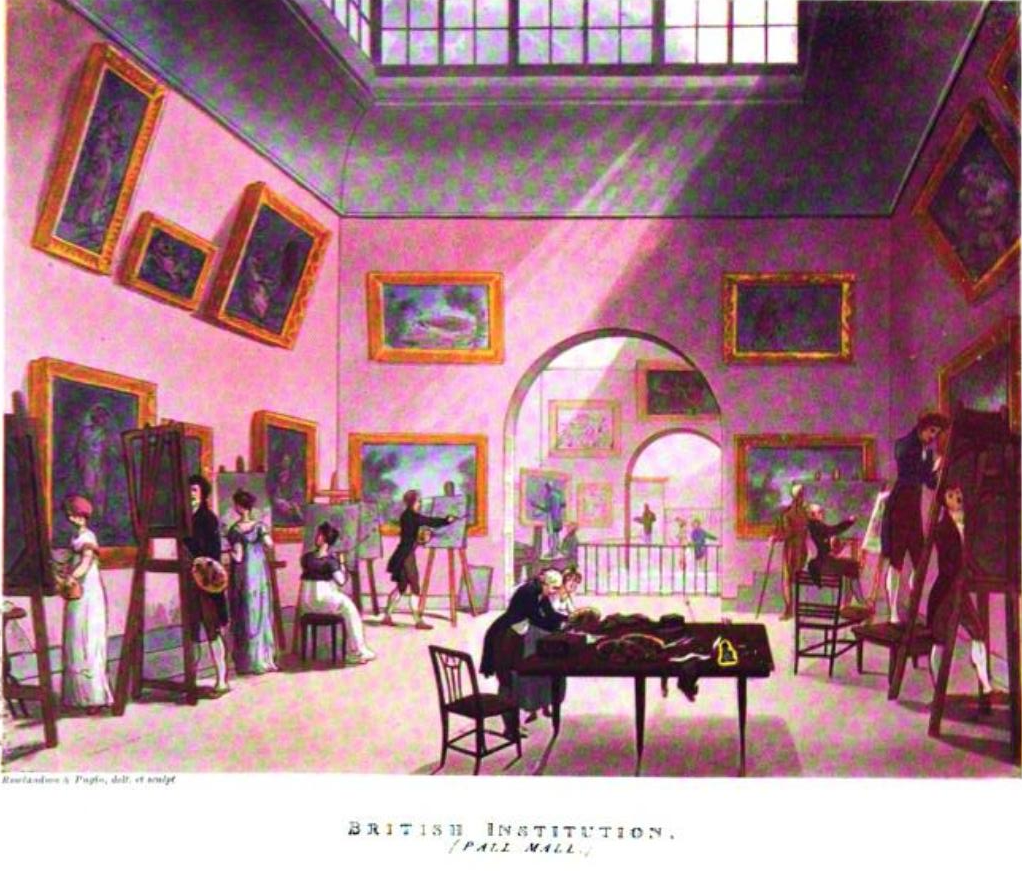
The following season the gallery was again opened to the students, but upon a different plan. It had been suggested by Sir Joshua Reynolds, in one of his lectures, that to take a fine picture by one of the old masters, and paint a companion to it, was a preferable mode of study to that of cold laborious copying: under this idea, the British Institution offered three prizes of 100/. 60/. and 40/. for the three best pictures painted as companions to such of the old masters as the artists chose.
The annexed print is a representation of the gallery at the time these students are at work.
The first premium given by the Institution, anno 1807, was gained by Mr. J. Pocock. The subject is, The insolent Visit of Thomas a Becket to King Henry the Second, A. D. 1164; painted as a companion to Vandyke’s Theodosius, in the collection of Mr. Angerstein.
The second premium was given to Mr. James Green, for his picture of Gadshill and the Carriers; painted as a companion to The Candlelight, by Rubens, in the possession of Mr. Duncombe.
The third premium was given to Miss C. Reinagle — The Interior of a Wood, with Banditti; painted as a companion to Mercury and Admetus, by Salvator Rosa, in the collection of Lord Grantham.
From so fine a school of art, where British genius is countenanced by so liberal an encouragement, what may we not expect? The present sale bids fair to exceed the two former. One of the regulations of the British Institution may be sufficient to give a general idea of the nature of the works admitted.
“Artists who are natives of, or resident in, the United Kingdom, may be exhibitors in the British Gallery; and their works, if originals, and their own property, will be received therein for exhibition and sale; such works being either historical subjects or landscapes painted in oil, statues, basso-relievos, or models in sculpture. But portraits whether large or in miniature, drawings in watercolours, and architectural drawings, are inadmissible.”
The artists pay towards the fund two and a.half percent. on those pictures which are sold; and they have since gratuitously added another two and a half percent. to Mr. V. Green, the the keeper, a very proper compliment to his unremitting attention and gentlemanly conduct in his office.
The annexed print gives a correct and interesting view of this very fine suite of rooms, and the figures have great spirit and appropriate character.
or models in sculpture. But portraits, whether in large or in miniature, drawings in water colours, and architectural drawings, are inadmissible.”
The artists pay towards the fund two and a half per cent, on those pictures which are sold; and they have since gratuitously added another two and a half per cent, to Mr. V. Green, the keeper; a very proper compliment to his unremitting attention and gentlemanly conduct in his office.
The annexed print gives a correct and interesting view of this very fine suite of rooms, and the figures have great spirit and appropriate character.
The annexed print is a view of the grand staircase, taken from the first landing-place, and has a magnificence becoming the residence of a nobleman: it is drawn with great taste and knowledge; the figures are judiciously introduced, and relieve the eye from the unvarying lines of perspective, and the whole presents a coup d’oeil that fills and satisfies the mind.
Montague House was rebuilt for Ralph, Duke of Montague, at the expence of Louis XIV. King of France, in 1678*, by Pouget.
Walpole observes of it, that “what is wanted in beauty, is compensated by the spacious and lofty magnificence of the apartments ” How far this observation is founded in truth, must be in some degree determined by the taste of the reader. The principal parts of the house are decorated by three painters, the historical and allegorical parts by La Fosse, landscapes by Rousseau, and flowers by Jean Baptist Monoyer. The union of these discordant styles produces a kind of garish splendour, which, with the heavy carved and gilt furniture of that day, must have had a large portion of cumbrous magnificence.
The British Museum was established in the year 1753, in consequence of Sir Hans Sloane bequeathing his valuable collection and library, which cost him 50,000/. to Parliament, on condition that they paid his executors 20,000/. for it. The money was raised the same year, by a guinea lottery.
In 1756, the valuable legacy of Egyptian antiquities collected by the late Colonel Lethulier, together with that of his nephew, were added to it.
The Harleian MSS. collected by Lord Oxford’s family, were purchased for 10,000/.; a collection of books, and also 7000/. in cash, left by Major Edwards: in addition to the Cottonian, is the library of Mr. Maddox, historiographer to his majesty, given by his widow.
In 1757, George II. gave the royal library, which consists of about ten thousand books, with eighteen hundred MSS. all collected by the different kings of England. The Cracherode collection has also been since added.
In 1772, by a vote of the House of Commons for the purchase of Sir William Hamilton’s collection of Etruscan, Grecian, and Roman antiquities, the sum of 8410/. was granted, and 840/. to the trustees to provide a repository for them. In 1804, a grant of 8000/. was voted towards an additional building for the reception of the Egyptian antiquities brought over by the expedition under Sir Ralph Abercrombie; and in 1805, a further grant of 8000/. for the same purpose.
In 1805, a grant of 20,000/. was voted for the purchase of the Townleian collection of Greek and Roman antiquities.
A collection of MSS. which were in the possession of the late Marquis of Lansdown, has been purchased for 4800/.
It is impossible in our limits to convey an adequate idea of the immensity of this collection; we shall, therefore, merely give a cursory glance at the general contents of the apartments in the order they are shown to visitors.
The first room contains a vast number of curiosities brought by Captains Cook, Byron, & c. from New Zealand, Otaheite, the Friendly and Sandwich Islands, western coast of California, 8cc.; consisting of dresses, weapons, canoes, fishing tackle, idols, and a variety of matters, remarkable for their ingenuity and exquisite taste.
Second room is a miscellaneous collection of the Harleian curiosities: there are two mummies, various models of works of art, weapons of the ancient Britons, Mexican idols, Chinese and Indian models, &c. and the celebrated portrait of Oliver Cromwell by Cooper.
Third room contains the Lansdown collection.
Fourth room, MSS. Sloaniana.
Fifth, Harleian library: a very curious inscription taken from the breast of a mummy; and portraits of Oliver Cromwell, Charles XII. the Czar Peter, Andrew Marvell, Algernon Sydney, Sir H. Vane, Sir Anthony More, Sir P. P. Rubens, Ben Jonson, and M. S. Merian, celebrated for the exquisite collection of insects painted by her.
Sixth, Harleiana library; containing portraits of Cranmer, Usher, Burleigh, Salisbury, Spelman, Dugdale, Cosmo de Medicis, Duke of Marlborough, Louis XIV. and a beautiful portrait of the unfortunate Duke of Monmouth.
Seventh, The royal library; containing the original Magna Charta; the portraits of Edward III. Henry II. Henry V. Henry VI. Countess of Richmond, Henry VIII. Edward VI. Mary, Elizabeth, Mary Queen of Scots, James I. Charles I. Henrietta, Charles II. William III. Speed, Camden, &c.
Eighth, Banqueting-room, contains only a portrait of George II. and a table made of various specimens of lava. In this room the three painters have exerted all their powers of decoration: it gives a perfect idea of the magnificence of that time, but it is heavy and incongruous; there are many good parts, but they do not unite.
Ninth, Sloane and Cracherode collection — volcanic minerals, spars, &c.
Tenth, Sloane and Cracherode — shells and petrifactions.
Eleventh, Sloane — marine productions and reptiles.
Twelfth, Sloane — birds and beasts.
Thirteenth, Fish and serpents.
Fourteenth, On the staircase is a crocodile 21 feet long.
The noble collections of Sir William Hamilton, Mr. Townley, and the Egyptian antiquities, are arranging in the new building, but not yet opened for public inspection.
The present establishment is as follows:
Forty-one trustees, twenty by virtue of their offices, six representing the Sloane, Cotton, and Harleian families, marked S. C. II. and fifteen chosen by the former twenty.
TRUSTEES BY OFFICE.
Archbishop of Canterbury.
The Lord Chancellor.
Lord President of the Council.
First Lord of the Treasury.
Lord Privy Seal.
First Lord of the Admiralty.
Lord Steward.
Lord Chamberlain.
Three Secretaries of State.
Bishop of London.
Speaker of the House of Commons.
Chancellor of the Exchequer.
Lord Chief Justice of the King’s Bench.
Master of the Rolls.
Lord Chief Justice of the Common Pleas.
Attorney General.
Solicitor General.
President of the Royal Society.
President of the College of Physicians.
FAMILY TRUSTEES.
C. Sir George Cornwall, Bart. LL. D.
H. Marquis of Tichfield.
C. Francis Annesley, Esq.
S. Hans Sloane, Esq. F. R. S.
H. Duke of Portland, F. R. and A. S. LL. D. K. G.
TRUSTEES ELECTED.
Dean of Lincoln.
Henry Cavendish, Esq. F. R. S.
Marquis Townshend, P. S. A. LL. D. and F. R. S.
Earl Aylesford.
Earl Spencer, K. G.
Duke of Grafton, K. G.
Lord Frederic Campbell.
Marquis Bute.
Bishop of Durham.
Earl of Hardwicke, K. G.
Right Hon. Sir William Scott.
Right Hon. George Rose.
Lord St. Helen’s.
Principal librarian, Joseph Planta, Esq.
Librarian of the MSS. department, F. Douce, Esq. and his assistant, the Rev. T. Maurice.
Printed books, Henry Ellis, Esq. and the Rev. H. Harvey Baber.
Natural history, Dr. Shaw and Charles Konig, Esq.
Coins and medals, Taylor Combe, Esq.
Secretary, Mr. Edward Bray.
The Museum is open Mondays, Wednesdays, and Fridays, except Christmas, Easter, and Whitsun-week, on Thanksgiving and Fast-days, and during August and September. Persons wishing admittance are to apply at the anti-room, between the hours of ten and two, and inscribe their names and residence in a book kept there. Five companies of not more than fifteen each are admitted, at ten, eleven, twelve, one, and two o’clock; but there is no necessity for fifteen going in one party, the first fifteen names on the book are admitted together, if they should happen to be all strangers to each other.
The reading-room is open, under certain regulations, from ten till four every day, except Saturdays and Sundays.
N. B. When the new rooms are opened for the inspection of visitors, it is understood that eight companies, instead of five, will be admitted.
* The Duke of Montague was at that time at the court of France, when receiving intelligence that his house was destroyed by fire, his spirits became greatly depressed, which induced Louis XIV. to send artists to London, to repair the losses the noble duke had sustained.
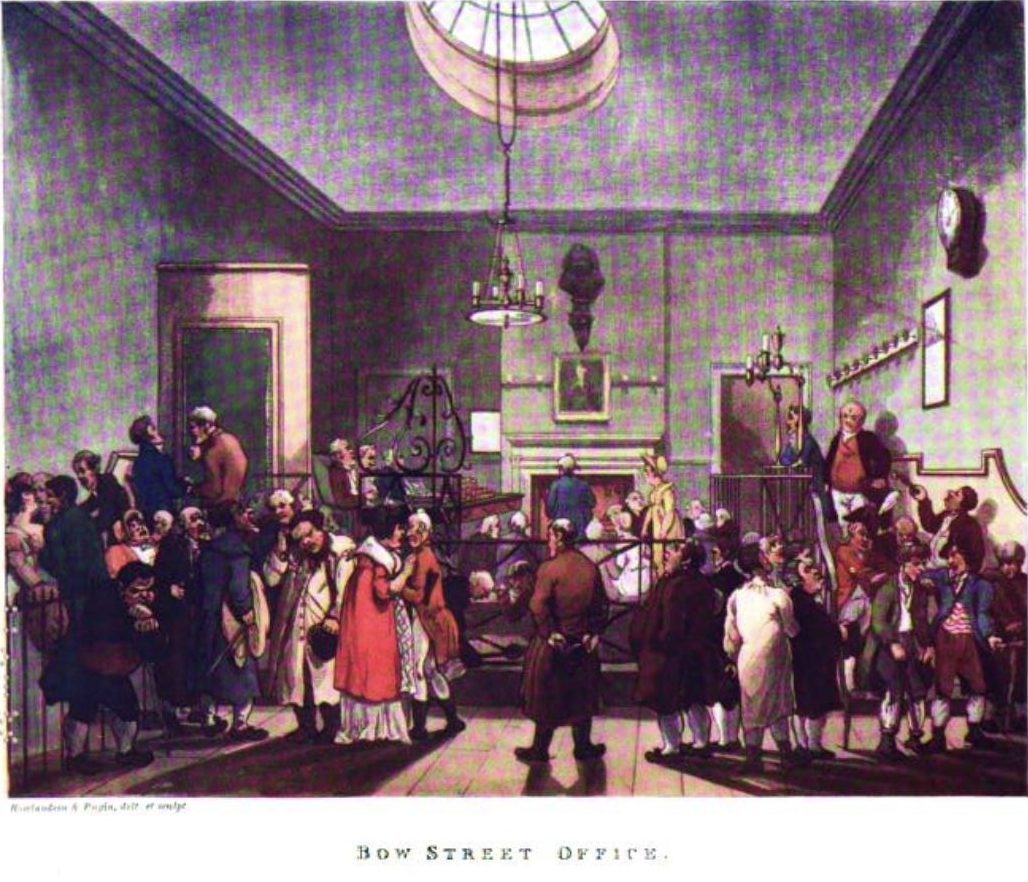
The annexed print gives an accurate representation of this celebrated office at the time of an examination: the characters are marked with much strength and humour, and the general effect broad and simple.
This office has the largest jurisdiction of any in the metropolis, its authority extending to every part of his majesty’s dominions, except the city of London, which is governed by its own magistrates.
Bow-street is, in a peculiar sense, the government office, besides acting as a police office in concert with the others, whose power extends only within a certain district. The police of this country has hitherto been very imperfect: the celebrated Henry Fielding was the first, who, by his abilities, contributed to the security of the public, by the detection and prevention of crimes. In August 1753, while a Bow-street magistrate, he was sent for by the Duke of Newcastle, on account of the number of street-robberies and murders committed nightly, and desired by the duke to form some plan for the detection and dispersion of the dreadful gangs of robbers by whom they were committed. Fielding wrote a plan, and offered to clear the streets of them, if he might have 600/. at his own disposal. The duke approved of his plan; and in a few days after he had received 200/. of the money, the whole gang was entirely dispersed; seven of them were in actual custody, and the rest driven, some out of town, and others out of the kingdom; and so fully had his plan succeeded, that in the entire freedom from street-robberies and murders, the winter of 1753 stands unrivalled during a course of many years. At this time the only profit arising to the magistrate was from the fees of his office: of the profits arising from these sources, however. Fielding had no very high opinion; after complaining that his maladies were much increased by his unremitted attention to his public duties, and having at that time a jaundice, a dropsy, and an asthma, he retired into the country, and from thence went to Lisbon, where he died. The following extract presents an agreeable specimen of that lively writer, still animated in all his sufferings, and it also gives a correct idea of the business of an active and upright magistrate at that time.
Fielding had been advised to try the Bath waters, but in consequence of the message from the Duke of Newcastle, and his exertions to free the metropolis from the desperate gangs of villains that infested it, his health considerably declined, and his was no longer a case in which the Bath waters are considered efficacious. The following account of himself and his office is from his Voyage to Lisbon:
“I had vanity enough to rank myself with those heroes of old times, who became voluntary sacrifices to the good of the public. But lest the reader should be too eager to catch at the word vanity, I will frankly own, that I had a stronger motive than the love of the public to push me on: I will therefore confess to him, that mv private affairs, at the beginning of the winter, had but a gloomy appearance; for I had not plundered the public or the poor of those sums which men who are always ready to plunder both of as much as they can, have been pleased to suspect me of taking; on the contrary, by composing the quarrels of porters and beggars, which I blush to say hath not been universally practised, and by refusing to take a shilling from a man who most undoubtedly would not have had another left, I had reduced an income of about 500/.* a year of the dirtiest money upon earth, to little more than 300/. an inconsiderable proportion of which remained with my clerk; and indeed if the whole had done so, as it ought, he would have been ill paid for sitting sixteen hours in the twenty-four in the most unwholesome as well as nauseous air in the universe.”
That this was the practice of Fielding, there can be no doubt: but that the conduct of some other justices was very flagrant, is equally indisputable; and the memory of the trading justices of Westminster, and Clerkenwell in particular, are handed down with abhorrence and contempt.
To Henry Fielding succeeded his brother, Sir John, who was many years an able and active magistrate.
Patrick Colquhoun, Esq. in his excellent work on the Police, exposed the defects of the system, and the necessity of a reform. It was taken into consideration by Parliament, and in 1792 an act was passed for that purpose, which established seven offices, besides Bow-street and the Marine Police; settled salaries were appointed to the magistrates, and the fees and penalties of the whole paid into the hands of a receiver, to make a fund for the paying these salaries and other incidental expences. This act of the 32d Geo. III. was amended by an act of the 37th, and by another of the 42d.
The present magistrates of Bow-street Office, 1808, are,
James Reed, Esq… £1000 per annum.
Aaron Graham, Esq.… 500
John Nares, Esq.… 500
Three clerks and eight officers.
It is impossible to make many extracts from Mr. Colquhoun’s valuable book. It is the basis of his system, that the numerous tribes of receivers in this metropolis are the great cause of the vice and immorality so widely prevalent, by the easy mode they hold out to the pilferer of disposing of what he has stolen, without his being asked any questions. There are upwards of three thousand receivers of stolen goods in the metropolis alone, and a proportionate number dispersed all over the kingdom.
Impressed with a deep sense of the utility of investigating the nature of the police system, the select committee of the House of Commons on finance turned their attention to this, among many other important objects, in the session of the year 1798; and after a laborious investigation, during which Mr. Colquhoun was many times personally examined, they made their final report; in which they recommended it to Parliament to establish funds, to be placed under the direction of the receiver-general of the police offices, and a competent number of commissioners: these funds to arise from the licensing of hawkers and pedlars, and hackney coaches, together with other licence duties proposed, fees, penalties, &c.; their payments subject to the approbation of the lords commissioners of the Treasury: the police magistrates to be empowered to make bye-laws, for the regulation of the minor objects of the police, such as relate to the controul of all coaches, carts, drivers, &c. and the removal of all annoyances, &c. subject to the approbation of the judges.
They recommended also the establishment of two additional police offices in the city of London, but not without the consent of the lord mayor, aldermen, and common council being previously obtained; and their authority to extend over the four counties of Middlesex, Kent, Essex, and Surry; and that of the other eight offices over the whole metropolis and the four counties also.
“It is proposed to appoint counsel for the crown, with moderate salaries, to conduct all criminal prosecutions.
“The keeping a register of the various lodging-houses.
“The establishment of a police gazette*, to be circulated at a low price, and furnished gratis to all persons under the superintendence of the board, who shall pay a licence duty to a certain amount.”
The two leading objects in the report are:
1st. The prevention of crimes and misdemeanours, by bringing under regulations a variety of dangerous and suspicious trades†, the uncontrouled exercise of which by persons of loose conduct, is known to contribute in a very high degree to the concealment, and by that means, to the encouragement and multiplication of crimes.
2d. To raise a moderate revenue for police purposes from the persons who shall be thus controuled, by means of licence duties and otherwise, so managed as not to become a material burden; while a confident hope is entertained, that the amount of this revenue will go a considerable length in relieving the finances of the country of the expences at present incurred for objects of police; and that in the effect of the general system a considerable saving will arise, in consequence of the expected diminution of crimes, particularly as the chief part of the expence appears to arise after the delinquents are convicted*.
As the leading feature of the report is the security of the rights of the innocent with respect to their life, property, and convenience, this will not only be effected by increasing the difficulty of perpetrating offences, through a controul over those trades by which they are facilitated and promoted; but also by adding to the risk of detection, by a more prompt and certain mode of discovery wherever crimes are committed. Thus must the idle and profligate be compelled to assist the state by resorting to habits of industry, while the more incorrigible delinquents will be intimidated and deterred from pursuing a course of turpitude and criminality, which the energy of the police will render too hazardous and unprofitable to be followed as a trade; and the regular accession of numbers to recruit and strengthen the hordes of criminal delinquents who at present infest society, will be in a great measure prevented.
Of the vigilance of the French system of police just before the Revolution, Mr. Colquhoun speaks highly. This system, which though neither necessary nor even proper to be copied as a pattern, might nevertheless furnish many useful hints, calculated to improve ours, and perfectly consistent with the existing laws; it might even extend and increase the liberty of the subject, without taking one privilege away, or interfering in the pursuits of any one class, except those employed in purposes of mischief, fraud, and criminality.
An anecdote related, on the authority of a foreign minister long resident at Paris, by Mr. C. will give a good idea of the secrecy of their system.
“A merchant of high respectability in Bourdeaux, had occasion to visit the metropolis upon commercial concerns, carrying with him bills and money to a very large amount.
“On his arrival at the gates of Paris, a genteel-looking man opened the door of his carriage, and addressed him to this effect: — ‘Sir, I have been waiting for you some time: according to my notes, you were to arrive at this hour; and your person, your carriage, and your portmanteau, exactly answering the description I hold in my hand, you will permit me to have the honour of conducting you to Monsieur de Sartine’.
“The gentleman, astonished and alarmed at this interruption, and still more so at hearing the name of the lieutenant of the police mentioned, demanded to know what M. de Sartine wanted with him; adding, at the same time, that he never had committed any offence against the laws, and that they could have no right to interrupt and detain him.
“The messenger declared himself perfectly ignorant of the cause of this detention; stating, at the same time, that when he had conducted him to M.de Sartine, he should have executed his orders, which were merely official.
“After some further explanations, the gentleman permitted the officer to conduct him to M. de Sartine, who received him with great politeness, and requesting him to be seated, to his great astonishment, described his portmanteau, and told him the exact sum in bills and specie which he had brought to Paris, where he was to lodge, his usual time of going to bed, and a number of other circumstances, which the gentleman had conceived could only be known to himself.
“M. de Sartine having thus excited attention, put this extraordinary question to him, ’Sir, are you a man of courage?’ The gentleman, still more astonished at the singularity of such an interrogatory, demanded the reason why he put such a strange question; adding, at the same time, that no man ever doubted his courage. M. de Sartine replied, ‘Sir, you are to be robbed and murdered this night! If you are a man of courage, you must go to your hotel, and retire to rest at the usual hour; but be careful that you do not fall asleep; neither will it be proper for you to look under your bed, or into any of the closets which are in your bedchamber: you must place your portmanteau in its usual situation near your bed, and discover no suspicion: — leave what remains to me.If, however, you do not feel your courage sufficient to bear you out, I will procurea person who shall personate you, and go to bed in your stead.’
“The gentleman being convinced, in the course of the conversation, that M. de Sartine’s intelligence was accurate in every particular, refused to be personated, and formed an immediate resolution literally to follow the directions he had received. He accordingly went to bed at his usual hour, which was eleven o’clock: at half past twelve (the time mentioned by M. de Sartine), the door of the bedchamber was burst open, and three men entered with a dark lantern, daggers, and pistols. The gentleman, who was awake, perceived one of them to be his own servant. They rifled his portmanteau undisturbed, and settled the plan of putting him to death. The gentleman, hearing all this, and not knowing by what means he was to be rescued, it may naturally be supposed was under great perturbation of mind during this awful interval; but at the moment the villains were prepared to commit the murder, four police officers, acting under M. de Sartine’s orders, who were concealed under the bed and in the closet, rushed out and seized the offenders with the property in their possession, and in the act of preparing to complete their plan.”
* “A predecessor of mine used to boast, that he made 1000/. a year in his office; but how he did it, is to me a secret. His clerk, now mine, told me I had had more business than he had ever known there; I am sure I had as much as any man could do. The truth is, that the fees are so very low, when any are due, and so much is done for nothing, that if a single justice of the peace had business enough to employ twenty clerks, neither he nor they would get much by their labour. The public will not therefore, I hope, think I betray a secret when I inform them, that I received from government a yearly pension out of the public service money; which I believe indeed would have been larger, had my great patron been convinced of an error which I have heard him utter more than once: — that he could not indeed say that the acting as a principal justice in Westminster was on all accounts very desirable, but that all the world knew it was a very lucrative office. Now to have shewn him plainly, that a man must be a rogue to make a very little this way, and that he could not make much by being as great a rogue as he could be, would have required more confidence than I believe he had in me, and more of his conversation than he chose to allow me; I therefore resigned the office, and the farther execution of my plan,to my brother.”
* This paper is called The Public Hue and Cri /, a police gazette, published every third Saturday in the month, at No. 240, Strand, and sent to the principal magistrates gratis.
† The trades alluded to are the following:
1. Wholesale and retail dealers in naval stores, hand-stuff, and rags.
2. Dealers in old iron and other metals.
3. Dealers in second-hand wearing apparel, stationary and itinerant.
4. Founders and others using crucibles.
5. Persons using draught and truck carts for conveying stores, rags, and metals.
6. Persons licensed to slaughter horses.
7. Persons keeping livery stables and letting horses for hire.
8. Auctioneers who hold periodical or diurnal sales.
The new revenues are estimated to yield 64,000/. The increase of the existing revenues is stated at 19,467/. Total, 83,467/.
* The amount of the general expence of the criminal police of the kingdom, is stated by the committee as follows:
1st. The annual average of the total expence of the seven public offices in the metropolis, from the institution in August 1792, to the end of the year 1797 . £ 18,281 18 6
2d. Total expence of the office in Bow-street in the year 1797, including remunerations to the magistrates in lieu of fees, perquisites, &c. and the expence of a patrol of sixty-eight persons 7,901 7 7
Total for the metropolis 26,183 6 1
The other expences incurred for the prosecution and conviction of felons, the maintenance, clothing, employment, and transportation of convicts, to which may be added the farther sums annually charged on the county rates, amounted in 1797 to 215,869 13 10|
The annexed print is a view of the great hall, which is conceived with a classic elegance, that does honour to the genius of the late Mr. Holland, who was the architect of Carlton House. The size of the hall is forty-four feet in length and twenty-nine in breadth. The entrance to the hall from the vestibule is by a flight of steps, which gives it an air of uncommon grandeur; it is supported by eight fine columns of the Ionic order, with architrave, frieze, and cornice. The ceiling is coved, and ornamented with plain caissons, and lighted by a skylight of an oval form. The columns are finely executed in scaglioni, of a yellow porphyry; the capitals and bases are bronzed, as are all the ornaments in the hall. In four corresponding niches are casts from the antique, of two Muses, the Antinous and the Discobulus; on the cornice are placed busts, urns, and griffins; over the niches are basso-relievos, which are also bronzed. At each . end of the hall is a stove of a new and elegant construction; six Termini of fine workmanship support a dome or canopy: the whole is executed in cast-iron bronzed. Over each fire-place is an allegorical painting in imitation of bronze basso-relievo, and compartments over the doors in the same manner: the tout-ensemble is striking and impressive. There is in this hall a symmetry and proportion, a happy adjustment of the parts to produce a whole, that are rarely seen; it is considered as the chef d’ oeuvre of Mr. Holland, and would do honour to any architect of any age or country.
Of the print it may be proper to say, that it is drawn with great accuracy and feeling, the perspective is easy and natural, and the general effect broad and simple. The figures are few, but introduced with great taste: it must be obvious, that a greater number would have impaired the general effect of the architectural design.
The new circular dining-room, when completed, will unquestionably be one of the most splendid apartments in Europe: the walls are entirely covered with silver, on which are painted Etruscan ornaments in relief, with vine-leaves, trellis-work, &c. There are eight fine Ionic columns in scaglioni, of red granite; the capitals and bases are silver, as are also the enrichments, moulding. See. of the architrave, frieze, and cornice: the latter is surmounted by an ornament that is somewhat Turkish in its character, and which, if it does not belong to the Ionic order, nevertheless adds to the splendour of the room. There are four immense pier glasses, and under each of them a fine marble chimney-piece of exquisite workmanship. As this sumptuous apartment is not yet completed, it would be improper to attempt a perfect description of it; indeed, almost the whole of Carlton House is undergoing alterations and improvements. On the south side of this apartment a door opens into the ballroom, a most magnificent and princely apartment: the walls are painted white, but the room is nearly covered with a profusion of gilding; the pilasters, architrave, frieze, and cornice are all covered with gold; the ceiling represents a pleasing sky, in which are genii sporting on the clouds; and in the compartments between the pilasters are some Etruscan ornaments, painted with great lightness and delicacy. On the opposite side another door opens into a new room, intended for a drawing-room, and though at present in a very unfinished state, it strikes the eye with the uncommon symmetry and harmony of its proportions.
Amid the curiosity and interest raised by a view of Carlton House, nothing can exceed that which is excited by an examination of
The Armory
This valuable and unique collection is a museum, not of arms only, but of various works of art, dresses, &c.: it is arranged with great order, skill, and taste, under the immediate inspection of His Royal Highness. It occupies five rooms on the attic story; the swords, firearms, &c. are disposed in various figures upon scarlet cloth, and inclosed in glass cases: the whole is kept in a state of the most perfect brightness. Here are swords of every country, many of which are curious and valuable, from having belonged to eminent men: of these the most remarkable is a sword of the famous Chevalier Boyard, the knight sans pear et sans reproche. The noble reply of this illustrious dying soldier, made to the Constable of Bourbon, deserves to be remembered. In the war between the Emperor Charles V. and Francis I. of France, the constable had gone over to the emperor, disgusted at the persecutions he met with in France, from the rage of Louisa of Savoy, the queen mother, whose overtures of marriage he had rejected. The emperor made the constable generalissimo of his armies; and in a battle which was fought in the duchy of Milan, and in which the French were obliged to retreat, the Chevalier Boyard was mortally wounded. Charles of Bourbon seeing him in this state, told him how greatly he lamented his fate. “It is not me” said the dying chevalier, “it is not me you should lament, but yourself, who are fighting against your king and country.” A sword of the great Duke of Marlborough, one of Louis XIV. and one of Charles II.: the two last are merely dress swords. A curious silver-basket-hilted broad sword of the Pretender’s, embossed with figures and foliage. But the finest sword in this collection is one of excellent workmanship, which once belonged to the celebrated patriot Hampden; it was executed by Benvenuto Cellini, a celebrated Florentine, who was much employed by Francis I. and Pope Clement VII.
Peter Torrigiano, who executed the monument of Henry VII. in Westminster abbey, endeavoured to bring over Cellini to England, to assist him; but Cellini disliking the violence of his temper, who used to boast that he had given the divine Michael Angelo a blow in the face with his fist, the marks of which he would carry to the grave*, refused to come with him. Vasari, who was contemporary with Cellini, speaks of him in the highest terms. He was originally a goldsmith and jeweller, and executed small figures in alto and basso-relievo with a delicacy of taste and liveliness of imagination not to be excelled: various coins of high estimation were executed by him for the Duke of Florence; and in the latter part of his life, he performed several large works in bronze and in marble with equal reputation. He wrote his own memoirs, which contain much curious and interesting information relative to the contemporary history of the arts.
The ornaments on the hilt and ferrule of the scabbard of this curious sword are in basso-relievo in bronze, and are intended to illustrate the life of David: it is a most beautiful piece of work, and in the highest preservation; it is kept with the greatest care in a case lined with satin.
In the armory is a youthful portrait of Charles XII. of Sweden, and beneath it is a couteau de chasse used by that monarch, of very rude and simple workmanship. A sword of General Moreau’s, and one of Marshal Luckner’s: but it would be impossible in our limits to notice a hundredth part of what is interesting in this collection.
In another room are various specimens of plate armour, helmets, and weapons; some Indian armour of very curious workmanship, composed of steel ringlets, similar to the hauberk worn by the Knights Templars, but not so heavy, and the helmets are of a different construction. Here are also some cuirasses, as worn at present in Germany; a very curious collection of firearms, of various countries, from the match-lock to the modern improvements in the firelock; air-guns, pistols, &c. In this room are also some curious saddles, Mamaluke, Turkish, &c.; some of the Turkish saddles are richly ornamented with pure gold.
Another room contains some Asiatic chain armour, and an effigy of Tippoo Sultaun on horseback, in a dress that he wore. Here are also a model of a cannon and a mortar on new principles; some delicate and curious Chinese works of art in ivory, many rich eastern dresses, and a palanquin of very costly materials.
In another apartment are some curious old English weapons, battle-axes,maces, daggers, arrows, &c.; several specimens also, from the Sandwich and other South Sea Islands, of weapons, stone hatchets, &c.
Our young men of fashion who wish to indulge a taste for antiquarian researches, may project the revival of an old pattern for that appendage of the leg called boots, from the series of them worn in various ages, which form a singular part of this collection.
In presses are kept an immense collection of rich dresses, of all countries; and indeed so extensive and multifarious are the objects, that to be justly appreciated it must be seen. His Royal Highness bestows considerable attention on this museum, and it has in consequence arrived in a few years to a pitch of unrivalled perfection. Among the dresses are sets of uniforms, from a general to a private, of all countries who have adopted uniforms, and military dresses of those who have not. All sorts of banners, colours, horse-tails, &c.; Roman swords, daggers, stilettoes, sabres, the great two-handed swords, and amongst the rest, one with which executions are performed in Germany, on the blade of which is rudely etched, on one side a figure of Justice, and on the other the mode of the execution, which is thus: — the culprit sits upon a chair, and the executioner comes behind him, and at one blow severs the head from the body. There are also some curious portraits in these apartments; besides the one of Charles XII. there is one of Frederic the Great, and various other princes and great men renowned for their talents in the art of war.
Of the exterior of Carlton House it may be sufficient to observe, that it is situated on the north side of St. James’s Park, and that the principal front faces Pall-Mall*. The portico is a most splendid and magnificent work, of the Corinthian order, enriched with every embellishment that elegant order is capable of receiving. It has been objected, that the other parts of this front are too plain to correspond with so rich a portico: the front is rustic, and therefore does not admit of ornament; but the eye is hurt by the violence of the transition from the most luxuriant decoration to the most rigid plainness. Carlton House, with its court-yard, is separated from Pall-Mall by a dwarf screen, which is surmounted by a very beautiful colonnade. A riding-house and stables, belonging to His Royal Highness, are at the back, immediately contiguous to St. James’s Park. The garden is laid out with the utmost taste and skill of which its limits are capable.
On the 8th of February, 1790, His Royal Highness the Prince of Wales had a state levee, for the first time, at his palace of Carlton House, which was the most numerous of any thing of the kind for many years; and, except the want of female nobility, was more numerous and splendid than the generality of the drawing-rooms even at St. James’s.
Carlton House was a palace belonging to the crown, and presented by His Majesty to His Royal Highness the Prince of Wales, on his coming of age, for his public town residence. The old building being out of repair, it was judged proper by Parliament to enable His Majesty to erect the present noble edifice in its room; and Mr. Holland had the honour of being appointed the architect. There is only one thing wanting in this palace, and which, from the present state of the arts, and still more the liberal manner in which they are at present patronized, we hope it is in His Royal Highness’s contemplation to supply. It is a collection of pictures by living artists; these, selected with His Royal Highness’s well known delicacy of taste and judgment, would complete the decorations of this truly magnificent and princely palace.
* This event happened in the palace of Cardinal di Medici: — Torrigiano being jealous of the superior honours paid to Michael Angelo, brutally struck him in the face; his nose was flattened by the blow: the aggressor fled, and entered into the army, but being soon disgusted with that life, left it and came over to England.
* Pall-Mall was formerly laid out as a walk, or place for the exercise of the mall, a game long since disused; its northern side being bounded by a row of trees, and that to the south by the old wall of St. James’s Park.
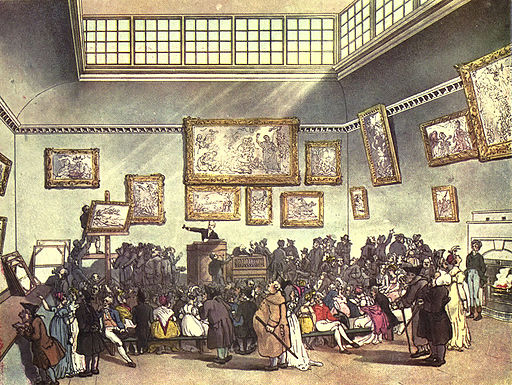
The print annexed is a spirited representation of that interesting scene, a public auction. The various effect which the lot (a Venus) has on the company, is delineated with great ability and humour. The auctioneer, animated with his subject, seems to be rapidly pouring forth such a torrent of eloquence as cannot fail to operate on the feelings of his auditors; indeed, having two of their senses enlisted in his favour, there seems to be little doubt that he will succeed. The eloquence of the rostrum is of a peculiar nature, Foote, who delineated every object that he chose with an astonishing truth and felicity, has, in his Minor, drawn an auctioneer with so much whim and drollery, and which, if a little outré, possesses so many striking characteristics, that it may serve for a portrait of the whole. Our animated auctioneer, adorning his Venus with all the flowers of rhetoric, seems to be saying, with Smirke in the Minor, “A-going for five and forty, — no body more than five and forty? — Pray, ladies and gentlemen, look at this piece! — quite flesh and blood, and only wants a touch from the torch of Prometheus, to start from the canvass and fall a-bidding!” And these flowers are not scattered in vain; (‘for,” continues Smirke, “a general plaudit ensued, — I bowed, and in three minutes knocked it down at sixty-three — ten”
The tout-ensemble of this print is marked with propriety and interest. The great variety of character, the masses of light and shade judiciously opposed to each other, the truth of the perspective, and the felicity of touch which the artist has adopted to give the idea of old pictures in the back ground, hwe the happiest effect imaginable.
That in the rage for purchasing old pictures the craft of experienced dealers should frequently impose upon those who might think it necessary to appear to have, what nature had denied them, taste and judgment, is not to be wondered at. All living genius was discouraged, or only found patrons in these dealers if they would condescend to manufacture for them Raphaels and Claudes, Corregios and Salvator Rosas. That they could not always get a sufficient supply of copies from Italy, the following extract from a valuable work may give some idea: — “Among the papers of a lately deceased virtuoso, I met with a few manuscript sheets, entitled ‘Hints for a History of the Arts in Great Britain, from the Accession of the Third George.’ The following extract proves, that painting pictures called after the ancient masters, was not confined to Italy: we had in England some industrious and laborious painters, who, like the unfortunate Chatterton, gave the honours of their best performances
To others. To the narrative there is no date, but some allusions to a late sovereign determine it to be a short time before we discovered that there were, in the works of our own poets, subjects as well worthy of the pencil as any to be found in the idle tales of antiquity, or the still more idle legends of Popery.
“The late edict of the emperor for selling the pictures of which he has despoiled the convents, will be a very fortunate circumstance for many of the artists in this country, whose sole employment is painting of old pictures; and this will be a glorious opportunity for introducing the modern antiques into the cabinets of the curious.
“A most indefatigable dealer, apprehensive that there might be a difficulty and enormous expence in procuring from abroad a sufficient quantity to gratify the eagerness of the English connoisseurs, has taken the more economical method of having a number painted here. The bill of one of his workmen, which came into my hands by an accident, I think worth preservation, and I have taken a copy for the information of future ages. Every picture is at present most sacredly preserved from the public eye, but in the course of a few months they will be smoked into antiquity, and roasted into old age, and may probably be announced in manner and form following:
‘To the Lovers of Virtu.
‘Mr. — has the heartfelt pleasure of congratulating the lovers of the fine arts upon such an opportunity of enriching their collections, as no period, from the days of the divine Apelles to the present irradiated era, ever produced; nor is it probable that there ever will be in any future age so splendid, superb, brilliant, and matchless ail assemblage of unrivalled pictures, as he begs leave to announce to the connoisseurs, are now exhibiting at his great room in; being the principal part of that magnificent bouquet, which has been accumulating for so many ages, been preserved with religious care, and contemplated with pious awe, while they had an holy refuge in the peaceful gloom of the convents of Germany. By the edict of the emperor, they are banished from their consecrated walls, and are now emerged from their obscurity with undiminished lustre! with all their native charms mellowed by the tender softening- pencil of time, and introduced to this emporium of taste! this favourite seat of the arts! this exhibition-room of the universe! and need only to be seen to produce the most pleasing and delightful sensations.
‘When it is added, that they were selected by that most judicious and quick-sighted collector. Monsieur D, it will be unnecessary to say more; his penetrating eye and unerring judgment, his boundless liberality and unremitting industry, have insured him the protection of a generous public, ever ready to patronise exertions made solely for their gratification.
‘N. B. Descriptive catalogues, with the names of the immortal artists, may be had as above.’
“THE BILL.
‘Monsieur Varnish, To Benjamin Bistre, Dr.
‘To painting the Woman caught in Adultery, on a green ground, by Hans Holbein £3 3 0
‘To Solomon’s wise Judgment, on pannel, by Michael Angelo . 2 12 6
‘To painting and canvass for a naked Mary Magdalen, in the undoubted style of Paul Veronese 2 2 0
‘To brimstone for smoking ditto 0 2 6
‘Paid Mrs. W for a live model to sit for Diana bathing, by Tintoretto 0 16 8
‘Paid for the hire of a layman, to copy the Robes of a Cardinal, for a Vandyke 0 5 0
‘Portrait of a Nun doing Penance, by Albert 0 2 2
‘Paid the female figure for sitting thirty minutes in a wet sheet, that I might give the dry manner of Vandyke* 0 10 6
‘The Tribute Money rendered with all the exactness of Quintin Mestius, the famed blacksmith of Antwerp 2 12 6
‘To Ruth at the Feet of Boaz, on an oak board, by Titian 3 3 0
‘St. Anthony preaching to the Fishes, by Salvator Rosa 3 10 0
‘The Martyrdom of St. Winifred, with a view of Holy well Bath, by Old Frank 1 11 6
‘To a large allegorical Altar-piece, consisting of Men and Angels, Florses and River-gods; ’tis thought most happily hit off for a Rubens 5 5 0
‘To Susannah bathing; the two Elders in the back ground, by Castiglione 2 2 0
‘To the Devil and St. Dunstan, high finished, by Teniers 2 2 0
‘To the Queen of Sheba falling down before Solomon, by Murillio 2 12 6
‘To Judith in the Tent of Holofernes, by Le Brun 1 16 0
‘To a Sisera in the Tent of Jael, its companion, by the same 1 16 0
‘Paid for admission into the House of Peers, to take a sketch of a great character, for a picture of Moses breaking the Tables of the Law, in the darkest manner of Rembrandt, not yet finished 0 2 6
It is to be hoped, that a general knowledge and taste for the arts are now so far diffused among us, that the nobility and gentry are awake to living merit, and can properly appreciate those powers by which the old masters have acquired their high reputation. They are no longer to be imposed on by the stale tricks of those jugglers in picture-craft, who made large fortunes by their ill-reposed confidence. A few recent examples will suffice to prove the increased taste and judgment of the public.
In March 1795, the very fine collection of pictures by the ancient masters, the property of Sir Joshua Reynolds, was sold by auction for 10,319/. 2s. 6d .; and in April 1796, various historical and fancy pieces of his own painting, together with some unclaimed portraits, were sold for 4505/. 18s. His very valuable collection of drawings and prints is not yet disposed of.
In April 1806, thirty-two choice Flemish pictures were sold by auction, and produced 6733 guineas. One of them, by Paul Potter, was knocked down at 1450 guineas; though this, it is said, was bought in.
But it is only for works of the very first-rate excellence, which, in the present state of pictorial knowledge, the nobility and gentry will be liberal; and many speculators in second and third-rate pictures have been miserably disappointed, notwithstanding the pompous and high-sounding names with which they crowded their catalogues. In the year 1802, Count Hagen consigned to England a collection of pictures, the catalogue of which announced a most select assemblage of the very first masters; and the prices they were valued at raised the expectation of cognoscent to the highest pitch: their number was about sixty, and their value he estimated at 20,000/. After many consultations whether they should be exhibited and sold by private contract, or public auction, the latter were as determined on; and that Mr. Christie, instead of two days’ view, should allow a week for their exhibition. This being settled, the sale came on, and the produce did not nearly cover the expences: it is true, that four of the best were bought in and sent back to Dresden; but the proprietor had a deficit to pay upon the others amounting to 183/. 16s. besides the freight, &c. for the return of the four unsold: so that he paid for selling his pictures, and gave them into the bargain.
About the same time a Mr. Lemmer arrived with another cargo from Vienna. This was a smaller collection, amounting to about thirty: it was generally supposed that they belonged to Count Harrach. This collection, however, met with no better success: for, after a long private exhibition, a public sale was resorted to; and the result was, that Mr. Lemmer let his rubbish go for whatever it would fetch, and bought in all the pictures that were tolerable. This mad speculation, considering the great distance, the travelling of three people in a carriage built on purpose, and drawn by six horses, and a residence of above eight months in London, could not have cost the noble speculator less than 12 or 1500/.
The fate of the Truschessian gallery is still a stronger proof of the absurd notions which foreigners entertain of the knowledge and judgment of English collectors. The count brought over a collection consisting of above one thousand pictures: and that among them were several chefs d’oeuvres, cannot be denied; but he asserted that the whole were unique, and of themselves sufficient to form a splendid national gallery; and, by his estimation, at a fourth part of their real value, they were worth 60,000/. But as Messrs. Fries, bankers at Vienna, had advanced 27,000/. to the count, and taken this collection as a security, after many unsuccessful endeavours to dispose of it, the mortgager determined to sell by public auction those not sold by private sale. These pictures were publicly exhibited for about two years: of course their merits and demerits would be fully ascertained. The net produce of the public and private sale did not amount to more than 18,000/.: and here it must be observed, that the mortgagees bought in more than twenty of the best, which they accounted for to the proprietor at the sums the auctioneer knocked them down at, and which are included in the 18,000/.
By the statute 19th Geo. III. c. 56. s. 3. it is provided, that no person shall exercise the trade or business of an auctioneer, or seller by commission, at any sale of estate, goods, or effects whatsoever, whereby the highest bidder is deemed the purchaser, without taking out a licence; which, if it is in the bills of mortality, shall be granted by the commissioners of excise, and elsewhere by the collectors, supervisors, & c.; for which licence to sell by auction in any part of England or Wales, shall be paid the sum of twenty shillings, and elsewhere five shillings; and the said licence shall be renewed annually, ten days at least before the expiration of the former; and if any person shall act without such licence, he shall forfeit 100/. if it is within the bills, and elsewhere 50/.
All kinds of property sold by auction, except cloth wove in this kingdom, and sold in the piece as taken from the loom, and in lots of 20/. or upwards, pays a duty of seven-pence in the pound; and the auctioneer shall give a bond on receiving his licence, with two sureties in 5000/. that he will, within fourteen days after every such sale, deliver an account thereof at the next excise-office, and will not sell any goods contrary to the directions of this act, 27th Geo. III. c. 13. &c.
Christie’s Auction Room
*Some of the ancient masters acquired a dry manner of painting from studying after wet drapery. WEBB on painting.
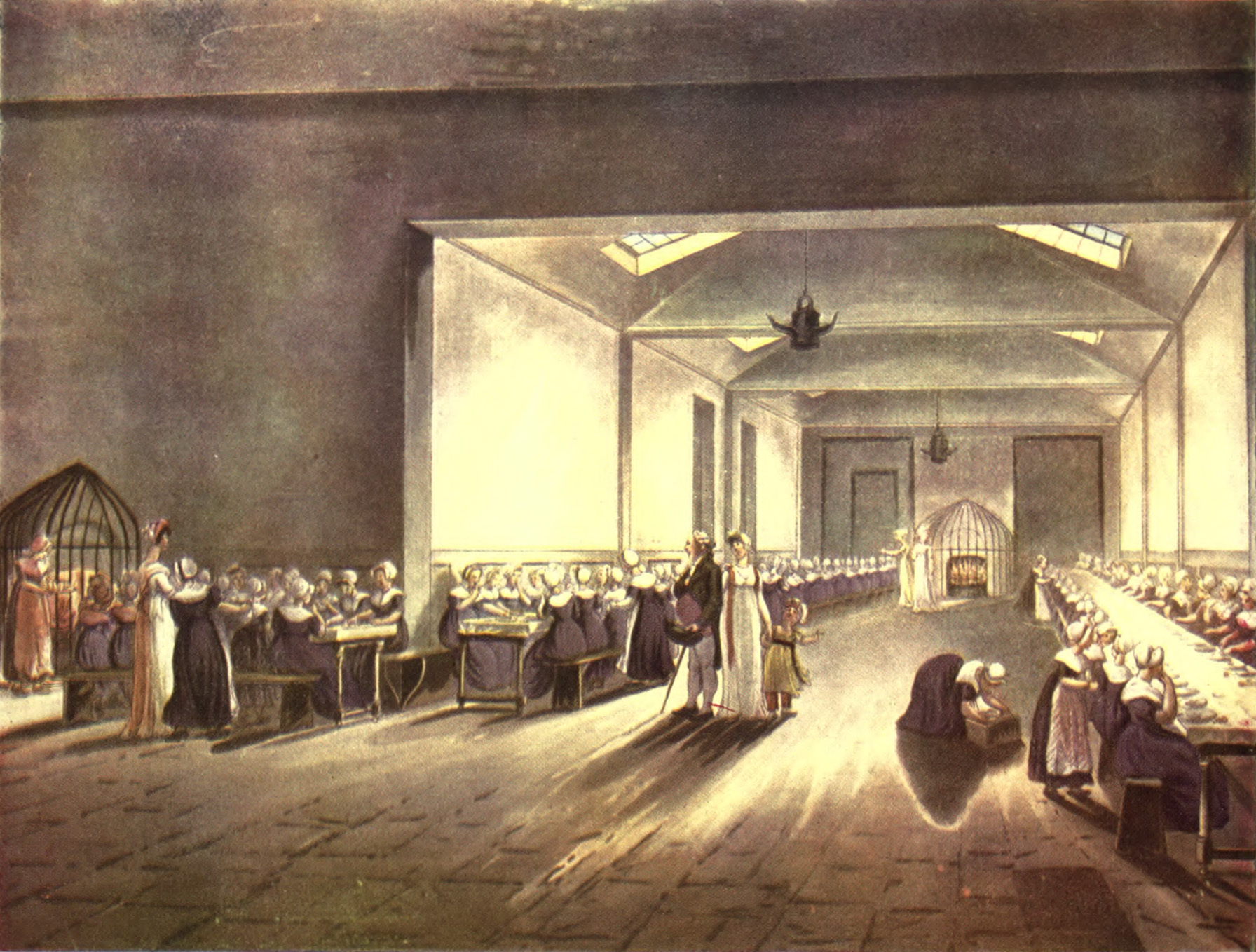
Is in the parish of Lambeth, in Surry, and was instituted in the year 1758, for the reception of friendless and deserted girls, the settlement of whose parents cannot be found. It was incorporated in the year 1800.
The annexed print is an interesting representation of the objects of this benevolent institution at their repast, in the presence of some of their guardians, who seem to contemplate the good order, cheerfulness, innocence, and comforts of their little wards, with all that interest and delight, that luxury of fine feeling, which irradiates the countenance when the heart is glowing with benevolence, animated with the exercise of an important duty, and gratified by the conviction that their virtuous endeavours are crowned with success. The coup d’ceil of the print is most impressive, and does great honour to’ the talents and feelings of the artists. The sweet innocence of the children, the benevolence of the guardians, and the chaste and matron-like simplicity of the building, aided by a fine breadth of effect, form a whole, which at the same time that the parts are in perfect harmony with each other, is admirably calculated to awaken the tender emotions of the humane heart, and excite the spectator to the exertion of those tender and kindly feelings, which do honour to our nature.
This charity owes its establishment to that vigilant and active magistrate. Sir John Fielding; who had long observed, that though the laws of this kingdom provided a parish settlement for every person, by birth, parentage, apprenticeships, &Y. yet many cases continually occurred, in which such settlements were difficult, if not impossible, to be ascertained; and therefore he and others were solicitous to remove, in part, this source of female wretchedness. By their exertions, and the continued endeavours of those who have hitherto conducted the plan, their benevolent intentions have been rewarded with the most signal success. The generous and discerning public has bestowed the means, which have prospered in the hands of the guardians, by whose care two hundred deserted females are daily sheltered and protected from vice and want, supplied with food and raiment, and taught whatever can render them useful in their situation, or comfortable and happy in themselves.
Carefully instructed in the principles of religion; in reading, writing, needlework, and household business, they are trained to habits of industry and regularity, by which means there is a supply of diligent and sober domestics for the use of that public, which, by its contributions, has so nobly acquired a right to their services.
The particular objects of this charity are, the children of soldiers, sailors, and other indigent persons, bereft of their parents, at a distance from any of their relations; who being too young to afford the necessary information respecting settlements, are often left destitute of protection and support, at an age when they are incapable of earning a subsistence, and contending with surrounding dangers.
Females of this description are, in a particular manner, the objects of compassion, and have also a double claim to the care of the humane and virtuous, from being not only exposed to the miseries of want and idleness, but, as they grow up, to the solicitations of the vicious, and the consequent misery of early seduction.
The following are some of the regulations for the government of this charity, which have been made by the guardians from time to time, and now continue in force.
Qualifications of Guardians.
The qualification of an annual guardian is, a yearly subscription of three guineas or upwards.
The qualification of a perpetual guardian is, a subscription of thirty guineas or upwards.
Legacies bequeathed to the use of this charity of one hundred pounds or upwards, when paid, shall entitle the first-named acting executor to be a perpetual guardian.
The guardians, conceiving it to be very essential for promoting one of the chief objects of this institution, earnestly solicit the ladies, who are particularly qualified for that purpose, frequently to visit the charity, inspect the management of the house, and particularly the employment of the children; also to see that they are properly instructed in housewifery, so as to be qualified for useful domestic servants; and from time to time communicate to the committee, by letter or otherwise, such observations as they shall deem proper to make.
Employment of the Children.
The children are to make and mend their own linen; make shirts, shifts, and table-linen; to do all kinds of plain needle-work, and to perform the business of the house and kitchen; to which latter twelve are appointed weekly, according to their age and abilities, to assist the cook, to wash, iron, and get up all the linen. They are likewise taught to read the Bible, write a legible hand, and understand the first four rules in arithmetic.
All kinds of plain needle-work are taken in at the Asylum, and performed
by the children at certain rates, which are regulated by the committee.
The following ore the Rules for placing out the Children.
They are to be bound apprentices for seven years, at the age of fifteen, or sooner, as domestic servants to reputable families in Great Britain.
No girl shall be apprenticed until the character of the master or mistress applying for the same, shall have been enquired into, and approved of by the committee.
Every person applying for an apprentice must appear at the committee, to give the necessary information respecting their situation, unless such appearance be dispensed with by the committee.
When any girl shall become qualified to be an apprentice, the guardian who presented her shall be acquainted therewith, in order to know if such guardian has any place in view for her.
The guardians, desirous of encouraging the children to serve their apprenticeship faithfully, have empowered the committee to grant any orphan apprenticed from the charity, who shall produce to the committee a certificate, signed by her master or mistress (or both if living), of her good behaviour during her apprenticeship, the sum of five guineas, such orphan having first returned public thanks in the chapel for the protection she has received. The committee are empowered to put out at any time, to any trade they shall think proper, such orphans as may have contracted any disease or infirmity, which may render them incapable of domestic service, with a premium not exceeding ten pounds.
The Establishment is as follows:
Patroness of the Institution.
Her Most Gracious Majesty the Queen of Great Britain
President.
His Royal Highness Prince Adolphus Frederick, Duke of Cambridge.
Vice-Presidents.
The Marquis of Blandford.
Right Honourable Earl Spencer, K. G.
Right Honourable Earl Mansfield.
Right Honourable Admiral Lord Radstock.
Right Honourable Lord Chief Baron.
Sir William Leighton, Knight and Alderman.
A chaplain, a morning preacher, an evening preacher, two physicians, two surgeons, an apothecary, a secretary, messenger, and collector. There are also a treasurer, and a committee consisting of nineteen gentlemen, that are elected annually at the general court held every April. Concerning these for each year, and many other things relative to this praise-worthy institution, every necessary particular may be found in a small abstract account to be had at the Asylum; from which we extracted the following regulations respecting devises or bequests to the charity, as we have much besides in the preceding pages.
Well-disposed persons, who may be inclined to make devises of rent, or bequests of personal property, for the benefit of this charity, being authorised so to do by the act of Parliament whereby it is incorporated, will be pleased to make such devises and bequests to this corporation by the style and title of The President, Vice-presidents, Treasurer, and Guardians of the Asylum for the Reception of Orphan Girls, the Settlement of whose Parents cannot be found.
Bankers and Receivers .
Messrs. Hankey and Co. Fenchurch-street.
Messrs. Drummond, Charing-Cross.
Messrs. Hoares, Fleet-street.
Messrs. Croft and Co. Lombard-street.
Messrs. Vere, Lucadon, and Co. Lombard-street.
Messrs. Sikes, Snaith, and Co. Mansion-house-street.
The committee, who meet at the Asylum every Thursday, at eleven o’clock in the forenoon.
Charles Wright, Esq. treasurer, and The Rev. Mr. Agutter, at the Asylum, chaplain and secretary.
We shall close the account of this benevolent institution with the animated apostrophe of the amiable Pennant.
“It is an institution of a most heavenly nature, calculated to save from perdition of soul and body the brighter part of the creation; those on whom Providence hath bestowed angelic faces and elegant forms, designed as blessings to mankind, but too often debased. The hazards that these innocents are constantly liable to from a thousand temptations, from poverty, from death of parents, from the diabolical procuress, and sometimes from the stupendous wickedness of parents themselves, who have been known to sell their beauteous girls for the purpose of prostitution, induced a worthy hand, in the year 1758, to found the Asylum, or House of Refuge. Long may it flourish, and eternal be the reward of those into whose mind so noble a design entered!”


 Susana's Parlour