Tag Archive | George II

The Microcosm of London or London in Miniature: The British Museum

published by Rudolph Ackermann in 3 volumes, 1808–1811.

or models in sculpture. But portraits, whether in large or in miniature, drawings in water colours, and architectural drawings, are inadmissible.”

The artists pay towards the fund two and a half per cent, on those pictures which are sold; and they have since gratuitously added another two and a half per cent, to Mr. V. Green, the keeper; a very proper compliment to his unremitting attention and gentlemanly conduct in his office.

The annexed print gives a correct and interesting view of this very fine suite of rooms, and the figures have great spirit and appropriate character.

The annexed print is a view of the grand staircase, taken from the first landing-place, and has a magnificence becoming the residence of a nobleman: it is drawn with great taste and knowledge; the figures are judiciously introduced, and relieve the eye from the unvarying lines of perspective, and the whole presents a coup d’oeil that fills and satisfies the mind.

Montague House was rebuilt for Ralph, Duke of Montague, at the expence of Louis XIV. King of France, in 1678*, by Pouget.

Walpole observes of it, that “what is wanted in beauty, is compensated by the spacious and lofty magnificence of the apartments ” How far this observation is founded in truth, must be in some degree determined by the taste of the reader. The principal parts of the house are decorated by three painters, the historical and allegorical parts by La Fosse, landscapes by Rousseau, and flowers by Jean Baptist Monoyer. The union of these discordant styles produces a kind of garish splendour, which, with the heavy carved and gilt furniture of that day, must have had a large portion of cumbrous magnificence.

The British Museum was established in the year 1753, in consequence of Sir Hans Sloane bequeathing his valuable collection and library, which cost him 50,000/. to Parliament, on condition that they paid his executors 20,000/. for it. The money was raised the same year, by a guinea lottery.

In 1756, the valuable legacy of Egyptian antiquities collected by the late Colonel Lethulier, together with that of his nephew, were added to it.

The Harleian MSS. collected by Lord Oxford’s family, were purchased for 10,000/.; a collection of books, and also 7000/. in cash, left by Major Edwards: in addition to the Cottonian, is the library of Mr. Maddox, historiographer to his majesty, given by his widow.

In 1757, George II. gave the royal library, which consists of about ten thousand books, with eighteen hundred MSS. all collected by the different kings of England. The Cracherode collection has also been since added.

In 1772, by a vote of the House of Commons for the purchase of Sir William Hamilton’s collection of Etruscan, Grecian, and Roman antiquities, the sum of 8410/. was granted, and 840/. to the trustees to provide a repository for them. In 1804, a grant of 8000/. was voted towards an additional building for the reception of the Egyptian antiquities brought over by the expedition under Sir Ralph Abercrombie; and in 1805, a further grant of 8000/. for the same purpose.

In 1805, a grant of 20,000/. was voted for the purchase of the Townleian collection of Greek and Roman antiquities.

A collection of MSS. which were in the possession of the late Marquis of Lansdown, has been purchased for 4800/.

It is impossible in our limits to convey an adequate idea of the immensity of this collection; we shall, therefore, merely give a cursory glance at the general contents of the apartments in the order they are shown to visitors.

The first room contains a vast number of curiosities brought by Captains Cook, Byron, & c. from New Zealand, Otaheite, the Friendly and Sandwich Islands, western coast of California, 8cc.; consisting of dresses, weapons, canoes, fishing tackle, idols, and a variety of matters, remarkable for their ingenuity and exquisite taste.

Second room is a miscellaneous collection of the Harleian curiosities: there are two mummies, various models of works of art, weapons of the ancient Britons, Mexican idols, Chinese and Indian models, &c. and the celebrated portrait of Oliver Cromwell by Cooper.

Third room contains the Lansdown collection.

Fourth room, MSS. Sloaniana.

Fifth, Harleian library: a very curious inscription taken from the breast of a mummy; and portraits of Oliver Cromwell, Charles XII. the Czar Peter, Andrew Marvell, Algernon Sydney, Sir H. Vane, Sir Anthony More, Sir P. P. Rubens, Ben Jonson, and M. S. Merian, celebrated for the exquisite collection of insects painted by her.

Sixth, Harleiana library; containing portraits of Cranmer, Usher, Burleigh, Salisbury, Spelman, Dugdale, Cosmo de Medicis, Duke of Marlborough, Louis XIV. and a beautiful portrait of the unfortunate Duke of Monmouth.

Seventh, The royal library; containing the original Magna Charta; the portraits of Edward III. Henry II. Henry V. Henry VI. Countess of Richmond, Henry VIII. Edward VI. Mary, Elizabeth, Mary Queen of Scots, James I. Charles I. Henrietta, Charles II. William III. Speed, Camden, &c.

Eighth, Banqueting-room, contains only a portrait of George II. and a table made of various specimens of lava. In this room the three painters have exerted all their powers of decoration: it gives a perfect idea of the magnificence of that time, but it is heavy and incongruous; there are many good parts, but they do not unite.

Ninth, Sloane and Cracherode collection — volcanic minerals, spars, &c.

Tenth, Sloane and Cracherode — shells and petrifactions.

Eleventh, Sloane — marine productions and reptiles.

Twelfth, Sloane — birds and beasts.

Thirteenth, Fish and serpents.

Fourteenth, On the staircase is a crocodile 21 feet long.

The noble collections of Sir William Hamilton, Mr. Townley, and the Egyptian antiquities, are arranging in the new building, but not yet opened for public inspection.

The present establishment is as follows:

Forty-one trustees, twenty by virtue of their offices, six representing the Sloane, Cotton, and Harleian families, marked S. C. II. and fifteen chosen by the former twenty.

TRUSTEES BY OFFICE.

  • Archbishop of Canterbury.
  • The Lord Chancellor.
  • Lord President of the Council.
  • First Lord of the Treasury.
  • Lord Privy Seal.
  • First Lord of the Admiralty.
  • Lord Steward.
  • Lord Chamberlain.
  • Three Secretaries of State.
  • Bishop of London.
  • Speaker of the House of Commons.
  • Chancellor of the Exchequer.
  • Lord Chief Justice of the King’s Bench.
  • Master of the Rolls.
  • Lord Chief Justice of the Common Pleas.
  • Attorney General.
  • Solicitor General.
  • President of the Royal Society.
  • President of the College of Physicians.

FAMILY TRUSTEES.

  • C. Sir George Cornwall, Bart. LL. D.
  • H. Marquis of Tichfield.
  • C. Francis Annesley, Esq. 
  • S. Hans Sloane, Esq. F. R. S.
  • H. Duke of Portland, F. R. and A. S. LL. D. K. G.

TRUSTEES ELECTED.

  • Dean of Lincoln.
  • Henry Cavendish, Esq. F. R. S.
  • Marquis Townshend, P. S. A. LL. D. and F. R. S.
  • Earl Aylesford.
  • Earl Spencer, K. G.
  • Duke of Grafton, K. G.
  • Lord Frederic Campbell.
  • Marquis Bute.
  • Bishop of Durham.
  • Earl of Hardwicke, K. G.
  • Right Hon. Sir William Scott.
  • Right Hon. George Rose.
  • Lord St. Helen’s.

Principal librarian, Joseph Planta, Esq.

Librarian of the MSS. department, F. Douce, Esq. and his assistant, the Rev. T. Maurice.

Printed books, Henry Ellis, Esq. and the Rev. H. Harvey Baber.

Natural history, Dr. Shaw and Charles Konig, Esq.  

Coins and medals, Taylor Combe, Esq.

Secretary, Mr. Edward Bray.

The Museum is open Mondays, Wednesdays, and Fridays, except Christmas, Easter, and Whitsun-week, on Thanksgiving and Fast-days, and during August and September. Persons wishing admittance are to apply at the anti-room, between the hours of ten and two, and inscribe their names and residence in a book kept there. Five companies of not more than fifteen each are admitted, at ten, eleven, twelve, one, and two o’clock; but there is no necessity for fifteen going in one party, the first fifteen names on the book are admitted together, if they should happen to be all strangers to each other.

The reading-room is open, under certain regulations, from ten till four every day, except Saturdays and Sundays.

N. B. When the new rooms are opened for the inspection of visitors, it is understood that eight companies, instead of five, will be admitted.

* The Duke of Montague was at that time at the court of France, when receiving intelligence that his house was destroyed by fire, his spirits became greatly depressed, which induced Louis XIV. to send artists to London, to repair the losses the noble duke had sustained.
Back to Table of Contents

Amusements of Old London: The Play Tables

Amusements of Old London

William B. Boulton, 1901

“… an attempt to survey the amusements of Londoners during a period which began… with the Restoration of King Charles the Second and ended with the accession of Her Majesty Queen Victoria.”

Hazard & White’s

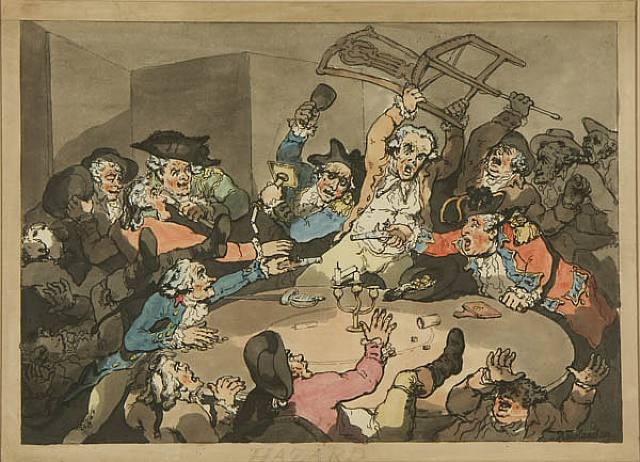
Hazard, the precursor of crap) was a game of pure chance where all players had a fairly equal chance of winning. But as it spread into the lower classes, “organized cheating at low taverns and gaming-houses became a regular profession.” Loaded dice was one way, but there were plenty of other ways. The often violent responses to cheating are illustrated in Rowlandson’s “Kick up at a Hazard Table.”

rowlandson-kickup-at-hazard-table

The game of hazard first became popular in the late 17th century at  the coffee-houses, such as (Mrs.) White’s Chocolate House and The Cocoa Tree. Early in the next century, the more fashionable gentlemen at White’s, wishing to avoid the card sharps and other unpleasant types that were inevitably present at these places, formed a more exclusive, private club, “where they could lose fortunes to each other in all privacy and decorum.” Considered by critics to be a “pit of destruction,” White’s saw many fortunes change hands at the turn of a dice.

Young Mr. Harvey of Chigwell, for instance, lost £100,000 to Mr. O’Birne, an Irish gamester. “You can never pay me,” said O’Birne. “Yes, my estate will sell for the money,” was the spirited reply. “No,” said O’Birne, “I will win but ten thousand, and you shall throw for the odd ninety.” They did so and Harvey won, lived to become an admiral, and to fight under Nelson at Trafalgar.

The Georges and Gaming at Court

It was a necessary qualification of a courtier of George the Second to be prepared to sit down with that monarch and the Suffolks and Walmodens and the other picturesque appanages of the court and lose a comfortable sum. Twelfth Night was always a fixture for a sitting of more than ordinary importance at St. James’s. On one of these occasions luck was in favour of Lord Chesterfield, who won so much money that he was afraid to carry it home with him through the streets, and was seen by Queen Caroline from a private window of the palace to trip up the staircase of the Countess of Suffolk’s apartments. He was never in favour at court afterwards.

George III, on the other hand, banished gaming at court and even White’s gambling became quite tame, which is why Almack’s (later Brooks’s) was opened as a venue for serious gamesters, such as Charles James Fox, who was known for playing carelessly “for the excitement alone,” without any concern for the consequences. On one particular day in 1771, after playing hazard for twenty-two hours and losing £11,000, he gave a speech at Westminster, went to White’s and drank until seven in the morning, and then to Almack’s, where he won £6,000, and later in the afternoon took off for Newmarket. A week later, he was back in London and lost £10,000.

Faro

The game of Faro evolved from a game called “basset,” played in the Stuart courts.

Faro was played between the dealer or keeper of the “bank” and the rest of the company, and, like hazard, it gave excitement to as many people as could find room round the table… Each of the company placed his stake upon any card of the thirteen he chose, and when the stakes were all set the dealer took a full pack and dealt it into two heaps, one on his right hand the other on his left, two cards at a time. He paid the stakes placed on such cards as fell on the right-hand pack, and received those of such as fell on his left hand. The dealing of each pair of cards was called a “coup,” and the dealer paid or received such stakes as were decided after each coup… [t]he odds were enormously in favour of the dealer. He claimed all ties, that is, when the same card appeared on both packs, the last card but one of the pack delivered its stake to him upon whichever hand it fell, and there was the impalpable but very real advantage of which was known as the “pull of the table” in his favour.

At Brooks’s, where faro reigned supreme, Charles James Fox and Richard Fitzpatrick (a Whig associate) had a very successful partnership. Lord Robert Spencer’s partnership with Mr. Hare enabled him to win £100,000, whereupon he gave up gambling entirely and purchased an estate in Sussex. “The success of the faro banks at Brooks’s was such that it led to the game being forbidden at White’s by a special rule of the managers.”

Faro, however, was played at many of the great houses and by women of fashion, who would “hire a dealer at five guineas a night to conduct operations, and to suggest that the profits of the table went to him and not to the hostess… to disguise the commercial nature of the transaction…”

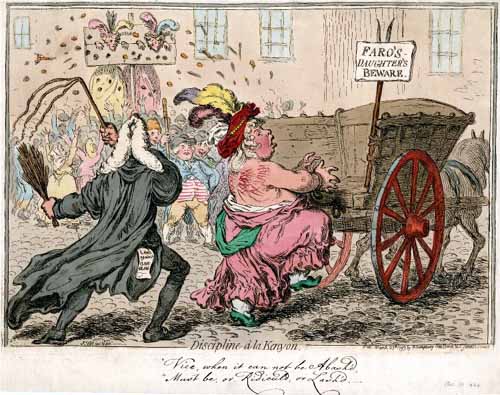
Following the 1797 public scandal in the courts where three society ladies were each fined £50 for playing at a public gaming-table—and the popularity of Mr. Gillray’s prints, such as “Pharaoh’s daughters in the pillory and at the cart tail”—the game lost much of its following.

faros-daughters-gillray

E.O.

E.O., a type of of roulette with a ball and a special table, called roly-poly, from the Continent, found at race meetings, country fairs, and the streets of London, lent itself well to cheating. Colonel O’Kelly, the eventual owner of Eclipse set himself up in business by winning at E.O.

Gaming Houses and the Damage They Caused

Cheap gaming houses all over town featured hazard, roulette, rouge et noir, and macao for small stakes. Frequent raiding did not discourage them, since fines were easily paid.

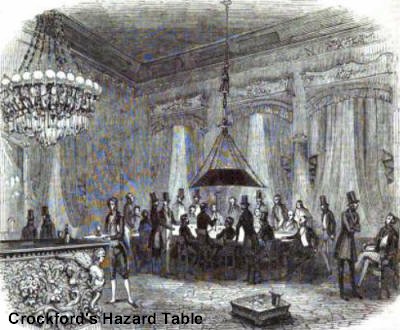
A hazard table at Crockford's

A hazard table at Crockford’s

The mischief these places did is almost incalculable; bankruptcies, embezzlements, duels, and suicides resulting from gaming were of weekly occurrence, and it would seem that half the tradesmen and clerks of London were before the magistrates or the coroners of the last years of [the 18th] century and the first quarter of [the 19th].

Hazard and faro had gone out of the older clubs, and club gaming of the [early 19th century] was represented by extremely deep play at whist at White’s and Brook’s. Macao flourished for a while at Wattiers, where the members lived on each other for some eight or ten years until their estates disappeared and the club expired by the flight of its supporters to Boulogne.

Such were the houses in which round games flourished after their decline at the great clubs. They steadily drained the pockets of the aristocracy of England for nearly half a century, and there is scarcely a great family to-day which does not still feel the effects of the play that went on within their doors sixty years ago.

Crockford’s Club

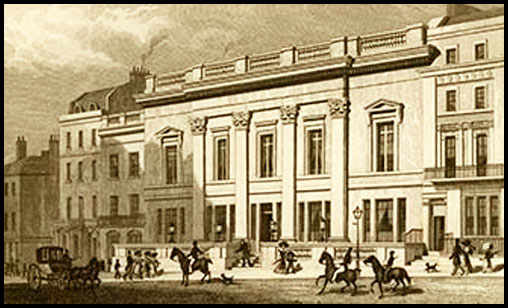
crockford_william_npgthomasjonesWilliam Crockford, a fishmonger who had a shop in the Strand near Temple Bar, made a killing on a turf transaction and rose from partnerships in shady gaming establishments to spending £94,000 to open his own fashionable club, Crockford’s Club, in 1827.

There is one thing, and one only, to be said in favour of Mr. Crockford’s enterprise, which, is that this establishment did away with the practice of gentlemen playing against each other for large sums. At Crockford’s, the game was one of Gentlemen versus Players, the players being always Mr. Crockford’s officials at the French hazard table, and the sole object of his business was to win the money of his patrons.

A committee of gentlemen was given charge of accepting and rejecting members, with the effect of making “entry to Crockford’s as difficult as to White’s or Brooks’s.” The price of subscription to Crockford’s establishment was low, but “in exchange for the princely accommodation of his house, and such fare as was unobtainable at any other club, Crockford asked for nothing in return that gentlemen should condescend to take a cast at his table at French hazard.” This incarnation of the old game required a fee called “box money” and “the pull of the table” that went directly into the coffers of the house.

crockfords-club

The men who walked into Crockford’s with their eyes open to encounter these odds were the pick of the society of the day, the men who had fought the battles of the country under Wellington, and men who were making great reputations at Westminster, as well as mere butterflies like the Dandies who loafed through life at White’s. They were most of them men of exceptional parts, and distinguished for shrewdness and ability in one walk of life or another, and yet in the short space of ten years, between the opening of the club in 1827 and the succession of her Majesty, their losses converted Mr. Crockford into a millionaire at least. There is absolutely no record of any considerable sum of money ever won at the place by a player.

The second Earl of Sefton lost £200,000 in his lifetime. His son, after paying off the debt, lost another £40,000. Sir Godfrey Webster lost £50,000 at a sitting. Other losers of enormous sums: Lord Rivers, Lord Chesterfield, Lord Anglesey, Lord D’Orsay.

Even before the Gaming Act of 1845, Crockford, having pretty much won all the money to be won, started consolidating and concealing his assets with a view toward retirement. When called to give evidence, he claimed that increasing age caused him to give over the management to the committee of gentlemen tasked with running the membership of the club.

“High play in England, as we believe, burnt itself out in those orgies at Crockford’s.”

The Scandal at Graham’s Club

Another reason for the decline of serious gaming in England was the cheating scandal at Graham’s Club in St. James’s Street.

…a man of an old and honoured name was detected cheating at whist, and was denounced as a dishonest trickster in a newspaper, the Satirist. He brought an action against his accusers, failed in it, went abroad, and died… the details of the trial disclosed ugly features in the circumstances which had much interest for thoughtful people, and undoubtedly tended to bring the whole institution of play for high stakes between gentlemen into great disrepute.

Witnesses at the trial testified that they had witnessed him cheating in any number of ways a hundred times and more, and not only did not turn him in, but continued to sit down with him to play at private clubs. Undoubtedly, many of them were cheating themselves, and thus had no wish to have their play scrutinized. Packs of his marked cards were produced in court. His hacking cough, which always resulted in producing a king of trump, became known as “—’s king cough.”

Since those days of Crockford’s and Graham’s and the Gaming Act, high play has ceased to be any considerable part of the social life of London at clubs or elsewhere.

The Gaming Act of 1845

made a wager unenforceable as a legal contract and stood as law, though amended, until 2007.

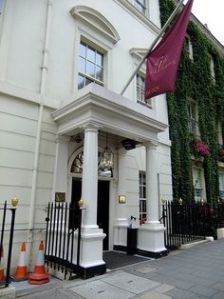
Crockford's today is an exclusive casino in Mayfair

Crockford’s today is an exclusive casino in Mayfair


Amusements of Old London series