Tag Archive | Duke of Montague

The Microcosm of London or London in Miniature: The British Museum

published by Rudolph Ackermann in 3 volumes, 1808–1811.

or models in sculpture. But portraits, whether in large or in miniature, drawings in water colours, and architectural drawings, are inadmissible.”

The artists pay towards the fund two and a half per cent, on those pictures which are sold; and they have since gratuitously added another two and a half per cent, to Mr. V. Green, the keeper; a very proper compliment to his unremitting attention and gentlemanly conduct in his office.

The annexed print gives a correct and interesting view of this very fine suite of rooms, and the figures have great spirit and appropriate character.

The annexed print is a view of the grand staircase, taken from the first landing-place, and has a magnificence becoming the residence of a nobleman: it is drawn with great taste and knowledge; the figures are judiciously introduced, and relieve the eye from the unvarying lines of perspective, and the whole presents a coup d’oeil that fills and satisfies the mind.

Montague House was rebuilt for Ralph, Duke of Montague, at the expence of Louis XIV. King of France, in 1678*, by Pouget.

Walpole observes of it, that “what is wanted in beauty, is compensated by the spacious and lofty magnificence of the apartments ” How far this observation is founded in truth, must be in some degree determined by the taste of the reader. The principal parts of the house are decorated by three painters, the historical and allegorical parts by La Fosse, landscapes by Rousseau, and flowers by Jean Baptist Monoyer. The union of these discordant styles produces a kind of garish splendour, which, with the heavy carved and gilt furniture of that day, must have had a large portion of cumbrous magnificence.

The British Museum was established in the year 1753, in consequence of Sir Hans Sloane bequeathing his valuable collection and library, which cost him 50,000/. to Parliament, on condition that they paid his executors 20,000/. for it. The money was raised the same year, by a guinea lottery.

In 1756, the valuable legacy of Egyptian antiquities collected by the late Colonel Lethulier, together with that of his nephew, were added to it.

The Harleian MSS. collected by Lord Oxford’s family, were purchased for 10,000/.; a collection of books, and also 7000/. in cash, left by Major Edwards: in addition to the Cottonian, is the library of Mr. Maddox, historiographer to his majesty, given by his widow.

In 1757, George II. gave the royal library, which consists of about ten thousand books, with eighteen hundred MSS. all collected by the different kings of England. The Cracherode collection has also been since added.

In 1772, by a vote of the House of Commons for the purchase of Sir William Hamilton’s collection of Etruscan, Grecian, and Roman antiquities, the sum of 8410/. was granted, and 840/. to the trustees to provide a repository for them. In 1804, a grant of 8000/. was voted towards an additional building for the reception of the Egyptian antiquities brought over by the expedition under Sir Ralph Abercrombie; and in 1805, a further grant of 8000/. for the same purpose.

In 1805, a grant of 20,000/. was voted for the purchase of the Townleian collection of Greek and Roman antiquities.

A collection of MSS. which were in the possession of the late Marquis of Lansdown, has been purchased for 4800/.

It is impossible in our limits to convey an adequate idea of the immensity of this collection; we shall, therefore, merely give a cursory glance at the general contents of the apartments in the order they are shown to visitors.

The first room contains a vast number of curiosities brought by Captains Cook, Byron, & c. from New Zealand, Otaheite, the Friendly and Sandwich Islands, western coast of California, 8cc.; consisting of dresses, weapons, canoes, fishing tackle, idols, and a variety of matters, remarkable for their ingenuity and exquisite taste.

Second room is a miscellaneous collection of the Harleian curiosities: there are two mummies, various models of works of art, weapons of the ancient Britons, Mexican idols, Chinese and Indian models, &c. and the celebrated portrait of Oliver Cromwell by Cooper.

Third room contains the Lansdown collection.

Fourth room, MSS. Sloaniana.

Fifth, Harleian library: a very curious inscription taken from the breast of a mummy; and portraits of Oliver Cromwell, Charles XII. the Czar Peter, Andrew Marvell, Algernon Sydney, Sir H. Vane, Sir Anthony More, Sir P. P. Rubens, Ben Jonson, and M. S. Merian, celebrated for the exquisite collection of insects painted by her.

Sixth, Harleiana library; containing portraits of Cranmer, Usher, Burleigh, Salisbury, Spelman, Dugdale, Cosmo de Medicis, Duke of Marlborough, Louis XIV. and a beautiful portrait of the unfortunate Duke of Monmouth.

Seventh, The royal library; containing the original Magna Charta; the portraits of Edward III. Henry II. Henry V. Henry VI. Countess of Richmond, Henry VIII. Edward VI. Mary, Elizabeth, Mary Queen of Scots, James I. Charles I. Henrietta, Charles II. William III. Speed, Camden, &c.

Eighth, Banqueting-room, contains only a portrait of George II. and a table made of various specimens of lava. In this room the three painters have exerted all their powers of decoration: it gives a perfect idea of the magnificence of that time, but it is heavy and incongruous; there are many good parts, but they do not unite.

Ninth, Sloane and Cracherode collection — volcanic minerals, spars, &c.

Tenth, Sloane and Cracherode — shells and petrifactions.

Eleventh, Sloane — marine productions and reptiles.

Twelfth, Sloane — birds and beasts.

Thirteenth, Fish and serpents.

Fourteenth, On the staircase is a crocodile 21 feet long.

The noble collections of Sir William Hamilton, Mr. Townley, and the Egyptian antiquities, are arranging in the new building, but not yet opened for public inspection.

The present establishment is as follows:

Forty-one trustees, twenty by virtue of their offices, six representing the Sloane, Cotton, and Harleian families, marked S. C. II. and fifteen chosen by the former twenty.

TRUSTEES BY OFFICE.

  • Archbishop of Canterbury.
  • The Lord Chancellor.
  • Lord President of the Council.
  • First Lord of the Treasury.
  • Lord Privy Seal.
  • First Lord of the Admiralty.
  • Lord Steward.
  • Lord Chamberlain.
  • Three Secretaries of State.
  • Bishop of London.
  • Speaker of the House of Commons.
  • Chancellor of the Exchequer.
  • Lord Chief Justice of the King’s Bench.
  • Master of the Rolls.
  • Lord Chief Justice of the Common Pleas.
  • Attorney General.
  • Solicitor General.
  • President of the Royal Society.
  • President of the College of Physicians.

FAMILY TRUSTEES.

  • C. Sir George Cornwall, Bart. LL. D.
  • H. Marquis of Tichfield.
  • C. Francis Annesley, Esq. 
  • S. Hans Sloane, Esq. F. R. S.
  • H. Duke of Portland, F. R. and A. S. LL. D. K. G.

TRUSTEES ELECTED.

  • Dean of Lincoln.
  • Henry Cavendish, Esq. F. R. S.
  • Marquis Townshend, P. S. A. LL. D. and F. R. S.
  • Earl Aylesford.
  • Earl Spencer, K. G.
  • Duke of Grafton, K. G.
  • Lord Frederic Campbell.
  • Marquis Bute.
  • Bishop of Durham.
  • Earl of Hardwicke, K. G.
  • Right Hon. Sir William Scott.
  • Right Hon. George Rose.
  • Lord St. Helen’s.

Principal librarian, Joseph Planta, Esq.

Librarian of the MSS. department, F. Douce, Esq. and his assistant, the Rev. T. Maurice.

Printed books, Henry Ellis, Esq. and the Rev. H. Harvey Baber.

Natural history, Dr. Shaw and Charles Konig, Esq.  

Coins and medals, Taylor Combe, Esq.

Secretary, Mr. Edward Bray.

The Museum is open Mondays, Wednesdays, and Fridays, except Christmas, Easter, and Whitsun-week, on Thanksgiving and Fast-days, and during August and September. Persons wishing admittance are to apply at the anti-room, between the hours of ten and two, and inscribe their names and residence in a book kept there. Five companies of not more than fifteen each are admitted, at ten, eleven, twelve, one, and two o’clock; but there is no necessity for fifteen going in one party, the first fifteen names on the book are admitted together, if they should happen to be all strangers to each other.

The reading-room is open, under certain regulations, from ten till four every day, except Saturdays and Sundays.

N. B. When the new rooms are opened for the inspection of visitors, it is understood that eight companies, instead of five, will be admitted.

* The Duke of Montague was at that time at the court of France, when receiving intelligence that his house was destroyed by fire, his spirits became greatly depressed, which induced Louis XIV. to send artists to London, to repair the losses the noble duke had sustained.
Back to Table of Contents

Romance of London: Montague House and the British Museum

Romance of London: Strange Stories, Scenes And Remarkable Person of the Great Town in 3 Volumes

John Timbs

John Timbs (1801-1875), who also wrote as Horace Welby, was an English author and aficionado of antiquities. Born in Clerkenwell, London, he was apprenticed at 16 to a druggist and printer, where he soon showed great literary promise. At 19, he began to write for Monthly Magazine, and a year later he was made secretary to the magazine’s proprietor and there began his career as a writer, editor, and antiquarian.

This particular book is available at googlebooks for free in ebook form. Or you can pay for a print version.

The Burning of Montague House

This noble mansion, situated on the north side of Great Russell Street, Bloomsbury, was first built about 1674, by Ralph Montague, Esq., afterwards Baron Montague of Boughton, and Duke of Montague, Keeper of the Wardrobe to Charles II., and who was subsequently in high favor with King William and Queen Anne. The house was erected in the manner of a French palace, from the design of Robert Hooke, the celebrated mathematician, and the inventor of spring-clocks and pocket-watches, and much employed in the rebuilding of London after the Great Fire; he was also Curator of the Royal Society, in the year 1678.

Within ten years this superb mansion was burned down by accident, or rather, by the carelessness of a servant. John Evelyn records in his Diary:—“Jan. 19. 1686.—This night was burnt to the ground my Lord Montague’s palace in Bloomsbery, than which, for paintings and furniture, there was nothing more glorious in England. This happened by the neglect of a servant airing, as they call it, some goods by the fire, in a moist season; indeed, so wet and mild a season had scarce been seen in man’s memory.”

The house was at this time in the occupation of the Earl of Devonshire, to whom Lord Montague had let it, for the sum of 500 guineas by the year. Of its destruction we find another entry:—

Whitehall, the 21st Jan. 1685-6.

“On Wednesday, at one in the morning, a sad fire happened at Montague House, in Bloomsbury, occasioned by the steward’s airing some hangings, &c., in expectation of my Lord Montague’s return home; and sending afterwards a woman to see that the fire-pans with charcoal were removed, which she told me she had done, though she never came there. The loss that my Lord Montague has sustained by this accident is estimated at 40,000l., besides 6,000l. In plate; and my Lord Devonshire’s loss in pictures, hangings, and other furniture is very considerable.”

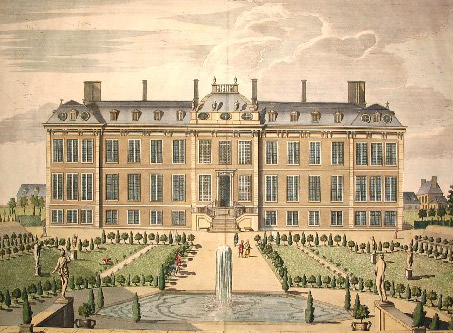
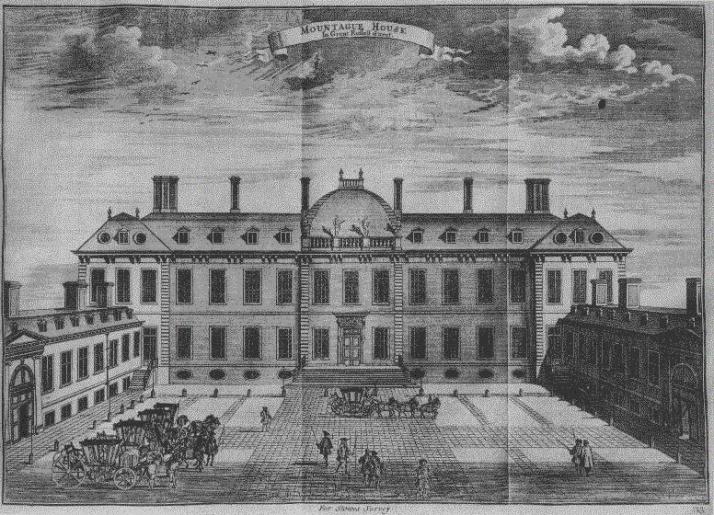
The North Prospect of Mountague House by James Simonic, 1715

The North Prospect of Mountague House by James Simonic, 1715

Montague House is rebuilt

Lord Montague’s large income was again placed in requisition for the reconstruction of his palace; and though executed by French artists, the plan (that of the hotels of the nobility at Paris) was the same, the new structure being raised upon the foundations and burnt walls of the old one. The architect now employed was one Peter Poughet, a native of Marseilles, who was assisted in the decoration by Charles de la Fosse, Jaques Rousseau, and Jean Baptist Monoyer…  This exclusive employment of French artists in the new house gave rise to the popular but improbable tale, that Montague House was rebuilt at the expense of Louis XIV., to whose court Lord Montague had twice been sent as ambassador.

The second Montague House was finished about 1687; and the eccentric but munificent owner, who in 1705, was created Marquis of Monthermer and Duke of Montague, resided in it till after his death, which took place March 9, 1709. He was succeeded in his titles and estates by his son John, second Duke of Montague, who quitted the vicinity of St. Giles’s for the more courtly region of Whitehall. While a new mansion was being erected for him there, he, however, continued to reside in one of the wings of Montague House. After his removal to Whitehall, the house in Great Russell Street remained unoccupied, until it was purchased, by Act of Parliament, of Lord Halifax, for 10,250l., in the spring of 1754, for “the British Museum.”

Montagu House drawing by Nicholas Sutton, published in 1754

Montagu House drawing by Nicholas Sutton, published in 1754

The British Museum

The building must have been in a very dilapidated condition, for the repairs cost more than the purchase, and, with furniture, &c., amounted to the large sum of 29,736l. 10s. 10d.

In plan, the old Museum resembled a French hotel of the first class: consisting of a large and lofty pile, with two sides built for offices, and a high front wall, with an arched doorway, and above it an octangular turret, surmounted by a cupola and vane; this was the principal entrance, and was known as “Montague Great Gate;” and at each extremity of the wall was a square turret.

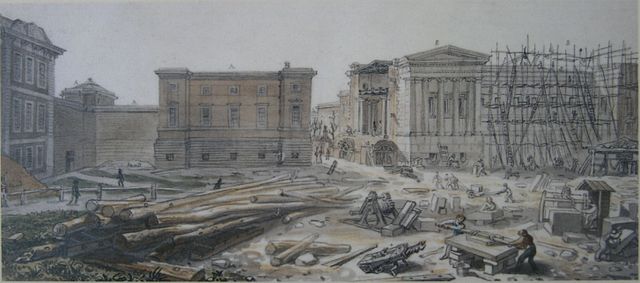
Left to Right: Montagu House, Towny Gallery, and Sir Robert Smirkes' West Wing Under Construction, July 1828

Left to Right: Montagu House, Towny Gallery, and Sir Robert Smirkes’ West Wing Under Construction, July 1828

To the original building additions were made from time to time, as the collection increased, until 1820, when the rebuilding of the Museum was commenced; the plan bordering three sides of the spacious area formerly occupied by the gardens of Montague House, behind the original mansion. By this means, the collection was removed from the old into the new building as the latter progressed, without any inconvenience to the public. In like manner, the principal front took the place of the old Montague House façade, which was removed piecemeal; and strange it was to see the lofty pitched roof, balustraded attic, and large windowed front of “the French manner,” giving way to the Grecian architecture of Sir Robert Smirke’s new design. The octangular and not unpicturesque apartment over the great gateway lingered for some time after, and was the last to disappear of old Montague House. The materials were sold by auction; and curious was it to see such pieces of the painted walls and ceilings as could be removed entire, bringing a few shillings—one of La Fosse’s deities for half-a-crown, or a bunch of Monoyer’s flowers for 1s. 6d.

The Waddesdon Bequest

This has nothing to do with Montague House, but is just something interesting I came across while researching this blog post. Last summer I visited Waddesdon Manor in Aylesbury, which is where Baron Ferdinand de Rothschild displayed the treasures he acquired from his travels to the Continent and beyond. Baron Rothschild is quite the romantic figure. He fell in love and married his second cousin Evelina, only to lose her in childbirth eighteen months later. He never married again, but spent his life in the acquisition and admiration of beautiful objects. Click here to take a look at my Pinterest board for Waddesdon Manor.

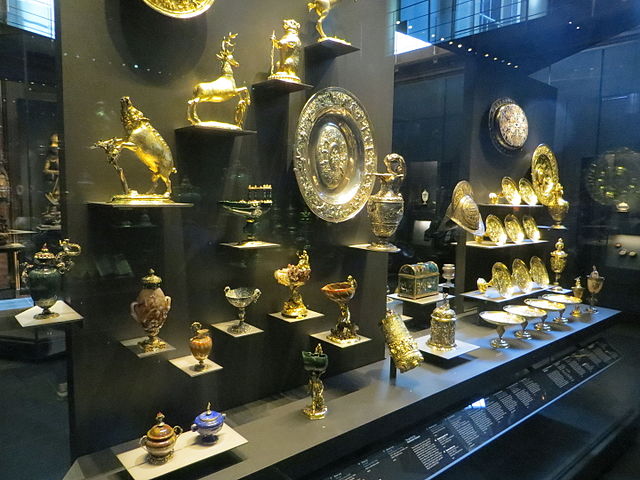
In 1898 he bequeathed the contents of his New Smoking Room at Waddesdon Manor to the British Museum.

This consisted of almost 300 pieces of objets d’art et de vertu which included exquisite examples of jewellery, plate, enamel, carvings, glass and maiolica, among them the Holy Thorn Reliquary, probably created in the 1390s in Paris for John, Duke of Berry. The collection was in the tradition of a schatzkammer or treasure house such as those formed by the Renaissance princes of Europe. Baron Ferdinand’s will was most specific, and failure to observe the terms would make it void, the collection should be

placed in a special room to be called the Waddesdon Bequest Room separate and apart from the other contents of the Museum and thenceforth for ever thereafter, keep the same in such room or in some other room to be substituted for it

The Waddesdon Bequest

The Waddesdon Bequest

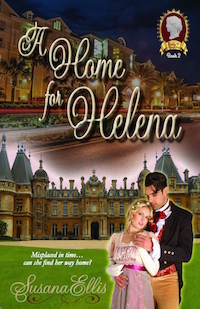
As a footnote, the cover of my time travel, A Home for Helena, includes a photograph of Waddesdon Manor taken last September at the time of my visit.

Home for Helena Cover 200x309

Amazon

Romance of London Series

  1. Romance of London: The Lord Mayor’s Fool… and a Dessert
  2. Romance of London: Carlton House and the Regency
  3. Romance of London: The Championship at George IV’s Coronation
  4. Romance of London: Mrs. Cornelys at Carlisle House
  5. Romance of London: The Bottle Conjuror
  6. Romance of London: Bartholomew Fair
  7. Romance of London: The May Fair and the Strong Woman
  8. Romance of London: Nancy Dawson, the Hornpipe Dancer
  9. Romance of London: Milkmaids on May-Day
  10. Romance of London: Lord Stowell’s Love of Sight-seeing
  11. Romance of London: The Mermaid Hoax
  12. Romance of London: The Bluestocking and the Sweeps’ Holiday
  13. Romance of London: Comments on Hogarth’s “Industries and Idle Apprentices”
  14. Romance of London: The Lansdowne Family
  15. Romance of London: St. Margaret’s Painted Window at Westminster
  16. Romance of London: Montague House and the British Museum
  17. Romance of London: The Bursting of the South Sea Bubble
  18. Romance of London: The Thames Tunnel
  19. Romance of London: Sir William Petty and the Lansdowne Family
  20. Romance of London: Marlborough House and Sarah, Duchess of Marlborough
  21. Romance of London: The Duke of Newcastle’s Eccentricities
  22. Romance of London: Voltaire in London
  23. Romance of London: The Crossing Sweeper
  24. Romance of London: Nathan Mayer Rothschild’s Fear of Assassination
  25. Romance of London: Samuel Rogers, the Banker Poet
  26. Romance of London: The Eccentricities of Lord Byron
  27. Romance of London: A London Recluse