Tag Archive | David Coke & Alan Borg

Vauxhall Gardens: Developments from 1751-1786

vauxhallbook

Vauxhall Gardens: A History

David Coke & Alan Borg

The Vauxhall Pleasure Gardens is one of the places I’d love to slip back in time to visit, just to catch a glimpse of what it was like. After recently splurging to buy this lovely coffee-table book, I thought it might make a wonderful subject for a new blog series. But do buy the book too, if you can! The photos are fabulous!

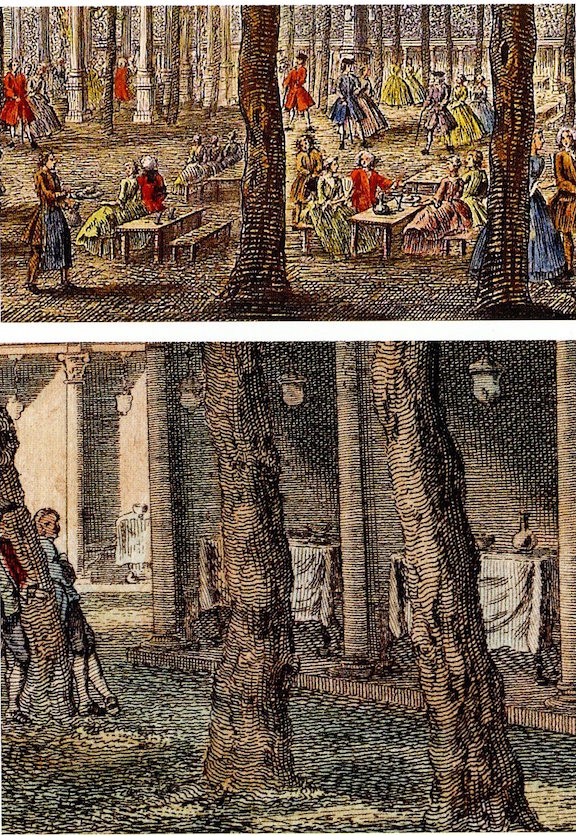
The year 1751 marked the pinnacle of Jonathan Tyers’s success. After twenty years his vision was at last complete, and the basic ensemble of landscape and buildings was in place. The following year the act to license places of public entertainment was passed, leaving just the three major gardens, Marylebone, Ranelagh and Vauxhall, with a virtual monopoly for the time being. Vauxhall’s prestige would never be higher, and the artworks, design and refreshments would never be surpassed. The opening night of the season, Monday 20 May, was attended by about seven thousand visitors, all eager to see the most recent changes, and to enjoy the new musical performances.

A contemporary publication that effectively and entirely objectively sums up Tyers’s achievements is Stephen Whatley’s guide to the main towns and villages of interest in the country, England’s Gazetteer. Apart from a short description of classical statuary at Cuper’s Gardens, the only entry for a pleasure garden is under “Foxhall (Surry)’ (neither Ranelagh nor Marylebone merited a mention):

This is the place, where are those called Spring Gardens, laid out in so grand a taste, that they are frequented, in the 3 summer months, by most of the nobility and gentry, then in and near London; and are often honoured with some of the royal family, who are here entertained with the sweet song of numbers of nightingales, in concert with the best band of musick in England. Here are fine pavilions, shady groves, and most delightful walks, illuminated by above 1000 lamps, so disposed, that they all take fire together, almost as quick as lightning, and dart such a sudden blaze, as is perfectly surprizing. Here are, among others, 2 curious statues of Apollo the god, and Mr. Handel the master of musick; and in the centre of the area, where the walks terminate, is erected the temple for the musicians, which is encompassed all round with handsome seats, decorated with pleasant paintings, on subjects most happily adapted to the season, place, and company.

The growing success of Vauxhall can be attributed directly to Jonathan Tyers’s continual upgrades in music, lights, and fine costumes. Profits from major events were plowed right back into the gardens, which is what drew an increasing number of visitors.

The Pillared Saloon

Prior to the 1751 season, the Pillared Saloon was opened up and an extension created that provided for space for artwork and made space for half again as many visitors. Unfortunately, the design was awkward and unsophisticated and was probably created by inexperienced students at the St. Martin’s Lane Academy.
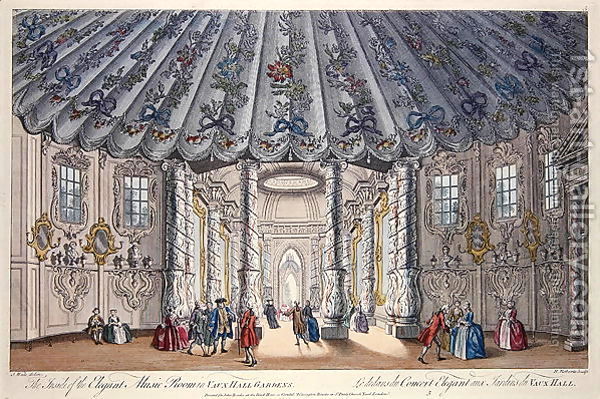
PILLARED SALLON REMODEL

H. Roberts after S. Wale, The Inside of the Elegant Music Room in Vaux Hall Gardens, engraving, 1752 (British Library, London)

The new indoor orchestra stand opposite the Pillared Saloon, behind a balustrade that separated it from the audience, shared its awkward style; the same foliate columns framed it, and similar paintings decorated its ceiling. It must have been a substantial space, as an Irish visitor in 1752 claimed that he saw fifty-four musicians performing there, accompanying the singers Thomas Lowe and Isabella Burchell.

The Triumphal Arches and Decorative Paintings

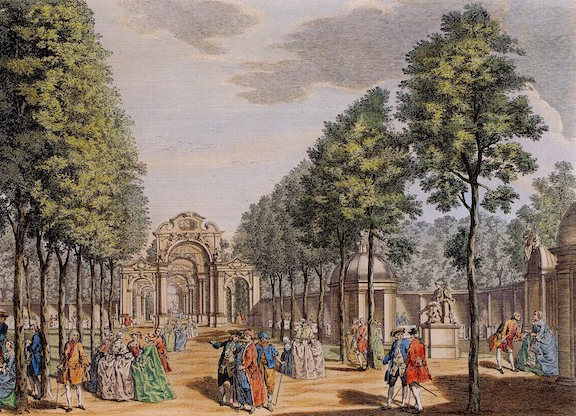
In contrast to the gaucherie of the Pillared Saloon, the three triumphal arches built over the South Walk at about the same time presented a more elegant, though more predictable, classical appearance… [T]hey were designed by ‘an ingenious Italian’ and made of timber and painted canvas.
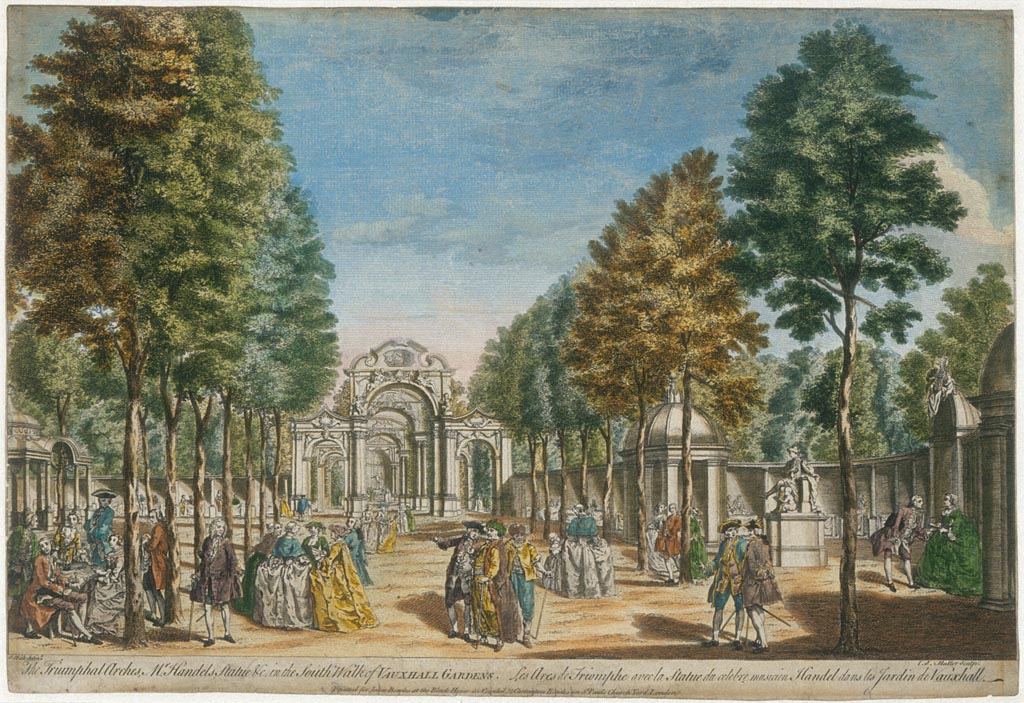
ARCHES

J.S. Muller after S. Wale, The Walk of Triumphal Arches and the Statue of Mr. Handle in Vauxhall Garden, engraving, 1751 (British Library, London).

…the undeniably theatrical view through the three Vauxhall arches to the piece of scenery at the end of the walk must have been impressive; the vista was focused and enclosed by the surrounding trees, and the trompe-l’oeil effect of the scenery seen at the proper distance was intended to draw visitors to that end of the walk, where, on arrival, they could marvel at the skill of the artist, who had fooled them into thinking it was a three-dimensional object.

PALMYRA

E. Rooker after Canaletto, A Vew of the Center Cross Walk &c. in Vauxhall Gardens, engraving, 1751 (British Library, London).

In addition to these theatrical-esque arches, four large scenes were painted and installed at the end of the walks, to camouflage the surrounding landscape and introduce a bit of fantasy. The Temple of Neptune, at the end of the South Walk, was soon replaced by the ruins of Palmyra, after the publication of Robert Wood’s journey there. A painting of an alcove of three niches with figures of Flora and the Genii, at the end of the Dark Walk, was replaced with a scene of a Chinese Garden in 1762. “At the opposite end was an altogether more eccentric scene of another alcove, but this one bore a representation of a scaffolding and ladder ready for artists to work on the canvas.” The explanation for this:

An eminent artist, but of dissipated character, was employed by the first proprietors of the gardens to paint some classical designs at the end of one of the walks; but the delay in their completion so irritated the proprietor, that, having to leave London for a fortnight, he declared to the artist that he would listen to no further excuses, and that if he found his scaffold, paint-pots, &c. on his return, they should be thrown over the garden wall. On his return, perceiving, as he thought, in the same position, the scaffold, paint-pots, &c., he hastened to the spot to put his threat into execution, when, to his great amazement, he found them to be so accurately pictured on the canvas, that he ever after lavished the most extravagant praises upon the delinquent artist.

The Cascade

The most popular of Tyers’s additions in the 1750’s was the artificial Cascade, which was likely conceived by Frances Hayman, from his work with scenery and special effects in the theater.

The Cascade was concealed behind a curtain which was drawn back at a particular time in the evening, as night fell, to reveal a three-dimensional illuminated scene of a landscape with a precipitous waterfall: the illusion was created with sheets of tin fixed to moving belts, turned by a team of Tyers’s lamplighters; when it was running, the noise and spectacle must have been terrific.

Throughout its existence the Cascade underwent various improvements, enlargements, alterations, replacements, demolitions, and moves, which continued into the 1840’s. No visual representation of it survives, but at the height of its popularity in 1762 an anonymous author described it as:

a most beautiful landscape in perspective of a fine open hilly country with a miller’s house and a water mill, all illuminated by concealed lights; but the principal object that strikes the eye is a cascade or water fall. The exact appearance of water is seen flowing down a declivity; and the turning the wheel of the mill, it rises up in a foam at the bottom, and then glides away. This moving picture attended with the noise of the cascade has a very pleasing and surprising effect on both the eye and ear.

Until well into the 1820’s, when it was demolished to make way for the new Ballet Theatre, the Cascade continued to delight and surprise Vauxhall audiences, with depictions of the tidal race and watermill at London Bridge, of distance military encampments, and other scenes.
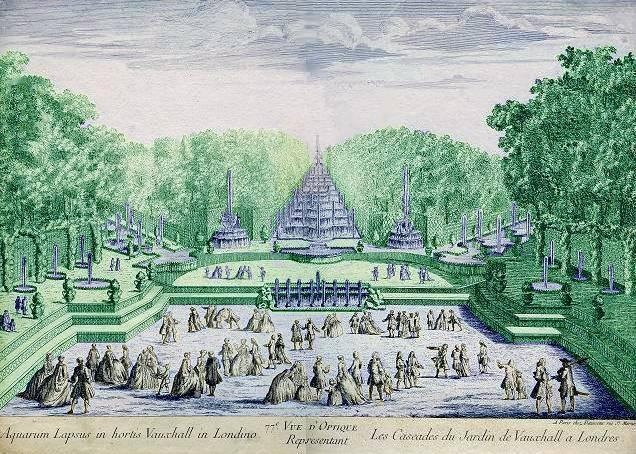
CASCADE

Well, I did find this image of the Cascade! Or at least it purports to be such.

The Gothic Orchestra

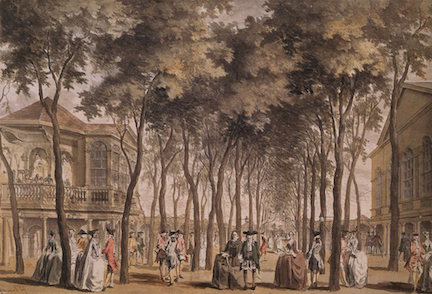
The original Orchestra building had outlived its usefulness, and was replaced in 1757-8 with a sort of Gothic-style building, made of wood and plaster and painted white and ‘bloom’, whatever that is. This building remained through the end of the gardens, having a domed roof with a “finial of Prince of Wales feathers”. The organ and musicians occupied the top floor, with supper-boxes on the bottom. The upper floor had graduated seating that made the musicians visible to the audience.

vauxhall_Muller_1751

Anon., A Perspective View of the Grand Walk in Vauxhall Gardens, and the Orchestra, engraving (David Coke’s collection), from the Gentleman’s Magazine (August 1765). The earliest view of the new Gothic Orchestra, built in 1757.

The Company

As we have mentioned previously, Vauxhall attracted a diverse group of visitors, more than any other entertainment of the period. The bulk of its income, however, came from the “Smarts,” which were middle-class young men, known for their licentiousness and self-indulgence, who came to show off to their female companions. A press reporter put it this way in July 1738:

The Smarts are, as it were, the sole Authors of our publick diversions at the Theatre they have a majority of the pit and the boxes: to them the Opera owes its subsistence, and Vaux Hall, the agreeable Vauxhall! would be a wilderness without them.

A big draw for the lower classes was the opportunity to encounter the upper classes, royalty, or other celebrities, that they would not normally be allowed anywhere near.

An account of a visit by an upper-class party is given by Horace Walpole:

I had a card from Lady Caroline Petersham to go with her to Vauxhall. I went accordingly to her house at half an hour after seven, and found her and little Ashe, or the pollard Ashe, as they call her; they had just finished their last layer of red, and looked as handsome as crimson could make them. […] We got into the best order we could and marched to our barge, with a boat of French horns attending and little Ashe singing. We paraded some time up the river and at last debarked at Vauxhall […]. At last we assembled in our booth, Lady Caroline in the front, with the vizor of her hat erect, and looking gloriously jolly and handsome. She had fetched my brother Orford from the next box, where he was enjoying himself with his Norsa and his petite partie, to help us to mince chickens. We minced seven chickens into a china dish, which Lady C. stewed over a lamp with three pats of butter and a flagon of water, stirring and rattling and laughing, and we every minute expecting to have the dish fly about our ears. She had brought Betty [Neale] the fruit girl, with hampers of strawberries and cherries from Rogers’s, and made her wait upon us, and then made her sup by us at a little table […]. In short, the whole air of our party was sufficient as you will easily imagine to take up the whole attention of the garden, so much so, that from eleven o’clock till half an hour after one, we had the whole concourse round our booth, at last they came into the little gardens of each booth on the sides of ours, till Harry Vane took up a bumper and drank their healths, and was proceeding to treat them with still greater freedom. It was three o’clock before we got home.

Then there was Henry Timberlake, who brought a group of Cherokee Indians to the gardens on two occasions, the second advertised ahead of time drawing ten thousand curious onlookers. (Note: those Cherokees had a very busy schedule. Take a peek here.)

A ‘silent majority’ of visitors came from the professional classes, lawyers, doctors, parsons, and increasingly in the 1780’s, after Tyers’s death, prostitutes and the demi-monde.
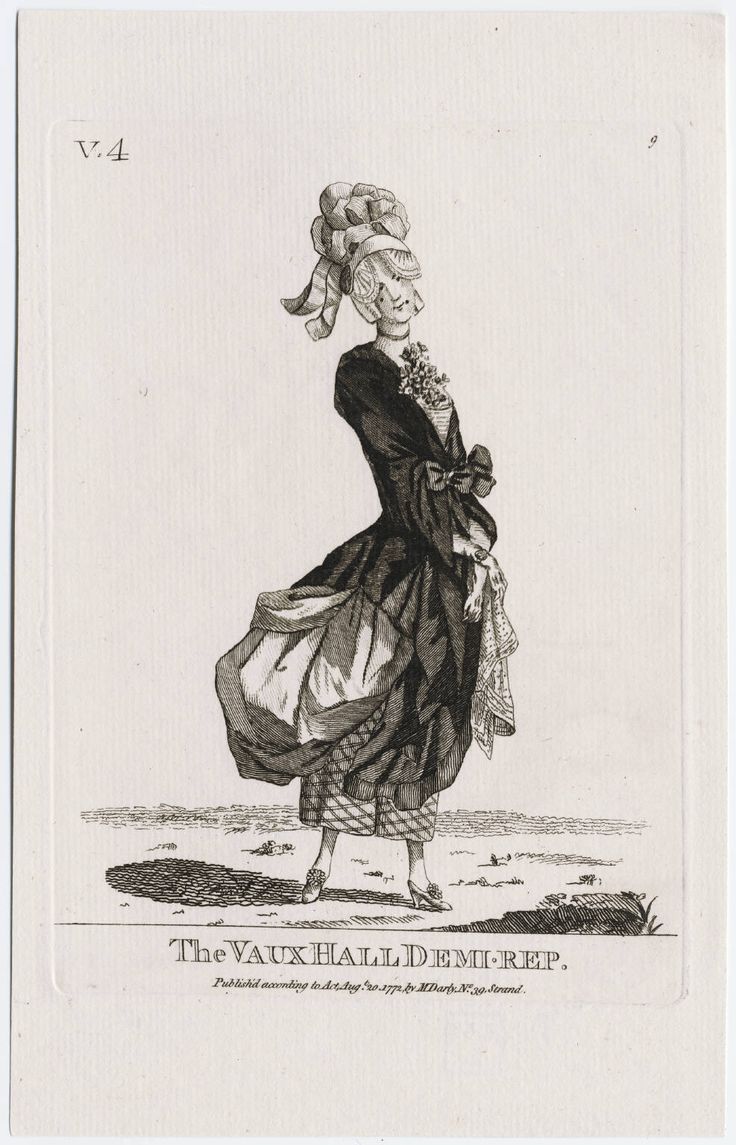
demi-rep

Anon., The Vauxhall Demi-Rep, engraving, 1772 (Senate House Library, London). One of the working girls who frequented the gardens. Less a prostitute than an escort, the demo-rep would join an all-male party to titillate and amuse the men.


Susana’s Vauxhall Blog Post Series

  1. Vauxhall Gardens: A History
  2. Vauxhall Gardens: Jonathan Tyers—“The Master Builder of Delight” 
  3. Vauxhall Gardens: A New Direction
  4. Vauxhall Gardens: The Orchestra and the Supper-Boxes 
  5. Vauxhall Gardens: The Organ, the Turkish Tent, and the Rotunda
  6. Vauxhall Gardens: Three Piazzas of Supper-Boxes
  7. Vauxhall Gardens: “whither every body must go or appear a sort of Monster in polite Company”
  8. Vauxhall Gardens: The Competition
  9. Vauxhall Gardens: The Artwork, Part I
  10. Vauxhall Gardens: The Artwork, Part II
  11. Vauxhall Gardens: The Music, 1732-1859
  12. Vauxhall Gardens: The Business Side
  13. Vauxhall Gardens: Developments from 1751-1786
  14. Vauxhall Gardens: Thomas Rowlandson’s Painting (1785)
  15. ‎Vauxhall Gardens: The Third Generation of the Tyers Family and the Jubilee of 1786
  16. Vauxhall Gardens: An Era of Change (1786-1822), Part I
  17. Vauxhall Gardens: An Era of Change (1786-1822), Part II
  18. Vauxhall Gardens: An Era of Change (1786-1822), Part III
  19. Vauxhall Gardens: The Final Years, Part I
  20. Vauxhall Gardens: The Final Years, Part II
  21. Vauxhall Gardens: The Final Years, Part III
  22. Vauxhall Gardens: The Final Years, Part IV
  23. Vauxhall Gardens: Farewell, for ever
Vauxhall Gardens: The Business Side

vauxhallbook

Vauxhall Gardens: A History

David Coke & Alan Borg

The Vauxhall Pleasure Gardens is one of the places I’d love to slip back in time to visit, just to catch a glimpse of what it was like. After recently splurging to buy this lovely coffee-table book, I thought it might make a wonderful subject for a new blog series. But do buy the book too, if you can! The photos are fabulous!

Vauxhall’s huge success after Jonathan Tyers’s acquisition of the property, which had been in existence for seventy years as the “New Spring Gardens”, can be attributed to the man’s perception that his idealistic dream must be counter-balanced by sound financial practices. An essential element of this was publicity, and of this, Tyers proved to be a master. How did he do this?

Promoting Vauxhall

He promoted the gardens as a sort of “heaven on earth,” a magical sort of place to lift one’s spirits after a hard day in the real world.

[T]his was achieved through stories in literature and the printed media, through popular songs and through the artworks and music he commissioned. The second was the flattery of his audience; he consistently treated his visitors as special people, always referring to them as persons of quality, ladies and gentlemen, patriots, libertarians, educated people who appreciated fine things and good music. And the last was the simple dissemination of factual information about Vauxhall, its history, its current attractions, and how this pleasure garden should be enjoyed, by means of articles in newspapers and periodicals, of histories and guidebooks and of topographical and satirical engravings.

John Lockman, Publicist

John Lockman, Publicist

In truth, of course, Vauxhall fell short of perfection, and that’s where John Lockman came in. He was a sort of early publicist, who wrote poems and songs designed to “underscore Tyers’s transformation of a notorious gathering place for drunks, gamblers and prostitutes into a civilised pleasure garden where anyone could enjoy a decorous evening’s entertainment without risk to their reputation.”
Lockman’s assistance was necessary because it was impossible to exclude troublemakers, particularly if they were respectably dressed. “[I]t was easier to sell an enhanced image of the place to a persuadable public.

Tyers was always careful to make everybody in his clientele feel good about themselves, and in particular about their patronage of Vauxhall. In his press announcements, for instance, he would often start by thanking his visitors for their support, especially if the weather had been bad, and would repeatedly finish by pledging to keep out of his gardens anyone not worthy of their company.

Another tactic was to use magazines and newspapers. Newspapers, of course, were a no-brainer. Letters such as the “S. Toupee” articles published in Scots Magazine may or may not have been instigated by Tyers, but they certainly proved valuable in driving up excitement for Vauxhall. “Of the Luxury of the English; and a Description of Ranelagh Gardens and Vaux-hall, in a Letter from a Foreigner to his Friend at Paris,” supposedly written by Henry Fielding (a friend of Tyers) and commissioned by Tyers, piled on the praise for Vauxhall in comparison to Ranelagh Gardens.

A female audience was enticed to Vauxhall by published songs and by scenes in novels set in Vauxhall Gardens. And then there were the Love at First Sight articles, or “Lonely Hearts” columns, which may or may not have been genuine. Here’s one from the London Chronicle in August 1758:

A young Lady who was at Vauxhall on Thursday night last, in company with two gentlemen, could not but observe a young gentleman in blue and a gold-laced hat, who, being near her by the orchestra during the performance, especially the last song, gazed upon her with the utmost attention. He earnestly hopes (if unmarried) she will favour him with a line directed to A.D. at the bar of the Temple Exchange Coffee-house, Temple-bar, to inform him whether fortune, family, and character, may not entitle him upon a further knowledge, to hope an interest in her heart.

Another marketing tactic was to engage actors dressed as gentlemen to patronize coffee-houses to express their intention to go to Vauxhall and entreat others to meet them there.

Tyers’s Management Style

It goes without saying that if one wishes to have customers return, one has to ensure that their first time is as pleasant and enjoyable as possible. If you knew Jonathan Tyers—and you probably wouldn’t because it was never himself he wanted to promote and therefore took pains to remain in the background—you could see him in the kitchens working as hard as his employees to get the food out to the customers.

Waiters, or “drawers” were freelance employees, who were constrained to work hard in order to earn tips and keep their posts. Since in other venues, “drawers” were known to steal from their employers, “Vauxhall waiters were required to pay for the food on collection from the kitchens, and themselves ran the risk of defaulting customers, especially if they had not been sufficiently polite or efficient in their service.”

Although he had to maintain a strict discipline among his employees, he was a thoughtful employer. When two of his waiters married two of his barmaids, he provided wedding rings and an elaborate dinner at his home in Denbies, with fifty of his staff as guests.

one shilling coin

Vauxhall Tickets

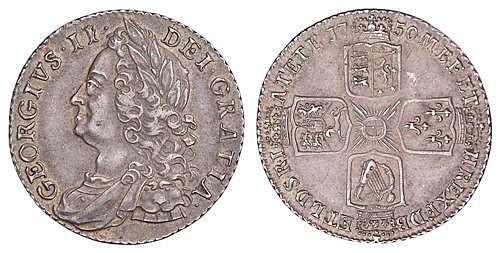
Up until 1736, the admission cost was sixpence, but afterward, the price was doubled to one shilling. Considering the expense of maintaining and improving the gardens and contriving new entertainments, this seems modest indeed; however, there was more to be made from the food and drink once the visitors were admitted. For the visitors, there was also the cost of dressing respectably and the cost of transportation. The one shilling price was fixed until 1792, when it was doubled to two shillings.

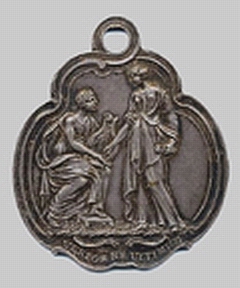
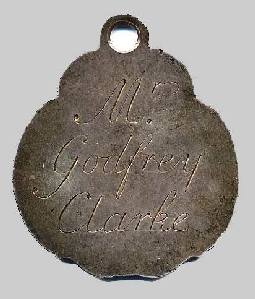
Season Ticket greySeason Ticket grey reverse

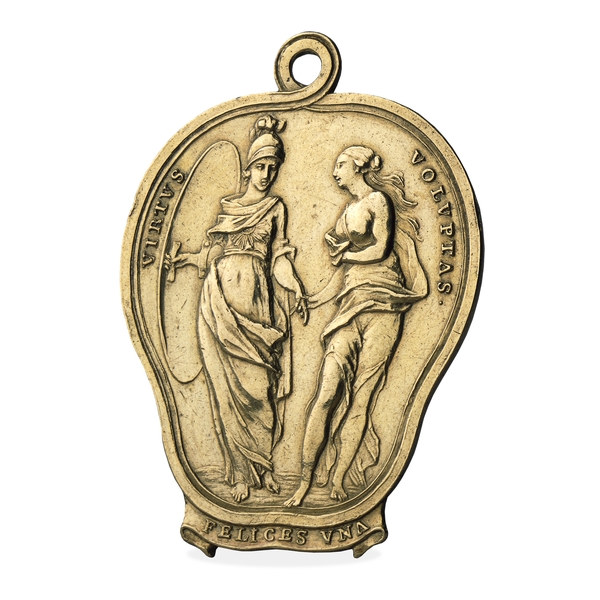
In 1737 Tyers initiated a subscription price, or season ticket. The metal tickets were issued to a thousand people at a guinea each, and would admit two people to the gardens for the entire season. Not only did this ensure repeat visits by two thousand people, it provided him with funds upfront to use for maintenance and improvement.

The relief on the obverse usually represented, through classical imagery, a particular aspect of Vauxhall Gardens, often associated with the music. On the reverse was engraved the subscriber’s name, accompanied… by the ticket’s number.

silver ticket

silver ticket

In 1738, the tickets were made of silver and the price rose by three shillings. In 1741, the price was raised to two guineas.

As a comparison, a season ticket for two to the Great Room in Soho was five guineas, while individual concerts were ten and a half shillings, the same price as Handel’s fundraising concert at the Foundling Hospital in 1749. Almack’s (founded in 1765) charged ten guineas for a once-weekly ball over twelve weeks, so Vauxhall tickets were considered quite a bargain.

Hogarth's gold "perpetual" ticket

Hogarth’s gold “perpetual” ticket

Attendance

“S. Toupee” in his letters in Scots Magazine estimated that “not less than one thousand shillings are received each evening of performance during the season,” not including season ticket holders. Special events, such as the rehearsal of Handel’s Music for the Royal Fireworks, drew several thousand spectators. Opening and closing nights and royal birthdays also drew large crowds.

The opening night of the 1769 season, for instance, was a remarkably fine evening for the time of year, and it was estimated that ‘there were upwards of twenty thousand of the first nobility present.’

Crime and Disorder

Even though it suffered occasional lean times, there can be little doubt that eighteenth-century Vauxhall Gardens became the most popular single visitor attraction for London… With these numbers of people coming together, especially to a place where alcohol was available, crime, vandalism and disorder were inevitable.

Nor was it just pickpockets and prostitutes his police force (initiated in 1732) had to deal with. While Tyers encouraged his waiters to restrict alcohol consumption, it was difficult for them or even him to police the mischievous London Bucks, who were of a class higher than his. Tyers and his staff managed these problems themselves, even if it meant “eating” the cost of vandalism, not wanting to involve courts, which would draw bad publicity. “S. Toupee,” in one of his letters in 1739, “pointed out that there was ‘a man in the posture of a Constable, to protect the Ladies from any insult, &c.’ at the end of each walk.

Besides the half-dozen or so constables, he employed up to eight men to guard the route from the river and led a (possibly regular) blitz against the pickpockets.

Refreshments

Anyone who has worked in the restaurant industry can tell you how difficult a task it is to prepare food for crowds of people, but how many restaurants have to cater for 500-1000 or more hungry people? This is a logistical nightmare that Tyers managed with aplomb.

Consistent with his insistence on featuring English art and music, the food at Vauxhall was simple and English. There were complaints about the prices, of course. Here are some prices from one of the “S. Toupee” letters in 1739:

  • one bottle of French claret: 5 shillings
  • one cold chicken: 2-1/2 shillings
  • one quarter of cyder: 1 shilling
  • one quart of small-beer: 4 pence
  • one slice of bread: 2 pence
  • one slice of cheese: 4 pence
  • dish of ham or beef: 1 shilling, salad, an extra pence
  • sweet pastries: 1 shilling
  • custards and cheesecakes: 4 pence
  • heart cakes and Shrewsbury cakes: 2 pence
  • one bottle of champagne and arrack: 8 shillings
  • two pounds of ice: sixpence
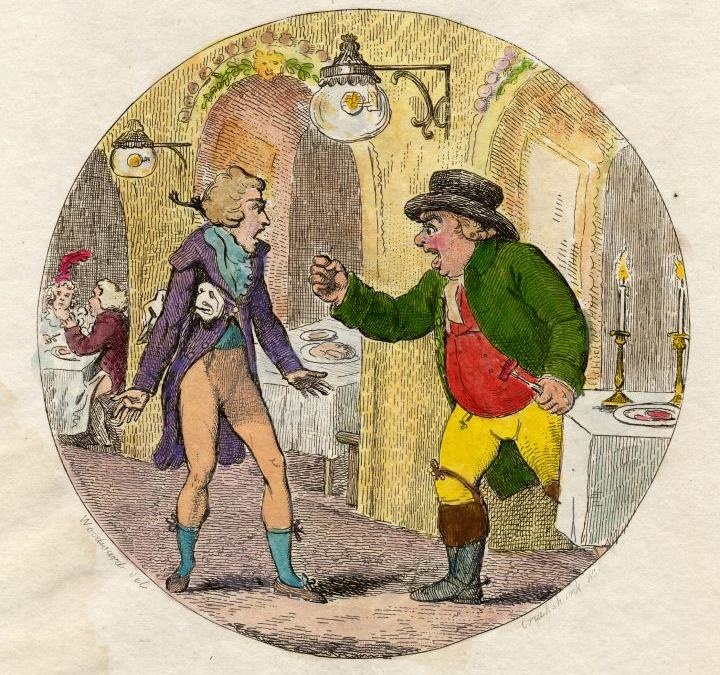
Isaac Cruikshank, A Country Farmer & Waiter at Vauxhall. A farmer in country dress, on his first visit to Vauxhall, has ordered ham in expectation of a plateful of English gammon. When the waiter brings him the notoriously thin slices that were Vauxhall ham, the farmer is furious.

Isaac Cruikshank, A Country Farmer & Waiter at Vauxhall. A farmer in country dress, on his first visit to Vauxhall, has ordered ham in expectation of a plateful of English gammon. When the waiter brings him the notoriously thin slices that were Vauxhall ham, the farmer is furious.

Even a devoted fan such as “S. Toupee” confessed that the food was expensive. The sliced meats were thin, especially the ham. “This was all part of the fun of the evening—a great joke on fashionable society who were happy to play along.” A well-known verse alluding to this:

Never trouble Ham House, or its inmates at all,

For a ghost, that may be but a sham,

But seek in a sandwich that’s cut at Vauxhall,

For the true apparition of Ham.’

Note:

The cost of the food did not alter significantly over the whole period from Tyers’s re-launch until the gardens’ final closure; the prices of wines and spirits, however, were a different matter, rising sharply in the nineteenth century.

Susana’s Vauxhall Blog Post Series

  1. Vauxhall Gardens: A History
  2. Vauxhall Gardens: Jonathan Tyers—“The Master Builder of Delight” 
  3. Vauxhall Gardens: A New Direction
  4. Vauxhall Gardens: The Orchestra and the Supper-Boxes 
  5. Vauxhall Gardens: The Organ, the Turkish Tent, and the Rotunda
  6. Vauxhall Gardens: Three Piazzas of Supper-Boxes
  7. Vauxhall Gardens: “whither every body must go or appear a sort of Monster in polite Company”
  8. Vauxhall Gardens: The Competition
  9. Vauxhall Gardens: The Artwork, Part I
  10. Vauxhall Gardens: The Artwork, Part II
  11. Vauxhall Gardens: The Music, 1732-1859
  12. Vauxhall Gardens: The Business Side
  13. Vauxhall Gardens: Developments from 1751-1786
  14. Vauxhall Gardens: Thomas Rowlandson’s Painting (1785)
  15. ‎Vauxhall Gardens: The Third Generation of the Tyers Family and the Jubilee of 1786
  16. Vauxhall Gardens: An Era of Change (1786-1822), Part I
  17. Vauxhall Gardens: An Era of Change (1786-1822), Part II
  18. Vauxhall Gardens: An Era of Change (1786-1822), Part III
  19. Vauxhall Gardens: The Final Years, Part I
  20. Vauxhall Gardens: The Final Years, Part II
  21. Vauxhall Gardens: The Final Years, Part III
  22. Vauxhall Gardens: The Final Years, Part IV
  23. Vauxhall Gardens: Farewell, for ever
Vauxhall Gardens: The Artwork, Part I

vauxhallbook

Vauxhall Gardens: A History

David Coke & Alan Borg

The Vauxhall Pleasure Gardens is one of the places I’d love to slip back in time to visit, just to catch a glimpse of what it was like. After recently splurging to buy this lovely coffee-table book, I thought it might make a wonderful subject for a new blog series. But do buy the book too, if you can! The photos are fabulous!

A Statue for the Greatest Composer of English Music (1738)

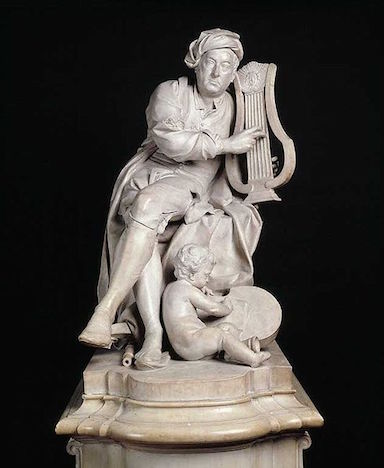
The life-sized sculpture of George Frideric Handel by Louis François Roubiliac (1702-62) was

the most important of Tyers’s early series of artistic commissions for the gardens. This work epitomised the explosive moment of the English Rococo style, not for any inclusion of outwardly Rococo motifs, but for the new spirit of playfulness and informality that it embodied, and it came to personify Vauxhall Gardens.

handel statue

There is now near finished a Statue of the justly celebrated Mr. Handel, exquisitely done by the ingenious Mr. Raubillac, of St. Martin’s-Lane, Statuary, out of one entire Block of white Marble, which is to be placed in a grand Nich, erected on Purpose in the great Grove at Vaux-hall Gardens.

alcove1

Note the Handel statue in its “Grand Nich” (original placement) at right

The “Grand Nich” or “Grand Alcove” was demolished after a decade to make room for more supper-boxes, and the statue was left free-standing until 1762, when it was arranged under a Doric portico similar in size to the “Grand Nich.” In 1786, following the Vauxhall Jubilee celebrations, it was removed to the back of the Orchestra. Before it was removed from the gardens in 1818, it held court in the New Supper Room built in 1791, and then, in 1813, “to its own small circular domed temple behind the Orchestra.”

Victoria and Albert Museum

The Handel statue can be seen today at the Victoria and Albert Museum in London, along with a group of the original supper-box paintings and Roubiliac’s terracotta model for the portrait bust of Jonathan Tyers.

In spite of many years’ exposure to the elements, to vandalism, accidental damage, relocations and restorations, the surface of the sculpture still bears the sculptor’s marks and finished, evidence of his high degree of skill and craftsmanship, equally of his mastery and love of the material.

“A mass audience for contemporary art”

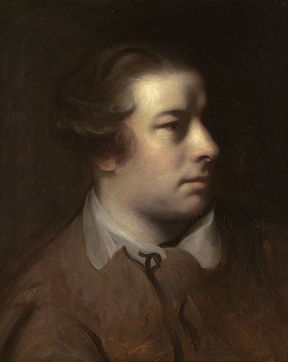
Francis Hayman by Sir Thomas Lawrence

Francis Hayman by Sir Thomas Lawrence, 1760’s

Artwork was an important element in Jonathan Tyers’ vision of capturing his visitors’ emotions and induce them “to enjoy themselves, to refresh their spirits and to spend their money.” In order to do this, Tyers formed an alliance with his friend William Hogarth’s nearby academy to produce the work he needed, which included buildings, paintings, sculptures, furnitures, tableware, glass, interiors, and lighting. This arrangement benefitted both parties, providing Tyers with the high-quality artisans he needed at a reasonable cost, and an opportunity for Hogarth’s students’ work to be displayed to the public in a way not seen before. The person chosen to manage the project was the theatrical scene-painter, Francis Hayman (1708-76).

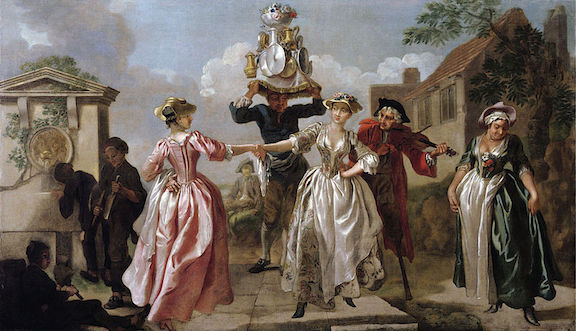
Francis Hayman and studio, The Milkmaids' Garland, oil on canvas, c. 1740 (Victoria and Albert Museum, London)

Francis Hayman and studio, The Milkmaids’ Garland, oil on canvas, c. 1740 (Victoria and Albert Museum, London)

The Supper-Box Paintings

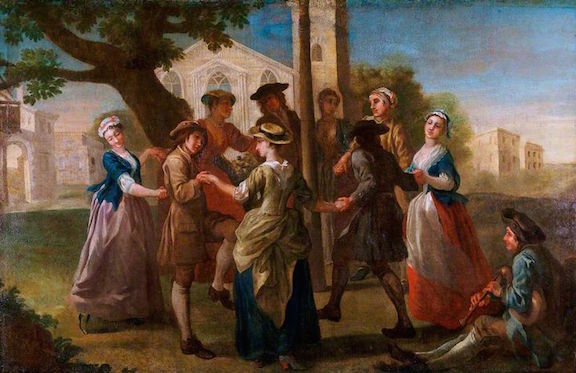
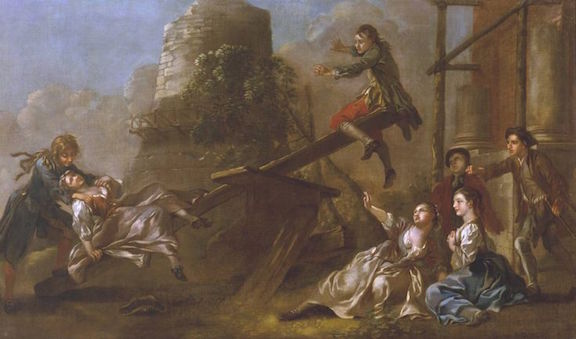
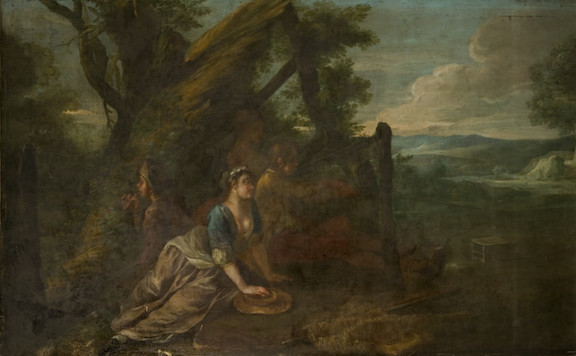
To add color and enhance the visitor’s mood, the back upper wall of each supper-box in the 1730’s and 40’s was decorated by an eight foot by five painting, designed by Francis Hayman and H.F. Gravelot and painted by the students at St. Martin’s Lane Academy. These paintings

represent people from all sectors of society, from villagers, peasant children and milkmaids to aristocratic and fashionable ladies and gentlemen. Painted on a large scale, some of the figures are nearly life-sized and close enough to the picture plane for the viewer to discern their expressions and interrelationships.

Francis Hayman and stuido, Country Dancers round the Maypole, oil on canvas, late 1730's (Victoria and Albert Museum, London)

Francis Hayman and stuido, Country Dancers round the Maypole, oil on canvas, late 1730’s (Victoria and Albert Museum, London)

The pictures depicted scenes of theatre, daily life and rustic amusements. A Toupee letter (see post here) of 28 June 1739 states that, when the paintings were revealed,

the eye is relieved by the agreeable surprise of some of the most favoured fancies of our poets in the most remarkable scenes of our comedies, some of the celebrated dancers, &c. in their most remarkable attitudes, several of the childish diversions, and other whims that are well enough liked by most people at a time they are disposed to smile, and every thing of a light kind, and tending to unbend the thoughts, has an effect desired before it is felt.

Francis Hayman and studio, The Play of See-saw, oil on canvas, 1740-43 (Tate, London)

Francis Hayman and studio, The Play of See-saw, oil on canvas, 1740-43 (Tate, London)

The Display of the Paintings

In the 1730’s the supper-boxes were open on all sides during daylight hours, to allow visitors to enjoy the views over the neighbouring countryside. However, as dusk fell, Tyers had created two extraordinary surprises for his guests. The first was the almost magical instantaneous illumination of the gardens with oil lamps. This wonder was swiftly followed by a second spectacular special effect, namely:

a master piece of machinery, by which all the English ladys and delicate gentlemen are in a moment screend from the damps of the night air. […] When the clock strikes nine, there is heard a third sound of the whistle, and immediately there rises, as out of the earth, a vast number of rollers, which unfolding themselves as they rise, cover all the boxes in three of their sides, and fasten themselves in the extremitys of each box. All these coverings are painted with elegant designs, in lively colours, so that each box is enclosed by three large pictures, and at the same time that they completely protect the company from the injurys of the air, present a numerous collection of grand and pleasing paintings.

By 1741, all the paintings were fixed in position on the back or side wall of the boxes… Tyers had introduced further improvements and the supper-boxes had been adapted to make them more weatherproof, more robust and more firmly divided from each other.

Francis Hayman and studio, Bird-catching, by a Decoy with a Whistle and Net, oil on canvas, c. 1740 (Victoria and Albert Museum, London)

Francis Hayman and studio, Bird-catching, by a Decoy with a Whistle and Net, oil on canvas, c. 1740 (Victoria and Albert Museum, London)

In spite of all the damage inflicted on these paintings by their exposure to the weather, the proximity of food, wine, candles, and oil lamps—not to mention the early days of being rolled up and down on a nightly basis—many of these paintings remained at Vauxhall for a hundred years.


Susana’s Vauxhall Blog Post Series

  1. Vauxhall Gardens: A History
  2. Vauxhall Gardens: Jonathan Tyers—“The Master Builder of Delight” 
  3. Vauxhall Gardens: A New Direction
  4. Vauxhall Gardens: The Orchestra and the Supper-Boxes 
  5. Vauxhall Gardens: The Organ, the Turkish Tent, and the Rotunda
  6. Vauxhall Gardens: Three Piazzas of Supper-Boxes
  7. Vauxhall Gardens: “whither every body must go or appear a sort of Monster in polite Company”
  8. Vauxhall Gardens: The Competition
  9. Vauxhall Gardens: The Artwork, Part I
  10. Vauxhall Gardens: The Artwork, Part II
  11. Vauxhall Gardens: The Music, 1732-1859
  12. Vauxhall Gardens: The Business Side
  13. Vauxhall Gardens: Developments from 1751-1786
  14. Vauxhall Gardens: Thomas Rowlandson’s Painting (1785)
  15. ‎Vauxhall Gardens: The Third Generation of the Tyers Family and the Jubilee of 1786
  16. Vauxhall Gardens: An Era of Change (1786-1822), Part I
  17. Vauxhall Gardens: An Era of Change (1786-1822), Part II
  18. Vauxhall Gardens: An Era of Change (1786-1822), Part III
  19. Vauxhall Gardens: The Final Years, Part I
  20. Vauxhall Gardens: The Final Years, Part II
  21. Vauxhall Gardens: The Final Years, Part III
  22. Vauxhall Gardens: The Final Years, Part IV
  23. Vauxhall Gardens: Farewell, for ever

Vauxhall Gardens: The Competition

vauxhallbook

Vauxhall Gardens: A History

David Coke & Alan Borg

The Vauxhall Pleasure Gardens is one of the places I’d love to slip back in time to visit, just to catch a glimpse of what it was like. After recently splurging to buy this lovely coffee-table book, I thought it might make a wonderful subject for a new blog series. But do buy the book too, if you can! The photos are fabulous!

“Imitation is the sincerest form of flattery.”

The success of Vauxhall naturally spawned imitators, but Vauxhall “outstripped all of them, not only in visitor numbers and longevity, but in the national and international renown achieved by the gardens, its use by writers as a setting in plays and novels, and the fact that its name became synonymous with the pleasure garden throughout Britain and all over the world.”

Ranelagh and Marylebone, however, did give Vauxhall’s founder a run for his money. S. Toupée, a correspondent from Scots Magazine (see last week’s post), writes:

It may not be amiss to tell you, the spirit of imitation increases amongst us every day. Vaux-hall has produced tickets and accommodations of the same nature, at Marybone, on this side of the Thames, and at Caper’s gardens, on t’other.”

Marylebone Gardens

John Donowell, A View of the Orchestra with the Band of Music, the Grand Walk &c. in Marybone Gardens, watercolor, 1755.

John Donowell, A View of the Orchestra with the Band of Music, the Grand Walk &c. in Marybone Gardens, watercolor, 1755.

Prior to its purchase by Daniel Gough, landlord of the neighboring Rose Tavern in 1737, Marylebone Gardens was “little more than a bowling green and gaming house.” In his attempt to imitate Vauxhall, “Gough built an outdoor Orchestra there… and installed an organ by Richard Bridge. In the winter of 1739-40 he added a Great Room for balls and suppers, facing the Orchestra.”

High quality music was the main attraction at Marylebone, and fireworks were added here decades before Vauxhall.

However, Marylebone did not even try to compete with Vauxhall in the visual arts, or in the order maintained in the gardens, and this proved to be its downfall; it was less selective of its visitors, and less proscriptive in the activities enjoyed by them, allowing the garden to become a haven for card-sharps and gamblers… Marylebone Gardens eventually closed, unmourned and leaving little trace, in 1778.

Ranelagh Gardens

T. Bowles after J. Maurer. Raleigh House and Gardens with the Rotunda, engraving, 1745.

T. Bowles after J. Maurer. Ranelagh House and Gardens with the Rotunda, engraving, 1745.

Opened in April 1742 by a syndicate of businessmen who saw the problems Vauxhall was having with inclement weather, Ranelagh featured a huge rotunda, inspired by the Pantheon in Rome.

Giovanni Antonio Canal, il Canaletto. The Interior of the Rotunda at Ranelagh, oil on canvas, c.1751.

Giovanni Antonio Canal, il Canaletto. The Interior of the Rotunda at Ranelagh, oil on canvas, c.1751.

Large numbers of people could saunter, take refreshments and listen to music without any of the natural inconveniences of an English summer. The building itself, especially the great domed space inside, became an architectural wonder in its own right, attracting crowds just to see, even during construction. With its grand central orchestra stand rising to the roof, its two levels of supper-boxes around the walls, its elaborate plaster decorations and chandeliers, this mostly timber Rotunda, 185 feet in diameter, was a remarkable space… During its first year at least, the Rotunda was the subject of much talk among fashionable society; Catherine Talbot wrote to Elizabeth Carter just two months after it had opened, saying that London’s neighborhood

is enriched since you was here, with a building which I am told exceeds in taste and magnificence every one in Europe: to untravelled eyes like mine ’tis to be sure an amazing fine thing, and quite worth your coming to see it next year, by which time they may possibly have found all that it wants to make it complete; some use for it answerable to the fineness and stateliness of the structure, for to be sure it is quite vexatious at present to see all the pomp and splendour of a Roman amphitheatre, devoted to no better use than a twelvepenny entertainment of cold ham and chicken.

Ranelagh did give Vauxhall a run for its money, however, even “beating Vauxhall at its own game” for a time. However,

once it lost its novelty it also lost much of its appeal. It was always the least disreputable of the pleasure gardens, being free of strong liquor and of gambling. This attracted the older generation and the more conservative sector of the public, as did the half-crown admission cost (to include tea and coffee), which excluded a large section of the London population. It was this very respectability, and the limited opportunities for change, that eventually drove away the fashionable set of the next generation and led to Ranelagh’s final downfall.

Like Marylebone, and indeed like Vauxhall itself, Ranelagh started to run into real difficulties around 1780, when, because of riots in London and perceived threats of invasion from across the Channel, the public enjoyment of frivolous pleasures had become socially less acceptable. Its proprietors battled on for another twenty years, but finally gave up 1803, unable to adapt to the demands of a new and more demanding public.

Vauxhall Reigns Supreme

…the al fresco character of Vauxhall, and its intimations of physical and moral danger, were essential features of its popular appeal. The Rotunda undeniably kept Ranelagh’s visitors’ feet dry, and eliminated any element of risk, but once everybody had seen and been seen by everybody else, the circular promenade became profoundly dull and repetitive. The walks at Vauxhall, although all straight and at right angles to one another, were at least all different, and allowed visitors to choose which way they walked, and to escape the bright lights, while still hearing the music.

None of Vauxhall’s rivals encompassed such a strong moral ideology as Vauxhall, and few invested anything like the same amounts as Tyers in the design or in the artworks that decorated and themed their gardens. It is certainly due in part to these factors that Vauxhall succeeded above its competitors.

Susana’s Vauxhall Blog Post Series

  1. Vauxhall Gardens: A History
  2. Vauxhall Gardens: Jonathan Tyers—“The Master Builder of Delight” 
  3. Vauxhall Gardens: A New Direction
  4. Vauxhall Gardens: The Orchestra and the Supper-Boxes 
  5. Vauxhall Gardens: The Organ, the Turkish Tent, and the Rotunda
  6. Vauxhall Gardens: Three Piazzas of Supper-Boxes
  7. Vauxhall Gardens: “whither every body must go or appear a sort of Monster in polite Company”
  8. Vauxhall Gardens: The Competition
  9. Vauxhall Gardens: The Artwork, Part I
  10. Vauxhall Gardens: The Artwork, Part II
  11. Vauxhall Gardens: The Music, 1732-1859
  12. Vauxhall Gardens: The Business Side
  13. Vauxhall Gardens: Developments from 1751-1786
  14. Vauxhall Gardens: Thomas Rowlandson’s Painting (1785)
  15. ‎Vauxhall Gardens: The Third Generation of the Tyers Family and the Jubilee of 1786
  16. Vauxhall Gardens: An Era of Change (1786-1822), Part I
  17. Vauxhall Gardens: An Era of Change (1786-1822), Part II
  18. Vauxhall Gardens: An Era of Change (1786-1822), Part III
  19. Vauxhall Gardens: The Final Years, Part I
  20. Vauxhall Gardens: The Final Years, Part II
  21. Vauxhall Gardens: The Final Years, Part III
  22. Vauxhall Gardens: The Final Years, Part IV
  23. Vauxhall Gardens: Farewell, for ever
Vauxhall Gardens: “whither every body must go or appear a sort of Monster in polite Company”

vauxhallbook

Vauxhall Gardens: A History

David Coke & Alan Borg

The Vauxhall Pleasure Gardens is one of the places I’d love to slip back in time to visit, just to catch a glimpse of what it was like. After recently splurging to buy this lovely coffee-table book, I thought it might make a wonderful subject for a new blog series. But do buy the book too, if you can! The photos are fabulous!

The Toupee Letters

Scots Magazine ran a series of articles in 1739-40 purporting to be “from a London correspondent, a certain ‘S. Toupee’, portraying the social scene in London, and at Vauxhall in particular, to the Scottish readership.”

The letters begin by explaining that because ordinary people of the London beau monde in search of simple pleasures were no longer satisfied with the traditional pastime of enjoying the beauties of nature, for their own sake, more fashionable amusements had been brought in from overseas, in particular the ridotto al fresco. Just how popular the gardens had become is illustrated by the fact that, despite the ingrained British dread of damp evenings, and the gentry’s habit of moving to the country in the summer, the average nightly number of paying visitors… was around a thousand. From this, it is possible to calculate that, as the Vauxhall season lasted for about one hundred evenings between May and September, the annual admissions income would amount to £5000 to £6000, a healthy figure that must have been substantially more than the normal revenue expenditure to run such a venture.

The type of entertainment provided was considered to be very new; it was well received, especially by fashionable ladies whose social life hitherto had been restricted to calling on acquaintances or going to the occasional ball, all within a very small circle of friends and relatives. Pleasure gardens opened up a whole new world to these people—a polite and exciting world where they could go with their family or friends, where they were free to entertain and mix socially with an infinitely broader circle than had been possible previously.

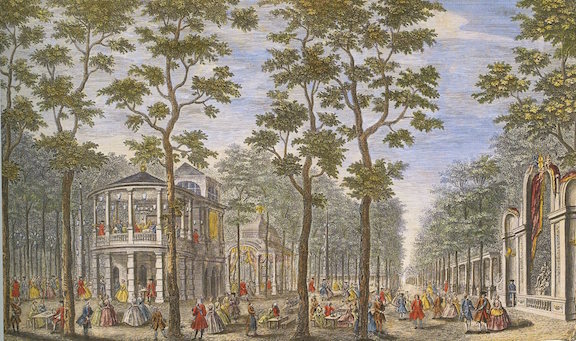
J. Maurer, A Perspective View of Vaux Hall Garden, etching, hand-coloured, 1744 (David Coke's collection). The view looking down the Grand South Walk before the classical triumphal arches were installed, with Roubiliac's Grand Alcove on the right.

J. Maurer, A Perspective View of Vaux Hall Garden, etching, hand-coloured, 1744 (David Coke’s collection). The view looking down the Grand South Walk before the classical triumphal arches were installed, with Roubiliac’s Grand Alcove on the right.

A Typical Visit to Vauxhall (from 7-10 p.m.)

The journey usually began with a boat ride from Whitehall or Westminster. On one occasion, Toupee writes about accompanying “a family group including Tom, a young musician who played the latest opera melodies on his French horn, while Miss Kitty was asked by her mother to sing one of the latest Italian songs.”

Others on their way to the gardens in neighbouring boats included ‘Sir John, from Fenchurch-street’, with his wife and all his children, attended by a footman. A Cheapside apprentence called William was on an illicit outing with Sukey, his master’s daughter… ‘An honest old mechanick’ and his wife followed; he was returning to Vauxhall after many years’ absence, to see how it had changed, reassuring his wife that the gardens must be a respectable place for her to be going, because the Prince of Wales himself was a regular visitor. This piece is clear evidence for the type of social mix that Tyers wanted to see at Vauxhall, although it is equally clear that, just because people inhabited the same space and came into direct contact, they did not necessarily interact in any meaningful way.

Pet dogs were not allowed in the gardens, but that did not stop people bringing them along for the ride, maybe to occupy the liveried footman who would not be admitted by Tyers’s gatekeeper, but could walk the dog in the fields of Lambeth. Having entered the tardens, Toupee’s party saw all the sights, listened to the music and strolled around the walks, watching and being watched by the other visitors.

The third letter, concerning the hour before closure at 10 p.m., starts with a detailed description of the dinner, accompanied by music from the Orchestra. The dramatic finale to the letter is the boat trip home, recounting the dangers of the riverside and the traditional ‘Thames ribaldry’, long-winded insults from the occupants of nearby boats that were suffered by voyagers as far apart in time as Addison’s Sir Roger in 1711 and Oakman’s John Gilpin in 1785.

“Sexual freedom was intrinsic to the gardens”

The overriding topic that runs flagrantly throughout the three letters is the meeting of the sexes, and the self-evident truth that human nature takes full advantage of any liberty offered to it. If Toupee is to be believed, Tyers was promoting his gardens as a place for lovers to meet, for initiating and nurturing romantic attachments, for sexual intrigue and adventures, and for illicit affairs; or, if he was not promoting these activities as such, he created an environment that made them possible and, indeed, inevitable. The river-crossing, the music, the paintings, the food, the walks and even the weather were all seen by Toupee as legitimate means to this one specific end.

The focus for most of the licentious activity in the gardens was not the Grove or the surrounding supper-boxes, which were too public, but the Druid’s Walk or Lover’s Walk, an unlit avenue running between and parallel with the Grand South Walk and Kennington Lane. It was distinguished from the other avenues by the fact that the trees met overhead, plunging it into shadow even before dusk. This concealing shade was unrelieved by artificial light until 1764, when magistrates forced Tyers to act against the immoral behaviour that the darkness encouraged, and to install lighting there.

At its eastern end, the Druid’s Walk met the avenue that ran around the eastern and northern edges of the gardens, always known as the Dark Walks; the darkness heightened the receptivity of impressionable young minds to emotional seduction, and no female reputation was safe…

Tyers employed constables to patrol the end of each walk in an attempt to keep such incidences to a minimum, but even they were not able to watch everybody all the time.

“The… cold and miserable spring of 1740”

I was blown through and through, in such a manner, as to drink four full glasses of French wine, before I knew I was alive. And, in that cold condition, as returning by water would have endanger’d my life, I was forced to be shook in a most unmerciful hack, till one half of my joins were distorted, and the other bruised to a jelly.

Indeed, all of the Toupee letters highlight the fact that the pleasures of the evening were never without their discomforts; and that a full enjoyment of the experience was predicated upon a full participation in the inconveniences, dangers and risks, whether perceived or real.

“The outstanding fashionable attraction of the London summer season”

In a sample letter from a young lady in town to her aunt in the country, published in 1741, the novelist Samuel Richardson confirmed that regular visits to the gardens had become an obligatory feature of the fashionable lifestyle, having his subject comment… that ‘I went on Monday last to Vaux-hall Gardens, whither every body must go, or appear a sort of Monster in polite Company.’

Susana’s Vauxhall Blog Post Series

  1. Vauxhall Gardens: A History
  2. Vauxhall Gardens: Jonathan Tyers—“The Master Builder of Delight” 
  3. Vauxhall Gardens: A New Direction
  4. Vauxhall Gardens: The Orchestra and the Supper-Boxes 
  5. Vauxhall Gardens: The Organ, the Turkish Tent, and the Rotunda
  6. Vauxhall Gardens: Three Piazzas of Supper-Boxes
  7. Vauxhall Gardens: “whither every body must go or appear a sort of Monster in polite Company”
  8. Vauxhall Gardens: The Competition
  9. Vauxhall Gardens: The Artwork, Part I
  10. Vauxhall Gardens: The Artwork, Part II
  11. Vauxhall Gardens: The Music, 1732-1859
  12. Vauxhall Gardens: The Business Side
  13. Vauxhall Gardens: Developments from 1751-1786
  14. Vauxhall Gardens: Thomas Rowlandson’s Painting (1785)
  15. ‎Vauxhall Gardens: The Third Generation of the Tyers Family and the Jubilee of 1786
  16. Vauxhall Gardens: An Era of Change (1786-1822), Part I
  17. Vauxhall Gardens: An Era of Change (1786-1822), Part II
  18. Vauxhall Gardens: An Era of Change (1786-1822), Part III
  19. Vauxhall Gardens: The Final Years, Part I
  20. Vauxhall Gardens: The Final Years, Part II
  21. Vauxhall Gardens: The Final Years, Part III
  22. Vauxhall Gardens: The Final Years, Part IV
  23. Vauxhall Gardens: Farewell, for ever
Vauxhall Gardens: Three Piazzas of Supper-Boxes

vauxhallbook

Vauxhall Gardens: A History

David Coke & Alan Borg

The Vauxhall Pleasure Gardens is one of the places I’d love to slip back in time to visit, just to catch a glimpse of what it was like. After recently splurging to buy this lovely coffee-table book, I thought it might make a wonderful subject for a new blog series. But do buy the book too, if you can! The photos are fabulous!

A Splash of the Exotic

The… striking similarity between the Grove and travellers’ descriptions of the great piazza of San Marco in Venice, where citizens were able to arrive by water, take refreshments, listen to music and watch street entertainers, would have highlighted Vauxhall’s exotic pedigree, evoking images of faraway places. This fusion of the familiar with the foreign, a constant feature of the gardens, is likely to have been a deliberate move to give visitors the thrill of romantic and magical scenes without the discomfort of distant travel.

In contrast to the aristocratic or amateur owners of great private gardens, whose wealth allowed them to indulge themselves with indiscriminate allusions to the classical past, ancient mythologies and dreamworlds, Tyers’s overriding consideration in all his investments at Vauxhall was the commercial imperative. Providing that it also furthered his aims, every improvement had to attract more people and increase his profits if it was to justify itself. The sales of food and drink represented the bulk of his income, so the more people he could persuade to purchase refreshments in the gardens, the better it was for his business. Increasing the number of supper-boxes by inserting several sweeping ‘piazzas’, or crescents of supper-boxes, was a very effective and elegant way of achieving this.

The Temple of Comus (later the Chinese Pavilions)

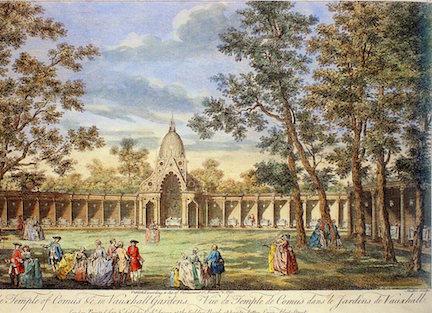
The Temple of Comus was named… after the god of cheer and good food… Ben Jonson described Comus as the ‘Prime master of arts, and the giver of wit;’ he is also associated with music and with floral decorations. The god thus encompassed all the purposes of the new building, which, although primarily devoted to dining, allowed for the appreciation of the arts and music as well as polite conversation in civilised surroundings.

J.S. Muller after Canaletto, A View of the Temple of Comus &c. in Vauxhall Gardens, an engraving hand-colored, 1751 (David Coke's collection). Families with small children are promenading in the foreground.

J.S. Muller after Canaletto, A View of the Temple of Comus &c. in Vauxhall Gardens, an engraving hand-colored, 1751 (David Coke’s collection). Families with small children are promenading in the foreground.

Initially, the building was “classical in style, with a colonnade of Ionic columns supporting a straight entablature, topped with urn finials; the semicircle flowed in a smooth curve out of the straight colonnade of the northern range of supper-boxes.” However, the designer also incorporated Gothic arches and “broad-ramped scrolls [that] acted as buttresses for the dome” and other unorthodox details. “The apparent breaking of architectural rules, mingling different styles in the same building, was deliberate and entirely typical of the unorthodox design of the English Rococo, which aimed to create playful, light-hearted works.”

piazza002 copy

T. Bowles after S. Wale. A View of the Chinese Pavillions and Boxes in Vaux Hall Gardens, engraving. c. 1840 (David Coke’s collection). This is a reprint of Bowles’ plate of 1751, published by Francis West, a Fleet Street optician and printseller who acquired many original plates of London views, probably after the sale of trade stock by Robert Wilkinson, Bowles’ successor, in 1825. The buildings of the Temple of Comus are shown with their newly applied elaborate surface decoration.

The Handel Piazza

piazza003 copy

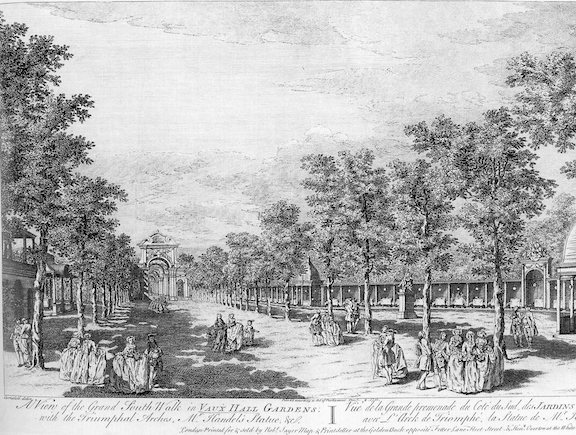
J.S. Muller after S. Wale, The Triumphal Arches, Mr. Handel’s Statue &c. in the South Walk of Vauxhall Gardens, engraving, c. 1840 (David Coke’s collection). The early version of the Handel Piazza.

The Handel Piazza on the Grand South Walk started life as a small semicircular colonnade of plain boxes, little more than an open setting for Roubiliac’s statue of the composer… The piazza was built in the simplest Doric order, although the domes of the two terminal pavilions were topped with Gothic lanterns. The rebuilding of 1750-51 created a much broader colonnade, with twenty-two flat-roofed boxes, still of the Doric order, but with urn finials on the roof over each column. As in the Temple of Comus, the central pavilion was more elaborate, marked out by the use of the Ionic order, with swagged decorations between the columns, but here in the Handel Piazza the classical order and restraint were maintained… This new structure added considerably to the number of supper-boxes available on the Grand South Walk… The opposing arrangement and contrasting decorative styles of the Chinese Pavilions and the Handel Piazza epitomise Tyers’s ideological belief in the balance between excess and moderation, with Comus appropriately representing pleasure and excess, and Handel, in his simpler classical architectural setting, representing virtuous sobriety.

piazza004 copy

J.S. Muller after Canaletto, A View of the Grand South Walk in Vaux Hall Gardens, with the Triumphal Arches, Mr. Handel’s Statue, &c. Engraving, 1751 (British Library, London). On the right is the second version of the Handel Piazza, with more supper-boxes.

The Gothic Piazza

The Gothic Piazza, looking down the Grand South Walk from its western end, is not shown from the front in any engraving of Vauxhall, although Wale’s General Prospect shows it from the back just to the south (right) of the Prince’s Pavilion). It is, however, fully described in Lockman’s Sketch, as

a little Semi-circle of Pavillions, in an elegant Gothic Style […}. At each Foot of this Semi-Circle, stands a lofty Gothic Tent, each having a fine Glass Chandelier, the Lamps in which are of a very peculiar frame, as are those in the grand Tent, built in the Grove, &c. In the Center of this Semi-Circle is a Pavilion, with a Portico before it; and over the Pavillion, a kind of Gothic Tower, with a Turret at Top. Here a Glass Moon was to have been seen; but its Light was found too dazzling for the Eye. Those who survey’d the Alley, the Grove, &c. thro’ this Glass, saw a lovely Representation of them in Miniature. As the painted triumphal Arches before mentioned are in the Grecian Style, and these Pavillions in the Gothic, they form a very pleasing Contrast.

…The implication is that visitors could climb to the top of the central pavilion of this piazza, to look down on the gardens through an optical device or lens during daylight, and after that, after dark, a light was shone through it towards visitors in the Grove, possibly spotlighting courting couples. [Scandal!]

“A remarkable body of original and innovatory architecture”

The group of structures in and around the Grove at the end of the 1740’s, comprising the Orchestra and organ buildings, the supper-boxes and three piazzas, the Prince’s Pavilion, the Turkish Tent and the Rotunda, represent a remarkably body of original and innovatory architecture that was both decorative and practical, achieved by Tyers and his team in the space of just thirteen years. Few other patrons could boast of such a diverse collection of modern works of architecture. The sheer expense incurred in this building spree is evidence of the level of Tyers’s income; as Hogarth’s friend the enameller Jean-André Rouquet wrote at the time, ‘The director of the entertainments of this garden acquires and expends very considerable sums of money there every year. He was born for undertakings of this kind. He is a man of an elegant and bold taste; afraid of no expence, when the point is to divert the public’—or rather, to attract the paying public to Vauxhall.

The fact that this elegant and bold taste was devoted to a pleasure garden, and that the buildings no longer exist, should not detract from their importance in the context of the development of British architecture, and in particular, of British interior design in the eighteenth century. They would have been some of the best-known modern buildings in the country, seen by tens of thousands of visitors every year.

Supper-Box Furniture

furniture001 copy

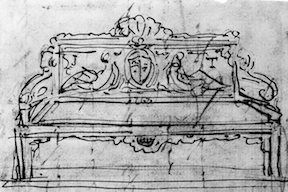
In the 1730’s and 1740’s, furniture at Vauxhall… was plain and serviceable, the tables usually covered with baize on linen. Rectangular square-legged farmhouse tables and foxed plain benches served the supper-boxes, with free-standing backless benches and plain tables out in the Grove. The Grove also boasted a number of slatted wooden garden seats, their circular inward-facing form, accessed through a single opening, providing the ideal setting for polite conversation for an intimate rendezvous.

furniture002

By the early 1750’s, however, contemporary engravings show a number of more elaborate and expensive tables and benches in the supper-boxes. The carved Rococo table-legs, showing below the tablecloths, appear to be ornamented with double-C scrolls.

After this brief period, however, the furniture again reverted to a simple farmhouse style. Indeed, it would be unsurprising if the carved Rococo tables of the 1750’s were found to be too delicate for the abuse they would have received at Vauxhall from the visitors and weather.

Susana’s Vauxhall Blog Post Series

  1. Vauxhall Gardens: A History
  2. Vauxhall Gardens: Jonathan Tyers—“The Master Builder of Delight” 
  3. Vauxhall Gardens: A New Direction
  4. Vauxhall Gardens: The Orchestra and the Supper-Boxes 
  5. Vauxhall Gardens: The Organ, the Turkish Tent, and the Rotunda
  6. Vauxhall Gardens: Three Piazzas of Supper-Boxes
  7. Vauxhall Gardens: “whither every body must go or appear a sort of Monster in polite Company”
  8. Vauxhall Gardens: The Competition
  9. Vauxhall Gardens: The Artwork, Part I
  10. Vauxhall Gardens: The Artwork, Part II
  11. Vauxhall Gardens: The Music, 1732-1859
  12. Vauxhall Gardens: The Business Side
  13. Vauxhall Gardens: Developments from 1751-1786
  14. Vauxhall Gardens: Thomas Rowlandson’s Painting (1785)
  15. ‎Vauxhall Gardens: The Third Generation of the Tyers Family and the Jubilee of 1786
  16. Vauxhall Gardens: An Era of Change (1786-1822), Part I
  17. Vauxhall Gardens: An Era of Change (1786-1822), Part II
  18. Vauxhall Gardens: An Era of Change (1786-1822), Part III
  19. Vauxhall Gardens: The Final Years, Part I
  20. Vauxhall Gardens: The Final Years, Part II
  21. Vauxhall Gardens: The Final Years, Part III
  22. Vauxhall Gardens: The Final Years, Part IV
  23. Vauxhall Gardens: Farewell, for ever
Vauxhall Gardens: Jonathan Tyers— “The Master Builder of Delight”

vauxhallbook

Vauxhall Gardens: A History

David Coke & Alan Borg

The Vauxhall Pleasure Gardens is one of the places I’d love to slip back in time to visit, just to catch a glimpse of what it was like. After recently splurging to buy this lovely coffee-table book, I thought it might make a wonderful subject for a new blog series. But do buy the book too, if you can! The photos are fabulous!

“The Master Builder of Delight”

In 1729, the site of the “Vauxhall Spring-Gardens was leased to a twenty-seven-year-old entrepreneur called Jonathan Tyers, whose goal was to transform it from a sort of seedy rural tavern to a respectable venue for all social classes.

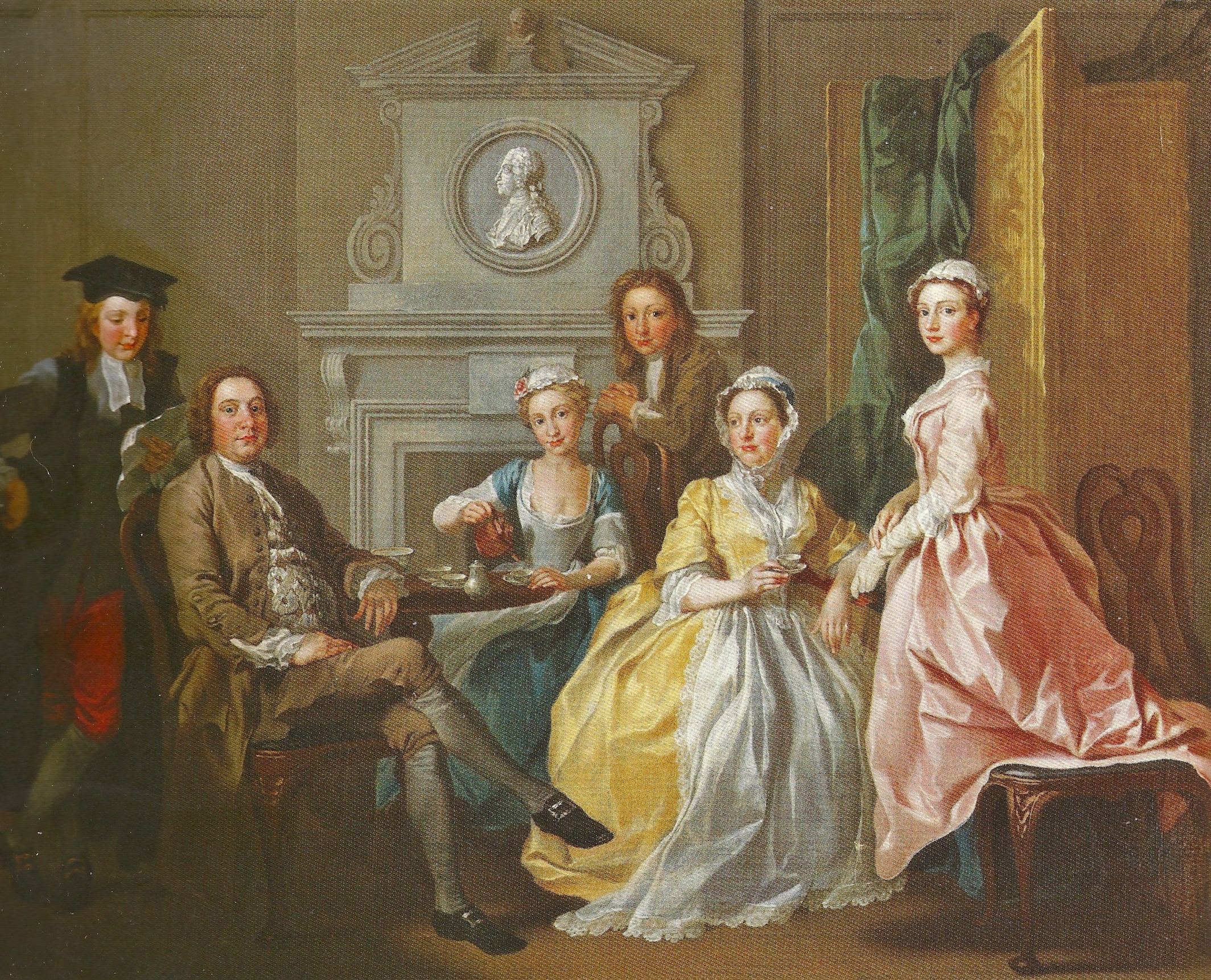
A fellmonger (dealer in animal hides or skins) by trade, Jonathan was not content to continue the family business, successful though it was. Driven by a desire to raise his family’s status—and improve the world as he did so—Tyers believed that culture and pleasurable entertainments should not be the sole prerogative of the upper classes, but that the middle and lower classes deserved to find some enjoyment in their lives as well.

tyers family

Family portrait by Francis Hayman, Jonathan Tyers and his Family, 1740. Left to right: Elder son Thomas, Jonathan, daughter Elizabeth, son Jonathan, wife Elizabeth, daughter Margaret.

Jonathan Tyers was a very complex character, with more than his fair share of contradictions and eccentricities. Upright, intelligent and self-assured, he also exhibited strains of arrogance and ambition. However, his ambitions were clearly projected chiefly upon his business rather than himself, while his personal aspirations were driven by a wish to raise his own status and that of his family to gentry, an object in which he succeeded at a remarkably early age. (p.35)

Through his association with The Wits’ Club, a social club for freethinkers, scholars, libertarians, and writers, Tyers became good friends with Charles Burney, Henry Fielding, William Hogarth, Harry Hatsell, Edward Moore, Thomas Cooke, Richard Dawson, and Leonard Howard. The club first met at Vauxhall Gardens later moved to a nearby tavern. Many of the ideas behind his development of the gardens came from the discussions at this club.

Although he never managed to mix with fashionable society in his lifetime, he was held in great respect and admiration by his peers, so much so that he was elected to the Royal Society of Arts in 1757, where he would have met many other prominent people, including Benjamin Franklin, when he visited London.

He and his creation were even featured in his friend Henry Fielding’s work of fiction, Amelia (1751).

The extreme Beauty and Elegance of this Place is well known to almost every one of my Readers; and happy is it for me that it is so; since to give an adequate Idea of it, would exceed my Power of Description. To delineate the particular Beauties of these Gardens, would, indeed, require as much pains and as much Paper too, as to rehearse all the good Actions of their Master [Tyers], whose Life proves the Truth of an Observation which I have read in some Ethic Writer, that a truly elegant Taste is generally accompanied with an Excellency of Heart; or in other Words, that true Virtue is, indeed, nothing else but true Taste.

The_Works_of_Henry_Fielding_Amelia_v2_1000373134

Tyers’s Mission

Besides his goal of cleaning up the gardens’ reputation, Tyers hoped to use the venue to improve people’s lives “through contact beauty and quality.” In other words, he planned to provide the lower orders with both art and beauty, and also expose them to “polite society,” who would educate them by example.

His influence on the manners and morals of eighteenth-century society was to be far-reaching, and his patronage of artists and designers would change the face of British art. But it was his ideological beliefs and priorities, his egalitarianism and his conviction that the pursuit of pleasure was a basic human right, and a vital element of the balanced life, that would really motivate his proprietorship of Vauxhall Gardens.

The Ridotto al Fresco

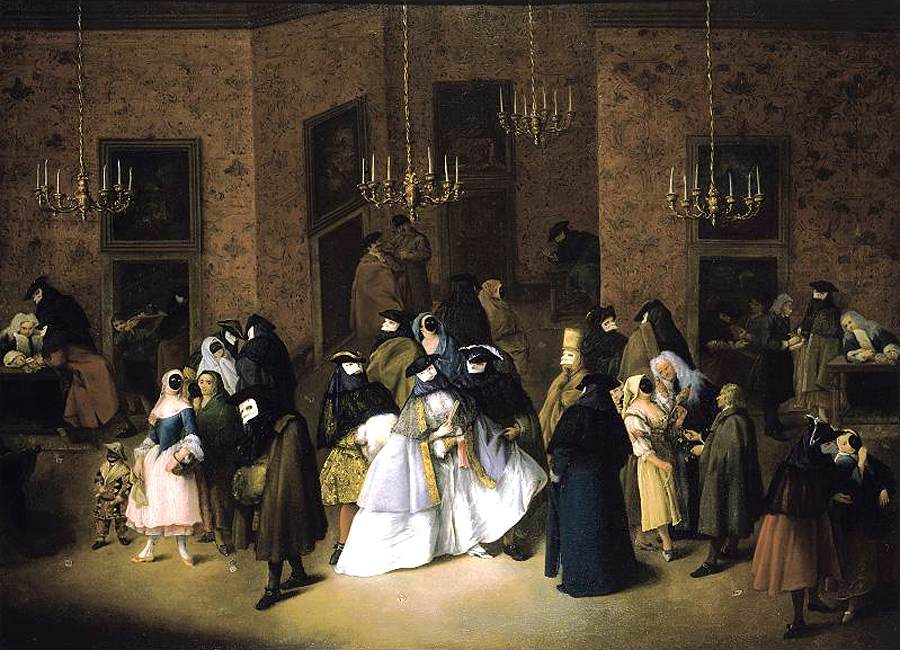
Tyers’s first event at Vauxhall was a masquerade ball in the manner of the Italian carnival in the spring of 1731. Not much is known of this event, except that there was outdoor dancing in masquerade costume and was restricted to the upper classes.

The Ridotto in Venice, Pietro Longhi, 1750's

The Ridotto in Venice, Pietro Longhi, 1750’s

By contrast, his second event in April of 1732, was attended by the poorer class of people, including “an oyster girl, a barber’s apprentice, a lawyer, an army captain, a doctor, a vicar and a number of prostitutes…”

The third event, considered to be the opening ceremony of Tyers’s Vauxhall Gardens, took place on 7 June 1732 and included the presence of Frederick, Prince of Wales. Under the guidance of John James Heidegger, Tyers created an extraordinary event that was talked about for years. A hundred armed soldiers were employed for the security of the distinguished guests, and he “hired the Westminster and Lambeth ferrymen for the whole night to carry his guests across the river and back.” Even with an admission fee of a guinea—which only the wealthy could afford—“between three and four hundred people actually attended the ridotto.” Besides the Prince of Wales’s entourage, the guests included politicians and their friends, “lawyers, bankers, printers, brewers, churchmen, military men and aristocrats.” The party broke up at around four in the morning. “The principal entertainments…were dancing and feasting, combined with the social intercourse between masked guests.”

The Ridotto in Venice, Pietro Longhi, 1750's

The Ridotto in Venice, Pietro Longhi, 1750’s

While by most accounts—particularly in the view of the Prince of Wales—this event was a great success, other accounts indicate that there was a distinct theme of preaching and moralizing via buildings set up to show the misery and pain that result from excessive self-indulgence that may have not gone over too well with the party-minded guests.

In any case, his final ridotto, which was held two weeks later on 21 June, likely at the request of the Prince, who was having the time of his life, was attended by only half as many, which, considering his expenses, would likely have completely wiped out any profits from the four events. No doubt this is the reason Tyers held no such events during 1733 or 1734, although the gardens themselves likely continued to be open to the public.

Susana’s Vauxhall Blog Post Series

  1. Vauxhall Gardens: A History
  2. Vauxhall Gardens: Jonathan Tyers—“The Master Builder of Delight” 
  3. Vauxhall Gardens: A New Direction
  4. Vauxhall Gardens: The Orchestra and the Supper-Boxes 
  5. Vauxhall Gardens: The Organ, the Turkish Tent, and the Rotunda
  6. Vauxhall Gardens: Three Piazzas of Supper-Boxes
  7. Vauxhall Gardens: “whither every body must go or appear a sort of Monster in polite Company”
  8. Vauxhall Gardens: The Competition
  9. Vauxhall Gardens: The Artwork, Part I
  10. Vauxhall Gardens: The Artwork, Part II
  11. Vauxhall Gardens: The Music, 1732-1859
  12. Vauxhall Gardens: The Business Side
  13. Vauxhall Gardens: Developments from 1751-1786
  14. Vauxhall Gardens: Thomas Rowlandson’s Painting (1785)
  15. ‎Vauxhall Gardens: The Third Generation of the Tyers Family and the Jubilee of 1786
  16. Vauxhall Gardens: An Era of Change (1786-1822), Part I
  17. Vauxhall Gardens: An Era of Change (1786-1822), Part II
  18. Vauxhall Gardens: An Era of Change (1786-1822), Part III
  19. Vauxhall Gardens: The Final Years, Part I
  20. Vauxhall Gardens: The Final Years, Part II
  21. Vauxhall Gardens: The Final Years, Part III
  22. Vauxhall Gardens: The Final Years, Part IV
  23. Vauxhall Gardens: Farewell, for ever
Vauxhall Gardens: A History

vauxhallbook

Vauxhall Gardens: A History

David Coke & Alan Borg

The Vauxhall Pleasure Gardens is one of the places I’d love to slip back in time to visit, just to catch a glimpse of what it was like. After recently splurging to buy this lovely coffee-table book, I thought it might make a wonderful subject for a new blog series. But do buy the book too, if you can. The photos are fabulous!

newspringgardensmap

Public Gardens

Royal Parks, such as St. James and Hyde Park, began to open up to the public in the seventeenth century. The first “Spring Garden” was located near St. James Park. Amenities in 1614 included a bathing pond, water fountains, graveled paths and fruit trees, a butt for archery, and a tiltyard. A bowling green was added by Charles II. It also became known for excessive drinking, quarrels, and hopeful prostitutes.

Samuel Pepys and the “Old” and “New” Spring Gardens

But there were also “Spring Gardens” at Vauxhall during the early seventeenth century, and after the Restoration, two of them, one “Old” and one “New” which has caused much confusion over the years. The “Old Spring Garden” was a pleasant place to walk with trees and flowers, with food available that Samuel Pepys spoke of as too “dear”, causing him and his family to eat at a nearby house instead after they had also visited the “New Spring Garden.” The word “New” was used to indicate that it was re-opened after the Restoration. Before 1750, when Westminster Bridge was opened, most visitors arrived by boat.

Taking water for vauxhall - Be careful, my love, don't expose your leg

TAKING WATER FOR VAUXHALL – Be careful, my Love, don’t expose your Leg

An early visitor, Balthasar de Monconys, described it:

We took a boat to the other side of the Thames to see two gardens, where everyone can go and walk, have something to eat in the restaurants or in the cabins in the garden. They are called Spring Gardens, that is to say Jardin du Printemps, and the new one is more beautiful than the old. I admired the beauty of the grassy walks and the niceness of the sanded ones. It is divided into a large number of plots twenty or thirty yards square, enclosed by gooseberry hedges, and these plots are also planted with raspberry bushes, roses, and other shrubs, as well as herbs and vegetables, such as peas, beans, asparagus, strawberries and so on. The walks are bordered with jonquils, gilliflowers or lilies. We returned after we had eaten and went again to Longacre.

Samuel_Pepys

Samuel Pepys

Samuel Pepys

Samuel Pepys was a frequent visitor to the gardens, mentioning it twenty-three times in his Diary from 1662 to July 1668. On one of his earlier visits, he mentions “boys doing tumbling tricks”. In 1665 when the plague began to take hold, he mentions “the ayre and pleasure of the garden, was a great refreshment to me, and methinks, that which we ought to Joy ourselves in.” A month later, he writes:

I to Fox-hall, where to the Spring-garden; but I do not see one guest there, the town being so empty of anybody to come thither. Only, while I was there, a poor woman came to scold with the master of the house that a kinswoman, I think, of hers, that was newly dead of the plague, might be buried in the church-yard; for, for her part, she should not be buried in the Commons, as they said she should.

A year later, Pepys describes visiting the park with a friend and having a sexual encounter with some prostitutes in a private arbor. He also mentions bird (particularly nightingale) and animal calls, an entertainment which was to become customary at Vauxhall. From his writings, one can infer that entrance to the gardens was free, but that food and drink were not. One entry describes a situation where ladies were stalked by drunken men. Pepys says this:

… at last, the ladies did get off out of the house and took boat and away. I was troubled to see them abused so; and could have found my heart, as little desire of fighting as I have, to have protected the ladies.

Another time, when he visited with his wife, he was again troubled by these young rapscallions:

So over the water with my wife and Deb and Mercer to Spring-garden, and there eat and walked, and observe how rude some of the young gallants of the town are become, to go into people’s arbors where there are not men, and almost force the women—which troubled me, to see the confidence of the vice of the age: and so we away by water, with much pleasure home.

Food and Drink at the Spring Gardens

Restoration literature mentions waiters. The food served was usually cold: the very thin ham shavings that Vauxhall was known for, chicken served with salad, and occasionally beef and lobster. Strawberries and cream were popular, the fruit grown in local market gardens. Beverages were wine, beer, and rack punch (a drink from India containing arrack—distilled from coconut sap—hot water, limes, sugar, and spice).

The Great Walk

Tom Brown mentions the Great Walk—the central feature of the gardens—in Amusements, published in 1700.

The ladies that have an inclination to be private take delight in the close walks of Spring Gardens, where both sexes meet and mutually serve one another as guides to lose their way; the windings and turnings in the little wilderness are so intricate that the most experienced mothers have often lost themselves in looking for their daughters.

Much mention is made of intrigues and sexual encounters in the “Spring Gardens,” although it is hinted that such is of a somewhat higher class there than in other public venues. Sir Roger de Coverley complained to the mistress of the house “that he should be a better customer to her garden if there were more nightingales and fewer strumpets” after he was accosted by a “wanton baggage” there.

An escape from the city

The Spring Gardens, although not really the countryside, were far enough away from the dirt and smells of the city that its widely diverse visitors could—at least for a short while—escape their troubles. The following anonymous verses were published in the Gentleman’s Magazine of June 1732:

At Vauxhall Stairs they land, their Passage pay,

And to Spring Gardens, tread the beck’ning way.

‘Hail pleasing Shades! O hail thou secret Grove!

The blest Retreat of Liberty and Love.

All hail, ye Bow’rs! Ye beaut’ous Silvan Scenes,

Ye Grotts, and Mazes of fresh blooming Greens;

Here dwells no Care, no matrimonial Strife,

The peevish Husband, nor the bawling Wife;

Here’s no Restraint to make our Pleasures cloy,

We part at will, and as we please enjoy

See how the Birds by Nature taught to rove,

How sweet they sing, and how like us they love.

With careless Ease they hop from Tree to Tree,

And are as Merry, and as blest as we.

Thrice happy State! Each am’rous Trulla says,

And baits with Poison all the various ways;

The Walks are fill’d with Throngs of different Sort,

From Fleet Street, Drury, and incog., from Court.

To these fair Shades, see Belles and Beaus advance,

Some sigh, some sing, some whistle, and some dance.

Susana’s Vauxhall Blog Post Series

  1. Vauxhall Gardens: A History
  2. Vauxhall Gardens: Jonathan Tyers—“The Master Builder of Delight” 
  3. Vauxhall Gardens: A New Direction
  4. Vauxhall Gardens: The Orchestra and the Supper-Boxes 
  5. Vauxhall Gardens: The Organ, the Turkish Tent, and the Rotunda
  6. Vauxhall Gardens: Three Piazzas of Supper-Boxes
  7. Vauxhall Gardens: “whither every body must go or appear a sort of Monster in polite Company”
  8. Vauxhall Gardens: The Competition
  9. Vauxhall Gardens: The Artwork, Part I
  10. Vauxhall Gardens: The Artwork, Part II
  11. Vauxhall Gardens: The Music, 1732-1859
  12. Vauxhall Gardens: The Business Side
  13. Vauxhall Gardens: Developments from 1751-1786
  14. Vauxhall Gardens: Thomas Rowlandson’s Painting (1785)
  15. ‎Vauxhall Gardens: The Third Generation of the Tyers Family and the Jubilee of 1786
  16. Vauxhall Gardens: An Era of Change (1786-1822), Part I
  17. Vauxhall Gardens: An Era of Change (1786-1822), Part II
  18. Vauxhall Gardens: An Era of Change (1786-1822), Part III
  19. Vauxhall Gardens: The Final Years, Part I
  20. Vauxhall Gardens: The Final Years, Part II
  21. Vauxhall Gardens: The Final Years, Part III
  22. Vauxhall Gardens: The Final Years, Part IV
  23. Vauxhall Gardens: Farewell, for ever