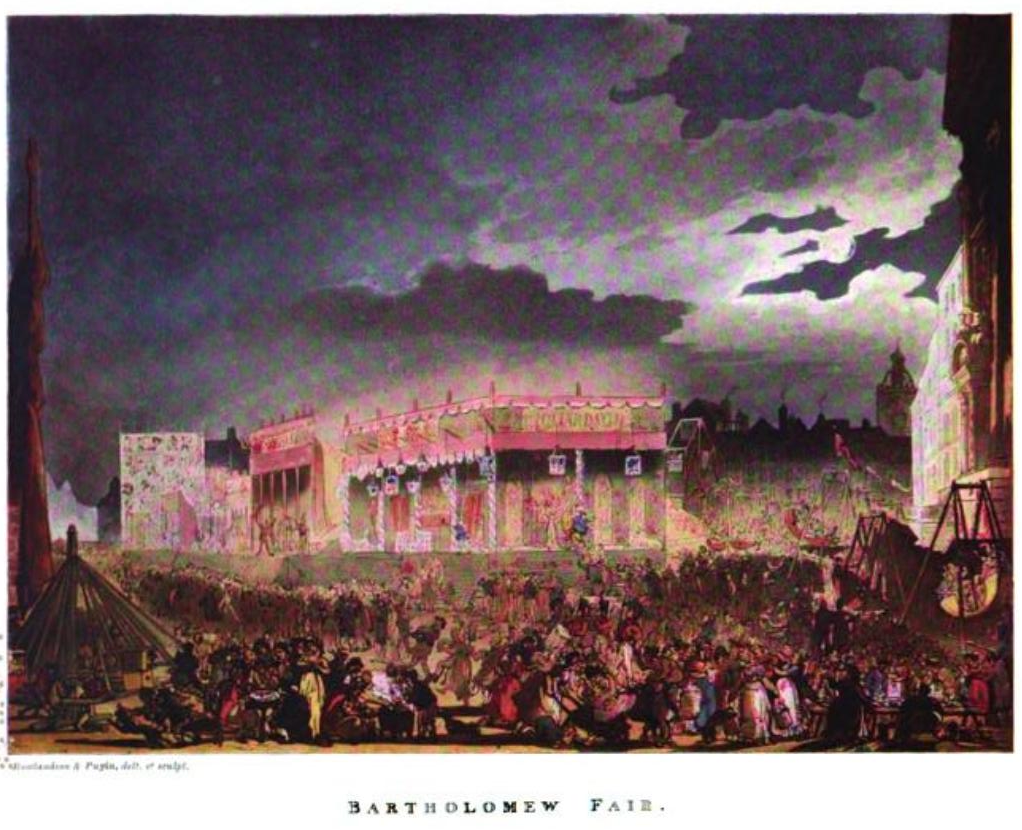
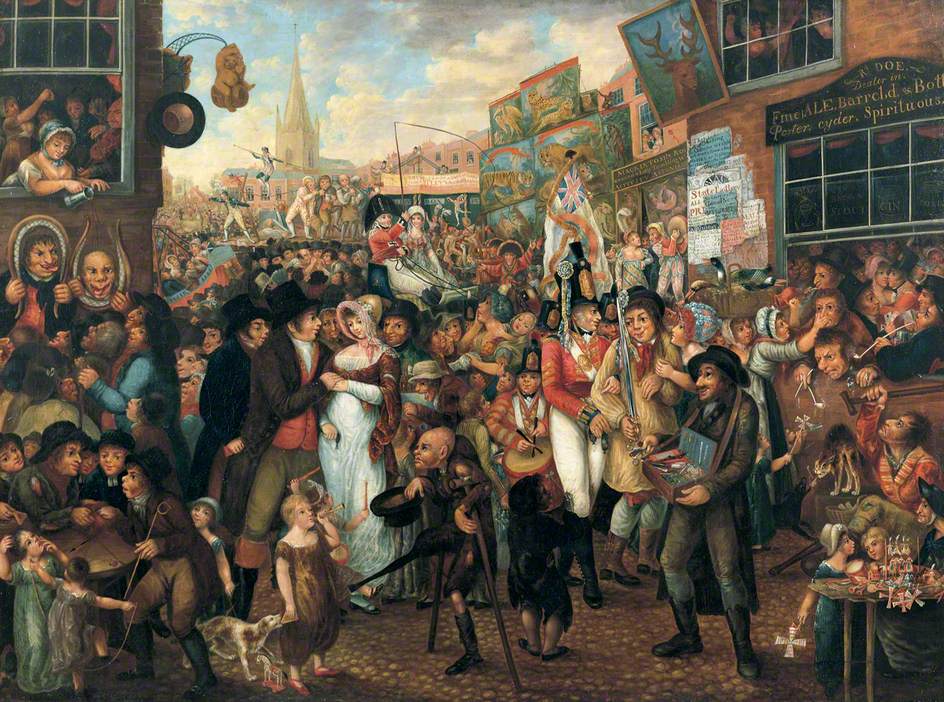
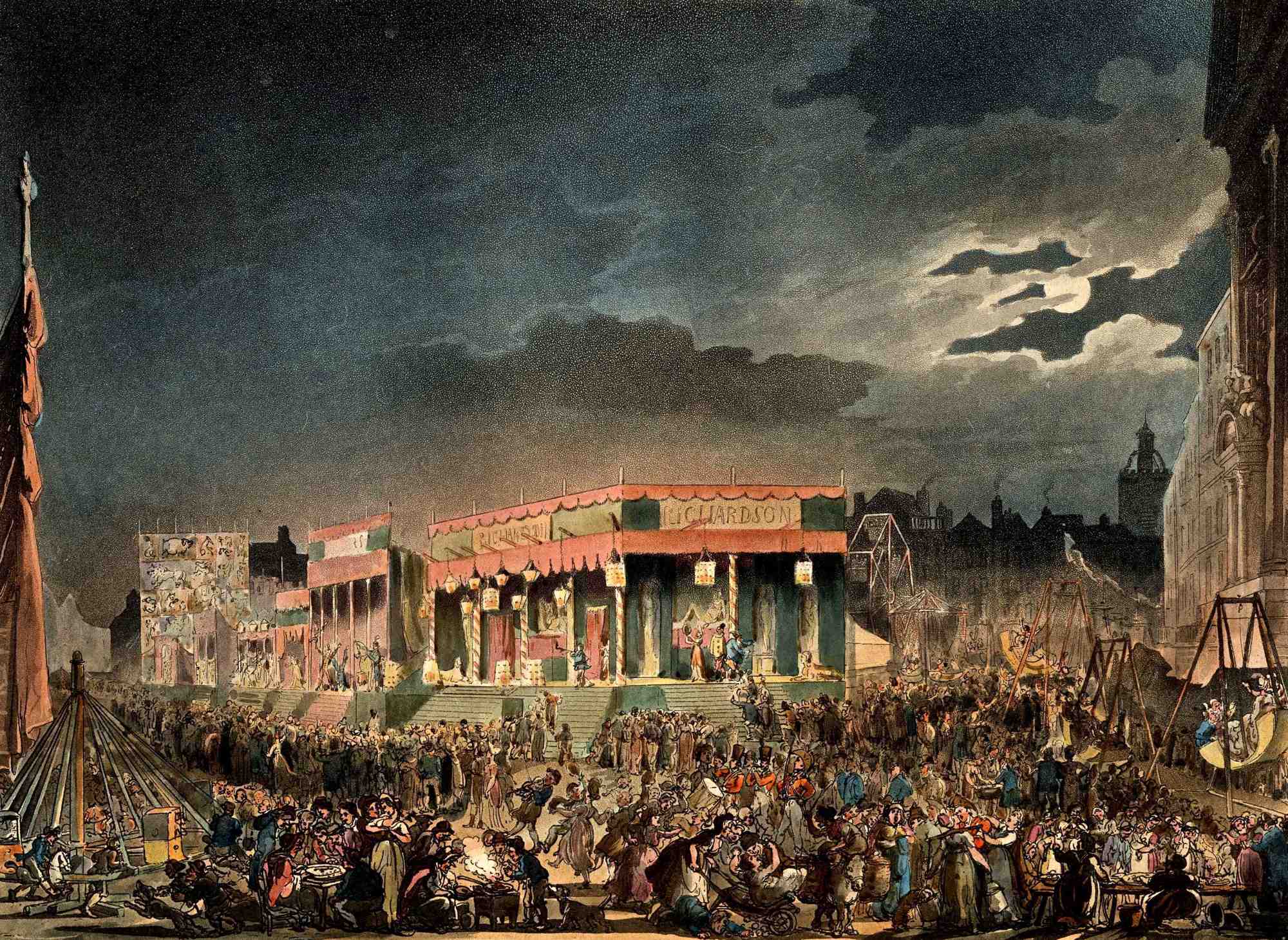
The annexed print is a spirited representation of this British Saturnalia. To be pleased in their own way, is the object of all. Some hugging, some fighting, others dancing: while many are enjoying the felicity of being borne along with the full stream of one mob, others are encountering all the dangers and vicissitudes of forcing their passage through another; while one votary of pleasure is feasting his delighted eyes with the martial port of Rolla, and the splendid habiliments of the Virgins of the Sun, another disciple of Epicurus is gratifying his palate with all the luxury of fried sausages, to which he is attracted by the alluring invitation of “Walk into my parlour!” The ambitious, who, seated in triumphal cars, are by the revolution of a wheel, like that of Fortune’s, raised to the highest pinnacle of human wishes, look down with scorn on the little grovellers below, reckless that they gain their dangerous elevation at the hazard of their necks, and that, by another turn of the wheel, they must sink to the base level from which they arose.
A number of youths, each with the lass he loves, are carelessly disporting in the swings; indeed so carelessly, that one of them appears to have fallen out. The mighty Nimrods, each bestriding their fiery coursers on the round-about, pursue the chace with ardour; their ladies, seated in chariots, lead or follow with alacrity in their circle of amusements.
The wise zoologist finds ample gratification in Mr. Prdcock’s astonishing exhibition of wild beasts, assured by the stentoric showman, that here is to be seen “The largest elephant in the world, except himself!” The conjuror overwhelms his wondering spectators with . his surprising manual dexterity, and the philosophic operation of eating fire. Saunders, with his equestrian exercises, rope-dancing, and tumbling, has also his full share of attraction. Richardson delights a joyous group with the humours of their old and ever-welcome friend Punch; while a lady, with a tambourine, and a hero with a trumpet, are, with all their powers, adding to the concert of sweet sounds, which resounds from every quarter.
The general effect of this print is highly interesting. The contrast of the gaudy glaring lights of the various booths, opposed to the calm and serene light of:
“the wandering moon,
“Riding near her highest noon,”
has the happiest effect imaginable. The bustle and confusion of the various groups are well conceived, and executed with spirit. The surrounding scenery, St. Bartholomew’s hospital, the church, and the houses in Smithfield, are correct, and give an identity and value to the scene.
Of the origin and progress of this ancient and celebrated fair, it may be necessary to give some account; and it may not be uninteresting to give some idea of the other sports and diversions of our warlike and gallant ancestors, when Smithfield was the principal scene of action.
From “Hogarth illustrated, by John Ireland,” the following essay on the rise and progress of fairs is extracted. — Vol. I. article Southwark Fair.
“At a time when martial hardihood was the only accomplishment likely to confer distinction, when war was thought to be the most honourable pursuit, and agriculture deemed the only necessary employment, there was little social intercourse, and so few retail dealers, that men had no very easy means of procuring those articles which they occasionally wanted. To remove this inconvenience, it was found necessary to establish some general mart, where they might be supplied. Fairs were therefore instituted, as a convenient medium between the buyer and seller, and were at first considered as merely places of trade*. They were generally held on the eve of saints’ days. Some of them continued open many weeks, and had peculiar privileges, to encourage the attendance of those who had goods upon sale. The pedlar travelled from city to city, or from town to town, with his movable warehouse, and furnished his customers with what served them until his periodical return.
“As men grew more polished, their wants increased, their intercourse became more general, and the importance of commerce was better understood. The merchant deposited his goods in a warehouse, and the trader opened a shop. Fairs, deserted by men of business, gradually changed their nature, and, instead of being crowded by the active and industrious, were the haunts of the idle and dissolute. Such were they at the time of this delineation [Southwark Fair], made in 1733, and may be considered as a true picture of the holiday amusements of that period. Bartholomew Fair had a similar origin.”
According to Fitz-stephen, a writer in the reign of Henry II. “Without one of the gates was a smooth or smethe field, both in name and deed, where, every Friday, unless it be a solemn bidden holiday, is a notable shew of horses to be sold. Earls, barons, knights, and citizens, repair thither to see or to buy. There may you of pleasure see amblers pacing it delicately; there you may see trotters fit for men of arms, sitting more hardily; there you may have young horses not yet broken, &c. In another part of that field are to be sold implements of husbandry, as also fat swine, milch kine,” &c.
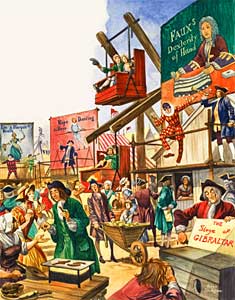
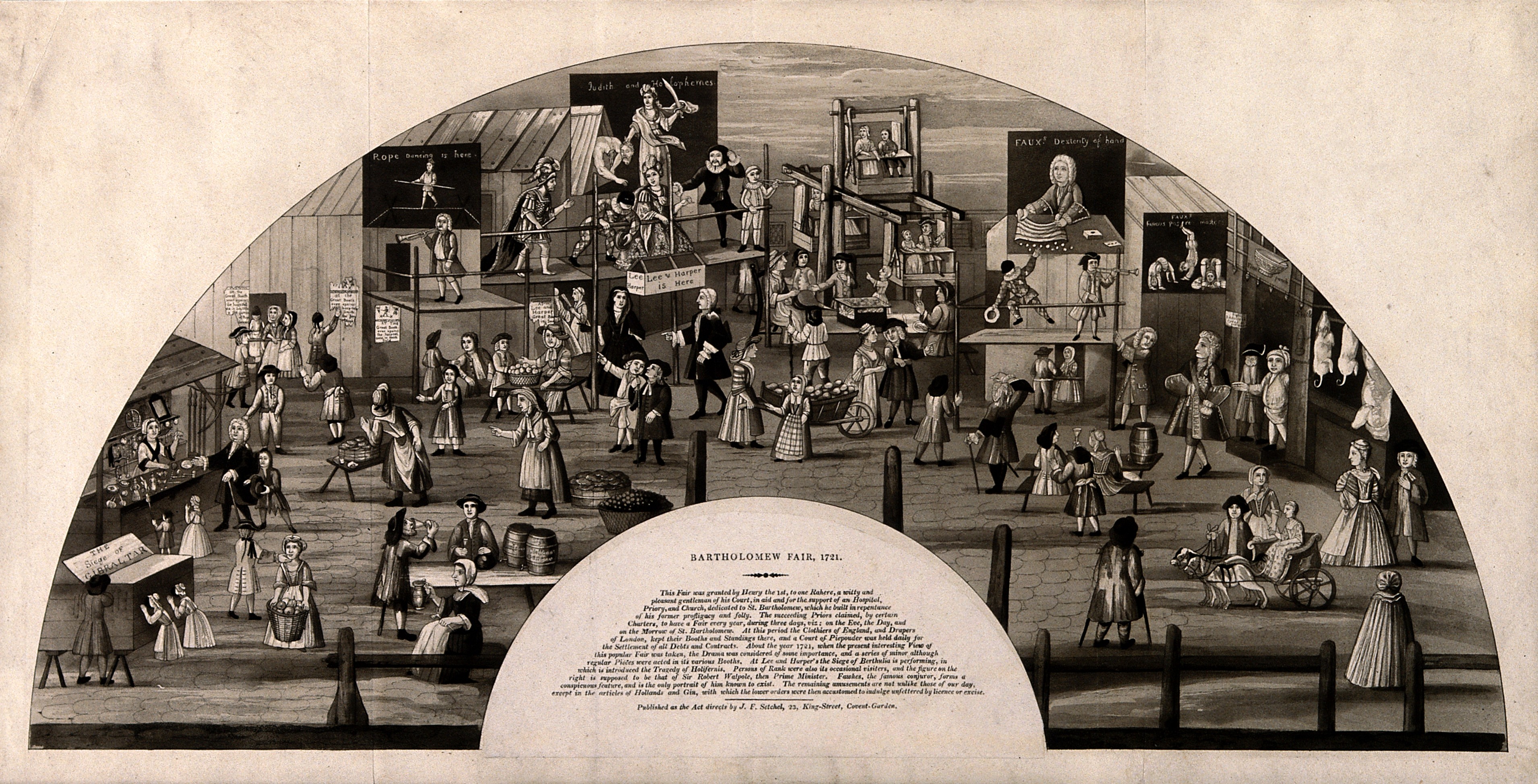
“To the priory of St. Bartholomew’, Henry II. granted the privilege of a fair, to be kept yearly, at Bartholomew’s tide, for three days, to wit, the eve, the day, and the next morrow. To the which the clothiers of England, and drapers of London, repaired; and had their booths and stalls within the churchyard of this priory, closed in with walls and gates, locked every night, and watched, for the safety of men’s goods and wares. A court of Piepowders was daily during the fair holden for debts and contracts. But now, notwithstanding all proclamations of the Prince, and also the act of Parliament, in place of booths within the churchyard, only letten out in the fair-time, and closed up all the year after, be many large houses budded; and the north wall towards Long-lane being taken down, a number of tenements are there erected for such as give great rents.” — Stow.
Smithfield, besides being. a market for cattle and horses, hay, straw, &c. and a cloth fair, was famous also for the celebration of royal jousts and tournaments. A general fair was likewise held a Bartholomew tide.
To shew the gallantry of those days of chivalry, it may not be impertinent to give an extract of one of those royal jousts from Froisart.
“In the fourteenth of Richard II. royal jousts and tournaments were proclaimed to be done in Smithfield, to begin on Sunday next after the feast of St. Michael. Many strangers came forth out of other countries, namely, Valerian, Earl of St. Paul, that had married King Richard’s sister; the Lady Maud Courteney and William, the young Earl of Ostarvant, son to Albret of Baviere, Earl of Holland and Henault.
“At the day appointed, there issued forth of the Tower, about the third hour of the day, sixty coursers, apparelled for the jousts; upon every one an esquire of honour, riding a soft pace. Then came forth sixty ladies of honour, mounted upon palfraies, riding on the one side*, richly apparelled; and every lady led a knight with a chain of gold. Those knights being on the king’s party, had their armour and apparel garnished with white harts, and crowns of gold about the harts’ necks; and so they came riding through the streets of London to Smithfield, with a great number of trumpets and other instruments of music before them. The king and queen, who were lodged in the bishop’s palace in the city of London, were come from thence with many great estates, and placed in chambers to see the jousts. The ladies that led the knights were taken down from their palfraies*, and went up to chambers prepared for them. Then alighted the esquires of honour from their coursers, and the knights in good order mounted upon them; and after the helmets were set on their heads, and being ready at all points, proclamation was made by the heralds, the jousts began, and many commendable courses run, to the great pleasure of the beholders. These jousts were continued many days with great feasting.”
One other instance we shall take from Stow, to shew that these sports were attended with some danger.
“In the year 1467, the seventh of Edward IV, the Bastard of Bourgoigne challenged the Lord Scales to fight with him on horseback and on foot. The king therefore caused the lists to be prepared in Smithfield: the timber-work cost two hundred marks, besides the fair and costly galleries prepared for the ladies and others: at which martial exercise the king and nobility were present. The first day they ran together with speeres, and departed with equal honour. The next day they tourneyed on horseback, the Lord Scales’s horse having on his chafron a long pike of steel, and as the two champions coped together, the same horse thrust his pike into the nostrils of the Bastard’s horse, so that for very pain he mounted so high, that he fell on the one side with his master; and the Lord Scales rode about him with his sword drawn, till the king commanded the marshal to help up the Bastard; who said, ‘I cannot hold up the clouds; for though my horse fail me, I will not fail an encounter, companion.’ But the king would not suffer them to do any more that day.
“The next morrow they came into the lists on foot with two pole-axes, and fought valiantly; but at last the point of the pole-axe of the Lord Scales entered into the side of the Bastard’s helm, and by force might have placed him on his knees, but the king cast down his warder, and the marshal severed them. The Bastard required that he might perform his enterprise, but the king gave judgment, as the Bastard relinquished his challenge.”
These were the amusements of the higher orders; those of the citizens are also interesting and instructive. “Let us now,” saith Fitz-stephen, “come to the sports and pastimes, seeing it is fit that a city should not only be commodious and serious, but also merry and sportful. In the holidays, all the summer, the youths are exercised in leaping, dancing, shooting, wrestling, casting the stone, and practising their shields. The maidens trip with their timbrels, and dance as long as they can well see.”
These manners continued with little variation to the time of Henry VIII.
In the infancy of the drama, the young men were taught to perform in the Holy Mysteries; one of which was exhibited in 1591, at the Skinners Well, adjoining Smithfield, which lasted three days together, the king, queen, and nobles being present; and in 1409, one which lasted eight days, and was intended to represent the Creation. To these succeeded the performance of tragedies and comedies, then called stage-plays, which have continued a favourite diversion with your Englishmen ever since the time
“When sweetest Shakespeare, Fancy’s child, “
Warbled his native wood-notes wild.”
Bartholomew Fair had now for a long time, instead of three days, lasted a fortnight, and was unquestionably productive of some habits of dissipation, and much loss of time, among the lower orders of people who attended it. At length, in 1708, the magistracy of the city determined to reduce the fair to the original time of three days, and confine it to its first purpose, that of selling merchandise only; and an order of common council was made accordingly: but seems to have been ill obeyed, as in 1735, the court of aldermen came to a resolution touching Bartholomew Fair, “that it shall not exceed Bartholomew eve, Bartholomew day, and the day after; and that during that time nothing but stalls and booths shall be erected for the sale of goods, wares, and merchandises, and no acting be permitted.” This order it appears was obeyed no better. But Southwark Fair, and many others, were at this time suppressed.
Of the acting at Bartholomew Fair, little is known before the time of Elkannah Settle, who is only now remembered from having been the rival of Dryden, and having been honoured by Pope with a niche in the Dunciad. Settle was born in 1648: in 1680 he was so violent a Whig, that the ceremony of pope-burning, on the 17th of November, was entrusted to his management;he wrote much in defence of the party, and with the leaders was in high estimation. Politicians and patriots were formed of much the same materials then as they are now. Settle being disappointed in some of his views, became as violent a Tory as he had been a Whig, and actually entered himself a trooper in King James’s army on Hounslow Heath. The Revolution destroyed all his prospects, and in the latter part of his life he was so reduced as to attend a booth, which was kept by Mrs. Minns, and her daughter, Mrs. Leigh, in Bartholomew Fair. From these people he received a salary for writing drolls, which were generally approved. In his old age he was obliged to appear in these wretched exhibitions; and in the farce of St. George for England, performed the part of the dragon in a case of green leather of his own invention. To this circumstance Dr. Young refers in his epistle to Pope:
“Poor Elkannah, all other changes past,
“For bread in Smithfield dragons hiss’d at last;
“Spit streams of fire, to make the butchers gape,
“And found his manners suited to his shape.”
In these humble representations some of our greatest actors made their first appearance, and not a few of them, after they had attained high eminence, ranted, strutted, and bellowed through all the days it was kept open, to their own emolument, and the heartfelt satisfaction of Thames-street beaux and the black-eyed beauties of Puddle-dock. In 1733, a booth was built in Smithfield for the use of T. Cibber, Bullock, and H. Hallum; at which the tragedy of Tamerlane, with the Fall of Bajazet, intermixed with the comedy of the Miser, was actually represented. The bill of fare with which these gentlemen tempted their customers, may properly enough be called an olio; and the royal elephant sheet on which the titles of the play were printed, throws the comparatively diminutive bills of a theatre royal into the back ground.
In some of the provinces distant from the capital, dramatic exhibitions are still given out in the quaint style which marked the productions of our ancestors. This sometimes excites the laughter of the scholar, but it whets the curiosity of the rustic; and whatever helps to fill a theatre, must be the best of all possible methods. From the mode of announcing some late productions at the two royal theatres, there seems good reason to expect, that the admirers of this style of writing will soon be gratified by having it introduced into the London play-bills, or at least into the London papers.
But leaving the mighty characters who tread the London boards to their admirers, let us return to humbler scenes, and give one example out of many which they annually afford. A play-bill printed some years ago at Ludloiv, in Shropshire, was nearly as large as their principal painted scene, and dignified with letters that were truly capital, for each of those which composed the name of a principal character was near a foot long. The play was for the benefit of a very eminent female performer, the bills said, to be written by herself, and thus was the evening’s amusement announced:
“For the benefit of Mrs. ******, by particular desire of B. G. Esq. and his most amiable lady, this present evening will be performed a deep tragedy containing the doleful history of King Lear and his Three Daughters, with the merry conceits of his majesty’s’ fool, and the valorous exploits of General Edmund, the Duke of Gloster’s bastard. All written by one William Shakespeare, a mighty great poet, who was born in Warwickshire, and held horses for gentlemen at the sign of the Red Bull in St. John’s-street, near West Smithfield; where was just such another play-house as that to which we humbly invite you, and hope for the good company of all friends round the Wrekin.”
“All you who would wish to cry or to laugh,
You had better spend your money here than in the alehouse by half.
And if you likes more about these things for to know,
Come at six o’clock to the barn in the Highstreet, Ludlow;
“Where presented by live actors, the whole may be seen:
So vivant rex, God save the king, not forgetting the Queen !”
See Hogarth illustrated by John Ireland.
After Cibber and his companions, Shuter and Yates exhibited at Bartholomew Fair; since which time none of the performers of the theatres royal have had booths there, and the fair has been reduced to its original term of three days.
*The fairs at Chester, and some few other places, still keep up the spirit of the original institution.
*It was in this reign side-saddles were first used in England.

 Susana's Parlour