Episode #12: Lady P’s Revelations Regarding George III and His Peculiar Progeny

Lady Pendleton, Damian Ashby’s eccentric aunt (see the epilogue to Treasuring Theresa on Susana’s web site), is visiting Susana from the early 19th century. She’s intrigued by life in 21st century Toledo, Ohio, and, of course, Susana is thrilled to have the opportunity to pick her brain about life in Regency England. It certainly gives her a great deal to write about in Susana’s Parlour!
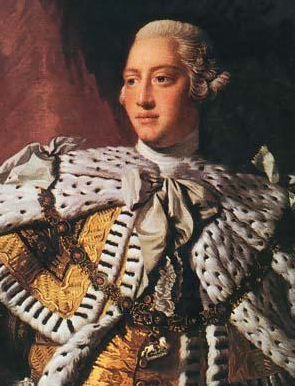
georgeiiiSusana: [to the Reader]: Lady Pendleton’s opinions on George III tend to be diametrically opposed to mine, which she attributes to my “ignorance due to indoctrination by history books written by misguided wretches attempting to justify the dreadful bloodbath caused by the radical colonists.”

It seems doubtful that we will ever come to agreement on that score—too many years of July 4th picnics and fireworks and, pledging allegiance to the flag, and singing “The Star-Spangled Banner”—but I have begun to see George III in a more sympathetic light. More than 200 years have passed and since my trip to England last year, I have come to realize that the English do not see him as the tyrant “we” do (and I say “we” even though at least some of my ancestors still lived in England during that time), and most never did.

And I have to say—in spite of all the patriotism instilled in me over decades—I am intrigued with the idea of growing up speaking with a British accent. (Can I be deported for saying that?)

Lady P: You must admit that the American accent sounds decidedly low class, Susana. Perhaps I could give you lessons in enunciating. Much like that Henry Higgins did to Eliza in that film we saw the other evening. You would never pass for upper class in society, of course, but it would be a definite improvement.

Susana: I thank you for offering, Lady P, but I’ll stick with the lazy American drawl for now. Perhaps some other time.

Lady P: Very well. Shall we discuss His Royal Highness King George III for your readers? Where shall I start?

Susana: At the beginning would be best. Where did you meet him?

Lady P: I was too young to attend his wedding to Queen Charlotte, but I do recall my mother bringing home a flower—was it a camellia or a rose?—but it was pink and she put it in one of the heaviest books in the library for pressing. I remember feeling very sad that she had to destroy such a pretty posy in order to preserve it. I wonder what happened to it? I believe my brother Henry inherited all the books in the library, so perhaps it’s still there. He was never one to read or study overmuch.

Susana: But you did meet him at some point?

Lady P: Goodness, yes. During my come-out—my mother was so vexed that the Royal Pair failed to attend my presentation ball—I was presented to Queen Charlotte, as were all of the young debutantes, you know, and I did meet them once or twice that season. After I was married to Lord Pendleton, we met more often. Lord P was in the House of Lords, you know, and we were obliged to attend certain political events.

Susana: What did you think of him?

Lady P: He was a kindly old man, quite stodgy, you understand. As a young girl, I didn’t appreciate that quality in him. One expected the King to be a cut above the rest of society, and he wasn’t at all. I recall complaining to Pendleton about the plainness of the fare at Windsor Castle and why the King could not have a French chef as skilled as ours, and he said the King didn’t appreciate rich food anymore than he did the French. Good, hearty English fare was good enough, he said.

Susana: I hear his marriage was a love-match.

Lady P [snorting in a very unladylike manner]: Romance again, Susana? Americans seem obsessed with it. The King met his betrothed on the day of the wedding. He wasn’t allowed to marry Lady Sarah Lennox when he wished to because she was only the sister of a duke. Royalty must marry royalty, you know. Or at least they did in my time.

Susana: But they did have fifteen children, so the marriage must have been somewhat of a success.

Lady P: Oh indeed, they got on well after that. Queen Charlotte was not well-favored, but she had a very pleasant disposition. She was a perfect wife for a down-to-earth man like the King.

Susana: So what happened to their children? The sons, at least, did not seem to be able to sustain such happy marriages. Look at the Prince Regent, for example. His life was like the antithesis of his father’s.

Lady P: Indeed. The King disliked his oldest son intensely. Frederick was his favorite. Pendleton told me the King often bemoaned the fact that Frederick was not his oldest son. Brought up to be a military man. He was the Commander-in-Chief of the Army, you know, until the scandal.

Susana: The scandal?

Lady P: Apparently he passed on military secrets to his mistress, a sly little hussy by the name of Mary Anne Clarke. She took bribes in exchange for promotions, and although she was the one to blame, it was his indiscretion in telling her such things that caused him to resign in disgrace. [shaking her head sadly] Should have stuck by his long-suffering wife. Frederica was a most amiable woman.

Susana: So even his favorite had feet of clay. What about the others? Wasn’t one of them accused of murder?

Lady P: Ernest, that was. He was an odd sort. Spread all sorts of cruel rumors about his brothers. His valet turned up with his throat cut, and it was whispered that he’d been seduced by his master, who murdered him when the man attempted to blackmail him.

Susana: Oh my. Homosexuals were hung in those days, were they not?

Lady P: Indeed they were. It would have been a massive scandal had that little fact become known. Which is no doubt why the inquest determined that the man committed suicide.

Susana [shuddering]: Who commits suicide by cutting their throat?

Lady P: Exactly. Not to mention that the man was left-handed, and the deed had to have been done with his right hand. [sighing] But I suppose such things must be done to protect the monarchy and the nation.

Susana: Surely among fifteen children there must have been at least one or two who turned out well. What about the daughters?

Lady P: Poor Amelia died in 1810. She was 27 and unmarried, since she had not been allowed to marry the man of her choice, Charles Fitzroy. She was the youngest and the King’s favorite and he was never the same after that. The other girls—well, the oldest, Princess Charlotte was married to the King of Württemburg—remained unmarried and living at home, and dear me, they never dissembled about expressing how they felt about that. Well, they were all rather plain, like their mother, and ran to fat, but they did adore their father, no matter how unstable he become as the years passed.

Susana: The Prince of Wales was made Regent because of his illness, which has been called dementia. Did you ever see him in that state, or know someone who did?

Lady P: I did not, of course, since he was kept in seclusion as soon as he began to exhibit symptoms. But Pendleton did, on one occasion, when he was attending the King on parliamentary business. [clucking her tongue]. He began speaking in shrill tones, so quickly that he could not be easily understood, calling for “the woman he loved,” a certain Lady Pembroke who served at court. His eyes bulged and he dropped his breeches to reveal his backside. Pendleton was horrified when I nearly fell over laughing when he described it. He said it was a horrifying experience.

Susana: The King of England mooned your husband? Heavens, what a sight that must have been! [grinning broadly]

Lady P: Harrumph! It was, rather. And yet I did feel very sorry for him. He was a fine king and deserved much better than to be afflicted by such an undignified malady. And then to have his sons to be such bounders, and one of his daughters to bear an illegitimate child… It is almost a blessing that such distressing news was kept from him.

Susana [sighing]: My belief in fairytale royal marriages died a tragic death after what happened with Princess Diana. Although I can’t help hoping that Prince William and Kate will end up happily.

Lady P: They do seem a sensible pair, and very well-matched, like my nephew Damian and his wife Theresa. Have I told you Theresa is expecting again?
mi_hacienda_edited-1Susana: You’ve mentioned it a few times. What do you think about Subway for dinner?

Lady P: What was that Spanish place we went to last week? I rather fancy one of those—what do you call them—burros?

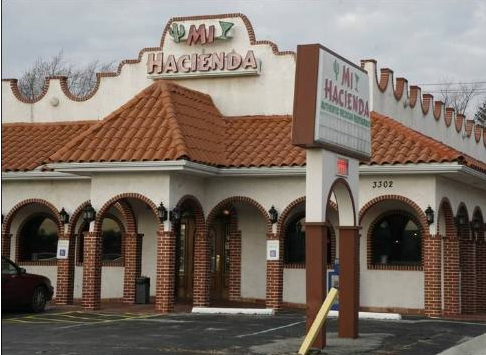
Susana: Burritos, Lady P. And it was Mexican, not Spanish. Mi Hacienda, on Glanzman Street. They offer salsa lessons on Wednesday nights. What do you say we paint the town while we’re at it.

Lady P: A burrito will do, Susana. And perhaps some of those savory chips. Never had anything like them before. Do you suppose I can take the recipe back with me for my own cook to prepare?

Susana [shaking her head]: Sorry, Lady P. We’ve had this discussion before. Remember the Prime Directive?

As always, please do comment if you have any questions you’d like to ask Lady P about the late Georgian/Regency era. She does love to chat!

The Lady P Series

Episode #1: Susana’s Adventures With Lady P: The Introduction

Episode #2: Lady P Talks About… Pride and Prejudice?

Episode #3: Lady P and the Duchess Who Lost a Billion Dollars

Episode #4: Lady P and the Face On the $100 Bill

Episode #5: In Which Lady P Discovers Sparkly Fabrics and Ponders Violating the Prime Directive

Episode #6: Lady P Dishes the Dirt on the Duchess of Devonshire

Episode #7: The Political Exploits of Lady P and the Duchess of Devonshire

Episode #8: Lady P and the Prince Regent’s Illicit Marriage

Episode #9: In Which Lady P Depletes the Cooking Sherry During Her Discussion of Caroline of Brunswick

Episode #10: Lord Byron: Mad, Bad, and Dangerous to Know

Episode #11: In Which Lady P Talks About Hannah More and the Rights of Women

Episode #12: Lady P’s Revelations Regarding George III and His Peculiar Progeny

Episode #13: Lady P Discusses the Luddite Uprising, the Assassination of Spencer Perceval, and the General Unfairness of Life

Episode #14: In Which Leticia, Lady Beauchamp, Pops In For an Interview On Her Personal Acquaintance With Princess Charlotte of Wales

Episode #15: Lady P On Assignment in 1814 Kent

Lady P Quizzes Jane Livingston, the Hero’s Sister From “A Twelfth Night Tale”
The Dress: Episode 2 + Giveaway

This post is part of a mini-series about the experiences of my mother and me in creating a Regency gown for the Romantic Times Convention on May 1-5, 2013 in Kansas City. You can find Episode 1, where we shopped for fabric and struggled with cutting out the dress pieces here.

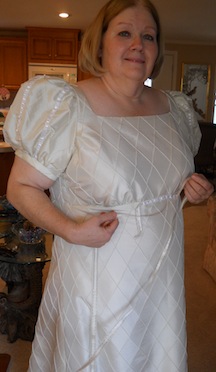
DSCN0032I tried the dress on and it fits!!!

It’s not finished yet. The fastening at the back remains to be done, plus the hem and lots of trim. But it does look like a dress now, and it does look pretty good on me, if I do say myself!

My mom’s a genius!

However, we had a bit of a setback a week ago when my uncle died unexpectedly and we all had to fly north for the funeral. It was cold and nasty and, well, sad, because we had to say goodbye to Uncle Bob, but it was good to see friends and family we haven’t seen for years.

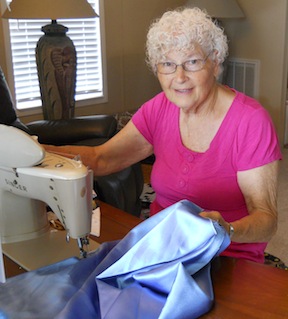
We still have a couple of weeks left, though, before I have to take off for Kansas City, and it’s quite likely we’ll have the blue satin coat done too, by that time. She’s already got the pieces for the gown and the lining cut out, as well as the organdy ruffle at the collar and the sleeve stays. We think this will go faster than the gown, since she’s already worked out the fit issues. But it is still rather a complicated design and she’s something of a perfectionist, so she’ll be putting in a lot of hours. That worries me a little bit, because I don’t want her to wear herself out. I try to help with lunch and errands and Dad, but I am seriously going to owe her after this. Big time.

Mom_sewing

Mom_cutting2

    Mom_fabric

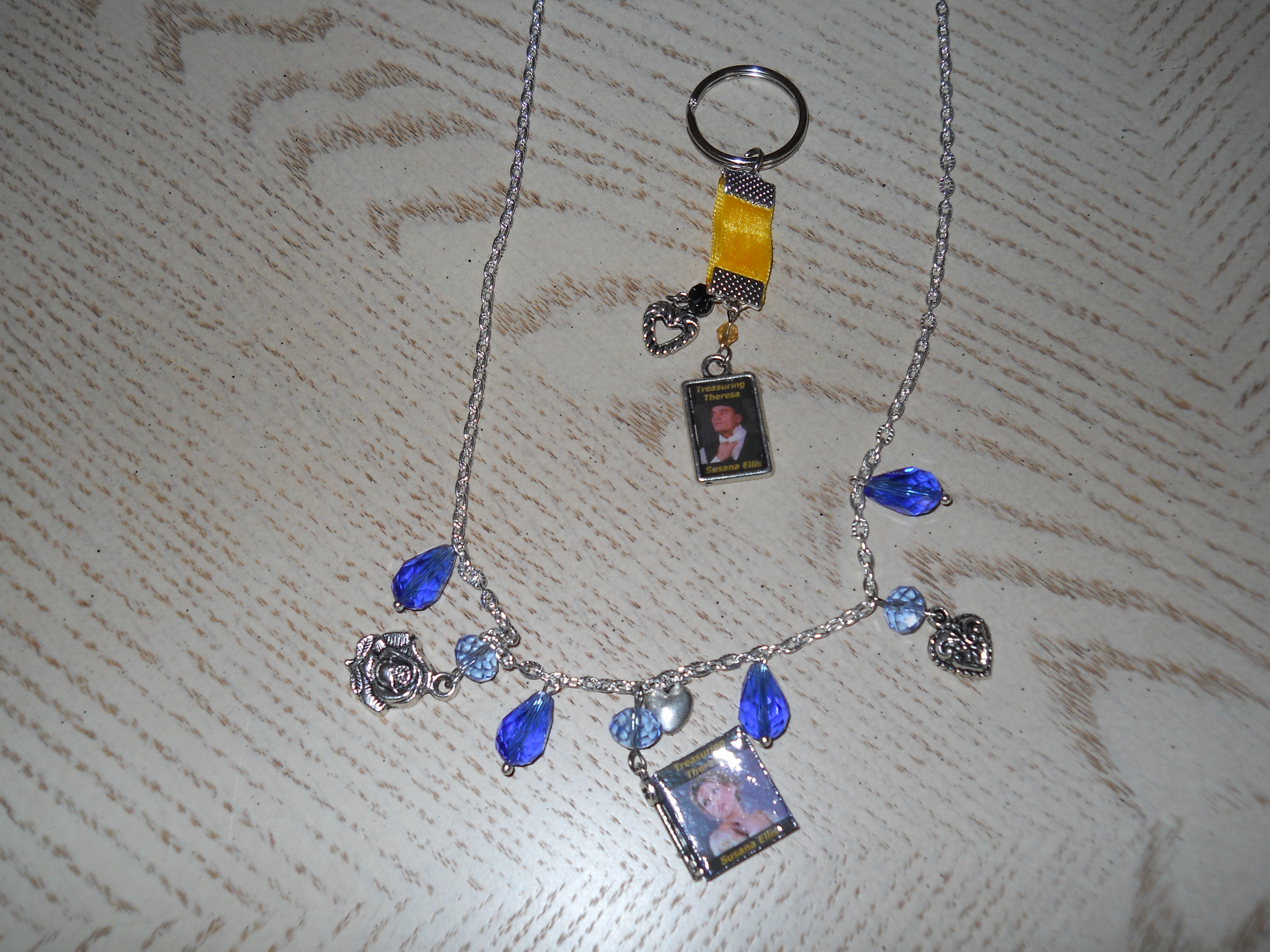
She also just had her 75th birthday on April 15th and wouldn’t let us buy her anything. Of course, I did give her a Treasuring Theresa necklace (see below), but I’m going to have do something really nice for her for Mother’s Day this year. Hmm. What can you give someone who doesn’t want you to “waste” money on her?

TT_necklace_keychain

Please comment with any suggestions you may have of how I can show my appreciation to Mom for her commitment to this massive project. One random commenter will receive a Treasuring Theresa keychain (see above), with Damian on one side and Theresa on the other).

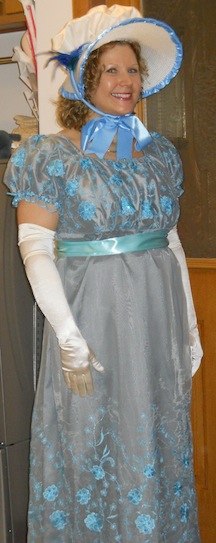
Letitia_gown_bonnet6P.S. Here’s my sister Gloria (aka Letitia, Lady Beauchamp) in the Regency gown she had made from an artisan on Etsy recently (and the hat our mother made). I offered to take her with me to the RT Convention as my lady’s maid (trust me, somebody is going to have to help me in and out of this gown), but she said she can’t leave her cat that long. A cat? Really? Hmm. At least I know where I stand!

Stand by for further reports on the progress with “The Dress.” The deadline approaches, but I have perfect confidence in my mother’s abilities.

Oh, and in case you’re wondering: Mom is NOT interested in taking this up as a profession or a hobby. Being retired is in itself very time-consuming. Once is enough for her…and I’m the lucky one!

Meg Mims: Traveling the Transcontinental Railroad + Giveaway

Meg is offering a free digital copy of Double or Nothing for one lucky reader and I’m throwing in a $10 Amazon gift card for another. To enter: leave a comment (and your email address) on this blog entry and then click here to enter the Rafflecopter. The winner will be chosen and notified on April 19th. Good luck!

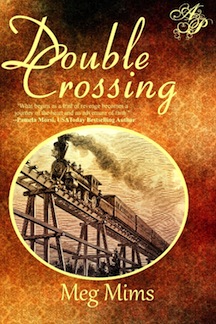
I love reading historical fiction. I love researching them even more… and the transcontinental railroad is a favorite topic because the first book in my Double Series is a twist of True Grit and Murder on the Orient Express. Double Crossing won the 2012 Spur Award for Best First Novel, and my new release, Double or Nothing, is the sequel. Book two is not set on a train, but incorporates some further information about the New York to San Francisco railroad.

So let’s talk trains! Most people take for granted the highways of today. Over 150 years ago, when gold was first discovered in California, men hoping to get rich traveled to San Francisco via steamships which navigated through the dangerous Panama River and jungle region in Central America. Settlers heading west chose stage coaches, river boats, Conestoga wagons, oxen or horses, which dictated how far one could go—and such trips would often take many months due to weather, Indians and no real roads.

After the ‘war of Rebellion,’ the Union Pacific began laying tracks west from Omaha. They had their own problems with marauding Indians, the Rocky mountains and keeping up the pace (although I’m not certain the AMC series Hell on Wheels is all that accurate). The Central Pacific had far greater obstacles and dangers. Relentless winter storms in the Sierra Nevada mountains stalled the work. Snow sheds were fashioned to keep progress going, and thank goodness for nitroglycerin and the Chinese laborers who gave their lives to build that route. The five-mile-long Summit Tunnel in the Sierra Nevada took 15 months, in fact, to finish. The “race” between the two companies ended at Promontory Point in Utah in May of 1869.

After the Golden Spike ceremony that joined the two lines, travelers could begin in New York and end up in Sacramento within a week or 10 days in good weather. But travel wasn’t easy. The Pullman Palace sleeping cars proved expensive for the average traveler, but were not luxurious by any standard. Station houses with 30-minute meal stops gave way to dining cars within the decade. Indians who had often sabotaged the Union Pacific crews withdrew further north to fight at the Little Big Horn—and eventual defeat after that short-lived victory by the turn of the century. The Western Pacific railroad was also built from Sacramento via Stockton and San Jose to get as close to San Francisco as possible, although many people took a spur railroad to Vallejo and then a ferry across the Bay. Within 25 years, the majority of fruit shipped to the East Coast from California via refrigerated freight cars.

The transcontinental railroad proved to be the biggest fuel for American western expansion. My Double series gives the reader that sense of the west, of adventure and mystery, a touch of romance, and a bit of inspiration as well. Double Crossing is a twist of True Grit and Murder on the Orient Express, while Double or Nothing continues the adventures of Lily and Ace with a twist on The Fugitive.

DOUBLE CROSSING—BOOK 1

Endorsed Double Crossing 500 x 750A murder arranged as a suicide…a missing deed…and a bereft daughter whose sheltered world is shattered.

August, 1869: Lily Granville is stunned by her father’s murder. Only one other person knows about a valuable California gold mine deed — both are now missing. Lily heads west on the newly opened transcontinental railroad, determined to track the killer. She soon realizes she is no longer the hunter but the prey.

As things progress from bad to worse, Lily is uncertain who to trust—the China-bound missionary who wants to marry her, or the wandering Texan who offers to protect her … for a price. Will Lily survive the journey and unexpected betrayal?

Click here to see the BOOK VIDEO

DoubleorNothing 500x750 (3)DOUBLE OR NOTHING—BOOK 2

A mysterious explosion. A man framed for murder. A strong woman determined to prove his innocence.

October, 1869: Lily Granville, heiress to a considerable fortune, rebels against her uncle’s strict rules. Ace Diamond, determined to win Lily, invests in a dynamite factory but his success fails to impress her guardian. An explosion in San Francisco, mere hours before Lily elopes with Ace to avoid a forced marriage, sets off a chain of consequences.

When Ace is framed for murder before their wedding night, Lily must find proof to save him from a hangman’s noose. Will she become a widow before a true wife?

CLICK HERE TO SEE THE BOOK VIDEO!

About the Author

Meg in ViennaClocks and time play a big part in any late bloomer’s life. And time plays a vital part in every mystery.

Meg Mims is an award-winning author and artist. She writes blended genres – historical, western, adventure, romance, suspense and mystery. Her first book, Double Crossing, won the 2012 Spur Award for Best First Novel from Western Writers of America and  was named a Finalist in the Best Books of 2012 from USA Book News for Fiction: Western.  Double or Nothing is the sequel. Meg has also written two contemporary romance novellas,The Key to Love and Santa Paws — which reached the Amazon Kindle Bestseller list.

Excerpt 

DOUBLE CROSSING — Chapter One

I burst into the house. Keeping the flimsy telegram envelope, I dumped half a dozen packages into the maid’s waiting arms. “Where’s Father? I need to speak to him.”

“He’s in the library, Miss Lily. With Mr. Todaro.”

Oh, bother. I didn’t have time to deal with Emil Todaro, my father’s lawyer. He was the last person I wanted to see—but that couldn’t be helped. Thanking Etta, I raced down the hall. Father turned from his roll-top desk, spectacles perched on his thin nose and hands full of rustling papers. Todaro rose from an armchair with a courteous bow. His silver waistcoat buttons strained over his belly and his balding head shone in the sunlight. I forced myself to nod in his direction and then planted a quick kiss on Father’s leathery cheek. The familiar scents of pipe tobacco and bay rum soothed my nervous energy.

“I didn’t expect you back so early, Lily. What is it?”

With an uneasy glance at Todaro, I slipped him the envelope. “The telegraph messenger boy caught me on my way home.” My voice dropped. “It’s from Uncle Harrison.”

Father poked up his wire rims while he pored over the brief message. His shoulders slumped. “I’ll speak plainly, Lily, because Mr. Todaro and I were discussing this earlier. My brother sent word that George Hearst intends to claim the Early Bird mine in a Sacramento court. Harrison believes his business partner never filed the deed. He needs to prove our ownership.”

“Hearst holds an interest in the Comstock Lode, Colonel.” Todaro had perked up, his long knobby fingers forming a steeple. The lawyer resembled an amphibian, along with his deep croak of a voice. “His lawyers are just as ambitious and ruthless in court.”

Father peered over his spectacles. “Yes, but I have the original deed. I didn’t plan to visit California until next month, so we’ll have to move up our trip.”

“Oh!” I clasped my hands, a thrill racing through me. “I’m dying to visit all the shops out there, especially in San Francisco. When do we leave?”

“We? I meant myself and Mr. Todaro.”

I stared at the lawyer, who didn’t conceal a sly smirk. “You cannot leave me behind, Father. I promised to visit Uncle Harrison, and what if I decide to go to China?”

“Lily, I refuse to discuss the matter. This trip is anything but a lark.”

“It’s a grueling two thousand miles on the railroad, Miss Granville. Conditions out west are far too dangerous for a young lady,” Todaro said. “Even with an escort.”

“The new transcontinental line has been operating all summer. Plenty of women have traveled to California. I’ve read the newspaper reports.”

“I’m afraid the Union and Central Pacific cars are not as luxurious as the reports say. You have no idea. The way stations are abominable, for one thing.”

I flashed a smile at him. “I’m ready for adventure. That’s why I’ve considered joining the missionary team with Mr. Mason.”

Father scowled. “You are not leaving Evanston until I give my approval.”

“You mean until you dissuade me from ‘such a ridiculous notion.’”

“Need I remind you of the fourth commandment, Lily?”

“No, Father. We’ll discuss this later.”

My face flushed hot. Annoyed by being reprimanded in front of Todaro, I ignored the rest of the conversation. I’d always wanted to see the open prairie and perhaps a buffalo herd chased by Indians, the majestic Rocky Mountains and California. California, with its mining camps, lush green meadows and warm sunshine, the cities of Sacramento and San Francisco that had to be as exhilarating as downtown Chicago. I’d pored over the grainy pen-and-ink drawings in the Chicago Times. Uncle Harrison, who’d gone west several years ago to make a fortune and succeeded, for the most part, would welcome me with open arms. I plopped down on an armchair and fingered the ridges of the brass floor lamp beside me. Somehow I needed to persuade Father to allow me to tag along on this trip.

Contacts

Website   Facebook page for Double Series   Amazon Author Page   Twitter


Guest Author Eva Scott and The Last Gladiatrix

Today my guest is Eva Scott, who recently joined a Facebook group called History Lovers, which was originally formed by several of us who were teammates in Savvy Authors NANO Smackdown with Entangled Editors last fall. We’re all history lovers, of course, and we write historical romance, although with quite diverse settings. 

Welcome to Susana’s Parlour, Eva!

eva scottThanks, Susana. It’s great to be here! I’d like to begin by talking about the role of women in ancient Rome.

While my novel The Last Gladiatrix is set in Rome my heroine is not actually Roman.  Xanthe is a Sarmatian, the people who are thought to be the source of the Amazon legend.  Sarmatian women fought side by side with their men in times of war, being equally as skilled in archery as in cooking up a mean pot of lamb stew for afterwards.  Their lives revolved around horses and many Sarmatians were bow-legged as a result of the custom of putting children of both sexes on horseback before they could walk.  The Sarmatians were a nomadic people travelling with the seasons, tending their flocks of sheep and goat not unlike their ‘cousins’ the Scythians or the Alans.

Roman women, however, were not quite as free.  A Roman woman was controlled by her father even after she married.  Her father could order her divorce if he so choose—even if the couple in question didn’t agree!  Once her father died she didn’t automatically pass into the authority of her husband.  If her father appointed a tutor before his death then that man would become her legal guardian.   Yet there was a way out from under the yoke.  If a free-born woman had three legitimate children, and her father was dead, she was rewarded the right to legal and economic independence from her tutor.

It wasn’t all gloom and doom for Roman women.  In the ideal Roman family a husband and wife shared a partnership and made important decisions together.  Not unlike our family model of today.  And there is a lot of historical evidence for the important role mothers played in their son’s life—for better or for worse.  Women often manoeuvred for power in the back rooms and salons of Roman society.  A powerful man often had a strong, clever woman helping behind the scenes.  And the older a woman became the more weight her opinion carried and the more respect she earned. I don’t know about you but I do like the sound of that!

Gladiatrix_Final (427x640)About The Last Gladiatrix

Captured and enslaved by a Roman legion, Xanthe never expects to end up training for the Coliseum floor, but every night after the day’s march, she is put through her paces by a Roman solider who challenges her, tests her, and excites her.

Titus is drawn to Xanthe, her fire and her spirit, so he breaks one of his rules and brings notice on himself, offering to train her as a gladiatrix to spare her a courtesan’s role. But training her, working with her, soon becomes too much. Titus knows the penalty for taking property that does not belong to him, but how long can he resist?

Excerpt

The flash of her green eyes in the candlelight reminded Titus of the verdant wild forests of Northern Italy, which they had recently left. He rubbed a smear of dirt from her cheek with his thumb, and then taking her hand, he raised Xanthe up to stand. With deliberate, slow movements he unfastened her tunic, letting it fall from her shoulders to pool on the ground at her feet.

Xanthe made no move to stop him, their eyes locked, her fear and trust clear to see. He slid his fingers beneath the waist of her leggings and tugged them down over her hips, leaving her naked, standing there before him.

Titus took a sponge and dipped it into a bowl of warm water, letting it soak before applying it to Xanthe’s flesh. He washed her with firm yet gentle strokes, and as the water ran over her skin it dripped deliciously from her breasts. The centurion bent his head and licked at a droplet, pleased to feel her shudder in response. Her nipple hardened, inviting him to explore further. He needed no invitation. Xanthe had to summon all her self-discipline to stand still while Titus explored the curves of her body. His touch turned her core to molten fire; she could barely contain her need.

http://www.amazon.com/The-Last-Gladiatrix-ebook/dp/B00BSKJF98/

http://www.escapepublishing.com.au/products/tag/historical

About the Author

I live on the Sunshine Coast, in Queensland Australia with my fabulous husband and gorgeous little boy. When I’m not writing romance you can find me out on the water kayaking, fishing or swimming. When on dry land it’s all about the shoes and the coffee.

http://www.evascottromance.com/

http://www.facebook.com/eva.scottromancewriter

http://www.facebook.com/pages/Romancing-The-Romans/476218929112324?ref=hl#!/pages/Romancing-The-Romans/476218929112324

http://www.twitter.com/EvaScottWriter

The Dress: Episode 1

The idea of wearing a Regency gown to the Romantic Times Book Convention (as well as book signings and other events) originated with my friend Ellen, who has lots of experience promoting her teacher books in conference exhibit halls. She said I should stand in front of the table, not behind it, wearing a period gown, and have a list of questions about the Regency period to ask in exchange for prizes. Wow, that sounded like a lot of fun to me, so I started looking around for gowns.

regencypatternI found a pattern on etsy.com and ordered it (have since found you can get it at Jo-Ann’s in the Butterick catalog), and my mom, who is a superb seamstress, offered to make it for me. (Actually, it’s a gown and coat both.) I don’t think at the time she realized how complicated it was going to get, but she is a woman of her word and determined to see it through.

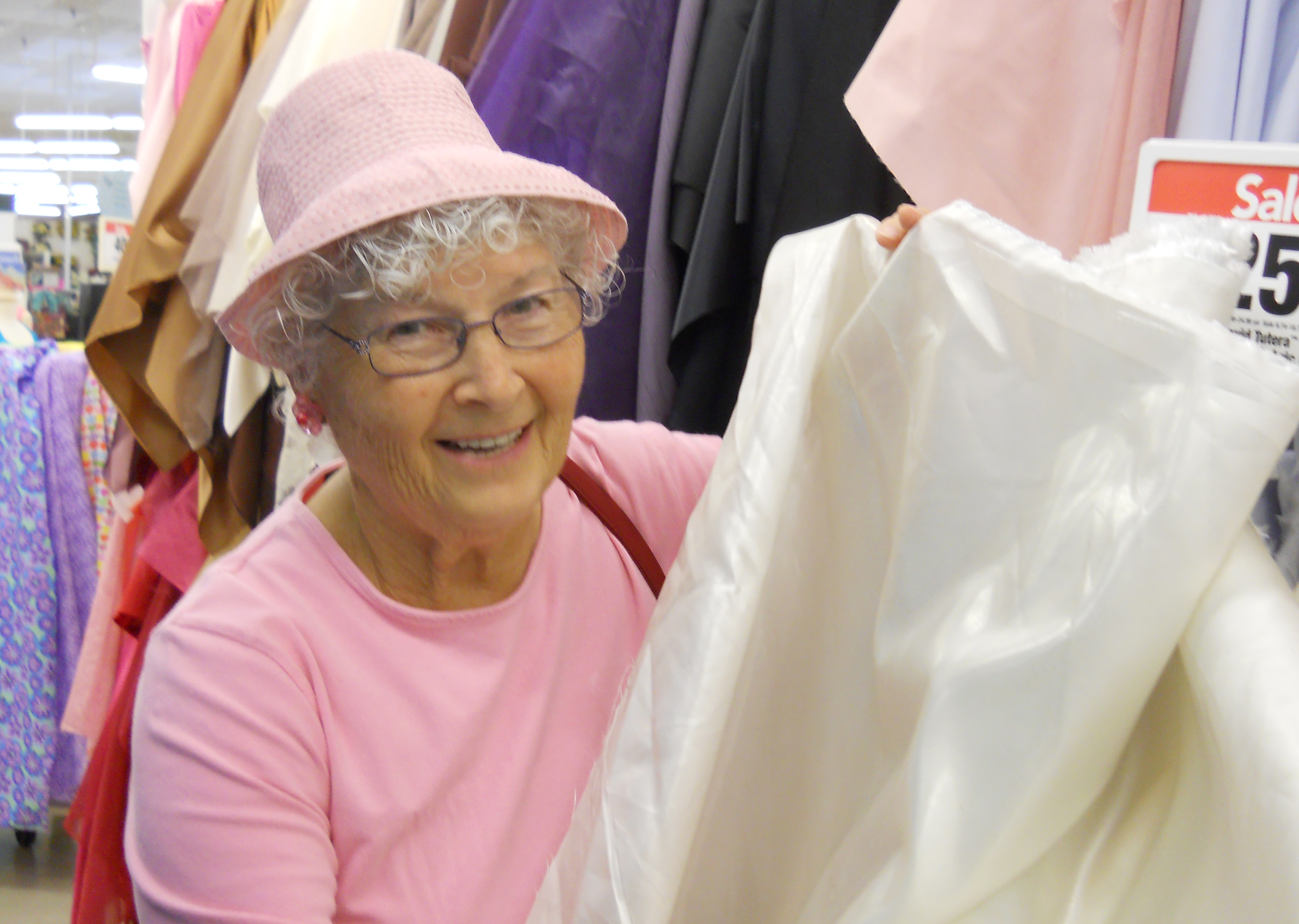
The first obstacle was shopping for materials. For one thing, fabric has changed a great deal in 200 years. While there are many beautiful fabrics today, many with sparkly threads and sequins that would look great on me, we had to bypass those and look closer to find fabrics that might at least resemble a Regency-era fabric. It was a painstaking process, because as soon as we found something we thought would be perfect, we’d discover there wasn’t enough fabric on the bolt, which turned out to be a constant problem. For some reason, fabric manufacturers have started putting less fabric on the bolts, so unless you find a brand new bolt, chances are there won’t be enough fabric for a long gown on it. Rats! We had this problem with the lining fabrics as well as the gown and coat, and had to find another Jo-Ann’s Fabrics in the next town to get enough. And buy a yard or two extra to make sure we had enough for the extra-long skirt pieces.

Eventually, we ended up with an off-white pintuck taffeta for the gown and a blue satin for the coat.

fabric2smBut that wasn’t the end, because these garments require lots of decorative trim. The coat has an organdy trim at the neckline, but the clerk at the fabric store had never heard of organdy! But we found something that seemed like organdy that will work. Then we needed several kinds of trim for the sleeves and empire waist for the gown and for the coat as well. The problem with this was that it couldn’t be anything too white, and it had to be a specified width. Inevitably we’d find the perfect trim and find that it was too wide or narrow.

As far as the cost, well, that could not be a concern. It was hard enough to find something that would work at all. There was no way I was going to take the time to shop around all the fabric stores in Central Florida to find stuff on sale. Not when this project has to be finished before I leave for RT on April 28! Thanks to Mom, we did have a 15% off coupon, though!

In case you’re wondering, this is definitely not an economical project. I have already spent quite a bit on Regency shoes from American Duchess (with beautiful shoe clips), period stockings, a ringlet hairpiece, and gloves, in addition to the fabric and notions that were so hard to find. (Obtaining the proper undergarments to give me the right shape was also quite costly.) My philosophy is you either do it right or not at all. So I’m not sweating the small (or the large) stuff. And it’s all tax-deductible for a Regency author, right?

So this week we got all the materials and started pulling out the pattern pieces and laying them out on the fabric. We started with the lining, moving the kitchen table in my folks’ house so that we could cut on the floor. NOT a great idea at all! We both ended up with aching backs from maneuvering ourselves into uncomfortable positions and having to get up and down off the floor so many times. After that, we decided to take everything down to the clubhouse (we live in a retirement community in Florida during the winter), move a few tables together, and do our cutting there. Voilà! SO much better. So now we have the lining and dress pieces cut out and ready to put together.

And a few people came in to get their mail and wondered what we were doing, so I took the opportunity to give them a bookmark for Treasuring Theresa. All good!

mom_smile_edited-1One thing that rather astonished me is the need for proper fitting. My own feeble sewing efforts have involved buying the fabric and the pattern and hoping it would fit by the time I was done. That might work with knits and stretchy fabrics, but not with Regency-era fabrics. No indeed. The bodice and the sleeves, at least, have to be fitted closely to the body, and it’s a painstaking process that I couldn’t do in a million years. Thank goodness I have a mother who not only knows how to do it but is willing to put in the hours and hours it takes to make things work!

First she worked on altering the pattern; in spite of having lost 30 pounds recently, the pattern still needed to be made larger to fit properly. Somewhat humiliating, but there’s no point in having a gown that won’t fit! Once she had the pattern right, she could cut out the lining and make a few more adjustments. Now she knows exactly what needs to be done with the bodice of the dress too, where there’s less room for error.

It turns out Mom and I make a pretty good team. She’s the brains and I’m the brawn. And the cook. I provide lunch every day and help her with simple things in the afternoon, like pinning the pattern pieces to the fabric, moving around tables and chairs, cleaning up afterward, things like that.

This is all great research, by the way. Whenever my heroines have to have dresses made, they go to the modiste’s and stand there for hours in their underwear while having pins stuck in them. Now I have a good idea how that feels! Ditto with searching out the right trim, ostrich feathers, etc. (Oh, should I look for an ostrich feather or two?)

My mornings are devoted to writing. I’m hoping to finish the first draft of Cherishing Charlotte in the next few days and then go over it and add some final touches before sending it off to my wonderful critique partners. Then I have another novel to finish, plus a Christmas story to submit for the Ellora’s Cave Christmas Cotillion anthology. Would like to finish all three projects before heading to Scotland on June 20!

Oh, by the way, my sister Gloria (aka Letitia Beauchamp) also has a Regency gown that she had made. She’ll have to come to some book signings with me to wear it. I wonder if her husband Mike (aka Lord Beauchamp) would consent to having a Regency outfit made for him? Sounds like a plan to me!

Stand by for further reports on the progress with “The Dress.” The deadline approaches, but I have perfect confidence in my mother’s abilities.

Oh, and in case you’re wondering: she is NOT interested in taking this up as a profession or a hobby. Being retired in itself is a very time-consuming activity. Once is enough…and I’m the lucky one!

Spotlight On Regency Personage Hannah More

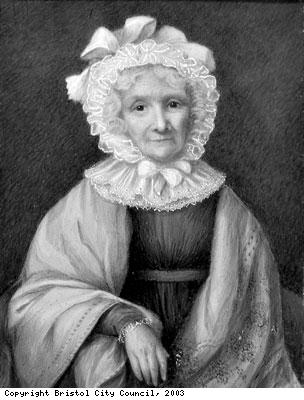
220px-HannahMoreMonday’s Lady P episode mentioned Hannah More as having a significant influence on the changing attitudes toward women in the late Georgian/Regency era. Regency readers will recognize the name as being the author of books that many well-meaning Regency mothers assigned their daughters to read while said daughters preferred to indulge themselves with Mrs. Radcliffe’s novels.

Hannah More grew up in a very religious family. Her father taught in a free school and later opened a girls’ school managed by his daughters while he himself managed a boys’ school. Hannah started writing at a young age, beginning with pastoral plays for the young girls at the school to act out, and eventually moving on to London, where her play Percy was a great success at Covent Garden. For several years she enjoyed the social circle of a well-known group of bluestockings (a pejorative term referring to a female intellectual). Her second play, however, was not a success, and after a falling-out with a poet friend, Hannah withdrew from London’s intellectual circles and began to focus on religious and philanthropic works.

As the Regency period advanced and the older generation of politically-active ladies died or became infirm, fewer women involved themselves directly in politics. In 1815 Hannah More wrote a study on St. Paul’s description of the female character, which instructed women to dress themselves modestly and atone for their spiritual weakness by keeping silent and learning from the men. By daring to publish her writing, Hannah was herself breaking these rules, for which she apologized in all of her works.

  • Thoughts on the Importance of the Manners of the Great to General Society (1788)
  • An Estimate of the Religion of the Fashionable World (1790)
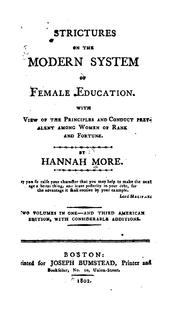
  • Strictures on the Modern System of Female Education (1799)
  • Hints toward Forming the Character of a Young Princess (1805)
  • Coelebs in Search of a Wife (1809)
  • Practical Piety (1811)
  • Christian Morals (1813)
  • Character of St. Paul (1815)
  • Moral Sketches (1819)

stricturesIn spite of the daunting titles, Hannah’s work outsold all of the authors of the aforementioned novels, and she became a force to be reckoned with, responsible for the sudden popularity of “religion of the heart” and countless conversions to the Evangelical faith.

Women could, of course, become involved in charity work to benefit the poor, and Hannah and her sisters threw themselves into establishing a series of schools in rural areas. The schools taught reading, the Bible, and catechism, as well as sewing and knitting, but not writing, as that was thought to give the poor too much power. Even then, they ran into opposition from the farmers, who feared that too much education would prove the end of agriculture, and from the clergy, who claimed that she was teaching Methodism, a religious movement of the lower classes that was considered dangerous by the established churches.

Along with William Wilberforce, she became a major force in the fight to abolish the slave trade, publishing a poem called Slavery in 1788.

The Pendulum Swings the Other Way

Through her writings and philanthropic work, Hannah More wielded a huge influence on English society, urging people to seek God in their hearts through Bible reading, to live their lives in an orderly and circumspect manner, and to help the poor escape their misery.

For the most part, though, her strictures did not address the moral depravity of the upper classes, where debauchery and excesses continued to rule the behavior of the Prince Regent and his brothers on down. The Evangelical movement did not address the inequalities in English society, but took the position that if God chose someone to be rich or poor, there must be a good reason for it, and the best thing to be done was to be content with one’s circumstances and look toward treasures in heaven. Wilberforce, for all of his efforts to help the poor in Africa, condemned as immoral the formation of unions against unfair employers in England. Easy to say for a man who inherited wealth and married more of it.

Another problem with the Evangelical movement that Hannah More was a part of was when the fight against “worldliness” went to extremes. Just about anything pleasurable was considered “worldly,” including dancing, card playing, and taking country walks on Sundays. By the time Thomas Bowdler had begun altering Shakespeare’s works to make them acceptable for reading in mixed company, the puritanical excesses of the Evangelicals were making them a laughingstock.

In Episode #11, Lady P decries the extremism in English morality. Hannah More’s popularity is proof that her “religion of the heart” was a timely one that many were eager to hear. Taken to extremes, as it was by Wilberforce and other Evangelicals, however, that message becomes lost in a sea of strictures and censorship that incites ridicule and rebellion.

Thanks go to:

Our Tempestuous Day by Carolly Erickson, 1986.

Episode #11: In Which Lady P Talks About Hannah More and the Rights of Women

Lady Pendleton, Damian Ashby’s eccentric aunt (see the epilogue to Treasuring Theresa on Susana’s web site), is visiting Susana from the early 19th century. She’s intrigued by life in 21st century Toledo, Ohio, and, of course, Susana is thrilled to have the opportunity to pick her brain about life in Regency England. It certainly gives her a great deal to write about in Susana’s Parlour!

Susana: [to the Reader]:

The other day, Lady P and I got to talking about the position of women in the Regency period and how it evolved from the late 18th century when women such as Georgiana Cavendish held political salons and marched in support of political candidates to a time when women were to be saintly and devout and “protected” from the seamier side of life, leaving the important decisions to their sturdier husbands.

Miss_Hannah_More-304x400Lady P: ‘Twas Hannah More and the Evangelicals that popularized it. Women were to be seen and not heard, at the same time obedient to their husbands and revered by them. [Snorting in an unladylike manner] Pendleton and I laughed about it on many an occasion. I’ve never been the obedient sort, and Lord P would not have wed me if I were. Nor did I wish to be worshiped either. The very idea!

Susana: No doubt it was a reaction against the excesses of the previous generation. The Devonshire ménage-à-trois, for example. The Prince Regent and his illicit marriage, as well as all of his mistresses and excessive spending. The scandalous behavior of Lady Caroline Lamb.

Lady P [Frowning]: There were excesses, of course, which did lead to the pendulum swinging in the other direction. But such extreme changes more often than not led to equally harmful excesses on the other side.

Susana: Indeed. I can certainly see that is true in the 21st century. But do explain what you mean, Lady P. What were the harmful excesses caused by the Evangelical movement?

Lady P: A popular interpretation of the wife-as-saintly approach was that the husband was allowed and even expected to be a sinner.

Susana: Which gave him the freedom to take mistresses and carouse as often as he liked, while his “sainted wife” stayed home and raised the children.

caroline_lambLady P: Well, yes, but it was rather more than that. As unrealistic and unfair as it was to the women, I believe it was equally unfair to the men. Lord Byron, for example. Why would such a dissolute young man choose to marry a staid bluestocking like Annabella Milbanke?

Susana: Because she was an heiress and he was close to bankruptcy?

Lady P: Then why would she agree to marry him? She had turned him down flat in the past, having recognized that he was a loose screw.

Susana: Because opposites attract? Because she thought she could reform him?

Lady P: Exactly! She was quite forthcoming about it, actually, and Lord Byron seemed to agree that she would be a good influence on him, at least at first. But as the wedding drew near, he began to have doubts, complaining to his bosom bows that he feared the medicine would be far more disagreeable than the disease itself.

Susana: It can be tiresome to be preached at all the time. In a true partnership, both partners accept each other, flaws and all.

Lady P: Precisely. In this case, Annabella overestimated her own influence and underestimated the extent of her husband’s vices. She did not know of his immoral relationship with his half-sister Augusta until after the marriage, for example, and like most women who incessantly nag their husbands, she came to be regarded by her husband as a nuisance.

Susana: But as you say, Byron was a bit of a loose screw. Would it have worked between them, do you think, if he’d been on some sort of medication?

Lady P [with a loud harrumph]: Your society seems to be of the opinion that all can be cured with a tiny pill, Susana, but I’m not so sure. We had quacks touting medicines in our day too. Why, the stories I could tell you about laudanum…!

Susana: But getting back to the issue of women’s rights, what did you think of people like Hannah More, Lady P? Was she a good influence or a bad one? She did influence people to care for the poor, did she not?

Lady P: Hannah More and those around her were neither good nor bad, Susana. The mistake, in my opinion, is to paint everything in life broadly as either white or black. Hannah More did a great deal to awaken society to the plight of the poor and stir up support on their behalf, that is true. But I believe that she did a disservice to both women and men in promoting the role of women as subservient to men.

Susana: But women were still legally the chattel of men, were they not? And they were not given the right to vote for another hundred years.

Lady P [somewhat impatiently]: Legally, yes, that is true. But my dear Susana, you must not assume that every marriage was built on such an unequal basis. Discerning women always knew how to manage their husbands, so long as they took care to marry a husband who could be managed, that is. I daresay even the redoubtable Hannah herself could not have managed such a bedlamite as Lord Byron.

Susana: But you said yourself that you never told Lord Pendleton about your Whig activities with the Duchess of Devonshire.

Lady P: Indeed not. It was for his own protection. His family would have been scandalized.

Susana [shaking her head]: Sometimes your logic escapes me, Lady P.

Lady P: I’m not saying that my own marriage was ideal, or that most marriages were not unequal in my day, Susana. There was just as much hypocrisy in society then as there is in your century. Why Hannah herself apologized in her books for having the temerity to write them at all, being a mere woman as she was. My point is that one must consider one’s options and make the wisest choices possible in whatever circumstances one finds oneself. I may have decided to become a Whig, but I wasn’t foolish enough to believe they should have unilateral power. No indeed. Some of their official policies were ridiculous in the extreme, and I was glad there were rational voices on the other side to temper their excesses.

Susana: In that respect, I certainly agree with you, Lady P. I find I cannot blindly accept any philosophy or ideology without considering each facet of it on its own merits. But I find it extremely frustrating that there are so many who do, as though they haven’t a brain to think for themselves.

Lady P [dryly]: So I’ve noticed that about you. But Susana, it does appear that you are missing the point. People are who they are, and there’s not a lot you can do to change them. My counsel in such cases has always been to do what you can and let the rest be, else you work yourself into a state fit for Bedlam.

Susana: [shaking her head]. You remind me so much of Dr. Ellis, author of How To Stubbornly Refuse To Make Yourself Miserable About Anything, Yes Anything.

Lady P: What a singular title for a book! The logic seems sound, however. Why, many was the time when Lord P left me alone to go to his club that I could have spent the night fuming, but I decided instead to use that time to follow my own interests.

Susana: Such as attend the Whig salons at Devonshire house?

Lady P: Yes, and attend balls and musicals that Lord P did not enjoy. It wasn’t fashionable to live in one another’s pockets, in any case. We muddled along well enough, I do believe. How I do miss the dear man! [Sigh]

As always, please do comment if you have any questions you’d like to ask Lady P about the late Georgian/Regency era. She does love to chat!

The Lady P Series

Episode #1: Susana’s Adventures With Lady P: The Introduction

Episode #2: Lady P Talks About… Pride and Prejudice?

Episode #3: Lady P and the Duchess Who Lost a Billion Dollars

Episode #4: Lady P and the Face On the $100 Bill

Episode #5: In Which Lady P Discovers Sparkly Fabrics and Ponders Violating the Prime Directive

Episode #6: Lady P Dishes the Dirt on the Duchess of Devonshire

Episode #7: The Political Exploits of Lady P and the Duchess of Devonshire

Episode #8: Lady P and the Prince Regent’s Illicit Marriage

Episode #9: In Which Lady P Depletes the Cooking Sherry During Her Discussion of Caroline of Brunswick

Episode #10: Lord Byron: Mad, Bad, and Dangerous to Know

Episode #11: In Which Lady P Talks About Hannah More and the Rights of Women

Episode #12: Lady P’s Revelations Regarding George III and His Peculiar Progeny

Episode #13: Lady P Discusses the Luddite Uprising, the Assassination of Spencer Perceval, and the General Unfairness of Life

Episode #14: In Which Leticia, Lady Beauchamp, Pops In For an Interview On Her Personal Acquaintance With Princess Charlotte of Wales

Episode #15: Lady P On Assignment in 1814 Kent

Lady P Quizzes Jane Livingston, the Hero’s Sister From “A Twelfth Night Tale”
A Favorite Scene From Treasuring Theresa!

The official excerpt is on http://www.susanaellis.com/pub.html. This scene comes later, however. Enjoy!

Copyright © SUSANA ELLIS, 2013

All Rights Reserved, Ellora’s Cave Publishing, Inc.

????????????????????????????????????????When does the waltzing begin?” he whispered as they performed the elaborate steps of the country dance. “I must claim the first waltz.”

We do not waltz here,” she whispered back. “It’s considered far too scandalous. Besides,” she added when they came back together, “we have already danced twice. A third would make us the talk of the shire.”

He chuckled. “Isn’t that what you were aiming for at the Sedgely ball? A juicy scandal to divert the gossips’ attention?”

She looked up at him in surprise. “You know,” she said, “I just realized I don’t care about that anymore. I’m glad Reese is happy with Eugenia.”

Indeed,” he managed, wondering why he suddenly felt so relieved.

She did condescend to dance another set with him, and Damian hoped all of the old biddy gossips had noticed.

On the return trip, Mrs. Noble babbled on incessantly about gowns and stale cakes while Damian found his eyes lingering over the curvaceous form of the young lady on the seat across from him, the light of the moon being thankfully dim enough to conceal his bold appraisal.

She was silent, in a reflective mood, her head turned toward the window and the shadowed images of the scenery outside.

Imagine that scamp Dickie Fielding enticing the Hampton chit to meet him in the garden!” Mrs. Noble exclaimed indignantly. “Why I thought her father would explode when they were discovered.” She lowered her voice. “I have it on good authority that they were embracing,” she revealed. “A dreadful scandal indeed should they not marry post-haste.”

theresa2.5webTheresa’s head shot around to face him, and he knew she was recalling that night at the betrothal ball when she’d tried to lure him out to the terrace and he’d made a hasty escape. He rather thought now that he would enjoy a pleasant interlude alone in the moonlight with her. He would hold her against him, her head on his chest, while his hands swept over her curves. When he felt her pulse rising, he would draw her chin toward him and take her lips in a long kiss while his other hand would cup her breast, already pebbling with her desire.

Damian froze. What was he thinking? Cousin Theresa was no strumpet. The only way he could indulge in such carnal delights with her would include an obligatory wedding first. And that was out of the question.

Wasn’t it?

Don’t forget: the Epilogue to Treasuring Theresa is also available as a bonus read on my web site. Be sure to read the original story first, however.

Guest Author Linda Carroll-Bradd Talks About “Dreams of Gold” + Giveaway

Thanks for hosting me today, Susana.

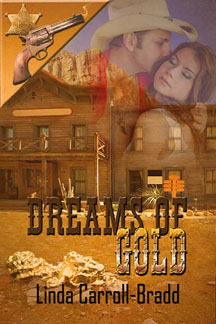
Today I’m talking about my sweet western historical novella, Dreams of Gold.  I love stories where one of the characters is definitely outside his or her comfort zone. That’s exactly where my heroine, Ciara Morrissey, finds herself when she acts on a deathbed promise made to her dear mother. From civilized Massachusetts to a frontier town in Wyoming Territory is quite a leap, and Ciara finds herself in all sorts of trouble.

Leave a comment here which includes your email address for a chance to win a copy of Dreams of Gold.

DreamsofGold_SMAbout Dreams of Gold

1871, Wyoming Territory

Easterner Ciara Morrissey travels west to honor a sacred promise to her mother and locate her fortune-seeking father. Three years of acting as caretaker to her grandparents and mother until their deaths has created a thirst in Ciara to see what the wide world has to offer.

Sheriff Quinn Riley has been tracking the Irish charlatan who swindled half the population of Bull City, Wyoming. He’s determined to stick close to the opinionated woman who arrived on the runaway stagecoach. Within only a few hours, easterner Ciara Morrissey upsets the townspeople by making inquires about his prime suspect. He’s duty-bound to keep her safe, even when being close to the green-eyed beauty sets off a stampede in his heart.

EXCERPT

More evidence she was a stranger to the wild circumstances of the western frontier. Anticipation of organizing the chase flitted through him. “Did they use names? Or speak to their horses?” At her head shake, he fought back the urgency rising in his chest. “Anything that might provide a clue?”

“We heard shots, and Mr. McGinnis shouted for us to do what we were told. A man rode up to the window on each side, demanding our money and jewels.” A dainty shoulder lifted in a shrug. “That’s when Miss Fairchild screamed her virtue was about to be stolen and swooned, landing in my lap.” Green eyes danced, and a high-pitched giggle escaped. “Frankly, I doubt the robbers planned on lifting anyone’s skirts.” Eyes widening, she clapped a hand over her mouth and shook her head.

Damn. Quinn had seen witnesses suddenly realize the danger they’d been in and that’s when hysterics set in. Lord, he could not abide a crying woman. “Did you notice any detail about their saddles or markings on their faces that stood out?”

Her brows scrunched low, and she squared her shoulders, pulling her jacket snug across her breasts. “I feared for my very life, sir, and you think I should have noticed their saddles?” She inhaled deeply, and then her whole body stilled. “Yes, I do remember something about the saddles.”

He watched the movement of her chest—in particular, how the buttons strained their closures. The rhythm of his heartbeat kicked up and a bead of sweat trickled on his forehead. Lifting his gaze to her face, he leaned forward, forcing himself to concentrate on what she might share. “What’s that?”

“Each man sat in one.” Her body rigid, she raised the mug to her lips and waited, an eyebrow arched high.

Excerpt © Linda Carroll-Bradd

All Rights Reserved, The Wild Rose Press

authorSMAuthor Bio

As a child, Linda was often found lying on her bed reading about characters having exciting adventures in places far away. Upon reaching a landmark birthday, she decided to write one of those romances she loved so much. Easier said than done. Perseverance paid out and twelve years later, she received her first call from a publisher and a confession story was published. Now Linda writes heartwarming contemporary and historical stories with a touch of humor, and many have a tie to her previous home of Texas.

Linda currently lives in the southern California mountains with her husband of 34 years and their two spoiled dogs, Shiba Inu Keiko and terrier mix Phoenix.

www.lindacarroll-bradd.com

Guest Author: Debra Glass + Giveaway

Susana:

Today my guest is Debra Glass, who, like me, writes historicals for Ellora’s Cave, although hers are quite a bit more steamy than mine! Last year I loved her ménage book, Scarlet Widow, so I’m eager to hear about her latest release, Lover For Ransom. Welcome to Susana’s Parlour, Debra!

Debra: 

Thank you very much for hosting me in the Parlour today.

A Yankee Teacher Comes South in Lover for Ransom

Cathleen Ryan is one of my favorite heroines. She’s feisty and no nonsense and has a firm grip on everyone and everything—except herself. I thoroughly enjoyed writing her interaction with Southern hero, Ransom Byrne, who found he was far more intrigued with the Yankee hired help than he wanted to admit.

Leave me a comment and be sure to include your email address. One lucky commenter will receive a copy of Lover for Ransom!

**********

Byrne’s End, Thompson’s Station, Tennessee

June 3, 1866

Mr. John A. Bennett

Dear Sir,

I have arrived in Tennessee in one piece, though at times, I highly doubted that would be the case. Once my train crossed the Mason Dixon line, there was a marked change in the land. Many once grand dwellings are now but burned out shells, skeletal remains of the bastions of slavery I so fervently fought against during my tenure as an abolitionist prior to the war. I must admit, however, this area referred to as Middle Tennessee by its inhabitants is, for the most part, unscathed by the ravages of the war.

Upon my arrival, I was met at the station by Mr. Ransom Byrne who, I’m given to understand, contracted my service with the Perkins School for the Blind. Though pleasant enough, Mr. Byrne embodies all the qualities I would have heretofore ascribed to a former officer in the Rebel Army. With his easy and overly familiar manner of speech, he seeks to dazzle and woo, but I assure you, Mr. Bennett, those cavalier charms are lost on an affirmed spinster such as I, but not, as I so shockingly observed, on the local maidens.

Mr. Byrne took it upon himself to confide in me that, during the war, he had been brought home to convalesce during an illness which he unwittingly spread to members of the Byrne family, including my charge, his younger sister, Jenny. The illness resulted in her blindness, and I have clearly determined that my work with the sixteen-year-old has been cut out for me. Like many who have been robbed of sight in the bloom of life, Miss Byrne is disillusioned and bitter. I have no doubts I shall be able to rectify that and teach her that the blind can indeed live full lives.

It is obvious to me that Mr. Byrne feels beholden to his family and their business of horse breeding. In fact, the Byrnes and their servants alike, put far too much stock and trust in the wiles of the beasts, as I unfortunately learned firsthand after a mishap with a wagon and its novice driver, seven-year-old Charles Hunt.

I imagine a lesser woman would be intimidated by the Southern aristocracy, but not I. I fully intend to not only adhere to the standards I have adopted from my friends and mentors, Mrs. Elizabeth Cady Stanton and Miss Susan B. Anthony, but to instruct these Southern women, long repressed by their menfolk, the way to equality both in the home and at the voting poll.

As soon as I begin my instruction with Miss Byrne, I will write to you and inform you of my progress. Again, I appreciate the opportunity you have afforded me to travel from my hometown of Boston to this godforsaken land where I might not only help this young woman, but also enlighten my Southern sisters.

Very Truly Yours,

Cathleen M. Ryan

loverforransom_msrSMwebAbout Lover For Ransom

Ransom Byrne has been ravaged by guilt since an illness rendered his little sister blind. The former Confederate cavalry officer has resolved to make amends by hiring a Yankee tutor who’ll hopefully restore order to his sister’s life. Once accomplished, he’ll be free to leave Byrne’s End.

From the moment she steps off the train in Tennessee, Cathleen Ryan makes a startling first impression. With her feminist ideas, the irrepressible Bostonian quickly outrages everyone—especially Ransom. He deems the bespectacled teacher too uptight and prim for his tastes. Appearances, however, are deceiving. She tenders decadent proposals that shock and intrigue him, and sultry nights spent submitting to his every illicit request offer them both love and redemption.

But when her steadfast convictions attract the attention of dangerous men, Cathleen risks losing her chance of becoming more than just a lover for Ransom.

Inside Scoop:  This 19th-century tale contains mild violence, spanking, sloppy puppy kisses, more spanking, fiery suffragette speeches and an attitudinal horse named String Bean.

A Romantica® historical erotic romance from Ellora’s Cave

Excerpt From: LOVER FOR RANSOM

Copyright © DEBRA GLASS, 2013

All Rights Reserved, Ellora’s Cave Publishing, Inc.

“Don’t you ever read anything for pleasure?”

She toyed with the earpieces of her glasses, her mind fixed on the way his velvety drawl had played havoc with the word pleasure. She cleared her throat. “There are far too many important things to read to waste my poor eyesight on frivolities, Mr. Byrne.”

He closed her book, set it on the table and stood. Cathleen flinched as his leg brushed hers when he passed on his way to the bookcase. He opened it and pressed his fingertip to his lips in thought as he perused its contents.

Cathleen studied his casual stance. His weight shifted to one leg and his head cocked to the side. He looked back at her, stared so long it made her insides quiver and then turned back to the collection and removed a slender book from the shelf.

“I shall read to you then,” he said with a smile and he returned to his chair. “To protect your poor eyesight from…frivolities.”

Cathleen gulped as his long fingers opened the book and he thumbed through the pages. It looked like a child’s volume in his hands and she couldn’t help but wonder what he’d chosen.

“Ah, here,” he said, placing his elbow casually on the armrest of his chair to hold the book at a comfortable height. “It was many and many a year ago, in a kingdom by the sea, that a maiden lived there that you may know by the name of Annabel Lee.”

Edgar Allan Poe. Of course she was familiar with the famed Baltimore author. But she’d read his works in braille, and certainly had never heard them read aloud by a man with such a hauntingly husky voice. This night—this moment, with the clock’s pendulum ticking off the seconds in time with the poem’s meter and the flickering glow of the lamp—seemed to be made for the dark, beautifully macabre poem about a woman who’d died before her time.

“For the moon never beams without bringing me dreams of the beautiful Annabel Lee,” Ransom continued.

Cathleen closed her eyes, picturing a pair of young lovers walking hand in hand on a stormy beach. Ransom’s voice transported her and she felt the anguish of the author who’d lost his love only to find himself frequented by her ghost.

“And so, all the night-tide, I lie down by the side, of my darling—my darling—my life and my bride, in the sepulcher there by the sea, in her tomb by the sounding sea.”

Eyes still closed, Cathleen sat in the stillness, absorbing the song contained in the words. When her lashes fluttered open, she was surprised at the tear that traced down her cheek. Blushing, she swept it away. “Very nice, Mr. Byrne.”

He raised his eyebrows in mock warning.

She giggled. She actually giggled. Closing her eyes for a split second, she struggled to compose herself. She was acting like a bashful schoolgirl. “Ransom,” she corrected, her voice but a breath.

In that instant, something had suddenly changed between them and she was at a loss to decipher it.

Staring, he inhaled. “With your hair loose, you reminded me of the woman in that poem.”

Her eyes widened. “Dead?”

He chuckled without mirth. “No. Wild and windswept.”

This time, Cathleen did begin to smooth her hair down.

“No,” he said. “No. Don’t touch it. It’s perfect the way it is.” He must have realized he’d said too much. “I mean, it’s only you and me. There’s no need for pretense.”

Cathleen nodded. Her gaze fell to the brown leather covered book in his hand. “Do you believe such love exists?”

He snorted and closed the book. “This was the fancy of a man who imbibed too much and who thought too much. Love like that is for the young and foolish—for people who haven’t experienced the things I have.”

Cathleen gnawed her bottom lip. “Are you referring to your time during the war?”

He suddenly looked uncomfortable. His big and masculine exterior seemed incongruous with his sudden unease. “Yeah,” he admitted. “I saw and did things no living human being should ever have to see or do. Things that’ll make you hate yourself.”

Cathleen didn’t know how to respond. Newspapers told of the hardships and combat. She’d seen soldiers boarding trains to join the fighting. She’d watched neighbors don their widow’s weeds. She herself had received a telegram informing her that her brother had been killed. But even when the war had come into her very home, it had always seemed a distant thing. But these Tennesseans had lived the war. This man had fought it. Federal troops had occupied their home. While on the train, she’d overheard tales about frightening guerilla raids from both sides, about men who didn’t live by any code of decency, who took what they wanted and killed indiscriminately. These families had lived day to day, wondering if their hard-earned food stores, their homes or even their very lives would be taken from them.

“No,” Ransom continued. “The war was anything but glory.”

Still, Cathleen remained uncharacteristically silent. While she pitied the plight of these people, in her eyes, the war had been a necessary evil, a vehicle through which an entire race had broken the bonds of slavery and declared themselves free. And yet, she didn’t feel free to admit her thoughts on the matter to Ransom Byrne. Not tonight.

“What about you, Cathleen?” he asked, his gaze finding and holding hers, daring her to correct him. “Do you believe in that kind of love?” His tone was almost mocking.

Realizing he’d shifted the conversation back to the poem, she let out a laugh. “Of course not. In fact, I don’t agree with marriage at all and I shall never marry.”

“How did you come to this conclusion?”

“Contrary to what you might think, I haven’t chosen a life of spinsterhood because I am bookish and outspoken, not to mention plain.” She straightened, confused at the way a belief she’d always maintained with pride, now hurt. “No. I simply do not accept as true that a woman should have to marry and live out her days in subjugation.”

“Subjugation?” he asked and then laughed. “I’ve always thought that was the other way around. All the married men I know are pretty beholden to their wives.”

“That’s but a puerile joke. We all know that marriage gives husbands rights to a woman’s livelihood and even her body, if he so chooses to claim them. For a woman, marriage is nothing but legalized…rape.”

This time, both his eyebrows shot up. “That’s a mighty strong word.”

“A married man can demand his rights anytime he chooses. Therefore, if a woman is forced into coitus with him, it is legalized rape.” Cathleen lifted her chin, awaiting an argument. It was a strong word. But he needed to know how she felt about subjugation. She needed him to know it.

Instead, he surprised her. “Don’t you ever feel desire?”

Yes, I’m feeling it this very instant.

Can’t wait for the drawing? Buy Lover for Ransom (available in all ereader formats ) at Ellora’s Cave today! http://www.ellorascave.com/lover-for-ransom.html

glass_SMAbout the Author

DEBRA GLASS is the author of over thirty-five books of historical and paranormal romance, non-fiction, young adult romance, and folklore. She is a member of Romance Writers of America and the Professional Authors’ Network as well as RWA’s Heart of Dixie and Southern Magic Chapters.

She lives in Alabama with her real life hero, a couple of smart-aleck ghosts, and a diabolical black cat.

www.DebraGlass.com