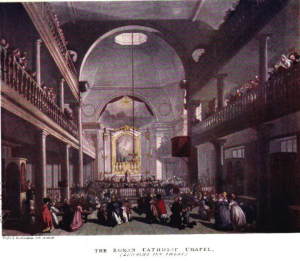
The annexed print is a very accurate and interesting view of this celebrated chapel: the general effect of the architecture is simple and agreeable. There is a singularity in the pillars; those in the second range in the galleries do not stand perpendicularly upon those under them, but are removed a little more backward: this is mentioned to account for the singular appearance they have in the view, and which might otherwise have been supposed to have proceeded from some error in the artist: in truth, the perspective in this, as in every production of Mr. Pugin’s, is always accurate, and conducted with real taste and elegance. The various groups of figures are designed with great spirit, and are highly characteristic of the groups we usually meet with in a Catholic chapel: the general effect of light and shade is broad and simple; the principal light being thrown upon the altar is highly judicious, and is productive of the happiest effect: the picture by Rigaud is in his best style, and the other decorations of the altar are extremely elegant.
The Catholic Chapel in Duke-street, Lincoln’s Inn Fields, was first opened in the reign of James II. and has continued ever since, with very little interruption, as a place of worship for the Catholics.
In the year 1762 it was burned down by accident, and soon after the present structure was erected, at the expence of the King of Sardinia, from a plan by Signor Jean Baptist Jaque, an amateur of architecture, and secretary of Count Vizi, the Sardinian envoy to the British court.
His Sardinian majesty was at all the expence of this chapel till he lost Savoy and Piedmont by the French revolution: at present it is principally supported by voluntary contributions.
The dreadful riots. of June 1780, were produced by the misguided zeal of Lord George Gordon, who having held out to the populace, that the church was in danger from an act which was passed, affording some relief to the Catholics, called a meeting of the Protestants in St. George’s Fields; and they, to the number of fifty thousand, signed a petition for the repeal of the act, and a 2 went in a body, with Lord George Gordon at their head, to present their petition to the House of Commons: they called themselves The Protestant Association. These people, though perhaps mistaken, were however generally respectable and orderly; but the cry of “No Popery” had spread among the lower orders of the people, who, incited by a set of abandoned and desperate wretches, involved the metropolis in all the horrors of anarchy and disorder.
Ignatius Sancho, in his letters, gives a very lively and animated description of that dreadful period. On the 2d of June, the day appointed for the consideration of the wished-for repeal. Lord North just got to the house a quarter of an hour before the associators arrived in Palace-yard. By the evening there were at least an hundred thousand poor, miserable, ragged rabble, from twelve to sixty years of age, with blue cockades in their hats, besides half as many women and children, all parading the streets, the bridge, and the park, ready for any and every mischief. Lord Sandwich was wounded by them, but was rescued by the guards. A large party of them went about two in the afternoon to visit the king and queen, and entered the park for that purpose, but found the guard too numerous to be forced, and after some useless attempts, gave it up. The Catholic Chapel, the subject of this article, was attacked by the mob and materially injured: with much other valuable property, they destroyed a fine-toned organ, and a very fine altar-piece, painted by Casali: the Sardinian ambassador offered live hundred guineas to the rabble, to save the picture and the organ; but they told him, they would burn him if they could get at him, and instantly destroyed them both.
These dreadful scenes continued to disgrace the metropolis till the 9th of June, when the rioters were suppressed, after having destroyed the premises of Mr. Langdale, an eminent distiller, on Holborn-Hill; numbers of them miserably perished in the flames, intoxicated to stupefaction with the spirituous liquors, which were set running down the kennels.
The mischief executed by these wicked and infatuated wretches was enormous. The Fleet prison, the Marshalsea, King’s Bench, both compters, and Tothill Fields, with Newgate, were forced open; Newgate partly burned, and three hundred felons, from thence only, let loose upon the world. The King’s Bench also was burned. The insurgents visited the Tower, but found it too strong for them. But so supine and feeble was the government of the city under Braek Kennett, then lord mayor, that the mob succeeded at the Artillery-ground, where they found, and took to their use, five hundred stand of arms. The Bank was threatened, but preserved by a detachment of the guards. Lord Mansfield’s house was completely destroyed; and, to the irreparable loss of learning and science, his valuable library and collection of manuscripts, which had been the labour of many years and great expence to bring together, devoted without mercy to the devouring flames.
The military power at last restored the affrighted capital to order. The obnoxious bill was repealed; many of the rioters were hanged, and Lord George Gordon committed to the Tower: he was afterwards tried and acquitted, hut was put in charge of his friends as a lunatic. It is whimsical, that this hero of the Protestant religion, when he was some years after confined in Newgate for a libel on the Queen of France, turned Jew.
To return to the chapel: it was again restored. The picture was replaced by one painted by John Francis Rigaud, R. A.; it represents Christ taken down from the cross, and is one of the best productions of his pencil. The new organ is much esteemed by connoisseurs; it was built by England.
All the church service, except the sermon, is in Latin. The masses are sung by the choir, which is under the direction of the organist, who is generally the composer of the music performed there. This chapel can boast of having had some of the most eminent British musicians for the directors of the choir, among whom the celebrated Dr. Arne was organist for several years. Mr. Samuel Webbe now holds that situation, a gentleman who is not only eminent for the grave and solemn style of his church music, but has also gained high reputation for the beauty and sprightliness of his lighter compositions.
The annexed print represents the greatest public exhibition made by this noble charity, on St. Matthew’s day, September 21st.
Two orations are annually pronounced in praise of this institution, one in Latin and the other in English, by two of the senior boys, called Grecians, who receive a superior education, being designed to complete their studies at the universities, one of them being sent annually to Cambridge, and every three years one is sent to Oxford. The orations are delivered in the presence of the governors and their friends, and the masters of the various schools, &c. in the great hall, a very noble apartment; the scene is truly impressive and solemn. The artists have exerted great ability and judgment in the disposition of such a numerous assemblage of people, in the distribution of the light and shade, and the truth of the perspective. The sketch of the very large picture in the hall adds to the interest.
In the year 1224, eighth Henry III. nine friars of the order of St. Francis arrived at Dover; five of them remained at Canterbury, the other four came to London, where they had so much influence on the piety or the superstition of the people, that in the following year John Ewin, mercer, purchased for them a piece of waste land within Newgate, on which, in about twenty years, rose the house and church of the Grey Friars; The church was one of the most superb of the conventual kind, and was erected by the contributions of the opulent devout. Margaret, second queen to Edward I. in 1306, began the choir, giving in her lifetime 2000 marks, and 100 marks by her testament. Isabella, queen to Edward II. gave 70/. and queen Philippa, wife to Edward III. 62/. towards the building. John de Britagne built the body of the church at a vast expense: Gilbert de Clare, Earl of Gloucester, gave twenty great beams out of his forest at Tunbridge. No order of monks seem to have had powers of persuasion equal to these poor friars: they raised vast sums for their buildings among the rich; and there were few of their admirers, when they came to die, who did not console themselves with the thoughts of lying within their expiating walls, and if they were particularly wicked, thought themselves secure from the assault of the devil, if their corpse was wrapped in the habit and cowl of a friar. Multitudes, therefore, of all ranks were crowded in this holy ground: it boasts of receiving four queens, Margaret and Isabella above-mentioned; Joan, daughter to Edward II. and wife of Edward Bruce, king of Scotland; and to make the fourth, Isabella, wife to William Warren, titular King of Man, is named. Of these, Isabella, whom Gray so strongly stigmatizes
“She-wolf of France, with unrelenting fangs,
That tear’st the bowels of thy mangled mate,”
I hope was wrapped in the friar’s garment, for few stood more in need of a daemonifuge. With wonderful hypocrisy, she was buried with the heart of her murdered husband on her breast.
John, Due de Bourbon, one of the noble prisoners taken at the battle of Agincourt, after eighteen years imprisonment, in 1443 here found a tomb.
In the same ground lies Thomas Burdett, Esq. ancestor of the present Sir Francis Burdett. He had a white buck, which he was particularly fond of: this the king, Edivard IV. happened to kill. Burdett, in anger, wished the horns in the person’s body who advised the king to it: for this he was tried, as wishing evil to his sovereign, and for this only, lost his head.
To the regret of the lovers of antiquity, all these ancient monuments and gravestones were sold, in 1545, by Sir Martin Bowes, lord mayor, for about 501.
The library founded here in 1429, by the munificent Whittington, must not be forgotten: it was 129 feet long, 31 broad. In three years it was filled with books to the value of 5561. of which Sir Richard contributed 400/. and Dr. Thomas Winchelsey, a friar, supplied the rest. This was about thirty years before the invention of printing.
On the dissolution, this fine church, after being spoiled of its ornaments for the king’s use, was made a storehouse for French prizes, and the monuments either sold or mutilated.
Henry, just before his death, touched with remorse, granted the convent and church to the city, and caused the church to be opened for divine service.
The building belonging to the friars was by Edward VI. applied to this useful charity. That amiable young prince did not require to be stimulated to good actions; but it is certain, that, after a sermon of exhortation by Ridley, bishop of London, he founded the three great hospitals in this city, judiciously adapted to provide for the necessities of the poor, divided into three classes:
Christ-Church Hospital for the orphan, St. Thomas’s Hospital for the diseased, and Bridewell for the thriftless. After the sermon, Edward ordered the good bishop to attend him. The account of this interview is very interesting, and as Stow relates it as a matter of fact from the word of the bishop, I shall extract a part of it verbatim.
“As soon as the sermon was ended, the king willing him not depart until that he had spoken to him, and this that I now write was the very report of the said Bishop Ridley, who, according to the king’s command, gave his attendance; and so soon as the king’s majesty was at leisure, he called for him to come unto him in a great gallery at Westminster; where, to his knowledge, and the king told him so, there was present no more persons but they two, and therefore made him sit down in one chair, and he himself in another, which, as it seemed, were before the bishop purposely set, and caused the bishop, maugre his teeth, to be covered, and then entered communication with him in this manner:
“First giving him hearty thanks for his sermon and good exhortation for the relief of the poor, ‘But, my lord,’ quoth he, ‘you willed such as are in authorityto be careful thereof, and to devise some good order for their relief, wherein I thinkyou mean me, for I am the first that must make answer to God for my negligence, if I should not be careful therein, knowing it to be the express command of Almighty God to have compassion of his poor and needy members, for whom we must make account unto him. And truly, my lord, I am before all things else most toil ling to travail that way; and I, doubting nothing of your long and approved wisdom and learning, who having such good zeal as wisheth help unto them, but also that you have had some conference with others what ways are best to be taken therein, the which I am desirous to understand, and therefore I pray you to say your mind.’
“The bishop was so amazed and astonished at the goodness and earnest zeal of the king, that he could not tell what to say: but, after some pause, advised him to begin with the city of London; and requested the king to direct his gracious letters to the lord mayor, to consult with such assistants as he thought fit on what might best be done, the bishop promising to assist them in their deliberations.
“To this the king agreed, but made the bishop wait till the letter was written, which having signed and sealed, he gave it to the bishop, desiring him to make all convenient speed, and to let him know the result as early as possible. The bishop the same night delivered the king’s letter to the then mayor. Sir Richard Dobbs, Knight; who the next day sent for two aldermen and six commoners, which were afterwards increased to twenty-four, who, with the good bishop, after various consultations, composed a book on the state of the poor in London.
“This book was presented to the king, who immediately founded the three royal hospitals. For the maintenance of Christ’s Hospital, he gave some lands of the value of 600/. per annum, which had been given to the Savoy, a house founded by Henry VII. for the lodging of pilgrims and strangers, but had declined from its original intention, and had become the resort of vagabonds, who strolled about the fields all day, and were harboured there at night. And for a further relief, a petition being presented to the king for a licence to take in mortmain lands to a certain yearly value, he ordered the patent to be brought to him, and with his own hand filled the blank space with 4000 marks by the year; and then said, in the hearing of his council, ‘Lord, Iyield thee most hearty thanks, that thou hast given me life thus long to finish this work to the glory of thy name.”
In two days after this excellent youth expired, in the sixteenth year of his age and the seventh of his reign, not without suspicion of his end being hastened by the ambitious Northumberland.
“All the English historians dwell with pleasure on the excellent qualities of this young prince. The flattering promises of hope, joined to many real virtues, made him an object of tender affection to the public: he possessed mildness of disposition, application to study and business, a capacity to learn and judge, and an attachment to equity and justice.” — Hume.
Christ’s Hospital, Bridewell, and St. Thomas the Apostle in Southwark, are incorporated by the name of, “The Mayor, Commonalty, and Citizens of the Cityof London, Governors of the Possessions, Revenues, and Goods of the Hospitals of Edward VI. King of England.”
It was not till the year 1552, five years after the king’s grant, that the house of the Grey Friars was fitted up for the reception of the children: they completed it in the same year, and called it Christ’s Hospital; and in September, they took in near four hundred orphans, and clothed them in russet; but ever after they wore blue cloth coats, their present habit, which consists of a blue cloth coat, close to the body, having petticoat skirts to the ankle, yellow under-petticoat, yellow stockings, and a flat round worsted cap: their shoes are tied with strings, from the quantity of which the various classes are distinguishable. In addition to this catalogue of their dress, they have of late years added a pair of breeches made of ticken, for which indulgence the boys gave up their meat suppers, to which they were before entitled, and have bread and cheese instead. Their fare is plain and wholesome, and they sleep in wards kept in a very clean state. There are at present about one thousand boys on this establishment, distributed into thirteen wards. The governors have established a school at Hertford, to which they send the youngest of the children, generally to the number of three hundred, who are taken into the house as room is made by apprenticing off the elder. It is between thirty and forty years since the girls were removed from London to be wholly educated at Hertford: all the girls are educated at this school.
At the instigation of Sir Robert Clayton, lord mayor, who was a great benefactor, Charles II. founded the mathematical school, to which he granted 7000/. to be paid out of a certain fund at 500/. per annum, for the educating forty boys for the sea: of these boys, ten are yearly put out apprentices to merchant vessels, and in their places ten more received.
Another mathematical school, for thirty-seven other boys, was afterwards founded by Mr. Travers; but these boys are not obliged to go to sea. Many able mathematicians and seamen have sprung from these institutions.
The hospital being nearly destroyed by the fire of London, the greater part was rebuilt under the direction of Sir Christopher Wren. The* writing school was founded in 1694, by Sir John Moor, alderman, who is honoured with a statue in front of the building. It is altogether a very extensive building, consisting of many irregular parts; the south front, adjoining Newgate-street, is perhaps the best. The cloisters, the only remains of the conventual house, serve for a thoroughfare, and for a place for the boys to play in. The great hall, a spacious and noble room, was built, after the fire of London, at the sole charge of Sir Joshua Frederic, alderman of London, and cost him 5000/.:
it is 130 feet long, 34 wide, and 44 in height. In this hall is an extraordinary large picture, by Verrio, of King James II. amidst his courtiers, receiving the president of this hospital, several of the governors, and numbers of the children, all kneeling: one of the governors with a grey head, and some of the children, are admirably painted. The history of this picture is curious: it was intended to have represented Charles II. who founded the mathematical school; but he dying while the picture was in hand, James, who never did any thing for the charity, had his own portrait introduced, together with that of the execrable Jefferies, then lord chancellor: Verrio has introduced his own portrait in a long wig. The founder is represented in another picture giving the charter to the governors, who are in their red gowns kneeling; the boys and girls are ranged in two rows: a bishop, probably Ridley*, is in the picture. If this was the work of Holbein, it has certainly been much injured by repair. There is also a fine picture of Charles II. in his robes, with a great flowing black wig: at a distance is a sea view, with shipping; and about him a globe, sphere, telescope, &c.: it was painted by Sir Peter Lely, in 1662.
In this hall the children are daily assembled to their meals: prayers are read by one of the senior boys, and hymns are sung by the children, for which purpose it is furnished with a pulpit; and an organ is played during the time of supper. These public suppers commence the first Sunday after Christmas, and end on Easter Sunday: the time of supping is from six o’clock till half past seven.
The following order has been recently hung up near the entrance of the hall:
Public Suppers
“Ordered, That no person be admitted within the great hall unless introduced by a governor.”
But the grand anniversary held in this hall is on St. Matthew’s day, an account of which accompanies the print.
In the court-room is a three-quarters length of Edward VI. a most beautiful portrait, and indisputably by Holbein.
In this room are also the portraits of two great benefactors to this hospital, and persons of the most enlarged and general benevolence. Sir Wolstan Dixie, lord mayor of London 1585, and Dame Mary Ramsay, wife of Sir Thomas Ramsay, lord mayor 1557.
In a room entirely lined with stone, are kept the records, deeds, and other writings of the hospital. One of the books is a curious piece of antiquity; it is the earliest record of the hospital, and contains the anthem sung by the first children, very beautifully illuminated.
The writing school is a handsome modern building of brick, supported by pillars, forming a spacious covered walk.
The grammar school is a plain brick building, more recently erected.
The permanent revenues of Christ’s Hospital are great, from royal and private donations in houses and lands; but without voluntary subscriptions they are inadequate to the present establishment.
By the grant of the city, the governors license the carts allowed to ply in the city, to the number of two hundred and forty, who pay a small sum for this privilege. They also receive a duty of about three farthings upon every piece of cloth brought to Blackwell Hall, granted by acts of common council.
The expenditure of this hospital is immense, being at present about 30,000/. per annum.
The governors, who choose their own officers and servants, are unlimited in their number. A donation of 400/. makes a governor: formerly the sum was less, but the office of governor being one of great trust, and of serious importance in its effect to the public, an enlargement of the sum was wisely adopted.
The governors of Christ’s Hospital have been made trustees to several other extensive charities by their founders. Among these charities, there is one of 10/. each, for life, to four hundred blind men. This ought to be known, because these funds have been often confounded with those of Christ’s Hospital, which they do not in the least augment, the governors not being at liberty to apply such funds to any of the uses of the hospital.
The greater part of the buildings belonging to this noble institution being through age in a state of irreparable decay, the governors have lately resolved to rebuild the whole upon a plan of uniformity and magnificence.
The present officers of Christ’s Hospital are,
President, Sir John William Anderson, Bart. Alderman.
Treasurer, James Palmer, Esq.
Physician, Richard Budd, M. D.
Surgeon, Thomas Ramsden, Esq.
Apothecary, Mr. Henry Field.
Chief clerk, Richard Corp, Esq.
Receiver, Mr. Thomas Whilby.
Assistant clerks, Mr. Matthew Cotton and Mr. James White.
Grammar master, Rev. Arthur William Trollop, M. A.
Under grammar master, Rev. L. P. Stephens, M. A.
Master of the reading school, Ralph Peacock, M. A.
Master of the mathematics, Mr. Lawrence Gwynne.
Master of the mathematics on Mr. Travers’s foundation, Rev. Thomas Edwards, M. A.
Writing masters, Mr. J. Allen and Mr. T. Goddard.
Drawing master, Mr. John Wells*.
Music master, Mr. Robert Hudson.
Steward, Mr. Matthew Hathaway.
AT HERTFORD.
Grammar master and catechist. Rev. F. W. Franklin, M. A.
Steward and upper writing master, Mr. Benjamin Flude.
Second writing master, Mr. Henry Rix Whittel.
Surgeon and apothecary, Mr. Colbeck.
Matron, Mrs. Royd.
Girls’ schoolmistress, Mrs. Ann Sparrow,
Second ditto. Miss Eliza Payne.
On the admission of a governor, the following serious and impressive charge is solemnly given him, in the presence of the president, or treasurer, and other governors assembled in court:
“Worshipful!
“The cause of your repair hither at this present is, to give you knowledge, that you are elected and appointed by the lord mayor and court of aldermen, to the office, charge, and governance of Christ’s Hospital.
“And, therefore, this is to require you and every of you, that you endeavour yourselves, with all your wisdom and power, faithfully and diligently to serve in this vocation and calling, which is an office of high trust and worship: for ye are called to be the faithful distributors and disposers of the goods of Almighty God to his poor and needy members; in the which office and calling if ye shall be found negligent and unfaithful, ye shall not only declare yourselves to be the most unthankful and unworthy servants of Almighty God, being put in trust to see the relief and succour of his poor and needy flock; but also ye shall shew yourselves to be very notable and great enemies to that work, which most highly doth advance and beautify the commonwealth of this realm, and chiefly of the city of London.
“These, therefore, are to require you, and every of you, that ye here promise, before God and this assembly of your fellow-governors, faithfully to travail in this your office and calling, that this work may have his perfection, and that the needy number committed to your charge be diligently and wholesomely provided for, as you will answer before God at the hour and time when you and we shall stand before him, to render an account of our doings. And this promising to do, you shall be now admitted into this company and fellowship.”
* So dreadful is the rage of religious persecution, that even this benevolent and virtuous prelate could not escape its fury: he was burnt for heresy at Oxford, together with J^atimer, bishop of Worcester, by order of Mary, 1555.
* About the year 1721, a drawing master was added to the establishment: Mr. Bernard Lens was the first; to him succeeded the late Mr. Green; the present gentleman is the third who has held the office.
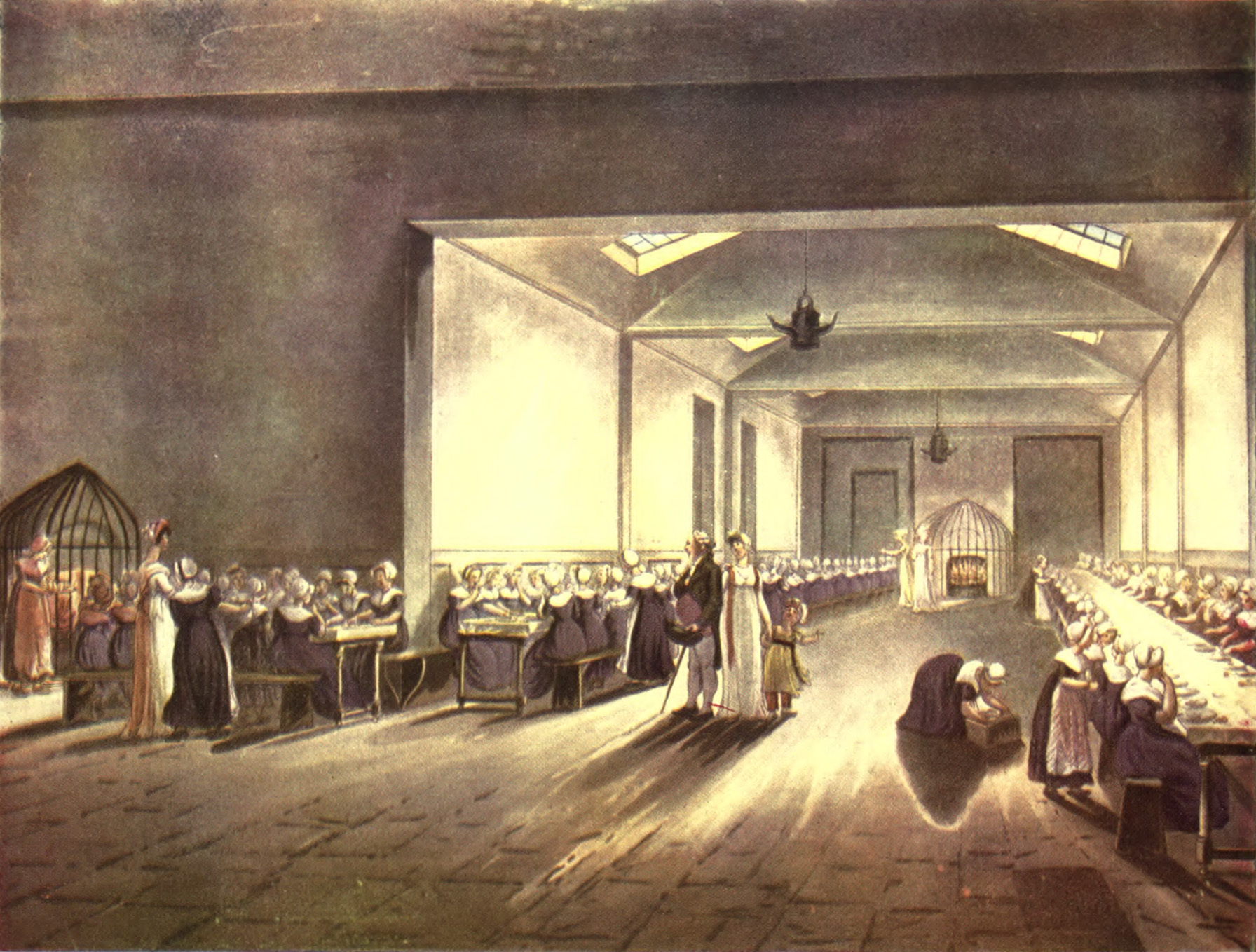
Is in the parish of Lambeth, in Surry, and was instituted in the year 1758, for the reception of friendless and deserted girls, the settlement of whose parents cannot be found. It was incorporated in the year 1800.
The annexed print is an interesting representation of the objects of this benevolent institution at their repast, in the presence of some of their guardians, who seem to contemplate the good order, cheerfulness, innocence, and comforts of their little wards, with all that interest and delight, that luxury of fine feeling, which irradiates the countenance when the heart is glowing with benevolence, animated with the exercise of an important duty, and gratified by the conviction that their virtuous endeavours are crowned with success. The coup d’ceil of the print is most impressive, and does great honour to’ the talents and feelings of the artists. The sweet innocence of the children, the benevolence of the guardians, and the chaste and matron-like simplicity of the building, aided by a fine breadth of effect, form a whole, which at the same time that the parts are in perfect harmony with each other, is admirably calculated to awaken the tender emotions of the humane heart, and excite the spectator to the exertion of those tender and kindly feelings, which do honour to our nature.
This charity owes its establishment to that vigilant and active magistrate. Sir John Fielding; who had long observed, that though the laws of this kingdom provided a parish settlement for every person, by birth, parentage, apprenticeships, &Y. yet many cases continually occurred, in which such settlements were difficult, if not impossible, to be ascertained; and therefore he and others were solicitous to remove, in part, this source of female wretchedness. By their exertions, and the continued endeavours of those who have hitherto conducted the plan, their benevolent intentions have been rewarded with the most signal success. The generous and discerning public has bestowed the means, which have prospered in the hands of the guardians, by whose care two hundred deserted females are daily sheltered and protected from vice and want, supplied with food and raiment, and taught whatever can render them useful in their situation, or comfortable and happy in themselves.
Carefully instructed in the principles of religion; in reading, writing, needlework, and household business, they are trained to habits of industry and regularity, by which means there is a supply of diligent and sober domestics for the use of that public, which, by its contributions, has so nobly acquired a right to their services.
The particular objects of this charity are, the children of soldiers, sailors, and other indigent persons, bereft of their parents, at a distance from any of their relations; who being too young to afford the necessary information respecting settlements, are often left destitute of protection and support, at an age when they are incapable of earning a subsistence, and contending with surrounding dangers.
Females of this description are, in a particular manner, the objects of compassion, and have also a double claim to the care of the humane and virtuous, from being not only exposed to the miseries of want and idleness, but, as they grow up, to the solicitations of the vicious, and the consequent misery of early seduction.
The following are some of the regulations for the government of this charity, which have been made by the guardians from time to time, and now continue in force.
Qualifications of Guardians.
The qualification of an annual guardian is, a yearly subscription of three guineas or upwards.
The qualification of a perpetual guardian is, a subscription of thirty guineas or upwards.
Legacies bequeathed to the use of this charity of one hundred pounds or upwards, when paid, shall entitle the first-named acting executor to be a perpetual guardian.
The guardians, conceiving it to be very essential for promoting one of the chief objects of this institution, earnestly solicit the ladies, who are particularly qualified for that purpose, frequently to visit the charity, inspect the management of the house, and particularly the employment of the children; also to see that they are properly instructed in housewifery, so as to be qualified for useful domestic servants; and from time to time communicate to the committee, by letter or otherwise, such observations as they shall deem proper to make.
Employment of the Children.
The children are to make and mend their own linen; make shirts, shifts, and table-linen; to do all kinds of plain needle-work, and to perform the business of the house and kitchen; to which latter twelve are appointed weekly, according to their age and abilities, to assist the cook, to wash, iron, and get up all the linen. They are likewise taught to read the Bible, write a legible hand, and understand the first four rules in arithmetic.
All kinds of plain needle-work are taken in at the Asylum, and performed
by the children at certain rates, which are regulated by the committee.
The following ore the Rules for placing out the Children.
They are to be bound apprentices for seven years, at the age of fifteen, or sooner, as domestic servants to reputable families in Great Britain.
No girl shall be apprenticed until the character of the master or mistress applying for the same, shall have been enquired into, and approved of by the committee.
Every person applying for an apprentice must appear at the committee, to give the necessary information respecting their situation, unless such appearance be dispensed with by the committee.
When any girl shall become qualified to be an apprentice, the guardian who presented her shall be acquainted therewith, in order to know if such guardian has any place in view for her.
The guardians, desirous of encouraging the children to serve their apprenticeship faithfully, have empowered the committee to grant any orphan apprenticed from the charity, who shall produce to the committee a certificate, signed by her master or mistress (or both if living), of her good behaviour during her apprenticeship, the sum of five guineas, such orphan having first returned public thanks in the chapel for the protection she has received. The committee are empowered to put out at any time, to any trade they shall think proper, such orphans as may have contracted any disease or infirmity, which may render them incapable of domestic service, with a premium not exceeding ten pounds.
The Establishment is as follows:
Patroness of the Institution.
Her Most Gracious Majesty the Queen of Great Britain
President.
His Royal Highness Prince Adolphus Frederick, Duke of Cambridge.
Vice-Presidents.
The Marquis of Blandford.
Right Honourable Earl Spencer, K. G.
Right Honourable Earl Mansfield.
Right Honourable Admiral Lord Radstock.
Right Honourable Lord Chief Baron.
Sir William Leighton, Knight and Alderman.
A chaplain, a morning preacher, an evening preacher, two physicians, two surgeons, an apothecary, a secretary, messenger, and collector. There are also a treasurer, and a committee consisting of nineteen gentlemen, that are elected annually at the general court held every April. Concerning these for each year, and many other things relative to this praise-worthy institution, every necessary particular may be found in a small abstract account to be had at the Asylum; from which we extracted the following regulations respecting devises or bequests to the charity, as we have much besides in the preceding pages.
Well-disposed persons, who may be inclined to make devises of rent, or bequests of personal property, for the benefit of this charity, being authorised so to do by the act of Parliament whereby it is incorporated, will be pleased to make such devises and bequests to this corporation by the style and title of The President, Vice-presidents, Treasurer, and Guardians of the Asylum for the Reception of Orphan Girls, the Settlement of whose Parents cannot be found.
Bankers and Receivers .
Messrs. Hankey and Co. Fenchurch-street.
Messrs. Drummond, Charing-Cross.
Messrs. Hoares, Fleet-street.
Messrs. Croft and Co. Lombard-street.
Messrs. Vere, Lucadon, and Co. Lombard-street.
Messrs. Sikes, Snaith, and Co. Mansion-house-street.
The committee, who meet at the Asylum every Thursday, at eleven o’clock in the forenoon.
Charles Wright, Esq. treasurer, and The Rev. Mr. Agutter, at the Asylum, chaplain and secretary.
We shall close the account of this benevolent institution with the animated apostrophe of the amiable Pennant.
“It is an institution of a most heavenly nature, calculated to save from perdition of soul and body the brighter part of the creation; those on whom Providence hath bestowed angelic faces and elegant forms, designed as blessings to mankind, but too often debased. The hazards that these innocents are constantly liable to from a thousand temptations, from poverty, from death of parents, from the diabolical procuress, and sometimes from the stupendous wickedness of parents themselves, who have been known to sell their beauteous girls for the purpose of prostitution, induced a worthy hand, in the year 1758, to found the Asylum, or House of Refuge. Long may it flourish, and eternal be the reward of those into whose mind so noble a design entered!”

 Susana's Parlour