Archives

The Workhouse, Southwell (aka The Greet House)

The Workhouse, Southwell

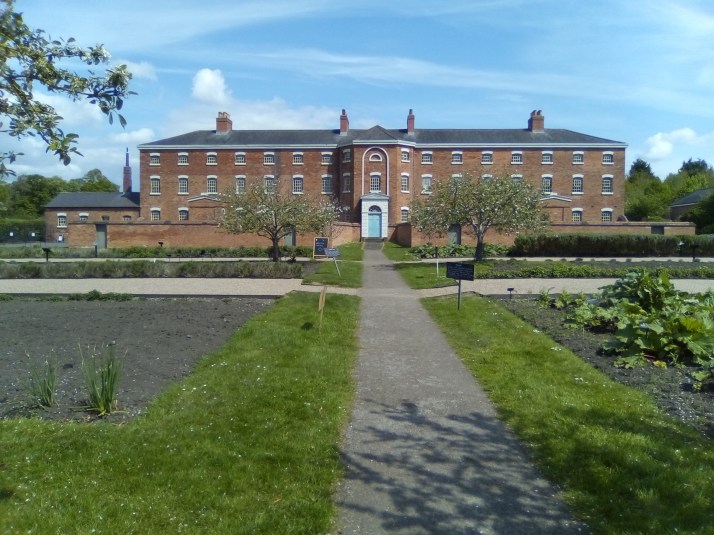
One of the first stops on my recent sojourn in the UK was this 1824 workhouse, near Nottingham. I was staying in Leicester at the time, so I arrived there by rail and taxi, in time for a fabulous tour by a knowledgeable guide. I expected to hear terrible stories about suffering and starving and desperate, mistreated inhabitants. Surprisingly, that was not the case.

While workhouse life was no picnic for its inmates, it was almost certainly better than the alternative; starving to death, dying of exposure, and having to watch your children and family suffer along with you. Before workhouses, the needs of the poor were to be attended to by the local parish. No doubt this system offered assistance to many, but it often came with resentment by the better-situated residents who had to fork up the funds to pay for it. Nobody likes to pay taxes, no matter what their economic situation. But if you’re working your butt off and just managing to get by, you might well resent some people getting taken care of with your money.
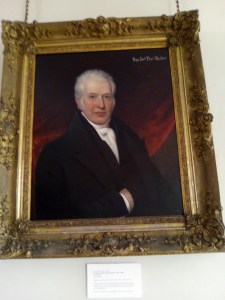
Dr. J.T. Becher, Founder

Then came the Rev. John Thomas Becher. He was Vicar-General of Southwell Minster from 1818-1840. A social reformer, he was instrumental in the creation of this prototype of 19th century workhouse that was cited by the Royal Commission on the poor law as the best example among the existing workhouses, before the New Poor Law of 1834 led to the construction of workhouses across the country. (Wikipedia)

The purpose of the workhouse was to provide an institution to feed, clothe, and house the poor in one place, which would supposedly be a significant savings to the parish. Which it did.

But, you ask, wasn’t it a horrible, prison-like existence to be an inmate there? Well, no. It wasn’t a prison at all. You could leave at any time, if you thought you could fare better elsewhere. And if you were wrong and wanted to come back, they might even take you back.

It wasn’t an easy life, but you had your basic needs met, and maybe even a few more. Many children did not go to school in those days (if they did they went on Sundays only and worked at home or at outside jobs the rest of the week), but this workhouse provided a school and a teacher for the children who lived there. These children would have a better chance to survive on their own when they were old enough to leave.
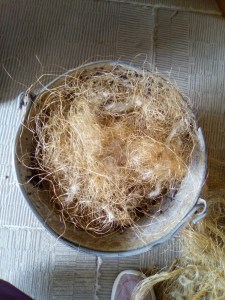
A pail of oakum

Of course, everyone who was able-bodied did have to work. Hard. Some of the work could be caring for those who were not able-bodied. Or it might be cooking or sewing or cleaning or laundry, if you were female. The males did the vegetable gardening and maintenance tasks. In the fall, they were sometimes hired (at cheap wages) by local farmers to bring in the harvest. Profits from their activities came back to the workhouse coffers. One particularly odd task suited for men and women who were incapable of hard physical work was to recycle old cords from sailing ships by “picking” (untangling) them. It was slow, tedious, and hard on thumbs and fingers. Men were assigned to pick 4-1/2 lbs. a day and women 3-1/2. Can you imagine? But pretty much everyone had to do their part. Because, you know, it brought in money, and they can’t be a burden on the taxpayers, can they?

The men, women, and children were segregated at Southwell’s workhouse. Which doesn’t mean they didn’t see each other. The women had to go into the men’s quarters to clean, and they may have glimpsed each other at meals. But they all had separate living and sleeping quarters and separate outside patios. No hanky panky here, even for married couples.

Except for the Master and Matron. This married couple who presided over the workhouse had their own separate living quarters. They managed the finances (although the advisory board made most of the decisions), kept records, and pretty much kept things running smoothly.

The building was in use up to the 1990’s, not as workhouse, but as a temporary residence for mothers and children. The National Trust acquired it after that, and had it renovated in the early 2000’s until it was opened to the public in 2002.

That’s not to say that all workhouses were similar to this one. It’s quite likely that many were as horrific as we assume them to be. I’m sure I’d rather not be inmate of any workhouse. But it provided help for many people who needed it at the time.

More photos available here.
The Blue Stockings Society and Benjamin Stillingfleet

In the Regency era, a young lady who gained the reputation of being a bluestocking would likely find herself “holding up the walls” as a wallflower at a ton event, since it was not the thing for a woman to be more educated than a man. Women were to be beautiful, fashionable, eloquent yet demure, and proficient in the social graces. A typical lady’s education would include reading, writing, geography, history, embroidery, drawing, French (or at least some French phrases), music, dancing, and, of course, riding, should her family have the means for a stable.

While there were, of course, learned ladies in society, it was thought prudent to keep one’s scholarly achievements private in order to avoid the bluestocking label, particularly for a young lady on the marriage market, which most genteel young ladies were. One hint that she might have blue tendencies could ruin her reputation and her opportunities for an advantageous marriage. And for most young ladies, marriage was the decision of a lifetime. Since divorce was nearly impossible and the husband held all the cards in the relationship, a mésalliance could very well mean a lifetime of misery and regrets.

In spite of this, there did exist a smattering of ladies—even some young, unmarried ladies—who defied prudence and flaunted their academic superiority to all and sundry. Some were married already, probably to indulgent husbands or those who were scholarly themselves. Those who were unmarried typically disdained the traditional role of women and did not aspire to giving some man control over them, although presumably these, too, were blessed with indulgent families with enough wealth to support a daughter for the rest of her life. There were some, like Hannah More, who, although she eschewed the frivolity of the ton, advocated the traditional role of marriage as the ideal for women, even though she herself never married.

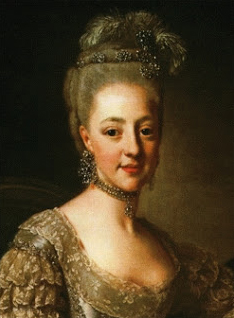
Elizabeth Montagu

In the mid-eighteenth century, Elizabeth Montagu and Elizabeth Vesey, among others, founded a women’s literary discussion group, that later came to include gentlemen as well. The society promoted education for all (including women and the poor). Several prominent members of the society, which came to be known as The Blue Stockings Society, were (at one time or another):

  • Elizabeth Montagu: social reformer, patron of the arts, salonist, literary critic, and writer who helped organize and lead the Blue Stockings Society
  • Elizabeth Vesey: a wealthy patron of the society
  • Samuel Johnson: poet, essayist, moralist, literary critic, biographer, editor and lexicographer
  • Anna Williams: poet and companion of Samuel Johnson
  • David Garrick: English author and playwright, friend of Samuel Johnson
  • Anna Laetitia Barbauld: a prominent English poet, essayist, literary critic, editor, and children’s author
  • James Beattie: Scottish poet, moralist, and philosopher
  • Frances Boscawen: literary hostess and correspondent
  • Edmund Burke: Irish statesman, author, orator, political theorist and philosopher
  • Frances Burney: novelist, diarist, and playwright
  • Elizabeth Carter: poet, classicist, writer, and translator
  • Margaret Cavendish-Harley: Duchess of Portland, and scholar/collector of natural history
  • Hester Chapone: author of conduct books for women
  • Mary Delaney: artist and letter-writer
  • Sarah Fielding: sister of Henry Fielding, novelist herself, who wrote the first children’s novel
  • Ada Lovelace: daughter of Lord Byron and his wife Annabella Millbank (who was a scholar herself), a noted mathematician and considered to be the first computer programmer
  • Catharine Macalay: historian
  • Hannah More: religious writer and philanthropost (see earlier post on this blog)
  • Sarah Scott: novelist, translator, social reformer, and sister of Elizabeth Montagu
  • Sir Joshua Reynolds: prominent portrait painter
  • Horace Walpole: art historian, man of letters, antiquarian, and Whig politician

Benjamin Stillingfleet

The name of the group supposedly came from an invited guest, Benjamin Stillingfleet, a noted botanist and scholar, who wore blue worsted stockings to the meetings because he could not afford the requisite black silk ones. Since the group prided itself on valuing conversation over fashion, the term bluestocking was more of a jest than a slight in the early days of the society. It was later that it became a term of shame and derision when applied to a young lady.

Stillingfleet was the son of a physician who attended Cambridge and worked as a tutor to his young relative, William Windham. He later accompanied Windham on a Grand Tour of the Continent, where they lingered several years, doing, among other things, scientific studies of the glaciers, for which his protégé was later honored as a Fellow of the Royal Society.

A bluestocking heroine, you say?

It can be done, of course. I’ve read dozens—if not hundreds—of historicals with bluestocking heroines. But she needs a special sort of hero, doesn’t she?—one who has enough confidence in his own abilities to appreciate and desire to nurture hers. Or at least, that’s what he needs to become by the end of the story. And I think it’s also important for him to be able to draw her out of her preoccupation with academics and into the real world on occasion as well.

However, in order to become a bluestocking in the first place, a heroine would need to have been brought up in a manner that would make this possible. A rare, scholarly family, perhaps, or a negligent one that doesn’t realize how much time she spends with her brother’s tutor and is properly horrified when they discover it. Because any girl tagged as a bluestocking would become the object of much derision and gossip by the high-sticklers of society, and these high-stickers never forgot such things, even when they were proven untrue. A marriage-minded miss and her mother would be horrified at the very thought.

Donning my teacher hat

As a former teacher, I cannot help comparing this to the seeming popularity of idiocy in modern culture, at least among the youth (I was a middle school teacher). It’s always been a concern of mine that adolescents—particularly girls—play down their intelligence in pursuit of popularity. Frankly, I’ve never understood it, not even when I was that age. Why anyone should eschew their God-given intelligence in order to cater to someone else’s insecurities is beyond me. One would think that we would have evolved beyond this by now, especially with the job market being so competitive, but I’ve seen too many students of both genders fail to take advantage of their academic abilities and end up with lives on the fringes of success. And frankly, all the standardized tests in the world are not making a whit of difference in the status quo.

That’s what I think anyway. What do you think? Do you think movies like Dumb and Dumber only serve to lower the value of serious scholarship among our young people?

Blog Barrage for Treasuring Theresa

CBLSbarragebanner

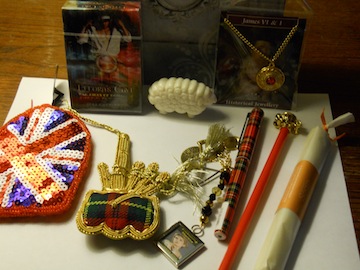
CBLS Promotions is sponsoring a Blog Barrage for Treasuring Theresa today and tomorrow. Check out the stops and enter the Rafflecopter contest for my newest treasure box (including UK souvenirs) (see below).

Lovely wooden box, 2013 Ellora's Cave playing cards (for adults only), sheep soap, James I and II necklace, Union Jack sequined coin purse, plaid bagpipes Christmas ornament, Treasuring Theresa key chain, plaid pen, crown pencil, fizzing bath crystals

Mark Your Calendar

fall2010

Coffeetime Romance Chat 

August 24  • 8:00-10:00 p.m. EDT

Eight Authors • Eight Giveaways

Theme: Historical Romance

Participating Authors

Aileen Fish
Shelly Munro
Lexi Post
Susana Ellis
Amy Hearst
Sasha Cottman
Sabrina York
Julie Johnstone