Archives

Beth Trissel: Traitor’s Legacy

SBB_TraitorsLegacy_Banner copy

Beth will be awarding a $35 Amazon gift card to a randomly drawn winner via Rafflecopter during the tour. Click here for the Rafflecopter. Click the banner above to follow the tour and increase your chances of winning.

About Traitor’s Legacy

1781. On opposite sides of the War of Independence, British Captain Jacob Vaughan and Claire Monroe find themselves thrust together by chance and expediency.

Captain Vaughan comes to a stately North Carolina manor to catch a spy. Instead, he finds himself in bedlam: the head of the household is an old man ravaged by madness, the one sane male of the family is the very man he is hunting, and the household is overseen by his beguiling sister Claire.

Torn between duty, love, and allegiances, yearning desperately for peace, will Captain Vaughan and Claire Monroe forge a peace of their own against the vagaries of war and the betrayal of false friends?

Excerpt

Cover_TraitorsLegacy copyShe fixed those wonderful eyes on him, more lethal than a backwoods rifleman. “Shall I lead the way, Captain?”

“Certainly.” He’d be tempted to follow her anywhere. A most unsettling thought.

Nothing about this fetching young lady struck Vaughan as calculating, but for the sake of her adored brother and sacred revolution he strongly suspected she’d try to deceive him. He’d hate to have to make her arrest. In fact, he should loathe it to his core. And he’d only just met her.

Why did she have such a potent effect on him, and why did it seem his fate to encounter beguiling females on the wrong side of this infernal conflict? If they weren’t Rebels to begin with, they inevitably adopted the cause.

Could he persuade Miss Monroe of her duty to the king, to him, and win her allegiance? Perhaps. She’d conducted herself splendidly thus far, and for such a prize he was willing to give his all.

About the Author

Author Beth Trissel copyMarried to my high school sweetheart, I live on a farm in the Shenandoah Valley of Virginia surrounded by my children, grandbabies, and assorted animals. An avid gardener, my love of herbs and heirloom plants figures into my work. The rich history of Virginia, the Native Americans and the people who journeyed here from far beyond her borders are at the heart of my inspiration. In addition to American settings, I also write historical and time travel romances set in the British Isles, and nonfiction about gardening, herbal lore, and country life.

 FacebookBlogTwitter Amazon Author PageBarnes & Noble Page

The Exeter Road: Basingstoke, Andover and Salisbury and the Events They Witnessed

dust jacket

The following post is the eighth of a series based on information obtained from a fascinating book Susana recently obtained for research purposes. Coaching Days & Coaching Ways by W. Outram Tristram, first published in 1888, is chock full of commentary about travel and roads and social history told in an entertaining manner, along with a great many fabulous illustrations. A great find for anyone seriously interested in English history!

Basingstoke

In 1645 Cromwell took Basing House after a four-year struggle, stripped the lead off the roof of the Abbey in order to cast bullets, leaving the house in ruins. Basingstoke, however was a popular place for coaches to stop for meals.

Between Basingstoke and Andover is a “desolate country” where coaches could make good time. The White Hart in Whitchurch was a “bustling place” where coaches from London to Salisbury and Oxford to Winchester crossed each other.” (Note: it’s still there and has fifteen rooms available should you desire to stay there!)

Andover

Here Henry VII rested from his labours after suppressing the insurrection of Perkin Warbeck; but whether the miserly Tudor put up at the Star and Garter, or the everlasting White Hart, or their medieval equivalents, if there were any, is more than I can say. It was upon Andover to link another royalty with the place, that James II fell back, after the breaking-up of the camp at Salisbury. Here it was that he was deserted by Prince George [Prince of Denmark, his daughter Anne’s husband], remarkable for his impenetrable stupidity and his universal panacea for all contingencies in a catch-word. Whatever happened, “Est-il possible?” was his exclaim. He supped with the king, who was at the moment overwhelmed naturally enough with his misfortunes, said nothing during a dull meal, but directly it was over slipped out to the stable in the company of the Duke of Ormond, mounted, and rode off. James did not exhibit much surprise on learning the adventure, being used to desertion by this time. He merely remarked, “What, is ‘Est-il possible?’ gone too! A good trooper would have been a greater loss;” and left for London—I was going to say by the next coach.

Two important coaching roads diverge about a half-mile out of Andover, which was also the scene of an escaped lioness on the Exeter Mail on October 20, 1816.

Salisbury
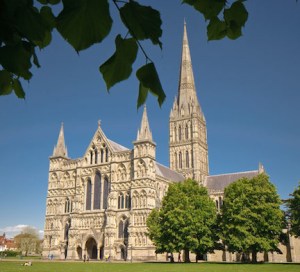
salisbury-cathedral-whats-on-in-salisbury“One of the most picturesque towns in the south of England,” Salisbury, where the Quicksilver (which could do 175 miles in 18 hours, our author notes repeatedly) stopped to change horses, “is almost exactly half way between Exeter and London.”

The town of Salisbury, which is eighty miles seven furlongs from Hyde Park Corner, is chiefly remarkable for its cathedral; and it owes this agreeable notoriety to the north wind. This may sounds trange in the ears of those who have not, attired as shepherds, highwaymen or huntsmen, braved the elements in the surrounding plain. Those however who have enjoyed this fortune, will not be surprised to learn, that when the winds raged in the good old days of 1220 round the original church of Old Sarum, which was quite unprotected and perched upon a hill, the congregation were utterly unable to hear the priests say mass; and no doubt they were unable to hear the sermon too. This fact much exercised the good Bishop Poore; and so, a less windy site having opportunely been revealed to him in a dream by the Virgin he got a license from Pope Honorius for removal. Which done—with a medieval disregard for the safety of the local cowherd or government inspector—he aimlessly shot an arrow into the air from the ramparts of Old Sarum, and (unlike Mr. Longfellow’s hero), having marked where it fell, there laid the foundations of the existing beautiful church.

The first among the myriad of royal visitors to Salisbury was Richard II, “who was here immediately before his expedition to Ireland, where he should clearly never have gone.” Apparently the town was not at all impressed with his “amiable inclination towards charging his subjects with his outings,” considering the fact that his household consisted of “ten thousand persons, three hundred of whom were cooks” and for him they had to provide tables. The town “a short time after expressed their thanks for his visit, by, with almost indecent alacrity, espousing the cause of Henry.”

In 1484

Richard III

Richard III

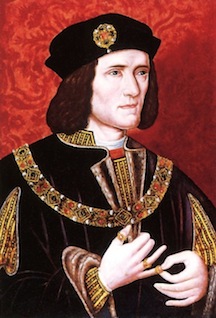
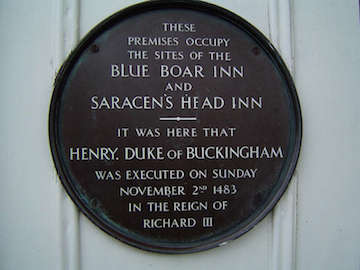
…the hunchbacked Richard honoured Salisbury with his presence; but he was not I expect in the best of tempers, for here to him was brought the Buckingham we have all read of in the play, who had just seized the fleeting opportunity to head an insurrection against the king, in an unprecedentedly wet season in Wales. The result was that he was unable to cross the Severn, and this misfortune brought him too to Salisbury, where Richard was waiting to superintend his execution at what is now the Saracen’s Head.

In the courtyard of this inn, which was then called the Blue Boar, and not “in an open space,” as Shakespeare has described it (as if he were speaking of Salisbury Plain), Buckingham had his head cut oft according to contemporary prescription. We have none of us seen the episode presented on the stage, but we have read the carpenters’ scene, which Shakespeare wrote in, to give the gentleman who originally played Buckingham a chance, and allow a few moments more preparation for Bosworth Field. And we may recollect that it consists princiapply in Buckingham asking whether King Richard will not let him speak to him, and on being told not at all, informing the general company, at some length, that it is All-Souls’ Day, and that as soon as he has been beheaded, he intends to commence “walking”.
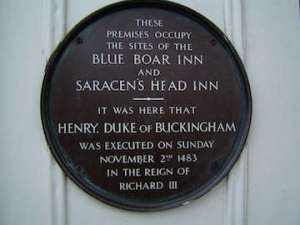
plaque2

Although the inn has been replaced by Debenham’s, a department store, some say they have seen or experienced the Duke’s ghost, so ladies, you might want to reconsider using the dressing rooms there—just an FYI.

After Richard and Buckingham, there came to Salisbury in the way of kings, Henry VII in 1491. Henry VIII in 1535 with Ann Boleyn, already in all probability engaged in those sprightly matrimonial differences as to men and the things which culminated the year following on Tower Green. Next in order, came to Salisbury, Elizabeth, bound for Bristol, bent, as on all her royal progresses, on keeping her nobility’s incomes within bounds, and shooting tame stags that were induced to meander before her bedroom windows. After the virgin queen came James I, who liked the solitudes which surrounded the Salisbury of those days, for the two-fold reason, firstly, because they saved him in a large measure from the invasion of importunate suitors (who were afraid of having their purses taken on Salisbury Plain before they could proffer their supplications), and, secondly, because they were well stocked with all sorts of game on which he could wreak his royal and insatiable appetite for hunting. The “open” nature of the country might perhaps be added as another reason for the sporting king’s liking for the place: for James was no horseman, and as he was in no danger of meeting a hedge in an area of thirty miles, the going must have suited him down to the ground.
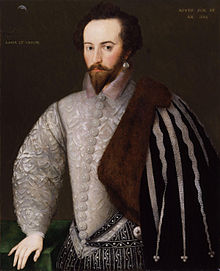
Sir Walter Raleigh

Sir Walter Raleigh

It was also hear that Sir Walter Raleigh, upon his return to England from an unsuccessful expedition to Spain, tried to gain audience with James to explain himself and beg pardon, but was forced to return to London where he was imprisoned and executed.

The merry monarch [Charles II] was here twice, but on neither occasion, I suspect was he peculiarly merry; for after the battle of Worcester, when he lay concealed near the town for a few days, and his companions used to meet at the King’s Arms in John Street, to plan his flight, the Ironsides were much too close on his track to allow opportunity for jesting; and when he came here as king in 1665, all but the most forced mirth was banished from a court which dreaded every day to be stricken by the plague.

 Index to all the posts in this series

1: The Bath Road: The (True) Legend of the Berkshire Lady

2: The Bath Road: Littlecote and Wild William Darrell

3: The Bath Road: Lacock Abbey

4: The Bath Road: The Bear Inn at Devizes and the “Pictorial Chronicler of the Regency”

5: The Exeter Road: Flying Machines, Muddy Roads and Well-Mannered Highwaymen

6: The Exeter Road: A Foolish Coachman, a Dreadful Snowstorm and a Romance

7: The Exeter Road in 1823: A Myriad of Changes in Fifty Years

8: The Exeter Road: Basingstoke, Andover and Salisbury and the Events They Witnessed

9: The Exeter Road: The Weyhill Fair, Amesbury Abbey and the Extraordinary Duchess of Queensberry

10: The Exeter Road: Stonehenge, Dorchester and the Sad Story of the Monmouth Uprising

11: The Portsmouth Road: Royal Road or Road of Assassination?

12: The Brighton Road: “The Most Nearly Perfect, and Certainly the Most Fashionable of All”

13: The Dover Road: “Rich crowds of historical figures”

14: The Dover Road: Blackheath and Dartford

15: The Dover Road: Rochester and Charles Dickens

16: The Dover Road: William Clements, Gentleman Coachman

17: The York Road: Hadley Green, Barnet

18: The York Road: Enfield Chase and the Gunpowder Treason Plot

19: The York Road: The Stamford Regent Faces the Peril of a Flood

20: The York Road: The Inns at Stilton

21: The Holyhead Road: The Gunpowder Treason Plot

22: The Holyhead Road: Three Notable Coaching Accidents

23: The Holyhead Road: Old Lal the Legless Man and His Extraordinary Flying Machine

24: The Holyhead Road: The Coachmen “More Celebrated Even Than the Most Celebrated of Their Rivals” (Part I)

25: The Holyhead Road: The Coachmen “More Celebrated Even Than the Most Celebrated of Their Rivals” (Part II)

26: Flying Machines and Waggons and What It Was Like To Travel in Them

27: “A few words on Coaching Inns” and Conclusion

The Exeter Road: A Foolish Coachman, a Dreadful Snowstorm and a Romance

dust jacket

The following post is the sixth of a series based on information obtained from a fascinating book Susana recently obtained for research purposes. Coaching Days & Coaching Ways by W. Outram Tristram, first published in 1888, is chock full of commentary about travel and roads and social history told in an entertaining manner, along with a great many fabulous illustrations. A great find for anyone seriously interested in English history!

Breakfast at The Three Pigeons Inn, Brentford

Brentford-Market & Three Pigeons

The Brentford Market and the Three Pigeons Inn

In the 17th and 18th centuries when Brentford was a thriving market and resort town, the Three Pigeons Inn was famous for its post-horses, of which it could stable up to one hundred. Its varied entertainments can be found in such literature as The Roaring Girle or Moll Cut-Purse (1611), She Stoops to Conquer (1773), The Merrie Conceited Jests of George Peele—The Jests of George Peele with Four of His Companions at Brainford (1607) and The Alchemist 1610).

Decisions! Decisions!

It’s snowing when our intrepid passengers are refreshed after their breakfast at The Three Pigeons. “…the coachman’s nose beams a benignant purple, and the ostler recommends another glass as an antidote to the weather, of which he presages the worst.”

Following their earlier adventure with the highway (see the previous post), the ladies are more concerned with the possibility of further encounters with outlaws. Mirabel, our gallant hero, squeezes the lovely Belinda’s hand in reassurance and they exchange “delicious looks.”

coach in snow

Upon reaching Hounslow, the coach begins to jolt and stops at The George Inn, where the landlord, who has six empty beds, warns them that the Bath Flying Machine has been snowed up at Colnbrook and that they had best stop for the night. “As sole answer to this appeal, the coachman, full of valour, calls for more brandy, and two more horses to take them over the heath…”

The first thing they encounter is the Salisbury Fly in a snowdrift.

The driver of the Exeter Fly observes this catastrophe, but he does not regard it, or regards it purely as a landmark, and majestically avoids the pit into which his unfortunate brother has fallen.

“The snow drives; the wind blows it full in their faces; the horses begin to show signs of suddenly capitulating.” The coachman whips them unmercifully, but they slow down to a walk. The passengers begin to believe they are lost, but then the snow relents, and the coach pulls in to The Bush at Staines. The landlord counsels them to stay for the night, and the passengers, if truth be told, would like to follow that advice.

Success, stimulant, and the lull in the snow storm have, however, made the coachman daring. He observes thickly that he is an Englishman, and declares his intention of inning at Bagshot for the night, whether the passengers leave the coach or stick to it. Upon this, the young captor of the highwayman [Mirabel] says, blushing with ingenuous shame, that he is willing to go on; upon which the lady [Belinda], blushing also, says that she is willing too. This necessitates the mother also putting her neck in jeopardy, and she, too, re-enters the coach.

brentford to bagshot map

A = Brentford, B = Bagshot

After this, the lawyer and the captain cannot honorably refuse, so the coach takes off with a full quota of passengers, and the snow begins to fall once more. Nerves on edge, the captain and the lawyer bicker, the guard, fearing highwaymen, takes out his blunderbuss, and the coachman tries to urge the horses to go faster as they approach Bagshot Heath. “…but highwaymen are not such fools as to be out in such weather, and the driver, who can see nothing at all, drives into a rut a yard deep.”

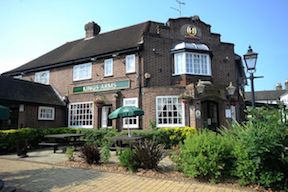
The gallant Mirabel takes the opportunity to rescue Belinda and her mother from the overturned coach, then turning to do the same with the rest of the motley crew. At that point he suggests that someone go on ahead to The King’s Arms at Bagshot to get help.

“The only answer to this appeal comes from the guard, who raises his blunderbuss gravely, and mistaking a too curious shepherd who approaches from behind a bush for a footpad, shoots him…”

The injured shepherd is given a bottle of brandy, and Mirabel, realizing he cannot be in two places at one time, confers the safety of the ladies to the lawyer, and takes off on one of the horses to get help. In under an hour, the rescuers approach, only to be shot at by the guard, who is drunk with power at having just shot the shepherd.

All’s Well That Ends Well

All the way to the King’s Arms he [the guard] babbles of the hundred pounds due him for ridding the heath of a footpad; the shepherd consults the lawyer meanwhile as to damages and as to how an action would lie…Mirabel gently presses Belinda’s hand and the pressure is ever so faintly returned…and the party arrive finally at The King’s Arms, Bagshot where a wonderful display of good cheer oppresses a groaning table—“Iris-tinted rounds of beef, marble-veined ribs, gelatinous veal pies, colossal hams, gallons of old ale, bins full of old port and burgundy.”

And here, in the midst of an old English plenty, my travellers are snowed up for nearly a week. And Mirabel proposes to Belinda, and is accepted; and the man of law drinks a congratulatory bottle of port with the fortunate wooer; and proposes himself to the widow next day, and is refused; and Mirabel drinks a bottle of port with him—a consolatory one this time; and the guard is forgiven by the shepherd; and the captain is rude to Betty the chambermaid, and gets his face slapped for his pains in a long oak corridor; and so in the old coaching days, when Exter was five days’ journey from London, and ladies wore hoops and farthingales, and gentlemen bag wigs and three-cornered hats, the old coaching world went round.

kings-arms

I love a happy ending. Don’t you?

BTW, today you could travel from Brentford to Bagshot in 36 minutes. But perhaps not in snowstorm.

Susana’s August Giveaway*

Susana brought back some lovely treasures from her trip to England, and she’d like to share them with you. This month she’s giving away a lovely mug (purchased at Chatsworth) illustrated with a famous painting of the Duchess of Devonshire.

Click on the image of the mug in the right column to enter the Rafflecopter. A runner-up will win “The Regency: Love’s Golden Age” mug. Enter every day if you wish! Good luck!

*International winners will receive the equivalent in gift cards.


 Index to all the posts in this series

1: The Bath Road: The (True) Legend of the Berkshire Lady

2: The Bath Road: Littlecote and Wild William Darrell

3: The Bath Road: Lacock Abbey

4: The Bath Road: The Bear Inn at Devizes and the “Pictorial Chronicler of the Regency”

5: The Exeter Road: Flying Machines, Muddy Roads and Well-Mannered Highwaymen

6: The Exeter Road: A Foolish Coachman, a Dreadful Snowstorm and a Romance

7: The Exeter Road in 1823: A Myriad of Changes in Fifty Years

8: The Exeter Road: Basingstoke, Andover and Salisbury and the Events They Witnessed

9: The Exeter Road: The Weyhill Fair, Amesbury Abbey and the Extraordinary Duchess of Queensberry

10: The Exeter Road: Stonehenge, Dorchester and the Sad Story of the Monmouth Uprising

11: The Portsmouth Road: Royal Road or Road of Assassination?

12: The Brighton Road: “The Most Nearly Perfect, and Certainly the Most Fashionable of All”

13: The Dover Road: “Rich crowds of historical figures”

14: The Dover Road: Blackheath and Dartford

15: The Dover Road: Rochester and Charles Dickens

16: The Dover Road: William Clements, Gentleman Coachman

17: The York Road: Hadley Green, Barnet

18: The York Road: Enfield Chase and the Gunpowder Treason Plot

19: The York Road: The Stamford Regent Faces the Peril of a Flood

20: The York Road: The Inns at Stilton

21: The Holyhead Road: The Gunpowder Treason Plot

22: The Holyhead Road: Three Notable Coaching Accidents

23: The Holyhead Road: Old Lal the Legless Man and His Extraordinary Flying Machine

24: The Holyhead Road: The Coachmen “More Celebrated Even Than the Most Celebrated of Their Rivals” (Part I)

25: The Holyhead Road: The Coachmen “More Celebrated Even Than the Most Celebrated of Their Rivals” (Part II)

26: Flying Machines and Waggons and What It Was Like To Travel in Them

27: “A few words on Coaching Inns” and Conclusion

The Exeter Road: Flying Machines, Muddy Roads and Well-Mannered Highwaymen

dust jacket

The following post is the fifth of a series based on information obtained from a fascinating book Susana recently obtained for research purposes. Coaching Days & Coaching Ways by W. Outram Tristram, first published in 1888, is chock full of commentary about travel and roads and social history told in an entertaining manner, along with a great many fabulous illustrations. A great find for anyone seriously interested in English history!

Traveling in Style

When the elegant and accomplished Barry Lyndon, about the 17th of May, 1773, and shortly after his marriage with the widow of the late Right Honourable Sir Charles Lyndon, K.B., set out to visit his estates in the West of England, where he had never yet set foot, he and his Honoria and suite left London in three chariots, each with four horses; an outrider in livery went before and bespoke lodgings from town to town; the party lay in state at Andover, Ilminster and Exeter; and the fourth evening arrived in time for supper, “before that antique baronial mansion of which the gate was in an odious Gothic taste that would have set Mr. Walpole wild with pleasure.”

George III traveling from Windsor to London

George III traveling from Windsor to London

The “Flying Machines”: “a slow form of lingering death”

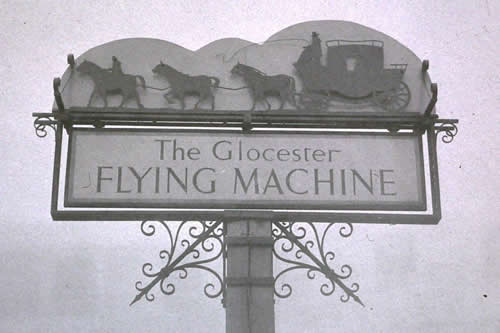
For travelers who could not afford three carriages pulled by twelve horses and outriders, there were the “Flying Machines,” stagecoaches whose owners boasted could convey you to your destination in the shortest time possible. The following flyer is from around 1670:

“Flying Machine.

“All those desirous to pass from London to Bath, or any other Place on their Road, let them repair to the Belle Savage on Ludgate Hill in London and the White Lion at Bath, at both which places they may be received in a Stage Coach every Monday, Wednesday, and Friday, which performs the whole journey in Three Days (if God permits), and sets forth at five in the Morning.

“Passengers to pay One Pound five Shillings each, who are allowed to carry fourteen Pounds Weight—for all above to pay three halfpence per Pound.”

Brockworth - Flying Machine Sign

You have noticed, of course, the disclaimer that should your journey take more than three days, the fault lies with God and not with stagecoach company itself. Our illustrious author, Mr. Tristram, seems to be of the opinion that such claims were exaggerated and that the travelers in Mr. Lyndon’s large retinue would not only arrive before the so-called “Flying Machines,” but in a great deal more comfort as well. Poor roads, snowdrifts and highwaymen were common hazards for all travelers, but Mr. Lyndon’s retinue was more prepared to deal with them than the vehicle that was described as “six cart horses harnessed to a diving bell.”

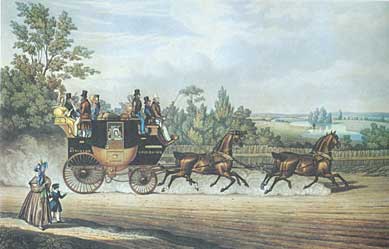
The Brighton Comet 1820

The Brighton Comet 1820

Hercules’ Pillars

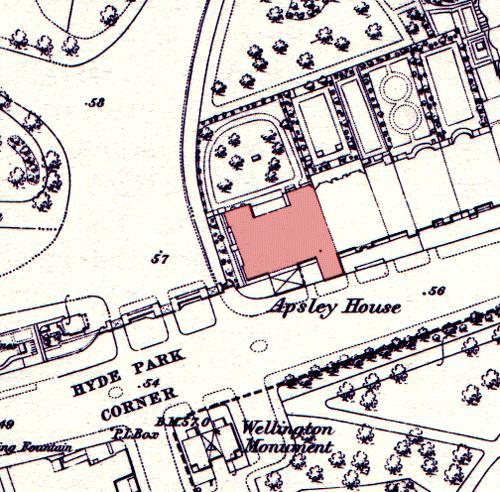
Apsley_house_on_an_1869_Ordnance_Survey_Map

Before Apsley House was constructed across from Hyde Park Corner by Robert Adam between 1771 and 1778, the site was occupied by an inn called Hercules’ Pillars, where coachmen would stop for a drink. Hercules’ Pillars played a prominent part in a very naughty book by Henry Fielding called The History of Tom Jones, a Foundling or simply Tom Jones. I suppose the drinks gave them courage to head into Knightsbridge, two furlongs away, which was known “as a place of bogs and highwaymen.”

Indeed, what better place for highwaymen to ply their trade than “a great impassable gulf of mud” as could be found in Knightsbridge!

An Amiable Outlaw Meets His Match

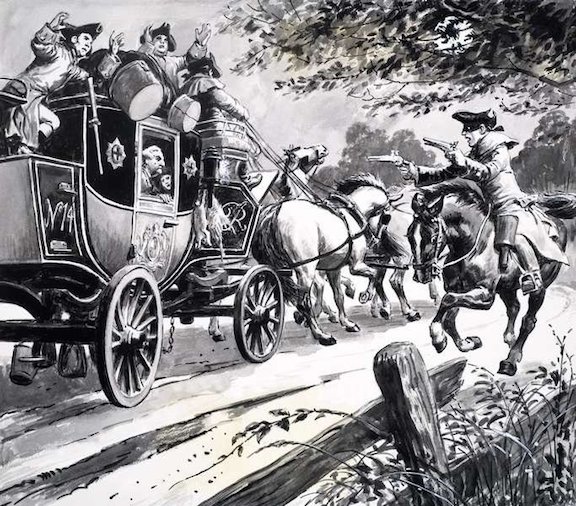
Into this great impassable gulf of mud the Exeter Fly presently descended, and after desperate flounderings which only made matters worse, stuck fast. To it, when thus safely anchored, entered a gentleman in a vizor and riding a dark chestnut mare, who good naturedly recommended the coachman to alight, and offered to relieve the passengers of their purses. The first to take advantage of this amiability and give up his purse was the [formerly boastful] warrior from Dettingen, who had been loud in his contempt for highwaymen ever since the Fly left the city, and had sketched, with an elaborate garnishing of oaths, the horrid fate to which any marauder would be subject who ventured to bar the way. He spoke no more now of Dettingen, and of the standard he had taken from the musketeer of the French guard. Far from it. He gave his little all to the gentleman who asked for it, counselled submission to his companions, and disappeared to eat straw in the bottom of the coach. The highwayman now asked the ladies to oblige, parenthetically observing that time pressed. The words were hardly out of his mouth when Mirabel [the name assigned by Tristram to the young man of the party], who had been biding his time, obliged him with a sudden blow on that jaw which he had somewhat ostentatiously intruded upon the company, and at the same moment jumped from coach and seized the bridle of the chestnut mare. The highwayman now said, “Zounds”! and discharged his pistol; but as the chestnut mare reared and fell back with him just as he was firing it, the aim was not so true as the intention; in point of fact, instead of shooting Mirabel through the head, he shot the guard through the hat, who announced in stentorian tones that he was a dead man, and left off his blunderbuss at the morning star. Meanwhile, the highwayman and Mirabel had closed and were wrestling in the mud, the ladies viewing the progress of the strife in a state of pleasing suppressed excitement, and the coachman flogging his horses with a view of driving off and leaving Mirabel and his antagonist to decide their interesting difference in solitude and peace. This genial intention was frustrated by the mud which held the coach fast and by the guard, who, mounting one of the leaders, succeeded in waking some watchmen, who, by way of performing their patrol between Kensington and Knightsbridge, were lying in graceful sleep at The Half-way Public House. They came upon the scene just as Mirabel was binding the highwayman’s hands behind his back, the man having yielded himself for worse when he felt eleven stone and a half kneeling on his chest and saw that the chestnut mare had run away. The watch now with great intrepidity took charge of the bound prisoner, helped the Exeter Fly out of the ditch, and Mirabel into the coach, who joined his companions in a somewhat mud-stained, flushed, and exhausted state, but not inwardly unpleased at what he had done.”

At the time, such stagecoach robberies were nearly a daily occurrence along that road.

highwayman

The Half-way House

Half-way between Knightsbridge and Kensington (until it was demolished in 1846) a disreputable inn frequented by footpads and highwaymen. Needless to say, coachmen generally tended to scramble past it as quickly as possible rather than stopping for a pint.

The Half-way House

The Half-way House


 Index to all the posts in this series

1: The Bath Road: The (True) Legend of the Berkshire Lady

2: The Bath Road: Littlecote and Wild William Darrell

3: The Bath Road: Lacock Abbey

4: The Bath Road: The Bear Inn at Devizes and the “Pictorial Chronicler of the Regency”

5: The Exeter Road: Flying Machines, Muddy Roads and Well-Mannered Highwaymen

6: The Exeter Road: A Foolish Coachman, a Dreadful Snowstorm and a Romance

7: The Exeter Road in 1823: A Myriad of Changes in Fifty Years

8: The Exeter Road: Basingstoke, Andover and Salisbury and the Events They Witnessed

9: The Exeter Road: The Weyhill Fair, Amesbury Abbey and the Extraordinary Duchess of Queensberry

10: The Exeter Road: Stonehenge, Dorchester and the Sad Story of the Monmouth Uprising

11: The Portsmouth Road: Royal Road or Road of Assassination?

12: The Brighton Road: “The Most Nearly Perfect, and Certainly the Most Fashionable of All”

13: The Dover Road: “Rich crowds of historical figures”

14: The Dover Road: Blackheath and Dartford

15: The Dover Road: Rochester and Charles Dickens

16: The Dover Road: William Clements, Gentleman Coachman

17: The York Road: Hadley Green, Barnet

18: The York Road: Enfield Chase and the Gunpowder Treason Plot

19: The York Road: The Stamford Regent Faces the Peril of a Flood

20: The York Road: The Inns at Stilton

21: The Holyhead Road: The Gunpowder Treason Plot

22: The Holyhead Road: Three Notable Coaching Accidents

23: The Holyhead Road: Old Lal the Legless Man and His Extraordinary Flying Machine

24: The Holyhead Road: The Coachmen “More Celebrated Even Than the Most Celebrated of Their Rivals” (Part I)

25: The Holyhead Road: The Coachmen “More Celebrated Even Than the Most Celebrated of Their Rivals” (Part II)

26: Flying Machines and Waggons and What It Was Like To Travel in Them

27: “A few words on Coaching Inns” and Conclusion