Archives

Regency Rites: The Well-Dressed Regency Lady

gowns

By the early nineteenth century, imitation of the classical was the rage in Europe, in architecture as well as fashion. Ladies’ gowns became simpler, with low necklines and ribbons tied beneath the bust, usually white due to a mistaken belief that the white marble statues being excavated in Greece were the original color. (They weren’t; the original brightly-colored paint had worn off.) Napoleon preferred ladies in white, and even though Britain and France were at war during this time, French fashions were all the rage.

Thin fabrics were de rigueur, muslin being the most popular, followed by silks and satins. As the new century progressed into the Regency and beyond, ladies’ gowns became more ornate, with another gown worn over the classical one, either a shorter length or with the front panels open to reveal the under-dress. Trims became more and more ornate, with ribbons, bows, and furbelows everywhere; collars of Elizabethan lace took the stage. By 1815, colored and grander fabrics were back.

Wardrobe

A fashionable lady had an extensive dress wardrobe, including:

  • carriage dresses

  • court dresses

  • dinner dresses

  • evening dresses

  • full evening dresses

  • garden dresses

  • morning dresses (also called “undress”)

  • opera dresses

  • promenade dresses

  • riding dresses

  • theater dresses

  • walking dresses

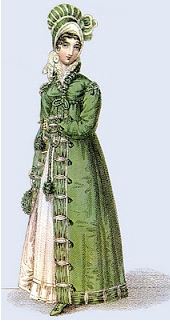
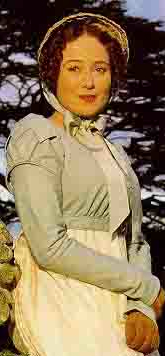
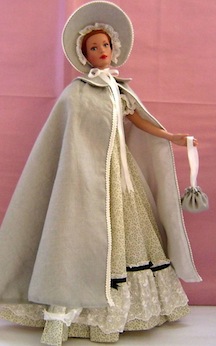
 Even in the dead of winter, many ladies would rather shiver in their flimsy gowns than be so unfashionable as to wear a heavy wrap. However, they did have shawls—Kashmir shawls had the advantage of being both light and warm—and various types of coats and jackets. A pelisse was an elegant overdress with long sleeves that buttoned down the front. A mantle was a rectangular fabric gathered at the neck. A spencer was simply a short jacket that reached the waist of the gown. Cloaks were often lined and/or trimmed with fur.
spencer
Lizzie wears a spencer over her dress.
pelisse
A pelisse à la militaire
mantle_reticule
The lady wears a mantle and carries a reticule.
For the most part, shoes in this period were “straights,” meaning there was no left or right shoe. Pumps made of embellished kid called slippers were very popular. Ladies had half-boots for walking, and stout boots for cold weather might be fur-lined. White silk hose tied at the knee (or later, the thigh) were often decorated with flowers or bowknots.

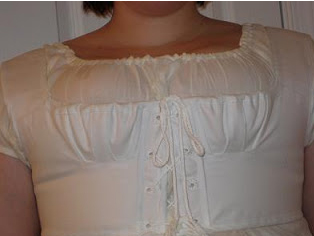
short corset common in the Regency

Under-drawers were not widely worn until after the Regency, around 1820. Short corsets with shaped cups for the breasts were common, although longer corsets were available to assist those with problem figures. A petticoat called a chemise was worn under the gown.

Hats & Accessories

Smaller, simpler bonnets gradually became more ornate, constructed with straw, velvet, satin, and crepe, trimmed with ribbons, ostrich plumes, and fabrics. Decorated caps (undress bonnets) of lace or satin were worn indoors and outdoors in informal settings. Turbans of various styles were popular for full-dress occasions.
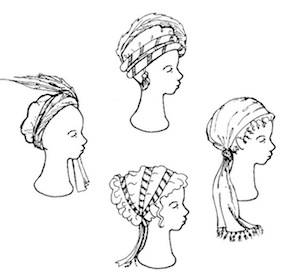
turbans
Various styles of turbans popular in the Regency
A fashionable lady had ribbons, jewels, combs, plumes, and hairpieces to dress up her hair for elegant evenings. Gone was the “big hair” of the previous century that towered so high that once a lady’s hair caught fire from the chandelier (Georgiana, Duchess of Devonshire). Classical hairstyles to match the classical gowns were “in”, and short, cropped hair, à la Titus, was popular through 1810.
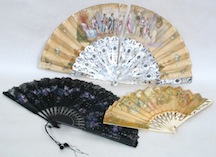
fans

Fans made of ivory with silk, gauze, or lace were another important accessory for every occasion. Every young lady learned the “language of the fan” in order to convey social messages without having to be rude. There were different fans for different occasions, and some were jeweled and hand-painted.

As for jewelry, simple gold crosses expanded to jeweled necklaces, bracelets, tiaras, and even elaborate clasps on shawls and wraps. Silk parasols, often decorated with fringe, were required during outdoor activities in order to prevent the development of freckles. A reticule, or ridicule, was a small bag often made with fabric from a gown used for carrying coins and items formerly carried in pockets.

parasol

A Lady’s Maid

A lady’s maid or abigail was necessary for such things as caring for clothing, preparing baths, dressing (gowns usually fastened in the back), and doing hair. She also accompanied her mistress while shopping and walking; young, unmarried ladies were not allowed out without chaperones, at least not while in the city.

Shopping!!!

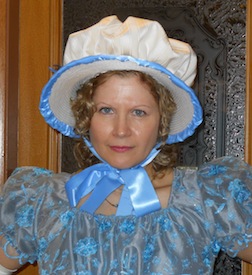
One of my favorite scenes in Regency stories is when the ladies go shopping. After having my own Regency gown and pelisse made for me this year (by my own very talented mother), I wasn’t all that keen on the frequent fittings. And not being able to get in and out of my gown without assistance. But I LOVE feeling like a princess when I wear it!

Of course, having a gown made this way is a great deal more complicated—and expensive—than buying one in a department store. But then, the dress you end up with is uniquely yours by the time you add the trim and embellishments—you’re not likely to ever see anyone else wearing it.

Would you ever consider having a period gown made up like this? Where would you wear it?

Click here to see photos of my Regency outfit.

 The Regency Companion, Sharon Laudermilk and Theresa L. Hamlin, Garland Publishing, Inc., 1989, pp. 30-48.

The Regency Rites series

Regency Rites: The Well-Dressed Regency Lady 

Regency Rites: Presentation at Court
Regency Rites: Almack’s Assembly Rooms 

Regency Rites: The London Season

Regency Rites: Presentation at Court

A young girl’s come-out in Polite Society started with her presentation at Court. During Regency times, she would “make her curtsy to the Queen”, be honored with a large ball given by her family at their London residence, and if she were very fortunate, receive a voucher for Almack’s, the exclusive “marriage mart” to which all marriage-minded misses and their mothers yearned to be invited. (See previous post)

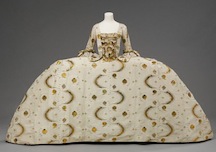
Wide hoops popular in the previous century were obligatory, even during the Regency when waistlines moved higher, and the result was considered ridiculous even then. But Queen Charlotte insisted, and…well…who was going to argue with the Queen?

courtdressgeorgian
An example of Georgian dress featuring hoops so wide the lady was obliged to walk sideways through doorways. But imagine these same hoops on high-waisted gowns such as those of the Regency period!

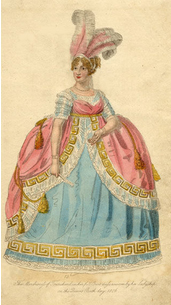
The elaborate gown consisted of a bodice, followed by a narrow hoop covered by layers of skirts. In her Memoirs, the Comtesse de Boigne describes “a satin skirt lavishly decorated with silver embroidery topped by a tulle skirt featuring a silver lace furbelow. The shortest and top skirt was made of silver-spangled tulle decorated with a garland of flowers. This last skirt was turned up and tucked so that the garland draped crosswise all around the skirt. To complete the proper style, the bottom of the white satin dress was turned up in loops and did not reach the base of the hoop skirt. Only the queen wore a train.” (see footnote)

In addition to the gown, an elaborate headdress with at least seven ostrich feathers was required. “The Comtesse’s head-gear beneath her plumes consisted of a garland of white roses upon a ringlet of pearls, a diamond comb, diamond buckles, and white silk tassels.” (see footnote)

It was also obligatory to display as much jewelry as possible, no matter how ridiculous it might appear. It is not surprising that these outfits cost an enormous amount of money in themselves, even though they might never be worn again.

courtdress2In fact, considering the cost of the court dress, an extensive wardrobe, the come-out ball, a suitable residence in the most exclusive part of town, and enough servants to staff it, only the very wealthy could afford such lavish expenditures. These things were necessary, however, if one wished one’s daughters to marry well—title, family connections, and wealth—and it’s not difficult to visualize a father with several daughters or one who didn’t “take” the first season agonizing over the huge amounts of money flowing out of the family coffers. Undoubtedly, the young ladies were well aware of their parents’ expectations; after all the money spent, they’d better not do something stupid like allow themselves to be ruined or fall in love with a penniless man.

On the day of the presentation, the young ladies would arrive in a long procession of carriages.down Piccadilly Street to St. James’s Palace. Amidst trumpets and gunfire, they would proceed into the palace and join the crush of richly-dressed ladies in ostrich plumes, hoop skirts, and diamonds. It was an exciting, but terrifying, initiation into the top echelons of London society. Each girl would be led to the Queen, make her curtsy, exchange greetings and perhaps pleasantries with Her Majesty, and then walk backwards out of the room (one should never turn one’s back on royalty), hoping against hope that she didn’t trip or cough or do something to earn the Queen’s disapproval.

Afterwards, during the remainder of the Season, there were balls and routs, trips to the opera, the theater, Vauxhall Pleasure Gardens and Hyde Park, Venetian breakfasts and ridottos (although not masquerades, since they were considered only for the fast set), and all manner of exciting social events where a young lady could establish herself in London Society…and make the acquaintance of many suitable gentlemen themselves seeking eligible matches.

courtdressmale
The gentlemen’s court dress didn’t change as dramatically as the ladies’ did. (The wig is from an earlier period.)

This all sounds thrilling, but for some reason, I seem to prefer writing romances with more down-to-earth characters in less grand settings. Perhaps because I’m a farmer’s daughter at heart? But as much as I enjoy reading and imagining such things, I still prefer characters who can be blissfully happy without all the glitter and the falderal.

What do you think? Can you visualize yourself “making your curtsy to the Queen”?

The Regency Companion, Sharon Laudermilk and Theresa L. Hamlin, Garland Publishing, Inc., 1989, p. 24.

The Regency Rites series

Regency Rites: The Well-Dressed Regency Lady 

Regency Rites: Presentation at Court
Regency Rites: Almack’s Assembly Rooms 

Regency Rites: The London Season

The Blue Stockings Society and Benjamin Stillingfleet

In the Regency era, a young lady who gained the reputation of being a bluestocking would likely find herself “holding up the walls” as a wallflower at a ton event, since it was not the thing for a woman to be more educated than a man. Women were to be beautiful, fashionable, eloquent yet demure, and proficient in the social graces. A typical lady’s education would include reading, writing, geography, history, embroidery, drawing, French (or at least some French phrases), music, dancing, and, of course, riding, should her family have the means for a stable.

While there were, of course, learned ladies in society, it was thought prudent to keep one’s scholarly achievements private in order to avoid the bluestocking label, particularly for a young lady on the marriage market, which most genteel young ladies were. One hint that she might have blue tendencies could ruin her reputation and her opportunities for an advantageous marriage. And for most young ladies, marriage was the decision of a lifetime. Since divorce was nearly impossible and the husband held all the cards in the relationship, a mésalliance could very well mean a lifetime of misery and regrets.

In spite of this, there did exist a smattering of ladies—even some young, unmarried ladies—who defied prudence and flaunted their academic superiority to all and sundry. Some were married already, probably to indulgent husbands or those who were scholarly themselves. Those who were unmarried typically disdained the traditional role of women and did not aspire to giving some man control over them, although presumably these, too, were blessed with indulgent families with enough wealth to support a daughter for the rest of her life. There were some, like Hannah More, who, although she eschewed the frivolity of the ton, advocated the traditional role of marriage as the ideal for women, even though she herself never married.

Elizabeth Montagu

In the mid-eighteenth century, Elizabeth Montagu and Elizabeth Vesey, among others, founded a women’s literary discussion group, that later came to include gentlemen as well. The society promoted education for all (including women and the poor). Several prominent members of the society, which came to be known as The Blue Stockings Society, were (at one time or another):

  • Elizabeth Montagu: social reformer, patron of the arts, salonist, literary critic, and writer who helped organize and lead the Blue Stockings Society
  • Elizabeth Vesey: a wealthy patron of the society
  • Samuel Johnson: poet, essayist, moralist, literary critic, biographer, editor and lexicographer
  • Anna Williams: poet and companion of Samuel Johnson
  • David Garrick: English author and playwright, friend of Samuel Johnson
  • Anna Laetitia Barbauld: a prominent English poet, essayist, literary critic, editor, and children’s author
  • James Beattie: Scottish poet, moralist, and philosopher
  • Frances Boscawen: literary hostess and correspondent
  • Edmund Burke: Irish statesman, author, orator, political theorist and philosopher
  • Frances Burney: novelist, diarist, and playwright
  • Elizabeth Carter: poet, classicist, writer, and translator
  • Margaret Cavendish-Harley: Duchess of Portland, and scholar/collector of natural history
  • Hester Chapone: author of conduct books for women
  • Mary Delaney: artist and letter-writer
  • Sarah Fielding: sister of Henry Fielding, novelist herself, who wrote the first children’s novel
  • Ada Lovelace: daughter of Lord Byron and his wife Annabella Millbank (who was a scholar herself), a noted mathematician and considered to be the first computer programmer
  • Catharine Macalay: historian
  • Hannah More: religious writer and philanthropost (see earlier post on this blog)
  • Sarah Scott: novelist, translator, social reformer, and sister of Elizabeth Montagu
  • Sir Joshua Reynolds: prominent portrait painter
  • Horace Walpole: art historian, man of letters, antiquarian, and Whig politician

Benjamin Stillingfleet

The name of the group supposedly came from an invited guest, Benjamin Stillingfleet, a noted botanist and scholar, who wore blue worsted stockings to the meetings because he could not afford the requisite black silk ones. Since the group prided itself on valuing conversation over fashion, the term bluestocking was more of a jest than a slight in the early days of the society. It was later that it became a term of shame and derision when applied to a young lady.

Stillingfleet was the son of a physician who attended Cambridge and worked as a tutor to his young relative, William Windham. He later accompanied Windham on a Grand Tour of the Continent, where they lingered several years, doing, among other things, scientific studies of the glaciers, for which his protégé was later honored as a Fellow of the Royal Society.

A bluestocking heroine, you say?

It can be done, of course. I’ve read dozens—if not hundreds—of historicals with bluestocking heroines. But she needs a special sort of hero, doesn’t she?—one who has enough confidence in his own abilities to appreciate and desire to nurture hers. Or at least, that’s what he needs to become by the end of the story. And I think it’s also important for him to be able to draw her out of her preoccupation with academics and into the real world on occasion as well.

However, in order to become a bluestocking in the first place, a heroine would need to have been brought up in a manner that would make this possible. A rare, scholarly family, perhaps, or a negligent one that doesn’t realize how much time she spends with her brother’s tutor and is properly horrified when they discover it. Because any girl tagged as a bluestocking would become the object of much derision and gossip by the high-sticklers of society, and these high-stickers never forgot such things, even when they were proven untrue. A marriage-minded miss and her mother would be horrified at the very thought.

Donning my teacher hat

As a former teacher, I cannot help comparing this to the seeming popularity of idiocy in modern culture, at least among the youth (I was a middle school teacher). It’s always been a concern of mine that adolescents—particularly girls—play down their intelligence in pursuit of popularity. Frankly, I’ve never understood it, not even when I was that age. Why anyone should eschew their God-given intelligence in order to cater to someone else’s insecurities is beyond me. One would think that we would have evolved beyond this by now, especially with the job market being so competitive, but I’ve seen too many students of both genders fail to take advantage of their academic abilities and end up with lives on the fringes of success. And frankly, all the standardized tests in the world are not making a whit of difference in the status quo.

That’s what I think anyway. What do you think? Do you think movies like Dumb and Dumber only serve to lower the value of serious scholarship among our young people?

Blog Barrage for Treasuring Theresa

CBLSbarragebanner

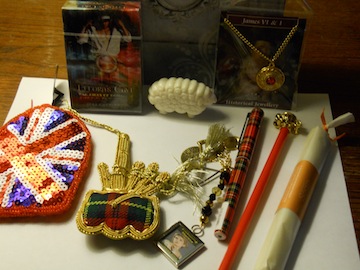
CBLS Promotions is sponsoring a Blog Barrage for Treasuring Theresa today and tomorrow. Check out the stops and enter the Rafflecopter contest for my newest treasure box (including UK souvenirs) (see below).

Lovely wooden box, 2013 Ellora's Cave playing cards (for adults only), sheep soap, James I and II necklace, Union Jack sequined coin purse, plaid bagpipes Christmas ornament, Treasuring Theresa key chain, plaid pen, crown pencil, fizzing bath crystals

Mark Your Calendar

fall2010

Coffeetime Romance Chat 

August 24  • 8:00-10:00 p.m. EDT

Eight Authors • Eight Giveaways

Theme: Historical Romance

Participating Authors

Aileen Fish
Shelly Munro
Lexi Post
Susana Ellis
Amy Hearst
Sasha Cottman
Sabrina York
Julie Johnstone

Regency Rites: Almack’s Assembly Rooms

What was Almack’s?

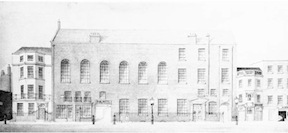
Almack’s was founded in 1765 by a Mr. McCall. The building was located on King Street just off St. James Street* and included a large ballroom, as well as supper rooms and card rooms.

Almack’s was ruled by a select committee of society matrons known as the Lady Patronesses. These ladies ruled the club with an iron hand; only the crème de la crème (about 25%) of London society were authorized to cross the threshold of this exclusive circle. Each application for membership was carefully scrutinized by the high-handed patronesses, who were not above using their power for retribution against their rivals or other personal reasons.

The food served was not of the best quality. Alcohol was not served—only tea and lemonade.The floor of the ballroom was said to be dreadful, and the rigid rules set by the patronesses could not be broken by anyone. It is said that the Duke of Wellington, the hero of the Peninsular War, was refused admission because he did not sport the proper dress—knee breeches, white neckcloth, and a long-tailed coat. The doors were locked precisely at eleven o’clock and no one was allowed in after that for any reason. There was a long list of”do’s” and “don’ts” (mostly don’ts) for the young debutantes, and any infraction could result in expulsion from the club and social censure. When the waltz was finally given the seal of approval—it was condemned for years as being scandalous due to the close proximity of the dancers’ bodies—the young ladies had to be individually approved to dance it by one of the patronesses.

Almack's Assembly Rooms

Almack’s Assembly Rooms

Almack’s balls were decidedly not anywhere near the grandest balls of the London Season, so why did the matchmaking mothers of the haut ton scramble to get their hands on those square cardboard vouchers that would gain them admittance?

One word—marriage. Almack’s was the exclusive “marriage mart” of the ton. While potential spouses for your sons and daughters could be found elsewhere, the “best” ones could ideally be found at Almack’s, where the average, everyday riffraff need not apply. Who wouldn’t want their daughter to find a wealthy, well-connected—perhaps titled—spouse to enrich the family fortunes? Matchmaking mothers everywhere yearned to have their marriageable offspring included among the exclusive company of Almack’s.

Who were the Patronesses?

The Lady Patronesses—six or seven at any one time—were:

Lady Castlereagh

Lady Castlereagh

Lady Castlereagh (Emily Anne) was a wealthy earl’s daughter who married the Viscount Castlereagh (later the 2nd Marquess of Londonderry), who held many political posts (Secretary of States for War, Secretary of State for Foreign Affairs, and leader of the House of Commons) during the period. Lady Castlereagh was the one who insisted that the door to Almack’s be closed promptly at eleven. She and Mrs. Drummond Burrell were both known for their disdainful arrogance.

Lady Jersey

Lady Jersey

Lady Jersey, “Queen Sarah,” “Silence,” or “Sally” to her close friends was the wealthy daughter of the 10th Earl of Westmoreland who married the 5th Earl of Jersey. Lady Jersey’s mother-in-law, Lady Frances Jersey, was at one time the mistress of the Prince of Wales (it was she who recommended he choose Princess Caroline for his wife), and her parents eloped to Gretna Green (quite the scandal). Lady Jersey’s younger sister married the brother of the scandalous Lady Caroline Lamb, but when the latter ridiculed her in her vengeful novel Glenarvon, Lady Jersey barred her from Almack’s forever.

Lady Sefton

Lady Sefton

Lady Sefton (Maria) assisted many a green girl to negotiate the hazards of the marriage mart. Her husband was an enthusiastic sporting man, and a member of the Four-in-Hand Club (an elite club for only the best drivers).

Lady Cowper

Lady Cowper

Lady Cowper (Emily) was the daughter of the great political hostess, Lady Melbourne, and due to her mother’s numerous affairs, her paternity was never verified. She disapproved of her sister-in-law, Lady Caroline Lamb, but was otherwise known as one of the kindest of the patronesses.

Princess Esterhazy

Princess Esterhazy

Princess Esterhazy (Thérèse) was the grand niece of Queen Charlotte and never let anyone forget it. Her husband Prince Paul Esterhazy served as the Austrian ambassador to England 1815-1842. She and the Countess Lieven demonstrated the utmost in continental sophistication.

Countess Lieven

Countess Lieven

Countess Lieven (Dorothea) was the first foreigner to serve as a patroness of Almack’s. Her husband the Count was the Russian ambassador to England from 1812 to 1834. Besides being a leader of London society, she was a significant political force in Great Britain, France and Russia.

Mrs. Drummond Burrell

Mrs. Drummond Burrell

Mrs. Drummond Burrell (Clementina) was a great heiress and daughter of an earl who later became a baroness when her husband succeeded to his father’s title. Although one of the younger patronesses, she was considered the most arrogant and haughty of them all.

Appearance was everything.

It’s interesting to note that while London society, as demonstrated by the Lady Patronesses, demanded a high degree of moral perfection, it was really the façade that counted. As long as you behaved with discretion—i.e., didn’t get caught—you could have adulterous affairs with impunity. While it was expected that wives would remain faithful to their husbands until the birth of an heir or two, after that, it was quite common for both husband and wife to indulge in affairs. It was widely known that Lady Melbourne had affairs with politically powerful men who fathered many of her children, but her the importance of her position precluded any open censure.

Most of the Lady Patronesses of Almack’s had notorious affairs. Emily Cowper, taking the advice of her mother, the above-mentioned Lady Melbourne, to be true to her lover rather than her husband, had a long affair with Lord Palmerston, who later became Prime Minister, and after her husband died, they married and lived happily ever after.

As long as it was behind closed doors—and you were wealthy and important enough—you could get away with a considerably lower standard of behavior. Of course, marriages tended to be more about property, wealth and family connections than any sort of love or affection, so perhaps such scenarios were a natural result of cold-blooded unions.

The King Street location of Almack’s is an office building now; when I was there two weeks ago, it was covered with scaffolding. Christie’s Auction House is across the street.

The Regency Rites series

Regency Rites: The Well-Dressed Regency Lady 

Regency Rites: Presentation at Court

Regency Rites: Almack’s Assembly Rooms 

Regency Rites: The London Season

Episode #14: In Which Leticia, Lady Beauchamp, Pops In For an Interview On Her Personal Acquaintance With Princess Charlotte of Wales

Susana [to the Reader]: I’m afraid Lady P had to return to the 19th century for a christening (no, not Damian and Theresa’s this time, but one of her own daughters’ offspring). She promised to return after she’s had a comfortable coze with her daughters and grandchildren, but in the meantime, she sent someone who she said was a personal friend of Princess Charlotte, the daughter of the Prince Regent.

Lady Beauchamp: I would not characterize our acquaintanceship in quite that manner, Miss Ellis.

Susana: Forgive me, Lady Beauchamp, but I am not finished speaking to the readers.

Lady Beauchamp: Well, do hurry, then. I have an important social engagement this afternoon.

Susana [taking a deep breath]: Yes, well, Lady Beauchamp is the former Leticia Snodgrass, who was presented in London about the same time as Lady P’s niece-by-marriage, Theresa Ashby. You can read more about that in the epilogue to Treasuring Theresa, which is a free read on my web site: http://www.susanaellis.com/pub.html.

gloria_gown_stern

Leticia, Lady Beauchamp, née Snodgrass

Lady Beauchamp: Is it really? I daresay I should like to see how I am characterized in the story.

Susana [hurriedly]: Perhaps we should get back to the subject at hand, you being a marchioness and your time being so valuable and all. Why don’t you begin by telling us about your marriage and your family?

Lady Beauchamp: Of course. I was quite sought-after in my first season—many offers were made for my hand, you know—but there were only a handful of dukes that year and they were all married, so I chose to wed Lord Beauchamp. We had a fabulous wedding at St. George’s, and the Prince kissed my hand and called me the most beautiful bride he’d ever seen.

Susana: And your husband and family? Please tell us about them.

Lady Beauchamp: Fortunately, my youngest, George Augustus, takes after his mother. [Smiling] He has the most adorable cherubic face and blue eyes so like mine. I think it quite likely that his hair will lighten before long as well.

Susana: And your older son?

Lady Beauchamp [grimacing]: It is most unfortunate that Robert William takes after his father. Sturdy, bookish, and quite dull. At least dear Robbie has not lost his hair as his father has. Lord Beauchamp is much older than I, you know. His first wife gave him only daughters, but it was I who gave him his heir and a spare. [Preening]

Susana: I…see. Well, now that my readers are informed as to your…uh…pedigree, let us move on to the topic at hand. How did you become acquainted with the Princess Charlotte, Lady Beauchamp?

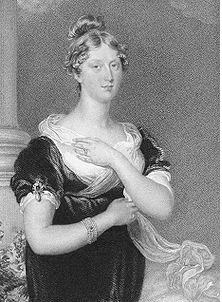
Princess Charlotte of Wales, during her pregnancy

Princess Charlotte of Wales, during her pregnancy

Lady Beauchamp [wrinkling her nose]: Of course. Well, we had met in passing at ton events when she was a child, although rarely with her mother, since her father wished to limit her exposure to her mother’s eccentricities. [Coughing delicately]. Blood will tell, however. Lady de Clifford, who had the charge of her at the time—only a baroness, you know—gave her far too much freedom. The girl had no sense of propriety—quite the hoyden as a child, but it was far worse when she reached adolescence.

Susana: Well, adolescence is a difficult time for everyone. I taught thirteen-year-olds for twenty-five years, you know. The best thing about it is that it eventually passes. I suppose the Princess showed the usual interest in the opposite sex?

Lady Beauchamp [shaking her head]: Oh, much worse than that, my dear Miss Ellis! If it wasn’t one of her cousins (illegitimate, you understand), it was William, Duke of Gloucester. They all took her fancy at one time or another. The rumors were rampant all over Town! Upon this proof that she took after her scandalous mother, the Prince Regent made arrangements for a marriage with William of Orange, hoping for an alliance with the Netherlands. It all came to nothing of course. Stubborn, stubborn girl! Not at all the sort of girl who ought to be a princess!

Susana: Do you know why she didn’t like the Prince of Orange?

Lady Beauchamp [curling her lip]: Indeed I do. She confided in me once—quite soon after she and Prince Leopold had settled at Claremont House—which is near Beauchamp’s estate in Surrey, you know—that he refused to promise to allow her mother to visit them after they were married because of her scandalous reputation, and after that, she steadfastly refused to have him. [Leaning closer to Susana] Of course, by then her mother had already fled to the Continent, and she never saw her again anyway.

Susana: How sad!

Lady Beauchamp [shrugging]: Was it? Many would say it was all for the best.

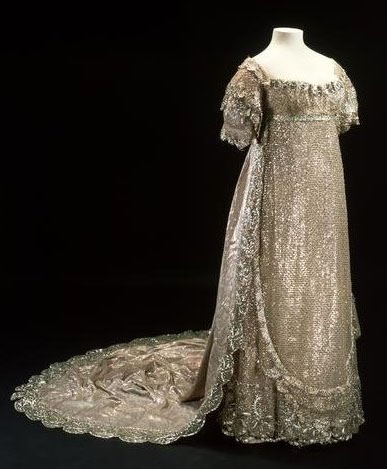
Princess Charlotte's silver lace wedding gown

Princess Charlotte’s silver lace wedding gown

Susana: So you socialized with the royal pair after their marriage. What can you tell us about them?

Lady Beauchamp: Quite a boring pair, really. Prince Leopold—who was quite impoverished, you understand, before he wed the heir to the throne of England—took rather too much of an interest in agriculture for my taste. Of course, he and Beauchamp used to tramp all over looking at crops, of all things. Her Royal Highness thought it was quaint.

Susana: But they got on well together?

Lady Beauchamp [reluctantly]: I suppose they must have. I never heard talk of rows between them, and her manner of dress became more sedate after her marriage. Indeed, Prince Leopold seemed to have a calming influence on her. We shared a box at the races once, and when Her Royal Highness began to show rather more enthusiasm than was proper, her husband caught her attention and said, “Doucement, chérie,” and she immediately smiled and regained her composure.

Susana [eyes filling with tears]: How sweet! What a shame their time together was so short! Were you around her during her pregnancy?

Lady Beauchamp: Her confinement, Miss Ellis. Do try to exercise a bit of restraint in your speech, even though you are American. [Sighing heavily]. Indeed I did see her a few times, although as her condition advanced, she was kept in seclusion. Considering all of the doctors who were consulted, one would have thought at least one would have been able to assist her safely through her trial. But no, she was allowed to eat until she reached elephantine proportions, and then they tried to starve her until she turned despondent. Why, Sir Richard Croft was not even a physician! My own husband would never have allowed a mere accoucheur near me when I was brought to bed. But it’s like my mother says, everything the Prince Regent touches ends in failure. Born under an unlucky star, she believes.

Susana: I understand Prince Leopold never recovered from the death of his wife and son.

Lady Beauchamp: Nor has England either. One would think the world has come to an end. The King has no legitimate grandchildren and his youngest son is over forty. The city closed down for two weeks and within a few days there was no black cloth to be had, as all of England was in mourning. Beauchamp said there wasn’t a dry eye to be seen during the funeral, when she was laid to rest with her son at her feet in St. George’s Chapel at Windsor Castle. To be sure, I can’t imagine what will happen to the succession now. I suppose all of the royal princes will run out and marry and try to sire an heir as quickly as possible. [Pursing her lips] Well, all I can say is they’d be well advised to do it soon, because the King’s health deteriorates as we speak, and the Regent isn’t much better. [Sliding her chair closer to Susana] My dear Miss Ellis, it occurs to me that you must be in possession of—shall we say?—interesting information about what happened with the succession. Perhaps you would be kind enough to indulge my curiosity?

Susana [glancing at her watch]: Oh dear, look at the time! If you do not return immediately, Lady Beauchamp, I fear you will be late for Lady Pritchard’s Venetian Breakfast. Do accept my sincere thanks for condescending to speak with me this morning!

Lady Beauchamp [with narrowed eyes]: As it happens, you are correct, Miss Ellis. I really must take my leave of you. However, you can be sure that I shall seek out Lady Pendleton as soon as may be to discover what she knows. [She waves her arms and disappears.]

Susana [gripping the arms of her chair]: I do wonder how this time travel thing is managed. Lady P has mentioned something about an old lady who runs the apothecary shop on Dapple Street, but she has so far declined to go into detail. [Frowning] When she does return, we are going to have a long chat about a few things I discovered after she left. For one thing, my digital camera is missing…after she went on a photography binge taking pictures of everything, even the engine of the car. And then there is a little matter of charges on my credit card for $800 at Toys R Us and more than $300 at the Battery Warehouse. Did she hear nothing I told her about the Prime Directive?

Lady P will be back soon. As always, please do comment if you have any questions you’d like to ask Lady P about the late Georgian/Regency era. She does love to chat!

The Lady P Series

Episode #1: Susana’s Adventures With Lady P: The Introduction

Episode #2: Lady P Talks About… Pride and Prejudice?

Episode #3: Lady P and the Duchess Who Lost a Billion Dollars

Episode #4: Lady P and the Face On the $100 Bill

Episode #5: In Which Lady P Discovers Sparkly Fabrics and Ponders Violating the Prime Directive

Episode #6: Lady P Dishes the Dirt on the Duchess of Devonshire

Episode #7: The Political Exploits of Lady P and the Duchess of Devonshire

Episode #8: Lady P and the Prince Regent’s Illicit Marriage

Episode #9: In Which Lady P Depletes the Cooking Sherry During Her Discussion of Caroline of Brunswick

Episode #10: Lord Byron: Mad, Bad, and Dangerous to Know

Episode #11: In Which Lady P Talks About Hannah More and the Rights of Women

Episode #12: Lady P’s Revelations Regarding George III and His Peculiar Progeny

Episode #13: Lady P Discusses the Luddite Uprising, the Assassination of Spencer Perceval, and the General Unfairness of Life

Episode #14: In Which Leticia, Lady Beauchamp, Pops In For an Interview On Her Personal Acquaintance With Princess Charlotte of Wales

Episode #15: Lady P On Assignment in 1814 Kent

Lady P Quizzes Jane Livingston, the Hero’s Sister From “A Twelfth Night Tale”

Episode #13: Lady P Discusses the Luddite Uprising, the Assassination of Spencer Perceval, and the General Unfairness of Life

Lady Pendleton, Damian Ashby’s eccentric aunt (see the epilogue to Treasuring Theresa on Susana’s web site), is visiting Susana from the early 19th century. She’s intrigued by life in 21st century Toledo, Ohio, and, of course, Susana is thrilled to have the opportunity to pick her brain about life in Regency England. It certainly gives her a great deal to write about in Susana’s Parlour!

Susana: Lady P and I recently returned to Ohio after spending a month in Florida where she enjoyed taking daily “constitutionals” around the retirement village where my parents live, and eventually condescended to take a dip in the heated pool, although the bathing costume she rigged for herself raised more than a few eyebrows from the other swimmers.

Lady P [indignantly]: My dear Susana, I could not possibly have appeared in public in those-those underthings you and your mother wore. I should have been utterly humiliated!

Susana: They are called swimsuits, Lady P. Bathing costumes. And that’s what everyone else wore.

Lady P [with a hand to her head]: The gentlemen—such as they were—were much worse. I thought I would swoon when I saw those naked chests!

Susana [chuckling]: But surely you have seen a bare-chested man before, Lady P. Why, you and Lord P were married for nearly twenty years, were you not?

Lady P: Well, of course I did, but not in public, Susana. Why, my Pendleton was exceedingly conscious of propriety. He would never have appeared in public half-dressed; why his valet would have slit his own throat before allowing it!

Susana [biting her lips to keep from laughing at the thought of the suicidal valet]: These gentlemen are from the 21st century, Lady P. Frankly, what these men wore was quite modest compared to some of the younger gentlemen. Don’t you remember that day when we went to the beach and saw—

Lady P [shuddering]: Do not even remind me, Susana. The young women’s attire…why they were nearly as naked as the day they were born! Where is their sense of modesty?

Susana [making a mental note to avoid beaches and pools in the future]: Perhaps we should get back to today’s topic—the Luddite revolt in 1811-12. Can you tell my readers what you recall of that uncertain time?

Lady P: Indeed I can, although one could wish to forget it.

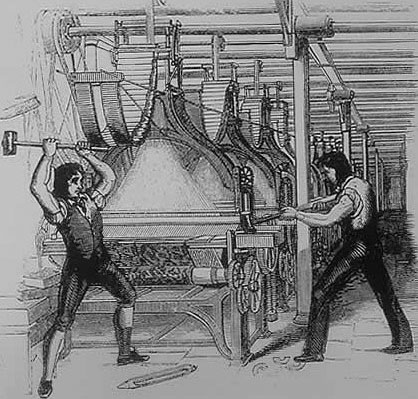
ludditesSusana: It started in the Midlands with the stocking industry, when stockingers, using looms and equipment leased from their employers in their homes, lost more than half their income when they were forced to produce cheap stockings that their employers could sell in larger quantities and increase their profits. Is that correct?

Lady P: How could I forget? Those stockings fell apart after barely a week of wear, and even the servants disdained them!

Susana: That was the same year the harvest failed, and food prices rose to an alarming level, and more and more people were suffering in economic distress.

Lady P: A shilling for a loaf of bread! It was outrageous!

Susana: People became desperate, and before long, gangs of disguised men started going around destroying the frames and looms used to produce the stockings to protest the treatment of the workers and the poverty more and more of them were forced to endure.

Lady P: That may be how it started, Susana, but it escalated into so much more than that. Why, many of us feared an uprising against the monarchy comparable to the French Terror of barely two decades past. And there wasn’t much to be done about it; Pendleton told me that fully half of the militia had taken up the cudgel for General Ludd in stealth and would turn against their officers in a trice if ordered to put down the revolutionaries.

Susana: I’m curious to know what Lord P thought should be done about it. He was a Tory, and the Tories were in power. Did he approve the decision to make frame-breaking a capital offense?

Lady P [shaking her head and sighing]: No, of course he did not. He thought it was incredibly stupid to think that masses of starving insurgents could be deterred by fear of the gibbet if they were caught. [Swallowing hard] He was, in fact, quite moved by Lord Byron’s speech in the House of Lords, where he decried the Tories’ attempt to solve the problem by force. He insisted—quite eloquently, Lord P admitted—that the Midland workers were being exploited to increase the profits of a few hosiers, and that the resulting misery benefitted no one.

Susana [thoughtfully]: The more things change, the more they stay the same. [Seeing Lady P’s raised eyebrow]: I was just thinking of how the Ohio House of Representatives just voted to eliminate the forty-hour work week so that employers won’t have to pay overtime—pay them double—for working more than that.

Lady P: As to that, I can’t say, Susana. But that is one reason I became a Whig. I would never go so far as to overturn the entire government and plunge the country into turmoil and terror such as what happened in France, but I have always believed that certain reforms to prevent the poor from being exploited could be instituted without much upheaval, and that the entire country would be the better for it. [Sighing] Dear Pendleton felt the same, but he was unable to persuade his colleagues to listen to reason. As afraid as they were of a revolution, the only solution the Tories could agree on was to threaten the insurgents.

Susana: It wasn’t long after that the Tories fell out of power, didn’t they? After the assassination of the Prime Minister?

Lady P: Indeed, and it was well-deserved too. Not because the Whigs’ ideas were much better, although they certainly used the Tories’ imprudence to their advantage. The Prince Regent’s intemperate behavior and his treatment of his wife made him vastly unpopular, so the Whigs took up the cudgel for Princess Caroline, proclaiming that she was being badly treated, and causing more riots, spreading to the north.

percevalSusana: And didn’t the people actually cheer the assassin as he was led to his execution a week later? There was that much dissatisfaction with the government that they cheered the murderer of the Prime Minister?

Lady P [tight-lipped]: Poor Lord Perceval. He was a good man. Had twelve children, you know. A family man. He could have gone far, if it weren’t for that Bellingham fellow shooting him in the House of Commons. Do you know the government wouldn’t even give him a public funeral because they were fearful of riots? I hardly knew what to say to his wife Jane when I saw her after that.

Susana [sighing]: Some things seem so unfair, don’t they? Like my friend whose daughter just died of breast cancer at age thirty-seven. Or many of my friends whose husbands lost their jobs and couldn’t find anything comparable afterward because of their age and the cost of health insurance. What do you say? How do you help them?

Lady P [clucking]: I suppose there will always be misery and injustice, no matter how diligently we try to eliminate it.

Susana: But that doesn’t mean we should stop trying.

Lady P [smiling]: Exactly. Now, Susana, don’t you think something should be done about all the weeds in the back garden? Since the weather turned warmer, they seem to be popping up all over the place.

Susana [leaving the room]: Have at ’em, Lady P. There’s a hoe in the shed and some work gloves in the drawer over there.

Lady P [frowning]: And where might you be going, then?

Susana [from the office]: I have a Christmas story to write. Deadline, you know. Can’t be bothered with weeds for awhile.

Lady P makes a beeline for the back door, audibly grumbling about “misplaced priorities,” “writing Christmas stories in May,” and that she “really should go back to the 19th century where there were gardeners to do such onerous tasks.”

As always, please do comment if you have any questions you’d like to ask Lady P about the late Georgian/Regency era. She does love to chat!

The Lady P Series

Episode #1: Susana’s Adventures With Lady P: The Introduction

Episode #2: Lady P Talks About… Pride and Prejudice?

Episode #3: Lady P and the Duchess Who Lost a Billion Dollars

Episode #4: Lady P and the Face On the $100 Bill

Episode #5: In Which Lady P Discovers Sparkly Fabrics and Ponders Violating the Prime Directive

Episode #6: Lady P Dishes the Dirt on the Duchess of Devonshire

Episode #7: The Political Exploits of Lady P and the Duchess of Devonshire

Episode #8: Lady P and the Prince Regent’s Illicit Marriage

Episode #9: In Which Lady P Depletes the Cooking Sherry During Her Discussion of Caroline of Brunswick

Episode #10: Lord Byron: Mad, Bad, and Dangerous to Know

Episode #11: In Which Lady P Talks About Hannah More and the Rights of Women

Episode #12: Lady P’s Revelations Regarding George III and His Peculiar Progeny

Episode #13: Lady P Discusses the Luddite Uprising, the Assassination of Spencer Perceval, and the General Unfairness of Life

Episode #14: In Which Leticia, Lady Beauchamp, Pops In For an Interview On Her Personal Acquaintance With Princess Charlotte of Wales

Episode #15: Lady P On Assignment in 1814 Kent

Lady P Quizzes Jane Livingston, the Hero’s Sister From “A Twelfth Night Tale”

Episode #12: Lady P’s Revelations Regarding George III and His Peculiar Progeny

Lady Pendleton, Damian Ashby’s eccentric aunt (see the epilogue to Treasuring Theresa on Susana’s web site), is visiting Susana from the early 19th century. She’s intrigued by life in 21st century Toledo, Ohio, and, of course, Susana is thrilled to have the opportunity to pick her brain about life in Regency England. It certainly gives her a great deal to write about in Susana’s Parlour!

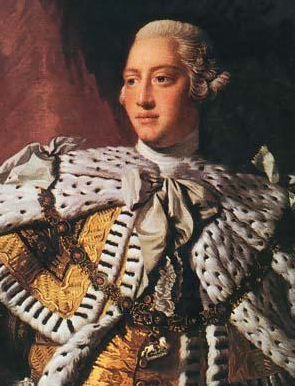
georgeiiiSusana: [to the Reader]: Lady Pendleton’s opinions on George III tend to be diametrically opposed to mine, which she attributes to my “ignorance due to indoctrination by history books written by misguided wretches attempting to justify the dreadful bloodbath caused by the radical colonists.”

It seems doubtful that we will ever come to agreement on that score—too many years of July 4th picnics and fireworks and, pledging allegiance to the flag, and singing “The Star-Spangled Banner”—but I have begun to see George III in a more sympathetic light. More than 200 years have passed and since my trip to England last year, I have come to realize that the English do not see him as the tyrant “we” do (and I say “we” even though at least some of my ancestors still lived in England during that time), and most never did.

And I have to say—in spite of all the patriotism instilled in me over decades—I am intrigued with the idea of growing up speaking with a British accent. (Can I be deported for saying that?)

Lady P: You must admit that the American accent sounds decidedly low class, Susana. Perhaps I could give you lessons in enunciating. Much like that Henry Higgins did to Eliza in that film we saw the other evening. You would never pass for upper class in society, of course, but it would be a definite improvement.

Susana: I thank you for offering, Lady P, but I’ll stick with the lazy American drawl for now. Perhaps some other time.

Lady P: Very well. Shall we discuss His Royal Highness King George III for your readers? Where shall I start?

Susana: At the beginning would be best. Where did you meet him?

Lady P: I was too young to attend his wedding to Queen Charlotte, but I do recall my mother bringing home a flower—was it a camellia or a rose?—but it was pink and she put it in one of the heaviest books in the library for pressing. I remember feeling very sad that she had to destroy such a pretty posy in order to preserve it. I wonder what happened to it? I believe my brother Henry inherited all the books in the library, so perhaps it’s still there. He was never one to read or study overmuch.

Susana: But you did meet him at some point?

Lady P: Goodness, yes. During my come-out—my mother was so vexed that the Royal Pair failed to attend my presentation ball—I was presented to Queen Charlotte, as were all of the young debutantes, you know, and I did meet them once or twice that season. After I was married to Lord Pendleton, we met more often. Lord P was in the House of Lords, you know, and we were obliged to attend certain political events.

Susana: What did you think of him?

Lady P: He was a kindly old man, quite stodgy, you understand. As a young girl, I didn’t appreciate that quality in him. One expected the King to be a cut above the rest of society, and he wasn’t at all. I recall complaining to Pendleton about the plainness of the fare at Windsor Castle and why the King could not have a French chef as skilled as ours, and he said the King didn’t appreciate rich food anymore than he did the French. Good, hearty English fare was good enough, he said.

Susana: I hear his marriage was a love-match.

Lady P [snorting in a very unladylike manner]: Romance again, Susana? Americans seem obsessed with it. The King met his betrothed on the day of the wedding. He wasn’t allowed to marry Lady Sarah Lennox when he wished to because she was only the sister of a duke. Royalty must marry royalty, you know. Or at least they did in my time.

Susana: But they did have fifteen children, so the marriage must have been somewhat of a success.

Lady P: Oh indeed, they got on well after that. Queen Charlotte was not well-favored, but she had a very pleasant disposition. She was a perfect wife for a down-to-earth man like the King.

Susana: So what happened to their children? The sons, at least, did not seem to be able to sustain such happy marriages. Look at the Prince Regent, for example. His life was like the antithesis of his father’s.

Lady P: Indeed. The King disliked his oldest son intensely. Frederick was his favorite. Pendleton told me the King often bemoaned the fact that Frederick was not his oldest son. Brought up to be a military man. He was the Commander-in-Chief of the Army, you know, until the scandal.

Susana: The scandal?

Lady P: Apparently he passed on military secrets to his mistress, a sly little hussy by the name of Mary Anne Clarke. She took bribes in exchange for promotions, and although she was the one to blame, it was his indiscretion in telling her such things that caused him to resign in disgrace. [shaking her head sadly] Should have stuck by his long-suffering wife. Frederica was a most amiable woman.

Susana: So even his favorite had feet of clay. What about the others? Wasn’t one of them accused of murder?

Lady P: Ernest, that was. He was an odd sort. Spread all sorts of cruel rumors about his brothers. His valet turned up with his throat cut, and it was whispered that he’d been seduced by his master, who murdered him when the man attempted to blackmail him.

Susana: Oh my. Homosexuals were hung in those days, were they not?

Lady P: Indeed they were. It would have been a massive scandal had that little fact become known. Which is no doubt why the inquest determined that the man committed suicide.

Susana [shuddering]: Who commits suicide by cutting their throat?

Lady P: Exactly. Not to mention that the man was left-handed, and the deed had to have been done with his right hand. [sighing] But I suppose such things must be done to protect the monarchy and the nation.

Susana: Surely among fifteen children there must have been at least one or two who turned out well. What about the daughters?

Lady P: Poor Amelia died in 1810. She was 27 and unmarried, since she had not been allowed to marry the man of her choice, Charles Fitzroy. She was the youngest and the King’s favorite and he was never the same after that. The other girls—well, the oldest, Princess Charlotte was married to the King of Württemburg—remained unmarried and living at home, and dear me, they never dissembled about expressing how they felt about that. Well, they were all rather plain, like their mother, and ran to fat, but they did adore their father, no matter how unstable he become as the years passed.

Susana: The Prince of Wales was made Regent because of his illness, which has been called dementia. Did you ever see him in that state, or know someone who did?

Lady P: I did not, of course, since he was kept in seclusion as soon as he began to exhibit symptoms. But Pendleton did, on one occasion, when he was attending the King on parliamentary business. [clucking her tongue]. He began speaking in shrill tones, so quickly that he could not be easily understood, calling for “the woman he loved,” a certain Lady Pembroke who served at court. His eyes bulged and he dropped his breeches to reveal his backside. Pendleton was horrified when I nearly fell over laughing when he described it. He said it was a horrifying experience.

Susana: The King of England mooned your husband? Heavens, what a sight that must have been! [grinning broadly]

Lady P: Harrumph! It was, rather. And yet I did feel very sorry for him. He was a fine king and deserved much better than to be afflicted by such an undignified malady. And then to have his sons to be such bounders, and one of his daughters to bear an illegitimate child… It is almost a blessing that such distressing news was kept from him.

Susana [sighing]: My belief in fairytale royal marriages died a tragic death after what happened with Princess Diana. Although I can’t help hoping that Prince William and Kate will end up happily.

Lady P: They do seem a sensible pair, and very well-matched, like my nephew Damian and his wife Theresa. Have I told you Theresa is expecting again?

mi_hacienda_edited-1Susana: You’ve mentioned it a few times. What do you think about Subway for dinner?

Lady P: What was that Spanish place we went to last week? I rather fancy one of those—what do you call them—burros?

Susana: Burritos, Lady P. And it was Mexican, not Spanish. Mi Hacienda, on Glanzman Street. They offer salsa lessons on Wednesday nights. What do you say we paint the town while we’re at it.

Lady P: A burrito will do, Susana. And perhaps some of those savory chips. Never had anything like them before. Do you suppose I can take the recipe back with me for my own cook to prepare?

Susana [shaking her head]: Sorry, Lady P. We’ve had this discussion before. Remember the Prime Directive?

As always, please do comment if you have any questions you’d like to ask Lady P about the late Georgian/Regency era. She does love to chat!

The Lady P Series

Episode #1: Susana’s Adventures With Lady P: The Introduction

Episode #2: Lady P Talks About… Pride and Prejudice?

Episode #3: Lady P and the Duchess Who Lost a Billion Dollars

Episode #4: Lady P and the Face On the $100 Bill

Episode #5: In Which Lady P Discovers Sparkly Fabrics and Ponders Violating the Prime Directive

Episode #6: Lady P Dishes the Dirt on the Duchess of Devonshire

Episode #7: The Political Exploits of Lady P and the Duchess of Devonshire

Episode #8: Lady P and the Prince Regent’s Illicit Marriage

Episode #9: In Which Lady P Depletes the Cooking Sherry During Her Discussion of Caroline of Brunswick

Episode #10: Lord Byron: Mad, Bad, and Dangerous to Know

Episode #11: In Which Lady P Talks About Hannah More and the Rights of Women

Episode #12: Lady P’s Revelations Regarding George III and His Peculiar Progeny

Episode #13: Lady P Discusses the Luddite Uprising, the Assassination of Spencer Perceval, and the General Unfairness of Life

Episode #14: In Which Leticia, Lady Beauchamp, Pops In For an Interview On Her Personal Acquaintance With Princess Charlotte of Wales

Episode #15: Lady P On Assignment in 1814 Kent

Lady P Quizzes Jane Livingston, the Hero’s Sister From “A Twelfth Night Tale”

Spotlight On Regency Personage Hannah More

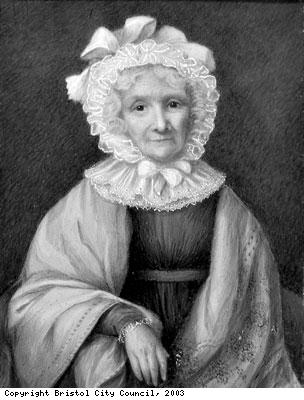
220px-HannahMoreMonday’s Lady P episode mentioned Hannah More as having a significant influence on the changing attitudes toward women in the late Georgian/Regency era. Regency readers will recognize the name as being the author of books that many well-meaning Regency mothers assigned their daughters to read while said daughters preferred to indulge themselves with Mrs. Radcliffe’s novels.

Hannah More grew up in a very religious family. Her father taught in a free school and later opened a girls’ school managed by his daughters while he himself managed a boys’ school. Hannah started writing at a young age, beginning with pastoral plays for the young girls at the school to act out, and eventually moving on to London, where her play Percy was a great success at Covent Garden. For several years she enjoyed the social circle of a well-known group of bluestockings (a pejorative term referring to a female intellectual). Her second play, however, was not a success, and after a falling-out with a poet friend, Hannah withdrew from London’s intellectual circles and began to focus on religious and philanthropic works.

As the Regency period advanced and the older generation of politically-active ladies died or became infirm, fewer women involved themselves directly in politics. In 1815 Hannah More wrote a study on St. Paul’s description of the female character, which instructed women to dress themselves modestly and atone for their spiritual weakness by keeping silent and learning from the men. By daring to publish her writing, Hannah was herself breaking these rules, for which she apologized in all of her works.

  • Thoughts on the Importance of the Manners of the Great to General Society (1788)
  • An Estimate of the Religion of the Fashionable World (1790)
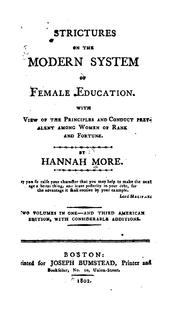
  • Strictures on the Modern System of Female Education (1799)
  • Hints toward Forming the Character of a Young Princess (1805)
  • Coelebs in Search of a Wife (1809)
  • Practical Piety (1811)
  • Christian Morals (1813)
  • Character of St. Paul (1815)
  • Moral Sketches (1819)

stricturesIn spite of the daunting titles, Hannah’s work outsold all of the authors of the aforementioned novels, and she became a force to be reckoned with, responsible for the sudden popularity of “religion of the heart” and countless conversions to the Evangelical faith.

Women could, of course, become involved in charity work to benefit the poor, and Hannah and her sisters threw themselves into establishing a series of schools in rural areas. The schools taught reading, the Bible, and catechism, as well as sewing and knitting, but not writing, as that was thought to give the poor too much power. Even then, they ran into opposition from the farmers, who feared that too much education would prove the end of agriculture, and from the clergy, who claimed that she was teaching Methodism, a religious movement of the lower classes that was considered dangerous by the established churches.

Along with William Wilberforce, she became a major force in the fight to abolish the slave trade, publishing a poem called Slavery in 1788.

The Pendulum Swings the Other Way

Through her writings and philanthropic work, Hannah More wielded a huge influence on English society, urging people to seek God in their hearts through Bible reading, to live their lives in an orderly and circumspect manner, and to help the poor escape their misery.

For the most part, though, her strictures did not address the moral depravity of the upper classes, where debauchery and excesses continued to rule the behavior of the Prince Regent and his brothers on down. The Evangelical movement did not address the inequalities in English society, but took the position that if God chose someone to be rich or poor, there must be a good reason for it, and the best thing to be done was to be content with one’s circumstances and look toward treasures in heaven. Wilberforce, for all of his efforts to help the poor in Africa, condemned as immoral the formation of unions against unfair employers in England. Easy to say for a man who inherited wealth and married more of it.

Another problem with the Evangelical movement that Hannah More was a part of was when the fight against “worldliness” went to extremes. Just about anything pleasurable was considered “worldly,” including dancing, card playing, and taking country walks on Sundays. By the time Thomas Bowdler had begun altering Shakespeare’s works to make them acceptable for reading in mixed company, the puritanical excesses of the Evangelicals were making them a laughingstock.

In Episode #11, Lady P decries the extremism in English morality. Hannah More’s popularity is proof that her “religion of the heart” was a timely one that many were eager to hear. Taken to extremes, as it was by Wilberforce and other Evangelicals, however, that message becomes lost in a sea of strictures and censorship that incites ridicule and rebellion.

Thanks go to:

Our Tempestuous Day by Carolly Erickson, 1986.

Episode #11: In Which Lady P Talks About Hannah More and the Rights of Women

Lady Pendleton, Damian Ashby’s eccentric aunt (see the epilogue to Treasuring Theresa on Susana’s web site), is visiting Susana from the early 19th century. She’s intrigued by life in 21st century Toledo, Ohio, and, of course, Susana is thrilled to have the opportunity to pick her brain about life in Regency England. It certainly gives her a great deal to write about in Susana’s Parlour!

Susana: [to the Reader]:

The other day, Lady P and I got to talking about the position of women in the Regency period and how it evolved from the late 18th century when women such as Georgiana Cavendish held political salons and marched in support of political candidates to a time when women were to be saintly and devout and “protected” from the seamier side of life, leaving the important decisions to their sturdier husbands.

Miss_Hannah_More-304x400Lady P: ‘Twas Hannah More and the Evangelicals that popularized it. Women were to be seen and not heard, at the same time obedient to their husbands and revered by them. [Snorting in an unladylike manner] Pendleton and I laughed about it on many an occasion. I’ve never been the obedient sort, and Lord P would not have wed me if I were. Nor did I wish to be worshiped either. The very idea!

Susana: No doubt it was a reaction against the excesses of the previous generation. The Devonshire ménage-à-trois, for example. The Prince Regent and his illicit marriage, as well as all of his mistresses and excessive spending. The scandalous behavior of Lady Caroline Lamb.

Lady P [Frowning]: There were excesses, of course, which did lead to the pendulum swinging in the other direction. But such extreme changes more often than not led to equally harmful excesses on the other side.

Susana: Indeed. I can certainly see that is true in the 21st century. But do explain what you mean, Lady P. What were the harmful excesses caused by the Evangelical movement?

Lady P: A popular interpretation of the wife-as-saintly approach was that the husband was allowed and even expected to be a sinner.

Susana: Which gave him the freedom to take mistresses and carouse as often as he liked, while his “sainted wife” stayed home and raised the children.

caroline_lambLady P: Well, yes, but it was rather more than that. As unrealistic and unfair as it was to the women, I believe it was equally unfair to the men. Lord Byron, for example. Why would such a dissolute young man choose to marry a staid bluestocking like Annabella Milbanke?

Susana: Because she was an heiress and he was close to bankruptcy?

Lady P: Then why would she agree to marry him? She had turned him down flat in the past, having recognized that he was a loose screw.

Susana: Because opposites attract? Because she thought she could reform him?

Lady P: Exactly! She was quite forthcoming about it, actually, and Lord Byron seemed to agree that she would be a good influence on him, at least at first. But as the wedding drew near, he began to have doubts, complaining to his bosom bows that he feared the medicine would be far more disagreeable than the disease itself.

Susana: It can be tiresome to be preached at all the time. In a true partnership, both partners accept each other, flaws and all.

Lady P: Precisely. In this case, Annabella overestimated her own influence and underestimated the extent of her husband’s vices. She did not know of his immoral relationship with his half-sister Augusta until after the marriage, for example, and like most women who incessantly nag their husbands, she came to be regarded by her husband as a nuisance.

Susana: But as you say, Byron was a bit of a loose screw. Would it have worked between them, do you think, if he’d been on some sort of medication?

Lady P [with a loud harrumph]: Your society seems to be of the opinion that all can be cured with a tiny pill, Susana, but I’m not so sure. We had quacks touting medicines in our day too. Why, the stories I could tell you about laudanum…!

Susana: But getting back to the issue of women’s rights, what did you think of people like Hannah More, Lady P? Was she a good influence or a bad one? She did influence people to care for the poor, did she not?

Lady P: Hannah More and those around her were neither good nor bad, Susana. The mistake, in my opinion, is to paint everything in life broadly as either white or black. Hannah More did a great deal to awaken society to the plight of the poor and stir up support on their behalf, that is true. But I believe that she did a disservice to both women and men in promoting the role of women as subservient to men.

Susana: But women were still legally the chattel of men, were they not? And they were not given the right to vote for another hundred years.

Lady P [somewhat impatiently]: Legally, yes, that is true. But my dear Susana, you must not assume that every marriage was built on such an unequal basis. Discerning women always knew how to manage their husbands, so long as they took care to marry a husband who could be managed, that is. I daresay even the redoubtable Hannah herself could not have managed such a bedlamite as Lord Byron.

Susana: But you said yourself that you never told Lord Pendleton about your Whig activities with the Duchess of Devonshire.

Lady P: Indeed not. It was for his own protection. His family would have been scandalized.

Susana [shaking her head]: Sometimes your logic escapes me, Lady P.

Lady P: I’m not saying that my own marriage was ideal, or that most marriages were not unequal in my day, Susana. There was just as much hypocrisy in society then as there is in your century. Why Hannah herself apologized in her books for having the temerity to write them at all, being a mere woman as she was. My point is that one must consider one’s options and make the wisest choices possible in whatever circumstances one finds oneself. I may have decided to become a Whig, but I wasn’t foolish enough to believe they should have unilateral power. No indeed. Some of their official policies were ridiculous in the extreme, and I was glad there were rational voices on the other side to temper their excesses.

Susana: In that respect, I certainly agree with you, Lady P. I find I cannot blindly accept any philosophy or ideology without considering each facet of it on its own merits. But I find it extremely frustrating that there are so many who do, as though they haven’t a brain to think for themselves.

Lady P [dryly]: So I’ve noticed that about you. But Susana, it does appear that you are missing the point. People are who they are, and there’s not a lot you can do to change them. My counsel in such cases has always been to do what you can and let the rest be, else you work yourself into a state fit for Bedlam.

Susana: [shaking her head]. You remind me so much of Dr. Ellis, author of How To Stubbornly Refuse To Make Yourself Miserable About Anything, Yes Anything.

Lady P: What a singular title for a book! The logic seems sound, however. Why, many was the time when Lord P left me alone to go to his club that I could have spent the night fuming, but I decided instead to use that time to follow my own interests.

Susana: Such as attend the Whig salons at Devonshire house?

Lady P: Yes, and attend balls and musicals that Lord P did not enjoy. It wasn’t fashionable to live in one another’s pockets, in any case. We muddled along well enough, I do believe. How I do miss the dear man! [Sigh]

As always, please do comment if you have any questions you’d like to ask Lady P about the late Georgian/Regency era. She does love to chat!

The Lady P Series

Episode #1: Susana’s Adventures With Lady P: The Introduction

Episode #2: Lady P Talks About… Pride and Prejudice?

Episode #3: Lady P and the Duchess Who Lost a Billion Dollars

Episode #4: Lady P and the Face On the $100 Bill

Episode #5: In Which Lady P Discovers Sparkly Fabrics and Ponders Violating the Prime Directive

Episode #6: Lady P Dishes the Dirt on the Duchess of Devonshire

Episode #7: The Political Exploits of Lady P and the Duchess of Devonshire

Episode #8: Lady P and the Prince Regent’s Illicit Marriage

Episode #9: In Which Lady P Depletes the Cooking Sherry During Her Discussion of Caroline of Brunswick

Episode #10: Lord Byron: Mad, Bad, and Dangerous to Know

Episode #11: In Which Lady P Talks About Hannah More and the Rights of Women

Episode #12: Lady P’s Revelations Regarding George III and His Peculiar Progeny

Episode #13: Lady P Discusses the Luddite Uprising, the Assassination of Spencer Perceval, and the General Unfairness of Life

Episode #14: In Which Leticia, Lady Beauchamp, Pops In For an Interview On Her Personal Acquaintance With Princess Charlotte of Wales

Episode #15: Lady P On Assignment in 1814 Kent

Lady P Quizzes Jane Livingston, the Hero’s Sister From “A Twelfth Night Tale”

Episode #10: Lord Byron: Mad, Bad, and Dangerous to Know

Lady Pendleton, Damian Ashby’s eccentric aunt (see the epilogue to Treasuring Theresa on Susana’s web site), is visiting Susana from the early 19th century. She’s intrigued by life in 21st century Toledo, Ohio, and, of course, Susana is thrilled to have the opportunity to pick her brain about life in Regency England. It certainly gives her a great deal to write about in Susana’s Parlour!

Susana: [to the Reader]:

Lady P and I just finished watching the 2007 BBC movie about Lord Byron, and I thought you might find some of her reminiscences of the original characters as intriguing as I did. [Turning to Lady P] You knew the real Lord Byron, did you not, Lady P? What was your impression of him?

byronLady P:

Oh yes, I was acquainted with the man, as was anyone who was anyone in the ton during the spring of 1812 when he came onto the scene. I could never understand why women were making cakes of themselves over him. He wasn’t all that well-favored, you know, not nearly as attractive as that actor who played him in the film. Although he did have a certain magnetism, I suppose, when he looked at a woman with “the stare,” that is, with hooded eyes. I’m not at all sure what he was conveying with that most peculiar stare, but whatever it was had the effect of making formerly sensible women abandon all pretense of prudence in order to attract his attention.

Susana:

Undoubtedly Lady Caroline Lamb was one of them.

Lady P:

She was the worst of them, but then, she was always somewhat of a loose screw, Susana. Even when she was small—she was eight years old when her mother, Georgiana’s sister, moved the family into Devonshire House to escape her father’s abuse—Georgiana used to tell me about her flights of fancy and frequent mood swings, and when she married George Lamb and moved into Melbourne House, we all hoped that her husband and Lady Melbourne, his mother, a prominent Whig hostess you know, would prove to be steadying influences on her.

Susana:

It didn’t work out that way, though, did it?

Lady P [shaking her head]:

Not at all. You know, Susana, it is never a good idea for a newlywed to move in with her husband’s family. Or the other way round, I’m sure. In this case, Caroline clashed constantly with Lady Melbourne, and it only got worse when Caroline and Byron were so foolish as to allow their affair to become public. Harriet—Lady Bessborough, Caroline’s mother, you know—tried to rein her in, especially after Lord Byron tried to break things off with her, but Caroline was so far gone from reality that she listened to no one. She foisted herself on his friends and begged them to help her win him back. She threatened to harm herself. She neither ate nor slept and was quite wraith-like when her mother and husband finally persuaded her to go to Ireland with them. But even that wasn’t the end of it. Poor Caroline raved over him until the day she died, alternately loving and hating him.

carolinelamb

Susana:

I suppose today she’d be diagnosed bipolar and given medication to help her cope with her illness.

Lady P [frowning]:

Bipolar?

Susana:

Mood swings. You know, when someone is rapturously happy and believes everything is right with the world and doesn’t care if everyone knows it, and then later falls into a serious depression. I’m no psychiatrist, of course, but it does sound to me like she suffered from such an affliction.

Lady P:

Well, she did suffer from some sort of affliction, that much is obvious. And I shouldn’t wonder if Lord Byron didn’t suffer from something similar. He too, was something of a loose screw. Although I can’t really say what he was like as a child. I did hear that his father was something of a tyrant, like Caroline’s.

Susana:

What an interesting thought! But did he exhibit an equal passion for her, at least while their affair was still going full-swing?

Lady P [with a decidedly unladylike snort]:

Oh yes, indeed. Of course, when he first came onto the social scene, he was a Nobody and she the reigning Beauty. No doubt he was flattered when she took an interest in him. They were both poets, you know, possessed of mercurial artistic temperaments. At first, her mad, childlike bravado attracted him, but when Lady Melbourne got her clutches into him and convinced him that Caroline’s antics could make him persona non grata in society, he began to cool toward her.

Susana:

Lady Melbourne? Caroline’s mother-in-law? Why would Lord Byron pay attention to anything she said about Caroline?

Lady P:

My dear Susana, Lady Melbourne was one of the premier Whig hostesses, exceedingly attractive for her age, and it was whispered about that Lord Byron was infatuated with her. Yes, even though she was more than thirty years his senior. It does happen, you know. She had many affairs with prominent men, including the Prince Regent, and her son George bears an uncanny resemblance to him too.

Susana:

So why was she so critical of Caroline, then, if she indulged in adulterous affairs herself?

Lady P [somewhat impatiently]:

The difference between them, my dear Susana, is that Lady Melbourne’s lovers were carefully chosen to increase her influence in political circles. She was also careful to manage them with the utmost discretion. Caroline, well, she had no such scruples. She was the victim of her impulses. And to a lesser extent, Lord Byron was to his as well.

Susana:

I feel so sorry for her. But Lord Byron did not pine away for her, did he?

Lady P:

Not at all. He cut a wide swathe among the ladies of London. [Lowering her voice] It is said that he had an incestuous relationship with his half-sister Augusta, and that her daughter Elizabeth is his.

Susana:

Goodness! For a society so bent on propriety, there was certainly a great deal of scandalous goings-on!

Lady P [sighing]:

Oh yes indeed! It was keeping up appearances that was the important thing. So hypocritical. Why, I always thought it was beyond outrageous when Lady Swindon cast her maid into the streets for being with child when she herself was having an affair with the Duke of Kent. I do hope I was able to instill better principles into my own daughters while they were growing up.

Susana:

Lord Byron eventually married, did he not? I heard that his daughter Ada was the world’s first computer programmer.

Lady P:

Computer programmer? Well, I can’t speak to that, since I have no notion of what that is, except for that machine you use for your writing. But yes, he did marry Annabella Milbank, who was Lady Melbourne’s favorite niece and an heiress besides. And now that I think on it, I do recall that she was thought to be something of a bluestocking, so it is likely that she would have an intelligent daughter. Why, Annabella was better educated than most of the men of the ton; you’d have thought she’d have better sense than to marry a sad rattle like George Byron.

Susana:

Those mesmerizing, hooded stares of his, no doubt.

Lady P:

She probably thought she could reform him. She was quite a devout young lady, I believe. [Shaking her head] Such a shame. Why, I made sure my girls knew better than to attempt such a thing with their husbands. There are ways a woman can influence her husband’s opinions—I can certainly attest to that—but it is far better to choose a mate who doesn’t require a great deal of changing. Do remember that, Susana.

Susana [rolling her eyes]:

Of course, Lady P. [To the reader] That’s all for today. I hope you enjoyed Lady P’s reminiscences about the celebrated poet that Lady Caroline called “mad, bad, and dangerous to know.”

As always, please do comment if you have any questions you’d like to ask Lady P about the late Georgian/Regency era. She does love to chat!