Archives

A Word About the Status of Catholics in Regency England

Painting-of-a-martyr-on-the-rack_large

“Sorry, but King Henry says your religion, which until very recently was King Henry’s religion, as well as our religion, as it had been for 9 centuries, is alien and un-English”

It wasn’t until recently when I read Philippa Carr’s Miracle at St. Bruno’s that I began to feel the English people’s pain as they were forced from Catholicism to Protestantism to Catholicism again and then finally back to Protestantism at the whim Henry VIII and his offspring. The heroine’s devout Catholic father must either accept his sovereign’s “reforms”—devised solely for the purpose of enabling him to divorce his wife—or offer his head on the block. Following Henry VIII’s death, his eldest daughter—granddaughter to the originators of the Inquisition, Ferdinand and Isabella of Spain—demanded that everyone revert back to Catholicism or likewise suffer the severing of their heads. When Bloody Mary died and was replaced with her Protestant sister Elizabeth, Catholicism was abolished. No more of this religious switching back and forth, chopping off heads of devout people who happened to align themselves with the “wrong” religion.

Sir Thomas More (by Hans Holbein): refused to accept Henry VIII as Head of the Anglican Church, was convicted of treason and beheaded

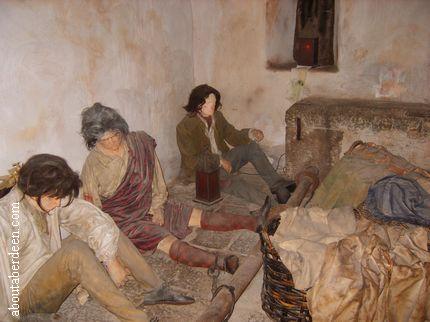
Unfortunately, that meant many years of religious persecution for the Catholics. Masses had to be said it secret. Priests had to be trained abroad, and if they were caught, it meant execution for them and those who harbored them. “Priest holes” or secret hiding places were constructed in homes harbor them in case of a search.

Persecution eased a bit when Charles II took the throne; he had a Catholic wife. By the 18th century there was much more social acceptance of Catholics—they were allowed to worship at the Embassies of Catholic nations in London, for example. In 1785, the Prince of Wales (later George IV) illegally married a divorced Catholic woman, Maria Fitzherbert (never officially acknowledged). Catholics were excluded from Parliament, magistristracies, military commissions, and universities, but most other fields were open to them. Catholic worship became legal in 1791, so Catholics no longer had to have masses performed secretly in their homes.

During the Regency, a Catholic could be an officer in the army or navy, but not hold a seat in Parliament. Catholic marriages had to be performed in an Anglican church with an Anglican minister in order to be valid, although a Catholic ceremony could be held afterward (doing it first could leave them open to fines). A mixed marriage with a Catholic wife was more easily accepted in Society than one with a Catholic husband. (Although, to be fair, the Catholics didn’t approve of mixed marriages either.) The Protestant husband had to take an oath abjuring the Pope, and generally, the children were to be brought up Protestant, although in some cases, the boys were Catholic and the girls Protestant.

Catholics could go about their business much the same way as Protestants, although there was still plenty of prejudice against them. Generally, most Protestant families steered their marriageable children away from Catholics, and vice versa.

In Lost and Found Lady, Catalina, born and bred in Spain, is a devout Catholic. Rupert has promised his father he will choose a “suitable wife,” so when sparks begin to fly between him and the lovely girl who saved his life, he has to keep his emotions in check because Catalina is in no way the sort of wife his father would accept. But as their relationship grows, Rupert finally realizes that his heart has already made the choice for him.

 waterloo_cover_best web

Our Stories

Jillian Chantal: Jeremiah’s Charge

Emmaline Rothesay has her eye on Jeremiah Denby as a potential suitor. When Captain Denby experiences a life-altering incident during the course of events surrounding the Battle of Waterloo, it throws a damper on Emmaline’s plans.

Téa Cooper: The Caper Merchant

The moon in Gemini is a fertile field of dreams, ideas and adventure and Pandora Wellingham is more than ready to spread her wings. When Monsieur Cagneaux, caper merchant to the rich and famous, introduces her to the handsome dragoon she believes her stars have aligned.

Susana Ellis: Lost and Found Lady

Catalina and Rupert fell in love in Spain in the aftermath of a battle, only to be separated by circumstances. Years later, they find each other again, just as another battle is brewing, but is it too late?

Aileen Fish: Captain Lumley’s Angel

Charged with the duty of keeping his friend’s widow safe, Captain Sam Lumley watches over Ellen Staverton as she recovers from her loss, growing fonder of her as each month passes. When Ellen takes a position as a companion, Sam must confront his feelings before she’s completely gone from his life.

Victoria Hinshaw: Folie Bleue

On the night of the 30th Anniversary of the Battle of Waterloo, Aimée, Lady Prescott, reminisces about meeting her husband in Bruxelles on the eve of the fighting. She had avoided the dashing scarlet-clad British officers, but she could not resist the tempting smile and spellbinding charm of Captain Robert Prescott of the 16th Light Dragoons who— dangerously to Aimée— wore blue.

Heather King: Copenhagen’s Last Charge

When Meg Lacy finds herself riding through the streets of Brussels only hours after the Battle of Waterloo, romance is the last thing on her mind, especially with surly Lieutenant James Cooper. However, their bickering uncovers a strange empathy – until, that is, the lieutenant makes a grave error of judgment that jeopardizes their budding friendship…

Christa Paige: One Last Kiss

The moment Colin held Beatrice in his arms he wanted one last kiss to take with him into battle and an uncertain future. Despite the threat of a soldier’s death, he must survive, for he promises to return to her because one kiss from Beatrice would never be enough.

Sophia Strathmore: A Soldier Lay Dying

Amelia and Anne Evans find themselves orphaned when their father, General Evans, dies. With no other options available, Amelia accepts the deathbed proposal of Oliver Brighton, Earl of Montford, a long time family friend. When Lord Montford recovers from his battle wounds, can the two find lasting love?

David W. Wilkin: Not a Close Run Thing at All

Years, a decade. And now, Robert had come back into her life. Shortly before battle was to bring together more than three hundred thousand soldiers. They had but moments after all those years, and now, would they have any more after?

About Lost and Found Lady

On April 24, 1794, a girl child was born to an unknown Frenchwoman in a convent in Salamanca, Spain. Alas, her mother died in childbirth, and the little girl—Catalina—was given to a childless couple to raise.

Eighteen years later…the Peninsular War between the British and the French wages on, now perilously near Catalina’s home. After an afternoon yearning for adventure in her life, Catalina comes across a wounded British soldier in need of rescue. Voilà! An adventure! The sparks between them ignite, and before he returns to his post, Rupert promises to return for her.

But will he? Catalina’s grandmother warns her that some men make promises easily, but fail to carry them out. Catalina doesn’t believe Rupert is that sort, but what does she know? All she can do is wait…and pray.

But Fate has a few surprises in store for both Catalina and Rupert. When they meet again, it will be in another place where another battle is brewing, and their circumstances have been considerably altered. Will their love stand the test of time? And how will their lives be affected by the outcome of the conflict between the Iron Duke and the Emperor of the French?

Amazon.com • iBooks • Kobo • Barnes & Noble

Amazon.uk • Amazon.ca • Amazon.au

Amazon Print

The Holyhead Road: Three Notable Coaching Accidents

dust jacket

The following post is the twenty-second of a series based on information obtained from a fascinating book Susana recently obtained for research purposes. Coaching Days & Coaching Ways by W. Outram Tristram, first published in 1888, is replete with commentary about travel and roads and social history told in an entertaining manner, along with a great many fabulous illustrations. A great find for anyone seriously interested in English history!

london-st albans

As soon as 1742, the North-western Roads were already famous for speed.

…it came to pass in 1754 that a company of Manchester merchants, having considered how Time flew, and to what a degree the success or non-success of commercial speculation coincided with the flight of Time, bethought them how most nearly in their passage to and from London they might fly themselves. To which end they started a new sensation called a “Flying Coach.” And they carefully put forward in a well-weighed prospectus the claims of their invention to the title, stating that there was non nonsensical pretence about the thing this time, but that in point of honest fact they seriously contemplated running their machine at the accelerated speed of five miles an hour; and that however incredible it might appear, the coach would actually, barring accidents, arrive in London four days and a half after leaving Manchester!

Before the days of MADD (Mothers Against Drunk Driving)

Bar-room_Scene,_William_Sidney_Mount,_1835

Bar-room Scene, William Sidney Mount, 1835

The first casualty to be noticed on the North-western Road occurred… so near to London indeed as Finchley Common (which is about a mile and a half beyond Highgate Archway), though the cause of the accident, the first cause, originated at a place called Redbourn, twenty-one miles down the road. And in this wise: Owing to an obstruction below Dunstable—in point of fact to heavy snow-drifts—four or five coaches started together thence. They all went at a fair pace, not racing, but passing each other at the different stages, till they reached the Green Man at Fincley, where according to immemorial prescription the four coachmen alighted for a drink, or rather for four. And now “a change came o’er the spirit of the scene.” In other words, one “Humpy,” so called either from his driving the Umpire (but I hope not) or from his having a hump on his back, which is more probably, was discovered to have taken too much spirits. For he was very noisy and shouted and hallooed at the top of his voice, though at what it is impossible to conjecture. However, the old coachman who tells the story… suspected that something would happen. So he kept behind, and waited to see what he would see. He first of all saw one of the three coaches by a fence opposite a public-house… he saw a coach lying on its side—the Manchester Umpire in fact—the coach of the too demonstrative Humpy… The forepart of the coach was broken, the luggage was scattered all over the road, also the passengers, who, thus agreeably circumstances, improved the shining hour by bewailing their bruises and cursing the conduct of Humpy. This was rather unchivalrous of them as it turned out, thus to rail against; for Humpy was also on his back perfectly helpless, “like a large black beetle,” moaning and groaning most hideously, and certainly more injured that anybody else… From Humpy himself therefore no explanation of how things had occurred was naturally forthcoming. But there were not wanting men unkind enough to allege that this complete turnover resultted from now more intricate a fact than that of the miserable Humpy having his leaders’ reins wrongly placed between his fingers, which was done when he took them from his box-passenger, after the last, the fatal, brandy and water. The natural but very embarrassing consequence was that when Humpy suddenly discovered that he was too near the fence, he pulled the wrong rein, and there they were—on their backs in the road.

No speed limits either?

'The Opposition Coaches', 1837 (1927).Artist: Charles Cooper Henderson

The Opposition Coaches, 1837, Charles Cooper Henderson (1927)

A more serious accident than this, inasmuch as one of the unfortunate passengers was killed, happened to the Holyhead Mail, a little further down the road, a mile indeed on the London side of St. Albans. This arose from the exciting but highly dangerous pastime of racing. The Holyhead Mail, via Shrewsbury, attempted to pass the Chester Mail by galloping furiously by on the wrong side of the road. The coachman of the Chester Mail resented the indignity, and pulled his leaders across his rival’s—a heap of stones conveniently placed by the road side did the rest of the business, and in a moment converted two spick and span turn-outs, full of passengers more or less alive and alarmed, into a mass of struggling horseflesh, splintered wood and groaning wounded. The inquest on the victim of this rivalry among coachmen was held at the Peahen inn in St. Albans, and a verdict of manslaughter was returned against both artists. Abundant subsequent opportunity was afforded them of meditating on their sins, for they were kept in irons in St. Albans for six months before they were tried at Hertford—in which town they enjoyed a further twelve months’ imprisonment in the county gaol.

Duty wins over heroism (unless the ladies are attractive)

The Louth Mail Accident

The Louth Mail Accident

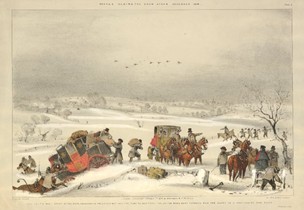
A snow effect is the next coaching incident to be chronicled in this neighbourhood of St. Albans, richer surely in its agreeably diversified crop of casualties than any other place in England. The North-western coaches… seem to have got the full benefit of the historic snow-storm of 1836. This visitation lasted the best part of a week and has never been equalled in England before or since. The drifts in some hollows were said to be twenty feet deep—which caused some passengers not unnaturally to report that they were “mountains high,” and some coachmen to state that the snow in some places was higher than their heads as they sat on the box. “Never before,” writes a correspondent of the Times of that day (quoted by Captain Malet in his Annals of the Road)—“never before within recollection was the London Mail stopped for a whole night at a few miles from London, and never before have we seen the intercourse between the southern shores of England and the metropolis interrupted for two whole days.”

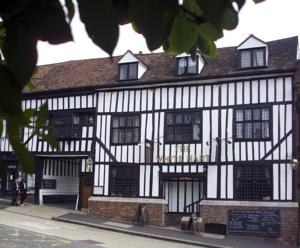
White Hart Inn, St. Albans

White Hart Inn, St. Albans

…many mails and coaches remained hopelessly stuck, able neither to get up the road nor down it—a state of affairs which must have caused many passengers to use srange words, and the landlords of the Angel, White Hart, and Woolpack to make hay while the snow fell. And some people were not so fortunate as to be stuck fast in a picturesque place where there was something eat, as Burdett, the guard of the Liverpool Mail, was able to testify. For on Tuesday, December 27, of this memorable year, this guard from his vnatage point, beheld a chariot buried in the snow and without horses, safely at anchor at about a mile on the London side of St. Albans. And he had no sooner seen it—and two elderly ladies inside it, who rent the welkin with clamorous cries for help—than he found, by being suddenly precipitated head firstinto twelve feet of snow, that his coach had got into a drift too. Having recovered his perpendicular, and emptied his mouth, a natural curiosity prompted Burdett to cross-examine the ladies on their somewhat forlorn position. They told him that their post-boy and left them for St. Albans to get fresh cattle, and had been gone two hours—no doubt having elected to get brandy for himself instead. Meanwhile, there they were—and in a very deplorable plight surely. But will it be believed that this heart-moving vision of beauty in distress did not move the guard of the Liverpool Mail in the least! No! He proceeded stolidly in the plain path which is duty’s—a fact whih tends to the suspicion that the ladies cannot have been beauties. But whether they were or no, Burdett, after having heard their story, turned a deaf ear to their appeals for help. He just helped his coachman, his passengers, and his four horses on to their feet—(for the horses too had assumed a recumbent position)—and having extricated his mail, by the help of his tools, curses, and other expedients not mentioned in the text, pursued his journey to London, leaving the chariot and the ladies to their fate.

Mail Coach in a Snowstorm c.1835-40 by Charles Cooper Henderson 1803-1877

Mail Coach in a Snowstorm c. 1835-40, Charles Cooper Henderson


 Index to all the posts in this series

1: The Bath Road: The (True) Legend of the Berkshire Lady

2: The Bath Road: Littlecote and Wild William Darrell

3: The Bath Road: Lacock Abbey

4: The Bath Road: The Bear Inn at Devizes and the “Pictorial Chronicler of the Regency”

5: The Exeter Road: Flying Machines, Muddy Roads and Well-Mannered Highwaymen

6: The Exeter Road: A Foolish Coachman, a Dreadful Snowstorm and a Romance

7: The Exeter Road in 1823: A Myriad of Changes in Fifty Years

8: The Exeter Road: Basingstoke, Andover and Salisbury and the Events They Witnessed

9: The Exeter Road: The Weyhill Fair, Amesbury Abbey and the Extraordinary Duchess of Queensberry

10: The Exeter Road: Stonehenge, Dorchester and the Sad Story of the Monmouth Uprising

11: The Portsmouth Road: Royal Road or Road of Assassination?

12: The Brighton Road: “The Most Nearly Perfect, and Certainly the Most Fashionable of All”

13: The Dover Road: “Rich crowds of historical figures”

14: The Dover Road: Blackheath and Dartford

15: The Dover Road: Rochester and Charles Dickens

16: The Dover Road: William Clements, Gentleman Coachman

17: The York Road: Hadley Green, Barnet

18: The York Road: Enfield Chase and the Gunpowder Treason Plot

19: The York Road: The Stamford Regent Faces the Peril of a Flood

20: The York Road: The Inns at Stilton

21: The Holyhead Road: The Gunpowder Treason Plot

22: The Holyhead Road: Three Notable Coaching Accidents

23: The Holyhead Road: Old Lal the Legless Man and His Extraordinary Flying Machine

24: The Holyhead Road: The Coachmen “More Celebrated Even Than the Most Celebrated of Their Rivals” (Part I)

25: The Holyhead Road: The Coachmen “More Celebrated Even Than the Most Celebrated of Their Rivals” (Part II)

26: Flying Machines and Waggons and What It Was Like To Travel in Them

27: “A few words on Coaching Inns” and Conclusion

A Celebration of Waterloo: The Prince of Orange

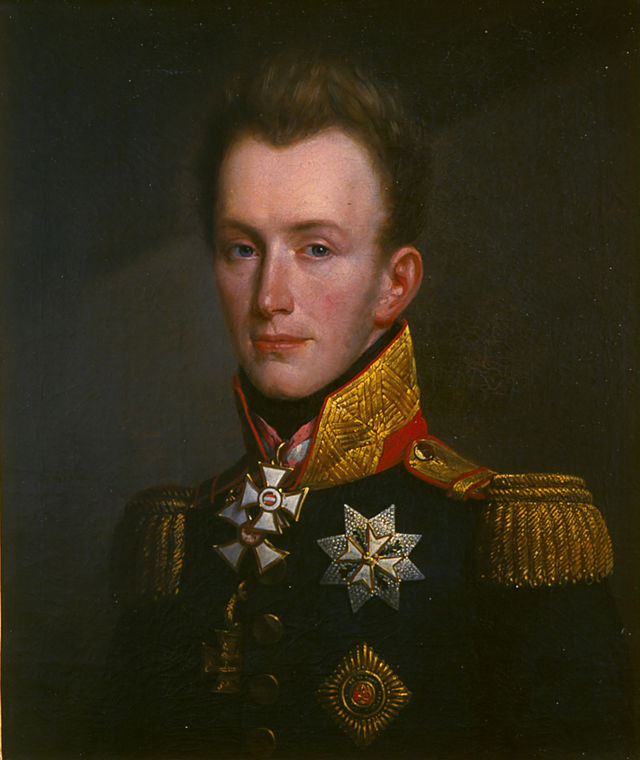
The young Prince of Orange

The young Prince of Orange

About the Prince

William Frederick George Louis was the son of William I of the Netherlands and Wilhelmina of Prussia. When his father proclaimed himself king in 1815 (16 March), he became Prince of Orange. After his father’s abdication in 1840, he became King William II of the Netherlands.

Avid readers of Regency historical fiction might recognize him as the rejected suitor of Princess Charlotte. The Prince Regent arranged the match, but his estranged wife opposed it, and when Charlotte finally met him, she did as well. Whether the problem lay with his personal qualities or the necessity of having to live in the Netherlands or both, the young princess eventually had her way, and married Prince Leopold of Saxe-Coburg-Saalfield (later King of Belgium) in 1816.

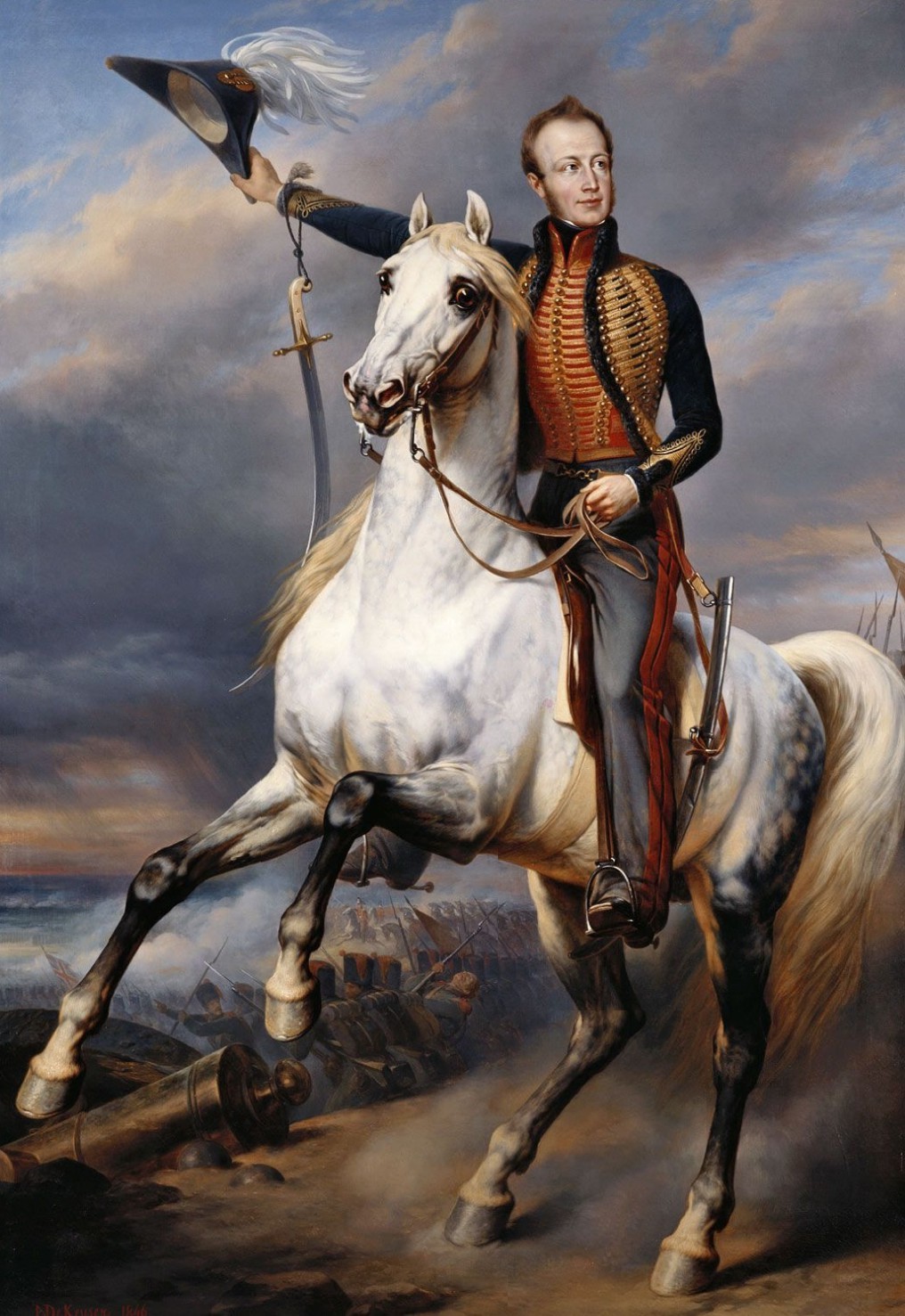
PRINCE OF ORANGE ON HORSEAt the age of two, William fled with his family from the French to Prussia, where he had a military education and served in the Prussian army. Then he studied at the University of Oxford, where he was quite popular and nicknamed “Slender Billy” by the English public. As a result of his ex-patriot upbringing, there were complaints when he eventually returned to the Netherlands that he seemed more foreign than Dutch.

William joined the British army and became aide-de-camp to Wellington in the Peninsular War in 1811 when he was only nineteen years old. In 1815 he joined the Allied Coalition for the final confrontation with Napoleon at Waterloo, where he commanded the I Allied Corps, which was a conglomeration of armies from Britain, Hanover, the Netherlands, Nassau, and Belgium.

This mishmash included many Belgian soldiers who had formerly fought in Napoleon’s Grand Armée—some of whom wore the same uniforms. A source of confusion? Indeed yes, but what was worse was that some allegiance to France still remained, as well as a very real fear of fighting against their former emperor. Communication between all these nationalities was also a problem. Wellington knew he had a problem there, but with rumors abounding of the swelling numbers of Napoleon’s troops, he couldn’t afford to be too selective as he was hastily assembling his own forces.

The Controversy

At 23, the Prince was considered by many to be too young to have the rank of Major-General and given an entire Corps to command. It was said that he was assigned this position because Wellington desperately needed the 30,000 Dutch-Belgian troops and that his son’s promotion was the price of the Dutch king’s cooperation.

The traditional (i.e., British) view was that 200 of the Dutch-Belgian troops took off in the opposite direction when faced by the French. Non-British sources protest, however, that newly-arrived British infantrymen, confused by the similarity of the French and Dutch uniforms, opened fire on them both, causing the Dutch-Belgians to lose a large number of horses, which caused these unmounted soldiers to fall back and not be available for active duty.

From The Cowards at Waterloo (a Dutch account of the battle: http://www.napolun.com/mirror/napoleonistyka.atspace.com/Waterloo_Cowards.html)

Unfortunately most of the British accounts have tended to magnify out of all proportion the accomplishments of the very modest numbers of British soldiers. These authors are unashamedly biased, their troops are super-human, the Duke practically a deity. Below is a fragment of hugely popular in English speaking countries book “Waterloo” by Cornwell (the adventures of super-soldier Major Sharpe). The readers are fed with some colorful descriptions of Belgian cowardice and ‘Dutch courage’. The Belgians and Dutch flee without fight, their commander Prince Orange is “little Dutch boy” etc. In contrast the British soldiers are all-conquering heroes, and their commanders are either tough as a nail or geniuses (or both).

Where does the truth lie? Probably somewhere in the middle. The Prince of Orange acquitted himself well in the Peninsula as aide-de-camp to Wellington, and he was certainly not the first young man his age to have such a high rank. The language problem throughout the conflict was not limited to his troops, and wasn’t his fault. Prejudice on both sides had to be a factor as well. Just as there are some who say the Prussians under Ziethen did come through in the end and should be given some credit for the victory. It’s hardly surprising that the British accounts give the British the lion’s share, but at the same time it’s advisable to take some conclusions with a grain of salt.

Lost and Found Lady

With that in mind, I had just read Bernard Cornwell’s Waterloo prior to writing this story, so my portrayal of the Prince of Orange and the Dutch-Belgian troops conforms to the traditional views. So keep in mind when you read it that the Prince was likely not a cartoon-character of a man at all, in spite of the way he has been characterized over the years.

waterloo_cover_best web

Our Stories

Jillian Chantal: Jeremiah’s Charge

Emmaline Rothesay has her eye on Jeremiah Denby as a potential suitor. When Captain Denby experiences a life-altering incident during the course of events surrounding the Battle of Waterloo, it throws a damper on Emmaline’s plans.

Téa Cooper: The Caper Merchant

The moon in Gemini is a fertile field of dreams, ideas and adventure and Pandora Wellingham is more than ready to spread her wings. When Monsieur Cagneaux, caper merchant to the rich and famous, introduces her to the handsome dragoon she believes her stars have aligned.

Susana Ellis: Lost and Found Lady

Catalina and Rupert fell in love in Spain in the aftermath of a battle, only to be separated by circumstances. Years later, they find each other again, just as another battle is brewing, but is it too late?

Aileen Fish: Captain Lumley’s Angel

Charged with the duty of keeping his friend’s widow safe, Captain Sam Lumley watches over Ellen Staverton as she recovers from her loss, growing fonder of her as each month passes. When Ellen takes a position as a companion, Sam must confront his feelings before she’s completely gone from his life.

Victoria Hinshaw: Folie Bleue

On the night of the 30th Anniversary of the Battle of Waterloo, Aimée, Lady Prescott, reminisces about meeting her husband in Bruxelles on the eve of the fighting. She had avoided the dashing scarlet-clad British officers, but she could not resist the tempting smile and spellbinding charm of Captain Robert Prescott of the 16th Light Dragoons who— dangerously to Aimée— wore blue.

Heather King: Copenhagen’s Last Charge

When Meg Lacy finds herself riding through the streets of Brussels only hours after the Battle of Waterloo, romance is the last thing on her mind, especially with surly Lieutenant James Cooper. However, their bickering uncovers a strange empathy – until, that is, the lieutenant makes a grave error of judgment that jeopardizes their budding friendship…

Christa Paige: One Last Kiss

The moment Colin held Beatrice in his arms he wanted one last kiss to take with him into battle and an uncertain future. Despite the threat of a soldier’s death, he must survive, for he promises to return to her because one kiss from Beatrice would never be enough.

Sophia Strathmore: A Soldier Lay Dying

Amelia and Anne Evans find themselves orphaned when their father, General Evans, dies. With no other options available, Amelia accepts the deathbed proposal of Oliver Brighton, Earl of Montford, a long time family friend. When Lord Montford recovers from his battle wounds, can the two find lasting love?

David W. Wilkin: Not a Close Run Thing at All

Years, a decade. And now, Robert had come back into her life. Shortly before battle was to bring together more than three hundred thousand soldiers. They had but moments after all those years, and now, would they have any more after?

About Lost and Found Lady

On April 24, 1794, a girl child was born to an unknown Frenchwoman in a convent in Salamanca, Spain. Alas, her mother died in childbirth, and the little girl—Catalina—was given to a childless couple to raise.

Eighteen years later…the Peninsular War between the British and the French wages on, now perilously near Catalina’s home. After an afternoon yearning for adventure in her life, Catalina comes across a wounded British soldier in need of rescue. Voilà! An adventure! The sparks between them ignite, and before he returns to his post, Rupert promises to return for her.

But will he? Catalina’s grandmother warns her that some men make promises easily, but fail to carry them out. Catalina doesn’t believe Rupert is that sort, but what does she know? All she can do is wait…and pray.

But Fate has a few surprises in store for both Catalina and Rupert. When they meet again, it will be in another place where another battle is brewing, and their circumstances have been considerably altered. Will their love stand the test of time? And how will their lives be affected by the outcome of the conflict between the Iron Duke and the Emperor of the French?

Amazon.comiBooksKoboBarnes & Noble

Amazon.uk Amazon.caAmazon.au

Amazon Print

Beaux, Ballrooms, and Battles: Release Day!

waterloo_cover_best webBeaux, Ballrooms, and Battles:

A Celebration of Waterloo

June 18, 1815 was the day Napoleon Bonaparte’s Grande Armée was definitively routed by the ragtag band of soldiers from the Duke of Wellington’s Allied Army in a little Belgian town called Waterloo. The cost in men’s lives was high—22,000 dead or wounded for the Allied Army and 24,000 for the French. But the war with Napoleon that had dragged on for a dozen years was over for good, and the British people once more felt secure on their island shores.

The bicentenary of the famous battle seemed like an excellent opportunity to use that setting for a story, and before I knew it, I had eight other authors eager to join me,and to make a long story short, today our Waterloo-themed anthology has been released to the world.

You are all invited to:

Our Stories

Jillian Chantal: Jeremiah’s Last Charge

Emmaline Rothesay has her eye on Jeremiah Denby as a potential suitor. When Captain Denby experiences a life-altering incident during the course of events surrounding the Battle of Waterloo, it throws a damper on Emmaline’s plans.

Téa Cooper: The Caper Merchant

The moon in Gemini is a fertile field of dreams, ideas and adventure and Pandora Wellingham is more than ready to spread her wings. When Monsieur Cagneaux, caper merchant to the rich and famous, introduces her to the handsome dragoon she believes her stars have aligned.

Susana Ellis: Lost and Found Lady

Catalina and Rupert fell in love in Spain in the aftermath of a battle, only to be separated by circumstances. Years later, they find each other again, just as another battle is brewing, but is it too late?

Aileen Fish: Captain Lumley’s Angel

Charged with the duty of keeping his friend’s widow safe, Captain Sam Lumley watches over Ellen Staverton as she recovers from her loss, growing fonder of her as each month passes. When Ellen takes a position as a companion, Sam must confront his feelings before she’s completely gone from his life.

Victoria Hinshaw: Folie Bleue

On the night of the 30th Anniversary of the Battle of Waterloo, Aimée, Lady Prescott, reminisces about meeting her husband in Bruxelles on the eve of the fighting. She had avoided the dashing scarlet-clad British officers, but she could not resist the tempting smile and spellbinding charm of Captain Robert Prescott of the 16th Light Dragoons who— dangerously to Aimée— wore blue.

Heather King: Copenhagen’s Last Charge

When Meg Lacy finds herself riding through the streets of Brussels only hours after the Battle of Waterloo, romance is the last thing on her mind, especially with surly Lieutenant James Cooper. However, their bickering uncovers a strange empathy—until, that is, the lieutenant makes a grave error of judgment that jeopardizes their budding friendship…

Christa Paige: One Last Kiss

The moment Colin held Beatrice in his arms he wanted one last kiss to take with him into battle and an uncertain future. Despite the threat of a soldier’s death, he must survive, for he promises to return to her because one kiss from Beatrice would never be enough.

Sophia Strathmore: A Soldier Lay Dying

Amelia and Anne Evans find themselves orphaned when their father, General Evans, dies. With no other options available, Amelia accepts the deathbed proposal of Oliver Brighton, Earl of Montford, a long time family friend. When Lord Montford recovers from his battle wounds, can the two find lasting love?

David W. Wilkin: Not a Close Run Thing At All

Years, a decade. And now, Robert had come back into her life. Shortly before battle was to bring together more than three hundred thousand soldiers. They had but moments after all those years, and now, would they have any more after?

About Lost and Found Lady

On April 24, 1794, a girl child was born to an unknown Frenchwoman in a convent in Salamanca, Spain. Alas, her mother died in childbirth, and the little girl—Catalina—was given to a childless couple to raise.

Eighteen years later…the Peninsular War between the British and the French wages on, now perilously near Catalina’s home. After an afternoon yearning for adventure in her life, Catalina comes across a wounded British soldier in need of rescue. Voilà! An adventure! The sparks between them ignite, and before he returns to his post, Rupert promises to return for her.

But will he? Catalina’s grandmother warns her that some men make promises easily, but fail to carry them out. Catalina doesn’t believe Rupert is that sort, but what does she know? All she can do is wait…and pray.

But Fate has a few surprises in store for both Catalina and Rupert. When they meet again, it will be in another place where another battle is brewing, and their circumstances have been considerably altered. Will their love stand the test of time? And how will their lives be affected by the outcome of the conflict between the Iron Duke and the Emperor of the French?

Amazon.com • Amazon.uk • Amazon.ca • Amazon.au

 Barnes & Noble • iBooks • Kobo

Excerpt

September 14, 1793

A beach near Dieppe, France

“I don’t like the look of those clouds, monsieur,” Tobias McIntosh said in fluent French to the gray-bearded old man in a sailor hat waiting impatiently near the rowboat that was beginning to bob more sharply with each swell of the waves. “Are you sure your vessel can make it safely all the way to Newhaven in these choppy seas?”

The old man waved a hand over the horizon. “La tempête, it is not a threat, if we leave immédiatement. Plus tard…” He shrugged. “Je ne sais pas.”

“Please, mon amour,” pleaded the small woman wrapped in a hooded gray cloak standing at his side. “Allow me to stay with you. I don’t want to go to England. I promise I will be prudent.”

A strong gust of wind caught her hood and forced it down, revealing her mop of shiny dark locks. Tobias felt like seizing her hand and pulling her away from the ominous waves to a place of safety where she and their unborn child could stay until the senseless Terreur was over.

“Justine, ma chère, we have discussed this endlessly. There is no place in France safe enough for you if your identity as the daughter of the Comte d’Audet is discovered.” He shivered. “I could not bear it if you were to suffer the same fate at the hands of the revolutionaries as your parents did when I failed to save them.”

She threw her arms around him, the top of her head barely reaching his chin. “Non, mon amour, it was not your fault. You could not have saved them. It was miraculeux that you saved me. I should have died with them.”

She looked up to catch his gaze, her face ashen. “Instead, we met and have had three merveilleux months together. If it is my time to die, I wish to die at your side.”

Tobias felt like his heart was going to break. His very soul demanded that the two of them remain together and yet… there was a price on both their heads, and the family of the Vicomte Lefebre was waiting for him in Amiens, the revolutionaries expected to reach them before midday. It was a dangerous work he was involved in—rescuing imperiled French nobility from bloodthirsty, vengeful mobs—but he had pledged himself to the cause and honor demanded that he carry on. And besides, there was now someone else to consider.

“The child,” he said with more firmness than he felt. “We have our child to consider, now, Justine ma chère. The next Earl of Dumfries. He must live to grow up and make his way in the world.”

Not to mention the fact that Tobias was human enough to wish to leave a child to mark his legacy in the world—his and Justine’s. He felt a heaviness in his heart that he might not live long enough to know this child he and Justine had created together. He could not allow his personal wishes to undermine his conviction. Justine and the child must survive.

Justine’s blue eyes filled with tears. “But I cannot! I will die without you, mon cher mari. You cannot ask it of me!”

“Justine,” he said, pushing away from her to clasp her shoulders and look her directly in the eye. “You are a brave woman, the strongest I have ever known. You have survived many hardships and you can survive this. Take this letter to my brother in London, and he will see to your safety until the time comes that I can join you. My comrades in Newhaven will see that you are properly escorted.”

He handed over a letter and a bag of coins. “This should be enough to get you to London.”

After she had reluctantly accepted and pocketed the items beneath her cloak, he squeezed her hands.

“Be sure to eat well, ma chère. You are so thin and my son must be born healthy.”

She gave him a feigned smile. “Our daughter is the one responsible for my sickness in the mornings… I do not believe she wishes me to even look at food.”

She looked apprehensively at the increasingly angry waves as they tossed the small boat moored rather loosely to a rock on the shore and her hands impulsively went to her stomach.

“Make haste, monsieur,” the old sailor called as he peered anxiously at the darkening clouds. “We must depart now if we are to escape the storm. Bid your chère-amie adieu maintenant or wait for another day. I must return to the bateau.”

“Tobias,” she said, her voice shaking.

He wondered if he would ever again hear her say his name with that adorable French inflection that had drawn him from their first meeting.

“Go, Justine. Go to my family and keep our child safe. I promise I will join you soon.”

He scooped her up in his arms and carried her toward the dinghy, trying to ignore her tears. The old sailor held the boat as still as he could while Tobias placed her on the seat and kissed her hard before striding back to the shore, each footstep heavier than the last.

He studied the darkening sky as the sailor climbed in the boat. “You are sure it is safe?”

“La Chasseresse, she is très robuste. A few waves will not topple her, monsieur.”

“Je t’aime, mon amour,” she said to him plaintively, her chin trembling.

“Au revoir, ma chère,” he said, trying to smile, although his vision was blurring from tears.

Will I ever see her again?

He stood watching as the dinghy made its way slowly through the choppy sea to the larger ship anchored in the distance, grief-stricken and unable to concentrate on anything but his pain. When the ship finally sailed off into the horizon, he fell to his knees and prayed as he had never done before for the safety of his beloved. He remained in that position until drops of rain on his face reminded him of the Lefebre family waiting for him in Amiens.

With a deep breath, he rose and made his way to the nearby forest, where his horse waited, tied to a tree.

“Come, my friend. We have a long, wet journey ahead of us.”

Setting foot in the stirrup, he swung his leg over the saddle and urged the horse to a gallop, feeling his heart rip into pieces with every step away from his beloved.

A Celebration of Waterloo: The Battle of Salamanca

map_sm

July 22, 1812

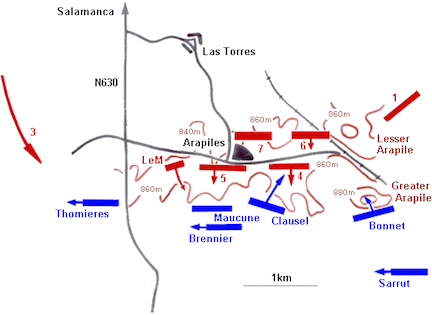
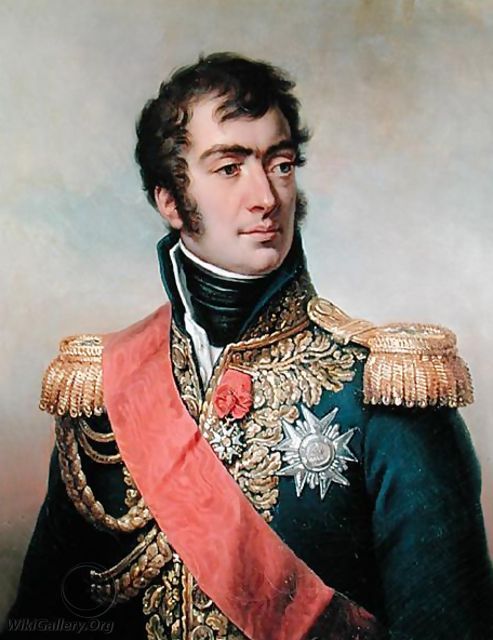
Both armies were just outside Salamanca. It was hot and humid, particularly after a heavy thunderstorm the night before. Wellington, aware that French reinforcements were expected, was planning to retreat back to Ciudad Rodrigo. Marmont, the French commander, was eager to do battle before the arrival of the reinforcements so that he could claim all the credit for defeating Wellington.

Auguste de Marmont

Auguste Marmont

However, Wellington received reports (no doubt from his Exploring Officers) that French troops were taking up positions on the slopes of two steep hills, the Arapiles (south of Salamanca). Wellington saw the danger immediately and ordered the French repulsed, sending two infantry divisions to take position below the ridge of the closer hill. Having seen the dust in the distance from the supply wagons on their way to Ciudad Rodrigo and believing that the British were in retreat, Marmont didn’t realize that most of Wellington’s troops were still hidden behind the ridge. Wellington ordered up two more divisions from Salamanca.

Cartoon - alava

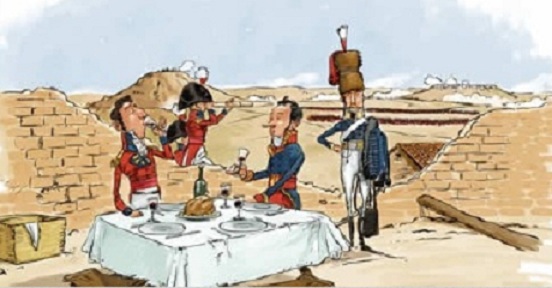
At midday, Wellington descended the near hill and joined his senior staff for a very late breakfast at a nearby farm where they had a good view of the area. Because of bullets flying from nearby skirmishes, the meal had to be moved to a safer place. Wellington paced the wall of the farmyard, scanning the area with his spyglass. When finally persuaded to eat some bread and part of a roast chicken, he grabbed one of the chicken legs and ate it with one hand while continuing to study the area between the two ridges with his spyglass.

At 2:00, he rose from the table with a whoop of delight, throwing the chicken leg over his shoulder and shouting, “By God! That will do!” and ran to his horse, ordering his men to follow him.

French troops were marching through the gap of the two ridges—exactly what he had been hoping to see. Turning to his Spanish aide-de-camp, Miguel Ricardo de Alava y Esquivel, he remarked, “Mon cher Alava, Marmont est perdu!” (My dear Alava, Marmont is lost!)

Marmont had made a fatal error in judgment and Wellington knew he was in a perfect position to crush the French.

Wellington struck hard and fast, taking the French by surprise. Marmont was badly wounded by an exploding shell and carried to the rear. Other French senior officers were killed or severely wounded, and the French had no chance to re-group.

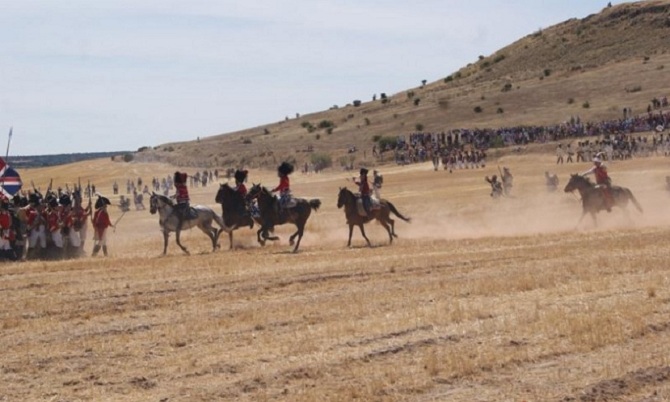
FrenchchargingasquareThe main battle took less than an hour. It was later said that Wellington had “defeated 40,000 men in 40 minutes.” Wellington himself took a ball in the thigh, but his holster took most of the hit, leaving him with a minor wound.

Unfortunately, most of the remaining French army managed to escape across the Tormes River, due to a failure of the Spanish commander abandoning his post against orders.

The night after the battle, the residents of Salamanca, having seen most of the conflict, came out onto the battlefield with provisions for the men, who had gone without eating and drinking for nearly a day while fighting a battle under the grueling Spanish sun.

Two imperial eagles snatched from the French during the Battle of Salamanca

Two imperial eagles snatched from the French during the Battle of Salamanca

Lost and Found Lady

Catalina lives near the battlefield outside a town called Las Torres. After the battle, she finds a wounded British soldier on the road and takes him to a place of safety where she can tend to his head wound. The British soldier is Rupert Ellsworth, one of Wellington’s Exploring Officers. The pair are immediately drawn to each other, but Rupert knows there’s no future for them, having promised his father he would marry a suitable English girl. A devout Catholic, Catalina is not a whore to be loved and abandoned. Still, Rupert cannot help but wish he could sweep her away from her disagreeable family. After he returns to his company, they both wonder if they will ever see each other again.

waterloo_cover_best web

Amazon.com • Amazon.uk • Amazon.ca • Amazon.au

 Barnes & Noble • iBooks • Kobo

Beaux, Ballrooms, and Battles

Release Day Party: April 1, 2015, 11 a.m. – 11 p.m. EDT

Rafflecopter: ends April 18

Website: www.beauxballroomsandbattles.com

Facebook Page

Jillian Chantal: Jeremiah’s Charge

Emmaline Rothesay has her eye on Jeremiah Denby as a potential suitor. When Captain Denby experiences a life-altering incident during the course of events surrounding the Battle of Waterloo, it throws a damper on Emmaline’s plans.

Téa Cooper: The Caper Merchant

The moon in Gemini is a fertile field of dreams, ideas and adventure and Pandora Wellingham is more than ready to spread her wings. When Monsieur Cagneaux, caper merchant to the rich and famous, introduces her to the handsome dragoon she believes her stars have aligned.

Susana Ellis: Lost and Found Lady

Catalina and Rupert fell in love in Spain in the aftermath of a battle, only to be separated by circumstances. Years later, they find each other again, just as another battle is brewing, but is it too late?

Aileen Fish: Captain Lumley’s Angel

Charged with the duty of keeping his friend’s widow safe, Captain Sam Lumley watches over Ellen Staverton as she recovers from her loss, growing fonder of her as each month passes. When Ellen takes a position as a companion, Sam must confront his feelings before she’s completely gone from his life.

Victoria Hinshaw: Folie Bleue

On the night of the 30th Anniversary of the Battle of Waterloo, Aimée, Lady Prescott, reminisces about meeting her husband in Bruxelles on the eve of the fighting. She had avoided the dashing scarlet-clad British officers, but she could not resist the tempting smile and spellbinding charm of Captain Robert Prescott of the 16th Light Dragoons who—dangerously to Aimée—wore blue.

Heather King: Copenhagen’s Last Charge

When Meg Lacy finds herself riding through the streets of Brussels only hours after the Battle of Waterloo, romance is the last thing on her mind, especially with surly Lieutenant James Cooper. However, their bickering uncovers a strange empathy—until, that is, the lieutenant makes a grave error of judgment that jeopardizes their budding friendship…

Christa Paige: One Last Kiss

The moment Colin held Beatrice in his arms he wanted one last kiss to take with him into battle and an uncertain future. Despite the threat of a soldier’s death, he must survive, for he promises to return to her because one kiss from Beatrice would never be enough.

Sophia Strathmore: A Soldier Lay Dying

Amelia and Anne Evans find themselves orphaned when their father, General Evans, dies. With no other options available, Amelia accepts the deathbed proposal of Oliver Brighton, Earl of Montford, a long time family friend. When Lord Montford recovers from his battle wounds, can the two find lasting love?

David W. Wilkin: Not a Close Run Thing at All

Years, a decade. And now, Robert had come back into her life. Shortly before battle was to bring together more than three hundred thousand soldiers. They had but moments after all those years, and now, would they have any more after?

A Celebration of Waterloo: Wellington’s Exploring Officers

All the business of war and indeed all the business of life, is to endeavor to find out what you don’t know by what you do: that’s what I call ‘guessing what was on the other side of the hill.’

Arthur Wellesley, 1st Duke of Wellington

 The Business of Spying

Up until the early 19th century, spying was considered an odious and ungentlemanly occupation and few officers would agree to do it.

But by the time the 19th century rolled around, with the spreading of Napoleon’s empire on the continent, General Brownrigg, the Quartermaster-General of the British Army, went to the Commander-in-Chief, Frederick, the Duke of York, to propose that army develop a unit called the Depot of Military Intelligence, and it was done. The problem was—nobody wanted to do it.

Wellington’s Exploring Officers

peninsular war map

When General Wellesley arrived in Portugal, he couldn’t find an accurate map of the country and had to write to his brother-in-law to send him one. Realizing that his lack of information about the movements of the enemy, as well as the terrain and countryside, Wellington established a corps of “Exploring Officers.”

Exploring officers had to be fine horsemen, skilled linguists, and able to express themselves in sketching and writing in the most concise terms. With the assistance of local inhabitants, they would map the countryside four miles to the inch. That done, they would move behind enemy lines, learn troop movements and strategic information, and return to disclose this information to Wellington.

Sir John Waters

Sir John Waters of the Royal Scots

John Waters of the Royal Scots was known as a wily and capable man behind enemy lines. However, he was caught by the French and given up for dead by his regiment. When a man dies, his personal possessions are generally auctioned off to his comrades, but Wellington forbade this, saying that “Waters should be back and would want his things.” And he was right. Waters did come back and supposedly did want his things back.

Most exploring officers wore their uniforms, since soldiers caught behind enemy lines out of uniform was immediately shot as a spy. John Grant was one of the few who went in disguise. He became very friendly with the Portuguese people and adopted their local dress, much to the horror of his fellow officers. After the war, instead of being lauded for their risk-taking, these courageous men were shunned by their former regiments as “gadabouts” who were not really engaged in the business of war.

Colquhoun Grant

From Wikipedia:

Colquhoun Grant, Gentleman Spy

Colquhoun Grant, Gentleman Spy

The youngest of eight brothers in a family from the Scots aristocracy, Grant was commissioned into the 11th Foot in 1795. In 1809 he was posted to the Iberian Peninsula under the command of Arthur Wellesley, who in 1810 appointed him to his personal staff as an exploring officer in the Peninsula Corps of Guides, a special reconnaissance unit who spoke the local languages.

Grant was captured by French forces on 16 April 1812. As he was in uniform he was treated as an officer and gentleman by his captors, who offered him parole, which Grant accepted. Grant was invited to dine with Marshal Marmont who hoped to find out more about Wellington, and who was angered by Grant’s reticence. Marmont had good reason to remain suspicious of Grant, as the latter managed to send and receive secret messages while in captivity.

marmont

Auguste de Marmont

Marmont sent Grant to Paris for interrogation. It is clear from Marmont’s correspondence that he had no intention of exchanging Grant for a prisoner of equal rank among the British, as was the custom of the time, considering him to be a spy. Grant, on seeing a copy of Marmont’s letter, decided that it invalidated his agreement to parole and left him free to escape.

Grant was able to avoid recapture by passing himself off as an American officer, and spent some weeks at liberty in the streets and salons of Paris, sending intelligence reports to Wellington. He then escaped to England, rejoining Wellington in early 1814. Promoted to lieutenant-colonel he was appointed commanding officer of the Corps of Guides and Head of Intelligence for the Peninsular Army.

During the Hundred Days Campaign, Grant was working as intelligence officer in France when Wellington put him in charge of his own intelligence operations. Grant sent in a steady stream of reports regarding the build-up of French troops along the border and returned to Brussels in time to take part in the Battle of Waterloo on 18 June.

Lost and Found Lady

Rupert Ellsworth, the hero in story in the Beaux, Ballrooms, and Battles anthology, is an exploring officer in Wellington’s army in 1812 when he decides to disguise himself as a French soldier following the Battle of Salamanca. Unfortunately, he’s not the greatest horseman and falls off the untrained French horse and hits his head on a rock. Fortunately he is discovered soon after by Catalina, a local girl, who takes it upon herself to nurse him back to health. One thing leads to another and it isn’t long before the pair fall in love. But Catalina is not a whore and Rupert has promised his father to marry a “suitable English girl,” so the future for them looks grim. Between one thing and another, the two are separated… to be reunited several years later in Belgium just as another war is brewing. Circumstances for both of them have drastically changed, and Rupert is bound for the battlefield. Will there be a future for them or is it too late?

waterloo_cover_best web

Amazon.com • Amazon.uk • Amazon.ca • Amazon.au

 Barnes & Noble • iBooks • Kobo

Beaux, Ballrooms, and Battles

Release Day Party: April 1, 2015, 11 a.m. – 11 p.m. EDT

Rafflecopter: ends April 18

Website: www.beauxballroomsandbattles.com

Facebook Page

Jillian Chantal: Jeremiah’s Charge

Emmaline Rothesay has her eye on Jeremiah Denby as a potential suitor. When Captain Denby experiences a life-altering incident during the course of events surrounding the Battle of Waterloo, it throws a damper on Emmaline’s plans.

Téa Cooper: The Caper Merchant

The moon in Gemini is a fertile field of dreams, ideas and adventure and Pandora Wellingham is more than ready to spread her wings. When Monsieur Cagneaux, caper merchant to the rich and famous, introduces her to the handsome dragoon she believes her stars have aligned.

Susana Ellis: Lost and Found Lady

Catalina and Rupert fell in love in Spain in the aftermath of a battle, only to be separated by circumstances. Years later, they find each other again, just as another battle is brewing, but is it too late?

Aileen Fish: Captain Lumley’s Angel

Charged with the duty of keeping his friend’s widow safe, Captain Sam Lumley watches over Ellen Staverton as she recovers from her loss, growing fonder of her as each month passes. When Ellen takes a position as a companion, Sam must confront his feelings before she’s completely gone from his life.

Victoria Hinshaw: Folie Bleue

On the night of the 30th Anniversary of the Battle of Waterloo, Aimée, Lady Prescott, reminisces about meeting her husband in Bruxelles on the eve of the fighting. She had avoided the dashing scarlet-clad British officers, but she could not resist the tempting smile and spellbinding charm of Captain Robert Prescott of the 16th Light Dragoons who—dangerously to Aimée—wore blue.

Heather King: Copenhagen’s Last Charge

When Meg Lacy finds herself riding through the streets of Brussels only hours after the Battle of Waterloo, romance is the last thing on her mind, especially with surly Lieutenant James Cooper. However, their bickering uncovers a strange empathy—until, that is, the lieutenant makes a grave error of judgment that jeopardizes their budding friendship…

Christa Paige: One Last Kiss

The moment Colin held Beatrice in his arms he wanted one last kiss to take with him into battle and an uncertain future. Despite the threat of a soldier’s death, he must survive, for he promises to return to her because one kiss from Beatrice would never be enough.

Sophia Strathmore: A Soldier Lay Dying

Amelia and Anne Evans find themselves orphaned when their father, General Evans, dies. With no other options available, Amelia accepts the deathbed proposal of Oliver Brighton, Earl of Montford, a long time family friend. When Lord Montford recovers from his battle wounds, can the two find lasting love?

David W. Wilkin: Not a Close Run Thing at All

Years, a decade. And now, Robert had come back into her life. Shortly before battle was to bring together more than three hundred thousand soldiers. They had but moments after all those years, and now, would they have any more after?

A Celebration of Waterloo: The Romance of Harry and Juana Smith

Beaux, Ballrooms, and Battles:

A Celebration of Waterloo

June 18, 1815 was the day Napoleon Bonaparte’s Grande Armée was definitively routed by the ragtag band of soldiers from the Duke of Wellington’s Allied Army in a little Belgian town called Waterloo. The cost in men’s lives was high—22,000 dead or wounded for the Allied Army and 24,000 for the French. But the war with Napoleon that had dragged on for a dozen years was over for good, and the British people once more felt secure on their island shores.

The bicentenary of the famous battle seemed like an excellent opportunity to use that setting for a story, and before I knew it, I had eight other authors eager to join me,and to make a long story short, in a bit over two weeks our anthology of nine Waterloo-themed stories will be released to the world.

You are all invited to:

The Inspiration for Lost and Found Lady

In my preparatory reading for this project, I discovered the real-life romance of Harry Smith and his wife Juana while reading Georgette Heyer’s The Spanish Bride. Add to that my deep affection for Spain and the Spanish language, and the result is a story of a romance between an injured British soldier and the extraordinary young peasant girl who rescued him after the Battle of Salamanca.

spain_Cadiz_hervas_map

Henry (Harry) George Wakelyn Smith (1787-1860)

220px-Sir_Harry_Smith

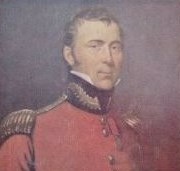
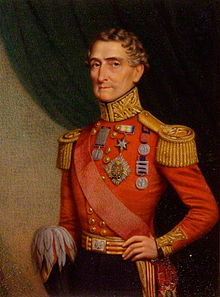
Harry was born in Whittlesey, Cambridgeshire, the son of a surgeon. He entered the army in 1805 and saw action in South America (1806-7), but it was his service in the Peninsular War with the 95th Rifles as a scout that brought him into prominence, and that’s where he met his wife. Prior to Waterloo, he served in the United States (witnessed the burning of the capitol in 1814), and after Waterloo, South Africa and India.

Juana María de los Dolores de León Smith (1798-1872)

juanasmith

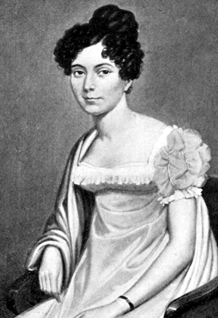
A descendent of Ponce de León, Juana was orphaned at fourteen and, deprived of all family property after the siege of Badajoz in April of 1812, she and her older sister approached the British Army for protection during the atrocious massacre (indiscriminate looting, killing, and raping of Spanish civilians by British and Portuguese soldiers following the heat of battle). It was love at first sight. Despite her youth (and marriage at that age was not uncommon in Spain at the time), Juana and Harry were married four days later, and remained devoted to each other the rest of their lives.

Despite her convent upbringing, Juana insisted on remaining with Harry throughout the war, bearing the privations of army life so cheerfully that she became the darling of the 95th Rifles. Wellington himself familiarly called her “Juanita”.

From The Autobiography of Lieutenant-General Sir Harry Smith

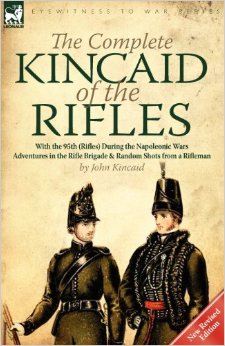
Now comes a scene of horror I would willingly bury in oblivion. The atrocities committed by our soldiers on the poor innocent and defenceless inhabitants of the city, no words suffice to depict. Civilized man, when let loose and the bonds of morality relaxed, is a far greater beast than the savage, more refined in his cruelty, more fiend-like in every act; and oh, too truly did our heretofore noble soldiers disgrace themselves, though the officers exerted themselves to the utmost to repress it, many who had escaped the enemy being wounded in their merciful attempts! Yet this scene of debauchery, however cruel to many, to me as been the solace and the whole happiness of my life for thirty-three years. A poor defenceless maiden of thirteen years was thrown upon my generous nature through her sister, as described so ably in Johnny Kincaid’s book, of which this in an extract—

kincaid“I was conversing with a friend the day after, at the door of his tent, when we observed two ladies coming from the city, who made directly towards us; they seemed both young, and when they came near, the elder of the two threw back her mantilla to address us, showing a remarkably handsome figure, with fine features; but her sallow, sun-burnt, and careworn, though still youthful, countenance showed that in her ‘the time for tender thoughts and soft endearments had fled away and gone.’

“She at once addressed us in that confident, heroic manner so characteristic of the high-bred Spanish maiden, told us who they were—the last of an ancient and honourable house—and referred to an officer high in rank in our army, who had been quartered there in the days of her prosperity, for the truth of her tale.

“Her husband, she said, was a Spanish officer in a distant part of the kingdom; he might, or he might not, still be living. But yesterday she and this her young sister were able to live in affluence and in a handsome house; to-day they knew not where to lay their heads, where to get a change of raiment or a morsel of bread. Her house, she said, was a wreck; and, to show the indignities to which they had been subjected, she pointed to where the blood was still trickling down their necks, caused by the wrenching of their ear-rings through the flesh by the hands of worse than savages, who would not take the trouble to unclasp them!

“For herself, she said, she cared not; but for the agitated and almost unconscious maiden by her side, whom she had but lately received over from the hands of her conventual instructresses, she was in despair, and knew not what to do; and that, in the rapine and ruin which was at that moment desolating the city, she saw no security for her but the seemingly indelicate one she had adopted—of coming to the camp and throwing themselves upon the protection of any British officer who would afford it; and so great, she said, was her faith in our national character, that she knew the appeal would not be made in vain, nor the confidence abused. Nor was it made in vain! Nor could it be abused, for she stood by the side of an angel! A being more transcendingly lovely I had never before seen—one more amiable I have never yet known!

“Fourteen summers had not yet passed over her youthful countenance, which was of a delicate freshness—more English than Spanish; her face, though not perhaps rigidly beautiful, was nevertheless so remarkably handsome, and so irresistibly attractive, surmounting a figure cast in nature’s fairest mould, that to look at her was to love her; and I did love her, but I never told my love, and int the mean time another and a more impudent fellow stepped in and won her! But yet I was happy, for in him she found such a one as her loveliness and her misfortunes claimed—a man of honour, and a husband in every way worthy of her!”

“That a being so young, so lovely, and so interesting, just emancipated from the gloom of a convent, unknowing of the world and to the world unknown, should thus have been wrecked on a sea of troubles, and thrown on the mercy of strangers under circumstances so dreadful, so uncontrollable, and not have sunk to rise no more, must be the wonder of every one. Yet from the moment she was thrown on her own resources, her star was in the ascendant.”

“Guided by a just sense of rectitude, an innate purity of mind, a singleness of purpose which defied malice, and a soul that soared above circumstances, she became alike the adored of the camp and of the drawing-room, and eventually the admired associate of princes. She yet lives, in the affections of her gallant husband, in an elevated situation in life, a pattern to her sex, and everybody’s beau ideal of what a wife should be.”

I confess myself to be the “more impudent fellow,” and if any reward is due to a soldier, never was one so honoured and distinguished as I have been by the possession of this dear child (for she was little more than a child at this moment), one with a sense of honour no knight ever exceeded in the most romantic days of chivalry, an understanding superior to her years, a masculine mind with a force of character no consideration could turn from her own just sense of rectitude, and all encased in a frame of Nature’s fairest and most delicate moulding, the figure of an angel, with an eye of light and an expression which then inspired me with a maddening love which, from that period to this (now thirty-three years), has never abated under many and the most trying circumstances. Thus, as good may come out of evil, this scene of devastation and spoil yielded to me a treasure invaluable; to me who, among so many dear friends, had escaped all dangers; to me, a wild youth not meriting such reward, and, however desirous, never able to express half his gratitude to God Almighty for such signal marks of His blessing shown to so young and so thoughtless a being. From that day to this she has been my guardian angel. She has shared with me the dangers and privations, the hardships and fatigues, of a restless life of war in every quarter of the globe. No murmur has ever escaped her. Bereft of every relative, of every tie to her country but the recollection of it, united to a man of different though Christian religion, yet that man has been and is her all…”

The Protagonists of Lost and Found Lady

Rupert Ellsworth, like Harry Smith is an explorer scout with the British Army in Spain. Also like Harry, he’s a younger son seeking to make his own way in life. He might have become a career soldier as Harry did, had his life not taken a different turn in 1812. When he meets Catalina, he’s not looking for love or marriage, and if he were, it certainly wouldn’t be to a penniless Spanish Catholic!

Catalina’s upbringing wasn’t at all like Juana Smith’s. Orphaned at birth, she is taken in by a couple who treat her as an unpaid servant. Her eagerness to learn attracts the attention of a local priest, who takes it upon himself to give her an education comparable to that of an elite gentleman. When she meets Rupert, she is reflecting on her limited options for the future and wondering if she could escape her humdrum life by becoming a nun. At eighteen when she meets Rupert, she’s older than Juana, but, like Harry’s wife, she’s reached a turning point in her life.

What happens when these two meet after the Battle of Salamanca? Hmm…

waterloo_cover_best web

Amazon.comAmazon.uk Amazon.caAmazon.au

 Barnes & Noble • iBooks • Kobo
Beaux, Ballrooms, and Battles

Release Day Party: April 1, 2015, 11 a.m. – 11 p.m. EDT

Rafflecopter: ends April 18

Website: www.beauxballroomsandbattles.com

Facebook Page

Jillian Chantal: Jeremiah’s Charge

Emmaline Rothesay has her eye on Jeremiah Denby as a potential suitor. When Captain Denby experiences a life-altering incident during the course of events surrounding the Battle of Waterloo, it throws a damper on Emmaline’s plans.

Téa Cooper: The Caper Merchant

The moon in Gemini is a fertile field of dreams, ideas and adventure and Pandora Wellingham is more than ready to spread her wings. When Monsieur Cagneaux, caper merchant to the rich and famous, introduces her to the handsome dragoon she believes her stars have aligned.

Susana Ellis: Lost and Found Lady

Catalina and Rupert fell in love in Spain in the aftermath of a battle, only to be separated by circumstances. Years later, they find each other again, just as another battle is brewing, but is it too late?

Aileen Fish: Captain Lumley’s Angel

Charged with the duty of keeping his friend’s widow safe, Captain Sam Lumley watches over Ellen Staverton as she recovers from her loss, growing fonder of her as each month passes. When Ellen takes a position as a companion, Sam must confront his feelings before she’s completely gone from his life.

Victoria Hinshaw: Folie Bleue

On the night of the 30th Anniversary of the Battle of Waterloo, Aimée, Lady Prescott, reminisces about meeting her husband in Bruxelles on the eve of the fighting. She had avoided the dashing scarlet-clad British officers, but she could not resist the tempting smile and spellbinding charm of Captain Robert Prescott of the 16th Light Dragoons who—dangerously to Aimée—wore blue.

Heather King: Copenhagen’s Last Charge

When Meg Lacy finds herself riding through the streets of Brussels only hours after the Battle of Waterloo, romance is the last thing on her mind, especially with surly Lieutenant James Cooper. However, their bickering uncovers a strange empathy—until, that is, the lieutenant makes a grave error of judgment that jeopardizes their budding friendship…

Christa Paige: One Last Kiss

The moment Colin held Beatrice in his arms he wanted one last kiss to take with him into battle and an uncertain future. Despite the threat of a soldier’s death, he must survive, for he promises to return to her because one kiss from Beatrice would never be enough.

Sophia Strathmore: A Soldier Lay Dying

Amelia and Anne Evans find themselves orphaned when their father, General Evans, dies. With no other options available, Amelia accepts the deathbed proposal of Oliver Brighton, Earl of Montford, a long time family friend. When Lord Montford recovers from his battle wounds, can the two find lasting love?

David W. Wilkin: Not a Close Run Thing at All

Years, a decade. And now, Robert had come back into her life. Shortly before battle was to bring together more than three hundred thousand soldiers. They had but moments after all those years, and now, would they have any more after?

The Holyhead Road: The Gunpowder Treason Plot

dust jacket

The following post is the twenty-first of a series based on information obtained from a fascinating book Susana recently obtained for research purposes. Coaching Days & Coaching Ways by W. Outram Tristram, first published in 1888, is replete with commentary about travel and roads and social history told in an entertaining manner, along with a great many fabulous illustrations. A great find for anyone seriously interested in English history!

Mr. Ambrose Rookwood

…in November, 1605, roads as we now understand them did not exist; but this same route, or at all events tracks across un-inclosed heaths; even then connected the above-mentioned places [St. Albans, Redbourn, Dunstable, Brick-hill, Towcester, Dunchurch, Coventry, Birmingham, and Shrewsbury] with each other and the capital, and marked the shortest way for those riding post to reach Northamptonshire, or the Counties beyond its borders.

Map: St. Albans – Dunstable – Towcester – Daventry
Mr. Ambrose Rookwood

Mr. Ambrose Rookwood

Early then in the November of 1605, certain elaborate preparations which had been made for rapid travelling between London and Dunchurch, 80 miles down in Warwickshire was the common talk of ostlers and loafers at the chief posting-houses at St. Albans, Dunstable, Towcester, and Daventry. At each of these places, a Mr. Ambrose Rookwood, a young Catholic gentleman of fortune, well known on the road for his splendid horses, had placed heavy relays. The heaviness of these relays excited continual discussion. The confused rumour of the tap-room, fed by chance travellers on the road, decreed presently that these heavy relays were to carry Mr. Ambrose Rookwood down to a great hunting party, to be shortly assembled at Dunsmoor. But when this hunting party was to take place, no one seemed to know, or why the young Catholic gentleman should have made such elaborate preparations to reach it so hurriedly.

An Aura of Fear Pervades London

And so the few intervening days passed till the 5th of November, 1605, dawned grayly over London—amidst torrents of driving rain and wild gusts of a west wind which had gathered strength as the night waned, and by daylight had grown into a hurricane—dawned on a city distracted. Narrow streets were already crowded with excited groups, who whispered, gesticulated at street corners. Some men but half dressed rushed from their houses as if the rumour of some monstrous imminent doom had startled them suddenly from sleep. Others with drawn swords in their hands counselled all men to arm in one breath, and, as now and again a woman’s shriek rose above the press everywhere,—but no fixed rumour prevailed. Only each man eyed his neighbour suspiciously, only a vague feeling as of some nightmare had seized upon London that the past darkness had brought forth a portent.

Mr. Ambrose Rookwood and Mr. Thomas Winter Join the Fray

thomas winter

Mr. Thomas Winter

In the dim twilight of that November dawn Mr. Ambrose Rookwood, the young Catholic gentleman, whose relays of fine horses had excited such discussion on the North-western Road—came out into these distracted streets, in company with a friend—one Mr. Thomas Winter. The two gentlemen walked aimlessly here and there for some time, listening attentively to all that was said on all sides, now joining themselves to a group and adding questions on their own part, to the sort of universal interrogatory which prevailed—now shuddering and passing, on their way wuickly as the unformed phantom of the people’s fear began to grow gradually into defined shape. Then as if fearful any longer of uncertainty, they made with extraordinary coolness towards the Parliament House.

The sun had not yet risen; but in the middle of King Street, Westminster, the two found a guard standing. Permission to pass was peremptorily refused. Then as Mr. Rookwood’s friend stood parleying with the guard a white-faced citizen passed by hurriedly, exclaiming in panic-stricken tones, “There is treason discovered! And the king and lords should have been blown up.”
Flight of the Conspirators

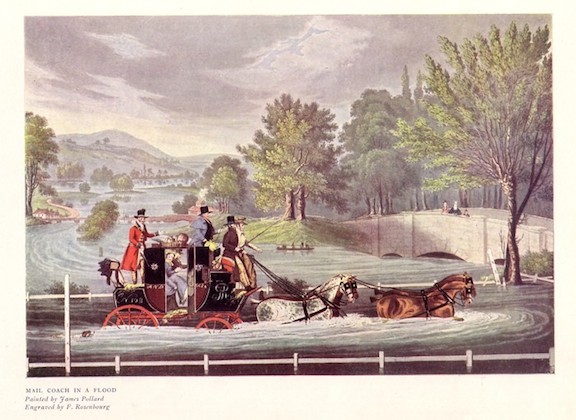
The two gentlemen turned without a word, and made for their horses. The heavy relays on the North-western Road were now to be put to their proper use. But great caution had to be exercised. The appalling news had circulated in the city with the rapidity of poison. Barricades were being hastily erected at the ends of the streets; passengers were being stopped and questioned; any appearance of hurry would have led to instant arrest. It was eleven o’clock therefore before the two gentlemen got clear of London—and they were but just in time; for rumours were already in the air of a proclamation forbidding anybody to leave the town for three days. Once clear of London they rode desperately.

Huddington Court, Worcester

Huddington Court, Worcester

Few incidents I think in history seize the imagination so forcibly as that wild flight of the Gunpowder Conspirators northward. Thomas Winter made for his brother’s house at Huddington in Worcestershire; but Rookwood rode fiercely down the North-western Road to bear the fatal news to the conspirators already assembling on Dunsmoor. Catesby, Piercy, John and Christopher Wright were he knew on the road in front. But the relays already placed for him, and the desperate fear which urged him forwards enabled Rookwood to overtake the others as they were rising the ascent at Brickhill.

In a few words he told them what had happened in London—that Fawkes had been arrested and lodged in the Tower—that at any moment torture might make him give up their names—that the whole scheme had fallen through, and that their only chance of safety lay in instantly joining their friends. From this moment the flight became a stampede. “They devoured the ground,” shouting as they rode through startled towns and villages that they were carrying despatches from the King to Northampton, flinging off their large cloaks, heavy with the rain that still poured remorselessly, that they might add wings even to their precipitate flight. Rookwood rode thirty miles in two hours on one horse. At six in the evening the fugitives arrived at Catesby’s house at Ashby St. Ledgers, about three miles from Daventry. They had ridden the eighty miles from London in seven hours.

Map: Ashby St. Ledgers – Gayhurst

The gatehouse occupied by the Catesbys

The gatehouse occupied by the Catesbys

Here after a brief consultation with Robert Winter, who was staying in the house (it still stands in all its gloomy suggestiveness, this home of England’s most desperate conspirator), they rode off hastily on the same tired horses to join Sir Everard Digby and the pretended hunting gathering on Dunsmoor Heath which the direct road to Holyhead still crosses at the eighty-fifth mile-stone from London.

Sir Everard Digby, knighted by the king three years before he plotted to kill him

Sir Everard Digby, knighted by the king three years before he plotted to kill him

Their further wild course through Warwickshire to Holbeach on the Staffordshire border calls here for no telling, as it is no longer associated with the Road. But so intimately associated with the Gunpowder Treason does the way to Holyhead seem that thought its history is closed so far as the directest route is concerned, the earlier route by Chester has another link to add to its story. A short distance from Newport Pagnell (fifty-one miles from London), stands Gayhurst,the fine Elizabethan house once the home of Sir Everard Digby. Of him a sympathetic historian writes, “His youth, his personal graces, the constancy which he had exhibited whilst he believed himself a martyr in a good cause, the deep sorrow which he testified on becoming sensible of his error, seem to have moved all hearts with pity and even admiration; and if so detestable a villainy as the Gunpowder Plot may be permitted to have its hero Everard Digby was undoubtedly the man.”

Gayhurst House

Gayhurst House

The gray walls of his beautiful Buckinghamshire house were indeed witnesses at all events of some of the most suggestive incidents in the heart-quaking scheme. Fawkes was a frequent guest here—meditating through the prolonged rains which heralded the approach of the destined day, on the state of the powder, by now safely placed under the Parliament House; riding to and fro frequently from London; often an unexpected, always a welcome guest. From Gayhurst, besides, set out that Pilgrimage to St. Winifred’s well, in Flintshire, the motive of which was so much discussed after the discovery of the Conspiracy.

St. Winefride's Well: site of the conspirators' meetings?

St. Winefride’s Well: site of the conspirators’ meetings?

Motives apart however, what is mort important from my point of view is that the company of about thirty persons—all relations of the conspirators; some of the actual conspirators among these, travelled in coaches—proceeded by Daventry to John Grant’s house at Norbrook, a fine melancholy, moated manor once (where is it now?), thence to Robert Winters, at Huddington, and so to Flintshire by Shrewsbury.

holbeche

Holbeche House: where the surviving conspirators were captured


 Index to all the posts in this series

1: The Bath Road: The (True) Legend of the Berkshire Lady

2: The Bath Road: Littlecote and Wild William Darrell

3: The Bath Road: Lacock Abbey

4: The Bath Road: The Bear Inn at Devizes and the “Pictorial Chronicler of the Regency”

5: The Exeter Road: Flying Machines, Muddy Roads and Well-Mannered Highwaymen

6: The Exeter Road: A Foolish Coachman, a Dreadful Snowstorm and a Romance

7: The Exeter Road in 1823: A Myriad of Changes in Fifty Years

8: The Exeter Road: Basingstoke, Andover and Salisbury and the Events They Witnessed

9: The Exeter Road: The Weyhill Fair, Amesbury Abbey and the Extraordinary Duchess of Queensberry

10: The Exeter Road: Stonehenge, Dorchester and the Sad Story of the Monmouth Uprising

11: The Portsmouth Road: Royal Road or Road of Assassination?

12: The Brighton Road: “The Most Nearly Perfect, and Certainly the Most Fashionable of All”

13: The Dover Road: “Rich crowds of historical figures”

14: The Dover Road: Blackheath and Dartford

15: The Dover Road: Rochester and Charles Dickens

16: The Dover Road: William Clements, Gentleman Coachman

17: The York Road: Hadley Green, Barnet

18: The York Road: Enfield Chase and the Gunpowder Treason Plot

19: The York Road: The Stamford Regent Faces the Peril of a Flood

20: The York Road: The Inns at Stilton

21: The Holyhead Road: The Gunpowder Treason Plot

22: The Holyhead Road: Three Notable Coaching Accidents

23: The Holyhead Road: Old Lal the Legless Man and His Extraordinary Flying Machine

24: The Holyhead Road: The Coachmen “More Celebrated Even Than the Most Celebrated of Their Rivals” (Part I)

25: The Holyhead Road: The Coachmen “More Celebrated Even Than the Most Celebrated of Their Rivals” (Part II)

26: Flying Machines and Waggons and What It Was Like To Travel in Them

27: “A few words on Coaching Inns” and Conclusion

The York Road: The Inns at Stilton

dust jacket

The following post is the twentieth of a series based on information obtained from a fascinating book Susana recently obtained for research purposes. Coaching Days & Coaching Ways by W. Outram Tristram, first published in 1888, is replete with commentary about travel and roads and social history told in an entertaining manner, along with a great many fabulous illustrations.

A Vivid Description of an Inn

bell inn2

The Bell Inn at Stilton

As I read Mr. Tristram’s description of these inns at Stilton—particularly the Bell—I found myself feeling the emotional impact of his words that made the visual details more alive and real to me. It was almost as though I were there in the innyard, watching the herds get shod for their long trip to London. Or later, watching the Scots prisoners march past from Culloden to await an uncertain future amongst the enemy.

Perhaps it’s just me and my own vivid imagination that responds so intimately to these passages. But I’m reproducing them here in the hope that you will also be able to experience the historical reality of these old inns, as described by W. Outram Tristram. I am convinced that not only will I be setting a scene here at some point in the near future in one of my own stories, but I will put this inn on my list for a place to stay at a future trip, as I find staying overnight in these historical buildings so inspiring!

bell inn

The Bell Inn

Click here for map

“No place more representative of the ‘Coaching Age Decayed,’ than Stilton, is to be found on Earth”

plaque-on-pub-wall

For here the Great Northern way has diverged from the line of the old road, and by doing so, has turned a vast coaching emporium into a corpse of a town… It was rather, in its best days, a village clustering about two magnificent inns, the Angel and the Bell, which still stare at each other stonily across the great North Road. At the Angel, well known in the coaching days as the house of the famed Miss Worthington (stout, smiling, the christener of Stilton cheeses made miles away, but so called because they were sold at her hospitable door), over 300 horses were stabled for coaching and posting purposes. Vast barracks indeed stretching at the back of the old house—one wing of which alone is now open to travellers—tell of the bustle of post-boys, of the hurrying to and fro of fidgety passengers over-eager to be off, the harnessing and unharnessing of horses, of all the many-voiced Babel of travel in fact which fifty years ago surged and swayed round this teeming coaching centre, now lying silent and deserted as the grave. I am told—and from its central position on the great North Road seventy-five miles from London, I can well understand the fact—that at Stilton in the old days the ebb and flow and traffic never ceased. All day coaches and postchaises continually poured into the place and out of it. And by night the great mails running from Johan o’Groat’s almost, into the heart of London, thundered through the splendid broad thoroughfare, visible mediums as it were of an empire’s circulation. And other wayfarers besides postillions and coachmen seemed never off the road—huge flocks of geese destined for the London market, and travelling the seventy-five miles with uncommon ease; enormous droves of oxen, not such roadsters born. Each beast was indeed thrown and shod at Stilton to enable them to bear the journey. And to show the huge press even of this kind of traffic, this business of shoeing oxen was a trade almost in itself, as I have been told by the present landlord of the Angel Inn, who used in his youth to do the office himself, and to whose still active memory I am indebted for most of the foregoing details.

The Bell Inn

The Bell Inn

And to cross the road (the breadth of the great North Road at Stilton at once seizes the imagination, it is royal, the breadth of it, and looks like the artery of a nation), to cross the road from the Angel, and to come to the Angel’s great rival, the Bell, is to bridge a whole period in the history of English travel; to pass in twenty yards from the age of crack coaches and spicy teams to times long antecedent, when Flying Machines were not; when the great roads were hazily marked over desolate heathy tracks; when men travelled on horseback and women rode pillion, and people only felt secure when they went in large companies; when the solitary travellers went in fear of their lives when the gloaming overtook them, and “spurred apace to reach the timely inn.”

Here is a picture of medieval travel such as I think must have often been witnessed from the windows of such old houses of entertainment as the Bell at Stilton, when the Tudors ruled England. And often sterner episodes of history must have passed beneath its magnificent copper sign than wedding processions of royal princesses, even in the days, when England was called merry, and was merry England indeed. During the year 1536 the Bell at Stilton was no doubt often visited by one of those medley cavalcades so common at the time, consisting of abbots in full armour, waggon-loads of victuals, oxen and sheep, and a banner borne by a retainer on which was worked a plough, a chalice, and a Host, a horn, and the five wounds of Christ—the well-known badge which marked the fiery course of the Pilgrimage of Grace. This great rising, which began in Lincolnshire ran much of its course along the Great North Road—who knows how much of it passed through the now-deserted rooms and corridors of the great Northern inns such as this Bell at Stilton! It was in an inn at Lincoln at all events that on a night of October there was present a gentleman of Yorkshire whose name (Robert Aske) a few weeks later was ringing through every English household in accents of terror or admiration.

robert-aske-leader-of-the-pilgrimage-of-grace1

Robert Aske leading the Pilgrimage of Grace: a rebellion against Henry VIII’s dissolution of the monasteries

But indeed standing before such a monument of days gone by as this is, it is not a question of this or that romantic episode rising to a fanciful man’s mind as the pageant of a whole nation’s history passing in a sort of ghostly procession. And what episode of that pageant or such part of it at all events as passed on the Great North Road, has not this great deserted house of entertainment seen, fed, sheltered within its now crumbling walls? Gallants of Elizaeth’s day, Cavaliers of Charles the First’s, Ironsides on their way to Marston Moor, Restoration Courtiers flying from the Plague. And in days more modern, King’s messengers spurring to London with the tidings of Culloden—and Cumberland himself fresh from his red victory, and the long line of Jacobite prisoners passing in melancholy procession, their arms pinioned behind them, each prisoner’s horse led by a foot soldier carrying a musket with fixed bayonet; each division preceeded by a troop of horse with drawn swords, the drums insulting the unhappy prisoners by beating a triumphal march in derision.

Jacobite_Prisoners

Jacobite prisoners after Culloden

Why, scenes beyond number such as these must have passed before the long gabled front of this old Bell at Stilton; passed, faded, been succeeded by hundreds more stirring, which in their turn too, vanished like some half-remembered dream. And the old house still seems to keep some mysterious memory of these scenes locked in its old withered heart; as gaunt, ghost-like, deserted, but half alive, it stares night and day on the lonely North Road.

bell inn4

The Bell Inn


 Index to all the posts in this series

1: The Bath Road: The (True) Legend of the Berkshire Lady

2: The Bath Road: Littlecote and Wild William Darrell

3: The Bath Road: Lacock Abbey

4: The Bath Road: The Bear Inn at Devizes and the “Pictorial Chronicler of the Regency”

5: The Exeter Road: Flying Machines, Muddy Roads and Well-Mannered Highwaymen

6: The Exeter Road: A Foolish Coachman, a Dreadful Snowstorm and a Romance

7: The Exeter Road in 1823: A Myriad of Changes in Fifty Years

8: The Exeter Road: Basingstoke, Andover and Salisbury and the Events They Witnessed

9: The Exeter Road: The Weyhill Fair, Amesbury Abbey and the Extraordinary Duchess of Queensberry

10: The Exeter Road: Stonehenge, Dorchester and the Sad Story of the Monmouth Uprising

11: The Portsmouth Road: Royal Road or Road of Assassination?

12: The Brighton Road: “The Most Nearly Perfect, and Certainly the Most Fashionable of All”

13: The Dover Road: “Rich crowds of historical figures”

14: The Dover Road: Blackheath and Dartford

15: The Dover Road: Rochester and Charles Dickens

16: The Dover Road: William Clements, Gentleman Coachman

17: The York Road: Hadley Green, Barnet

18: The York Road: Enfield Chase and the Gunpowder Treason Plot

19: The York Road: The Stamford Regent Faces the Peril of a Flood

20: The York Road: The Inns at Stilton

21: The Holyhead Road: The Gunpowder Treason Plot

22: The Holyhead Road: Three Notable Coaching Accidents

23: The Holyhead Road: Old Lal the Legless Man and His Extraordinary Flying Machine

24: The Holyhead Road: The Coachmen “More Celebrated Even Than the Most Celebrated of Their Rivals” (Part I)

25: The Holyhead Road: The Coachmen “More Celebrated Even Than the Most Celebrated of Their Rivals” (Part II)

26: Flying Machines and Waggons and What It Was Like To Travel in Them

27: “A few words on Coaching Inns” and Conclusion

The York Road: The Stamford Regent Faces the Peril of a Flood

dust jacket

The following post is the nineteenth of a series based on information obtained from a fascinating book Susana recently obtained for research purposes. Coaching Days & Coaching Ways by W. Outram Tristram, first published in 1888, is replete with commentary about travel and roads and social history told in an entertaining manner, along with a great many fabulous illustrations. A great find for anyone seriously interested in English history!

The Playfulness of the River Ouse

Click here to see map.

At a place called St. Neot’s, fifty-six miles from London, the Regent coach used to leave the main road, every now and then, for some reason which remains occult, and go round by some paper mills, which were naturally situated on the flat. The river Ouse has a habit, as is well known, of playfully overflowing its banks, and the consequence was that the road lying before the Regent coach lay sometimes for half a mile under water. Now an extra pair of leaders were put on, and ridden by a horsekeeper, who made the best of his way through a situation which was novel not to say precarious. The water was often up to the axle-trees; and on the particular occasion…went beyond this limit and invaded the inside of the coach. For a moment or two the Stamford Regent was afloat, also two old ladies who were inside of it, with their goods and chattels. Their cries and laments when they found the coach gradually be converted into an Ark were heartrending in the extreme. They gave themselves utterly for gone, and prepared for the most comfortable, but noisiest of all deaths. Nor were the outside passengers in very much better plight. For though they were not sitting absolutely in the water, as I am sorry to say the old ladies were; still they were sitting in wet clothes, which is the next thing to it—and in this situation commanded as fine a prospect of water above, below, and around, as has been seen by travellers I should say since the flood. In addition to this not altogether gratifying panorama of flood effects, unseen dangers were on every side; to wit, a large ditch on one side, and a series of huge heaps of stones on the other; both pleasantly invisible by reason of great waters, but both clearly there for a specific purpose; the stones to overturn the carriage; the ditch to receive it when it had been overturned. It must have been a truly critical five minutes for the Rent, Tom Hennessy, the passengers, the horses and everybody else, but they all got safely through and thanked their stairs.

 carriage flood 18831908-horse-carriage-print-river-flood_700_600_O7K9

 Index to all the posts in this series

1: The Bath Road: The (True) Legend of the Berkshire Lady

2: The Bath Road: Littlecote and Wild William Darrell

3: The Bath Road: Lacock Abbey

4: The Bath Road: The Bear Inn at Devizes and the “Pictorial Chronicler of the Regency”

5: The Exeter Road: Flying Machines, Muddy Roads and Well-Mannered Highwaymen

6: The Exeter Road: A Foolish Coachman, a Dreadful Snowstorm and a Romance

7: The Exeter Road in 1823: A Myriad of Changes in Fifty Years

8: The Exeter Road: Basingstoke, Andover and Salisbury and the Events They Witnessed

9: The Exeter Road: The Weyhill Fair, Amesbury Abbey and the Extraordinary Duchess of Queensberry

10: The Exeter Road: Stonehenge, Dorchester and the Sad Story of the Monmouth Uprising

11: The Portsmouth Road: Royal Road or Road of Assassination?

12: The Brighton Road: “The Most Nearly Perfect, and Certainly the Most Fashionable of All”

13: The Dover Road: “Rich crowds of historical figures”

14: The Dover Road: Blackheath and Dartford

15: The Dover Road: Rochester and Charles Dickens

16: The Dover Road: William Clements, Gentleman Coachman

17: The York Road: Hadley Green, Barnet

18: The York Road: Enfield Chase and the Gunpowder Treason Plot

19: The York Road: The Stamford Regent Faces the Peril of a Flood

20: The York Road: The Inns at Stilton

21: The Holyhead Road: The Gunpowder Treason Plot

22: The Holyhead Road: Three Notable Coaching Accidents

23: The Holyhead Road: Old Lal the Legless Man and His Extraordinary Flying Machine

24: The Holyhead Road: The Coachmen “More Celebrated Even Than the Most Celebrated of Their Rivals” (Part I)

25: The Holyhead Road: The Coachmen “More Celebrated Even Than the Most Celebrated of Their Rivals” (Part II)

26: Flying Machines and Waggons and What It Was Like To Travel in Them

27: “A few words on Coaching Inns” and Conclusion