Archives

Vauxhall Gardens: The Artwork, Part II

vauxhallbook

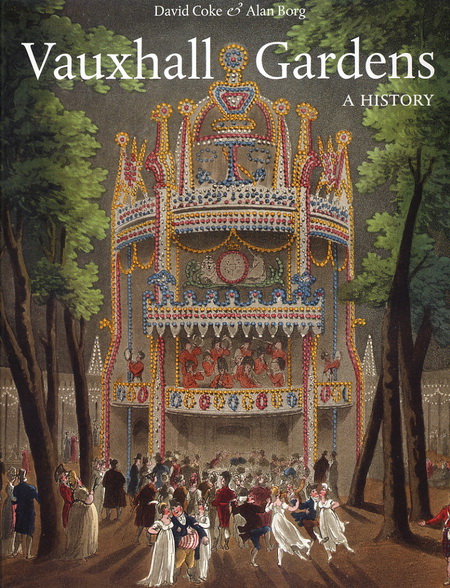
Vauxhall Gardens: A History

David Coke & Alan Borg

The Vauxhall Pleasure Gardens is one of the places I’d love to slip back in time to visit, just to catch a glimpse of what it was like. After recently splurging to buy this lovely coffee-table book, I thought it might make a wonderful subject for a new blog series. But do buy the book too, if you can! The photos are fabulous!

The Paintings in the Pillared Saloon

The Pillared Saloon was built onto the Rotunda in 1750-51 to provide more wall space for paintings and, of course, draw more visitors. The original idea was to have allegorical paintings of the royal family—Prince Frederick and his family—demonstrating how love of the arts manifested his virtue and patriotism. Frederick’s untimely death in 1751 put paid to this idea and delayed the project for almost ten years.

Two full-length portraits of George III and Queen Charlotte in their coronation robes did appear soon after their marriage in 1761. The royal pair is known to have sat for the painter—undoubtedly Frances Hayman—in person as a special favor to Jonathan Tyers.

The Seven Years’ War Paintings

In contrast to the lightheartedness of the supper-box paintings and the drama of the Shakespearean scenes, the four remaining paintings for the Pillared Saloon were to be patriotic history paintings. These were not the typical classical scenes or representations of events from the distance past, but “very recent military actions populated by real living people wearing contemporary costume.”

[Hayman] chose not the violence of heroic death or even topographical portrayals of military action, but rather its aftermath, in order to convey the virtues of the individual British military commanders, magnanimous and humane in victory.

pillaredsaloon001

The Surrender of Montreal to General Amherst

Amazingly, this painting appeared in the Pillared Saloon in 1761, only eight months after the event it depicts.

It was the most overtly propagandic of the four military scenes, emphasising the selfless humanity of General Jeffrey Amherst: Hayman showed him handing out food to the starving and defeated population and returning to them their possessions; this was intended to be in stark contrast to the merciless treatment they might have expected from the French, had they been victorious, and especially from their Indian allies.

In the Description (1762), much is made of the contrast between the defeated and miserable French and the victorious but humane British, and the author instructed readers to view the paintings as a true representation of one of ‘the most glorious transactions of the present war’.
pillaredsaloon002

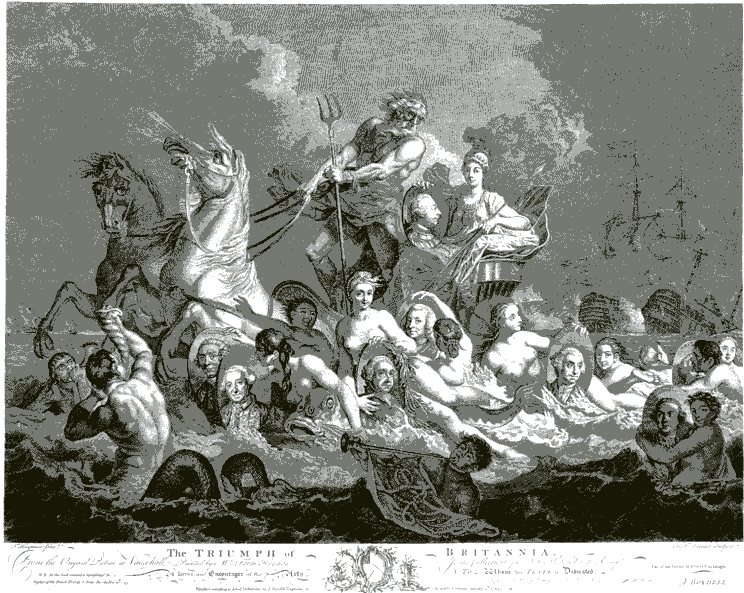
The Triumph of Britannia

The second painting, which was installed for the opening of the 1762 season, was a representation of the defeat of the French fleet at Quiberon Bay in November 1759. “As its allegorical title would suggest, it was intended to glorify the British military leaders involved in the action and the natural alliance of Britannia with Neptune that had given Britain mastery of the seas.”

However, because it did not entirely succeed in capturing the essential majestic dignity that was necessary to this type of allegorical work, the Triumph of Britannia was not always taken seriously by its audience. It is specifically and humorously singled out in Fanny Burney’s novel Evelina of 1778; during a visit to Vauxhall, Mr. Smith ridiculously mistakes the figure of Neptune for that of a famous general, despite the fact that he is wearing ‘the oddest dress for a general ever I see’.
Lord Clive, Hayman, 1760

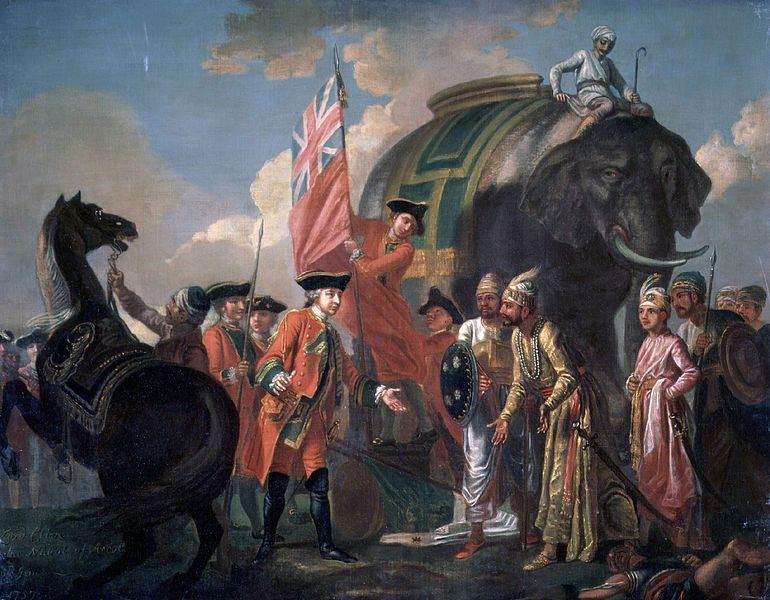
Lord Clive Receiving the Homage of the Nabob

A companion piece to the Surrender, this painting was installed in time for the 1763 season. The historical event depicted was the Battle of Plassey, at which Robert Clive ousted the ruling Nawab of Bengal, Siraj-ud-daula and, “in an apparently magnanimous act, [Clive] then supported the claim to supremacy of the elderly general Mir Jafar (c. 1691-1765), Nawab of Murshidabad, who had actually fought against the British, but who was more easily persuaded to the British point of view.”

In that battle the British forces were famously outnumbered by twenty to one, but were nevertheless victorious with the loss of only eighteen men (according to Clive), lending it the heroic ideal; in fact this was undeserved, and the British were saved from probable defeat only by the quick thinking of their artillerymen who covered their weapons and powder during a downpour, while the enemy did not.

The description of the painting started with “The subject of this picture is of the most interesting nature, to every Briton who regards the honour and propsperity of this country’, no doubt insinuating that it would be unpatriotic to criticize it.
The second description

praises General Clive for his leadership, and for his generosity in giving the sultanate to Mir Jafar;

therefore performing for his Country a most important Service, as well as procuring for the India Company and Individuals the Sum of Three Millions Sterling, for their Losses sustained at Calcutta; with such Privileges, Immunities, and Advantages, as they never enjoyed before. And this Revolution hath been moreover the Means of the India Company’s acquiring the Territorial Possessions, to the Amount of Seven hundred thousand Pounds per Annum.

In retrospect, General Clive’s generosity seems less altruistic considering the huge commercial gains resulting from the acquisition of this territory.

Britannia Distributing Laurels

A companion piece to the Triumph of Britannia, Britannia Distributing Laurels was installed in 1764. Unfortunately, no version of this piece is known to be in existence. However, it is known to have depicted the full-length figures of Generals Granby, Monckton, Albemarle, Coote, Townshend and Wolfe, all in Roman costume, allegorical in nature.

The story goes that, when Granby came to Hayman’s studio in St. Martin’s Lane, he challenged Hayman to a boxing match before the sitting. After a hesitant start, which Granby overcame by saying that the exercise would give animation to his portrait, Hayman apparently floored the marquis with a tremendous punch to the stomach, and Mrs. Hayman, hurrying upstairs to see what the noise was, found them ‘rolling over each other on the carpet like two bears.’

Tyers as the Ultimate Patron of 18th century British Art

The inscription under the engraving of Hayman’s Triumph of Britannia describes him as a ‘”Lover and Encourager of the Arts.’” He was described by Henry Angelo as having “laid out more money in the encouragement of English art than any man of his time. Indeed, his house was so full of pictures, that after hanging them, even on his stair-case, there were still some to spare.”

Jonathan Tyers didn’t just use art to further his commercial ambitions; he was a true conoisseur. And it was his dream to open up the arts to all layers of society, not just the upper class.

The huge developments in British art through the middle of the eighteenth century were in large part due to the concurrence of Vauxhall Gardens, the Foundling Hospital, the Society of Artists and the Royal Academy and to the men involved in those institutions, notably Hogarth, Hayman and, of course, Tyers… After the collaboration of Tyers and Hayman, the visual arts at Vauxhall never again received the same degree of patronage from its proprietors.

The paintings and sculpture at Vauxhall Gardens would have been the best-known works of art in England at the time, seen by tens of thousands of people, including significant numbers of artists, every year. Although Tyers owed much to Hogarth, initially the driving force behind the artistic concept of the gardens, it was Hayman, Tyers’s artistic director, who could be seen as the more influential figure. This was partly because of the huge exposure of his original work at Vauxhall, and also because he was the linchpin that held together the London art profession, with a finger in all the principal artistic pies of the time—the St Martin’s Lane Academy, Vauxhall Gardens, the Foundling Hospital, the Society of Artists and, eventually, their august offspring, the Royal Academy.

Susana’s Vauxhall Blog Post Series

  1. Vauxhall Gardens: A History
  2. Vauxhall Gardens: Jonathan Tyers—“The Master Builder of Delight” 
  3. Vauxhall Gardens: A New Direction
  4. Vauxhall Gardens: The Orchestra and the Supper-Boxes 
  5. Vauxhall Gardens: The Organ, the Turkish Tent, and the Rotunda
  6. Vauxhall Gardens: Three Piazzas of Supper-Boxes
  7. Vauxhall Gardens: “whither every body must go or appear a sort of Monster in polite Company”
  8. Vauxhall Gardens: The Competition
  9. Vauxhall Gardens: The Artwork, Part I
  10. Vauxhall Gardens: The Artwork, Part II
  11. Vauxhall Gardens: The Music, 1732-1859
  12. Vauxhall Gardens: The Business Side
  13. Vauxhall Gardens: Developments from 1751-1786
  14. Vauxhall Gardens: Thomas Rowlandson’s Painting (1785)
  15. ‎Vauxhall Gardens: The Third Generation of the Tyers Family and the Jubilee of 1786
  16. Vauxhall Gardens: An Era of Change (1786-1822), Part I
  17. Vauxhall Gardens: An Era of Change (1786-1822), Part II
  18. Vauxhall Gardens: An Era of Change (1786-1822), Part III
  19. Vauxhall Gardens: The Final Years, Part I
  20. Vauxhall Gardens: The Final Years, Part II
  21. Vauxhall Gardens: The Final Years, Part III
  22. Vauxhall Gardens: The Final Years, Part IV
  23. Vauxhall Gardens: Farewell, for ever
Susana’s 2015 English Adventure: Travel Tips

Screen Shot 2015-09-29 at 7.13.26 AM

Plan in advance

As I’ve mentioned before, I planned mine with Cheryl Bolen’s excellent book, English Stately Homes By Train. I used the print version during the planning stage and the digital version for reference while in England. It’s always a good idea to check each location’s website before you go for updated information such as opening times.

bolen

Arrange for a home base

If your trip is longer than a week, consider renting a flat in a location central to the area you want to visit. London (Baker Street) is my choice, but it is pricey, so you’ll have to weigh the price against the value of convenience. On my recent trip, I spent six of my nineteen paid nights outside of London, which added to the cost, but was totally worth it, in my opinion, not to have to carry all of my luggage around with me.

Of course, traveling with others and splitting the cost is a great way to economize, even if you have to find a larger flat. Mine is a studio efficiency consisting of one room, a bathroom, and a tiny kitchen. Perfect for one person or perhaps a married couple.

Be sure to check for amenities before you sign the contract. My flat has satellite TV and Wifi, but no air conditioning. Last year when I was there in May and June, it was so hot I couldn’t sleep. The management finally got me a small fan, which was a great help, and I was glad to see it was still there this year.

No matter how careful you are, there may be unforeseen issues. For example, last year, someone in a nearby flat was doing construction during the day. If you plan to be out most of the day, this won’t be a problem. But if you want to stay home and rest or write on a weekday, you’ll need some really good noise-canceling headphones.

Get a cell phone

My U.S. phone does not work outside of the U.S., but my rental flat comes with one. I didn’t use it last year, but found that to be a mistake. As wonderful as the rail system in England is, there are plenty of unmanned train stations in the middle of nowhere. Last year, I found myself stranded at such a place, finding not even a public telephone, and panicked for a few moments until a kind person offered to make a call for me. This year I took the rental flat phone around with me, and needed to use it several times. (As helpful as Cheryl Bolen’s book is, there are times when you will find there are no taxis at the taxi queue you are counting on being there and you will need to call for one to get to your destination.)

If I hadn’t had to use it, it would still have been worth it for the peace of mind. I’m used to traveling on my own—although this year I did have Squidgeworth with me—but I don’t like to think I might get stranded in some unknown place. The Brits I’ve met have been exceedingly friendly and helpful, but there’s always a chance I might meet up with one who is not.

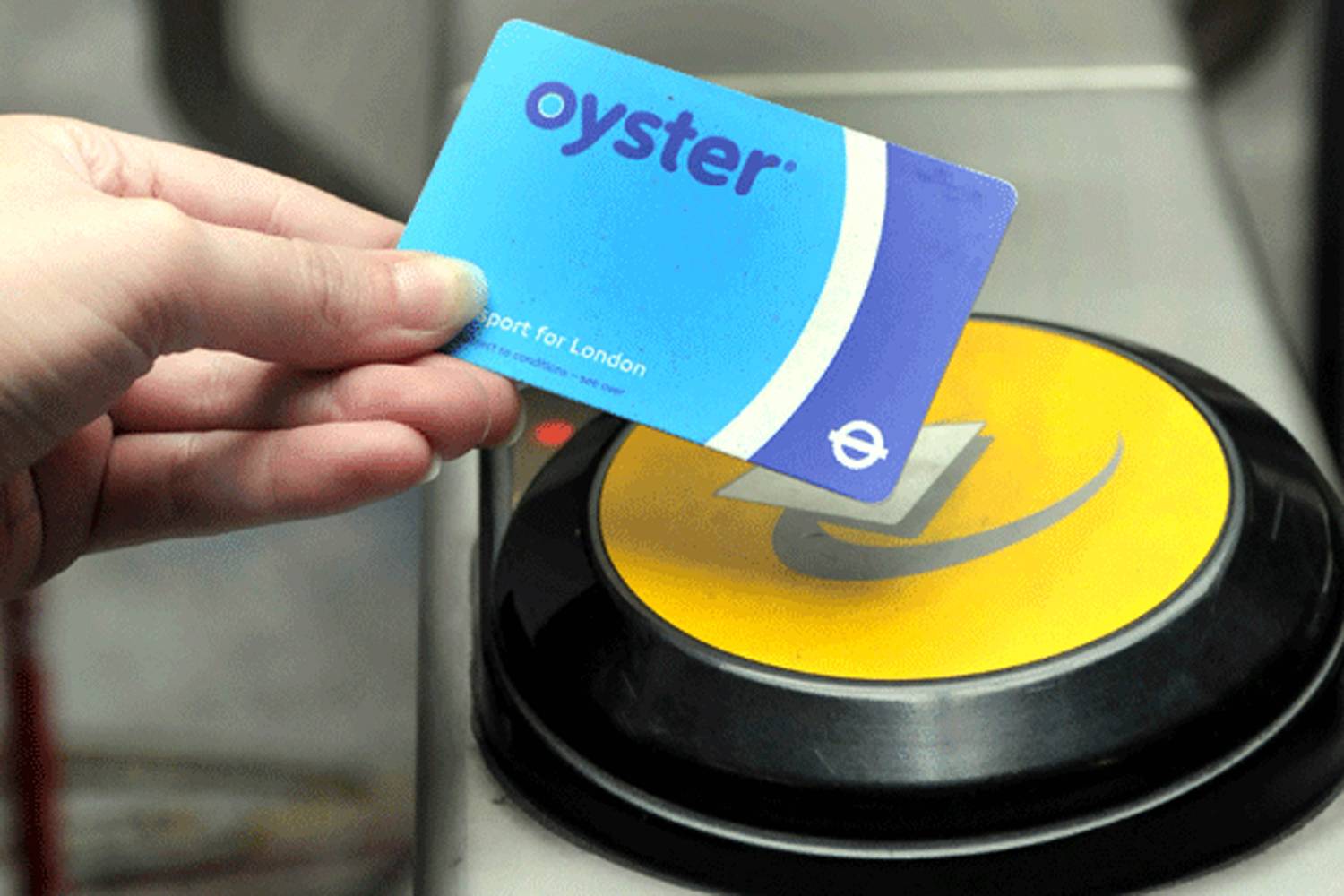
Get an Oyster card

An Oyster card is an electronic card for use in the London Underground system, which includes buses and some localized trains. You can get the card upon arrival at the airport. You pay something like £5 for the card and then whatever amount you want to load onto it. I bought mine four years ago and use it every year. It’s easy to load the card from one of the machines at each Underground station. I estimate I used about £90 on mine during my three-week trip.

oyster

If this is your first trip, you can purchase the London Pass, which gives you fast-track entry to many of the most popular London sights, and an Oyster card is included. Keep the Oyster card for future trips.

Get a BritRail pass

BritRailFlexiPass2009

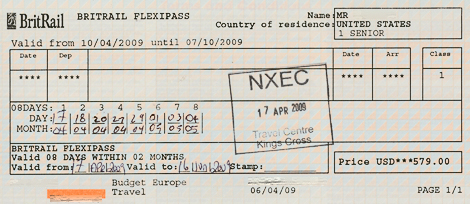
This is a Google image. Mine did not cost this much.

In previous years I simply used my computer to buy rail tickets online and learned how to retrieve them from the machine at the rail station. This year I decided to try a BritRail pass instead—which must be obtained before your arrival in England. I purchased mine from the VisitBritain Shop. I wasn’t sure how many days I’d be traveling by train, but the eight-day, non-consecutive one proved perfect for my three-week trip. Besides being a money-saver, it’s convenient not to have to make a commitment for a specific train and then worry about missing it and having to buy another ticket. For example, when I went to Waddesdon Manor, I simply checked online beforehand to ascertain the availability of trains for the return journey and while there I could enjoy myself without having to rush to make it in time for the train. (I did, however, have to make arrangements with the taxi driver to pick me up at a certain time, since there is no taxi queue at Waddesdon Manor either.)

Consider purchasing English Heritage and National Trust passes

englishheritage

If many of the sights you wish to see are designated as English Heritage or National Trust locations, you might be able to save money by purchasing passes valid for the length of your trip. I purchased a National Trust pass from the VisitBritain Shop, but lost it. Oh well. I always feel good about supporting the efforts to maintain these wonderful-but-expensive historic buildings.

nationaltrust

Prepare for inclement weather

It rains in England. Get over it.

As much as we would all love having warm, sunny days for our long-anticipated visit, chances are it’s going to rain. Maybe it’ll just rain for a few minutes. But it might rain all day, and if you’re really unlucky, it might rain all day, every day. Don’t let it spoil your trip. Take a waterproof jacket and an umbrella and some good walking shoes that won’t be ruined by mud. You might not feel like traipsing through miles of gardens in rainy weather, but you can still see the manor house and the outbuildings (if any), and get a few photos of the grounds. At Witley Court, I took a video of the fountain in the rain (goes off every hour).

Frankly, I prefer a bit of rain to 80-90-degree weather. These manor houses do not have air conditioning, so when it’s hot outside, it’s at least as hot inside. But if that’s what I get, oh well. C’est la vie. Some things are just not worth whining over.

Prepare to do lots of walking

You walk to the Tube station. You walk a lot inside the Tube station. You walk from the Tube station to your destination. While at your destination, you walk. The same goes for trains. While you can take the Tube to Osterley, you still have to walk a bit to get to the grounds of Ostlerley Park, and then there is a very long driveway to get to the house. (There is a shuttle, but I didn’t encounter the shuttle until I was almost there.) In any case, you have to remember that these stately manors were built on huge estates, often set back a mile or more from the main road. If—like me—you’ve decided not to try to drive in England, you’re going to have to get used to walking. And paying for taxis for the more inaccessible places. That’s just the way it is.

The way I figure it, walking is good for me. I should walk more than I do. It’s great to be able to walk. I wear good walking shoes, carry as little as possible with me, and take Extra-Strength Tylenol when my back starts to hurt. (And I wear my Fitbit and brag online about my walking, but that’s optional.)

If you are a great walker to begin with and would like to extensively explore the grounds of the manor you are visiting, you might consider staying overnight nearby. Oftentimes the house is open only four or five hours, and the grounds a bit longer, but if you want to make thorough visits to both, you might want to plan for two days or even more. You’ll probably have to pay an extra entrance fee for an additional day, but most places have a lower fee for the grounds only. And if it’s a National Trust or English Heritage site, having the pass will save you lots if you want to visit multiple times.

Consider staying overnight at a historical site

Last year I stayed at Leeds Castle (the Stable Courtyard) and Hever Castle (the Astor Wing), and loved being able to get up early in the morning and walk in the grounds before the gates opened to the public. I also stayed at the Devonshire Arms in Beeley the night before I went to Chatsworth. Lovely little town on the Devonshire estate.

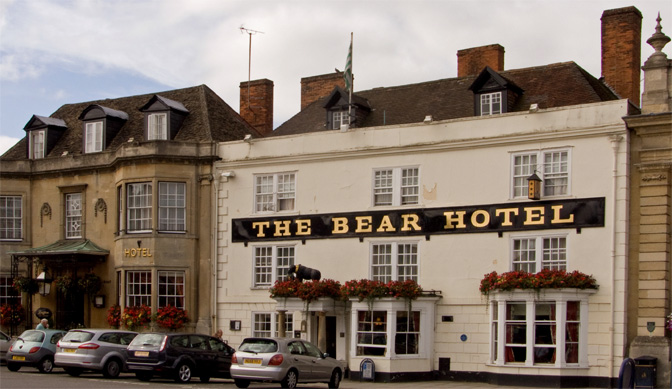
This year I stayed at the Bear Inn at Devizes, which was one of the coaching inns mentioned in my Coaching Days & Coaching Ways blog series last year. There are so many of these out-of-the-way places in England. Seek out a few and enjoy the atmosphere that comes with centuries-old buildings and towns. You won’t regret it.

Consider… gulp… renting a car and driving

Did I just say that? I guess I did. The thing is, there are lots of great places to visit  that might be more than a little problematic to get to without driving. At the moment, I still have quite a few to go before I get to that point. But if I do, would I forego visiting them just because I’m hesitant to drive on the left side of the road? I don’t think so. I’ll find a way to do it if I have to. Because I don’t think I’ll ever be done with visiting England’s great historical sites.

driving_left_0903

But when I do get to that point, I’ll be sure to warn my English friends of my travel plans so they can stay out of my way.

Addendum: About electrical converters…

You probably won’t need them. Yes, you’ll need an adapter plug or two for charging up your electronic equipment, but these days most (if not all) of them are multi-voltage devices. Click here for more information. In most cases, you won’t need to take a hair dryer with you, since hotels and B&B’s usually provide them. Newer hair dryers are dual-voltage and have a switch for 110- or 220-volt electrical currents. If you need something like a curling or straightening iron, you might consider buying one in the UK to use for this and future trips. It’s a lot simpler than messing around with converters and the like. For a toothbrush, I keep a battery-operated one in my travel case, so there’s no need to recharge it.

Susana’s 2015 English Adventure: Week 4

map

On Monday I hopped on a train to Birmingham, then changed to one for Kidderminster. (I just love these English names, don’t you? Mousehole is my favorite, but I’m assured that it is a lovely place to visit despite the name.) At Kidderminster, I took a taxi to The Elms Hotel in Abberley, where I was met by the lovely Heather King and her fabulous, quadralingual dog, Roxy. Heather is an amazingly talented author of Regency stories (and, as Vandalia Black, of rather darker paranormal ones). Heather and I are online friends and have been part of two Regency anthologies, Beaux Ballrooms, and Battles and Sweet Summer Kisses. It was truly awesome to meet her in person, as well as Roxy and the ponies, Merlin and Dub-Dub, and Sootie, the black cat whose offspring were too high-in-the-instep to become acquainted with a Yankee. Heather served me Toad-in-the-Hole, which turned out to be a sort of English comfort food: sausages baked in a sort of pancake batter and served with hot gravy. Besides being very tasty, it served to warm us up inside and outside, after a day spent mucking about the ruins of Witley Court in the pouring rain. (It rains in England. Deal with it.)

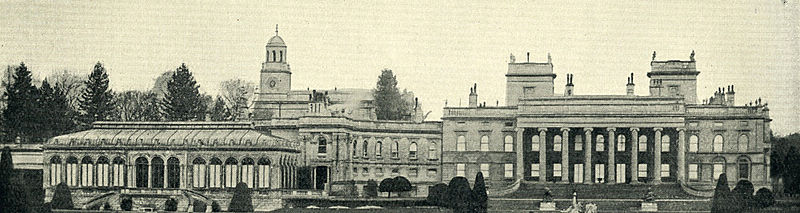
Witley Court

Witley Court was once one of the great houses of the Midlands, but a devastating fire in 1937 left it in ruins. While one cannot but regret the loss of such a beautiful home, the exposure of the “bare bones” has proved to be valuable to historians interested in learning about historical building practices.

800px-Witley_Court_circa_1900_2

Witley Court, 1900

Witley Court today

Witley Court today

Thomas Foley (whose grandson became the 1st Baron Foley) built the house in 1665 on the site of a manor house. Additions were made by John Nash in the 19th century, and the house was sold to the Dudley family (later to be given an earldom) in 1837.

Tramping about the ruins of the house turned out to be much more appealing than one might have expected, even in the pouring rain! The gardens are lovely, particularly the fountain (see video here), and the parish church on the property—which is not a ruin—is magnificent.

See photos here.

Berrington Hall

On Tuesday Heather, Roxy, and I visited Berrington Hall, a splendid country home in Leominster (pronounced Lemster, or so they tell me). It was designed in the late 18th century by Henry Holland, whose talent, although not eclipsing that of my favorite, Robert Adam, puts him solidly in second place, in my estimation.

In addition to the rich furnishings and décor, there was an exhibit of Georgian fashion throughout the house, which included—believe it or not—costumes from the 1995 BBC production of Pride and Prejudice. Yes, I was close enough to touch the costumes worn by Darcy and Lizzie during the final proposal scene, as well as many others. Truly an awesome experience!

Henry Holland!!!

Henry Holland!!!

The vast grounds include a walled garden with some vintage apple trees, a ha-ha, a lake, and some lovely paths. Heather and I enjoyed a delicious picnic before exploring further some of those paths. And not a drop of rain!

See photos here.

Waddesdon Manor

On Wednesday I took a train to Aylesbury, in Buckinghamshire (where, incidentally, the estate of my hero in The Third MacPherson Sister is located) to visit Waddesdon Manor.

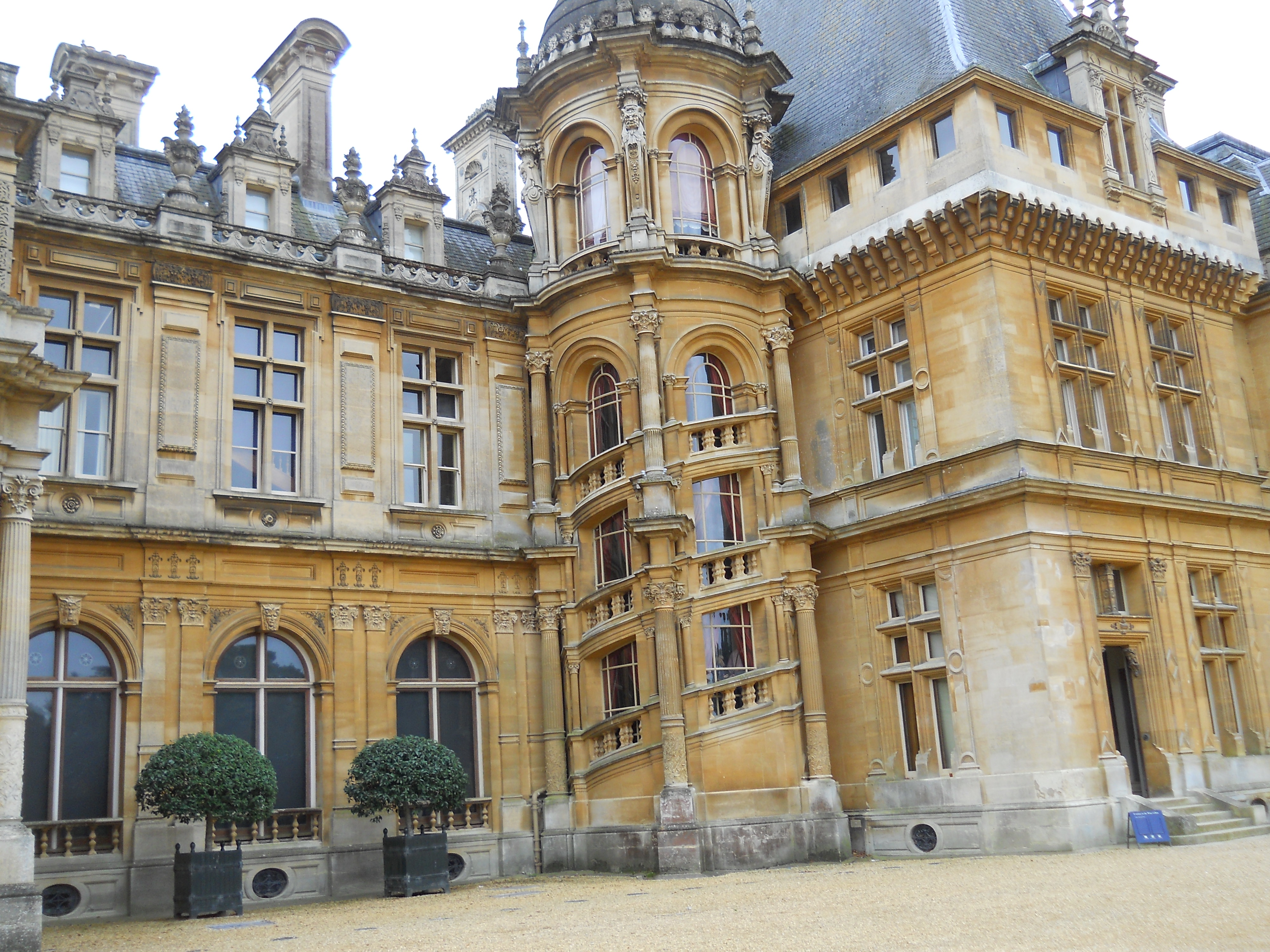
Waddesdon Manor was built in neo-renaissance style in the late 19th century as a sort of French château by the Baron Ferdinand de Rothschild of the Austrian banking family. The baron fell in love with his second cousin, Evelina, and married her, only to lose her in childbirth eighteen months later. The baron never married again, but became a compulsive collector instead. The furnishings are considered to be among the richest of any stately manor anywhere.

These stairs are reminiscent of those at the Château de Chambord in France

These stairs are reminiscent of those at the Château de Chambord in France

Unfortunately, I was only able to tour the house due to time considerations, but I plan to visit again to get a good look at the extensive grounds and other buildings, such as the Aviary and the Dairy.

Although cloudy, it didn’t rain until I had returned to London, where I got promptly soaked making a last round of Piccadilly Street and Fortnum & Mason. But hey, it rains in England. That’s why it’s so beautiful!

See photos here.

Adieu to England

Squidgeworth enjoyed his orange juice on the plane.

Squidgeworth enjoyed his orange juice on the plane.

It was with a tear in my eye as Squidgeworth and I said goodbye to England on Thursday. For now. We had a marvelous time and were fortunate to be able to visit many wonderful places, but there are still lots more on our bucket list. I’ve already booked our flight and flat for next year’s trip in August.

So much to see, so little time!

Next week: Squidgeworth and I have some travel tips for you!

Susana’s 2015 English Adventure: Week 3

house copy

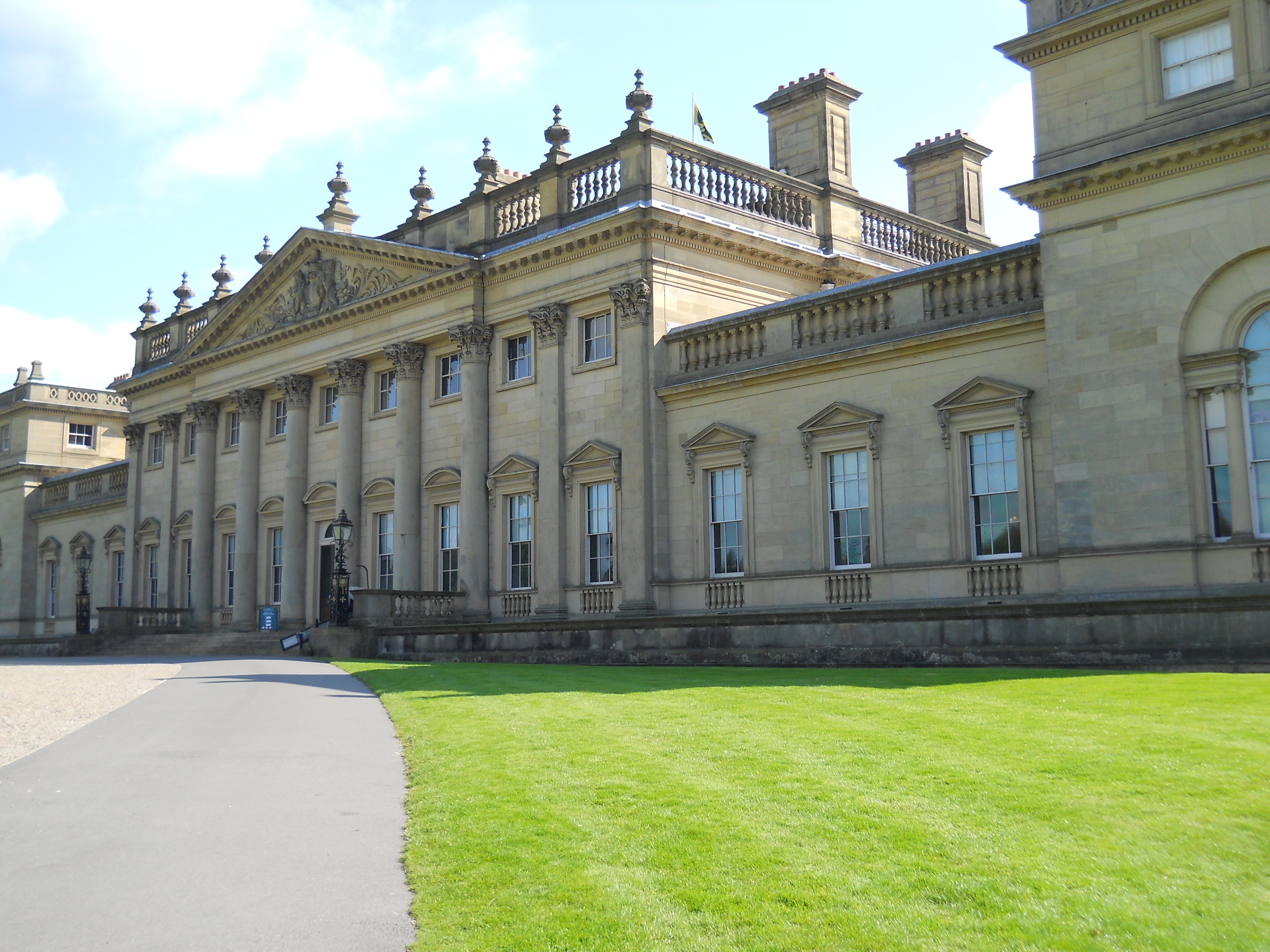
Harewood House

Harewood

On Monday I took an early train north to York, left my suitcase at the hotel, and headed off to Harewood (which can be pronounced either hairwood or hahrwood, depending on the person with whom you are speaking).

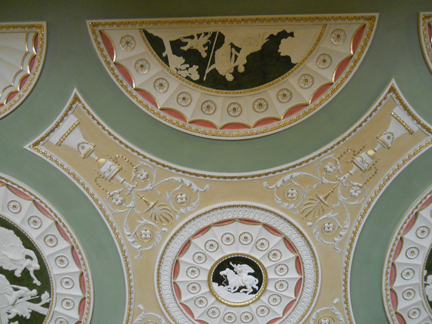
My overall reaction to Harewood is… Robert Adam! I don’t know how the man got around to accomplishing so much in England’s great houses in one lifetime, but from now on I will judge all of the ones I visit by the quality of their Robert Adam touches (or lack of it).

ceiling5 copy

Oh yes, I suppose I should mention the excellent work by Charles Barry and the Chippendale furniture too. Utterly fabulous!

In later years, Harewood was the home of Queen Elizabeth’s aunt, the Princess Mary, after she married the sixth Earl of Harewood, Henry Lascelles, who served in the First World War.

Photos of Harewood

Castle Howard

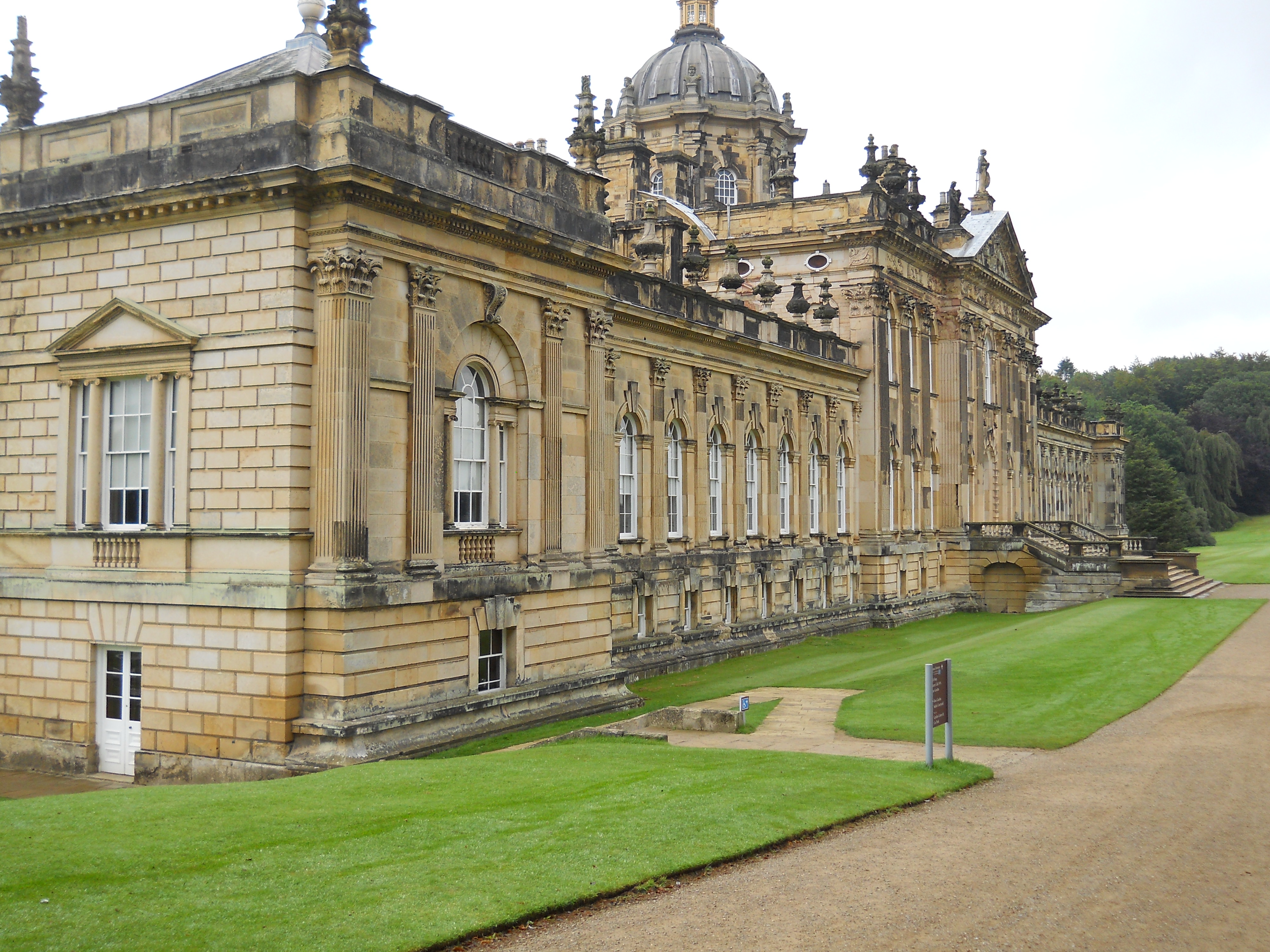
Castle Howard was originally built in 1700 by the 3rd Earl of Carlisle, who was a younger son of the Duke of Norfolk. Yes, Catherine Howard, unfortunate fifth wife of Henry VIII, was of the same family, but she predated the house. John Vanbrugh, the architect, was also the architect for Blenheim Palace, which is spectacular in itself.

The 4th and 5th earls traveled widely on the continent and were great collectors. The current earl lives at another house, and this one is owned by a private trust, headed by Carlisle family members.

CastleHoward2 copy

Castle Howard is well-known for being the setting of the popular Brideshead Revisited television series.

The 6th countess was the eldest daughter of the 5th Duke of Devonshire and his wife Georgiana. She became the mother of 12 children, and you can see her bedroom in the photos.

Photos of Castle Howard

Haworth

One of my favorite books of all time is Jane Eyre, and I loved Wuthering Heights as well. So visiting the parsonage where the Brontë family lived with their vicar father was a significant milestone. Very different from the magnificent houses I’ve been visiting on this trip! Startling to hear that nearly half of all children born at this time died before the age of six, and poor Rev. Brontë saw his wife and all his children die before he did.

paintingbyBranwell

Photos of Haworth

The Foundling Museum

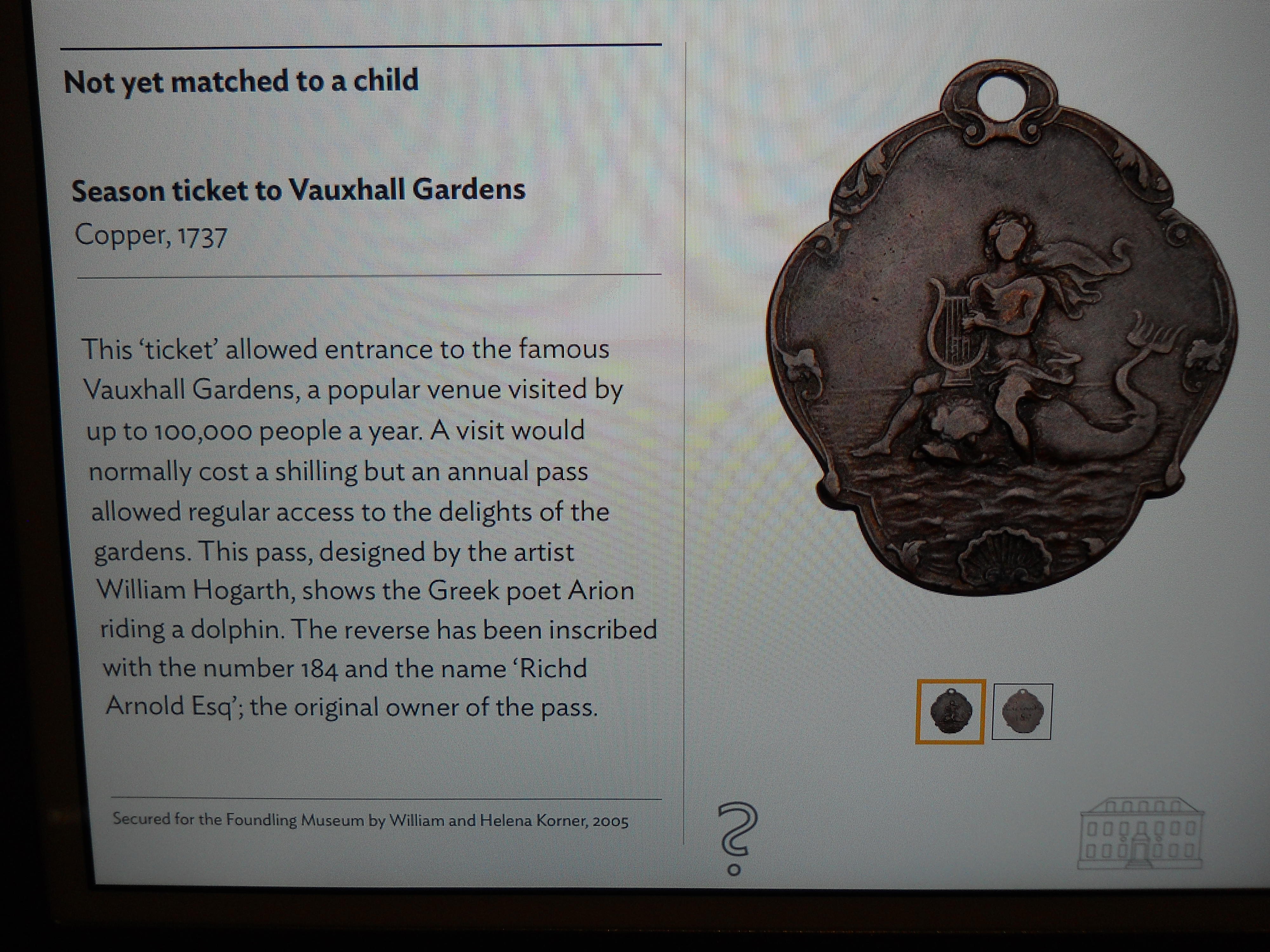
If you ever wondered what happened to England’s abandoned children, this museum tells the sobering story of the Foundling Hospital, Britain’s first home for abandoned children. Mothers who left their children there also left tokens (buttons, jewelry, coins, or whatever they had) to identify their children in case their circumstances changed and they could claim them someday. Unfortunately, most of the children were never claimed. At the ages of 9-14, children were sent away to be apprentices or servants. It wasn’t an ideal situation, but at least the children were fed and clothed and educated up to a point, which was certainly better than being left to die in the streets, which was a common practice in some areas. Sadly, much of society shunned the offspring of prostitutes or unmarried couples and really didn’t consider it a great loss if they died.

One mother left a Vauxhall season pass as a token for her child

One mother left a Vauxhall season pass as a token for her child

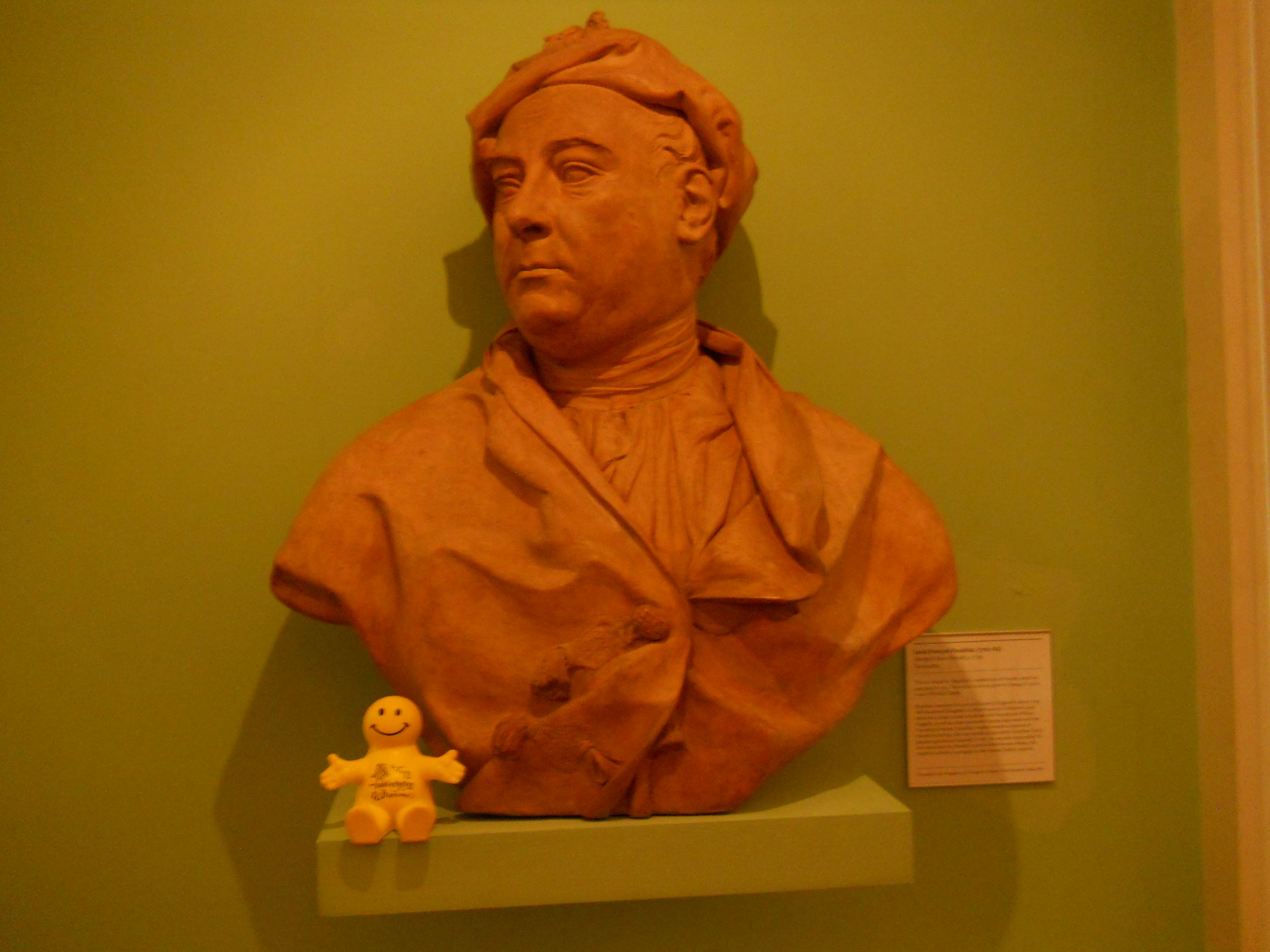
Another focus of the museum is the founder, Thomas Coram, as well as supporters William Hogarth and George Frideric Handel and a large collection of paintings donated to the hospital that were used to entice potential contributors to come to the hospital.

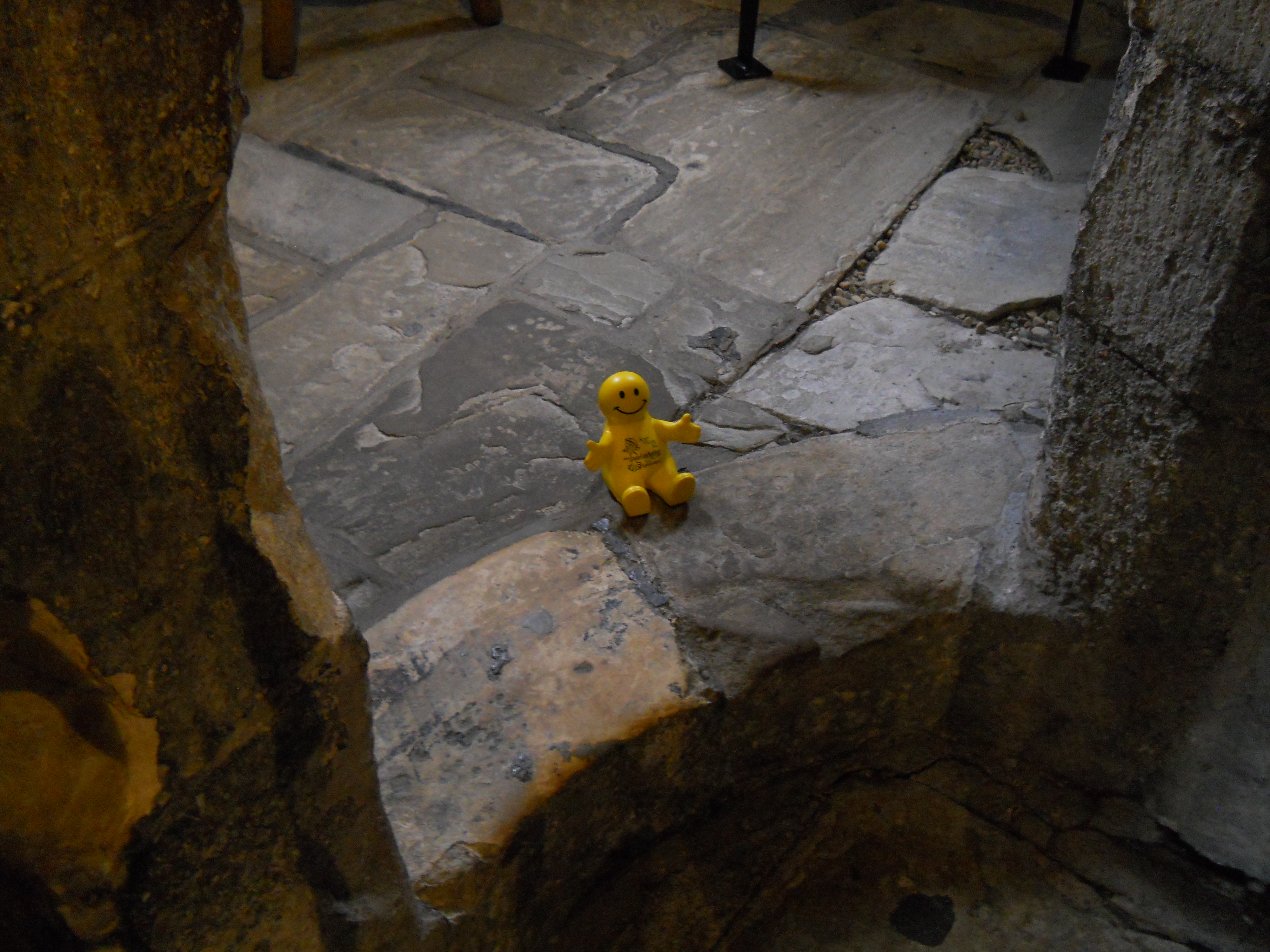
Squidgeworth found a friend!

Squidgeworth found a friend!

See photos here.

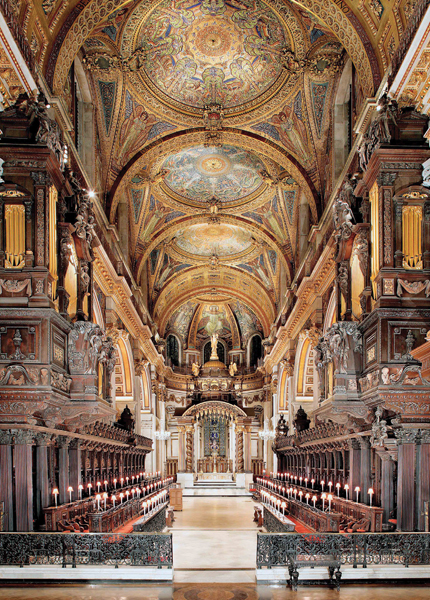
St. Paul’s Cathedral

Beautiful and impressive. Admiral Lord Nelson and the Duke of Wellington are buried in the crypt.

GTO 225 London.qxp:Regional Update.qxd

See photos here.

York

Spent a day walking around York and shopping. Did the Richard III Experience and Squidgeworth got put in jail for a short time, but he smiled all the way through it. Nothing gets him down, not even getting shut up in that tiny cell.

yorkprison

See photos here.


Sadly, less than a week remains before Squidgeworth and I fly back across the pond.

So much to see, so little time!

The Bluestocking Belles: Mistletoe, Marriage & Mayhem

box set 2

The first joint volume of the Bluestocking Belles—seven Christmas novellas about runaway brides—will be released on November 1, 2015. We’re excited! It’s currently running #12 on Amazon’s Hot New Releases, and if you order it now, you’ll have it on your device by November 1 at only 99¢.

100% of royalties go to the Malala Fund. Find out more here.

About Mistletoe, Marriage & Mayhem

All She Wants for Christmas

Amy Rose Bennett

A frosty bluestocking and a hot-blooded rake. A stolen kiss and a Yuletide wedding. Sparks fly, but will hearts melt this Christmas?

The Ultimate Escape

Susana Ellis

Abandoned on his wedding day, Oliver must choose between losing his bride forever or crossing over two hundred years to find her and win her back.

‘Tis Her Season

Mariana Gabrielle

Charlotte Amberly returns a Christmas gift from her intended—the ring—then hares off to London to take husband-hunting into her own hands. Will she let herself be caught?

Gingerbread Bride

Jude Knight

Travelling with her father’s fleet has not prepared Mary Pritchard for London. When she strikes out on her own, she finds adventure, trouble, and her girlhood hero, riding once more to her rescue.

A Dangerous Nativity

Caroline Warfield

With Christmas coming, can the Earl of Chadbourn repair his widowed sister’s damaged estate, and far more damaged family? Dare he hope for love in the bargain?

Joy to the World

Nicole Zoltack

Eliza Berkeley discovers she is marrying the wrong man—on her wedding day. When the real duke turns up, will her chance at marital bliss be spoiled?

Under the Mistletoe

Sherry Ewing

Margaret Templeton will settle for Captain Morledge’s hand in marriage, until she sees the man she once loved at the Christmas party she presides over for her would-be betrothed.

Available now for pre-order price of 99¢

Amazon.comAmazon.caAmazon.uk Amazon.au

KoboiBooks

About the Bluestocking Belles

The Bluestocking Belles’ books carry you into the past for your happy-ever-after. When you have turned the last page of our novels and novellas, keep up with us (and other historical romance authors) in the Teatime Tattler, a Regency scandal sheet, and join in with the characters you love for impromptu storytelling in the Bluestocking Bookshop on Facebook. Also, look for online games and contests and monthly book chats, and find us at BellesInBlue on Facebook, Twitter, and Pinterest. Come visit at http://www.BluestockingBelles.com and kick up your bluestockinged heels!

Website FacebookTwitterPinterest • Newsletter

Check out our recent publication:

The Bluestocking Belles’ Guide to a Good Time

gamebooktoshare

  • games and puzzles related to historical romance
  • excerpts from some of the Belles’ books
  • information about the Malala Fund, to which all profits from our joint projects are committed

Free download here or purchase here for $4.99

Susana’s 2015 English Adventure: Week 2

Hatfield House

Hatfield House is a Jacobean manor built by Robert Cecil, the son of William Cecil, the most trusted advisor of Elizabeth I. Robert succeeded his father as Elizabeth’s advisor, eventually becoming an advisor of James I as well. Robert Cecil is the one who discovered the plot of Guy Fawkes and others to blow up the House of Lords. A later Cecil (James) was made Marquis of Salisbury, and the Salisburys still own and live at Hatfield House more than 500 years later.

Hatfield Palace, which stood nearby (of which only a banquet room remains) was where all of Henry VIII’s children (Mary, Elizabeth, and Edward) were raised. It was here where Elizabeth learned that she was queen after the death of her sister Mary.

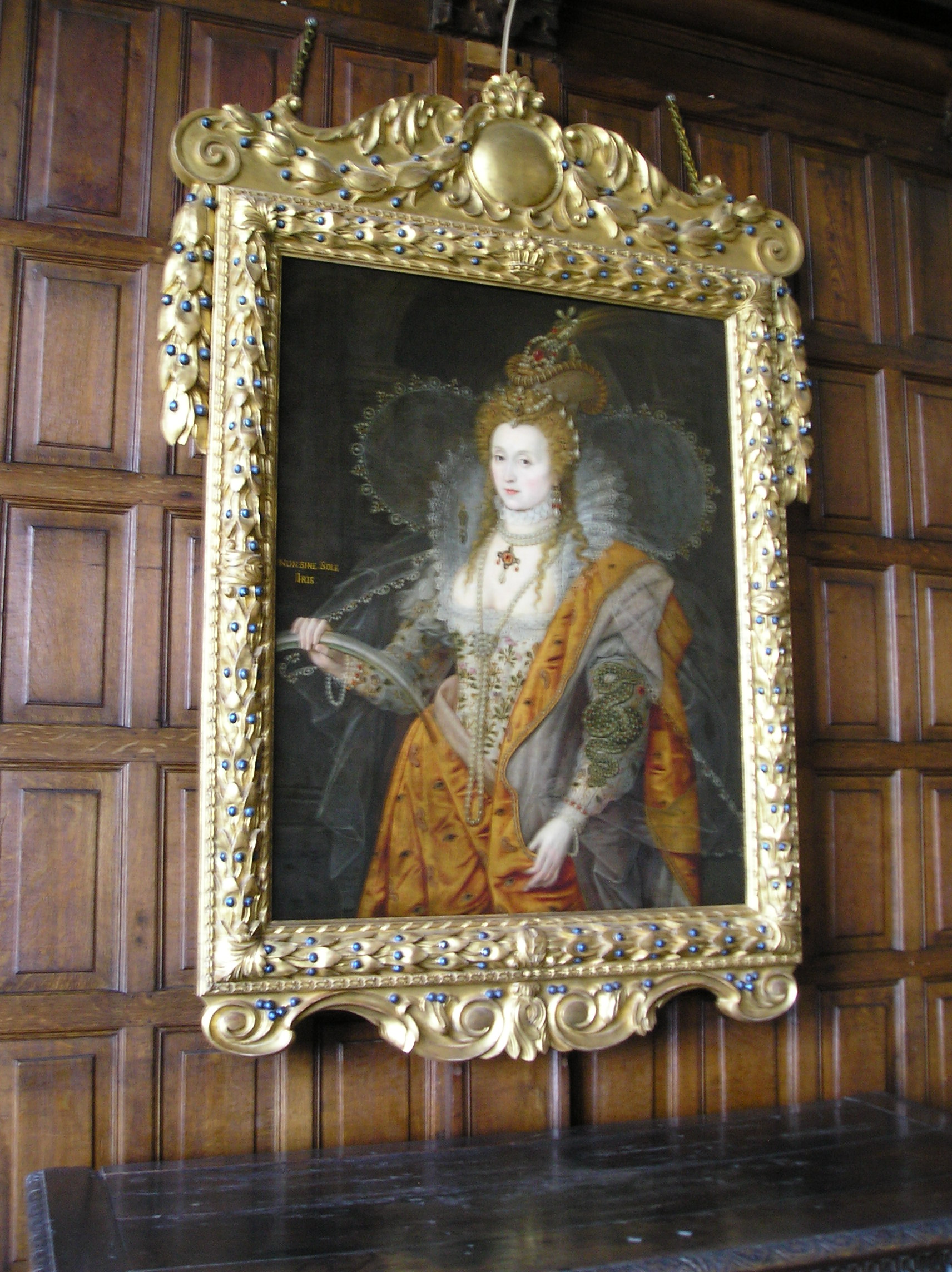
OLYMPUS DIGITAL CAMERA

Elizabeth I

Photos of Hatfield House

Kenwood House

William Murray, 1st Earl of Mansfield, bought the house in 1754 and commissioned Robert Adam to remodel it, which he did from 1764-1779. The library is a masterpiece of Robert Adam genius, but the rest of the house is equally splendid. It is a pity that most of the original Adam-designed furniture was dispersed long ago, but a later owner, a Lord Iveagh, purchased the house in 1925 and displayed his fabulous collection of paintings there before leaving the house and its contents to the nation in 1927.

LIBRARY3

Lord Mansfield and his wife never had children of their own, but they did take in two young daughters of nephews: Lady Elizabeth Murray and Dido Belle, who was a mixed-race daughter of an enslaved West Indian woman. Dido Belle was the subject of a recent film, Belle.

Dido Belle and Elizabeth Murray

Dido Belle and Elizabeth Murray

Pictures of Kenwood House

Buckingham Palace

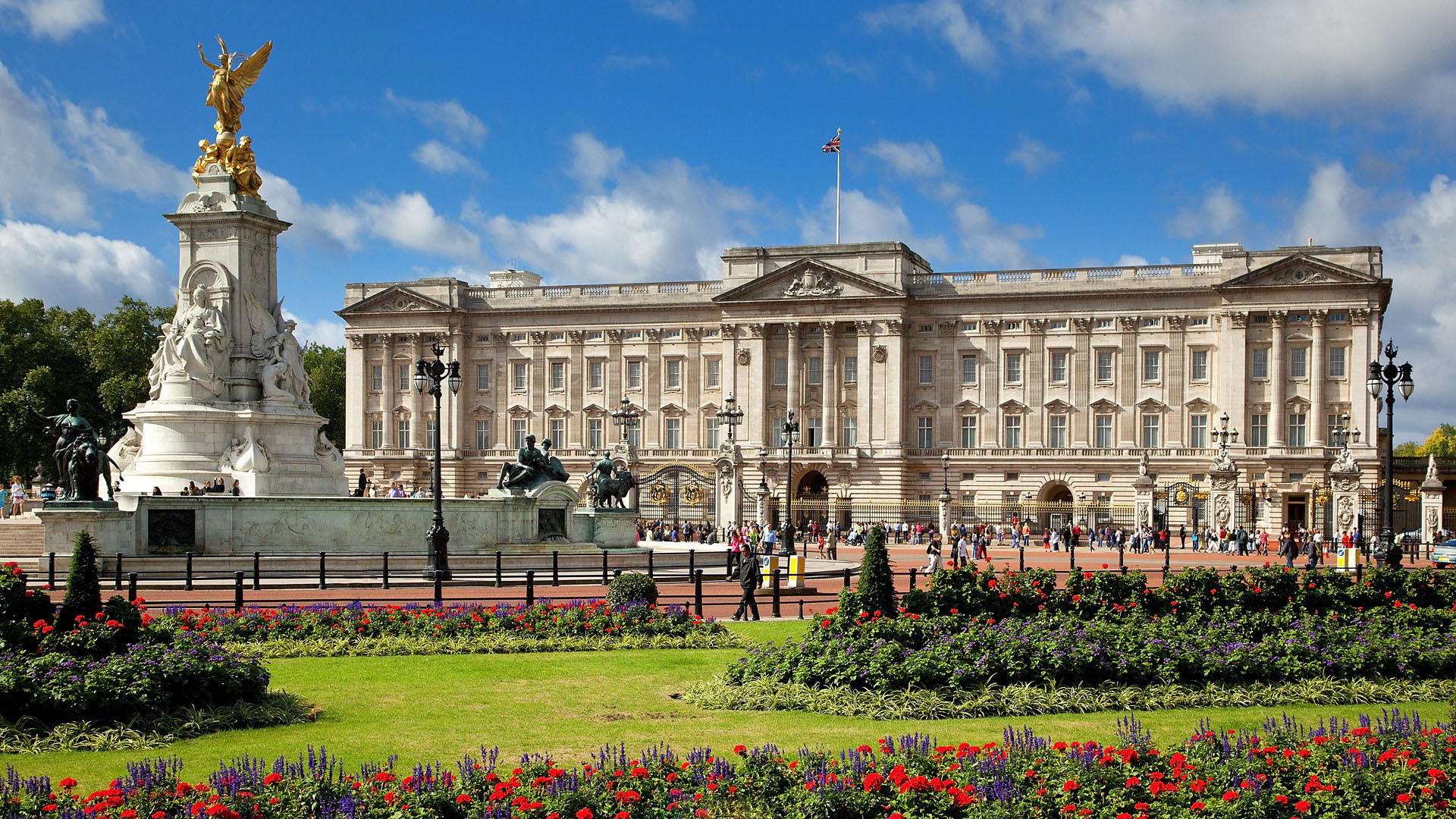
Buckingham Palace needs no introduction from me. I scheduled my trip this year so that I could visit, since it’s only open to visitors when the Queen is on holiday in Scotland (August and September). No photographs allowed, so I pinned these from other people’s Pinterest boards.

Here’s Squidgeworth ready to enjoy a coffee and scone with me after the tour.

SNACKATBUCKINGHAM

Pictures of Buckingham Palace

Osterley Park

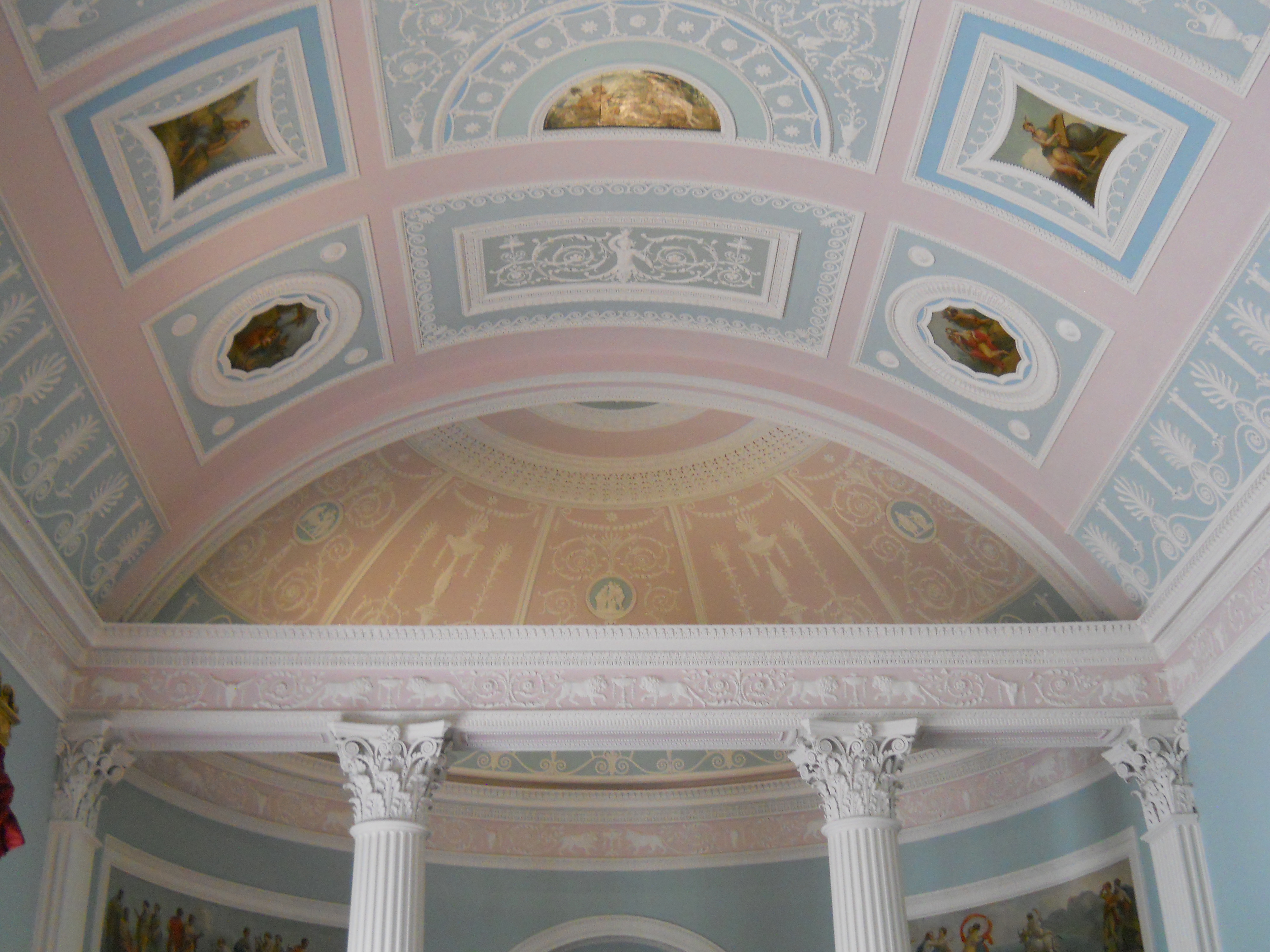
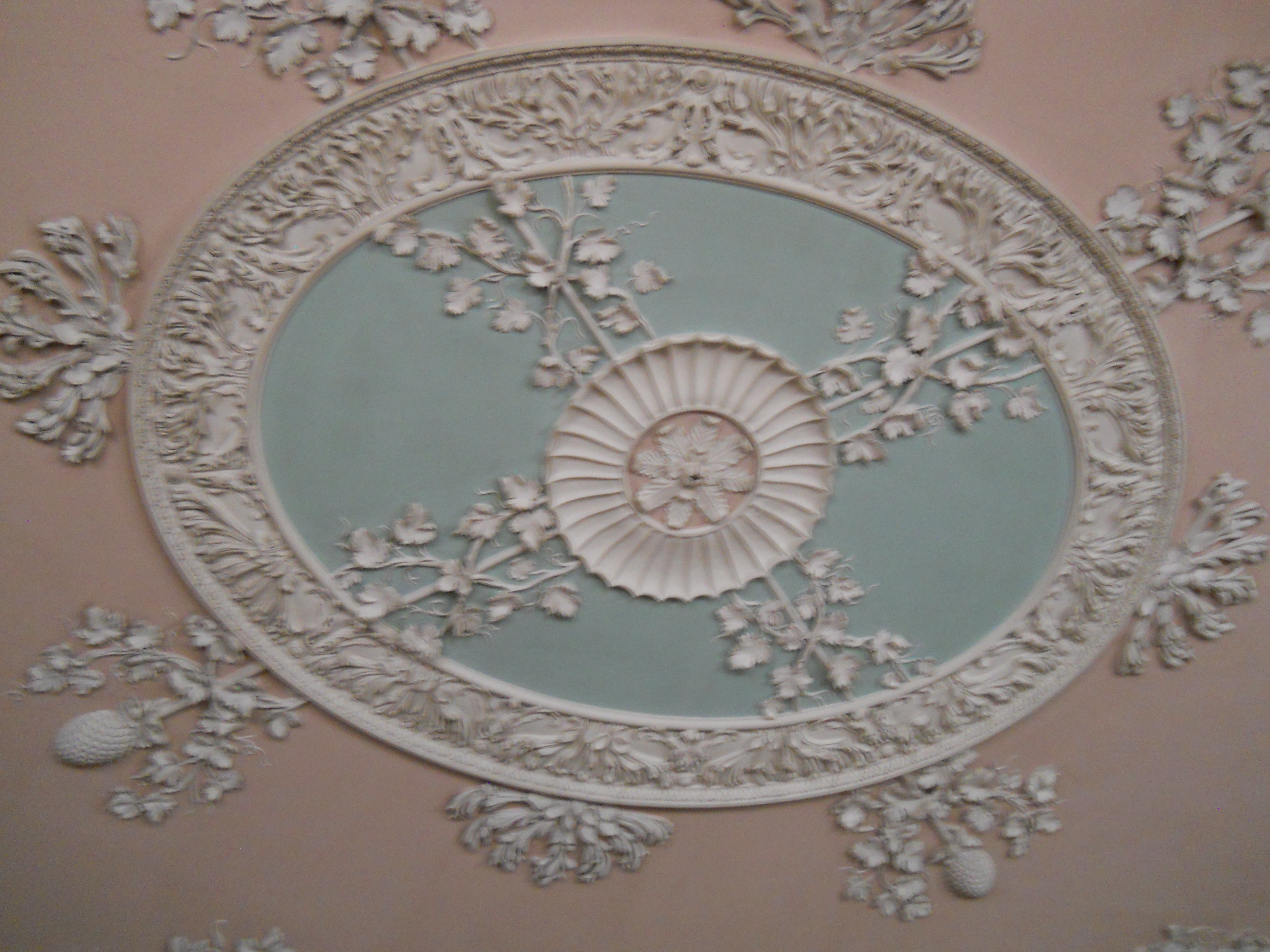
Built by Sir Thomas Gresham, financial advisor of Elizabeth I, Osterley Park was later purchased by Robert Child, a wealthy banker, who left it (and his entire fortune) to his granddaughter, Sarah Fane, who married George Villiers and became Lady Jersey (yes, Sally Jersey, one of the patronesses at Almack’s during the Regency period) a year later. But the house has been little used, as the Jerseys preferred spending their time at other properties. Here you will see not only the Robert Adam touches, but also nearly all of the original furniture, including the room where Adam worked and some of his drawings.

PINK:BLUECEILING

Pictures of Osterley Park

Devizes & the Bear Hotel

BEARHOTEL

The Bear Inn was once owned by the father of a young Thomas Lawrence, who used to charm the clientele by reciting poetry and drawing likenesses. He was quite good, and was eventually knighted for his portrait painting. See my blog post here.

Pictures of Devizes

Bath

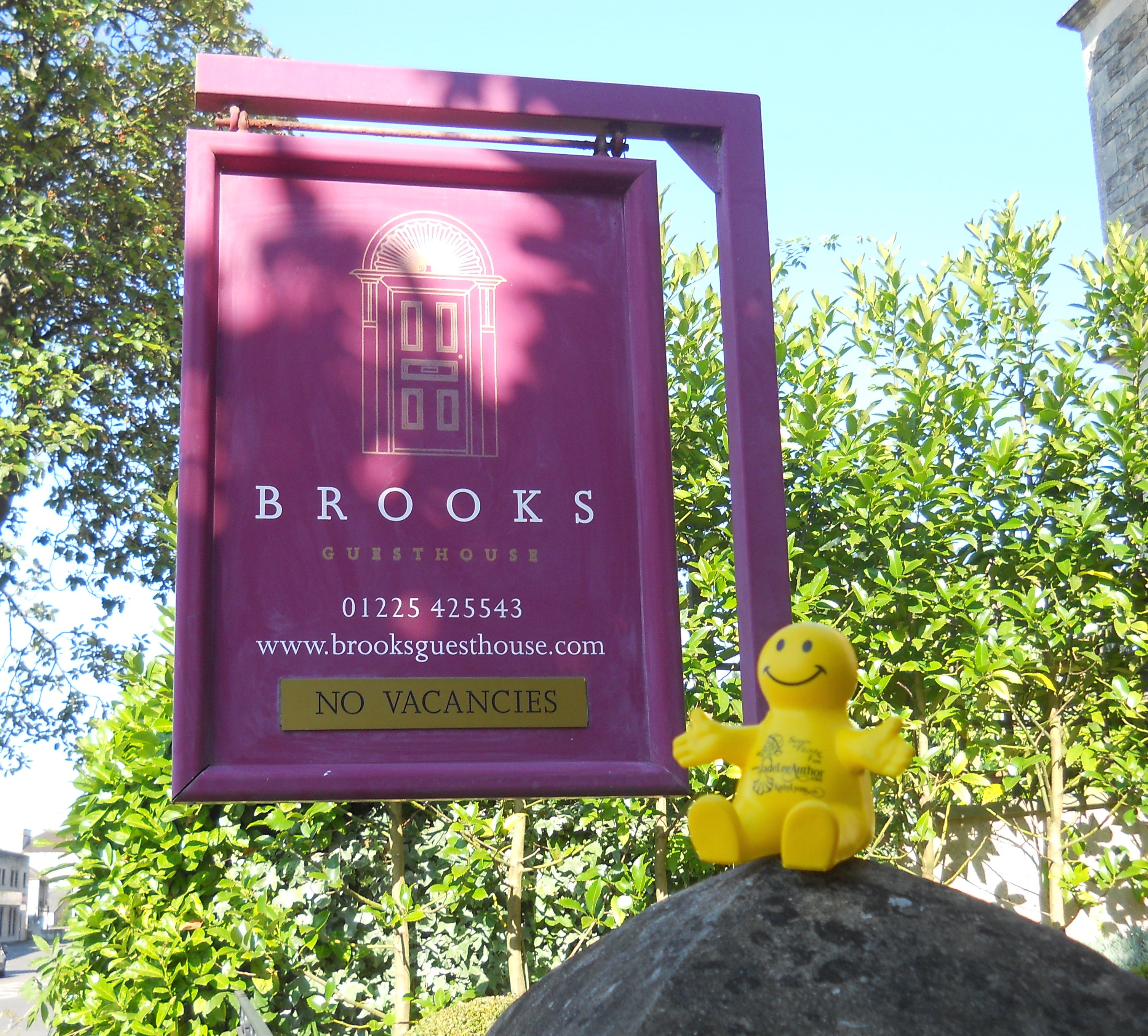
Squidgeworth and I had a very enjoyable two days in Bath, staying at the Brooks Guesthouse, where I stayed three years ago on my Rick Steves tour. Here I visited No. 1 Royal Crescent, the Jane Austen Centre, the Victoria Art Gallery, the Holburne Museum, the Assembly Rooms and Fashion Museum (second visit), and Sally Lunn’s.

Here’s Squidgeworth saying goodbye to Bath.

SquidgeBrooks

Pictures of Bath

Susana’s 2015 English Adventure: Week 1

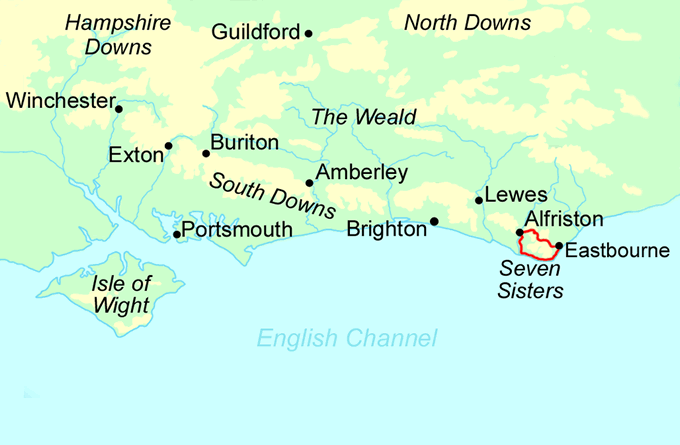
eastbourne map

For the first three days, Squidgeworth and I were the guests of Jay Dixon, a friend of mine who lives in Eastbourne. She was kind enough to take us around to visit some historical places of interest in the area, including the Redoubt Fortress, a quaint little town called Alfriston, Firle Place, and Chartwell.

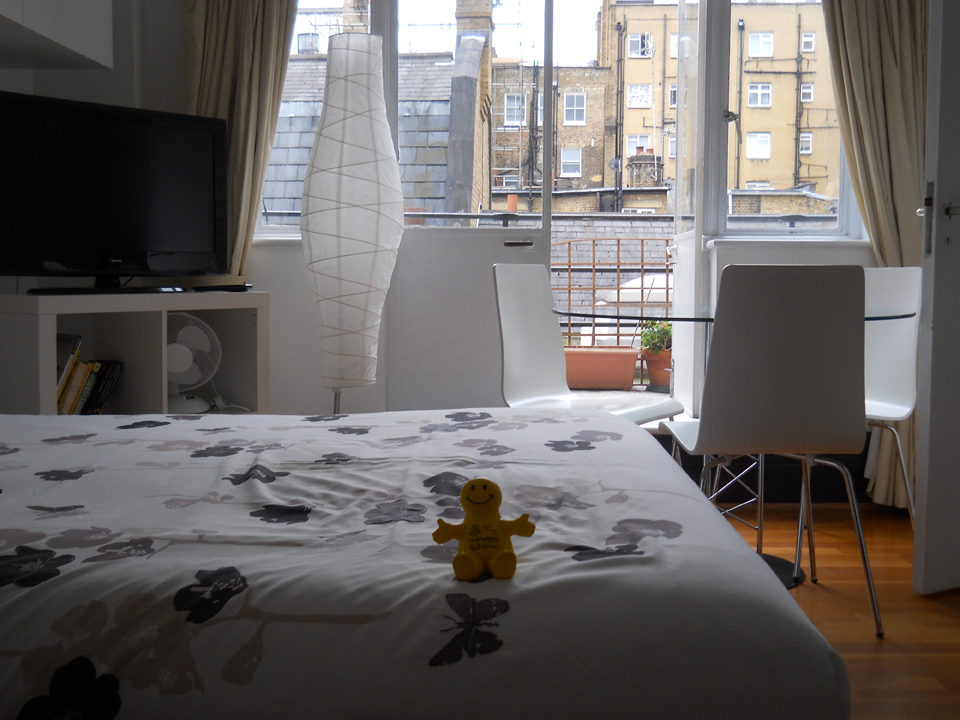
Unfortunately, I could not get my laptop to work with her Wifi system, so I had to go cold turkey from the Internet, which was instrumental later on when I arrived in London at my rental flat. It turns out that the previous renters of the flat I was scheduled for had trashed the place, and the company had switched me to another one, but I didn’t get the message because of my Internet blackout. It was a bit harrowing at first, but I was delighted that the flat they switched me to was the one I stayed in last year, near Baker Street, so I already knew the ropes. (I wanted this one, but at the time I was booking, it was already taken. There must have been a cancellation.)

Squidgeworth makes himself at home at our rental flat near Baker Street

Squidgeworth makes himself at home at our rental flat near Baker Street

Eastbourne: The Redoubt

The Redoubt is a circular military fortress that was built in 1804 when it was rumored that Napoleon had plans to invade England.

REDOUBT MODEL VILLAGE

Wikipedia

The Village of Alfriston

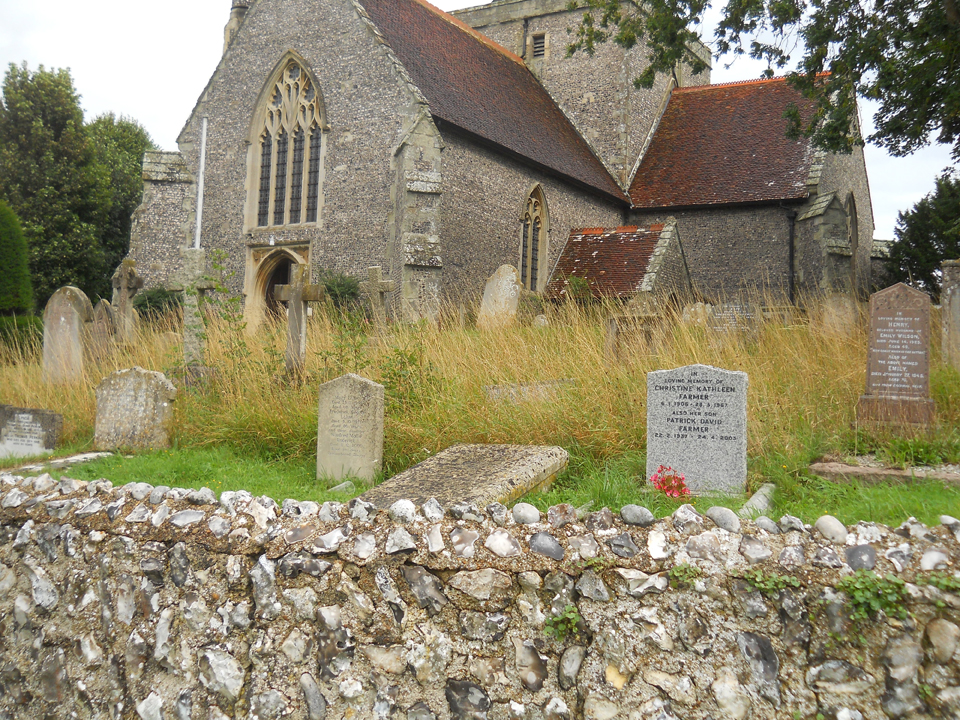
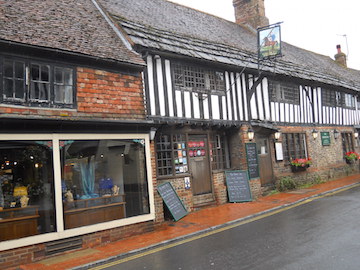
On Thursday we visited this quaint little village not far from Eastbourne. In addition to the historic buildings, a highlight was St. Andrew’s Church. The Clergy House was the first property purchased by the National Trust. Unfortunately, it was closed, but I did get photos of the outside.

The Clergy House

The Clergy House

St. Andrew's Church & Cemetery, Alfriston

St. Andrew’s Church & Cemetery, Alfriston


GEORGE INN copy

The George Inn, Alfriston


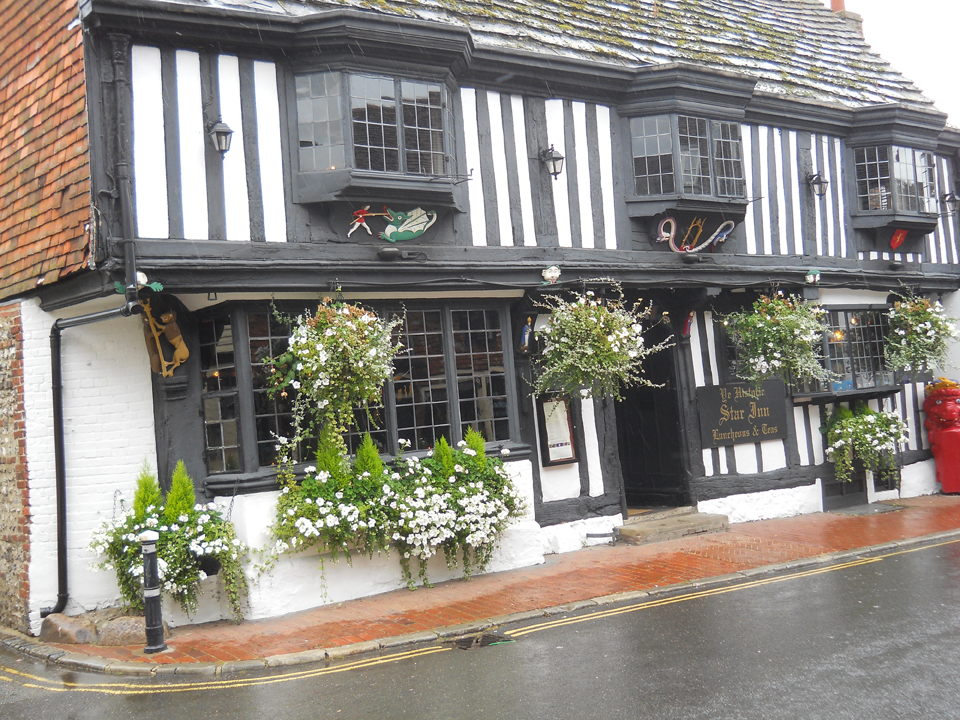
The Star Inn, Alfriston

The Star Inn, Alfriston


Squidge at a The Apiary Café in Alfriston

Squidge at a The Apiary Café in Alfriston

Wikipedia

Firle Place

Firle Place is the family seat of the Gages, the current owner being Nicholas Gage, the 8th Viscount Gage. The manor house has been in the family for over 500 years, and the estate includes a village among its 6000 acres of land. Sir John Gage was the executor of Henry VIII’s will. General Thomas Gage was at one time commander-in-chief of the British Army during the American Revolution, but was replaced after the disaster of Bunker Hill.

Squidgeworth at Firle Place

Squidgeworth at Firle Place


Firle Place

Firle Place

Wikipedia

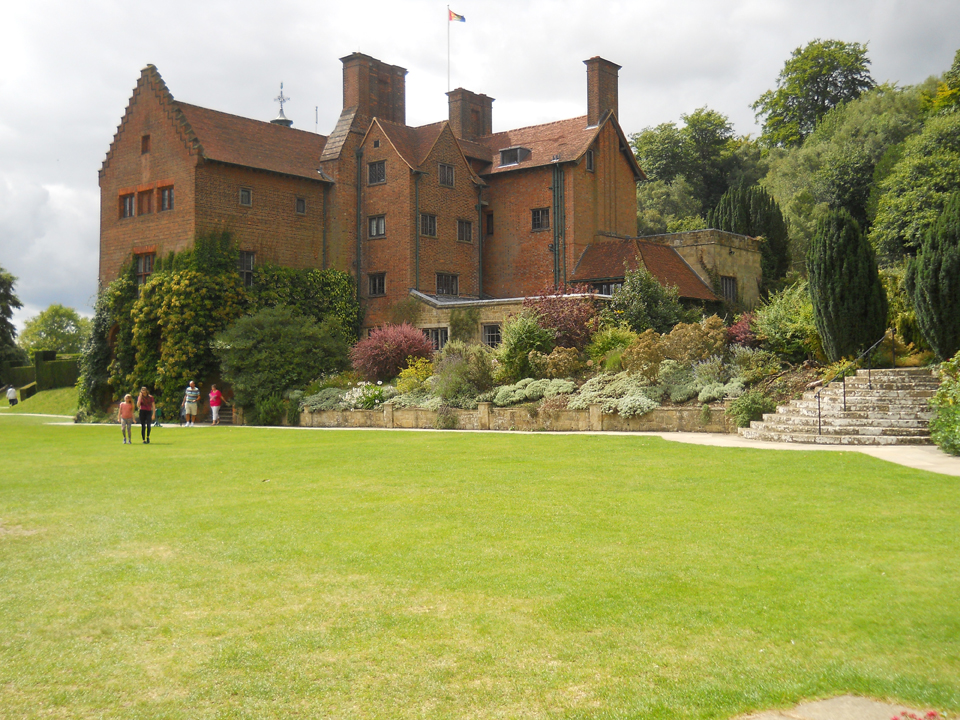
Chartwell

Chartwell, in Kent, was the principal residence of Winston Churchill, in his adult life. Henry VIII is believed to have stayed here during his courtship of Anne Boleyn, who lived at nearby Hever Castle.

The Churchills extensively renovated the house and gardens. Winston actually became a licensed brick layer and was noted for his wall building.

Chartwell

Chartwell


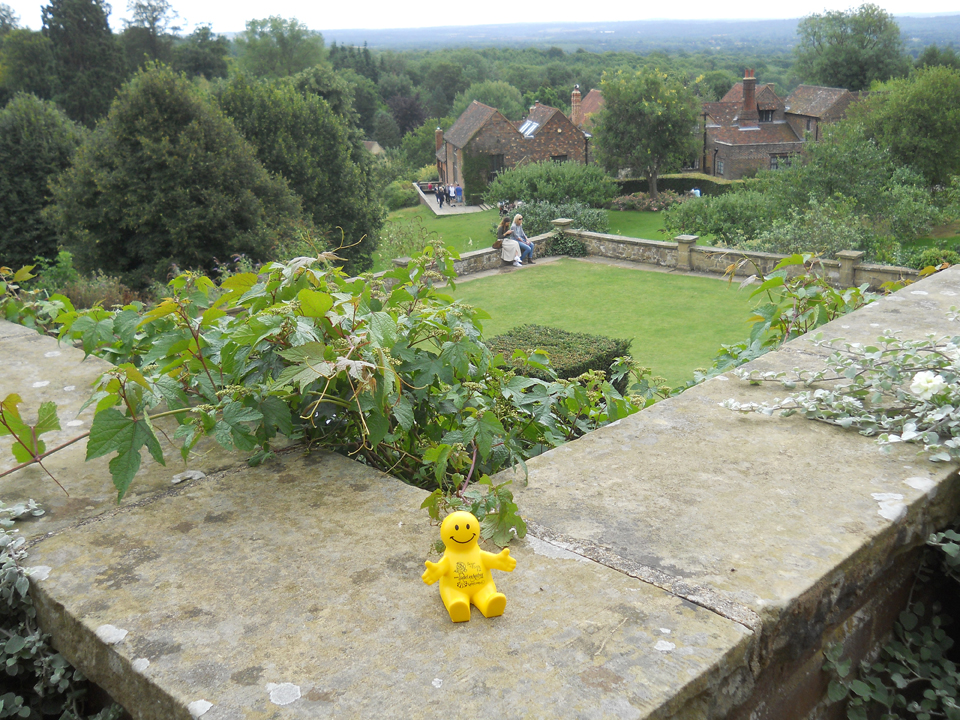
Squidgeworth at Chartwell

Squidgeworth at Chartwell

Wikipedia

The Victoria & Albert Museum

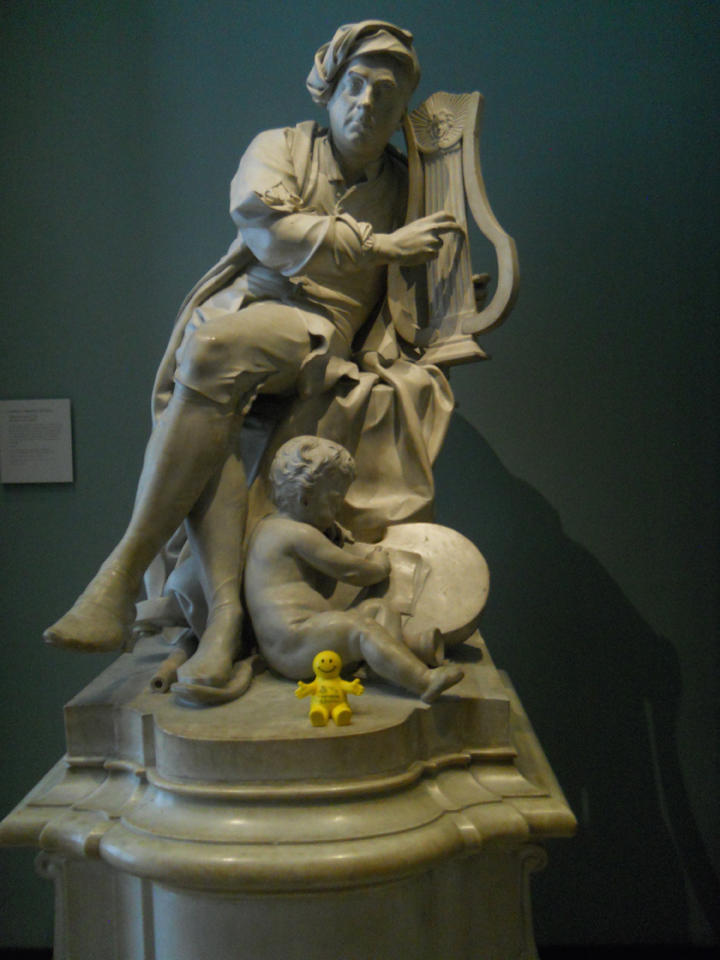
A visit to the V & A is a must for every trip to London. On this trip, my focus was Vauxhall, as the Handel statue is here, as well as three of the supper-box paintings. Unfortunately, it was difficult to get good photos of the paintings and other pictures due to the darkness of the room (which is true of many other things I tried to photograph). No doubt the low light is an attempt to preserve the aged items as long as possible. But I did get a good photo of the Handel statue, with Squidgeworth getting in on the action, as usual.

Squidgeworth and the Handel statue that used to sit in Vauxhall Gardens

Squidgeworth and the Handel statue that used to sit in Vauxhall Gardens

My Vauxhall Gardens board on Pinterest is a work in progress, but you can see there two videos about Vauxhall Gardens, one of which I photographed at the V & A and another I found on YouTube. I’ll be adding more photos as I find the time.

Susana’s Vauxhall Gardens Pinterest Board

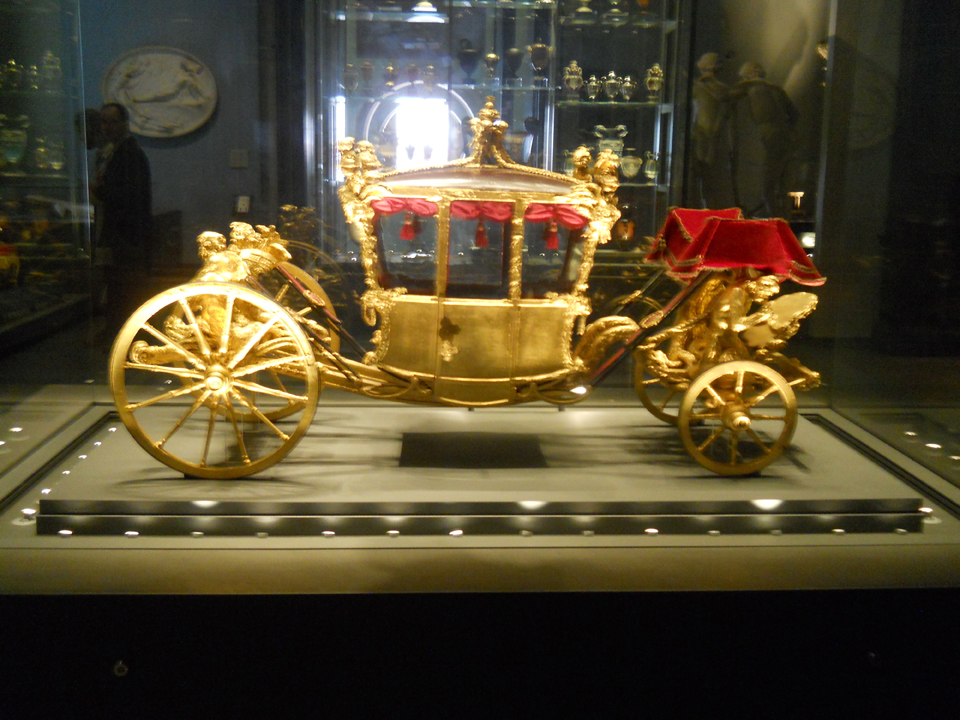
Coach at the V

Coach at the V & A Museum


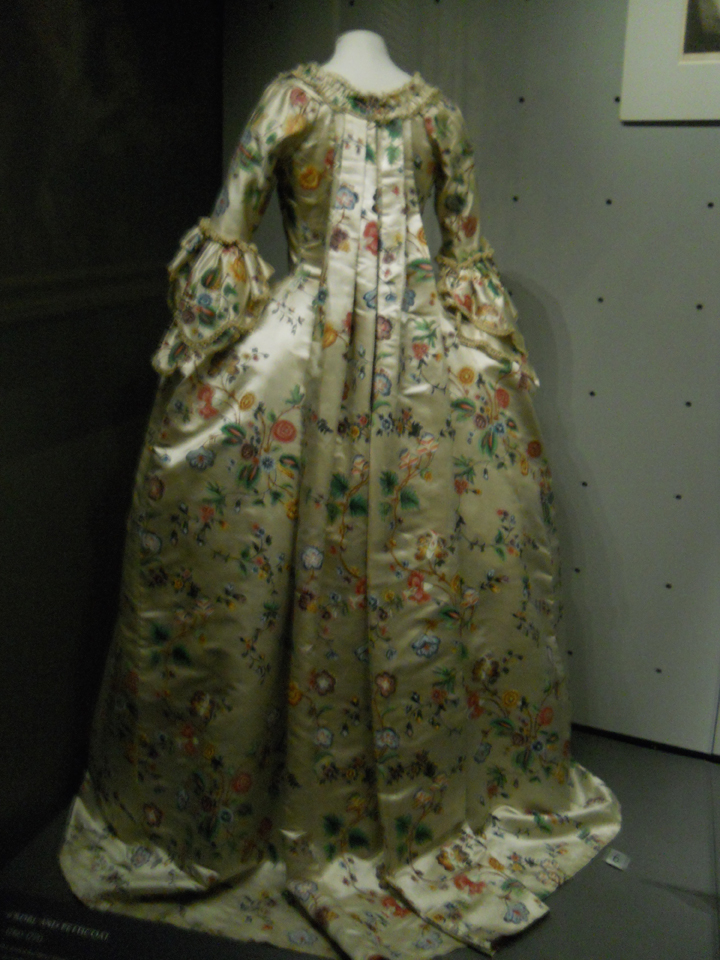
Painted silk gown

Painted silk gown at the V & A Museum

Susana’s 2015 English Adventure: Introducing Squidgeworth

DSCN0006

Squidgeworth

Tomorrow afternoon, Susana will be on her way across the pond to London for her 2015 English adventure. This time, however, she won’t be traveling alone. Her dear friend Squidgeworth, who turned chartreuse with envy when his cousin Squidge got to travel there with Ki Pha earlier this year, will be accompanying her on the trip and posing for photos along the way. Squidgeworth and his cousin appear identical—as indeed does every member of the Squidge family—but the Squidgeworths are the aristocratic blue-bloods of the family. He was quite indignant that his commoner cousin got to visit the land of their ancestors before he did. He got over his fit of pique when Susana explained that she was going later this year because she wanted to visit when Buckingham Palace was open to the public. Squidge, after all, didn’t get to go there.

So… where else are Squidgeworth and Susana going this year?

Sussex

A dear friend invited them to stay a few days in Eastbourne, where they will be visiting Firle Place and/or the Glynde Estate, Chartwell, visiting the quaint village of Alfriston, and Quebec House. They will also be taking in a play called Flare Path.

London

From there, they will travel to London, where they will be residing in a rented flat near London Bridge. There are always plenty of things to see in or near London, and some of the places on this year’s list include:

  • Buckingham Palace (of course)
  • Osterley Park
  • Kenwood
  • Ham House
  • The White Hart, St. Albans
  • Marble Hill
  • The Foundling Museum
  • The Victoria & Albert Museum: specifically, the Vauxhall exhibit, with the Handel statue and supper-box paintings.

cung-dien-buckingham-542a55cd9cd54

Day Trips from London

  • Petworth, West Sussex
  • Waddesdon Manor
  • Hatfield House, Hertfordshire
  • Burghley House, Lincolnshire
  • Bateman’s House, East Sussex
  • The Bell Inn, Stilton
  • Lyme Park, Cheshire
  • Greenway, Devon
  • Charlecote, Warwickshire
  • Arundel Castle, West Sussex

Overnight Stays

Bath and Devizes

The Bear Hotel

The Bear Hotel

In Devizes, Susana and Squidgeworth will be staying at the historic Bear Inn, which featured in Susana’s Coaching Days & Coaching Ways blog series. Then they will spend two days in Bath, visiting some of the sights that figure in Susana’s story, The Third MacPherson Sister, from the Sweet Summer Kisses box set.

York

Following that, S & S will be heading north for two nights in York, where they will be paying visits to Harewood, Castle Howard, and Haworth, as well as enjoying the lovely city itself.

bolen

England’s Stately Homes By Train

Neither Susana nor Squidgeworth is interested in driving in England, so Cheryl Bolen’s book, English Stately Homes By Train, has been very helpful in planning the trip. Susana used the print version for planning and will take the digital version on her iPad for the trip.

Follow S & S on their wanderings

Squidgeworth will be appearing regularly on Susana’s Facebook Page, and photos will be downloaded to Pinterest as well. Highlights of the week will appear on Mondays on this blog. Please keep in touch so they don’t get too homesick!

À bientôt

Susana & Squidgeworth

Vauxhall Gardens: The Competition

vauxhallbook

Vauxhall Gardens: A History

David Coke & Alan Borg

The Vauxhall Pleasure Gardens is one of the places I’d love to slip back in time to visit, just to catch a glimpse of what it was like. After recently splurging to buy this lovely coffee-table book, I thought it might make a wonderful subject for a new blog series. But do buy the book too, if you can! The photos are fabulous!

“Imitation is the sincerest form of flattery.”

The success of Vauxhall naturally spawned imitators, but Vauxhall “outstripped all of them, not only in visitor numbers and longevity, but in the national and international renown achieved by the gardens, its use by writers as a setting in plays and novels, and the fact that its name became synonymous with the pleasure garden throughout Britain and all over the world.”

Ranelagh and Marylebone, however, did give Vauxhall’s founder a run for his money. S. Toupée, a correspondent from Scots Magazine (see last week’s post), writes:

It may not be amiss to tell you, the spirit of imitation increases amongst us every day. Vaux-hall has produced tickets and accommodations of the same nature, at Marybone, on this side of the Thames, and at Caper’s gardens, on t’other.”

Marylebone Gardens

John Donowell, A View of the Orchestra with the Band of Music, the Grand Walk &c. in Marybone Gardens, watercolor, 1755.

John Donowell, A View of the Orchestra with the Band of Music, the Grand Walk &c. in Marybone Gardens, watercolor, 1755.

Prior to its purchase by Daniel Gough, landlord of the neighboring Rose Tavern in 1737, Marylebone Gardens was “little more than a bowling green and gaming house.” In his attempt to imitate Vauxhall, “Gough built an outdoor Orchestra there… and installed an organ by Richard Bridge. In the winter of 1739-40 he added a Great Room for balls and suppers, facing the Orchestra.”

High quality music was the main attraction at Marylebone, and fireworks were added here decades before Vauxhall.

However, Marylebone did not even try to compete with Vauxhall in the visual arts, or in the order maintained in the gardens, and this proved to be its downfall; it was less selective of its visitors, and less proscriptive in the activities enjoyed by them, allowing the garden to become a haven for card-sharps and gamblers… Marylebone Gardens eventually closed, unmourned and leaving little trace, in 1778.

Ranelagh Gardens

T. Bowles after J. Maurer. Raleigh House and Gardens with the Rotunda, engraving, 1745.

T. Bowles after J. Maurer. Ranelagh House and Gardens with the Rotunda, engraving, 1745.

Opened in April 1742 by a syndicate of businessmen who saw the problems Vauxhall was having with inclement weather, Ranelagh featured a huge rotunda, inspired by the Pantheon in Rome.

Giovanni Antonio Canal, il Canaletto. The Interior of the Rotunda at Ranelagh, oil on canvas, c.1751.

Giovanni Antonio Canal, il Canaletto. The Interior of the Rotunda at Ranelagh, oil on canvas, c.1751.

Large numbers of people could saunter, take refreshments and listen to music without any of the natural inconveniences of an English summer. The building itself, especially the great domed space inside, became an architectural wonder in its own right, attracting crowds just to see, even during construction. With its grand central orchestra stand rising to the roof, its two levels of supper-boxes around the walls, its elaborate plaster decorations and chandeliers, this mostly timber Rotunda, 185 feet in diameter, was a remarkable space… During its first year at least, the Rotunda was the subject of much talk among fashionable society; Catherine Talbot wrote to Elizabeth Carter just two months after it had opened, saying that London’s neighborhood

is enriched since you was here, with a building which I am told exceeds in taste and magnificence every one in Europe: to untravelled eyes like mine ’tis to be sure an amazing fine thing, and quite worth your coming to see it next year, by which time they may possibly have found all that it wants to make it complete; some use for it answerable to the fineness and stateliness of the structure, for to be sure it is quite vexatious at present to see all the pomp and splendour of a Roman amphitheatre, devoted to no better use than a twelvepenny entertainment of cold ham and chicken.

Ranelagh did give Vauxhall a run for its money, however, even “beating Vauxhall at its own game” for a time. However,

once it lost its novelty it also lost much of its appeal. It was always the least disreputable of the pleasure gardens, being free of strong liquor and of gambling. This attracted the older generation and the more conservative sector of the public, as did the half-crown admission cost (to include tea and coffee), which excluded a large section of the London population. It was this very respectability, and the limited opportunities for change, that eventually drove away the fashionable set of the next generation and led to Ranelagh’s final downfall.

Like Marylebone, and indeed like Vauxhall itself, Ranelagh started to run into real difficulties around 1780, when, because of riots in London and perceived threats of invasion from across the Channel, the public enjoyment of frivolous pleasures had become socially less acceptable. Its proprietors battled on for another twenty years, but finally gave up 1803, unable to adapt to the demands of a new and more demanding public.

Vauxhall Reigns Supreme

…the al fresco character of Vauxhall, and its intimations of physical and moral danger, were essential features of its popular appeal. The Rotunda undeniably kept Ranelagh’s visitors’ feet dry, and eliminated any element of risk, but once everybody had seen and been seen by everybody else, the circular promenade became profoundly dull and repetitive. The walks at Vauxhall, although all straight and at right angles to one another, were at least all different, and allowed visitors to choose which way they walked, and to escape the bright lights, while still hearing the music.

None of Vauxhall’s rivals encompassed such a strong moral ideology as Vauxhall, and few invested anything like the same amounts as Tyers in the design or in the artworks that decorated and themed their gardens. It is certainly due in part to these factors that Vauxhall succeeded above its competitors.

Susana’s Vauxhall Blog Post Series

  1. Vauxhall Gardens: A History
  2. Vauxhall Gardens: Jonathan Tyers—“The Master Builder of Delight” 
  3. Vauxhall Gardens: A New Direction
  4. Vauxhall Gardens: The Orchestra and the Supper-Boxes 
  5. Vauxhall Gardens: The Organ, the Turkish Tent, and the Rotunda
  6. Vauxhall Gardens: Three Piazzas of Supper-Boxes
  7. Vauxhall Gardens: “whither every body must go or appear a sort of Monster in polite Company”
  8. Vauxhall Gardens: The Competition
  9. Vauxhall Gardens: The Artwork, Part I
  10. Vauxhall Gardens: The Artwork, Part II
  11. Vauxhall Gardens: The Music, 1732-1859
  12. Vauxhall Gardens: The Business Side
  13. Vauxhall Gardens: Developments from 1751-1786
  14. Vauxhall Gardens: Thomas Rowlandson’s Painting (1785)
  15. ‎Vauxhall Gardens: The Third Generation of the Tyers Family and the Jubilee of 1786
  16. Vauxhall Gardens: An Era of Change (1786-1822), Part I
  17. Vauxhall Gardens: An Era of Change (1786-1822), Part II
  18. Vauxhall Gardens: An Era of Change (1786-1822), Part III
  19. Vauxhall Gardens: The Final Years, Part I
  20. Vauxhall Gardens: The Final Years, Part II
  21. Vauxhall Gardens: The Final Years, Part III
  22. Vauxhall Gardens: The Final Years, Part IV
  23. Vauxhall Gardens: Farewell, for ever
Vauxhall Gardens: “whither every body must go or appear a sort of Monster in polite Company”

vauxhallbook

Vauxhall Gardens: A History

David Coke & Alan Borg

The Vauxhall Pleasure Gardens is one of the places I’d love to slip back in time to visit, just to catch a glimpse of what it was like. After recently splurging to buy this lovely coffee-table book, I thought it might make a wonderful subject for a new blog series. But do buy the book too, if you can! The photos are fabulous!

The Toupee Letters

Scots Magazine ran a series of articles in 1739-40 purporting to be “from a London correspondent, a certain ‘S. Toupee’, portraying the social scene in London, and at Vauxhall in particular, to the Scottish readership.”

The letters begin by explaining that because ordinary people of the London beau monde in search of simple pleasures were no longer satisfied with the traditional pastime of enjoying the beauties of nature, for their own sake, more fashionable amusements had been brought in from overseas, in particular the ridotto al fresco. Just how popular the gardens had become is illustrated by the fact that, despite the ingrained British dread of damp evenings, and the gentry’s habit of moving to the country in the summer, the average nightly number of paying visitors… was around a thousand. From this, it is possible to calculate that, as the Vauxhall season lasted for about one hundred evenings between May and September, the annual admissions income would amount to £5000 to £6000, a healthy figure that must have been substantially more than the normal revenue expenditure to run such a venture.

The type of entertainment provided was considered to be very new; it was well received, especially by fashionable ladies whose social life hitherto had been restricted to calling on acquaintances or going to the occasional ball, all within a very small circle of friends and relatives. Pleasure gardens opened up a whole new world to these people—a polite and exciting world where they could go with their family or friends, where they were free to entertain and mix socially with an infinitely broader circle than had been possible previously.

J. Maurer, A Perspective View of Vaux Hall Garden, etching, hand-coloured, 1744 (David Coke's collection). The view looking down the Grand South Walk before the classical triumphal arches were installed, with Roubiliac's Grand Alcove on the right.

J. Maurer, A Perspective View of Vaux Hall Garden, etching, hand-coloured, 1744 (David Coke’s collection). The view looking down the Grand South Walk before the classical triumphal arches were installed, with Roubiliac’s Grand Alcove on the right.

A Typical Visit to Vauxhall (from 7-10 p.m.)

The journey usually began with a boat ride from Whitehall or Westminster. On one occasion, Toupee writes about accompanying “a family group including Tom, a young musician who played the latest opera melodies on his French horn, while Miss Kitty was asked by her mother to sing one of the latest Italian songs.”

Others on their way to the gardens in neighbouring boats included ‘Sir John, from Fenchurch-street’, with his wife and all his children, attended by a footman. A Cheapside apprentence called William was on an illicit outing with Sukey, his master’s daughter… ‘An honest old mechanick’ and his wife followed; he was returning to Vauxhall after many years’ absence, to see how it had changed, reassuring his wife that the gardens must be a respectable place for her to be going, because the Prince of Wales himself was a regular visitor. This piece is clear evidence for the type of social mix that Tyers wanted to see at Vauxhall, although it is equally clear that, just because people inhabited the same space and came into direct contact, they did not necessarily interact in any meaningful way.

Pet dogs were not allowed in the gardens, but that did not stop people bringing them along for the ride, maybe to occupy the liveried footman who would not be admitted by Tyers’s gatekeeper, but could walk the dog in the fields of Lambeth. Having entered the tardens, Toupee’s party saw all the sights, listened to the music and strolled around the walks, watching and being watched by the other visitors.

The third letter, concerning the hour before closure at 10 p.m., starts with a detailed description of the dinner, accompanied by music from the Orchestra. The dramatic finale to the letter is the boat trip home, recounting the dangers of the riverside and the traditional ‘Thames ribaldry’, long-winded insults from the occupants of nearby boats that were suffered by voyagers as far apart in time as Addison’s Sir Roger in 1711 and Oakman’s John Gilpin in 1785.

“Sexual freedom was intrinsic to the gardens”

The overriding topic that runs flagrantly throughout the three letters is the meeting of the sexes, and the self-evident truth that human nature takes full advantage of any liberty offered to it. If Toupee is to be believed, Tyers was promoting his gardens as a place for lovers to meet, for initiating and nurturing romantic attachments, for sexual intrigue and adventures, and for illicit affairs; or, if he was not promoting these activities as such, he created an environment that made them possible and, indeed, inevitable. The river-crossing, the music, the paintings, the food, the walks and even the weather were all seen by Toupee as legitimate means to this one specific end.

The focus for most of the licentious activity in the gardens was not the Grove or the surrounding supper-boxes, which were too public, but the Druid’s Walk or Lover’s Walk, an unlit avenue running between and parallel with the Grand South Walk and Kennington Lane. It was distinguished from the other avenues by the fact that the trees met overhead, plunging it into shadow even before dusk. This concealing shade was unrelieved by artificial light until 1764, when magistrates forced Tyers to act against the immoral behaviour that the darkness encouraged, and to install lighting there.

At its eastern end, the Druid’s Walk met the avenue that ran around the eastern and northern edges of the gardens, always known as the Dark Walks; the darkness heightened the receptivity of impressionable young minds to emotional seduction, and no female reputation was safe…

Tyers employed constables to patrol the end of each walk in an attempt to keep such incidences to a minimum, but even they were not able to watch everybody all the time.

“The… cold and miserable spring of 1740”

I was blown through and through, in such a manner, as to drink four full glasses of French wine, before I knew I was alive. And, in that cold condition, as returning by water would have endanger’d my life, I was forced to be shook in a most unmerciful hack, till one half of my joins were distorted, and the other bruised to a jelly.

Indeed, all of the Toupee letters highlight the fact that the pleasures of the evening were never without their discomforts; and that a full enjoyment of the experience was predicated upon a full participation in the inconveniences, dangers and risks, whether perceived or real.
“The outstanding fashionable attraction of the London summer season”

In a sample letter from a young lady in town to her aunt in the country, published in 1741, the novelist Samuel Richardson confirmed that regular visits to the gardens had become an obligatory feature of the fashionable lifestyle, having his subject comment… that ‘I went on Monday last to Vaux-hall Gardens, whither every body must go, or appear a sort of Monster in polite Company.’

Susana’s Vauxhall Blog Post Series

  1. Vauxhall Gardens: A History
  2. Vauxhall Gardens: Jonathan Tyers—“The Master Builder of Delight” 
  3. Vauxhall Gardens: A New Direction
  4. Vauxhall Gardens: The Orchestra and the Supper-Boxes 
  5. Vauxhall Gardens: The Organ, the Turkish Tent, and the Rotunda
  6. Vauxhall Gardens: Three Piazzas of Supper-Boxes
  7. Vauxhall Gardens: “whither every body must go or appear a sort of Monster in polite Company”
  8. Vauxhall Gardens: The Competition
  9. Vauxhall Gardens: The Artwork, Part I
  10. Vauxhall Gardens: The Artwork, Part II
  11. Vauxhall Gardens: The Music, 1732-1859
  12. Vauxhall Gardens: The Business Side
  13. Vauxhall Gardens: Developments from 1751-1786
  14. Vauxhall Gardens: Thomas Rowlandson’s Painting (1785)
  15. ‎Vauxhall Gardens: The Third Generation of the Tyers Family and the Jubilee of 1786
  16. Vauxhall Gardens: An Era of Change (1786-1822), Part I
  17. Vauxhall Gardens: An Era of Change (1786-1822), Part II
  18. Vauxhall Gardens: An Era of Change (1786-1822), Part III
  19. Vauxhall Gardens: The Final Years, Part I
  20. Vauxhall Gardens: The Final Years, Part II
  21. Vauxhall Gardens: The Final Years, Part III
  22. Vauxhall Gardens: The Final Years, Part IV
  23. Vauxhall Gardens: Farewell, for ever