Archives

Cotillion Christmas Traditions: Susana Ellis and “A Twelfth Night Tale”

Christmas Traditions is the theme of this year’s Ellora’s Cave Blush Cotillion Christmas series. Eight stories focusing on Christmas traditions during the Regency will be released digitally, and then in print version as two anthologies.

The eight stories in the series are:

10/10/13: Twelve Days of Christmas, Barbara Miller

10/17/13: A Christmas Caroline, Christa Paige and Vivien Jackson

10/24/13: Festive Persuasion, Charlene Roberts

10/31/13: Lydia’s Christmas Charade, Saralee Etter

11/7/13: Snug in a Snowstorm, Cynthia Moore

11/14/13: Helena’s Christmas Beau, Aileen Fish

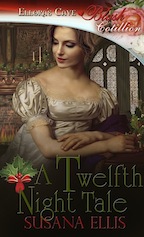
11/21/13: A Twelfth Night Tale, Susana Ellis

11/28/13: Sense of the Season, Kate Dolan

twelfthnighttale_4inch

Celebrate the Release Day of A Twelfth Night Tale!

Susana is giving away a fabulous sterling silver necklace and A Twelfth Night Tale Christmas charm bracelet (silver-plated). Click here for the Rafflecopter!

best_necklace:bracelet

About A Twelfth Night Tale

A wounded soldier and the girl next door find peace and love amidst a backdrop of rural Christmas traditions.

Without dowries and the opportunity to meet eligible gentlemen, the five Barlow sisters stand little chance of making advantageous marriages. But when the eldest attracts the attention of a wealthy viscount, suddenly it seems as though Fate is smiling upon them.

Lucy knows that she owes it to her younger sisters to encourage Lord Bexley’s attentions, since marriage to a peer will secure their futures as well as hers. The man of her dreams has always looked like Andrew Livingston, her best friend’s brother. But he’s always treated her like a child, and, in any case, is betrothed to another. Perhaps the time has come to put away childhood dreams and accept reality…and Lord Bexley.

Andrew has returned from the Peninsula with more emotional scars to deal with than just the lame arm. Surprisingly, it’s his sister’s friend “Little Lucy” who shows him the way out of his melancholy. He can’t help noticing that Lucy’s grown up into a lovely young woman, but with an eligible viscount courting her, he’ll need a little Christmas magic to win her for himself.

Available

Ellora’s CaveAmazonBarnes & NobleKobo • Sony

Excerpt

All Rights Reserved, Ellora’s Cave Publishing, Inc.

A Blush® Regency romance from Ellora’s Cave

Chapter One

The Barlow Home

near Charlbury, Oxfordshire

23 December 1813

“It’s so kind of you to call, Lord Bexley. The flowers you sent are simply lovely, are they not, Lucy?”

Unable to miss the warning tone in her mother’s voice, Lucy sat up straight in her chair and smiled sweetly at their caller.

“Oh yes indeed. They are undoubtedly the most beautiful I’ve ever received, my lord.”

Of course, she did not mention that they were the first flowers she’d ever been sent by a gentleman. And considering that there were few opportunities to meet eligible gentlemen in the quiet little neck of the woods where the Barlows resided, the arrangement was quite likely to remain the only floral tribute to come her way.

Her caller beamed with pleasure. “They were the best I could find at the florist, but of course they cannot hold a candle to your beauty and sweetness, Miss Barlow.”

Lucy swallowed and forced herself to reply. “You embarrass me with your flattery, my lord.”

“Not at all,” he insisted. “You were quite the belle of the Christmas Ball last evening, Miss Barlow. I was much envied to be allowed the honor of two dances with you when so many gentlemen had to be turned away.”

The “Christmas Ball” was merely a small celebration at the local assembly rooms. Her mother had encouraged her to favor Lord Bexley, but in truth, Lucy herself had not found him objectionable. He was an accomplished dancer and quite distinguished-looking, in spite of the fact that he had at least twenty years over her. At eighteen, she was of an age to be out in society, and Lord Bexley, a wealthy widower from Warwickshire, was undoubtedly the most eligible gentleman in the county. Recently out of mourning, he was seeking a new wife and a mother to his three children, and as Mrs. Barlow kept telling her, Lucy should be flattered that he seemed to be favoring her for the role.

Well, she was flattered. Wasn’t she? The number of young ladies far exceeded that of eligible gentlemen, and she didn’t wish to be left on the shelf. With her family in financial difficulties and four younger sisters to be married off, Lucy knew she owed it to them to marry well and do what she could to find her sisters suitable matches as well.

She was prepared to do her duty and make the best of it, but somehow, when she thought of marriage and children, it was not the kindly Lord Bexley who came to mind. It was the face of the strapping, dark-haired Adonis with laughing gray eyes who lived on an adjoining estate with his younger sister—her bosom friend Jane—who had teased her unmercifully from the time she learned to walk. She couldn’t remember a time when she hadn’t been in love with Andrew Livingston—she’d even asked him to marry her at the age of five when he’d been twelve and about to leave for Eton. He’d laughed and quipped that it would be like marrying his sister, and she’d nursed a broken heart ever since.

She sighed as she frequently did when she thought of Andrew and his affianced wife, and her mother glared at her. Fortunately, Phillips wheeled in the tea cart and Mrs. Barlow’s attention was mercifully diverted.

“Please do the honors, Lucy. An excellent opportunity to practice your housewifely skills.”

Lucy flushed. Could her mother’s intentions be more obvious? But Lord Bexley did not seem to notice. He smiled kindly at her somewhat shaky inquiry as to his preferences, and thanked her graciously when she brought him his tea and a plate of cherry tarts.

“Quite charming,” he commented as he regarded her with obvious approval. It was unclear whether he was speaking to her or to her mother, and Lucy wasn’t sure how to respond.

Fortunately, there was a shriek followed by the sound of fierce arguing from the back rooms of the house. Lucy turned instinctively to the door, which was promptly thrust open and filled by the figure of her sister Lydia, who was breathing hard and wringing her hands in agitation.

“Do come, Lucy! Lila and Louisa are having one of their rows again, in the kitchen of all places. Lila broke one of Cook’s mixing bowls, and Cook swears she’ll leave if someone doesn’t stop them and you know you’re the only one who can, Lucy!” She flushed when she saw Lord Bexley and her mother’s angry face. “Oh…pardon me, I didn’t realize we had a guest.” She backed out into the hall, shooting Lucy a pleading look as she did so.

Relieved for an excuse to terminate the social call, Lucy muttered her excuses and scrambled out of the room. But not before she heard her mother’s mortified apology and Lord Bexley’s soothing reply that he found it quite agreeable to discover a young lady so accomplished in the maternal skills.

Goodness, he really was intent on courting her! She should be flattered. She was a sensible girl, and it was pointless to set her cap at Andrew Livingston, in any case. Lord Bexley would be an excellent match for her. His three daughters could not possibly be as troublesome as her two youngest sisters, after all.

She gritted her teeth and hurried to the kitchen, the ineffectual Lydia as usual trailing behind her. The second eldest Barlow daughter was as helpless as their mother at controlling the two youngest children. When Lucy married and left the house, as she would in time, her bookish middle sister Laura was going to have to take up the reins.

About the Author

P1smsqA former teacher, Susana is finally living her dream of being a full-time writer. She loves all genres of romance, but historical—Regency in particular—is her favorite. There’s just something about dashing heroes and spunky heroines waltzing in ballrooms and driving through Hyde Park that appeals to her imagination.

In real life, Susana is a lifelong resident of northwest Ohio, although she has lived in Ecuador and studied in Spain, France and Mexico. More recently, she was able to travel around the UK and visit many of the places she’s read about for years, and it was awesome! She is a member of the Maumee Valley and Beau Monde chapters of Romance Writers of America.

Contacts

Web site • Email • Facebook • Twitter • Linked In • Pinterest • Google+Goodreads

Susana’s Parlour (Regency Blog) • Susana’s Morning Room (Romance Blog)
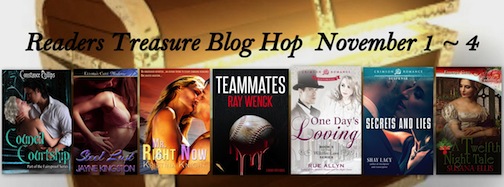
Readers’ Treasure Blog Hop: November 1-4

RTBH1

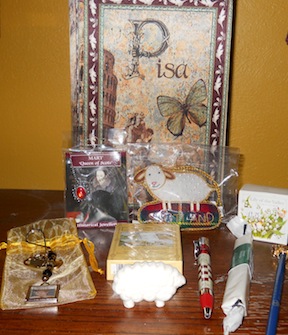
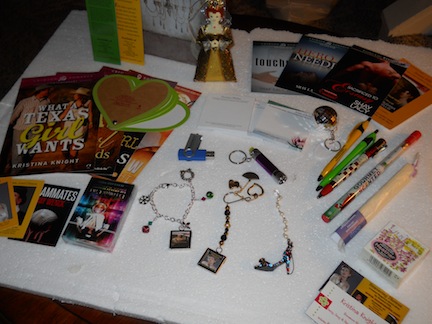
The following authors are each offering a prize for some lucky reader. Susana’s consists of a lovely wooden book box with lots of great treasures (see below). Click here for the Rafflecopter.

treasure hunt4

lovely wooden book box • Mary Queen of Scots ornament (from Scotland) • Ellora’s Cave playing cards • thumb drive • heart note pad • post-it note pads • A Twelfth Night Tale Christmas bracelet (silver-plated) • Treasuring Theresa key chain • silver ball key chain • high heeled shoe bookmark (Kristina Knight) • flashlight key chain (Constance Phillips) • four pens • aromatic pencil (peppermint) • fizzy bath crystals (from Scotland) • heather-scented soap (from Scotland) • bookmarks • signed cover flats • magnets

Participating Authors

Constance Phillips

Kristina Knight

Jayne Kingston

Shay Lacy

Rue Allyn

Ray Wenck

Readers’ Treasure Blog Hop

From the time I learned to read, I’ve been obsessed with reading. I even got in trouble with my second grade teacher because I was reading a book on my lap instead of attending to her arithmetic lesson. Sorry, Mrs. Stover and all my subsequent math teachers, but words are so much more compelling than silly numbers!

Words have a magical power to help me convert the colorful images in my mind into stories that (I hope) others find entertaining. At a very early age—maybe six or seven—I used to tell stories to my younger sister while we were doing dishes. I used to climb up the tree we called “the treehouse” and imagine it was a real treehouse—I always wanted one after we read a story in first grade about Trudy’s treehouse—and serve tea and cakes to imaginary guests. I’d go into the old barn—we lived out in the country on a farm—and pretend it was my house and make up stories. When I was mowing the lawn with the riding mower, I’d be Nancy Drew zipping along in her “roadster.” When my little sisters came along,—I was already a teenager by then—I’d tell them stories about the soap suds’ families while giving them baths. They still remember that today, even with children of their own!

Reading opens up worlds that a young girl living on a somewhat isolated Midwestern farm doesn’t see. I’m sure that’s what sparked my interest in foreign countries. I can’t remember when I didn’t have the travel bug.( I went on my first overseas trip at 17.)There’s just something about walking down a street between buildings constructed in 500 or more years ago, or exploring the maze constructed by Henry VIII or standing in the very spot where Anne Boleyn lost her head. It’s not just in my head, however. I’m convinced there’s something in the air—spirits or snippets of emotions or something—that grips me and takes me back to the years gone by.

And so began my interest in history—not the dates and the battles that seemed to predominate history classes—but in historical people—how did they live, what did they think, what made them tick? I’d love to go back in time and see for myself how it really was, but without that option, historical novels are, for me, the next best thing. I started with Georgette Heyer, moved on to Jean Plaidy, and went on from there. It became an obsession with me, but decidedly an enriching one. Besides the historical knowledge that I’ve absorbed, it’s also given me the ability to correlate current events with the past. After all: those who ignore the past are doomed to repeat it.

So yeah, I’m a historical nut, but I read pretty much everything: paranormals, futuristic, suspense, contemporaries. They all satisfy my mind’s yearning for new worlds, new characters, new stories, new insights. For me, a world without imagination is a world without soul.

What about you? Tell me about your reading experiences.

About A Twelfth Night Tale

twelfthnighttale_4inchA wounded soldier and the girl next door find peace and love amidst a backdrop of rural Christmas traditions.

Without dowries and the opportunity to meet eligible gentlemen, the five Barlow sisters stand little chance of making advantageous marriages. But when the eldest attracts the attention of a wealthy viscount, suddenly it seems as though Fate is smiling upon them.

Lucy knows that she owes it to her younger sisters to encourage Lord Bexley’s attentions, since marriage to a peer will secure their futures as well as hers. The man of her dreams has always looked like Andrew Livingston, her best friend’s brother. But he’s always treated her like a child, and, in any case, is betrothed to another. Perhaps the time has come to put away childhood dreams and accept reality…and Lord Bexley.

Andrew has returned from the Peninsula with more emotional scars to deal with than just the lame arm. Surprisingly, it’s his sister’s friend “Little Lucy” who shows him the way out of his melancholy. He can’t help noticing that Lucy’s grown up into a lovely young woman, but with an eligible viscount courting her, he’ll need a little Christmas magic to win her for himself.

Available for Pre-order (Release Date: November 21, 2013)

Ellora’s CaveAmazonBarnes & NobleKobo

Excerpt

All Rights Reserved, Ellora’s Cave Publishing, Inc.

A Blush® Regency romance from Ellora’s Cave

Chapter One

The Barlow Home

near Charlbury, Oxfordshire

23 December 1813

“It’s so kind of you to call, Lord Bexley. The flowers you sent are simply lovely, are they not, Lucy?”

Unable to miss the warning tone in her mother’s voice, Lucy sat up straight in her chair and smiled sweetly at their caller.

“Oh yes indeed. They are undoubtedly the most beautiful I’ve ever received, my lord.”

Of course, she did not mention that they were the first flowers she’d ever been sent by a gentleman. And considering that there were few opportunities to meet eligible gentlemen in the quiet little neck of the woods where the Barlows resided, the arrangement was quite likely to remain the only floral tribute to come her way.

Her caller beamed with pleasure. “They were the best I could find at the florist, but of course they cannot hold a candle to your beauty and sweetness, Miss Barlow.”

Lucy swallowed and forced herself to reply. “You embarrass me with your flattery, my lord.”

“Not at all,” he insisted. “You were quite the belle of the Christmas Ball last evening, Miss Barlow. I was much envied to be allowed the honor of two dances with you when so many gentlemen had to be turned away.”

The “Christmas Ball” was merely a small celebration at the local assembly rooms. Her mother had encouraged her to favor Lord Bexley, but in truth, Lucy herself had not found him objectionable. He was an accomplished dancer and quite distinguished-looking, in spite of the fact that he had at least twenty years over her.

At eighteen, she was of an age to be out in society, and Lord Bexley, a wealthy widower from Warwickshire, was undoubtedly the most eligible gentleman in the county. Recently out of mourning, he was seeking a new wife and a mother to his three children, and as Mrs. Barlow kept telling her, Lucy should be flattered that he seemed to be favoring her for the role.

Well, she was flattered. Wasn’t she? The number of young ladies far exceeded that of eligible gentlemen, and she didn’t wish to be left on the shelf. With her family in financial difficulties and four younger sisters to be married off, Lucy knew she owed it to them to marry well and do what she could to find her sisters suitable matches as well.

She was prepared to do her duty and make the best of it, but somehow, when she thought of marriage and children, it was not the kindly Lord Bexley who came to mind. It was the face of the strapping, dark-haired Adonis with laughing gray eyes who lived on an adjoining estate with his younger sister—her bosom friend Jane—who had teased her unmercifully from the time she learned to walk. She couldn’t remember a time when she hadn’t been in love with Andrew Livingston—she’d even asked him to marry her at the age of five when he’d been twelve and about to leave for Eton. He’d laughed and quipped that it would be like marrying his sister, and she’d nursed a broken heart ever since.

She sighed as she frequently did when she thought of Andrew and his affianced wife, and her mother glared at her. Fortunately, Phillips wheeled in the tea cart and Mrs. Barlow’s attention was mercifully diverted.

“Please do the honors, Lucy. An excellent opportunity to practice your housewifely skills.”

Lucy flushed. Could her mother’s intentions be more obvious? But Lord Bexley did not seem to notice. He smiled kindly at her somewhat shaky inquiry as to his preferences, and thanked her graciously when she brought him his tea and a plate of cherry tarts.

“Quite charming,” he commented as he regarded her with obvious approval. It was unclear whether he was speaking to her or to her mother, and Lucy wasn’t sure how to respond.

Fortunately, there was a shriek followed by the sound of fierce arguing from the back rooms of the house. Lucy turned instinctively to the door, which was promptly thrust open and filled by the figure of her sister Lydia, who was breathing hard and wringing her hands in agitation.

“Do come, Lucy! Lila and Louisa are having one of their rows again, in the kitchen of all places. Lila broke one of Cook’s mixing bowls, and Cook swears she’ll leave if someone doesn’t stop them and you know you’re the only one who can, Lucy!” She flushed when she saw Lord Bexley and her mother’s angry face. “Oh…pardon me, I didn’t realize we had a guest.” She backed out into the hall, shooting Lucy a pleading look as she did so.

Relieved for an excuse to terminate the social call, Lucy muttered her excuses and scrambled out of the room. But not before she heard her mother’s mortified apology and Lord Bexley’s soothing reply that he found it quite agreeable to discover a young lady so accomplished in the maternal skills.

Goodness, he really was intent on courting her! She should be flattered. She was a sensible girl, and it was pointless to set her cap at Andrew Livingston, in any case. Lord Bexley would be an excellent match for her. His three daughters could not possibly be as troublesome as her two youngest sisters, after all.

She gritted her teeth and hurried to the kitchen, the ineffectual Lydia as usual trailing behind her. The second eldest Barlow daughter was as helpless as their mother at controlling the two youngest children. When Lucy married and left the house, as she would in time, her bookish middle sister Laura was going to have to take up the reins.

About the Author

A former teacher, Susana is finally living her dream of being a full-time writer. She loves all genres of romance, but historical—Regency in particular—is her favorite. There’s just something about dashing heroes and spunky heroines waltzing in ballrooms and driving through Hyde Park that appeals to her imagination.

In real life, Susana is a lifelong resident of northwest Ohio, although she has lived in Ecuador and studied in Spain, France and Mexico. More recently, she was able to travel around the UK and visit many of the places she’s read about for years, and it was awesome! She is a member of the Maumee Valley and Beau Monde chapters of Romance Writers of America.

Contacts

Web site • Email • Facebook • Twitter • Linked In • Pinterest • Google+Goodreads

Susana’s Parlour (Regency Blog) • Susana’s Morning Room (Romance Blog)
Lady P Quizzes Jane Livingston, the Hero’s Sister From “A Twelfth Night Tale”

Lady Pendleton (the eccentric aunt of Damian Ashby from the epilogue to Treasuring Theresa) is a time-traveling Regency lady who is currently enjoying the Little Season in 1813 London. She was introduced to Miss Jane Livingston at a ball, and being notoriously meddlesome, she corners Jane in the ladies’ retiring room and quizzes her unmercifully, as is her custom.

Lady P: I understand that your family resides in Oxfordshire, Miss Livingston. Are you related to the late Ruth Livingston, perhaps?

Jane [stiffly]: She was my mother, ma’am.

Lady P [with a nod]: Indeed, just as I thought. I knew her when she came out, as Ruth Marley, of course. I was newly married at the time, but I recall her being a most gracious young lady, and the match with young Livingston seemed unexceptional. [Cocking her head to the right] She wasn’t much in London over the years, was she?

Jane: She was more comfortable in country society. My father too. We did go to London occasionally, though. My brother and I loved to go to Astley’s Amphitheatre and the British Museum.

Lady P: Ah, you have a brother. Tell me about him.

Jane [swallowing back tears]: We’ve just received word that Andrew has been wounded at Roncesvalles, and will be returning home soon. We haven’t been notified as to the nature of his injury, but he is alive, and for that we are exceedingly grateful.

Lady P [taking Jane’s hands]: Oh my dear, I do apologize for distressing you. I had no idea. Here, take my handkerchief.

Jane [dabbing at her eyes]: Thank you, Lady Pendleton. You need not apologize; the news has only just reached us that Andrew is on his way back to us, accompanied by his comrade, a Mr. Bainbridge. We are anxious to see him, of course, but also quite worried about the nature and gravity of his injuries.

Lady P: Of course, my dear. Take comfort in the fact that his injuries will surely mend more quickly once he is in the bosom of his family.

Jane [looking doubtful]: Perhaps. But there is just Papa and me. [Frowning] And Cecilia, of course. [At Lady P’s blank look] Andrew’s betrothed.

Lady P [with a reassuring smile]: A young lady to fuss over him…just what the doctor ordered.

Jane: [wrinkling her nose]: Cecilia Ashburton? Fussing over him? Somehow I can’t imagine it.

Lady P [frowning]: I take it you don’t approve of Miss Ashburton?

Jane [sighing]: Well, she did seem to care for him at first, but when he left for the Peninsula she seemed to have forgotten all about us. Her lively social life makes all the society columns, and her behavior—well, she’s surrounded by beaux who don’t seem to know about Andrew at all! I’ve been in Town this year for my come-out and she hasn’t called even once!

Lady P [patting Jane’s hand]: Perhaps she has been fretting for him and is simply trying to fill the void of his absence. One never knows what another person is feeling, you know.

Jane: Perhaps, but I could wish that Andrew would marry a nice, down-to-earth girl like my good friend Lucy Barlow. She’d be perfect for him, and then we would be sisters! But he still treats her like a child—even though she’s all of eighteen now!

Lady P: Lucy Barlow? I don’t recall that name. Has she been presented at court?

Jane [sadly]. No. The Barlows haven’t the means for it, and there are five daughters. Not much hope that any of them will marry to advantage, stuck in Charlbury the way they are.

Lady P [clasping Jane’s hand]: Take heart, my dear. Things work out the way they were meant to be. For now, let us pray that your brother returns safely and makes a satisfactory recovery.

Jane [swallowing]: Indeed, my lady. Andrew must be our first concern. Thank you for your counsel. I shall endeavor not to meddle in my brother’s personal life.

Lady P [rising]: As to that, my dear, I believe I have quizzed you long enough. Let us return to the ball and set our minds on happier things. I believe young Lord Needham was seeking a dance with you before I whisked you away.

Jane [with a rueful smile]: A reminder that I have yet to find my own match, after a whole Season! It is much easier to find matches for others, do you not agree, Lady P?

Lady P [with a secret smile]: Sometimes it is, Miss Livingston. And sometimes it just comes naturally.

About A Twelfth Night Tale

twelfthnighttale_4inchA wounded soldier and the girl next door find peace and love amidst a backdrop of rural Christmas traditions.

Without dowries and the opportunity to meet eligible gentlemen, the five Barlow sisters stand little chance of making advantageous marriages. But when the eldest attracts the attention of a wealthy viscount, suddenly it seems as though Fate is smiling upon them.

Lucy knows that she owes it to her younger sisters to encourage Lord Bexley’s attentions, since marriage to a peer will secure their futures as well as hers. The man of her dreams has always looked like Andrew Livingston, her best friend’s brother. But he’s always treated her like a child, and, in any case, is betrothed to another. Perhaps the time has come to put away childhood dreams and accept reality…and Lord Bexley.

Andrew has returned from the Peninsula with more emotional scars to deal with than just the lame arm. Surprisingly, it’s his sister’s friend “Little Lucy” who shows him the way out of his melancholy. He can’t help noticing that Lucy’s grown up into a lovely young woman, but with an eligible viscount courting her, he’ll need a little Christmas magic to win her for himself.

Available

Ellora’s CaveAmazonBarnes & Noble • Kobo • Sony • AllRomance eBooks

Excerpt

All Rights Reserved, Ellora’s Cave Publishing, Inc.

A Blush® Regency romance from Ellora’s Cave

Chapter One

The Barlow Home

near Charlbury, Oxfordshire

23 December 1813

“It’s so kind of you to call, Lord Bexley. The flowers you sent are simply lovely, are they not, Lucy?”

Unable to miss the warning tone in her mother’s voice, Lucy sat up straight in her chair and smiled sweetly at their caller.

“Oh yes indeed. They are undoubtedly the most beautiful I’ve ever received, my lord.”

Of course, she did not mention that they were the first flowers she’d ever been sent by a gentleman. And considering that there were few opportunities to meet eligible gentlemen in the quiet little neck of the woods where the Barlows resided, the arrangement was quite likely to remain the only floral tribute to come her way.

Her caller beamed with pleasure. “They were the best I could find at the florist, but of course they cannot hold a candle to your beauty and sweetness, Miss Barlow.”

Lucy swallowed and forced herself to reply. “You embarrass me with your flattery, my lord.”

“Not at all,” he insisted. “You were quite the belle of the Christmas Ball last evening, Miss Barlow. I was much envied to be allowed the honor of two dances with you when so many gentlemen had to be turned away.”

The “Christmas Ball” was merely a small celebration at the local assembly rooms. Her mother had encouraged her to favor Lord Bexley, but in truth, Lucy herself had not found him objectionable. He was an accomplished dancer and quite distinguished-looking, in spite of the fact that he had at least twenty years over her.

At eighteen, she was of an age to be out in society, and Lord Bexley, a wealthy widower from Warwickshire, was undoubtedly the most eligible gentleman in the county. Recently out of mourning, he was seeking a new wife and a mother to his three children, and as Mrs. Barlow kept telling her, Lucy should be flattered that he seemed to be favoring her for the role.

Well, she was flattered. Wasn’t she? The number of young ladies far exceeded that of eligible gentlemen, and she didn’t wish to be left on the shelf. With her family in financial difficulties and four younger sisters to be married off, Lucy knew she owed it to them to marry well and do what she could to find her sisters suitable matches as well.

She was prepared to do her duty and make the best of it, but somehow, when she thought of marriage and children, it was not the kindly Lord Bexley who came to mind. It was the face of the strapping, dark-haired Adonis with laughing gray eyes who lived on an adjoining estate with his younger sister—her bosom friend Jane—who had teased her unmercifully from the time she learned to walk. She couldn’t remember a time when she hadn’t been in love with Andrew Livingston—she’d even asked him to marry her at the age of five when he’d been twelve and about to leave for Eton. He’d laughed and quipped that it would be like marrying his sister, and she’d nursed a broken heart ever since.

She sighed as she frequently did when she thought of Andrew and his affianced wife, and her mother glared at her. Fortunately, Phillips wheeled in the tea cart and Mrs. Barlow’s attention was mercifully diverted.

“Please do the honors, Lucy. An excellent opportunity to practice your housewifely skills.”

Lucy flushed. Could her mother’s intentions be more obvious? But Lord Bexley did not seem to notice. He smiled kindly at her somewhat shaky inquiry as to his preferences, and thanked her graciously when she brought him his tea and a plate of cherry tarts.

“Quite charming,” he commented as he regarded her with obvious approval. It was unclear whether he was speaking to her or to her mother, and Lucy wasn’t sure how to respond.

Fortunately, there was a shriek followed by the sound of fierce arguing from the back rooms of the house. Lucy turned instinctively to the door, which was promptly thrust open and filled by the figure of her sister Lydia, who was breathing hard and wringing her hands in agitation.

“Do come, Lucy! Lila and Louisa are having one of their rows again, in the kitchen of all places. Lila broke one of Cook’s mixing bowls, and Cook swears she’ll leave if someone doesn’t stop them and you know you’re the only one who can, Lucy!” She flushed when she saw Lord Bexley and her mother’s angry face. “Oh…pardon me, I didn’t realize we had a guest.” She backed out into the hall, shooting Lucy a pleading look as she did so.

Relieved for an excuse to terminate the social call, Lucy muttered her excuses and scrambled out of the room. But not before she heard her mother’s mortified apology and Lord Bexley’s soothing reply that he found it quite agreeable to discover a young lady so accomplished in the maternal skills.

Goodness, he really was intent on courting her! She should be flattered. She was a sensible girl, and it was pointless to set her cap at Andrew Livingston, in any case. Lord Bexley would be an excellent match for her. His three daughters could not possibly be as troublesome as her two youngest sisters, after all.

She gritted her teeth and hurried to the kitchen, the ineffectual Lydia as usual trailing behind her. The second eldest Barlow daughter was as helpless as their mother at controlling the two youngest children. When Lucy married and left the house, as she would in time, her bookish middle sister Laura was going to have to take up the reins.

About the Author

P1smsqA former teacher, Susana is finally living her dream of being a full-time writer. She loves all genres of romance, but historical—Regency in particular—is her favorite. There’s just something about dashing heroes and spunky heroines waltzing in ballrooms and driving through Hyde Park that appeals to her imagination.

In real life, Susana is a lifelong resident of northwest Ohio, although she has lived in Ecuador and studied in Spain, France and Mexico. More recently, she was able to travel around the UK and visit many of the places she’s read about for years, and it was awesome! She is a member of the Maumee Valley and Beau Monde chapters of Romance Writers of America.

Contacts

Web site • Email • Facebook • Twitter • Linked In • Pinterest • Google+Goodreads

Susana’s Parlour (Regency Blog) • Susana’s Morning Room (Romance Blog)
Regency Rites: The Well-Dressed Regency Lady

gowns

By the early nineteenth century, imitation of the classical was the rage in Europe, in architecture as well as fashion. Ladies’ gowns became simpler, with low necklines and ribbons tied beneath the bust, usually white due to a mistaken belief that the white marble statues being excavated in Greece were the original color. (They weren’t; the original brightly-colored paint had worn off.) Napoleon preferred ladies in white, and even though Britain and France were at war during this time, French fashions were all the rage.

Thin fabrics were de rigueur, muslin being the most popular, followed by silks and satins. As the new century progressed into the Regency and beyond, ladies’ gowns became more ornate, with another gown worn over the classical one, either a shorter length or with the front panels open to reveal the under-dress. Trims became more and more ornate, with ribbons, bows, and furbelows everywhere; collars of Elizabethan lace took the stage. By 1815, colored and grander fabrics were back.

Wardrobe

A fashionable lady had an extensive dress wardrobe, including:

  • carriage dresses

  • court dresses

  • dinner dresses

  • evening dresses

  • full evening dresses

  • garden dresses

  • morning dresses (also called “undress”)

  • opera dresses

  • promenade dresses

  • riding dresses

  • theater dresses

  • walking dresses

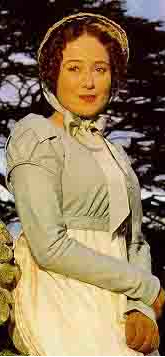
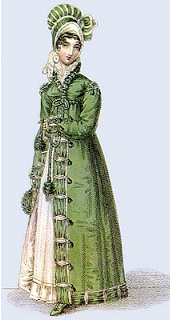
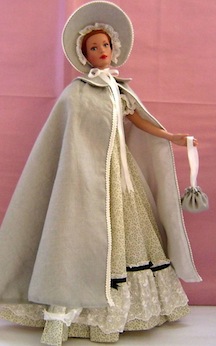
 Even in the dead of winter, many ladies would rather shiver in their flimsy gowns than be so unfashionable as to wear a heavy wrap. However, they did have shawls—Kashmir shawls had the advantage of being both light and warm—and various types of coats and jackets. A pelisse was an elegant overdress with long sleeves that buttoned down the front. A mantle was a rectangular fabric gathered at the neck. A spencer was simply a short jacket that reached the waist of the gown. Cloaks were often lined and/or trimmed with fur.

spencer
Lizzie wears a spencer over her dress.
pelisse
A pelisse à la militaire
mantle_reticule
The lady wears a mantle and carries a reticule.

For the most part, shoes in this period were “straights,” meaning there was no left or right shoe. Pumps made of embellished kid called slippers were very popular. Ladies had half-boots for walking, and stout boots for cold weather might be fur-lined. White silk hose tied at the knee (or later, the thigh) were often decorated with flowers or bowknots.

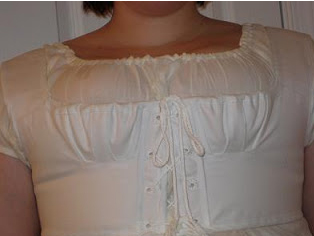
short corset common in the Regency

Under-drawers were not widely worn until after the Regency, around 1820. Short corsets with shaped cups for the breasts were common, although longer corsets were available to assist those with problem figures. A petticoat called a chemise was worn under the gown.

Hats & Accessories

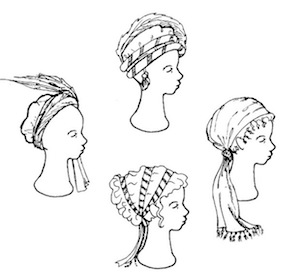
Smaller, simpler bonnets gradually became more ornate, constructed with straw, velvet, satin, and crepe, trimmed with ribbons, ostrich plumes, and fabrics. Decorated caps (undress bonnets) of lace or satin were worn indoors and outdoors in informal settings. Turbans of various styles were popular for full-dress occasions.

turbans
Various styles of turbans popular in the Regency

A fashionable lady had ribbons, jewels, combs, plumes, and hairpieces to dress up her hair for elegant evenings. Gone was the “big hair” of the previous century that towered so high that once a lady’s hair caught fire from the chandelier (Georgiana, Duchess of Devonshire). Classical hairstyles to match the classical gowns were “in”, and short, cropped hair, à la Titus, was popular through 1810.

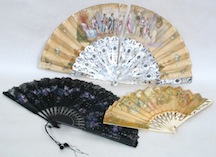
fans

Fans made of ivory with silk, gauze, or lace were another important accessory for every occasion. Every young lady learned the “language of the fan” in order to convey social messages without having to be rude. There were different fans for different occasions, and some were jeweled and hand-painted.

As for jewelry, simple gold crosses expanded to jeweled necklaces, bracelets, tiaras, and even elaborate clasps on shawls and wraps. Silk parasols, often decorated with fringe, were required during outdoor activities in order to prevent the development of freckles. A reticule, or ridicule, was a small bag often made with fabric from a gown used for carrying coins and items formerly carried in pockets.

parasol

A Lady’s Maid

A lady’s maid or abigail was necessary for such things as caring for clothing, preparing baths, dressing (gowns usually fastened in the back), and doing hair. She also accompanied her mistress while shopping and walking; young, unmarried ladies were not allowed out without chaperones, at least not while in the city.

Shopping!!!

One of my favorite scenes in Regency stories is when the ladies go shopping. After having my own Regency gown and pelisse made for me this year (by my own very talented mother), I wasn’t all that keen on the frequent fittings. And not being able to get in and out of my gown without assistance. But I LOVE feeling like a princess when I wear it!

Of course, having a gown made this way is a great deal more complicated—and expensive—than buying one in a department store. But then, the dress you end up with is uniquely yours by the time you add the trim and embellishments—you’re not likely to ever see anyone else wearing it.

Would you ever consider having a period gown made up like this? Where would you wear it?

Click here to see photos of my Regency outfit.

 The Regency Companion, Sharon Laudermilk and Theresa L. Hamlin, Garland Publishing, Inc., 1989, pp. 30-48.

The Regency Rites series

Regency Rites: The Well-Dressed Regency Lady 

Regency Rites: Presentation at Court

Regency Rites: Almack’s Assembly Rooms 

Regency Rites: The London Season

Regency Rites: Presentation at Court

A young girl’s come-out in Polite Society started with her presentation at Court. During Regency times, she would “make her curtsy to the Queen”, be honored with a large ball given by her family at their London residence, and if she were very fortunate, receive a voucher for Almack’s, the exclusive “marriage mart” to which all marriage-minded misses and their mothers yearned to be invited. (See previous post)

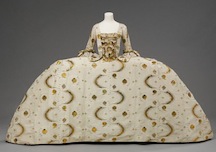
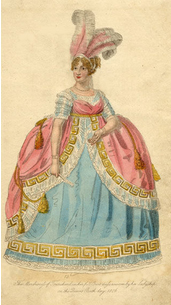
Wide hoops popular in the previous century were obligatory, even during the Regency when waistlines moved higher, and the result was considered ridiculous even then. But Queen Charlotte insisted, and…well…who was going to argue with the Queen?

courtdressgeorgian
An example of Georgian dress featuring hoops so wide the lady was obliged to walk sideways through doorways. But imagine these same hoops on high-waisted gowns such as those of the Regency period!

The elaborate gown consisted of a bodice, followed by a narrow hoop covered by layers of skirts. In her Memoirs, the Comtesse de Boigne describes “a satin skirt lavishly decorated with silver embroidery topped by a tulle skirt featuring a silver lace furbelow. The shortest and top skirt was made of silver-spangled tulle decorated with a garland of flowers. This last skirt was turned up and tucked so that the garland draped crosswise all around the skirt. To complete the proper style, the bottom of the white satin dress was turned up in loops and did not reach the base of the hoop skirt. Only the queen wore a train.” (see footnote)

In addition to the gown, an elaborate headdress with at least seven ostrich feathers was required. “The Comtesse’s head-gear beneath her plumes consisted of a garland of white roses upon a ringlet of pearls, a diamond comb, diamond buckles, and white silk tassels.” (see footnote)

It was also obligatory to display as much jewelry as possible, no matter how ridiculous it might appear. It is not surprising that these outfits cost an enormous amount of money in themselves, even though they might never be worn again.

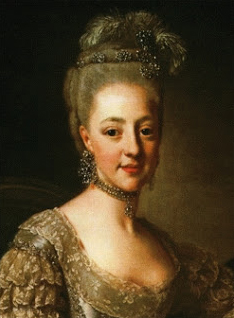
courtdress2In fact, considering the cost of the court dress, an extensive wardrobe, the come-out ball, a suitable residence in the most exclusive part of town, and enough servants to staff it, only the very wealthy could afford such lavish expenditures. These things were necessary, however, if one wished one’s daughters to marry well—title, family connections, and wealth—and it’s not difficult to visualize a father with several daughters or one who didn’t “take” the first season agonizing over the huge amounts of money flowing out of the family coffers. Undoubtedly, the young ladies were well aware of their parents’ expectations; after all the money spent, they’d better not do something stupid like allow themselves to be ruined or fall in love with a penniless man.

On the day of the presentation, the young ladies would arrive in a long procession of carriages.down Piccadilly Street to St. James’s Palace. Amidst trumpets and gunfire, they would proceed into the palace and join the crush of richly-dressed ladies in ostrich plumes, hoop skirts, and diamonds. It was an exciting, but terrifying, initiation into the top echelons of London society. Each girl would be led to the Queen, make her curtsy, exchange greetings and perhaps pleasantries with Her Majesty, and then walk backwards out of the room (one should never turn one’s back on royalty), hoping against hope that she didn’t trip or cough or do something to earn the Queen’s disapproval.

Afterwards, during the remainder of the Season, there were balls and routs, trips to the opera, the theater, Vauxhall Pleasure Gardens and Hyde Park, Venetian breakfasts and ridottos (although not masquerades, since they were considered only for the fast set), and all manner of exciting social events where a young lady could establish herself in London Society…and make the acquaintance of many suitable gentlemen themselves seeking eligible matches.

courtdressmale
The gentlemen’s court dress didn’t change as dramatically as the ladies’ did. (The wig is from an earlier period.)

This all sounds thrilling, but for some reason, I seem to prefer writing romances with more down-to-earth characters in less grand settings. Perhaps because I’m a farmer’s daughter at heart? But as much as I enjoy reading and imagining such things, I still prefer characters who can be blissfully happy without all the glitter and the falderal.

What do you think? Can you visualize yourself “making your curtsy to the Queen”?

The Regency Companion, Sharon Laudermilk and Theresa L. Hamlin, Garland Publishing, Inc., 1989, p. 24.

The Regency Rites series

Regency Rites: The Well-Dressed Regency Lady 

Regency Rites: Presentation at Court

Regency Rites: Almack’s Assembly Rooms 

Regency Rites: The London Season

The Blue Stockings Society and Benjamin Stillingfleet

In the Regency era, a young lady who gained the reputation of being a bluestocking would likely find herself “holding up the walls” as a wallflower at a ton event, since it was not the thing for a woman to be more educated than a man. Women were to be beautiful, fashionable, eloquent yet demure, and proficient in the social graces. A typical lady’s education would include reading, writing, geography, history, embroidery, drawing, French (or at least some French phrases), music, dancing, and, of course, riding, should her family have the means for a stable.

While there were, of course, learned ladies in society, it was thought prudent to keep one’s scholarly achievements private in order to avoid the bluestocking label, particularly for a young lady on the marriage market, which most genteel young ladies were. One hint that she might have blue tendencies could ruin her reputation and her opportunities for an advantageous marriage. And for most young ladies, marriage was the decision of a lifetime. Since divorce was nearly impossible and the husband held all the cards in the relationship, a mésalliance could very well mean a lifetime of misery and regrets.

In spite of this, there did exist a smattering of ladies—even some young, unmarried ladies—who defied prudence and flaunted their academic superiority to all and sundry. Some were married already, probably to indulgent husbands or those who were scholarly themselves. Those who were unmarried typically disdained the traditional role of women and did not aspire to giving some man control over them, although presumably these, too, were blessed with indulgent families with enough wealth to support a daughter for the rest of her life. There were some, like Hannah More, who, although she eschewed the frivolity of the ton, advocated the traditional role of marriage as the ideal for women, even though she herself never married.

Elizabeth Montagu

In the mid-eighteenth century, Elizabeth Montagu and Elizabeth Vesey, among others, founded a women’s literary discussion group, that later came to include gentlemen as well. The society promoted education for all (including women and the poor). Several prominent members of the society, which came to be known as The Blue Stockings Society, were (at one time or another):

  • Elizabeth Montagu: social reformer, patron of the arts, salonist, literary critic, and writer who helped organize and lead the Blue Stockings Society
  • Elizabeth Vesey: a wealthy patron of the society
  • Samuel Johnson: poet, essayist, moralist, literary critic, biographer, editor and lexicographer
  • Anna Williams: poet and companion of Samuel Johnson
  • David Garrick: English author and playwright, friend of Samuel Johnson
  • Anna Laetitia Barbauld: a prominent English poet, essayist, literary critic, editor, and children’s author
  • James Beattie: Scottish poet, moralist, and philosopher
  • Frances Boscawen: literary hostess and correspondent
  • Edmund Burke: Irish statesman, author, orator, political theorist and philosopher
  • Frances Burney: novelist, diarist, and playwright
  • Elizabeth Carter: poet, classicist, writer, and translator
  • Margaret Cavendish-Harley: Duchess of Portland, and scholar/collector of natural history
  • Hester Chapone: author of conduct books for women
  • Mary Delaney: artist and letter-writer
  • Sarah Fielding: sister of Henry Fielding, novelist herself, who wrote the first children’s novel
  • Ada Lovelace: daughter of Lord Byron and his wife Annabella Millbank (who was a scholar herself), a noted mathematician and considered to be the first computer programmer
  • Catharine Macalay: historian
  • Hannah More: religious writer and philanthropost (see earlier post on this blog)
  • Sarah Scott: novelist, translator, social reformer, and sister of Elizabeth Montagu
  • Sir Joshua Reynolds: prominent portrait painter
  • Horace Walpole: art historian, man of letters, antiquarian, and Whig politician

Benjamin Stillingfleet

The name of the group supposedly came from an invited guest, Benjamin Stillingfleet, a noted botanist and scholar, who wore blue worsted stockings to the meetings because he could not afford the requisite black silk ones. Since the group prided itself on valuing conversation over fashion, the term bluestocking was more of a jest than a slight in the early days of the society. It was later that it became a term of shame and derision when applied to a young lady.

Stillingfleet was the son of a physician who attended Cambridge and worked as a tutor to his young relative, William Windham. He later accompanied Windham on a Grand Tour of the Continent, where they lingered several years, doing, among other things, scientific studies of the glaciers, for which his protégé was later honored as a Fellow of the Royal Society.

A bluestocking heroine, you say?

It can be done, of course. I’ve read dozens—if not hundreds—of historicals with bluestocking heroines. But she needs a special sort of hero, doesn’t she?—one who has enough confidence in his own abilities to appreciate and desire to nurture hers. Or at least, that’s what he needs to become by the end of the story. And I think it’s also important for him to be able to draw her out of her preoccupation with academics and into the real world on occasion as well.

However, in order to become a bluestocking in the first place, a heroine would need to have been brought up in a manner that would make this possible. A rare, scholarly family, perhaps, or a negligent one that doesn’t realize how much time she spends with her brother’s tutor and is properly horrified when they discover it. Because any girl tagged as a bluestocking would become the object of much derision and gossip by the high-sticklers of society, and these high-stickers never forgot such things, even when they were proven untrue. A marriage-minded miss and her mother would be horrified at the very thought.

Donning my teacher hat

As a former teacher, I cannot help comparing this to the seeming popularity of idiocy in modern culture, at least among the youth (I was a middle school teacher). It’s always been a concern of mine that adolescents—particularly girls—play down their intelligence in pursuit of popularity. Frankly, I’ve never understood it, not even when I was that age. Why anyone should eschew their God-given intelligence in order to cater to someone else’s insecurities is beyond me. One would think that we would have evolved beyond this by now, especially with the job market being so competitive, but I’ve seen too many students of both genders fail to take advantage of their academic abilities and end up with lives on the fringes of success. And frankly, all the standardized tests in the world are not making a whit of difference in the status quo.

That’s what I think anyway. What do you think? Do you think movies like Dumb and Dumber only serve to lower the value of serious scholarship among our young people?

Blog Barrage for Treasuring Theresa

CBLSbarragebanner

CBLS Promotions is sponsoring a Blog Barrage for Treasuring Theresa today and tomorrow. Check out the stops and enter the Rafflecopter contest for my newest treasure box (including UK souvenirs) (see below).

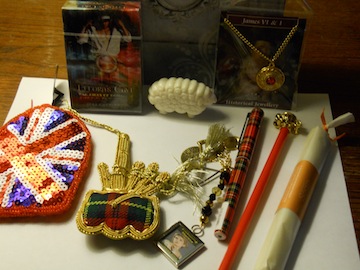
Lovely wooden box, 2013 Ellora's Cave playing cards (for adults only), sheep soap, James I and II necklace, Union Jack sequined coin purse, plaid bagpipes Christmas ornament, Treasuring Theresa key chain, plaid pen, crown pencil, fizzing bath crystals

Mark Your Calendar

fall2010

Coffeetime Romance Chat 

August 24  • 8:00-10:00 p.m. EDT

Eight Authors • Eight Giveaways

Theme: Historical Romance

Participating Authors

Aileen Fish
Shelly Munro
Lexi Post
Susana Ellis
Amy Hearst
Sasha Cottman
Sabrina York
Julie Johnstone

It’s Party Time for Susana’s Parlour!

???????????????????????????????????????????????????????????????????????????????????

Susana’s Parlour was born a year ago, after I returned from my first RWA conference, in Anaheim, California. I had the time of my life there—especially in the evenings when my friend Selene Grace Silver took me Laguna Beach and other nearby sights. It was magical!

I knew from my local RWA chapter mates that I would need a blog eventually, but at the time I was an unpublished author and didn’t really expect to be published right away. I mean, don’t most writers have to plug away for a few years before they get “the call”? But I guess I finally allowed myself to be convinced that waiting until then to start a blog was a mistake.

So…what to write about? I decided I didn’t want it to be an “author” blog—where the author talks about the daily struggles of writing. It would be a “reader” blog, for those readers who enjoy reading historical—especially Regency—romances as I do. As far as content, I decided to use an article I had begun about my pet peeves in historical romances. And that’s how the “Deal Breakers” series began.

It was only two months later that I did get “the call”—or rather, “the email”—and by January, I was a published author!

That’s about when Lady P popped in to inspire me with all of her fascinating tidbits about the Regency era. And things just spiraled from there.

So what’s in store for the next year on Susana’s Parlour? Well, I’ve discovered that it’s hard to predict what Lady P will do, but she promises that she will be back at summer’s end when the weather in England starts to chill…and will be removing with me to central Florida for the winter. She’s anxious to see a real alligator and insists she wants to go to Disney World too. Will I ever get any writing done at all with her there???

But she assures me that she has lots of great things to talk about. Even though she spent most of the summer in the country with her daughter’s family, she will be in London for the Little Season and promises to bring back all the latest on-dits and fashion news. And it should be fun to introduce her to the other inhabitants of our retirement community. I wonder if they played bingo in Regency times. Hmm.

Announcement, announcement, annou-ounce-ment!

I’ve just contracted with Ellora’s Cave to have my Christmas novella published this season! It will come out digitally as a single and then in a print anthology with other Regency Christmas stories in the Christmas traditions series.

Yep, you heard right! It’ll be in PRINT!

I can’t post an excerpt yet because the edits haven’t been completed and the final product might look a whole lot different. But I can give you a little sneak peak.

About A Twelfth Night Tale

Wounded physically and emotionally, Andrew returns home from the War on the Peninsula to find himself drawn to the now-grown-up girl next door. Lucy has always worshiped her best friend’s brother, but first she’ll have to turn down the wealthy viscount who can secure the futures of her and her four sisters.

Lucy and her best friend Jane are busy planning a party for the community Twelfth Night celebration. Jane’s brother Andrew has been home for some time when they finally run into each other, and Andrew can’t believe what he sees. The little girl who used to tag along after him everywhere he went has grown into a beautiful young lady! He tries to convince himself she’s off limits; after all, he was recently jilted by an avaricious fiancée and she’s being courted in earnest by a wealthy viscount. But the more time he spends with Lucy, the more drawn to her he becomes, and he wonders if he might have a chance with her after all.

Lucy has loved Andrew forever, but thought him lost to her when he became engaged to another woman. Her parents have five daughters to marry off with little in the way of dowries, and it seems like an answer to prayer when a wealthy viscount comes to call on their oldest daughter. Lucy has just about resigned herself to the match when she and Andrew—sans fiancée—are suddenly thrown together. But he’s still coming to terms with his own situation, and she can’t keep the viscount hanging on forever.

If there is any chance for a match between them, it’s going to take a bit of Christmas magic to make it happen.

Contest on The Romance Studio’s End-of-Summer Bash

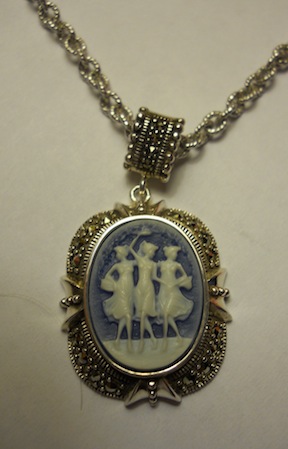
Test Your Knowledge of Regency-Speak…and win a blue silver and marcasite cameo necklace!

DSCN0493

This contest ends at the end of the day Friday, August 16th

Historical Romance Deal Breaker #6: Heroes With Mistresses or Who Sleep With Servants

susana's avatarSusana's Parlour

Literally decades of reading historical romances have led me to develop strong opinions of what defines a truly satisfying story, so the other day I set about making a list of characteristics that turn a potential five-star read into a one- or two-star. Admittedly, there are some skillful authors who manage to successfully incorporate one or more of these scenarios in their books; however, I have run across quite a few more who in my opinion haven’t quite managed it.

These are what I call “deal breakers”—characteristics that make a book a wall-banger instead of a pleasurable diversion. Not surprisingly, many involve character, particularly, the character of the hero and heroine. They have to be likable. They have to be three-dimensional, i.e., well-drawn-out characters with flaws, not fairy princesses. And they have to be able to fall in love, convincingly, the head-over-heels kind of love.

Overview of Susana’s Historical Romance Deal…

View original post 492 more words

Historical Romance Deal Breaker #5: Unattractive or Drop-Dead Gorgeous Heroines

Blast From the Past: Susana has been busy traveling in Scotland and attending the RWA Conference this month, and she thought some of you might enjoy revisiting some of her previous posts on Susana’s Parlour.

Decades of reading historical romances have led me to develop strong opinions of what defines a truly satisfying story, so the other day I set about making a list of characteristics that turn a potential five-star read into a one- or two-star. Admittedly, there are some skillful authors who manage to successfully incorporate one or more of these scenarios in their books; however, I have run across quite a few more who in my opinion haven’t quite managed it.

These are what I call “deal breakers”—characteristics that make a book a wall-banger. Not surprisingly, many involve character, particularly, the character of the hero and heroine. They have to be likable. They have to be three-dimensional, i.e., well-drawn-out characters with flaws, not fairy princesses. And they have to be able to fall in love, convincingly, the head-over-heels kind of love.

Overview of Susana’s Historical Romance Deal-Breakers

  1. Reluctant Heroes
  2. Adultery
  3. Anachronistic Behavior and Historical Inaccuracies
  4. Cliffhanger Endings
  5. Unattractive or Drop-Dead Gorgeous Heroines
  6. Heroes With Mistresses or Who Sleep With Servants
  7. Drop-Dead Gorgeous Heroes
  8. Promiscuous Heroines
  9. Contrived Endings
  10. Waifs and Silly Heroines
  11. Long Separations
  12. Excessively Cruel Heroes and Heroines
  13. Breaking the Rules: Why Some Authors Get Away With It


Historical Romance Deal Breaker #5: Unattractive or Drop-Dead Gorgeous Heroines

  • Heroines who are fat and/or described as “plain” or unattractive

Like the majority of readers, I am not the most attractive person out there. I’m middle-aged, struggle with weight issues, and use artificial means to enhance my hair and facial features. I consider myself “average.”

Also like the majority of readers, I like to fantasize about being more attractive and irresistible than I am. When I read, I’m picturing myself as the heroine; her experiences are mine, right up to the HEA at the end.

It just doesn’t do it for me when the heroine seems to have virtually *no* physical attractions. Especially when this is paired with too many psychological issues stemming from her doubts about her physical appearance. A little of this goes a long way, for me. I want the story to be about the characters falling in love. If I wanted to read a story that is more psychological drama than romance, I wouldn’t read romance.

While the heroine does not have to be drop-dead gorgeous (see below), she absolutely must have some attractive qualities. She might have mousy brown hair, but her figure should be unobjectionable and she might have the most intriguing grey eyes.  Maybe her breasts aren’t voluminous, but she has a small waist and neat ankles (whatever that is). She may be considered plain by many, but we get to see from the beginning that the hero finds some things about her attractive, which become even more appealing once he becomes better acquainted with her.

You get the drift.

Considering the growing number of books featuring fat and unattractive heroines—and the readers who seem to rave over them—I wonder if I’m in the minority here.

However, I also have a problem with:

  • Heroines who are so beautiful and sweet that everyone falls in love with them (even birds and wild animals)

I also find it difficult to identify with heroines who are too perfect. (Actually, I want to slap them silly.)

In a romance it is important to create three-dimensional characters because the characters are the story. If the main characters in your story are too good to be believed, you risk your story becoming a Disney movie, with its happy cartoon characters sailing off into the sunset. Even if you enjoy cartoons, surely you have to wonder if Cinderella and her prince really did live happily ever after without ever once clashing over raising the children or the price of glass slippers. You don’t have to be diabetic to suffer from the effects of consuming too much sugar.

A heroine can be beautiful, but she has to have some flaws too. Perhaps she perceives her nose is too long. Or she’s too tall or too short. Or her hair is too dark to be the current trend.

Her flaws can also be emotional. Perhaps she fears that people only like her because of her physical attractions. (I had a roommate like that once; I never thought she was that beautiful. Oh well.) Or she’s plagued with shyness. Or she blurts out things better left unsaid. Or she thinks she is unworthy because of her birth or social class or a past indiscretion.

adore a good HEA. I feel cheated if I don’t get one. But I want them to seem at least somewhat realistic. I want to be convinced that my hero and heroine love each other enough—have survived enough challenges as their romance developed and matured in the story—that their relationship is strong enough to survive the uncertainties of the future.

Am I the only one who feels this way? Have you run across any five-star reads with extremely ugly or extremely attractive heroines? Do tell!


Welcome to the History Lovers Grand Tour & Scavenger Hunt!

—International—

graphic4medweb copy

As the name implies, we’re a group of readers and authors who love both history and romance, especially when they’re combined in a delightful story. If you feel the same, you’re welcome to join us on our Facebook page and converse with us about historical romance fiction.

Below you’ll find authors of historical romances set in a wide variety of time periods. Perhaps by participating in our Grand Tour you’ll discover some new authors for your future reading pleasure. Hop around to your heart’s content, feel free to comment on the posts, hunt for answers to the authors’ questions, and perhaps you’ll be one of our 25 lucky prize winners (see contest details below)…although you’re already a winner if you find a new story to read, do you not agree?

The theme for this tour is Courting Rituals, and for my post, I’ve chosen to talk about the difficulty of finding suitable husbands for young ladies confined to the country.

The Plight of Country Ladies of Limited Means

Previous posts about the London Season and Almack’s have mentioned the most appealing attractions in London, and I’m sure these will be described by some of the other Regency authors on this tour. But what I’d like to consider here is how difficult it could be for a genteel young lady confined to the country to find a suitable husband.

All you have to do is recall the situation of the Bennet family from Pride and Prejudice to understand that it was not an easy task, even if the young lady was exceedingly pretty like Jane or appealing in other ways like Lizzie. While the Bennets possessed no wealth or aristocratic family connections to give them entrée into the elegant ballrooms of London society, they were still of sufficiently high social status to prevent them from making matches with the lower classes: farmers, tradesmen, etc. Consequently, young ladies like Lizzie Bennet and Charlotte Lucas often had to choose between a mundane marriage to a man like Mr. Collins or a life of blessed spinsterhood. Jane Austen herself chose the latter when her own Mr. Darcy failed to appear.

Genteel country families did socialize, of course. There were dinners and parties and, for those who had the means, house parties, where guests were invited to spend a week or more hobnobbing with their host family. Young people could become acquainted at local assemblies or at other community activities, such as church services or local fêtes, such as the one Theresa and Damian organized for the village of Granville in Treasuring Theresa.

However, in many places there was a dearth of eligible suitors. Well-to-do families could send their sons and daughters to London to find spouses, which reduced the number even further for young ladies like the Bennet daughters. All things considered, Mrs. Bennet’s excitement when she heard Netherfield was to be let to a young single man of means seems only natural. Such an opportunity did not come often; surely one of her girls could manage to entice him into marriage.

The Bennet family’s situation was an unenviable one also because the estate was entailed to the nearest male relative, which meant that the house and attached lands would pass to Mr. Collins upon Mr. Bennet’s death. While there would be a jointure of some sort for his widow and daughters, it wouldn’t be much, and they would have to find another place to live as well. If one of the daughters could marry well, they would be able to assist their mother and sisters when Longbourne passed to Mr. Collins.

Lady Theresa

Lady Theresa

Although she is an earl’s daughter and did have a London Season, Lady Theresa is a country girl who has always expected to marry the boy next door, Reese Bromfield, the squire’s son. But when her father loses his fortune and Reese returns from London with a fiancée, Theresa’s options are few. To make it worse, her father becomes ill and seems determined to match Theresa with his heir, a distant cousin she despises…and who returns her feelings full-force. But what other options does she have? Marriage to a Cit in search of aristocratic connections? A life of servitude as a governess or companion? What would you do in a similar situation?

The prize I am offering is a wooden gift box of goodies from London and Scotland ($50 value) and it will go to one lucky responder (chosen randomly) to the question: What would you do if you were in a situation similar to Lady Theresa’s? Be sure to include your email address with your comment.

Inside the lovely wooden box: Mary Queen of Scots necklace, sheep ornament, Treasuring Theresa keychain in bag, bar of soap, bath crystals, sheep soap, pen, pencil, Castles and Palaces of Scotland playing cards

Inside the lovely wooden box: Mary Queen of Scots necklace, sheep ornament, Treasuring Theresa keychain in bag, bar of soap, bath crystals, sheep soap, pen, pencil, Castles and Palaces of Scotland playing cards

Here’s my question for the scavenger hunt: In the British system of primogeniture, titles and estates were often entailed, or required to be passed on, to what person after the death of the owner?

Click on the History Lovers Grand Tour page to fill in the answer, and you may continue on from there. Enjoy!

About Treasuring Theresa

At the betrothal ball of the man she had expected to marry herself, Lady Theresa latches on to Damian Ashby, hoping to divert attention from her own humiliating situation. Of course, she’s not seriously interested because he’s a useless London fribble, in her opinion. He is not favorably impressed with her either.

Still, she’s the daughter of an earl, and he’s the heir to her father’s title and estate, so they are destined to spend more time in each other’s company…sooner rather than later. And who knew that the two of them would develop an unlikely attraction to one another?

But can a London swell and a country lady ever make their diverse lives and interests work together?

Excerpt

The dancing had already begun when they arrived. Damian stayed close at Theresa’s side, his arm lightly around her so that his fingers pressed into the small of her back, while she introduced him to her friends and acquaintances. They shared a set of country dances, and when he returned to her side after fetching a glass of lemonade, she was chatting merrily with a cluster of her friends, so he danced a trio of sets with some of the other young ladies. He managed to get back to her in time for the supper dance, just ahead of a tall, fresh-faced youth in a poorly tied Mathematical and a waistcoat that went out of style years ago.

Damian Ashby, Lord Clinton

Damian Ashby, Lord Clinton

“When does the waltzing begin?” he whispered as they performed the elaborate steps of the country dance. “I must claim the first waltz.”

“We do not waltz here,” she whispered back. “It’s considered far too scandalous. Besides,” she added when they came back together, “we have already danced twice. A third would make us the talk of the shire.”

He chuckled. “Isn’t that what you were aiming for at the Sedgely ball? A juicy scandal to divert the gossips’ attention?”

She looked up at him in surprise. “You know,” she said, “I just realized I don’t care about that anymore. I’m glad Reese is happy with Eugenia.”

“Indeed,” he managed, wondering why he suddenly felt so relieved.

She did condescend to dance another set with him, and Damian hoped all of the old biddy gossips had noticed.

On the return trip, Mrs. Noble babbled on incessantly about gowns and stale cakes while Damian found his eyes lingering over the curvaceous form of the young lady on the seat across from him, the light of the moon being thankfully dim enough to conceal his bold appraisal.

She was silent, in a reflective mood, her head turned toward the window and the shadowed images of the scenery outside.

“Imagine that scamp Dickie Fielding enticing the Hampton chit to meet him in the garden!” Mrs. Noble exclaimed indignantly. “Why I thought her father would explode when they were discovered.” She lowered her voice. “I have it on good authority that they were embracing,” she revealed. “A dreadful scandal indeed should they not marry post-haste.”

Theresa’s head shot around to face him, and he knew she was recalling that night at the betrothal ball when she’d tried to lure him out to the terrace and he’d made a hasty escape. He rather thought now that he would enjoy a pleasant interlude alone in the moonlight with her. He would hold her against him, her head on his chest, while his hands swept over her curves. When he felt her pulse rising, he would draw her chin toward him and take her lips in a long kiss while his other hand would cup her breast, already pebbling with her desire.

Damian froze. What was he thinking? Cousin Theresa was no strumpet. The only way he could indulge in such carnal delights with her would include an obligatory wedding first. And that was out of the question.

Wasn’t it?

Available

Ellora’s Cave • Amazon • Barnes & Noble • AllRomance eBooks • Kobo • Sony

History Lovers Grand Tour Authors

Rue Allyn • Amylynn Bright  • Collette Cameron • Téa Cooper  • Beverley Eikli  • Susana Ellis • Aileen Fish • Debra Glass  • Amy Hearst • Evangeline Holland • Piper Huguley • Eliza Knight  • Kristen Koster • Cora Lee  • Georgie Lee • Suzi Love • Denise Lynn • Deborah Macgillivray  • Barbara Monajem • Shelly Munro • Ella Quinn • Eva Scott  • Shereen Vedam  • Elaine Violette

Prizes

  1. Each author will offer a prize for a contest, the specifics of which is set up entirely by her. The contest will be open to all participants, regardless of geographic location. For logistical purposes, authors may substitute a digital prize (gift card, etc.) of equal value for another prize that might prove difficult to mail to a distant location.
  2. The Grand Prize for the Scavenger Hunt will be awarded to the participant with the most correct answers to the authors’ scavenger hunt questions.  In case of a tie, the winner will be chosen randomly.
  3. The winners will be posted on the History Lovers Grand Tour page the following week.

Scavenger Hunt

  • Click on the above links to each author’s blog. The blog tour entry can be identified by the graphic in the upper right corner of the post. If it is not the top post, look for the graphic in a prominent location on the sidebar, and click on it to find the blog tour entry.
  • Read the blog post and the author’s short answer question at the end. Locate the answer to the question, then click on the link to the History Lovers Grand Tour page and type in the answer next to the author’s name. Be sure to fill in the your name and email address!
  • You may go back to same page and read more of the author’s post (excerpt, etc.) or you may click on another author’s name on the answer sheet and repeat the process.
  • When you are finished, check to make sure the spaces for your name and email address are filled in correctly, and submit your answer sheet to the tour coordinator. If you submit an incomplete answer sheet, you may come back later and make another submission with the remaining answers when you have more time.
  • Any questions about the scavenger hunt should be directed to the tour coordinator .