Archives

Guest Author Eva Scott and The Last Gladiatrix

Today my guest is Eva Scott, who recently joined a Facebook group called History Lovers, which was originally formed by several of us who were teammates in Savvy Authors NANO Smackdown with Entangled Editors last fall. We’re all history lovers, of course, and we write historical romance, although with quite diverse settings. 

Welcome to Susana’s Parlour, Eva!

eva scottThanks, Susana. It’s great to be here! I’d like to begin by talking about the role of women in ancient Rome.

While my novel The Last Gladiatrix is set in Rome my heroine is not actually Roman.  Xanthe is a Sarmatian, the people who are thought to be the source of the Amazon legend.  Sarmatian women fought side by side with their men in times of war, being equally as skilled in archery as in cooking up a mean pot of lamb stew for afterwards.  Their lives revolved around horses and many Sarmatians were bow-legged as a result of the custom of putting children of both sexes on horseback before they could walk.  The Sarmatians were a nomadic people travelling with the seasons, tending their flocks of sheep and goat not unlike their ‘cousins’ the Scythians or the Alans.

Roman women, however, were not quite as free.  A Roman woman was controlled by her father even after she married.  Her father could order her divorce if he so choose—even if the couple in question didn’t agree!  Once her father died she didn’t automatically pass into the authority of her husband.  If her father appointed a tutor before his death then that man would become her legal guardian.   Yet there was a way out from under the yoke.  If a free-born woman had three legitimate children, and her father was dead, she was rewarded the right to legal and economic independence from her tutor.

It wasn’t all gloom and doom for Roman women.  In the ideal Roman family a husband and wife shared a partnership and made important decisions together.  Not unlike our family model of today.  And there is a lot of historical evidence for the important role mothers played in their son’s life—for better or for worse.  Women often manoeuvred for power in the back rooms and salons of Roman society.  A powerful man often had a strong, clever woman helping behind the scenes.  And the older a woman became the more weight her opinion carried and the more respect she earned. I don’t know about you but I do like the sound of that!

Gladiatrix_Final (427x640)About The Last Gladiatrix

Captured and enslaved by a Roman legion, Xanthe never expects to end up training for the Coliseum floor, but every night after the day’s march, she is put through her paces by a Roman solider who challenges her, tests her, and excites her.

Titus is drawn to Xanthe, her fire and her spirit, so he breaks one of his rules and brings notice on himself, offering to train her as a gladiatrix to spare her a courtesan’s role. But training her, working with her, soon becomes too much. Titus knows the penalty for taking property that does not belong to him, but how long can he resist?

Excerpt

The flash of her green eyes in the candlelight reminded Titus of the verdant wild forests of Northern Italy, which they had recently left. He rubbed a smear of dirt from her cheek with his thumb, and then taking her hand, he raised Xanthe up to stand. With deliberate, slow movements he unfastened her tunic, letting it fall from her shoulders to pool on the ground at her feet.

Xanthe made no move to stop him, their eyes locked, her fear and trust clear to see. He slid his fingers beneath the waist of her leggings and tugged them down over her hips, leaving her naked, standing there before him.

Titus took a sponge and dipped it into a bowl of warm water, letting it soak before applying it to Xanthe’s flesh. He washed her with firm yet gentle strokes, and as the water ran over her skin it dripped deliciously from her breasts. The centurion bent his head and licked at a droplet, pleased to feel her shudder in response. Her nipple hardened, inviting him to explore further. He needed no invitation. Xanthe had to summon all her self-discipline to stand still while Titus explored the curves of her body. His touch turned her core to molten fire; she could barely contain her need.

http://www.amazon.com/The-Last-Gladiatrix-ebook/dp/B00BSKJF98/

http://www.escapepublishing.com.au/products/tag/historical

About the Author

I live on the Sunshine Coast, in Queensland Australia with my fabulous husband and gorgeous little boy. When I’m not writing romance you can find me out on the water kayaking, fishing or swimming. When on dry land it’s all about the shoes and the coffee.

http://www.evascottromance.com/

http://www.facebook.com/eva.scottromancewriter

http://www.facebook.com/pages/Romancing-The-Romans/476218929112324?ref=hl#!/pages/Romancing-The-Romans/476218929112324

http://www.twitter.com/EvaScottWriter

The Dress: Episode 1

The idea of wearing a Regency gown to the Romantic Times Book Convention (as well as book signings and other events) originated with my friend Ellen, who has lots of experience promoting her teacher books in conference exhibit halls. She said I should stand in front of the table, not behind it, wearing a period gown, and have a list of questions about the Regency period to ask in exchange for prizes. Wow, that sounded like a lot of fun to me, so I started looking around for gowns.

regencypatternI found a pattern on etsy.com and ordered it (have since found you can get it at Jo-Ann’s in the Butterick catalog), and my mom, who is a superb seamstress, offered to make it for me. (Actually, it’s a gown and coat both.) I don’t think at the time she realized how complicated it was going to get, but she is a woman of her word and determined to see it through.

The first obstacle was shopping for materials. For one thing, fabric has changed a great deal in 200 years. While there are many beautiful fabrics today, many with sparkly threads and sequins that would look great on me, we had to bypass those and look closer to find fabrics that might at least resemble a Regency-era fabric. It was a painstaking process, because as soon as we found something we thought would be perfect, we’d discover there wasn’t enough fabric on the bolt, which turned out to be a constant problem. For some reason, fabric manufacturers have started putting less fabric on the bolts, so unless you find a brand new bolt, chances are there won’t be enough fabric for a long gown on it. Rats! We had this problem with the lining fabrics as well as the gown and coat, and had to find another Jo-Ann’s Fabrics in the next town to get enough. And buy a yard or two extra to make sure we had enough for the extra-long skirt pieces.

Eventually, we ended up with an off-white pintuck taffeta for the gown and a blue satin for the coat.

fabric2smBut that wasn’t the end, because these garments require lots of decorative trim. The coat has an organdy trim at the neckline, but the clerk at the fabric store had never heard of organdy! But we found something that seemed like organdy that will work. Then we needed several kinds of trim for the sleeves and empire waist for the gown and for the coat as well. The problem with this was that it couldn’t be anything too white, and it had to be a specified width. Inevitably we’d find the perfect trim and find that it was too wide or narrow.

As far as the cost, well, that could not be a concern. It was hard enough to find something that would work at all. There was no way I was going to take the time to shop around all the fabric stores in Central Florida to find stuff on sale. Not when this project has to be finished before I leave for RT on April 28! Thanks to Mom, we did have a 15% off coupon, though!

In case you’re wondering, this is definitely not an economical project. I have already spent quite a bit on Regency shoes from American Duchess (with beautiful shoe clips), period stockings, a ringlet hairpiece, and gloves, in addition to the fabric and notions that were so hard to find. (Obtaining the proper undergarments to give me the right shape was also quite costly.) My philosophy is you either do it right or not at all. So I’m not sweating the small (or the large) stuff. And it’s all tax-deductible for a Regency author, right?

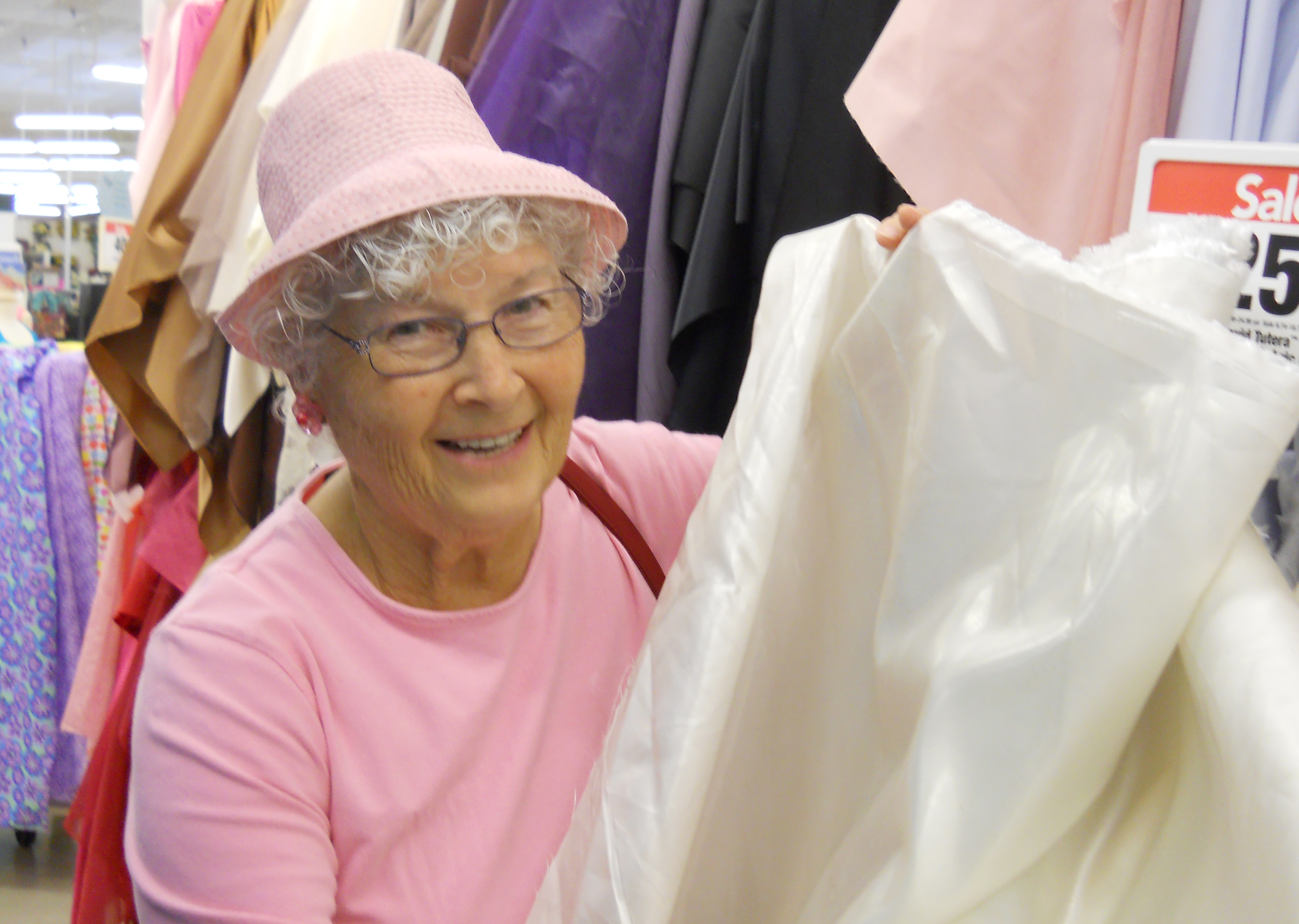
So this week we got all the materials and started pulling out the pattern pieces and laying them out on the fabric. We started with the lining, moving the kitchen table in my folks’ house so that we could cut on the floor. NOT a great idea at all! We both ended up with aching backs from maneuvering ourselves into uncomfortable positions and having to get up and down off the floor so many times. After that, we decided to take everything down to the clubhouse (we live in a retirement community in Florida during the winter), move a few tables together, and do our cutting there. Voilà! SO much better. So now we have the lining and dress pieces cut out and ready to put together.

And a few people came in to get their mail and wondered what we were doing, so I took the opportunity to give them a bookmark for Treasuring Theresa. All good!

mom_smile_edited-1One thing that rather astonished me is the need for proper fitting. My own feeble sewing efforts have involved buying the fabric and the pattern and hoping it would fit by the time I was done. That might work with knits and stretchy fabrics, but not with Regency-era fabrics. No indeed. The bodice and the sleeves, at least, have to be fitted closely to the body, and it’s a painstaking process that I couldn’t do in a million years. Thank goodness I have a mother who not only knows how to do it but is willing to put in the hours and hours it takes to make things work!

First she worked on altering the pattern; in spite of having lost 30 pounds recently, the pattern still needed to be made larger to fit properly. Somewhat humiliating, but there’s no point in having a gown that won’t fit! Once she had the pattern right, she could cut out the lining and make a few more adjustments. Now she knows exactly what needs to be done with the bodice of the dress too, where there’s less room for error.

It turns out Mom and I make a pretty good team. She’s the brains and I’m the brawn. And the cook. I provide lunch every day and help her with simple things in the afternoon, like pinning the pattern pieces to the fabric, moving around tables and chairs, cleaning up afterward, things like that.

This is all great research, by the way. Whenever my heroines have to have dresses made, they go to the modiste’s and stand there for hours in their underwear while having pins stuck in them. Now I have a good idea how that feels! Ditto with searching out the right trim, ostrich feathers, etc. (Oh, should I look for an ostrich feather or two?)

My mornings are devoted to writing. I’m hoping to finish the first draft of Cherishing Charlotte in the next few days and then go over it and add some final touches before sending it off to my wonderful critique partners. Then I have another novel to finish, plus a Christmas story to submit for the Ellora’s Cave Christmas Cotillion anthology. Would like to finish all three projects before heading to Scotland on June 20!

Oh, by the way, my sister Gloria (aka Letitia Beauchamp) also has a Regency gown that she had made. She’ll have to come to some book signings with me to wear it. I wonder if her husband Mike (aka Lord Beauchamp) would consent to having a Regency outfit made for him? Sounds like a plan to me!

Stand by for further reports on the progress with “The Dress.” The deadline approaches, but I have perfect confidence in my mother’s abilities.

Oh, and in case you’re wondering: she is NOT interested in taking this up as a profession or a hobby. Being retired in itself is a very time-consuming activity. Once is enough…and I’m the lucky one!

Episode #11: In Which Lady P Talks About Hannah More and the Rights of Women

Lady Pendleton, Damian Ashby’s eccentric aunt (see the epilogue to Treasuring Theresa on Susana’s web site), is visiting Susana from the early 19th century. She’s intrigued by life in 21st century Toledo, Ohio, and, of course, Susana is thrilled to have the opportunity to pick her brain about life in Regency England. It certainly gives her a great deal to write about in Susana’s Parlour!

Susana: [to the Reader]:

The other day, Lady P and I got to talking about the position of women in the Regency period and how it evolved from the late 18th century when women such as Georgiana Cavendish held political salons and marched in support of political candidates to a time when women were to be saintly and devout and “protected” from the seamier side of life, leaving the important decisions to their sturdier husbands.

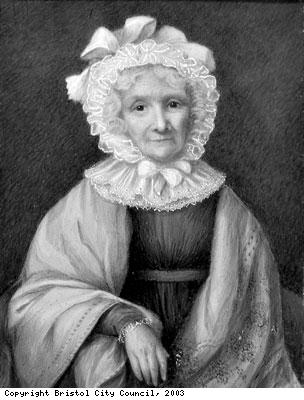
Miss_Hannah_More-304x400Lady P: ‘Twas Hannah More and the Evangelicals that popularized it. Women were to be seen and not heard, at the same time obedient to their husbands and revered by them. [Snorting in an unladylike manner] Pendleton and I laughed about it on many an occasion. I’ve never been the obedient sort, and Lord P would not have wed me if I were. Nor did I wish to be worshiped either. The very idea!

Susana: No doubt it was a reaction against the excesses of the previous generation. The Devonshire ménage-à-trois, for example. The Prince Regent and his illicit marriage, as well as all of his mistresses and excessive spending. The scandalous behavior of Lady Caroline Lamb.

Lady P [Frowning]: There were excesses, of course, which did lead to the pendulum swinging in the other direction. But such extreme changes more often than not led to equally harmful excesses on the other side.

Susana: Indeed. I can certainly see that is true in the 21st century. But do explain what you mean, Lady P. What were the harmful excesses caused by the Evangelical movement?

Lady P: A popular interpretation of the wife-as-saintly approach was that the husband was allowed and even expected to be a sinner.

Susana: Which gave him the freedom to take mistresses and carouse as often as he liked, while his “sainted wife” stayed home and raised the children.

caroline_lambLady P: Well, yes, but it was rather more than that. As unrealistic and unfair as it was to the women, I believe it was equally unfair to the men. Lord Byron, for example. Why would such a dissolute young man choose to marry a staid bluestocking like Annabella Milbanke?

Susana: Because she was an heiress and he was close to bankruptcy?

Lady P: Then why would she agree to marry him? She had turned him down flat in the past, having recognized that he was a loose screw.

Susana: Because opposites attract? Because she thought she could reform him?

Lady P: Exactly! She was quite forthcoming about it, actually, and Lord Byron seemed to agree that she would be a good influence on him, at least at first. But as the wedding drew near, he began to have doubts, complaining to his bosom bows that he feared the medicine would be far more disagreeable than the disease itself.

Susana: It can be tiresome to be preached at all the time. In a true partnership, both partners accept each other, flaws and all.

Lady P: Precisely. In this case, Annabella overestimated her own influence and underestimated the extent of her husband’s vices. She did not know of his immoral relationship with his half-sister Augusta until after the marriage, for example, and like most women who incessantly nag their husbands, she came to be regarded by her husband as a nuisance.

Susana: But as you say, Byron was a bit of a loose screw. Would it have worked between them, do you think, if he’d been on some sort of medication?

Lady P [with a loud harrumph]: Your society seems to be of the opinion that all can be cured with a tiny pill, Susana, but I’m not so sure. We had quacks touting medicines in our day too. Why, the stories I could tell you about laudanum…!

Susana: But getting back to the issue of women’s rights, what did you think of people like Hannah More, Lady P? Was she a good influence or a bad one? She did influence people to care for the poor, did she not?

Lady P: Hannah More and those around her were neither good nor bad, Susana. The mistake, in my opinion, is to paint everything in life broadly as either white or black. Hannah More did a great deal to awaken society to the plight of the poor and stir up support on their behalf, that is true. But I believe that she did a disservice to both women and men in promoting the role of women as subservient to men.

Susana: But women were still legally the chattel of men, were they not? And they were not given the right to vote for another hundred years.

Lady P [somewhat impatiently]: Legally, yes, that is true. But my dear Susana, you must not assume that every marriage was built on such an unequal basis. Discerning women always knew how to manage their husbands, so long as they took care to marry a husband who could be managed, that is. I daresay even the redoubtable Hannah herself could not have managed such a bedlamite as Lord Byron.

Susana: But you said yourself that you never told Lord Pendleton about your Whig activities with the Duchess of Devonshire.

Lady P: Indeed not. It was for his own protection. His family would have been scandalized.

Susana [shaking her head]: Sometimes your logic escapes me, Lady P.

Lady P: I’m not saying that my own marriage was ideal, or that most marriages were not unequal in my day, Susana. There was just as much hypocrisy in society then as there is in your century. Why Hannah herself apologized in her books for having the temerity to write them at all, being a mere woman as she was. My point is that one must consider one’s options and make the wisest choices possible in whatever circumstances one finds oneself. I may have decided to become a Whig, but I wasn’t foolish enough to believe they should have unilateral power. No indeed. Some of their official policies were ridiculous in the extreme, and I was glad there were rational voices on the other side to temper their excesses.

Susana: In that respect, I certainly agree with you, Lady P. I find I cannot blindly accept any philosophy or ideology without considering each facet of it on its own merits. But I find it extremely frustrating that there are so many who do, as though they haven’t a brain to think for themselves.

Lady P [dryly]: So I’ve noticed that about you. But Susana, it does appear that you are missing the point. People are who they are, and there’s not a lot you can do to change them. My counsel in such cases has always been to do what you can and let the rest be, else you work yourself into a state fit for Bedlam.

Susana: [shaking her head]. You remind me so much of Dr. Ellis, author of How To Stubbornly Refuse To Make Yourself Miserable About Anything, Yes Anything.

Lady P: What a singular title for a book! The logic seems sound, however. Why, many was the time when Lord P left me alone to go to his club that I could have spent the night fuming, but I decided instead to use that time to follow my own interests.

Susana: Such as attend the Whig salons at Devonshire house?

Lady P: Yes, and attend balls and musicals that Lord P did not enjoy. It wasn’t fashionable to live in one another’s pockets, in any case. We muddled along well enough, I do believe. How I do miss the dear man! [Sigh]

As always, please do comment if you have any questions you’d like to ask Lady P about the late Georgian/Regency era. She does love to chat!

The Lady P Series

Episode #1: Susana’s Adventures With Lady P: The Introduction

Episode #2: Lady P Talks About… Pride and Prejudice?

Episode #3: Lady P and the Duchess Who Lost a Billion Dollars

Episode #4: Lady P and the Face On the $100 Bill

Episode #5: In Which Lady P Discovers Sparkly Fabrics and Ponders Violating the Prime Directive

Episode #6: Lady P Dishes the Dirt on the Duchess of Devonshire

Episode #7: The Political Exploits of Lady P and the Duchess of Devonshire

Episode #8: Lady P and the Prince Regent’s Illicit Marriage

Episode #9: In Which Lady P Depletes the Cooking Sherry During Her Discussion of Caroline of Brunswick

Episode #10: Lord Byron: Mad, Bad, and Dangerous to Know

Episode #11: In Which Lady P Talks About Hannah More and the Rights of Women

Episode #12: Lady P’s Revelations Regarding George III and His Peculiar Progeny

Episode #13: Lady P Discusses the Luddite Uprising, the Assassination of Spencer Perceval, and the General Unfairness of Life

Episode #14: In Which Leticia, Lady Beauchamp, Pops In For an Interview On Her Personal Acquaintance With Princess Charlotte of Wales

Episode #15: Lady P On Assignment in 1814 Kent

Lady P Quizzes Jane Livingston, the Hero’s Sister From “A Twelfth Night Tale”

A Favorite Scene From Treasuring Theresa!

The official excerpt is on http://www.susanaellis.com/pub.html. This scene comes later, however. Enjoy!

Copyright © SUSANA ELLIS, 2013

All Rights Reserved, Ellora’s Cave Publishing, Inc.

????????????????????????????????????????When does the waltzing begin?” he whispered as they performed the elaborate steps of the country dance. “I must claim the first waltz.”

We do not waltz here,” she whispered back. “It’s considered far too scandalous. Besides,” she added when they came back together, “we have already danced twice. A third would make us the talk of the shire.”

He chuckled. “Isn’t that what you were aiming for at the Sedgely ball? A juicy scandal to divert the gossips’ attention?”

She looked up at him in surprise. “You know,” she said, “I just realized I don’t care about that anymore. I’m glad Reese is happy with Eugenia.”

Indeed,” he managed, wondering why he suddenly felt so relieved.

She did condescend to dance another set with him, and Damian hoped all of the old biddy gossips had noticed.

On the return trip, Mrs. Noble babbled on incessantly about gowns and stale cakes while Damian found his eyes lingering over the curvaceous form of the young lady on the seat across from him, the light of the moon being thankfully dim enough to conceal his bold appraisal.

She was silent, in a reflective mood, her head turned toward the window and the shadowed images of the scenery outside.

Imagine that scamp Dickie Fielding enticing the Hampton chit to meet him in the garden!” Mrs. Noble exclaimed indignantly. “Why I thought her father would explode when they were discovered.” She lowered her voice. “I have it on good authority that they were embracing,” she revealed. “A dreadful scandal indeed should they not marry post-haste.”

theresa2.5webTheresa’s head shot around to face him, and he knew she was recalling that night at the betrothal ball when she’d tried to lure him out to the terrace and he’d made a hasty escape. He rather thought now that he would enjoy a pleasant interlude alone in the moonlight with her. He would hold her against him, her head on his chest, while his hands swept over her curves. When he felt her pulse rising, he would draw her chin toward him and take her lips in a long kiss while his other hand would cup her breast, already pebbling with her desire.

Damian froze. What was he thinking? Cousin Theresa was no strumpet. The only way he could indulge in such carnal delights with her would include an obligatory wedding first. And that was out of the question.

Wasn’t it?

Don’t forget: the Epilogue to Treasuring Theresa is also available as a bonus read on my web site. Be sure to read the original story first, however.

Guest Author Linda Carroll-Bradd Talks About “Dreams of Gold” + Giveaway

Thanks for hosting me today, Susana.

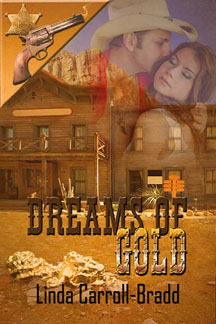
Today I’m talking about my sweet western historical novella, Dreams of Gold.  I love stories where one of the characters is definitely outside his or her comfort zone. That’s exactly where my heroine, Ciara Morrissey, finds herself when she acts on a deathbed promise made to her dear mother. From civilized Massachusetts to a frontier town in Wyoming Territory is quite a leap, and Ciara finds herself in all sorts of trouble.

Leave a comment here which includes your email address for a chance to win a copy of Dreams of Gold.

DreamsofGold_SMAbout Dreams of Gold

1871, Wyoming Territory

Easterner Ciara Morrissey travels west to honor a sacred promise to her mother and locate her fortune-seeking father. Three years of acting as caretaker to her grandparents and mother until their deaths has created a thirst in Ciara to see what the wide world has to offer.

Sheriff Quinn Riley has been tracking the Irish charlatan who swindled half the population of Bull City, Wyoming. He’s determined to stick close to the opinionated woman who arrived on the runaway stagecoach. Within only a few hours, easterner Ciara Morrissey upsets the townspeople by making inquires about his prime suspect. He’s duty-bound to keep her safe, even when being close to the green-eyed beauty sets off a stampede in his heart.

EXCERPT

More evidence she was a stranger to the wild circumstances of the western frontier. Anticipation of organizing the chase flitted through him. “Did they use names? Or speak to their horses?” At her head shake, he fought back the urgency rising in his chest. “Anything that might provide a clue?”

“We heard shots, and Mr. McGinnis shouted for us to do what we were told. A man rode up to the window on each side, demanding our money and jewels.” A dainty shoulder lifted in a shrug. “That’s when Miss Fairchild screamed her virtue was about to be stolen and swooned, landing in my lap.” Green eyes danced, and a high-pitched giggle escaped. “Frankly, I doubt the robbers planned on lifting anyone’s skirts.” Eyes widening, she clapped a hand over her mouth and shook her head.

Damn. Quinn had seen witnesses suddenly realize the danger they’d been in and that’s when hysterics set in. Lord, he could not abide a crying woman. “Did you notice any detail about their saddles or markings on their faces that stood out?”

Her brows scrunched low, and she squared her shoulders, pulling her jacket snug across her breasts. “I feared for my very life, sir, and you think I should have noticed their saddles?” She inhaled deeply, and then her whole body stilled. “Yes, I do remember something about the saddles.”

He watched the movement of her chest—in particular, how the buttons strained their closures. The rhythm of his heartbeat kicked up and a bead of sweat trickled on his forehead. Lifting his gaze to her face, he leaned forward, forcing himself to concentrate on what she might share. “What’s that?”

“Each man sat in one.” Her body rigid, she raised the mug to her lips and waited, an eyebrow arched high.

Excerpt © Linda Carroll-Bradd

All Rights Reserved, The Wild Rose Press

authorSMAuthor Bio

As a child, Linda was often found lying on her bed reading about characters having exciting adventures in places far away. Upon reaching a landmark birthday, she decided to write one of those romances she loved so much. Easier said than done. Perseverance paid out and twelve years later, she received her first call from a publisher and a confession story was published. Now Linda writes heartwarming contemporary and historical stories with a touch of humor, and many have a tie to her previous home of Texas.

Linda currently lives in the southern California mountains with her husband of 34 years and their two spoiled dogs, Shiba Inu Keiko and terrier mix Phoenix.

www.lindacarroll-bradd.com

Guest Author: Debra Glass + Giveaway

Susana:

Today my guest is Debra Glass, who, like me, writes historicals for Ellora’s Cave, although hers are quite a bit more steamy than mine! Last year I loved her ménage book, Scarlet Widow, so I’m eager to hear about her latest release, Lover For Ransom. Welcome to Susana’s Parlour, Debra!

Debra: 

Thank you very much for hosting me in the Parlour today.

A Yankee Teacher Comes South in Lover for Ransom

Cathleen Ryan is one of my favorite heroines. She’s feisty and no nonsense and has a firm grip on everyone and everything—except herself. I thoroughly enjoyed writing her interaction with Southern hero, Ransom Byrne, who found he was far more intrigued with the Yankee hired help than he wanted to admit.

Leave me a comment and be sure to include your email address. One lucky commenter will receive a copy of Lover for Ransom!

**********

Byrne’s End, Thompson’s Station, Tennessee

June 3, 1866

Mr. John A. Bennett

Dear Sir,

I have arrived in Tennessee in one piece, though at times, I highly doubted that would be the case. Once my train crossed the Mason Dixon line, there was a marked change in the land. Many once grand dwellings are now but burned out shells, skeletal remains of the bastions of slavery I so fervently fought against during my tenure as an abolitionist prior to the war. I must admit, however, this area referred to as Middle Tennessee by its inhabitants is, for the most part, unscathed by the ravages of the war.

Upon my arrival, I was met at the station by Mr. Ransom Byrne who, I’m given to understand, contracted my service with the Perkins School for the Blind. Though pleasant enough, Mr. Byrne embodies all the qualities I would have heretofore ascribed to a former officer in the Rebel Army. With his easy and overly familiar manner of speech, he seeks to dazzle and woo, but I assure you, Mr. Bennett, those cavalier charms are lost on an affirmed spinster such as I, but not, as I so shockingly observed, on the local maidens.

Mr. Byrne took it upon himself to confide in me that, during the war, he had been brought home to convalesce during an illness which he unwittingly spread to members of the Byrne family, including my charge, his younger sister, Jenny. The illness resulted in her blindness, and I have clearly determined that my work with the sixteen-year-old has been cut out for me. Like many who have been robbed of sight in the bloom of life, Miss Byrne is disillusioned and bitter. I have no doubts I shall be able to rectify that and teach her that the blind can indeed live full lives.

It is obvious to me that Mr. Byrne feels beholden to his family and their business of horse breeding. In fact, the Byrnes and their servants alike, put far too much stock and trust in the wiles of the beasts, as I unfortunately learned firsthand after a mishap with a wagon and its novice driver, seven-year-old Charles Hunt.

I imagine a lesser woman would be intimidated by the Southern aristocracy, but not I. I fully intend to not only adhere to the standards I have adopted from my friends and mentors, Mrs. Elizabeth Cady Stanton and Miss Susan B. Anthony, but to instruct these Southern women, long repressed by their menfolk, the way to equality both in the home and at the voting poll.

As soon as I begin my instruction with Miss Byrne, I will write to you and inform you of my progress. Again, I appreciate the opportunity you have afforded me to travel from my hometown of Boston to this godforsaken land where I might not only help this young woman, but also enlighten my Southern sisters.

Very Truly Yours,

Cathleen M. Ryan

loverforransom_msrSMwebAbout Lover For Ransom

Ransom Byrne has been ravaged by guilt since an illness rendered his little sister blind. The former Confederate cavalry officer has resolved to make amends by hiring a Yankee tutor who’ll hopefully restore order to his sister’s life. Once accomplished, he’ll be free to leave Byrne’s End.

From the moment she steps off the train in Tennessee, Cathleen Ryan makes a startling first impression. With her feminist ideas, the irrepressible Bostonian quickly outrages everyone—especially Ransom. He deems the bespectacled teacher too uptight and prim for his tastes. Appearances, however, are deceiving. She tenders decadent proposals that shock and intrigue him, and sultry nights spent submitting to his every illicit request offer them both love and redemption.

But when her steadfast convictions attract the attention of dangerous men, Cathleen risks losing her chance of becoming more than just a lover for Ransom.

Inside Scoop:  This 19th-century tale contains mild violence, spanking, sloppy puppy kisses, more spanking, fiery suffragette speeches and an attitudinal horse named String Bean.

A Romantica® historical erotic romance from Ellora’s Cave

Excerpt From: LOVER FOR RANSOM

Copyright © DEBRA GLASS, 2013

All Rights Reserved, Ellora’s Cave Publishing, Inc.

“Don’t you ever read anything for pleasure?”

She toyed with the earpieces of her glasses, her mind fixed on the way his velvety drawl had played havoc with the word pleasure. She cleared her throat. “There are far too many important things to read to waste my poor eyesight on frivolities, Mr. Byrne.”

He closed her book, set it on the table and stood. Cathleen flinched as his leg brushed hers when he passed on his way to the bookcase. He opened it and pressed his fingertip to his lips in thought as he perused its contents.

Cathleen studied his casual stance. His weight shifted to one leg and his head cocked to the side. He looked back at her, stared so long it made her insides quiver and then turned back to the collection and removed a slender book from the shelf.

“I shall read to you then,” he said with a smile and he returned to his chair. “To protect your poor eyesight from…frivolities.”

Cathleen gulped as his long fingers opened the book and he thumbed through the pages. It looked like a child’s volume in his hands and she couldn’t help but wonder what he’d chosen.

“Ah, here,” he said, placing his elbow casually on the armrest of his chair to hold the book at a comfortable height. “It was many and many a year ago, in a kingdom by the sea, that a maiden lived there that you may know by the name of Annabel Lee.”

Edgar Allan Poe. Of course she was familiar with the famed Baltimore author. But she’d read his works in braille, and certainly had never heard them read aloud by a man with such a hauntingly husky voice. This night—this moment, with the clock’s pendulum ticking off the seconds in time with the poem’s meter and the flickering glow of the lamp—seemed to be made for the dark, beautifully macabre poem about a woman who’d died before her time.

“For the moon never beams without bringing me dreams of the beautiful Annabel Lee,” Ransom continued.

Cathleen closed her eyes, picturing a pair of young lovers walking hand in hand on a stormy beach. Ransom’s voice transported her and she felt the anguish of the author who’d lost his love only to find himself frequented by her ghost.

“And so, all the night-tide, I lie down by the side, of my darling—my darling—my life and my bride, in the sepulcher there by the sea, in her tomb by the sounding sea.”

Eyes still closed, Cathleen sat in the stillness, absorbing the song contained in the words. When her lashes fluttered open, she was surprised at the tear that traced down her cheek. Blushing, she swept it away. “Very nice, Mr. Byrne.”

He raised his eyebrows in mock warning.

She giggled. She actually giggled. Closing her eyes for a split second, she struggled to compose herself. She was acting like a bashful schoolgirl. “Ransom,” she corrected, her voice but a breath.

In that instant, something had suddenly changed between them and she was at a loss to decipher it.

Staring, he inhaled. “With your hair loose, you reminded me of the woman in that poem.”

Her eyes widened. “Dead?”

He chuckled without mirth. “No. Wild and windswept.”

This time, Cathleen did begin to smooth her hair down.

“No,” he said. “No. Don’t touch it. It’s perfect the way it is.” He must have realized he’d said too much. “I mean, it’s only you and me. There’s no need for pretense.”

Cathleen nodded. Her gaze fell to the brown leather covered book in his hand. “Do you believe such love exists?”

He snorted and closed the book. “This was the fancy of a man who imbibed too much and who thought too much. Love like that is for the young and foolish—for people who haven’t experienced the things I have.”

Cathleen gnawed her bottom lip. “Are you referring to your time during the war?”

He suddenly looked uncomfortable. His big and masculine exterior seemed incongruous with his sudden unease. “Yeah,” he admitted. “I saw and did things no living human being should ever have to see or do. Things that’ll make you hate yourself.”

Cathleen didn’t know how to respond. Newspapers told of the hardships and combat. She’d seen soldiers boarding trains to join the fighting. She’d watched neighbors don their widow’s weeds. She herself had received a telegram informing her that her brother had been killed. But even when the war had come into her very home, it had always seemed a distant thing. But these Tennesseans had lived the war. This man had fought it. Federal troops had occupied their home. While on the train, she’d overheard tales about frightening guerilla raids from both sides, about men who didn’t live by any code of decency, who took what they wanted and killed indiscriminately. These families had lived day to day, wondering if their hard-earned food stores, their homes or even their very lives would be taken from them.

“No,” Ransom continued. “The war was anything but glory.”

Still, Cathleen remained uncharacteristically silent. While she pitied the plight of these people, in her eyes, the war had been a necessary evil, a vehicle through which an entire race had broken the bonds of slavery and declared themselves free. And yet, she didn’t feel free to admit her thoughts on the matter to Ransom Byrne. Not tonight.

“What about you, Cathleen?” he asked, his gaze finding and holding hers, daring her to correct him. “Do you believe in that kind of love?” His tone was almost mocking.

Realizing he’d shifted the conversation back to the poem, she let out a laugh. “Of course not. In fact, I don’t agree with marriage at all and I shall never marry.”

“How did you come to this conclusion?”

“Contrary to what you might think, I haven’t chosen a life of spinsterhood because I am bookish and outspoken, not to mention plain.” She straightened, confused at the way a belief she’d always maintained with pride, now hurt. “No. I simply do not accept as true that a woman should have to marry and live out her days in subjugation.”

“Subjugation?” he asked and then laughed. “I’ve always thought that was the other way around. All the married men I know are pretty beholden to their wives.”

“That’s but a puerile joke. We all know that marriage gives husbands rights to a woman’s livelihood and even her body, if he so chooses to claim them. For a woman, marriage is nothing but legalized…rape.”

This time, both his eyebrows shot up. “That’s a mighty strong word.”

“A married man can demand his rights anytime he chooses. Therefore, if a woman is forced into coitus with him, it is legalized rape.” Cathleen lifted her chin, awaiting an argument. It was a strong word. But he needed to know how she felt about subjugation. She needed him to know it.

Instead, he surprised her. “Don’t you ever feel desire?”

Yes, I’m feeling it this very instant.

Can’t wait for the drawing? Buy Lover for Ransom (available in all ereader formats ) at Ellora’s Cave today! http://www.ellorascave.com/lover-for-ransom.html

glass_SMAbout the Author

DEBRA GLASS is the author of over thirty-five books of historical and paranormal romance, non-fiction, young adult romance, and folklore. She is a member of Romance Writers of America and the Professional Authors’ Network as well as RWA’s Heart of Dixie and Southern Magic Chapters.

She lives in Alabama with her real life hero, a couple of smart-aleck ghosts, and a diabolical black cat.

www.DebraGlass.com

Episode #10: Lord Byron: Mad, Bad, and Dangerous to Know

Lady Pendleton, Damian Ashby’s eccentric aunt (see the epilogue to Treasuring Theresa on Susana’s web site), is visiting Susana from the early 19th century. She’s intrigued by life in 21st century Toledo, Ohio, and, of course, Susana is thrilled to have the opportunity to pick her brain about life in Regency England. It certainly gives her a great deal to write about in Susana’s Parlour!

Susana: [to the Reader]:

Lady P and I just finished watching the 2007 BBC movie about Lord Byron, and I thought you might find some of her reminiscences of the original characters as intriguing as I did. [Turning to Lady P] You knew the real Lord Byron, did you not, Lady P? What was your impression of him?

byronLady P:

Oh yes, I was acquainted with the man, as was anyone who was anyone in the ton during the spring of 1812 when he came onto the scene. I could never understand why women were making cakes of themselves over him. He wasn’t all that well-favored, you know, not nearly as attractive as that actor who played him in the film. Although he did have a certain magnetism, I suppose, when he looked at a woman with “the stare,” that is, with hooded eyes. I’m not at all sure what he was conveying with that most peculiar stare, but whatever it was had the effect of making formerly sensible women abandon all pretense of prudence in order to attract his attention.

Susana:

Undoubtedly Lady Caroline Lamb was one of them.

Lady P:

She was the worst of them, but then, she was always somewhat of a loose screw, Susana. Even when she was small—she was eight years old when her mother, Georgiana’s sister, moved the family into Devonshire House to escape her father’s abuse—Georgiana used to tell me about her flights of fancy and frequent mood swings, and when she married George Lamb and moved into Melbourne House, we all hoped that her husband and Lady Melbourne, his mother, a prominent Whig hostess you know, would prove to be steadying influences on her.

Susana:

It didn’t work out that way, though, did it?

Lady P [shaking her head]:

Not at all. You know, Susana, it is never a good idea for a newlywed to move in with her husband’s family. Or the other way round, I’m sure. In this case, Caroline clashed constantly with Lady Melbourne, and it only got worse when Caroline and Byron were so foolish as to allow their affair to become public. Harriet—Lady Bessborough, Caroline’s mother, you know—tried to rein her in, especially after Lord Byron tried to break things off with her, but Caroline was so far gone from reality that she listened to no one. She foisted herself on his friends and begged them to help her win him back. She threatened to harm herself. She neither ate nor slept and was quite wraith-like when her mother and husband finally persuaded her to go to Ireland with them. But even that wasn’t the end of it. Poor Caroline raved over him until the day she died, alternately loving and hating him.

carolinelamb

Susana:

I suppose today she’d be diagnosed bipolar and given medication to help her cope with her illness.

Lady P [frowning]:

Bipolar?

Susana:

Mood swings. You know, when someone is rapturously happy and believes everything is right with the world and doesn’t care if everyone knows it, and then later falls into a serious depression. I’m no psychiatrist, of course, but it does sound to me like she suffered from such an affliction.

Lady P:

Well, she did suffer from some sort of affliction, that much is obvious. And I shouldn’t wonder if Lord Byron didn’t suffer from something similar. He too, was something of a loose screw. Although I can’t really say what he was like as a child. I did hear that his father was something of a tyrant, like Caroline’s.

Susana:

What an interesting thought! But did he exhibit an equal passion for her, at least while their affair was still going full-swing?

Lady P [with a decidedly unladylike snort]:

Oh yes, indeed. Of course, when he first came onto the social scene, he was a Nobody and she the reigning Beauty. No doubt he was flattered when she took an interest in him. They were both poets, you know, possessed of mercurial artistic temperaments. At first, her mad, childlike bravado attracted him, but when Lady Melbourne got her clutches into him and convinced him that Caroline’s antics could make him persona non grata in society, he began to cool toward her.

Susana:

Lady Melbourne? Caroline’s mother-in-law? Why would Lord Byron pay attention to anything she said about Caroline?

Lady P:

My dear Susana, Lady Melbourne was one of the premier Whig hostesses, exceedingly attractive for her age, and it was whispered about that Lord Byron was infatuated with her. Yes, even though she was more than thirty years his senior. It does happen, you know. She had many affairs with prominent men, including the Prince Regent, and her son George bears an uncanny resemblance to him too.

Susana:

So why was she so critical of Caroline, then, if she indulged in adulterous affairs herself?

Lady P [somewhat impatiently]:

The difference between them, my dear Susana, is that Lady Melbourne’s lovers were carefully chosen to increase her influence in political circles. She was also careful to manage them with the utmost discretion. Caroline, well, she had no such scruples. She was the victim of her impulses. And to a lesser extent, Lord Byron was to his as well.

Susana:

I feel so sorry for her. But Lord Byron did not pine away for her, did he?

Lady P:

Not at all. He cut a wide swathe among the ladies of London. [Lowering her voice] It is said that he had an incestuous relationship with his half-sister Augusta, and that her daughter Elizabeth is his.

Susana:

Goodness! For a society so bent on propriety, there was certainly a great deal of scandalous goings-on!

Lady P [sighing]:

Oh yes indeed! It was keeping up appearances that was the important thing. So hypocritical. Why, I always thought it was beyond outrageous when Lady Swindon cast her maid into the streets for being with child when she herself was having an affair with the Duke of Kent. I do hope I was able to instill better principles into my own daughters while they were growing up.

Susana:

Lord Byron eventually married, did he not? I heard that his daughter Ada was the world’s first computer programmer.

Lady P:

Computer programmer? Well, I can’t speak to that, since I have no notion of what that is, except for that machine you use for your writing. But yes, he did marry Annabella Milbank, who was Lady Melbourne’s favorite niece and an heiress besides. And now that I think on it, I do recall that she was thought to be something of a bluestocking, so it is likely that she would have an intelligent daughter. Why, Annabella was better educated than most of the men of the ton; you’d have thought she’d have better sense than to marry a sad rattle like George Byron.

Susana:

Those mesmerizing, hooded stares of his, no doubt.

Lady P:

She probably thought she could reform him. She was quite a devout young lady, I believe. [Shaking her head] Such a shame. Why, I made sure my girls knew better than to attempt such a thing with their husbands. There are ways a woman can influence her husband’s opinions—I can certainly attest to that—but it is far better to choose a mate who doesn’t require a great deal of changing. Do remember that, Susana.

Susana [rolling her eyes]:

Of course, Lady P. [To the reader] That’s all for today. I hope you enjoyed Lady P’s reminiscences about the celebrated poet that Lady Caroline called “mad, bad, and dangerous to know.”

As always, please do comment if you have any questions you’d like to ask Lady P about the late Georgian/Regency era. She does love to chat!

Susana Welcomes the Lucky in Love Blog Hop!

luckyinlove

We have TWO grand prizes. You as a reader can go to EACH blog and comment with your email address and be entered to win. Yep, you can enter over 200 times!

 Now what are those prizes?

  1. 1st Grand Prize: A $100 Amazon or B&N Gift Card
  2. 2nd Grand Prize: A Swag Pack that contains paperbacks, ebooks, 50+ bookmarks, cover flats, magnets, pens, coffee cozies, and more!

But wait…there’s more!

Win a $20 Amazon Gift Card and/or a Treasuring Theresa coffee mug!

Susana’s Parlour is celebrating the Lucky in Love Blog Hop with the Treasuring Theresa Lucky In Love Giveaway. To enter the contest, click the graphic at right or the Treasuring Theresa graphic in the side bar.

Before you go, leave a comment on today’s guest post for five contest entries. Be sure to include your email address in your comment so that you are eligible for Carrie Ann’s Grand Prizes!

Lucky Like Lizzie or Lucky Like Jane?

Like just about anything else, finding love is just as much as matter of choice as luck. Let’s take Elizabeth Bennet of Pride and Prejudice. She was fortunate to be born into a genteel family, but since she had no brothers, and her father’s estate was entailed to the nearest male heir, her prospects of making a good marriage were minuscule. There were other problems too, such as her mother’s lack of breeding and connections to the merchant class, but Lizzie, out of all her sisters, was determined to marry someone she could love and respect or else become a maiden aunt to all of her sisters’ children.

lizzieConsidering her prospects, most would have agreed with her mother that she was fortunate indeed to have won the admiration of Mr. Collins. After all, he would one day own Longbourn and if she were his wife, her mother and sisters would still have a home after her father’s death. It was no more than the truth when Mr. Collins told her that she might never get another proposal of marriage.

But as much as she loved her family, Lizzie was intelligent enough to know that it would be a mistake to marry a man she despised just to secure a home for her family. Had things not worked out with Mr. Darcy, no doubt there were relatives who would have provided for them to prevent them from being cast into the street. But they would have been reduced to living in straitened circumstances, making it even less likely that they would find suitable matches, and they would be beholden to their relatives for the rest of their lives.

So Mr. Darcy’s appearance was a lucky stroke for Lizzie. And yet…if she’d been the sort of woman who was on the lookout for a meal ticket, he wouldn’t have looked twice at her. Because it was her character that attracted him as much as her appearance.

jane_bennetNow Jane Bennet is another story. I get the feeling that Jane would have married Mr. Collins if she’d been given the chance (and it’s not just Lost in Austen that makes me think so). Because of her astonishing good looks, she’d been brought up to believe that she owed it to her family to marry well, no matter what. For her, yes, it was an amazing stroke of luck that she managed to win the affection of the man she loved, and that he was wealthy as well.

I don’t know about you, but I have to respect Lizzie for her strength of character more than Jane for her willingness to sacrifice herself for her family. It might have something to do with the fact that the heroine of my current project, Cherishing Charlotte, faces a similar dilemma. But I can’t help thinking that in general, luck is a fickle friend. What if you marry a Mr. Collins for security and then meet the love of your life? What you considered good luck has now turned into a dreadful mistake. And in the Regency era, marriage was pretty much forever. And in spite of what is implied in so many historical romances (and in Lost in Austen), it wasn’t at all simple to get an annulment or a divorce. For most people it was impossible.

So I guess what I’m trying to say is that the romantic side of me likes leprechauns and pots of gold and love at first sight, but the practical side reminds me that what many consider “luck” is at least partly the result of a sense of self-worth and determination to be true to oneself, no matter what the consequences.

If you were a Bennet daughter, would you be more like Lizzie or Jane in your attitude toward marriage? Why do you think so?

Click here to continue your journey through the Lucky in Love Blog Hop.

Spotlight on Jane Ashford + Giveaway

TRRanniversarysmWin a $20 Amazon Gift Card and/or a Treasuring Theresa coffee mug!

Susana’s Parlour is celebrating the second anniversary of The Romance Reviews with the Treasuring Theresa Lucky In Love Giveaway. To enter the contest, click the TRR graphic at right or the Treasuring Theresa graphic in the side bar.

Before you go, leave a comment on today’s guest post for five contest entries. Be sure to include your email address in your comment!

Spotlight on Jane Ashford

In my younger days, I used to devour the old Signet, Zebra, Candlelight, etc. Regencies by the dozens, and still have quite a collection on my TBR shelves. Jane Ashford was one of my favorites. I’m glad to see that she is making some of these available in digital form so that they can be enjoyed by the younger Regency readers.

ashfordThe more I learned about Jane Ashford (whose real name is Jane LeCompte), the more I realized how much we have in common. She discovered Georgette Heyer in junior high school, while I discovered Heyer’s magic in ninth grade, but both of us were entranced with “the glittering world and witty language of Regency England.” She studied English literature in college. I have an English minor. She traveled widely in Britain and Europe. I studied abroad in Spain, France and Mexico, lived in Ecuador for three years, and have traveled around Europe, Central and South America. She was born in Ohio and lived in New York, Boston, and Los Angeles. As for me, I’ve always lived in Ohio, except for the three years in Quito, Ecuador. She started writing at a younger age, but her career was interrupted by various life events. I read voraciously during my teaching career and began writing seriously afterward.

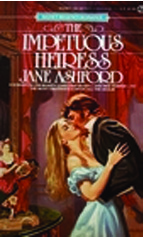
At the moment I’m reading The Impetuous Heiress, which features a strong, self-confident society lady labeled an “ice queen” because she’s turned down so many offers of marriage. But when she meets a tall flame-haired Scotsman who isn’t impressed by her popularity or beauty, she falls hard. This time, though, she is the one who gets turned down, and oddly enough, it only seems to make him more attractive to her. Will the Scotsman see through her social veneer to the sweet, generous girl beneath, or will his first impression of her as a rather “fast” society lady make a love match between them extremely unlikely?

impetuousWhich of Jane’s Regencies have you read? Do you miss the shorter Regencies as much as I do?

Giveaway#2: One randomly chosen commenter will receive the following SIX vintage Jane Ashford Regencies*:

  • The Repentant Rebel (1984)
  • The Irresolute Rivals (1985)
  • Meddlesome Miranda (1988)
  • Gwendeline (1980)
  • A Radical Arrangement (1983)
  • The Impetuous Heiress (1984)

*These are used books in relatively good condition.

Jane’s new historical release is Once Again a Bride:

onceagainPushed by her dying father into a marriage with one of his friends, Charlotte Rutherford Wylde finds herself bound to an old man who disdains and ignores her. Miserable, furious, she determines to take drastic action, but before she can confront him, her husband is murdered in the dark London streets. From the moment Charlotte hears this upsetting news, she is subject to shock after shock. Her dead husband has spent the fortune she brought him, leaving her nearly penniless. His will reflects his obsession with the artifacts of ancient Rome, turning her home into a museum. And most astonishing of all, he had an entire family that he never mentioned.

The fashionable Wyldes are as surprised to hear of Charlotte’s existence as she is of theirs. To the charismatic Alex she is, at first, just another obligation in his overburdened life. He has to grapple with his dead relative’s shady business dealings, an attempted robbery, and a suspicious Bow Street Runner. But it’s not long before Alec realizes that there is nothing he would rather do than cherish the entrancing Widow Wylde.

Jane discusses marriage laws in Regency England on the Historical Hussies blog.

Historical romances by Jane Ashford include:

  • Once Again a Bride (Sourcebooks – February 2013)
  • The Marriage Wager (Sourcebooks re-issue in September 2013)
  • The Bargain (Bantam Books)
  • Charmed and Dangerous (Bantam Books_
  • Bride to Be (Bantam Books)

Regency romances by Jane Ashford include:

  • Gwendeline (Warner Books)
  • Bluestocking (Warner Books)
  • Man of Honour (Sourcebooks re-issue in August 2013)
  • Rivals of Fortune (Warner Books)
  • The Three Graces (Sourcebooks re-issue in October 2013)
  • The Marchington Scandal (NAL/Signet)
  • The Headstrong Ward (NAL/Signet)
  • A Radical Arrangement (NAL/Signet)
  • First Season (NAL/Signet)
  • The Impetuous Heiress (NAL/Signet)
  • The Repentant Rebel (NAL/Signet)
  • The Irresolute Rivals (NAL/Signet)
  • The Reluctant Rake (NAL/Signet)
  • Meddlesome Miranda (NAL/Signet)

Jane Ashford’s Web Site


Episode #9: In Which Lady P Depletes the Cooking Sherry During Her Discussion of Caroline of Brunswick

TRRanniversarysmWin a $20 Amazon Gift Card and/or a Treasuring Theresa coffee mug!

Susana’s Parlour is celebrating the second anniversary of The Romance Reviews with the Treasuring Theresa Lucky In Love Giveaway. To enter the contest, click the TRR graphic at right or the Treasuring Theresa graphic in the side bar.

Before you go, leave a comment on today’s post for five contest entries. Be sure to include your email address in your comment!

Lady Pendleton, Damian Ashby’s eccentric aunt (see the epilogue to Treasuring Theresa on Susana’s web site), is visiting Susana from the early 19th century. She’s intrigued by life in 21st century Toledo, Ohio, and, of course, Susana is thrilled to have the opportunity to pick her brain about life in Regency England. It certainly gives her a great deal to write about in Susana’s Parlour!

Susana [to the Reader]:

In our last encounter, Lady P enlightened us on the Prince of Wales’ illegal marriage to a twice-widowed Catholic lady unsuitable in every way to be Queen Consort of England. Following that, he married—for reasons of state—his first cousin, Caroline of Brunswick, daughter of his father’s sister. I’ve read of what a dreadful disaster that was, but I wanted to pick Lady P’s brain about it.

Lady P:

Really, Susana! Pick my brain, indeed! What an indelicate turn of phrase!!

Susana:

It’s just an expression, your ladyship. It means—well, I should have said only that I’m curious to learn what you have to say about the Prince’s choice of wife.

Lady P [shuddering]:

Naturally I have a great deal to say about it, but first I must shake off the image of some quack physician performing surgery on my brain. Is there anything left of the cooking sherry?

Susana:

No, you finished that one off last week after watching the finale of Downton Abbey, don’t you remember? But don’t despair—I bought a new bottle yesterday at the Kroger store.

[A slight pause while Susana leaves the room and returns with a glass of wine for Lady P.]

Lady P [after draining half the glass and dabbing at her lips with a handkerchief]:

Just the thing. I do enjoy a little wine in the evening, you know. What a pity you have no wine cellar. Why, in my day, every reputable household had a wine cellar and a stock of good wine. Even though you yourself do not indulge, Susana, you ought at least to think of your guests!

Susana [shrugging]:

My friends and I usually go out. In any case, if your ladyship is properly refreshed, I wonder if we could resume our conversation about the Princess of Wales. I have heard that she and the Prince detested each other on sight. Is that true, do you think?

caroline2Lady P:

That was indeed the on dit, and I must say, I could believe it. The Prince arrived late to his wedding, and in a most intoxicated state, too. Lady Bessborough—Georgiana’s sister Harriet, you know—told me that the night before he’d written a note declaring his everlasting love to Maria Fitzherbert—with whom he was estranged at the time—and he made out a will leaving everything he owned to her as well. Harriet was much distressed to see the state he was in.

Susana [shaking her head]:

Then why was she chosen in the first place? He was a grown man; surely he could have found a way to avoid it if he’d wished to.

Lady P:

Was he? A grown man, I mean. Much of the time his behavior resembled that of an over-indulged child. [Looking around nervously] I suppose I can say that with impunity since he’s been dead for nearly two centuries, but truly, my dear, the Prince of Wales was never the man his father was, the madness notwithstanding. [Sighing] In any case, the Prince had accumulated such debts that Mr. Pitt—the Prime Minister, you know—promised to give him a substantial increase in income if he were to make a suitable marriage.

Susana:

So…he was forced to marry Caroline of Brunswick to pay his debts? Did he have no other prospective brides to choose from?

Lady P:

Well, when you eliminate the Catholic royalty and those who were already wed, there were only two who were eligible, both of them his first cousins. Princess Louise of Mecklenberg-Strelitz was his father’s brother’s daughter, and frankly, she was the prettier of the two and seemingly possessed of the better temperament. There were rumors of Princess Caroline’s scandalous behavior even then, you see.

Susana:

Then why did he choose her? Did she have a larger dowry?

Lady P [clucking]:

The on dit was that Lady Jersey—the Prince’s mistress at the time—chose her because she seemed a less formidable rival.

Susana:

So…he allowed his mistress to choose his wife?

Lady P:

If you believed the Prince to be a man of integrity and good character, my dear Susana, then you have not been attending my words at all. The man had no intention of forming a true marriage, and even though he had broken with Maria, in some manner he still considered her his true wife and resented the necessity of making another connection for state purposes.

Susana:

So he didn’t really care who he married.

Lady P:

Whom, my dear. Not who. No, I don’t suppose he did. Consequently, when he ended up with a wife as odious as Caroline, nearly everyone secretly believed his punishment was well deserved.

Susana:

Did you agree with them, Lady P?

Lady P [sighing]:

As many faults as the Prince had, my dear, they were nothing compared to those of Caroline of Brunswick. Those who defended her when apprised of his cruel treatment—and that was nearly the whole of England, you know—could hardly have been well acquainted with her. Well, Sally Jersey was an exception, but then, Sally never did approve of the Prince, since she was forever having to live down the fact that her mother-in-law had been his mistress for a time, and had, in fact, chosen Caroline for him in the first place.

Susana:

Sally Jersey, one of the patronesses of Almack’s? Who would refuse vouchers to young ladies who did not demonstrate the utmost propriety in their conduct?

Lady P:

The same.

carolineSusana:

What did you think of Caroline, Lady P?

Lady P [throwing up her arms]:

She was truly dreadful, Susana. She rarely bathed, ate and drank to excess, was most immoderate in her dress and speech, and it was said that she was not chaste. But you should really ask Leticia, Lady Beauchamp, since she served—most unwillingly, I must say—as one of the Princess’s ladies-in-waiting.

Susana:

Lady Beauchamp? Where have I heard that name before?

Lady P:

She was an acquaintance of Theresa’s, you know, Damian’s wife?

Susana:

Ah, yes. But they were hardly bosom friends, as I recall.

Lady P [smiling]

Oh my, not at all. But they were merely young girls at the time, and you know how catty young girls can be. But then…perhaps we should arrange to have Leticia come for a visit sometime soon. I think you would enjoy—how did you put it—performing surgery on her brain for a time.

Susana:

Picking her brain is the proper expression, Lady P.

Lady P:

It is not proper at all, Susana, and you know it quite well. I do feel the need for another glass of that cooking sherry, if you don’t mind.

Susana [to the Readers]:

That’s all for this episode. But I am intrigued by the idea of speaking with Leticia, Lady Beauchamp. Perhaps Lady P will be able to persuade her to come for a brief visit to tell me about her experiences with the infamous Princess of Wales who was never allowed to be Queen. I can’t promise anything, however. This time travel thing can be very complicated.

As always, please do comment if you have any questions you’d like to ask Lady P about the late Georgian/Regency era. She does love to chat!

The Lady P Series

Episode #1: Susana’s Adventures With Lady P: The Introduction

Episode #2: Lady P Talks About… Pride and Prejudice?

Episode #3: Lady P and the Duchess Who Lost a Billion Dollars

Episode #4: Lady P and the Face On the $100 Bill

Episode #5: In Which Lady P Discovers Sparkly Fabrics and Ponders Violating the Prime Directive

Episode #6: Lady P Dishes the Dirt on the Duchess of Devonshire

Episode #7: The Political Exploits of Lady P and the Duchess of Devonshire

Episode #8: Lady P and the Prince Regent’s Illicit Marriage

Episode #9: In Which Lady P Depletes the Cooking Sherry During Her Discussion of Caroline of Brunswick

Episode #10: Lord Byron: Mad, Bad, and Dangerous to Know

Episode #11: In Which Lady P Talks About Hannah More and the Rights of Women

Episode #12: Lady P’s Revelations Regarding George III and His Peculiar Progeny

Episode #13: Lady P Discusses the Luddite Uprising, the Assassination of Spencer Perceval, and the General Unfairness of Life

Episode #14: In Which Leticia, Lady Beauchamp, Pops In For an Interview On Her Personal Acquaintance With Princess Charlotte of Wales

Episode #15: Lady P On Assignment in 1814 Kent

Lady P Quizzes Jane Livingston, the Hero’s Sister From “A Twelfth Night Tale”